Lenten Discipline: Meeting and Welcoming

“Come Unto Me” Window
 St. Paul’s United Methodist Church, Houston

At first glance, hospitality seems like an odd suggestion for a Lenten practice.  After all, meeting and welcoming others is a way of being or acting like a Christian, but what does it have to do with our own spiritual walk?  The truth is, hospitality is more than making cupcakes and hosting a great party (although if you do that, I’m always open for an invitation!).  It’s more than making a guest feel comfortable in your home (which is, after all, the mark of any good host).  In fact, it’s about more than welcoming anyone, friend or stranger, at all.  The spiritual practice of hospitality is about entering another’s life and, perhaps even more difficult, allowing an other to enter yours.  It is walking the way that Christ walked–welcoming all unto himself and then allowing them to see him in the deepest and most profound way.

We struggle with this.  Our society teaches us to protect ourselves, to stand up for our place, and to not let anyone in who we do not trust.  And so we put up fences around our borders and walls around our lives all in the name of protecting what we have and who we see ourselves to be.  OK, really, at the risk of sounding trite, is that what Jesus would do?  I doubt it. After all, while we’re arguing over how many additional persons to allow into this country of “respectable” immigrants (most of which are probably descended from illegal immigrants themselves!–I know my great-great-grandfather probably stowed away on a boat to get here from Germany!), Jesus is welcoming the Samaritan woman at the well and giving her life. So, let’s see–respectability vs. life.  Sounds like there’s a winner to me!

Maybe we’ve forgotten what hospitality is.  What is it to you?  For me, I think at the very least its civility.  Dr. Jim Bankston, our Senior Pastor, mentioned in today’s sermon Mark DeMoss, a conservative evangelical Republican that partnered with Lanny Davis, a liberal Jewish Democrat to work on what they called The Civility Project.  They came up with a 32-word Civility Pledge that says:
            (1) I will be civil in my public discourse and behavior.
            (2) I will be respectful of others whether or not I agree with them.
            (3) I will stand against incivility when I see it.
They sent the pledge and asked for signatures from the 585 sitting members of Congress and state governors.  Well, apparently, these 32 words are pretty divisive, because they got a whole 3 signatures.  Yes, 3 SIGNATURES!  First of all, I would encourage you to write and thank Sen. Joseph Lieberman (Conn.), Rep. Frank Wolf (Va.), and Rep. Sue Myrick (NC).  Secondly, I would encourage you to read the letter at http://www.demossnews.com/resources/civility_project.pdf.  And then, maybe we need to start talking a little more about civility.  This is amazing!

As I said, civility is the LEAST, the starting point.  I think good hosts go a step farther and welcome.  And maybe those among us who do care about others will develop a spirit of tolerance and respect toward one another’s lives.  But those who walk the way of Christ do more.  Those who walk the way of Christ accept one another not in spite of what they are but because of who they are–a child of God, a brother or sister in this big human family, a co-worker in bringing the vision of God to be.  You know, you don’t have to become friends.  You don’t have to agree.  In truth, you don’t even have to like each other.  Just be open to what you can offer each other.  Just be open to the way that you can encounter God in the face of another.  We are all children of God, immigrants to this earth, visitors for a time until we finally return home together.

So, as your Lenten disciple, go and welcome a stranger and be open to what he or she can bring to your life.     

“People do not enter our lives to be coerced or manipulated, but to enrich us by their differences, and the be graciously received in the name of Christ.”  (Elizabeth Canham)

Grace and Peace,

Shelli
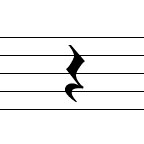
First Rest

Quarter Rest

If you read music, you know that it is seldom composed of a never-ending stream of notes.  There are rests, spaces between.  The spaces are not places to stop.  They are places to rest, to breathe, to soak in and soak up what has happened, and to prepare oneself for the rest of the song.  The point is that they are part of the music.  Journeys are no different.  We need rest.  We need breathing room. We need to cease journeying and look back at where we’ve been.  That is part of the journey.

This journey that we call the Season of Lent has become more and more important to me over the past few years.  I have learned that I need to intentionally do something during or give up something.  I need to change what is usual and routine about my life.  I need to insert a rest and just take a breath.  Some of us give something up and some of us add something on.  I don’t think it matters which and I don’t think it matters what.  We just need to do something different.  I think that each of us has to do what is best for our life and our own way of living.  Maybe a good rule to use when figuring that out is to lose something that ensnares or contains you, that keeps you safe and comfortable and dependent, or gain something that gives you freedom, that pushes your boundaries and gives you life.  What is it that contains you?  What is it that gives you freedom?

This year I’ve chosen to write each day on this blog as my Lenten discipline.  About one-third of this season is behind us, so it is time for our “first rest”.  It is time to look back at our journey.  I love to write.  It truly does give me freedom; it truly does give me life.  This time of intentional, sometimes “ritualistic” writing (as in when I don’t have time–I’m sure you can recognize those!) has given me a new perspective.  It has made me look at things differently.  Ordinary things like missing exits and seeing funny little handmade signs on the backs of pianos have become new journeys through life.  Extraordinary occurrences like Supermoons have become glimpses of the unknown, glimpses of what God has in store.  And those difficult things that are going on in our world–tsunamis and bombings and wars–have somehow been made anew into life-giving phenomena.  This journey is somewhat planned and, yet, part of the plan is to be open to the way the Spirit moves.  That’s what it’s all about!  (But I do wish that the Spirit would not inspire Maynard quite so much.  I’m running out of Bibles!)

So, on this Lenten journey, take your first rest.  Look around.  What is it that contains you?  What is it that gives you freedom?

Grace and Peace,

Shelli

LENT 3A: Perfect Peace

LECTIONARY TEXT:  Romans 5: 1-11
Therefore, since we are justified by faith, we have peace with God through our Lord Jesus Christ, through whom we have obtained access to this grace in which we stand; and we boast in our hope of sharing the glory of God. And not only that, but we also boast in our sufferings, knowing that suffering produces endurance, and endurance produces character, and character produces hope, and hope does not disappoint us, because God’s love has been poured into our hearts through the Holy Spirit that has been given to us.  For while we were still weak, at the right time Christ died for the ungodly. Indeed, rarely will anyone die for a righteous person—though perhaps for a good person someone might actually dare to die. But God proves his love for us in that while we still were sinners Christ died for us. Much more surely then, now that we have been justified by his blood, will we be saved through him from the wrath of God. For if while we were enemies, we were reconciled to God through the death of his Son, much more surely, having been reconciled, will we be saved by his life. But more than that, we even boast in God through our Lord Jesus Christ, through whom we have now received reconciliation.

Thomas Merton said that “the Christian must not only accept suffering; the Christian must make it holy.”  That is very strange to us.  What exactly is holy suffering?  Suffering is bad; suffering is unbecoming; suffering is something that we all try to avoid.  So, how then, can we accept this claim that suffering produces hope?  Keep in mind that the early believers to whom Paul wrote were used to a Roman understanding of peace.  Augustus Caesar had established the Pax Romana, which sought to move in on the entire world.  It was an understanding of peace that would come from Roman prosperity and Roman power.  (I suppose they thought that peace would come if everyone else would just shut up and live the way they do!)  So, Paul is taking the “motto of the day” and turning it inside out.  This peace places its hope in glory; it is part of that larger hope of life in Christ.

Today’s news, for me, does not echo chords of peace–a bombing at a Jerusalem bus stop, the military action over Libya, and rumblings of discords from other countries in the area.  And so our discussions about peace become discussions about power.  We seem to be arguing more over who is going to be in charge of the military operations than talking about peace.  Our vision of peace has a lot to do with who’s in charge, with who has the power.  Our idea of power is an end in and of itself, rather than a way to peace.  Maybe we could stand a little reframing from Paul too.  For us, suffering is a failure; within the vision of God, suffering holds hope for newness.  Because in the midst of suffering, just like in the midst of everything else, we find God.  God walks with us through it, loving us and holding us, perhaps even revealing a way out of it, if we would only listen, and gives us a glimpse of what is to come.  The suffering of the world reveals the heart of God, reveals the holiness that is, if we will only look.

Truthfully, I don’t know what perfect peace looks like.  Chances are, I, like all of you, would be limited by a peace that makes my life easier and a lot less scary.  That’s not what it is, comfortable and lovely as that may sound.  Perfect peace is not lack of suffering; it is oneness with God.  And oneness with God enables us to see holiness in everything, to see beauty where there is none, and to see light even in the darkness.  In this season of Lent, we once again walk toward the Cross, with the drums of discord, still this moment far in the distance, growing louder with each step.  This season lasts for forty days.  But those forty days do not include the Sundays of Lent.  Known as “little Easters”, they are opportunities to glimpse and celebrate the Resurrection even in the midst of darkness.  They are reminders that even in this season of Christ’s Passion and Death, their is always a light on the horizon.  Resurrection always comes.  But it’s not a fix; it’s not a reward for the most powerful; it’s what happens when God’s love is poured into our hearts.

So, in this Lenten season, definitely pray for peace but, in the meantime, walk toward hope.

Grace and Peace,

Shelli    

LENT 3A: Thirst-Quenching

Lectionary Text:  Exodus 17: 1-7
From the wilderness of Sin the whole congregation of the Israelites journeyed by stages, as the Lord commanded. They camped at Rephidim, but there was no water for the people to drink. The people quarreled with Moses, and said, “Give us water to drink.” Moses said to them, “Why do you quarrel with me? Why do you test the Lord?” But the people thirsted there for water; and the people complained against Moses and said, “Why did you bring us out of Egypt, to kill us and our children and livestock with thirst?” So Moses cried out to the Lord, “What shall I do with this people? They are almost ready to stone me.” The Lord said to Moses, “Go on ahead of the people, and take some of the elders of Israel with you; take in your hand the staff with which you struck the Nile, and go. I will be standing there in front of you on the rock at Horeb. Strike the rock, and water will come out of it, so that the people may drink.” Moses did so, in the sight of the elders of Israel. He called the place Massah and Meribah, because the Israelites quarreled and tested the Lord, saying, “Is the Lord among us or not?”

The wilderness journey has begun.  It all sounded so simple:  Just lead them across the wilderness to the Promised Land.  But things are not going well.  There are rumblings of discontent.  The people are questioning the vision and direction of their leader.  And, to top everything off, they are thirsty.  Aaaaggghhh!  QUIT COMPLAINING!  (You know that’s what Moses wanted to say!)  But he didn’t.  He listened.  And then, the text says, he cried out to the Lord.  The truth was, they were thirsty.  People get downright beligerant when they are hungry or thirsty.  And the waters came–thirst-quenching waters.

You know, sometimes we hear responses that we don’t want to hear.  And all of us know that it would have been a whole lot easier for Moses to just go on by himself (and a whole lot quieter!).  Today, I’ve sat through several interviews by our conference’s Board of Ministry.  They are interviews for ordination candidates at which the board ascertains whether or not the candidate is doing effective ministry.  What exactly is effectiveness?  Like I said, sometimes it would be a whole lot easier to just go off by yourself, to just pray that the problems or the problem people go away.  But that’s not the way this faith journey works.  Sometimes the faith journey includes quarreling and testing.  Sometimes it includes a whole lot of complaining.  But always, always it includes more grace than any of us can handle.  And the waters came–thirst-quenching waters.

In one of the interview rooms, I saw a hand-printed sign (as in off of someone’s computer–no one knows what “handwritten” is anymore, I suppose!).  It was actually for a children’s choir, but I think it works beyond that.  The sign said “Listen louder than you sing.”  That’s what Moses did.  That’s what this journey is.  It’s about realizing that you’re part of a bigger picture, that you cannot just go off by yourself and leave everyone behind.  It’s about letting God lead you.  It’s about listening louder than you sing (or complain or quarrel or anything else).  It’s about knowing that the waters will come–thirst-quenching waters.

So on this Lenten journey, listen louder than you sing!

Grace and Peace,

Shelli

Lenten Discipline: Picking and Choosing

I remember when I got my first Bible.  I was determined to start at Genesis 1:1 and read the whole thing through.  I was sure that was what I was supposed to do.  After all, that’s the way you read a book, right?  Well, I have to confess that that never happened.  In fact, it’s now more than forty years later and it STILL hasn’t happened.  I’ve taught Bible studies and got an M.Div. from seminary and it STILL didn’t happen.  In fact, I’ve never sat down and read the whole Bible at all.  (Shhh!)  (It’s sort of like the way you accidentally hit the wrong button and publish a blog before you’re ready, right?  So, for those who only got half an email, just call it a spiritual teaser.  I know you couldn’t wait for me to finish my thought and write the whole thing through!)
Maynard, the Bible Eater
One day a couple of months ago, I came out into the living room and was greeted with Maynard (my dog) eating a Bible.  Yes, he ate a Bible!  I’m not sure what to think about that.  When I told people what had happened, they just looked at me in amazement.  He ATE a Bible?  The question was always the same: Did he eat the whole thing?  No, I responded, he’s just like the rest of us–just picking and choosing what he wants to digest.  Actually, I’m not so sure that’s NOT the way that we’re supposed to read the Scriptures.  After all, it’s not meant to be a historical narrative.  We don’t plow through it trying to memorize each and every detail.  (Note:  This is not going to be on the test!) 

Spiritual reading is more about entering the text than it is memorizing it (or, for that matter, even fully understanding it!  Remember Nicodemus?).  And the place through which we enter is different for each one of us and is different from day to day or hour to hour for each of us.  We are reading to be formed and transformed.  We must enter in the place where God reveals Godself to us through the Scriptures.  And I suppose that involves a bit of picking and choosing.  Read the words and then let God’s Spirit wash over you.  Do not worry so much about becoming a Biblical scholar.  (After all, remember that this is not the whole story!)  Just read so that your heart, rather than your head, becomes full.

Plumbing the Depths

In her book, Soul Feast, Marjorie Thompson says that “scripture has been compared to a lake whose depths have never been fully plumbed.  On the surface it looks like any other lake; that is, we see human words like those in other books.  But when we jump into the lake and begin to swim downward, we may be unable to find the bottom.  It is as if those human words become transparent to some mysterious and infinite depth we can never fully grasp…God has chosen to be bound to the words of Scripture; in and through them, the Holy One comes near…Scripture is both God’s Word and human words.  It is part of God’schosen self-revelation, simultaneously familiar and strange…It is not that the words magically or mechanically contain God’s presence, but that as we allow the same Spirit through which the Scriptures were written to inform our listening, the presence of God in and beyond those words becomes alive for us once more.” (In Soul Feast: An Invitation to the Christian Spiritual Life, Marjorie Thompson, p. 19-20)

So pick and choose the words where you can this day enter the Word.  Dive in and let God’s Presence come alive for you.  This is your story.  It is not complete.  Which chapter is yours to add?

Grace and Peace,

Shelli

Supermoon

Today’s moon is being called a Supermoon, an astronomical phenomena when the moon will be closer to the earth (nearly 17,000 miles closer than average) than it will be for another twenty years.  The scientific term for this occurrence is perigee-sygygy.  Perigee is Greek word essentially meaning orbit and sygygy (also with some Greek roots) implies unity that comes through alignment. 

“Unity that comes through alignment”–what a great image for this Lenten season, a season of realigning one’s priorities, one’s thoughts, indeed one’s very life with God.  But most people probably have in their minds right now that God is the metaphorical moon moving closer to us as we work toward completion of this realignment process, as if what we are doing is somehow successfully pulling a wandering God back toward us.  No, that’s not it.  We are the ones that tend to wander, that tend to sometimes move so far away that it is difficult to see God.  God is not static or unmoving but God is not running away.  God is inviting us to move as God moves, a sort of orbital dance, if you will.  Maybe, then, Lent is about our becoming a Supermoon, moving closer than we ever have, close enough to be part of that sygygy, part of the dance, part of that unity that comes through alignment.

So in this Lenten season, be a Supermoon!

LENT 2A: Anothen

LECTIONARY PASSAGE:  John 3: 1-17
Now there was a Pharisee named Nicodemus, a leader of the Jews. He came to Jesus by night and said to him, “Rabbi, we know that you are a teacher who has come from God; for no one can do these signs that you do apart from the presence of God.” Jesus answered him, “Very truly, I tell you, no one can see the kingdom of God without being born from above.” Nicodemus said to him, “How can anyone be born after having grown old? Can one enter a second time into the mother’s womb and be born?” Jesus answered, “Very truly, I tell you, no one can enter the kingdom of God without being born of water and Spirit. What is born of the flesh is flesh, and what is born of the Spirit is spirit. Do not be astonished that I said to you, ‘You must be born from above.’ The wind blows where it chooses, and you hear the sound of it, but you do not know where it comes from or where it goes. So it is with everyone who is born of the Spirit.” Nicodemus said to him, “How can these things be?” Jesus answered him, “Are you a teacher of Israel, and yet you do not understand these things? “Very truly, I tell you, we speak of what we know and testify to what we have seen; yet you do not receive our testimony. If I have told you about earthly things and you do not believe, how can you believe if I tell you about heavenly things? No one has ascended into heaven except the one who descended from heaven, the Son of Man. And just as Moses lifted up the serpent in the wilderness, so must the Son of Man be lifted up, 15that whoever believes in him may have eternal life. “For God so loved the world that he gave his only Son, so that everyone who believes in him may not perish but may have eternal life. “Indeed, God did not send the Son into the world to condemn the world, but in order that the world might be saved through him.

At church, part of what I do is handle our endowment program.  And once each month, I sit down to reconcile our operating account on Quickbooks.  When you print the reconciliation, the screen has what I think is the most hilarious directive.  You have the option of clicking a box to print it out in color.  But next to the box, it says “Print the document in color (only for color printers)”.  Well, duh!  It’s just funny.  I thought about that when I started thinking about this term “born again”.  I am tired of hearing what has become a never-ending cast of characters in the public media describing someone (or even themself!) as a “Born Again Christian”.  When did that become a proper name?  What exactly is the difference between a “Born Again Christian” and a “Christian”.  I’m confused.  It’s like reading the 16th verse of this passage and interpreting it “Every one who believes has eternal life. (only for those who are born again).”  It’s just funny!

I don’t think that Jesus ever meant these words to shut out anyone.  After all, in light of the rest of what we know about him and his life here on earth, would that really make sense?  The Greek word used here is anothen.  It can mean “born from above”, “born anew”, or “born again”.  So take your pick.  It can be translated as a time one is born (again) and a place one is born (above) and what it all looks like (anew).  Well, no wonder Nicodemus was confused!  He focuses on one meaning (born again) and protests that it is impossible.  Well, of course it is!  But Jesus is telling him that if he will just stop trying pick it apart, he would see it.  He would see the Kingdom of God.  The passage tells us that no one can see the kingdom of God without being born from above…the wind blows and you hear the sound of it but you do not know where it comes from or where it goes.  So it is with everyone who is born of the Spirit.  Jesus wasn’t belittling Nicodemus or shutting him out.  Jesus was telling him that he was just like everyone else–that what he was seeing and what he was hearing did not make sense through the lenses and the ears of this world.  It’s like he was saying,”Nicodemus, my son, relax and come with me.  I want to show you what comes next.  I want to show you life.”  Indeed, God did not send the Son into the world to condemn the world, but in order that the world might be saved through him.  So, Jesus came to save the whole world?  Hmmm!

I do not call myself a “Born Again Christian”.  When I was little and well-meaning people would ask the question, “when were you born again?”, I didn’t know.  I was always a little afraid that I had missed it.  What a horrible thing to do to a child!  I have decided that the term is redundant.  I am a Christian.  I follow the Way of Jesus Christ, the Way that leads me closer and closer to a oneness with God, a return to the Source from whence I came.  According to this passage, that is the Way to see and know the Kingdom of God.  “Born again” is more to me than a slogan on a T-shirt or fodder for a talk show.  It is a gift, an indescribeable, albeit hard to understand, gift.  It is life.  Jesus just showed us where to look.       

So on this Lenten journey, don’t worry about it making sense.  Just follow the Way of Christ, the way that leads to new life.
 
Grace and Peace,
 
Shelli