With My Mind Stayin’ on Jesus


Kneeling at the CrossScripture Text: Mark 8: 31-38

31Then he began to teach them that the Son of Man must undergo great suffering, and be rejected by the elders, the chief priests, and the scribes, and be killed, and after three days rise again. 32He said all this quite openly. And Peter took him aside and began to rebuke him. 33But turning and looking at his disciples, he rebuked Peter and said, “Get behind me, Satan! For you are setting your mind not on divine things but on human things.”  34He called the crowd with his disciples, and said to them, “If any want to become my followers, let them deny themselves and take up their cross and follow me. 35For those who want to save their life will lose it, and those who lose their life for my sake, and for the sake of the gospel, will save it. 36For what will it profit them to gain the whole world and forfeit their life? 37Indeed, what can they give in return for their life? 38Those who are ashamed of me and of my words in this adulterous and sinful generation, of them the Son of Man will also be ashamed when he comes in the glory of his Father with the holy angels.”

So many of us are like Peter. We want to “fix” things, to make sure that everything and everyone is safe and alright. We want things to be OK. We want to get this wilderness place cleaned up and ready for show. But that was never part of the promise. I think Peter actually DID understand that Jesus was the Messiah. He just didn’t fully grasp what that meant. For him, the Messiah was here to fix things, to make it all turn out like it was supposed to turn out. And now Jesus was telling them that the way they had thought it would all turn out was not to be, that instead this Messiah, this one who was supposed to make everything right, was to be rejected and would endure great suffering.  “No, this can’t be!” yelled Peter.  This cannot happen.  We have things to accomplish.  We are not done.  This ministry is important. It cannot go away.  You have to fix this. You have to fix this now! We are not ready to do it alone. We are not ready to be without you. 

Now, contrary to the way our version of the Scriptures interprets it, I don’t think Jesus was accusing Peter of being evil or Satan or anything like that.  More than likely, this was Jesus’ way of reprimanding Peter for getting hung up on the values of this world, getting hung up on our very human desire to save ourselves and the way we envision our lives to be, to fix things.  But what God had in store was something more than playing it safe.  I think that Peter, like us, intellectually knew that.  We know that God is bigger and more incredible than anything that we can imagine.  And yet, that’s hard to take.  We still sort of want God to fix things, to make things comfortable, or at least palatable.  We still sort of want God to lead us to victory, to lead us to being the winning team.  Face it, we sort of still want Super Jesus in the story.  And, of course, Peter loved Jesus.  He didn’t even want to think about the possibility of Jesus, his friend, his mentor, his confidante, suffering, of Jesus dying.

You know, there is a danger in our thinking that God is here to make life easier for us, to keep us safe and warm and free from harm. After all, there’s that whole Cross thing that gets in the way. If we think that God came into this world, Emmanuel, God-with-us to make life better or easier or grander for us, then what do we do with a crucified Savior? What do we do with the cross?  Well, let’s be honest, most of us clean it up, put it in the front of the sanctuary, and, sadly, go on with the security of our lives.  So, what does it mean to “take up your cross and follow”? What does it MEAN to follow God not just to the altar where that gleaming, cleaned-up cross sits, but to follow Christ to the hills of Golgotha, to walk with Jesus all the way to the Cross?  I think it means that sometimes faith is hard; sometimes faith is risky; in fact, sometimes faith is downright dangerous. And, to be honest, faith rarely makes sense in the context of the world in which we live. After all “denying ourselves”, “losing our life to save it”, and “letting go to gain” make absolutely no sense to us. They don’t make sense because we are setting our minds on the human rather than the Divine.

There’s a old Gospel song with these lyrics:  (Hear it at https://www.youtube.com/watch?v=Xit39G0lIk4)

Well, woke up this mo’nin with my mind, stayin’ on Jesus

Woke up this mo’nin with my mind, stayin’ on Jesus

Well, woke up this mo’nin with my mind, stayin’ on Jesus

Halleluh, halleleluh, halleleluh


In all probability, none of us will be physically crucified for our faith.  But it doesn’t mean that we should clean it up and put it out for display either.  Sometimes our journey will take us through waters that are a little too deep and torrential; sometimes we will find ourselves bogged down by mud; and sometimes faith takes us to the edge of a cliff where we are forced to precariously balance ourselves until we find the way down.  The promise was not that it would be safe; the promise was that there was something more than we could ever imagine and that we would never journey through the wilderness alone. The promise was that a Savior would come, not to save us from the world or to save us from evil, but to save us from ourselves.

On this Lenten journey, this journey that takes us through the wilderness all the way to that place beyond the wilderness, to the Cross, we are called to follow Christ. We are called to begin to wake up in the morning with our minds “stayin’ on Jesus”. It will not lead you to safety; it will lead you to Life.

He comes to us as One unknown, without a name, as of old, by the lakeside…He speaks to us the same word:  ‘Follow thou me!” and sets us to the tasks which He has to fulfill for our time…And to those who obey, whether they be wise or simple, [God] will reveal {Godself] in the toils, the conflicts, the sufferings which they shall pass through in this fellowship, and, as an ineffable mystery, they shall learn in their own experience Who [God] is.  (Albert Schweitzer)

FOR TODAY:  Put your plans aside.  Let go of the images of God that you have conjured up.  Let go of the notion of a Savior who will fix things.  Close your eyes.  Then wake up…wake up with minds stayin’ on Jesus…all the way through the wilderness of Golgotha to Life.

Grace and Peace,

Shelli
Beyond the Wilderness


Moses and the Burning BushScripture Text:  Exodus 3: 1-5

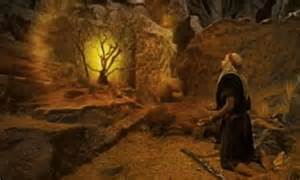
 Moses was keeping the flock of his father-in-law Jethro, the priest of Midian; he led his flock beyond the wilderness, and came to Horeb, the mountain of God. 2There the angel of the Lord appeared to him in a flame of fire out of a bush; he looked, and the bush was blazing, yet it was not consumed. 3Then Moses said, “I must turn aside and look at this great sight, and see why the bush is not burned up.” 4When the Lord saw that he had turned aside to see, God called to him out of the bush, “Moses, Moses!” And he said, “Here I am.” 5Then he said, “Come no closer! Remove the sandals from your feet, for the place on which you are standing is holy ground.”

We sometimes miss that nuance when we read this story.  I think I read this for years as if this miraculous burning bush was placed right in Moses’ path, impeding his way, something that he could not possibly miss, perhaps something that he would just trip over if he wasn’t paying attention.  But the passage says that Moses had to “go over” or turn aside to see it, had to actually get off the path that he was on to see this incredible sight.

Here is Moses, who has led his flock to a place “beyond the wilderness”.  I’m not sure what that is.  But it’s apparently a place to which only a journey through the wilderness can take you.  If it’s a literal place, then it’s WAY off any map that we have.  I think it’s more than likely that it’s the place to which you come when you yield to the wilderness, when you let yourself relinquish control and let go of what you are holding so tightly, when, finally, you trust God enough to turn aside to see what God has in store for you.  But, whatever this place is, Moses is leading his flock off the beaten path into a mysterious and unknown place right up to the mountain of God.

And there, off the path, not where he could stumble over it, but where he had to leave his planned pathway to investigate, he sees it—a bush blazing brightly with a fire that did not consume.  This was beyond what was normal.  Well, needless to say, his curiosity was piqued.  He needed to know more, needed to get a closer look.  So he steps toward it.  And then he hears his name.  “Moses, Moses.”  Startled, Moses stammered out a meager response:  “Here I am.”

Now in that moment, I think it’s probable that Moses didn’t even completely understand what was happening.  After all, remember, in early Hebrew thought, if you see God, if you hear God, you die.  And then this great voice tells him to take off his shoes, to take off his shoes because he was standing on holy ground.  Holy ground?  Well, it was ordinary a minute ago!  How did it get to be holy? And then God tells Moses what Moses is called to do.  This shepherd, this ordinary person standing in bare feet on the side of what used to be an ordinary mountain is called to deliver the people of Israel, to lead them to freedom.  This is Moses’ commissioning. And somehow he began to process and understand what was happening.  So, he began to take control of the situation and try his best to get out of what was happening.  After all, Holy Ground is a dangerous place.  For there, you touch the Divine and are changed forever.  There is no going back.

Our Lenten journey is one that will take us beyond the wilderness, to a place where you will see and know things that you’ve never seen and known before, to a place where you will finally turn aside from your plans, from your routine and, there, find yourself standing on Holy Ground.

Holiness comes wrapped in the ordinary. There are burning bushes all around you. Every tree is full of angels. Hidden beauty if waiting in every crumb. Life wants to lead you from crumbs to angels, but this can happen only if you are willing to unwrap the ordinary by staying with it long enough to harvest its treasure. (Macrina Wiederkher, A Tree Full of Angels)

FOR TODAY: Journey to a place beyond the wilderness, beyond the place where you have so far allowed yourself to go. Then turn aside.

Grace and Peace,

Shelli

Always

Presence of God Scripture Text:  Thessalonians 5: 16-19
Rejoice always, pray without ceasing, give thanks in all circumstances; for this is the will of God in Christ Jesus for you. Do not quench the Spirit.  Do not despise the words of prophets, but test everything; hold fast to what is good; abstain from every form of evil.  May the God of peace himself sanctify you entirely; and may your spirit and soul and body be kept sound and blameless at the coming of our Lord Jesus Christ.  The one who calls you is faithful, and he will do this.

Pray without ceasing?  Are you kidding me?  Think how much we have to do in this season!  I mean, prayer is a good thing, a great thing in fact.  We all know that.  But pray without ceasing?  As in ALWAYS?  So, what do we do with those distractions, with all those who need us to do something?  What do we do with life?  What do you do with all the preparations that the season holds?  How do you fit that in?  Uh oh…Spirit effectively quenched!  Not good…I hate it when that happens!


The truth is, Paul was not telling us that we had to spend our days body-bent and knee-bowed.  The truth is, there is WAY too much work to do.  We’ve got some Kingdom-building to do, after all.  Paul was not calling us to a life spent in prayer but rather to a prayerful life, a life that is sacred, hallowed, a life lived in the unquenchable Spirit of God.  This has nothing to do with counting the number of hours or minutes or nano-seconds that you spend in prayer.  A prayerful life is one that sees everything as hallowed and holy, sees everything as of God, embraces life as a gift rather than a vessel to be filled with things and to do lists and results.  Praying without ceasing is not about “doing”; it is about being. Olga Savin says that “[the Scriptures] tell us that ceaseless prayer in pursuit of God and communion with [God] is not simply life’s meaning or goal, the one thing worth living for, but it is life itself.”  And a life lived the way it is called to be lived is the very will of God, the very will of, as the Scripture says, the one who is faithful.  It is prayer–ceaseless prayer.


Wouldn’t it be wonderful if in our Advent waiting, we found a time of prayer, we found a time, as Mary did, to ponder (Luke 2: 19).  Maybe THAT’S what’s wrong with us.  Maybe we’ve lost our ability to ponder, to be attentive to what resides in the deepest part of our soul, to be aware of God’s Presence in our lives.  Maybe this time of waiting is so that we’ll take the opportunity to do some serious pondering, to pray without ceasing.  After all, what in your life is NOT holy?  What in your life is NOT positively bursting with the Divine?  What in your life is NOT a gift from God?  Well, the answer is nothing.  There is NOTHING in your life that is not full to the very brim–spilling-over-chock-full-seemingly-unable-to-put-anything-else-in-brim–with the presence of the one who calls you, the one who is faithful, the one who is ALWAYS there.  Make everything you do an offering to God.  Let everything you have and everything you are be a preparation for God’s coming.  Offer it to God.  G.K. Chesterton once said “let your religion be less of a theory and more of a love affair.”  Praying without ceasing is probably more about living, about loving, about holy waiting, than it is about prayer as we often define it.  It has little to do with the words we say and everything to do with tuning ourselves to the conversation that God is already inviting us to live.


The day of my spiritual awakening was the day I saw—and knew I saw—all things in God and God in all things.  (Mechtilde of Magdeburg, 13th century)


FOR TODAY:  Pray without ceasing.  Look around you.  EVERYTHING that you see, EVERYTHING that you touch, EVERYTHING that you imagine, EVERYTHING that you let loose, EVERYTHING that you pick up, EVERYTHING that you eat, EVERYTHING that you love, EVERYTHING that is you…EVERYTHING is full to the brim with God.  Pray without ceasing.


Grace and Peace,

Shelli


Waiting on the World to Change


Door near Bethany, Jerusalem

Scripture Text:  Hebrews 13:2

Do not neglect to show hospitality to strangers, for by doing that some have entertained angels without knowing it.

Imagine that you are at home one evening. You’ve just finished dinner and the dishwasher is humming with the satisfaction of a job well-done. All the leftovers are put away in the refrigerator. You have settled in for the evening—full stomach, warm house, a time of togetherness, the house locked up and the alarm is set. You look at the clock: 9:00—just in time to settle down to watch that recording of “The Good Wife” that you haven’t had time to watch. Just then, there is a knock on the door. Who in the world? You peer out through the peephole and see a man standing there—dirty, disheveled, unshaven, a far-away look in his eyes.  Hmmm!  Not sure what to do…maybe he will just go away.


After all, the world is a scary place.  You don’t know who this is.  And he was so dirty…really, really dirty…The man is dirty because he has traveled a great many miles on the open, dusty road. He is disheveled because he is tired. He has gone from house to house asking for help. Most people do not answer the door. He knows they’re at home. He can see the eyes through the peephole and hear them inside. But who can blame them? It’s been days since he’s had a chance to shave. He’s almost at the end of his rope. He’s worried and afraid and he’s sure it shows in his eyes. So he turns and heads back down the block toward the car that only made it this far. He has no idea what to do. He has no money left after the long trip—no money for gas, no money to fix the car, no money for food for him and his wife. And the time is almost here. The baby is coming. But there’s doesn’t seem to be room anywhere he goes.   Come, Thou Long-Expected Jesus…


So, what ARE you expecting?  For what are you waiting?  For what are you preparing?  God comes in ways that we never expect.  God comes into those places where the needs are the greatest, where the hurt is the deepest, where the wilderness seems to close around us.  And there…there God comes.  While we are waiting on the world to change, God comes.  While we are wondering why someone doesn’t fix things, God comes.  While we are watching riots and marches, poverty and wars, and politicians arguing over who is in control and bemoaning the fact that the world seems to be coming apart, God comes.  On the darkest of nights, when the world is so loud we almost can’t stand it, God tiptoes in through the one door of our lives that we forgot to lock, forgot to decorate, perhaps forgot was even there, and is born in a stable and laid in a manger because there was no room.  While we are waiting for the world to change, God knocks on the door to our lives and shows us that it the change has already begun.  Come, Thou Long-Expected Jesus…


The Advent mystery is the beginning of the end in all of us that is not yet Christ. (Thomas Merton)


FOR TODAY:  Through what door is God coming into your life?  What have you done to make room for God in your life?  Be the change that you are waiting to see.


Grace and Peace,


Shelli

Seeing in a New Light

Reflexion of a lunar path in water.Scripture Text:  Psalm 85: 8-13

Let me hear what God the Lord will speak, for he will speak peace to his people, to his faithful, to those who turn to him in their hearts. Surely his salvation is at hand for those who fear him, that his glory may dwell in our land. Steadfast love and faithfulness will meet; righteousness and peace will kiss each other. Faithfulness will spring up from the ground, and righteousness will look down from the sky. The Lord will give what is good, and our land will yield its increase. Righteousness will go before him, and will make a path for his steps.


We’ve talked a lot about waiting and preparation, about opening ourselves to what God holds for us.  For what are we preparing though?  Well, of course, for the coming of God’s Kingdom in its fullness.  But what does that look like.  Today’s psalter is a good depiction–steadfast, unconditional love intersecting with faithfulness, becoming faithfulness; righteousness and peace being so close that they touch, linking and embracing.  The fullness is pervasive–from the ground to the sky.  The land, all of creation, will finally be what it is meant to be and the way, already prepared, will be found to be paved with righteousness.  So how does that fit into today’s world?  In this world filled with heartache and poverty, with the recent race riots exploding throughout our nation, with the fear of war or terrorism all over the globe, and with humanity’s fear of deadly disease as it leaps the oceans’ edges, how do we see love and faithfulness, peace and righteousness.  How do we see that pathway on which God can break through?


The truth is, a good part of faith includes a little imagination.  It has to do with letting ourselves look beyond where we are, with learning to see things in a different light. The French Impressionist painter, Claude Monet, is probably best known for his incredible landscapes and works of nature as well as for his paintings of those things that were a normal part of his own life. But the most fascinating part of Monet’s work are those paintings that he did as part of several series representing similar or even the same subjects—his own incredible gardens, poppy fields, a woman with a parasol, and those unusual haystacks.


The paintings in this series of haystacks were painted under different light conditions at different times of day. Monet would rise before dawn, paint the first canvas for half an hour, by which time the light had changed. Then he would switch to the second canvas, and so on. The next day and for days and months afterward, he would repeat the process. In each painting, the color of the haystack is different not because it is a different haystack, but because the amount and quality of the light shining on the haystack is different. The subject is the same but the perspective from which it is viewed changes with the light.  Up until this time, color was thought to be an intrinsic property of an object, such as weight or density. In other words, oranges were orange and lemons were yellow, with no variation as to the lens through which they were viewed. But with Monet’s studies in light and how it affects our view of life, that all changed. As Monet once said, “the subject is of secondary importance to me; what I want to reproduce is that which is in between the subject and me.” Monet’s study was one in seeing things differently.  Beyond just painting the subject that was in front of him, he began to paint the light that illumined it.


You see, as we walk through the Advent, the light changes.  The dawn is just beginning to break.  Can you see it?  Aren’t things beginning to look a little different?  That’s the whole idea.  Maybe rather than waiting for the glory of God to come, we are called to begin to see the world as it is illumined by the coming light.  God is in our midst.  God’s glory surrounds us.  What would it mean for us to begin to imagine the world bathed in its light?


For the enlightened few, the world is always lit. (Scott Russell Sanders)


FOR TODAY:  Look toward the light.  See the world differently.  Be light.


Grace and Peace,

Shelli


Holy Patience

PatienceScripture Text (Advent 2B): 2 Peter 3:8-9

But do not ignore this one fact, beloved, that with the Lord one day is like a thousand years, and a thousand years are like one day.  The Lord is not slow about his promise, as some think of slowness, but is patient with you, not wanting any to perish, but all to come to repentance.


I must admit that I am not the most patient person I know.  I think it’s safe to assume that, really, few of us are.  The world just moves too fast.  The patient ones, the ones who wait, tend to get left behind.  And yet, those of us of us who are always on the move don’t really get there any sooner.  What is that about?  And then we read this passage that describes God as patient.  Have you ever thought of the Divine, the Holy, the Creator, the One who is always and forever on the move, compelling us to go forward, to live into this glorious Vision that God has, as “patient.”  I suppose the impatient ones of us want God to get this show on the road, already.  After all, where IS peace?  Where IS righteousness?  Where IS this promise of no poverty, no hunger, no suffering?  But wait, it doesn’t say that God is sitting back on the holy laurels and being slow about things happening.  God is not slow to fill the world with glory; God is waiting for us, patiently waiting for us, to catch up.


So perhaps our impatience, our living life full-throttle, without stopping, just stopping to see what God is doing, to hear where God is calling, is what is slowing this whole thing down.  After all, God knows where God is going.  God is waiting for us, waiting for our response, waiting for us to perhaps wait to see, wait to hear.  Oh, shoot!  It’s back to that waiting thing.  We CAN’T hurry this along.  We CAN’T live for the next thing.  We CAN’T live as if we are in a season that is not quite yet.  God is waiting for us to stop, to wait on God, so that we can catch up to what God envisions us to be.  It’s back to the Sabbath ideal.  God created times for us to stop, to wait, to let ourselves sort of regroup so that we could move forward down the way we are called to go.


You’ve heard the story of the American traveler on safari in Kenya.  He was loaded down with maps, and timetables, and travel agendas.  Porters from a local tribe were carrying his cumbersome supplies, luggage, and “essential stuff.”  On the first morning, everyone awoke early and traveled fast and went far into the bush.  On the second morning, they all woke very early and traveled very fast and went very far into the bush.  On the third morning, they all woke very early and traveled very fast and went even farther into the bush.  The American seemed pleased.  But on the fourth morning, the porters refused to move.  They simply sat by a tree.  Their behavior incensed the impatient American.  “This is a waste of valuable time.  Can someone tell me what is going on here?”  The translator answered, “They are waiting for their souls to catch up with their bodies.”


This Advent time is a time of waiting for God.  But it is also a time when God waits on us–patiently and lovingly waits for us to awake to God’s Presence, awake to God’s beckoning, awake to finally see where we were meant to be all along.  We cannot do that if we are too busy impatiently moving through life, always reaching and grasping for the next thing and missing that God is waiting for us now.  If we would be a little more patient, if we could just for a moment stop and breathe in that Holy Patience of God, perhaps God would no longer have to wait another day or another thousand years for the promises to come to be.


Earth’s crammed with heaven, And every common bush afire with God; But only [they] who see, take off [their] shoes—The rest sit round it and pluck blueberries. (Elizabeth Barrett Browning, from “Aurora Leigh”)


FOR TODAY:  Stop moving so fast.  Be patient.  Look.  Listen.  Take off your shoes and be.  God is waiting.


Grace and Peace,

Shelli


Comfort, O Comfort My People


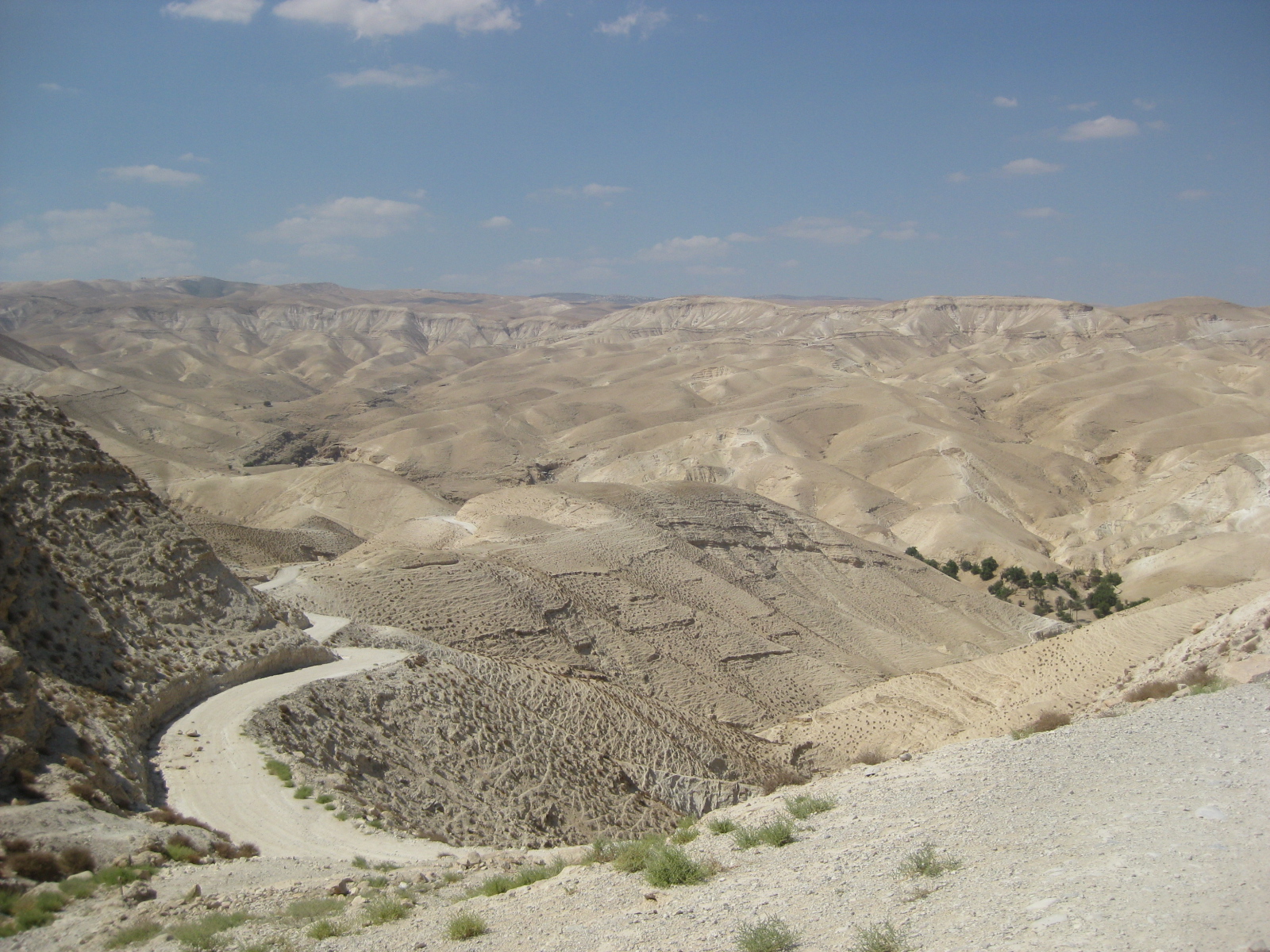
Scripture Text:  Isaiah 40: 1-5Road through the desert

Comfort, O comfort my people, says your God. Speak tenderly to Jerusalem, and cry to her that she has served her term, that her penalty is paid, that she has received from the Lord’s hand double for all her sins.  A voice cries out: “In the wilderness prepare the way of the Lord, make straight in the desert a highway for our God. Every valley shall be lifted up, and every mountain and hill be made low; the uneven ground shall become level, and the rough places a plain. Then the glory of the Lord shall be revealed, and all people shall see it together, for the mouth of the Lord has spoken.”

“Comfort, O Comfort my people.”  That sounds nice.  It sounds warm and inviting, something that we can just sort of fold ourselves into and relax and let God take care of us.  Well, maybe.  But then what happens?  What we do with our lives after that?  The truth is, as much as we like to imagine a warm and fuzzy God that heaps everything we desire and everything we need to make our lives easy and comfortable on us, that’s not exactly the way it always is.  Here, comfort is not solace; here comfort is transformation.  God is promising something new.  These words begin with God’s initiative–to bring the exiles home.  Sure, it will mean ending their suffering and making their lives better.  But it is more.  It means that they will become something new–a new creation.  The former things have passed away.  God is not in the habit of rebuilding or “fixing” the way it is easy for us to imagine could happen.  God is the Creator, the great I AM, the one who brings newness and life.


So, God prepares a highway through the wilderness.  Now, don’t think that there wasn’t already a road there.  In the year 539 BCE, Cyrus of Persia conquered the Babylonians. Now he tended to be sort of a benign and tolerant ruler and so he allowed those who had been previously exiled from Jerusalem the chance to return home. So the people are beginning to return home, but to a home that was nothing like it was before. If you can imagine, these waves upon waves of people on this highway that leads toward Jerusalem—a Jerusalem that now lies in ruins without the Temple that used to be in the center of its life. This highway, a highway through the desert that, typical of the ancient world, was originally built to accommodate royal processions. Everything was done to make the highway smooth and clear.   The road was there, already made straight and smooth for the royals to travel.  And so the exiles, returning to “who knows what?” were on this road.


But, wait, look, over here.  God also promises a highway, smoothed and cleared of mountains and deep, treacherous valleys that would impede the journey.  God promises a holy highway built for a grand procession led by the Almighty God.  It’s still a road that you have to travel, but, rather than leading you to the ruins of the life you once knew, THIS road leads you Home.  And as we travel this road, God is creating and creating and creating the whole time, unfolding our life before us as long as we keep our eyes open to see what God is doing.  This is the way that the Glory of the Lord shall be revealed.


This is the road that Advent shows us.  It’s not one that takes us to the place that we’ve always known.  Advent shows us the newness that God is offering.  In the Advent season, we remember those generations upon generations that waited for a Savior.  We also prepare ourselves to remember once again how Christ came and comes.  But there’s another part of Advent that we miss.  It is this road, this road that we’re on that leads us to finally see things in a different light.  There is a Maori proverb that says “turn your face to the sun and the shadows will fall behind you.”  “Comfort, O Comfort my people.”  The Light is changing and you, even you, even now, are being made new.  “Then the Glory of the Lord shall be revealed, and all people shall see it together.”


Learn to see and then you’ll know there is no end to the new worlds of our vision.  (Carlos Castaneda)


FOR TODAY:  What newness has God created in your life?  During this Advent, what newness can you find on the road?


Grace and Peace,


Shelli