Lighted Windows

Candle in the WindowScripture Passage for Reflection:  John 1:5

The light shines in the darkness, and the darkness did not overcome it.

There are bumps in every road–even the road to Bethlehem.  There are things that we plan, that we need, that somehow do not go the way we envisioned.  For me, one of my favorite services is the Service of the Longest Night, the service of light where we remember that even in the midst of those bumps in the road, even in the darkest darkness, is God, walking with us, bumping along just like we are.  And then Wednesday night, I got sick.  Now I don’t do sick well.  It’s hard to admit that I’m sick.  But Thursday was just not going to happen for me so I missed the Service of the Longest Night.  I missed the service that I probably needed to help me get through some bumps in the road because of a bump in the road.  Go figure!

I actually don’t think that original journey to Bethlehem was without its bumps.  Life is like that.  The little caravan with the pregnant couple whose world had been turned upside down probably encountered lots of things.  They probably couldn’t drive straight through.  There were places that they had to avoid, places that were filled with danger from thieves or wild animals or parts of the road that were all but impassable.  And the weather was totally unpredictable.  Who knew that it would be this cold at night?  But they knew that this was something that they had to walk and they knew that they were not alone.  But it was so incredibly dark!

We are told that this is the season of light.  We are usually made to believe that this season should be a joyous one of celebration.  We are made to feel that we should put aside our worries and our cares and enjoy ourselves; we are told to embrace the celebrations and be happy; we are told to look toward the light, the birth of the Christ child.  And yet, tonight, here we sit in darkness. This is the winter solstice, the longest night of the year–fourteen hours of darkness.  The word “solstice” is derived from the Latin “solstitium”, from two words meanings “sun” and “stand still”.  Technically, this comes from the fact that during the days surrounding the solstice, the sun appears at its lowest point in the sky and then seems to have the same noontime elevation for several days in a row.  To early astronomers, the sun appeared to hang in the sky, suspended, paralyzed, as if waiting for some word to move on.

So it seems that on this night of darkness, it is appropriate to acknowledge those parts of our lives that do not seem to “fit” with the joyous season—our frustrations, our fears and anxieties, our anger, our depression, our loneliness, our despair, our grief.  These are not things that we can just leave at the door to the season and then pick them up later.  They are part of us.  And just as we bear them, God takes them and holds them and in what can only be attributed to the mystery of God, somehow manages to put a light in the window in the midst of our darkest night.

That’s exactly what happened that first Christmas.  Think about it.  Things were far from completely right with the world.  The young couple Mary and Joseph were not wealthy, prominent citizens of the capital city of Jerusalem.  They were poor working class citizens of a no-name town in what was essentially a third-world country.  Remember the Scriptures:  nothing good comes from Nazareth.  There was nothing there.  And we tend to romanticize their trip to Bethlehem, making it into some sort of painting of a starlit camping trip with a lovely dark blue backdrop and a beaming star above.  That wasn’t exactly the way it was.  If they did indeed have to make that journey as the writer of the Gospel According to Luke claims, it’s about an 80 mile trip, a 4-day journey under the best of circumstances.  But, as we know, the teen-age Mary was pregnant and at that time, they would probably want to avoid Samaria (which was not the friendliest of territories to the Israelites), which means they probably would have circled through what is now modern-day Jordan, making it an even longer trip.  And, remember, the whole reason that they were traveling at all was for the tax census, imposed by a foreign government to pay for foreign rulers that ruled their lives.  These were not the best of times.  They traveled in darkness.  But that part of the story somehow falls away when it is illumined by the light in the window.  God came, Immanuel, God with us.  “The light shines in the darkness and the darkness did not overcome it.”

You know, since humanity began, light has been important.  But for those of us who live in the city, where profound physical darkness almost never comes, we may have lost that sense of what light really means.  It’s about more than just lighting our way or giving us a pathway so that we can see where we are going.  Think about those who lived before there was electricity and streetlights every 500 feet or so.  When the sun went down, they were plunged into darkness, save for a few strategically-placed stars.  Until, that is, they lit a candle.  And cultures all over the world and throughout history have had traditions of putting a candle in the window.

The Irish tradition of putting a candle in a window is a symbol of hospitality.  Reminiscent of the first Christmas, it was seen as a gesture to ancient travelers who could find no shelter that there was room for them.  During those times in Irish history when Catholicism was abolished, a candle in the window designated a safe place for Catholic members and clergy.  And we’ve all seen movies and depictions of people trudging through a dark and foreboding snowy night only to be saved by seeing a light in a window.  So, lighted windows are much, much more than something that provides us light to see.  They are places of hospitality, of welcome.  They signify shelter and protection.  A candle in the window draws us in from the darkness.  It brings us home.

So, maybe we who live always surrounded by light don’t really have an appreciation for what lighted windows really mean—until, that is, we find ourselves surrounded by darkness, until we find ourselves encountering a bump in the road.  And in those times, there is the light—a place of welcome, of shelter, of safety.  It draws us home.  The promise of the season is not that there will be no darkness but that it will not overcome the light, that it will not overcome us.

Reflection:  What bumps in the road have you encountered this Advent?  Where have the lights in the window been for you?

Grace and Peace,

Shelli

Advent 4A: The Other Side of the Manger


"Joseph With Infant Christ", Bartoleme' Estaban Murillo, 1665-1666, Museum of Fine Arts, Sevilla, Spain
“Joseph With Infant Christ”, Bartoleme’ Estaban Murillo, 1665-1666, Museum of Fine Arts, Sevilla, Spain

Lectionary Gospel Passage for Reflection:  Matthew 1: 18-25

Now the birth of Jesus the Messiah* took place in this way. When his mother Mary had been engaged to Joseph, but before they lived together, she was found to be with child from the Holy Spirit. Her husband Joseph, being a righteous man and unwilling to expose her to public disgrace, planned to dismiss her quietly. But just when he had resolved to do this, an angel of the Lord appeared to him in a dream and said, ‘Joseph, son of David, do not be afraid to take Mary as your wife, for the child conceived in her is from the Holy Spirit. She will bear a son, and you are to name him Jesus, for he will save his people from their sins.’ All this took place to fulfill what had been spoken by the Lord through the prophet:   ‘Look, the virgin shall conceive and bear a son, and they shall name him Emmanuel’, which means, ‘God is with us.’ When Joseph awoke from sleep, he did as the angel of the Lord commanded him; he took her as his wife, but had no marital relations with her until she had borne a son; and he named him Jesus.

Poor Joseph!  This is the only time that he really gets a starring role in the story and he doesn’t even really have a speaking part. We are all guilty of sort of skipping over Joseph, sort of putting him back in the stable, so to speak.  After all, he’s sort of just an extra character to complete the happy little family, right?  But can you imagine what he must have been going through?  This was not just affecting Mary’s life. It was affecting his life too.  The proper (and probably the easiest) thing would be to quietly divorce her and go on with his life.  To be honest, you have to admire him for just wanting to quietly dismiss the whole problem.  After all, he couldn’t marry her at this point.  The text says that he was a “righteous” man.  This meant that he was faithful to the Scriptures, to the laws of the Torah.  He didn’t have a choice.  He HAD to divorce Mary.  But he would do it quietly.  It seems that he really did feel compassion for her.  But he also had to be a little hurt, probably a little angry.  We can only imagine.

But in the night in a wild fit of sleep came the dream.  Ah, the dream!  “Listen to her, Joseph, she is telling the truth.  And she needs you.  This child will need you.  He will need a father in his life to show him how to grow up, to show him how to become a man.  He will need someone to hold him when he is afraid and scold him when he gets off course as all children do.  He really just needs someone to love him into being.  And Mary?  She is scared.  She needs you.  You can do this together.”  Joseph, God is calling you too.  Mary cannot go through this alone.  And, so Joseph awakened, took Mary in his arms, and entered the sacred story that had been handed to him from generations before him.  And their lives changed forever.

This is his announcement, the Annunciation to Joseph.  The name “Joseph” means “God will add” or “God will increase”.  God called Mary as the God-bearer; but God called Joseph to also respond, to add to the meaning of the story.  After all, it is the Joseph side of the story that once again upsets the social and religious expectation apple cart, so to speak.  It is Joseph that must break the ranks of righteousness and instead become human.  This beautiful nativity story is both wondrous and scandalous at the same time.  And so, somehow Joseph had to trust this strange news that he, too, was being drawn into the story.  Somehow Joseph had to get on board with God turning his whole life upside down.

And then God waits patiently for Joseph to respond. The world hangs suspended if only for a time, its very salvation teetering on the brink of its demise. After all, Mary’s already on board.  But she needs help.  She needs you.  God needs you.  So, how can this be? I do believe in the omnipotence of God. But I also believe that God, in God’s infinite wisdom, chose to give up part of that power. It’s called free will. God gave a piece of the Godself to each of us that we might choose to respond in faith. How can this be? Certainly not without God and not even without us. Our faith journey is a partnership with God, a dance between the human and the Divine. And so God waits…How can this be?…Only if you respond. So, both Mary and Joseph said “yes” and the Divine began to spill into the womb of the world. Salvation has begun.  The world is with child.

Maybe we continually put Joseph on the other side of the manger because it’s more comfortable for us.  After all, this beautiful story that we love so much is not just about God and Mary and a baby.  It is God coming into the world, it is God coming into our midst, it is God coming to us.  And Joseph is really just a plain old guy.  It’s easier to give a small part in the story rather than realize that God needed him too.  Because of God needed Joseph, then God needs us.  God needs us to wake up to what God is calling us to do.

It’s almost time!  There are bells ringing in the distance and hope and peace and eternity are waiting in the wings.  How can this be?  Because the God of all that is Divine also claims the ordinariness of our lives.  God wants to live with each one of us, as one of us.  And each of us is called to be the God-bearer, to bring the hope and peace and eternity that is waiting into our world.  Each of us is called to add to the numbers of generations before us.  The miracle of Christmas does not stop with the birth of a baby.  It instead happens every day that we say “yes” to eternity, “yes” to God’s Kingdom, and “yes” to bringing the Divine into the world.  It’s almost time!  The world is with child.

Who put Joseph in the back of the stable?  Who dressed him in brown, put a staff in his hand, and told him to stand in the back of the crèche, background for the magnificent light of the Madonna?  God-chosen, this man Joseph was faithful in spite of the gossip in Nazareth, in spite of the danger from Herod.  This man, Joseph, listened to angels and it was he who named the Child Emmanuel.  Is this a man to be stuck for centuries in the back of the stable?

Actually, Joseph probably stood in the doorway guarding the mother and child or greeting shepherds and kings.  When he wasn’t in the doorway, he was probably urging Mary to get some rest, gently covering her with his cloak, assuring her that he would watch the Child.  Actually, he probably picked the Child up in his arms and walked him in the night, patting him lovingly until he closed his eyes.

This Christmas, let us give thanks to God for this man of incredible faith into whose care God place the Christ Child.  As a gesture of gratitude, let’s put Joseph in the front of the stable where he can guard and greet and cast an occasional glance at this Child who brought us life.

Ann Weems, Kneeling in Bethlehem


Reflection:  What is your part in the Nativity story?  To what is God calling you to awaken?

Grace and Peace,

Shelli

Last Minute Details

Last MinuteScripture Passage for Reflection:  Mark 1: 1-3

The beginning of the good news of Jesus Christ, the Son of God. As it is written in the prophet Isaiah, ‘See, I am sending my messenger ahead of you,  who will prepare your way; the voice of one crying out in the wilderness:    “Prepare the way of the Lord,  make his paths straight” ’…

One week left!  So how many emails did you get today promising free shipping or half off priority shipping or 35% off or 40% off or perhaps a gift card to use later?  Everyone is in the last minute crunch.  And just as we enter the final stretch of all this waiting, it sometimes gets a little difficult to remember why we do it at all.  How long have we waited?  Well, this year, we’re only 18 days into it.  Good thing we weren’t part of those who waited for centuries upon centuries, trying their best to ready the world and ready their souls.  Good thing we weren’t there.  We’re probably not that patient.  So, are you prepared for what will come?  Are you prepared for that for which we’ve been waiting?

I must admit that waiting is hard for me.  But it’s because it’s sort of a strange notion.  I want so badly for that which I’m waiting to come and yet, the “perfectionist” part of me knows I’m not ready.  I mean, there’s always so much more to do, right? So, what if you turn on your computer or your television or whatever it is that’s the first thing you look first thing in the morning at and find out, horror of horrors, that Christmas arrived 6 days early this year?  Ugh oh!  That would be bad.  After all, we’re not ready!

I wonder what it was like that first Christmas.  After all, they had had centuries of waiting behind them so surely, surely they were ready.  And yet, don’t you think Mary and Joseph spent at least a little bit of time talking to each other:  “Really?  Now?  Now is really not a good time.  Why can’t we wait until we’re married, maybe wait until we’ve got a little bit of savings in the bank, or perhaps we should have another child first and practice.  I mean, really, this is a lot to ask.  We’re really not ready.  Good grief, we don’t even have a reservation!”  And those shepherds?  “Now?  We have to go now?  What am I supposed to do, just leave these sheep wandering on the hillside.  SURELY, you can wait just until we’ve got everything together, everything worked out.”  And what about the innkeeper:  “Oh come now, NOW?  Good grief, this is the first time that we’ve boasted 100% occupancy!  And NOW you come?”  And those poor wise men from the East:  “OK, I thought I had made it.  I thought this was the job of jobs. And you want me to go where?  The other way.  NOW?  Oh, come on, let me do this for awhile, maybe stock some savings away.  It’s not all that bad.  That is not good planning.”

Do you really think the world was ready?  Do you really think that they were all that different from us?  When are you ready to have your foundations shaken to the core and your whole world turned upside down?  Maybe the lesson of Advent is not to make sure that all of the last minute details are done but to teach us to prepare to be surprised, prepare to follow wherever God leads.  That’s the way you prepare the Way.  God will come when God will come.  We don’t have to have everything perfect; we just have to pay attention.

God did not wait till the world was ready, till nations were at peace.  God came when the Heavens were unsteady and prisoners cried out for release.  God did not wait for the perfect time.  God came when the need was deep and great.  In the mystery of the Word made flesh, the maker of the Stars was born.  We cannot wait till the world is sane to raise our songs with joyful voice, or to share our grief, to touch our pain.  God came with Love.  Rejoice!  Rejoice!  And go into the Light of God. (“First Coming”, by Madeleine L’Engle)

Reflection:  OK, this one’s hard…What do you have left to do to prepare for Christmas?  Take a look at your last minute details.  Now cross one off.  Ignore it.  And instead of burying yourself in the details, look up.  THAT’S the way you prepare the WAY.

Grace and Peace,

Shelli

Advent 4A: A Little Bit of Water and a Ritz Cracker

Ritz CrackersLectionary Epistle for Reflection:  Romans 1: 1-7

Paul, a servant of Jesus Christ, called to be an apostle, set apart for the gospel of God, which he promised beforehand through his prophets in the holy scriptures, the gospel concerning his Son, who was descended from David according to the flesh and was declared to be Son of God with power according to the spirit of holiness by resurrection from the dead, Jesus Christ our Lord, through whom we have received grace and apostleship to bring about the obedience of faith among all the Gentiles for the sake of his name, including yourselves who are called to belong to Jesus Christ, To all God’s beloved in Rome, who are called to be saints: Grace to you and peace from God our Father and the Lord Jesus Christ.

First of all, this has to be the king of run-on sentences.  Perhaps Paul was not one for taking lots of breaths.  Or was he almost in a panic-state trying to get the words out?  It was as if his audience was somehow drifting away, heading down a road that he did not think was good, leaving Paul behind in a sense.  So, Paul, with more words than a sentence could hold, went chasing after them.  Whatever it is, Paul is reminding his hearers to whom they belong.  Maybe it was his way of trying to call them away from the lure of the world, from what Paul saw as an almost competing society, a competing way of living and being.  See, these people probably had no problem seeing themselves as belonging to Christ, as part of Christ’s kingdom.  I mean, they were new believers.  They were excited.  They were still pumped up from that first evangelical moment that they had experienced.  And yet, there was the Roman Empire looming large around them.  It was hard to refuse.  Who are we kidding?  It was dangerous to refuse.  One could quickly lose everything.

Now I don’t think Paul really wanted them to leave it all behind.  After all, his own identity as a Jew in the Roman Empire was important to him.  He just wanted them to see something different.  He wanted them to see something bigger.  He wanted them to realize that it was not that the Roman Empire was where they belonged now and the Kingdom of God was where they were going; rather, the two existed together.  He wanted people to understand that the Kingdom of God was not the “other way”, not the veritable opposite of the way they were living but rather the “Thing” that encompassed the “thing”.  And maybe they belonged to both things.  (I mean, in our own context, patriotism is not anti-God; it just has the possibility of developing into sort of a misplaced devotion that competes with our spiritual selves.)  All that we are and all that we have and all to which we belong belongs to God.  It is the way God lays claim on us, bursting into our lives as we know them, pouring the very Godself into each and every crevice of our lives until all (yes, ALL) is recreated in the Name of Christ.  We are called not to choose between Christ and the world but to bring Christ to the world.

The other day I baptized a young child that was eating a Ritz cracker through the whole thing. Now, we don’t usually pass out hor’dourves with the Sacraments, but, really, did that change God’s Presence in that moment?  For that matter, who’s to say that it didn’t make that Presence more real?  (OK, so maybe I’m not as much of a sacramental purist as you thought!)  God’s presence and God’s promise comes wherever one is.  Our calling is to respond to that presence in the midst of the lives we lead.  But that entails learning to see and listen in a way that many of us do not.  We need to appreciate how God calls others into being so that we might be able to better discern our own unique way that God is entering our lives.  And the Ritz?  Well, who hasn’t eaten a Ritz? (And, for me, a little peanut butter)  It is not part of the “other” way of living.  All that we have and all that we are belongs to God.  And, you know, that little bit of water that I sprinkled onto that child’s head does not exist in a vacuum.  The choice is not to choose the water or the Ritz.  The choice is not to choose God or empire.  The choice is to follow God through all that is and all that we encounter, to open oneself to becoming new not instead of the old but as even it is made new.

In this Advent season, we have walked in the wilderness.  We have encountered darkness.  We have waited and waited for God to make the Godself known to us.  Maybe that for which we’ve waited was here all along–in the wilderness, in the darkness, in the Empire.  Maybe God’s Presence is found in all of it when we learn to see, when we learn to open ourselves to possibilities.  Maybe God’s Presence is not some big, flashy extravaganza like we’ve been expecting.  Maybe it’s been there all along, sort of like a little bit of water and a Ritz cracker, or maybe more like a baby born into a world that was not ready, that was never ready, a world that couldn’t move over and make room.  Advent is not about welcoming a King; Advent is about making room for a God who comes into our ordinary lives as an ordinary person into an ordinary place and makes it all extraordinary.  Advent is a lot like eating a Ritz cracker through a Holy Sacrament.

Reflection:  What are you expecting God’s Presence to be?  What is the most ordinary thing that you see right now?  Where might God’s Presence in it?

Grace and Peace,

Shelli

Traveling Mercies

Mary and Joseph Journeying to BethlehemScripture Passage for Reflection:  Luke 2: 1-5

In those days a decree went out from Emperor Augustus that all the world should be registered. This was the first registration and was taken while Quirinius was governor of Syria. All went to their own towns to be registered. Joseph also went from the town of Nazareth in Galilee to Judea, to the city of David called Bethlehem, because he was descended from the house and family of David. He went to be registered with Mary, to whom he was engaged and who was expecting a child.

The journey has begun.  We know the drill.  We’ve seen the pictures of the very-pregnant Mary on the donkey with a worn-out Joseph leading the way on the road to Bethlehem.  We know the story.  They were going to Bethlehem, to the city of Joseph’s ancestors.  Now there are reputable scholars that claim that more than likely the writers of Luke and Matthew’s Gospels were mistaken.  There was not,after all, a requirement to return for this registration and so, perhaps, Jesus was actually born in Nazareth (as in the “Jesus of Nazareth”) or EVEN in a small town outside of Nazareth called Bethlehem of Galilee, a Roman-Byzantine town in the northern part of the Jezreel valley.  (Again, does it matter?)  But to make this story work with all the Christmas carols and the myriads of Nativity scenes, they need to go to Bethlehem of Judea.  And so it becomes our journey.

Jezreel ValleyThe 80-100 mile journey probably would have taken about 8 days if Mary was truly bouncing along on some sort of equine creature. So in the second day of their journey, they would have entered the Jezreel valley south of Nazareth and journeyed along the hills of Samaria.  It’s really a foreign concept to us, this traveling of about 10 miles a day or so through weather and wild animals and the certain threat of bandits and thieves as they neared what was essentially foreign territory for them.  But I’ve always had this sense that they did not travel alone but rather were accompanied by other family members, townspeople, or others that would have joined them along the way.  Sadly, I guess I envision traffic!  I mean, after all, this thing didn’t happen in a vaccuum.  Life was going on even in that moment. And life includes traffic!

That’s the way journeys are.  We seldom travel alone.  Together, we begin to let go of what we know, leave behind our securities and all things familiar.  We try to come prepared, packing as many provisions as this poor donkey can hold. And then we try our best to make our way through the sometimes-rough terrain.  So, why do we go through this?  Well, have you ever noticed that the entire Bible is full of people on the move, migrating from one country to another, from one way of being to another?  I mean, it started with that garden story when, essentially, Adam and Eve were moved on for whatever reason.  And Abraham, well he was like the journeying king, dragging his family across miles and miles of land in search of a promise.  In fact, that was the whole deal.  You know, “if you’ll leave your country and journey to a place that you’ve never seen and that you don’t know, this is all going to turn out.” (or something like that).  And then Moses, ah…Moses…dragging hoards of people through wilderness wanderings for 40 or so years.  Are you sensing a pattern here?  Maybe it’s not about where we are headed but the journey itself.  After all, we know this whole Bethlehem tale.  We know that they’ll get there and there won’t be a place.  There’s never a place.  None of these people built a mansion and settled in the gated communities of their lives.  They kept going, sometimes making it and sometimes never seeing the place to which they were journeying.

Our journey is no different.  There’s never a place.  You see, God does not call us down roads that are paved with our plans and our preconceptions.  God calls us instead to travel through the wilds of our lives, to journey with our eyes open that we might see this new thing that God is doing.  T.S. Eliot once said that “the end of all our exploring…will be to arrive where we started…and know the place for the first time.”  There’s never a place.  We never really “arrive”.  The journey does not end. It’s always new, re-created.  That’s the point.   After all, even Mary and Joseph turned and made their way home.  But they were never the same again.  And the baby that is coming?  Well, he was never meant to settle down and stay put.  And there was never really room for him at all.  God didn’t intend to show us how to build a house; God revealed the journey home and threw in traveling mercies on the way. So, let us go and see this thing that the Lord has made known to us!

God travels wonderful paths with human beings; God does not arrange matters to suit our opinions and views, does not follow the path that humans would like to prescribe for God.  God’s path is free and original beyond all our ability to understand or to prove.  (Dietrich Bonhoeffer, in Christmas With Dietrich Bonhoeffer, Manfred Weber, ed.)

Reflection:  What will you take on your journey?  What should you leave behind?  How do you envision your journey today?

Grace and Peace,

Shelli

Advent 4A: All of the Above

Winding PathLectionary Old Testament Passage for Reflection:  Isaiah 7: 10-16

Again the Lord spoke to Ahaz, saying, Ask a sign of the Lord your God; let it be deep as Sheol or high as heaven. But Ahaz said, I will not ask, and I will not put the Lord to the test. Then Isaiah said: “Hear then, O house of David! Is it too little for you to weary mortals, that you weary my God also? Therefore the Lord himself will give you a sign. Look, the young woman is with child and shall bear a son, and shall name him Immanuel. He shall eat curds and honey by the time he knows how to refuse the evil and choose the good. For before the child knows how to refuse the evil and choose the good, the land before whose two kings you are in dread will be deserted.

During this season of Advent this year, we have read texts that get louder and louder with prophetic messages of what is to come.  This is the thing of which Christmas’s are made.  And now we read of the signs and wonders that were shown to the House of David.  “Here, listen people, there is a young woman with child.  She shall bear a son and the world will change.”  That’s essentially what it says.  But wait a minute!  We always read this as a prophetic sign of what will come, a prophet’s vision of the coming of Christ, Immanuel.  But, read it again.  This is in the present tense.  The young woman IS with child.  (as in already)  So, which is it?  Is it a child born immediately after this writing or are we talking about the birth of Jesus?  After all, the writer known as Matthew depicted it differently.  Is it then or is it later?  Yes.  All of the above.

The sign is a child.  The child’s name, Immanuel (or “God with us”) reinforces the divine promise to deliver the people from sure demise.  The child is born of a young woman, the Hebrew “almah”, which means a young woman of marriageable age.  Many scholars think that the young woman may have been Ahaz’s wife and her son the future king Hezekiah.If the author had wanted to depict the woman as a virgin, the word “betulah” would have been used.  But in the Greek translation of the Old Testament, the word was translated as “parthenos” or “virgin”.  So the writer of The Gospel According to Matthew understood the verse as a prediction of the birth of Jesus.  And then all those translators that came after that capitalized on that notion, perhaps in an effort to explain the unexplainable, to rid the text of the ambiguities that were probably meant to be there in the first place.

So, which is it?  Is it a virgin or a young woman?  Is it talking about Hezekiah or Jesus?  Is it what the writer known as Isaiah probably wrote or what the writer known as Matthew assumed or what the later redactors translated?  Yes.  All of the above.  The text and, indeed, the whole Bible is ambiguous at best.  Who are we kidding?  Faith is ambiguous.  It encompasses surety and doubt, light and darkness, life and death.  I don’t really get wrapped up in what “really” happened.  It doesn’t bother me if this is actually talking about Hezekiah.  But it was part of the Matthean writer’s tradition.  It meant something to him.  Somewhere in the words, in the text of his faith, he saw God.  He felt God.  To him, it mean Immanuel.  And so what better way to depict the first century nativity story that we love?  The coming of God WAS foretold–over and over and over again–through sacred stories told and shared by a waiting people.  It continues to be told, the story of God who breathed Creation into being, who entered the very Creation that held the God-breath, and who comes into each of our lives toward the glorious fulfillment of all that was meant to be.

I don’t think that God ever intended to lay it all out for us like some sort of lesson for us to memorize.  God doesn’t call us to have it all figured out but rather to live it, to open our eyes to all the sign and wonders of the world, to all the ways that God walks with us, to all the ways that God calls us to follow, to become.  All of the above, the obvious and the ambiguous, are part of the Truth that God reveals (whether or not our human minds can fathom it as “true”).  We are about to begin our journey to Bethlehem.  It is a road that is filled with ambiguities–loss and finding, sorrow and joy, fear and assurance, doubts and fears, a manger and a cross.  But along the way are signs of the God who is always with us, Immanuel, who carries us from moment to moment and from eon to eon with the promise of new life.  Let us go and see this thing that the Lord has made known–you know, all of the above.  It is this for which we were made.

If God’s incomprehensibility does not grip us in a word, if it does not draw us into [God’s] superluminous darkness, if it does not call us out of the little house of our homely close-hugged truths…we have misunderstood the words of Christianity. (Karl Rahner)

On prisoners of darkness the sun begins to rise, the dawning of forgiveness upon the sinner’s eyes, to guide the feet of pilgrims along the paths of peace, O bless our God and Savior with songs that never cease. (Michael Perry)

Reflection:  What are the things that are ambiguous for you in the story?  How do they really change the story for you?

Grace and Peace,

Shelli
A Pondering Faith


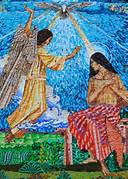
Church of the Annunciation, Nazareth, Israel

Scripture Passage for Reflection:  Luke 1: 26-35

In the sixth month the angel Gabriel was sent by God to a town in Galilee called Nazareth, to a virgin engaged to a man whose name was Joseph, of the house of David. The virgin’s name was Mary. And he came to her and said, ‘Greetings, favoured one! The Lord is with you.’* But she was much perplexed by his words and pondered what sort of greeting this might be. The angel said to her, ‘Do not be afraid, Mary, for you have found favour with God. And now, you will conceive in your womb and bear a son, and you will name him Jesus. He will be great, and will be called the Son of the Most High, and the Lord God will give to him the throne of his ancestor David. He will reign over the house of Jacob for ever, and of his kingdom there will be no end.’ Mary said to the angel, ‘How can this be, since I am a virgin?’* The angel said to her, ‘The Holy Spirit will come upon you, and the power of the Most High will overshadow you; therefore the child to be born* will be holy; he will be called Son of God.

So, what does it mean to ponder?  If you read this Scripture, it does not mean thinking something through until you understand it or until you “get it”.   Nowhere does it say that Mary was ever completely sure about what was going to happen.  Nowhere does it say that she ever stopped asking questions, that she ever stopped pondering what this would mean for her life.  Nowhere does it say that she expected this turn of events.  When you think about it, Mary was probably just like the rest of us.  She probably pretty well had her life figured out.  She was just trying to live it.  And then this angel shows up.  “Excuse me Mary, I know that this might be a little out of the box for you but I need you to stop everything that you’re doing and listen.  God has something special just for you.  See, if it’s not too much trouble, we’d like you to birth the Savior, the Son of God and the Son of Humanity, Emmanual, the Messiah, the very Godself into being.  And, we’d really like to get this show on the road now.”

What if Mary had said no?  What if her fear or her plans had gotten the best of her?  What if she was just too busy planning for whatever was going to happen next in her life?  What if she really didn’t have time to do any pondering today? Now, as much as we’d like to think that we have the whole story of God neatly constructed between the covers of our Bible or on that nifty little Bible app that you have on your iPhone, you and I both know that there is lots of God’s work that is missing.  We really just sort of get the highlights.  Who knows?  Maybe Mary wasn’t the  first that God asked to do this.  Maybe she was the second, or the tenth, or the 386th.  After all, this is a pretty big deal.  I mean, this pretty much shoots that long-term life plan out of the water.  But, you see, this story is not about Mary; it’s about God.  And through her willingness to ponder, her willingness to let go of the life that she had planned, her willingness to open herself to God’s entrance into her life and, indeed, into her womb, this young, dark-haired, dark-skinned girl from the wrong side of the tracks in a sleepy little suburb of Jerusalem called Bethlehem, was suddenly thrust into God’s redemption of the world.  It is in this moment that all those years of envisioning what would be, all those visions that we’ve talked about, it is here, in this moment, that they begin to be.

Annunciation literally means “the announcement”.  The word by itself probably holds no real mystery.  But it is the beginning of the central tenet of our entire Christian faith—The Annunciation, Incarnation, Transfiguration, Resurrection.  For us, it begins the mystery of Christ Jesus.  For us, the fog lifts and there before us is the bridge between the human and the Divine.  Now we Protestants really don’t tend to give it much credence.  We sort of speed through this passage we read as some sort of precursor to “In those days a decree went out from Emperor Augustus…” so we can light our Christmas candle.  This, for us, is the typical beginning of the birth story. But think back.  Something happened nine months before.  This human Jesus, like all of us, had to be grown and nurtured in the womb before the miracles and the ministry started.  The Feast of the Annunciation is the turning point of human history.  It is in this moment, this very moment, that God steps through the fog into humanity and, just like every human that came before, must wait to be fully birthed into this world.

What about us?  When do you let yourself ponder?  When do you expect to encounter the unexpected?  What is your answer when the angel or some other God-sent character comes bursting into your life:  “Excuse me [You], I know that this might be a little out of the box for you but I need you to stop everything that you’re doing and listen.  God has something special just for you.  See, if it’s not too much trouble, we’d like you to birth the Savior, the Son of God and the Son of Humanity, Emmanual, the Messiah, the very Godself into being.  And, we’d really like to get this show on the road now.”  Again, what if Mary had said no?  So, why are we so different from that scared little girl.  So, maybe it’s time for us to get busy pondering!

Annunciation 2Mary pondered these things in her heart, and countless generations have pondered them with her.  Mary’s head is bowed, and she looks up at the angel through her lashes.  There is possibly the faintest trace of a frown on her brow.  “How shall this be, seeing that I know not a man?” she asks, and the angel, the whole of Creation, even God himself, all hold their  breath as they wait for what she will say next.

“Be it unto me according to thy word,” she says, and jewels blossom like morning glories on the arch above them.  Everything has turned to gold.  A golden angel.  A golden girl.  They are caught up together in a stately golden dance.  Their faces are grave.  From a golden cloud between them and above, the Leader of the dance looks on.

The announcement has been made and heard.  The world is with child.

Frederick Buechner, The Faces of Jesus:   A Life Story, p. 8-9

Reflection:  What is God asking you to do with your life?  What part of the story is yours to play, or yours to write, or yours to live?  When have you taken time to ponder?

Grace and Peace,

Shelli