Lenten Discipline: Picking and Choosing

I remember when I got my first Bible.  I was determined to start at Genesis 1:1 and read the whole thing through.  I was sure that was what I was supposed to do.  After all, that’s the way you read a book, right?  Well, I have to confess that that never happened.  In fact, it’s now more than forty years later and it STILL hasn’t happened.  I’ve taught Bible studies and got an M.Div. from seminary and it STILL didn’t happen.  In fact, I’ve never sat down and read the whole Bible at all.  (Shhh!)  (It’s sort of like the way you accidentally hit the wrong button and publish a blog before you’re ready, right?  So, for those who only got half an email, just call it a spiritual teaser.  I know you couldn’t wait for me to finish my thought and write the whole thing through!)
Maynard, the Bible Eater
One day a couple of months ago, I came out into the living room and was greeted with Maynard (my dog) eating a Bible.  Yes, he ate a Bible!  I’m not sure what to think about that.  When I told people what had happened, they just looked at me in amazement.  He ATE a Bible?  The question was always the same: Did he eat the whole thing?  No, I responded, he’s just like the rest of us–just picking and choosing what he wants to digest.  Actually, I’m not so sure that’s NOT the way that we’re supposed to read the Scriptures.  After all, it’s not meant to be a historical narrative.  We don’t plow through it trying to memorize each and every detail.  (Note:  This is not going to be on the test!) 

Spiritual reading is more about entering the text than it is memorizing it (or, for that matter, even fully understanding it!  Remember Nicodemus?).  And the place through which we enter is different for each one of us and is different from day to day or hour to hour for each of us.  We are reading to be formed and transformed.  We must enter in the place where God reveals Godself to us through the Scriptures.  And I suppose that involves a bit of picking and choosing.  Read the words and then let God’s Spirit wash over you.  Do not worry so much about becoming a Biblical scholar.  (After all, remember that this is not the whole story!)  Just read so that your heart, rather than your head, becomes full.

Plumbing the Depths

In her book, Soul Feast, Marjorie Thompson says that “scripture has been compared to a lake whose depths have never been fully plumbed.  On the surface it looks like any other lake; that is, we see human words like those in other books.  But when we jump into the lake and begin to swim downward, we may be unable to find the bottom.  It is as if those human words become transparent to some mysterious and infinite depth we can never fully grasp…God has chosen to be bound to the words of Scripture; in and through them, the Holy One comes near…Scripture is both God’s Word and human words.  It is part of God’schosen self-revelation, simultaneously familiar and strange…It is not that the words magically or mechanically contain God’s presence, but that as we allow the same Spirit through which the Scriptures were written to inform our listening, the presence of God in and beyond those words becomes alive for us once more.” (In Soul Feast: An Invitation to the Christian Spiritual Life, Marjorie Thompson, p. 19-20)

So pick and choose the words where you can this day enter the Word.  Dive in and let God’s Presence come alive for you.  This is your story.  It is not complete.  Which chapter is yours to add?

Grace and Peace,

Shelli

Supermoon

Today’s moon is being called a Supermoon, an astronomical phenomena when the moon will be closer to the earth (nearly 17,000 miles closer than average) than it will be for another twenty years.  The scientific term for this occurrence is perigee-sygygy.  Perigee is Greek word essentially meaning orbit and sygygy (also with some Greek roots) implies unity that comes through alignment. 

“Unity that comes through alignment”–what a great image for this Lenten season, a season of realigning one’s priorities, one’s thoughts, indeed one’s very life with God.  But most people probably have in their minds right now that God is the metaphorical moon moving closer to us as we work toward completion of this realignment process, as if what we are doing is somehow successfully pulling a wandering God back toward us.  No, that’s not it.  We are the ones that tend to wander, that tend to sometimes move so far away that it is difficult to see God.  God is not static or unmoving but God is not running away.  God is inviting us to move as God moves, a sort of orbital dance, if you will.  Maybe, then, Lent is about our becoming a Supermoon, moving closer than we ever have, close enough to be part of that sygygy, part of the dance, part of that unity that comes through alignment.

So in this Lenten season, be a Supermoon!

LENT 2A: Anothen

LECTIONARY PASSAGE:  John 3: 1-17
Now there was a Pharisee named Nicodemus, a leader of the Jews. He came to Jesus by night and said to him, “Rabbi, we know that you are a teacher who has come from God; for no one can do these signs that you do apart from the presence of God.” Jesus answered him, “Very truly, I tell you, no one can see the kingdom of God without being born from above.” Nicodemus said to him, “How can anyone be born after having grown old? Can one enter a second time into the mother’s womb and be born?” Jesus answered, “Very truly, I tell you, no one can enter the kingdom of God without being born of water and Spirit. What is born of the flesh is flesh, and what is born of the Spirit is spirit. Do not be astonished that I said to you, ‘You must be born from above.’ The wind blows where it chooses, and you hear the sound of it, but you do not know where it comes from or where it goes. So it is with everyone who is born of the Spirit.” Nicodemus said to him, “How can these things be?” Jesus answered him, “Are you a teacher of Israel, and yet you do not understand these things? “Very truly, I tell you, we speak of what we know and testify to what we have seen; yet you do not receive our testimony. If I have told you about earthly things and you do not believe, how can you believe if I tell you about heavenly things? No one has ascended into heaven except the one who descended from heaven, the Son of Man. And just as Moses lifted up the serpent in the wilderness, so must the Son of Man be lifted up, 15that whoever believes in him may have eternal life. “For God so loved the world that he gave his only Son, so that everyone who believes in him may not perish but may have eternal life. “Indeed, God did not send the Son into the world to condemn the world, but in order that the world might be saved through him.

At church, part of what I do is handle our endowment program.  And once each month, I sit down to reconcile our operating account on Quickbooks.  When you print the reconciliation, the screen has what I think is the most hilarious directive.  You have the option of clicking a box to print it out in color.  But next to the box, it says “Print the document in color (only for color printers)”.  Well, duh!  It’s just funny.  I thought about that when I started thinking about this term “born again”.  I am tired of hearing what has become a never-ending cast of characters in the public media describing someone (or even themself!) as a “Born Again Christian”.  When did that become a proper name?  What exactly is the difference between a “Born Again Christian” and a “Christian”.  I’m confused.  It’s like reading the 16th verse of this passage and interpreting it “Every one who believes has eternal life. (only for those who are born again).”  It’s just funny!

I don’t think that Jesus ever meant these words to shut out anyone.  After all, in light of the rest of what we know about him and his life here on earth, would that really make sense?  The Greek word used here is anothen.  It can mean “born from above”, “born anew”, or “born again”.  So take your pick.  It can be translated as a time one is born (again) and a place one is born (above) and what it all looks like (anew).  Well, no wonder Nicodemus was confused!  He focuses on one meaning (born again) and protests that it is impossible.  Well, of course it is!  But Jesus is telling him that if he will just stop trying pick it apart, he would see it.  He would see the Kingdom of God.  The passage tells us that no one can see the kingdom of God without being born from above…the wind blows and you hear the sound of it but you do not know where it comes from or where it goes.  So it is with everyone who is born of the Spirit.  Jesus wasn’t belittling Nicodemus or shutting him out.  Jesus was telling him that he was just like everyone else–that what he was seeing and what he was hearing did not make sense through the lenses and the ears of this world.  It’s like he was saying,”Nicodemus, my son, relax and come with me.  I want to show you what comes next.  I want to show you life.”  Indeed, God did not send the Son into the world to condemn the world, but in order that the world might be saved through him.  So, Jesus came to save the whole world?  Hmmm!

I do not call myself a “Born Again Christian”.  When I was little and well-meaning people would ask the question, “when were you born again?”, I didn’t know.  I was always a little afraid that I had missed it.  What a horrible thing to do to a child!  I have decided that the term is redundant.  I am a Christian.  I follow the Way of Jesus Christ, the Way that leads me closer and closer to a oneness with God, a return to the Source from whence I came.  According to this passage, that is the Way to see and know the Kingdom of God.  “Born again” is more to me than a slogan on a T-shirt or fodder for a talk show.  It is a gift, an indescribeable, albeit hard to understand, gift.  It is life.  Jesus just showed us where to look.       

So on this Lenten journey, don’t worry about it making sense.  Just follow the Way of Christ, the way that leads to new life.
 
Grace and Peace,
 
Shelli

Getting to a Thin Place


The Celtic Spiral

Happy St. Patrick’s Day!  I do not know of any true Irish blood in my family but my hodge-podge geneaology includes enough of the British Isles to at leaast come close.  So I have donned my green and I’m set for the day!
St. Patrick was said to have been born Maewyn Succat (Lat. Magonus Succetus) in Roman Britain (Scotland) around the year 387.  As the story goes, when he was sixteen, he was captured by Irish raiders and taken as a slave to Ireland, where he lived for six years before escaping and returning to his family.  He wrote that his faith grew in captivity and he prayed daily. The story is told that one day Patrick heard a voice saying “your ship is ready” and took it to mean that it was time to return home.  Fleeing his master, he traveled to a port two hundred miles away, found a ship, and sailed home.  He entered the church and later returned to Ireland as a missionary.  By the eighth century, he had become the patron saint of Ireland.

In this season of Lent, we are called to do our own returning.  Part of Lent is about returning to your source, to that from whence you came.  It is our season of returning to God, letting go of all the baggage that we’ve stacked up along the way, and beginning again.  Lent is about relearning to travel light.  Celtic spirituality is based primarily on pilgrimage.  Life, in this understanding, is about growing and moving and not “pitching our tent” in one place too long.  It is about connecting with all of Creation.  It is about connecting with God.  It is about recognizing the transcendent, those places where one meets God in his or her life.  In Celtic Spirituality, they are called “thin places”, those places where the spiritual spills into the material, where time and space are one, those places where we feel so connected to God, to our source, that the eternal is there for the taking.  It is those places that are in this life and in this world where one has the sense that one hears the harps eternal just over the not-too-distant hill.  It carries an understanding that all in life is sacred, that all in life is of God; we just have to return with new eyes and new ears and a new heart to see it.  Lent calls us to find our own thin places.  They are not the places where God exists but rather the places where we can finally sense the Presence of the One who is everywhere.

Legend credits St. Patrick for banishing all of the snakes from Ireland.  It is interesting to note, though, that evidence suggests that post-glacial Ireland never really had any snakes.  Perhaps it was an account of Patrick’s influence in the doing away with the belief in serpents that were so common in Druid belief.  Or perhaps it is a reminder to us what a life of true faith, a life of singular devotion to God, can mean.  When one returns to his or her source, when one finds that place where one knows God and senses the God who is all things and everywhere, all those things that haunt us, all those things that perch around corners and strike unexpectedly, all those things in life that we try to avoid, try not to step on, finally do not matter.  It is said that Patrick feared nothing, not even death, so complete was his trust in God.

So, in this Lenten journey, may you find your thin place.

Christ with me, Christ before me, Christ behind me, Christ within me,
Christ beneath me, Christ above me, Christ at my right, Christ at my left,…
Christ in the heart of everyone who thinks of me,
Christ in the mouth of everyone who speaks to me,
Christ in every eye that sees me,
Christ in every ear that hears me.
I bind to myself today the strong virtue of an invocation of the Trinity,
I believe the Trinity in the Unity,
The Creator of the Universe.  
(From The Prayer of St. Patrick’s Breastplate, supposedly composed by him in preparation for victory over Paganism.)

Grace and Peace,

Shelli

LENT 2A: Turning Right

LECTIONARY PASSAGE:  Romans 4: 1-5, 13-17
What then are we to say was gained by Abraham, our ancestor according to the flesh? For if Abraham was justified by works, he has something to boast about, but not before God. For what does the scripture say? “Abraham believed God, and it was reckoned to him as righteousness.” Now to one who works, wages are not reckoned as a gift but as something due. But to one who without works trusts him who justifies the ungodly, such faith is reckoned as righteousness.

For the promise that he would inherit the world did not come to Abraham or to his descendants through the law but through the righteousness of faith. If it is the adherents of the law who are to be the heirs, faith is null and the promise is void. For the law brings wrath; but where there is no law, neither is there violation. For this reason it depends on faith, in order that the promise may rest on grace and be guaranteed to all his descendants, not only to the adherents of the law but also to those who share the faith of Abraham (for he is the father of all of us, as it is written, “I have made you the father of many nations”) —in the presence of the God in whom he believed, who gives life to the dead and calls into existence the things that do not exist.

Driving in Houston is almost always a challenge, even for those savvy ones of us who grew up in the area and do it all the time.  There is something that you do not expect–a closed freeway (I actually think they do that every week-end whether they need to or not), a new pothole, or simply a major freeway or intersection that is completely stopped for no apparent reason.  In a city in which you can literally drive for two hours on a “good” traffic day and never actually leave the city, there is lots of room for things that get in your way.  One day not too long ago, I was driving on a road that I drive often.  I got to an intersection under the Southwest Freeway with which I was pretty familiar.  There is a sign there with an arrow on it that implies a right turn only onto the feeder from that lane.  But apparently one of the bolts had come out of the top of the sign and the sign had slid farther down the pole and upside down.  If I took the sign literally, it would have told me to turn the car around, go back from where I came, and turn the opposite direction.  No, that’s not right!
 
Even with signs all around us, we know the rules.  We know what it normal.  We know the way.  And in that respect, we are no different from those in the Roman Empire to which Paul was writing this passage that is part of our lectionary readings for this week.  They all knew that if they followed the rules and did what was expected, everything would be fine.  They would get what they deserved.  They would end up where they needed to be.  They would receive their reward.  But now Paul was telling them that these things that they thought would make them “right” with God didn’t really matter at all.  That was not the way it worked.  It had to be hard for them to hear.  According to Paul (and possibly a surprise to many of these first century hearers and a few of us!), God is not waiting around for us to do the “right thing” so that we can be in “right relationship” with God.  God blesses all of us, all of humanity, as children of God.
 
Paul claims that the right relationship is not something that Abraham had earned because he had done the right thing.  It was freely offered by God.  Abraham’s belief did not create the “right relationship”; it was because of it.  Paul is almost contending that our belief is a fruit, rather than a reason, for our right relationship with God.  The right relationship is a free and undeserved gift.  (Hey, that sounds like grace to me!)  The relationship is already there.  We just have to live into it.  We don’t have to create it; we just have to turn toward it.  That’s what this season of Lent is about–not cleaning up your act, but turning toward God.
 
So, TURN RIGHT!
 
Grace and Peace,
 
Shelli

LENT 2A: Parshas Lech Lecha

LECTIONARY PASSAGE:  Genesis 12: 1-4a
Now the Lord said to Abram, “Go from your country and your kindred and your father’s house to the land that I will show you. I will make of you a great nation, and I will bless you, and make your name great, so that you will be a blessing. I will bless those who bless you, and the one who curses you I will curse; and in you all the families of the earth shall be blessed.” So Abram went, as the Lord had told him; and Lot went with him.

It means “to be a blessing”, parshas lech lecha.  This passage begins what is often called the Patriarchal history of Genesis. All of a sudden the camera zooms into a single family of nomads in a small town in Mesopotamia and, finally, to a single individual.  This is where the history of Israel begins.  The truth is, Abram never saw his future.  And yet his response shaped it.  Abram is chosen to be the one through whom God’s blessing is showered upon the whole world. But in order for this to happen, Abram is told to leave what he knows, to in effect sever ties and go to a new place. (We at this point immediately jump to what that would mean for us–to leave our home, our family, our life.  What, we imagine, a great act of faith!) But remember that Abram’s family was nomadic. They probably didn’t really have a concept of home anyway. And there really wasn’t a family, to speak of—Abram had probably long ago outlived his parents and he had no children. So what was he leaving? Maybe God was calling him away from hopelessness and loneliness and finally showing him purpose, showing him home.

And the Lord promises that Abram will not be alone. And, more than that, God promises blessing. No longer is this just one person or one family; it is the conduit to God showering blessing throughout the world.
Abram is called to be a blessing, the Hebrew Parshas Lech Lecha. It becomes an integral part of the Genesis story and is used eighty-eight times in the book. A blessing is a gift. It involves every sphere of existence. It is more than what we 21st century hearers have allowed it to be. It is not payment for a life well-lived. “Being blessed” is being recreated. (For Abram, this meant moving from a life of nomadic purposelessness to being the “father of a great nation” and, thousands of years later, the patriarch of three world religions.) It takes time. I think to be a blessing means that one enters the story. God calls, God promises, and God walks with us. That is how God is revealed. But the blessing doesn’t come and the blessing doesn’t continue unless one enters the story. God calls, God promises, and God blesses.

Blessing is one of the ways that God makes the presence of God known here and now.  (Joan Chittister)

So, go and be a blessing!
 
Grace and Peace,
 
Shelli

Lenten Discipline: Seeking and Tuning

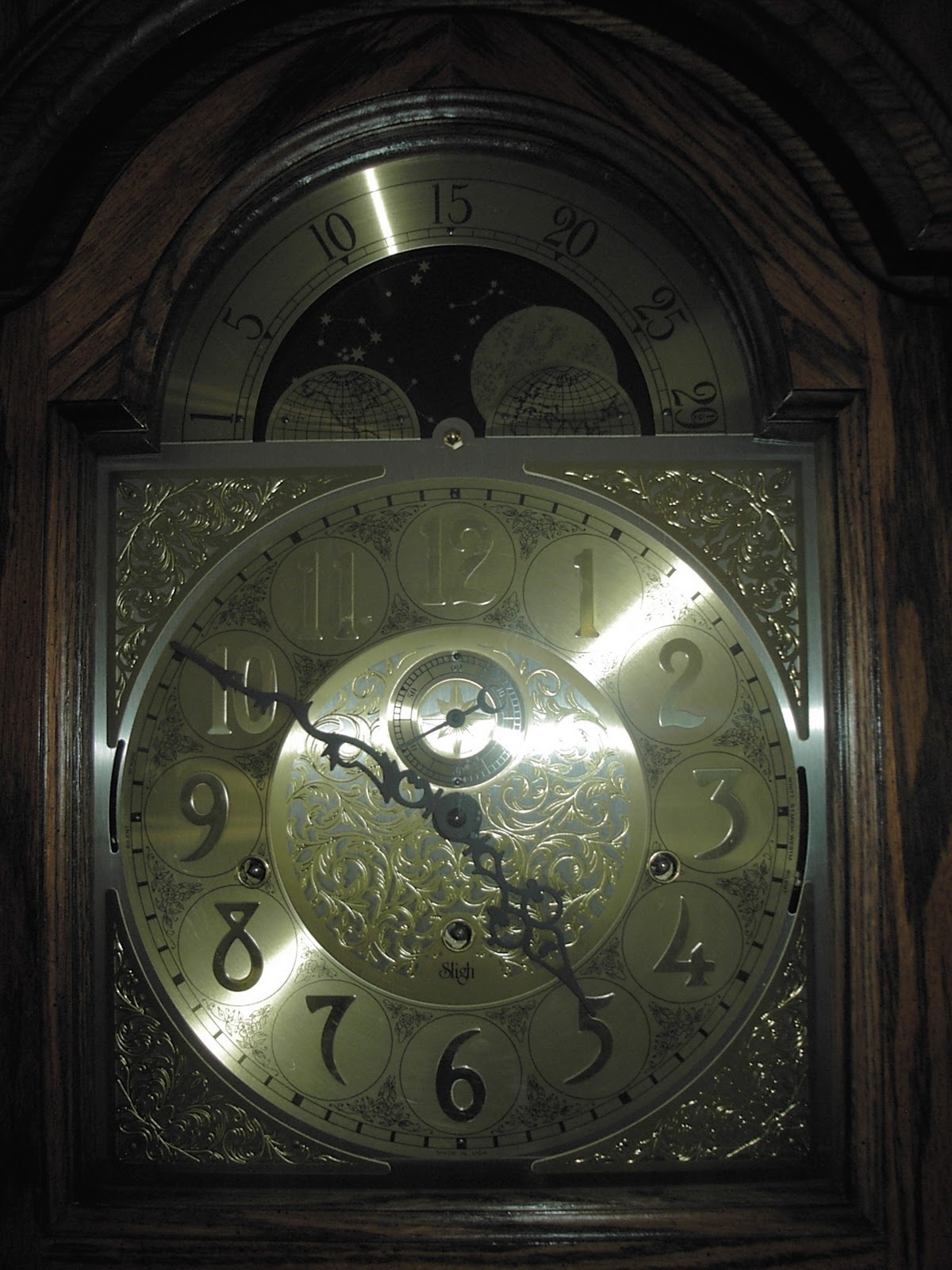
Today we lost an hour to the dreaded Daylight Savings Time adjustment.  I hate this day.  What is that about?  The claim is that we get “more daylight”.  Really? Have these people not had math or astronomy?  It is very bizarre.  So, I woke up at 5:00 (which was really, as my body clock pointed out to me, 4:00).  And while I went around and did all of my Sunday morning things for what was already an early day, Maynard (the dog) slept in.  He knew better and just didn’t want to be bothered with anything that might get in the way of his schedule.  Maynard is a rescue lab that I got in August and as this was our first “spring forward” day together, I think it confirmed to him that I really am nuts. 

I drove to the church at the time that I was usually privileged to view the sunrise on Sunday mornings.  There was no sunrise but rather a sky that held varying degrees of light as the sunrise began to stretch and get ready for the day, not really wanting to be bothered with anything that might get in the way of its schedule.  It really was rather beautiful, though (sans light, of course).  I stopped at the same red light at the same intersection that I do twice each year. It seems that I always change my car clock at the same place.  And I always have to once again figure out how to do it.  You punch “Clock” and then the radio screen lights up with the directions:  “H-Seek…M-Tune”.  (It’s telling you to use the “seek” and “tune” buttons to recalibrate your time and adjust its setting so that it makes more sense.)

The meaning was not lost on me even in my somewhat blurry state.  What a great metaphor for this Lenten season–seeking and tuning.  Usually when we see the word “seek”, our finely-trained minds go immediately to “finding”.  But on this spiritual path, that doesn’t work as well.  This is not a path of seeking and finding God.  God is not lost.  God is not hiding out waiting for some grand hide and seek game to end.  God is right here waiting for us, waiting for us to hear, waiting for us to listen.  And so this time of Lent is a time of our seeking and tuning, a time of recalibrating our lives so that we will be in line with the time of God, a time of adjusting our setting, so to speak, so that it will make more sense.  God is never out of the bounds of our life; sometimes we just have to stop and tune ourselves to the music that was there all along.  And once a year, the church year gives us a chance to do just that.  My memory is a little rusty.  I usually have to figure out how to do it all over again.  But God is patiently waiting for me to spiritually tune myself.  And if I don’t get it completely right, God, in infinite grace and mercy, always moves a little closer to me anyway.

So in this Season of Lent, tune yourself to the place where you best connect with God!

Grace and Peace,

Shelli