14David remained in the strongholds in the wilderness, in the hill country of the Wilderness of Ziph. Saul sought him every day, but the Lord did not give him into his hand. 15David was in the Wilderness of Ziph at Horesh when he learned that Saul had come out to seek his life. 16Saul’s son Jonathan set out and came to David at Horesh; there he strengthened his hand through the Lord. 17He said to him, “Do not be afraid; for the hand of my father Saul shall not find you; you shall be king over Israel, and I shall be second to you; my father Saul also knows that this is so.”
David is one that spends a lot of time in the dark wilderness according to the Scriptures. Here, he is running, running for his very life. He knows that Saul is coming after him. So, he runs into the “strongholds of the wilderness”. Isn’t that interesting that this place that holds such danger, such peril, such forsakenness, is, here, a place of protection? David stays there, hidden away, as the wilderness surrounds him and holds him offering comfort and safety. I suppose given the alternative (you know, like when a really angry man with an army is chasing you), the wilderness appears to be a very attractive place. And it becomes easy to enter its wilds and close ourselves off to the world.
During this season of Lent, we talk a lot about wilderness, about darkness, about those places that do not provide comfort and repose. It would be easy for us to think that the wilderness is a place for us to stay. Now, don’t get me wrong. Sometimes I would like nothing better than to close myself off and not have to deal with my part of the world. Sometimes, I would love to just stay in my room for days on end and write. But even though God calls us into the wilderness in certain seasons of our lives, the wilderness is not meant to be home. The wilderness is not a place where we put down stakes and plant roots. The wilderness is not a home; it is an encounter. It is the place that pushes us. If a wilderness begins to offer us solace, we have, sadly, tamed its wilds.
I’ve thought again about those early Desert Mothers and Fathers, who spent the better part of a lifetime wandering in the wilderness, communing with God, and writing the tales. But they did not live in the wilderness as a home; they did not tame it enough that they could close themselves off. Imagine them moving in a way that their feet never really touched the ground. Maybe that’s the operative word…moving.
When you think about it, the Bible is a story of movement. God creates life and just as quickly pushes it into the wilds. The creatures wander for a time and then they begin to plant their feet and build walls and boundaries (and dress themselves). So, God, with loving hands, pushes them farther out into the world. They wander and then they begin building. The Bible is a story of the rhythms of God driving us into the world and our building of walls and boundaries. It happens over and over and over again. It is no different here. David is driven into the wilderness and then decides, “you know, I’ll stay awhile and let it offer me solace and protection”. It did not last long.
Lent, like the wilderness, is not meant to be our home; it is meant to be our way of life. Because when we wander in the wilderness, we are free, we are vulnerable. University of Houston’s Dr. Brene’ Brown tells us that connection begins by allowing ourselves to be seen; in other words, being vulnerable, allowing ourselves to be seen, leaves us open to encounter. If we quit wandering and sit down and plant our feet and build a home that is not meant to be, that is not ours, we close ourselves off to encounter. We close ourselves off to God. So, if you feel the need to stay where you are, to build a home, to wall yourselves off, at least an opening so you can see the sun and breathe the air and know that God is always there.
The darkness, the wilderness, that place where we struggle and look for answers is indeed a place where we do not feel at home, where our comforts and all those things to which we’ve become accustomed, are stripped away. We are laid raw in a way. And, as uncomfortable as that is, it is in those places where we are most ready to connect with God.
So, here we are in this unfamiliar place, wandering, perhaps lost. Breathe…Breathe out the need to tame it, to make it your home. Breathe out the need to calm it and understand it. And then breathe in…breathe in the wildness, the untamed, the vulnerable, the lack of control. Breathe in…God. God is always there offering mercy and salvation. But God does not always offer comfort. God does not always tame the wilderness or light the darkness. Sometimes God just lets us be…and gives us a chance to breathe. Sometimes we need the darkness. Sometimes we need the wilderness. Sometimes realizing our vulnerability, our lack of control, our needs leads us to what we needed all along.
“When we were children, we used to think that when we were grown-up we would no longer be vulnerable. But to grow up is to accept vulnerability… To be alive is to be vulnerable.” (Madeleine L’Engle)
O come, let us sing to the Lord; let us make a joyful noise to the rock of our salvation! Let us come into his presence with thanksgiving; let us make a joyful noise to him with songs of praise! For the Lord is a great God, and a great King above all gods. In his hand are the depths of the earth; the heights of the mountains are his also. The sea is his, for he made it, and the dry land, which his hands have formed. O come, let us worship and bow down, let us kneel before the Lord, our Maker! For he is our God, and we are the people of his pasture, and the sheep of his hand. O that today you would listen to his voice! Do not harden your hearts, as at Meribah, as on the day at Massah in the wilderness, when your ancestors tested me, and put me to the proof, though they had seen my work. For forty years I loathed that generation and said, “They are a people whose hearts go astray, and they do not regard my ways.” Therefore in my anger I swore, “They shall not enter my rest.”
Sometimes I think that “worship” in our culture is defined based on how gratifying it is to us, on whether or not it is meaningful to us or leave us feeling “spiritual”. Our worship is sort of graded based on how good the sermon is, or how wonderful the music is, or how it makes us feel. I’m guilty of it. There are just certain styles of worship and worship music that do not feel “worshipful” to me. But, really, is that what worship is? What is the point of worship? Worshippers in Early Judaism believed that God was actually IN the worship space that they carried with them. And so, they would approach the tabernacle with awe and joy. They didn’t get wrapped up in worship styles or whether or not they liked the sermon. Worship was about God, about coming into the very Presence of God with thanksgiving. Worship was about realizing that there was more than us, that God held all of Creation in the Divine Hands and was worthy of worship.
So, when did we lose that? When did we lose the notion that worship is not about us? Soren Kierkegaard, when talking about worship, asked that we think about what it means to us. Using his depiction of worship as a theater, think about your own notion of worship. Where is the stage? (Most would say the chancel or the altar. (Newsflash: It’s really NOT a stage.)) Who are the actors? (Most would say the clergy, the choir, and perhaps the ushers and acolytes, those that “make it happen”) Who is the audience? (Well, of course the congregation.) But Kierkegaard would say that the stage is the whole sanctuary, perhaps the whole world, all of those places where worship happens. And the actors? Well, that would be us–all of us, all of us bowing in worship. And the audience? The audience is God. I love that. I think it reminds us that we are not the center of worship. It is not about us.
The Psalm reminds us that God is the God of all, that everything is within God’s realm, resting in God. So, we are called to make a joyful noise. It doesn’t call for happiness. Happiness, that self-gratifying feeling, is always a little bit elusive. But joy–joy resides in the deepest part of our being. It is that sense of awe and presence when we know that God is there, always there, and can do nothing else but come into God’s Presence, nothing else but worship the God of us all. God desires our worship, not because God is selfish, not because God wants to be honored, not because we in some way owe God that; God desires our worship because God desires us, wants desperately to be with us, for us to feel and know and live in God’s Presence. And, there, there in God’s Presence, we worship. Our whole lives, we worship. Every moment, every place, every piece of our being, worships. O Come, Let us Sing to the Lord!
So, on this day, breathe out… breathe out your opinions of worship. Breathe out your judgment of how “good” the worship is, what order the bulletin is in, or how long it lasts. (And, for today, breathe out the fact that you’re tired because the time changed and it starts an hour earlier!) And as you worship today, breathe in the very presence of God. Breathe in the God who is always there and who wants desperately to be with you. Worship is not separate from life. If you breathe in deeply enough, it will become your life. Your life will become worship.
Oh…and make sure you turn you pay attention to what time it is!
To worship is to quicken the conscience by the holiness of God, to feed the mind with the truth of God, to purge the imagination by the beauty of God, to open the heart to the love of God, to devote the will to the purpose of God. (William Temple)
So he came to a Samaritan city called Sychar, near the plot of ground that Jacob had given to his son Joseph.Jacob’s well was there, and Jesus, tired out by his journey, was sitting by the well. It was about noon.A Samaritan woman came to draw water, and Jesus said to her, “Give me a drink.”(His disciples had gone to the city to buy food.) The Samaritan woman said to him, “How is it that you, a Jew, ask a drink of me, a woman of Samaria?” (Jews do not share things in common with Samaritans.)Jesus answered her, “If you knew the gift of God, and who it is that is saying to you, ‘Give me a drink,’ you would have asked him, and he would have given you living water.” The woman said to him, “Sir, you have no bucket, and the well is deep. Where do you get that living water? Are you greater than our ancestor Jacob, who gave us the well, and with his sons and his flocks drank from it?” Jesus said to her, “Everyone who drinks of this water will be thirsty again, but those who drink of the water that I will give them will never be thirsty. The water that I will give will become in them a spring of water gushing up to eternal life.” The woman said to him, “Sir, give me this water, so that I may never be thirsty or have to keep coming here to draw water.” Jesus said to her, “Go, call your husband, and come back.” The woman answered him, “I have no husband.” Jesus said to her, “You are right in saying, ‘I have no husband’; for you have had five husbands, and the one you have now is not your husband. What you have said is true!” The woman said to him, “Sir, I see that you are a prophet. Our ancestors worshiped on this mountain, but you say that the place where people must worship is in Jerusalem.” Jesus said to her, “Woman, believe me, the hour is coming when you will worship the Father neither on this mountain nor in Jerusalem. You worship what you do not know; we worship what we know, for salvation is from the Jews. But the hour is coming, and is now here, when the true worshipers will worship the Father in spirit and truth, for the Father seeks such as these to worship him. God is spirit, and those who worship him must worship in spirit and truth.” The woman said to him, “I know that Messiah is coming” (who is called Christ). “When he comes, he will proclaim all things to us.” Jesus said to her, “I am he, the one who is speaking to you.”
Several years ago, I had the opportunity to lead a discussion with the a UMW group on “Immigration and the Bible”. It’s based on a book with that same name by Joan Maruskin that was published to be a 2013 UMW study (that’s United Methodist Women for you non-Methodists! They’ve now changed their names but whatever…). Now, that “immigration” word is, for us, probably nothing less than a lightning bold word. It is so politically charged nowadays that most of us shy away from it. But the truth is, it is what the Bible is about. The Bible is about movement. The Bible is about immigration. It begins with God’s Spirit moving across the face of the earth and ends with a depiction of a city, a New Jerusalem, moving from heaven to earth. And in between, we read stories of people continuing to be uprooted. They move from one place to another seeking safety and sanctuary and we are continually given reminders of how we are called to welcome the stranger into our midst. The Bible is a story of movement and a story of welcome. And along the way, the call is not to build and prosper but to encounter each other and enter each other’s lives.
But each of us in this world works hard to preserve our perceived image of what that world should be—a world where our political views, our boundaries we have drawn, our wealth and possessions we hold, our standard of living and our understanding of who God is remain intact. The problem is that our need to preserve ourselves usually gets in the way of our ability to connect with others, our ability to encounter the rest of God’s children. Because if each of us is waiting for the other to respond in love first, then love will never be the response and the walls of hatred become stronger and more difficult to tear down.
Take the relationship between the Samaritans and the Jews. Both believed in God. Both had a monotheistic understanding of the one true God, the YHWH of their shared tradition of belief. But where the temple of YHWH for the Jews existed on Mount Zion in Jerusalem, the Samaritans instead believed the Scriptures supported the worshipping of God on Mount Gerizim near the ancient city of Shechem. And with that, a new line of religious understanding was formed. The Samaritans believed that their line of priests was the legitimate one, rather than the line in Jerusalem and they accepted only the Law of Moses, The Torah, as divinely inspired, without recognizing the writings of the prophets or the books of wisdom. These differences between the two peoples probably began as early as one thousand years before the birth of Christ and what started as a simple religious division, a different understanding of how God relates to us and we relate to God, eventually grew into a cultural and political conflict that would not go away. The tension escalated and the hatred for the other was handed down for centuries from parent to child over and over again.
So here is this woman depicted as a stranger, an outcast, a Samaritan. And here is Jesus breaking all of the boundaries of traditional and accepted Judaism. First, he, unescorted, speaks to a woman. In the Talmud, the rabbis warned that conversing with women would ultimately lead to unchastity. In fact, Jose ben Johanan, of Jerusalem, who lived around 160 B.C., wrote, “He that talks much with womankind brings evil upon himself and neglects the study of the Law and at the last will inherit Gehenna (or the destination of the wicked). ” (Wow! That sounds pretty serious!) Secondly, Jesus speaks to a woman of questionable repute. Now, in all probability, this woman was probably just a victim of some form of Levirate marriage gone bad, where she had been handed in marriage from relative to relative as her husbands died, leaving her penniless and out of options. And, finally, Jesus speaks to the so-called “enemy”. The truth is, there is nothing about this woman that is wrong or sinful or anything else that we try to tack on her reputation. The woman was just different. Her life had been difficult. She lived in darkness and had no way out of it. And the most astonishing thing is that this seemingly low-class Samaritan woman who is not even given a name in our Scriptures becomes the witness to the Gospel of Jesus Christ. Because, you’ll notice, Jesus did not just ask her for a drink. He engaged her in conversation about spiritual matters. Once again, the Gospel is found not in Jerusalem and not on Mt. Gerizim and not even in whatever faith community you call “yours”, but in our shared existence as part of this “new humanity”. The Gospel is found in our encounter with each other. Here, too, Jesus enters a new phase of his ministry. Up until this point, Jesus’ encounters have been pretty ethno-centric. But, here, the Gospel begins to spread to other ethnicities and other peoples. It begins to include an encounter with the world. It begins to include the “other”, the immigrant.
For most of us, our problem is that we are always waiting for someone else to make the first move toward acceptance and reconciliation. But Jesus did not wait. Jesus stepped into encounter. That is what we are called to do. We are called to go forward on an unpaved road to meet the other. We are called to somehow reach through our prejudice and even our fears and take each other’s hand. We are called to cross boundaries, rather than constructing them. We are called to reach through our differences and find our common, shared humanity, all children of God, all made in the image of God. That is the way that peace is found—one hand at a time. And that is the way that we encounter Jesus Christ.
Putting this study of “Immigration and the Bible” together, I began to see a new pattern emerge in the Scriptures—well, new for me as I read the Scriptures through a different lens. The Biblical story is a story of God calling us to go forth and our drawing borders, walling ourselves off, protecting who we are and what we have. God calls us to go and we draw borders. God calls us to go and we construct gates. God calls us to go and we build walls. But we are called to encounter the stranger. It is more than being welcoming. It is more than letting them into our carefully-constructed lives. It means entering their life and completely opening ours to them. It means that they become us and we become them. It means that we encounter each other.
We are in the middle of this season of Lent. It IS the season of wandering, the season of the wilderness journey. We always begin Lent with Jesus going into the wilderness, leaving what he knows, leaving the comforts of home. And I think that part of the reason for that, is that we are called to be wanderers, aliens, and sojourners. We do not stand in one place waiting for others to come to us. The Christian journey is always moving us toward something, so we go the way that God calls us to go and along the way, we gather the children of God. We encounter each other. As Jesus once said, “Go to the street corners and invite to the banquet anyone you find.” In other words, go and encounter each other because that is how you encounter Christ.
So, let us breathe out that fear of the other. Let us breathe out the preservation of our way. Let us breathe out the notion that our view of the world, our view of who God is, is all there is. And let us breathe in what our brother and sisters can teach us. Let us breathe in the world and all the ever-widening circles that means.
I live my life in ever-widening circles that reach out across the world. I may not complete this last one but I give myself it it. I circle around God, around the primordial tower. I’ve been circling for thousands of years and I still don’t know: am I a falcon, a storm, or a great song? (Rainer Maria Rilke)
The answer’s been here all along We just need to hold each other ’til the hurt is gone Oh, to belong, still a dream
Look what we’ve imagined with pain Make believing we aren’t the same But you and I know the truth Imagine what we could do If we imagined with love
Wild where the energy flows The window’s wide open All we see is the door that’s closed Sad how it goes So it goes, ’til it goes
Look what we’ve imagined with pain Make believing we aren’t the same But you and I know the truth Imagine what we could do If we imagined with love
Time for all of us to wake up out of this hypnotic state Instead of dreaming fast asleep, we should be dreaming wide awake
Look what we’ve imagined with pain Make believing we aren’t the same But you and I know the truth Imagine what, we could do, if we choose Yeah, what do we have to lose If we imagined with love?
18For the message about the cross is foolishness to those who are perishing, but to us who are being saved it is the power of God. 19For it is written, “I will destroy the wisdom of the wise, and the discernment of the discerning I will thwart.” 20Where is the one who is wise? Where is the scribe? Where is the debater of this age? Has not God made foolish the wisdom of the world? 21For since, in the wisdom of God, the world did not know God through wisdom, God decided, through the foolishness of our proclamation, to save those who believe… 24but to those who are the called, both Jews and Greeks, Christ the power of God and the wisdom of God. 25For God’s foolishness is wiser than human wisdom, and God’s weakness is stronger than human strength.
Well, you have to give Paul credit. After all, he’s the only one that actually said what we were all thinking out loud. Admit it, you were. I mean, really? After years and years (no scratch that, after centuries and centuries and centuries) of waiting for a Savior, waiting for the Messiah, he finally shows up. He’s from a no-name-blip-on-the-road town and is born in another no-name-blip-on-the-road town to young, no-name working-class peasants. He’s born in a grotto of some sort and is placed in a feed trough. Then after a considerable amount of hoopla surrounding his birth, he sort of drops out of site for three decades or so. Then he bursts onto the scene to take on the world. He’s baptized in a river by some relative of his that lives in the wilderness and wears camel hair and eats locusts and seems to preach a little hellfire and brimstone. Then he goes out and lives in the desert for six weeks or so completely alone. Then instead of hobnobbing with those who had the power to finally make his ministry fruitful, he hangs around the Lake of Galilee for a couple of years gathering other no-name folks to help him out. He shies away from things like pledge campaigns and evangelism programs and instead opts to tell stories, to stand out in the weather and the elements and try to get people not necessarily on board with his fledgling ministry but just to turn their lives around. He never even, as far as I can tell, took up an offering unless you count that meager fish lunch that he somehow managed to use to feed the multitudes.
Then this young itinerant pastor and his motley brood make their way to Jerusalem. They go right in the gates, taking on the best and the brightest, taking on the Holy City itself. I mean, who writes this stuff? Well, we know how it all turned out. Because, you see, when you take on the strong and the powerful, when you begin to unseat those in charge, when you point to their vulnerabilities, to their shortcomings, it seldom ends well. You know, there are seasons and places where that can get you crucified!
In this Season of Lent, as we come closer and closer to the cross, we get a better and better sense of its meaning. Because in terms of the world, Jesus, Jesus’ Life, even the Cross is utter foolishness. The world says “mind your own business”; Jesus says “there is no such thing as your own business”. The world says “buy low, sell high”; Jesus says “give it all away”. The world says “take care of your health”; Jesus says “surrender your life to me”. The world says “Drive carefully—the life you save may be your own”; Jesus says “whoever would save his life will lose it, and whoever loses his life for my sake will find it.” The world says “get what you are due”; Jesus says, “love your neighbor as yourself”. We say “America First”; Jesus says, “You are the light of the world…let your light shine before others.”
So, we try our best to make the story presentable to the world. We polish the gleaming cross at the front of the sanctuary. We make the pews comfortable with back support and we make sure the temperature is comfortable. We spend hours making the bulletin user-friendly so it will all make sense. We try our best to keep the worship service to an hour so that everyone can get back to their lives (or their sports dates).
Maybe once in a while, it would do us good to embrace the sheer foolishness of it all instead of trying to make it presentable to the world. After all, this promise of Life did not come to us unscathed. God’s promise is life born of death. It does not just appear in the midst of a beautiful array of carefully-placed lilies on Easter morning. God took something so horrific, so dirty, so unacceptable and recreated it into Life Everlasting. But in terms of what we know, what we expect, even what we deserve, it is an act of utter foolishness. Perhaps wisdom, though, is not about worshipping a gleaming, pristine cross but rather looking at an instrument of death and seeing the life it holds. Because, you see, if it all made sense, we wouldn’t need it at all.
The truth is, the ones that got it were not the powerful or the rich or the ones in charge. The ones who got it were the ones whose lives the world assumes makes no sense—the poor, the blind, the prisoners, the weak, the meek, the givers, the peacemakers, even the outsiders. They were the ones who think the world should change. The ones that don’t fit into what the world expects, those that the world thinks are less than others or are being foolish themselves, those are the ones that get the Cross, those are the ones that can make sense of the foolishness of God. And the rest of us? Maybe we are indeed the fools.
So, what do we do? What do we breathe out? Maybe we breathe out the world. No, I don’t mean shunning the world. I mean breathing out the ways that the world accepts, the ways that make the world comfortable. The Scriptures are not there to make us comfortable; they are there to push us beyond ourselves, to compel us toward the vision that God holds for us. So, breathe out the ways of the world. And breathe in the vision that God holds. I know. This is hard right now. We’ve all got different ideas of what that vision holds. We’re in the middle of a war, a war that most of us don’t really understand at all. We’re divided among ourselves. Breathe out. Breathe out needing to claim rightness or superiority or the “winning” message. Breathe in the foolishness of God. It will make sense later. Open yourselves to what you do not know. Open yourselves to what you’re missing. And then breathe it all in.
“If the world is sane, then Jesus is mad as a hatter and the Last Supper is the Mad Tea Party…In terms of the world’s sanity, Jesus is crazy as a coot, and anybody who thinks he can follow him without being a little crazy too is laboring less under a cross than under delusion.” (Frederick Buechner, “The Faces of Jesus”)
Therefore, since we are justified by faith, we have peace with God through our Lord Jesus Christ, through whom we have obtained access to this grace in which we stand; and we boast in our hope of sharing the glory of God. And not only that, but we also boast in our sufferings, knowing that suffering produces endurance, and endurance produces character, and character produces hope, and hope does not disappoint us, because God’s love has been poured into our hearts through the Holy Spirit that has been given to us. For while we were still weak, at the right time Christ died for the ungodly. Indeed, rarely will anyone die for a righteous person—though perhaps for a good person someone might actually dare to die. But God proves his love for us in that while we still were sinners Christ died for us. Much more surely then, now that we have been justified by his blood, will we be saved through him from the wrath of God. For if while we were enemies, we were reconciled to God through the death of his Son, much more surely, having been reconciled, will we be saved by his life. But more than that, we even boast in God through our Lord Jesus Christ, through whom we have now received reconciliation.
This is one of the hardest Scriptures for us (or at least the part of “us” that is “me”). What do you mean suffering results in hope? That can’t be right. I mean, suffering is bad, hope is good. Everyone knows that. Isn’t that how it works? But suffering is a part of life. It doesn’t mean that you did something wrong. It certainly doesn’t mean that God is sitting off somewhere doling out suffering like it’s some sort of giant card game. And, please, DO NOT tell me that God would never give me more than I can handle. (aaaggghhh!) What, are we all supposed to get some sort of ration of suffering? No, that’s not the way it happens at all. Suffering just happens. It happens because it is part of life. We do not live as mechanical robots. Suffering is part of the richness and profundity of life. Maybe it’s the downside of having skin, of being created, of being real. We all have needs. Sometimes life is just too much. (And sometimes it’s not enough.) But we will all suffer. And where is God? There…there in the midst of the suffering. Suffering reveals the heart of God.
Nearly thirty years ago, I had the opportunity to visit Auschwitz, Poland. I expected to be appalled; I expected to be moved; I expected to be saddened at what I would fine. I did not expect to become so personally or spiritually involved. I did not expect my empathy to kick in in a way that I felt it so deeply. As you walk through the concentration camp, you encounter those things that belonged to the prisoners and victims that were unearthed when the camp was captured–suitcases, eye glasses, books, clothes, artificial limbs, and shoes–lots and lots and lots and lots of shoes–mountains of humanity, all piled up in randomness and namelessness and despair. This is the epitome of suffering. This is humanity at its worst. This is humanity making unthinkable decisions about one another based on the need to be in control, based on the need to be proven right or worthy or acceptable at the expense of others’ lives, based on the assumption that one human is better or more deserving than another. It is something that in this divisive and vitriolic climate, we need to think about, to perhaps revisit what happened in what seems another world but is in THIS century of humanity.
I’ve thought about that trip a lot lately. There is so much suffering today. And somehow we make excuses for 72,000 dead in Gaza since October 7, 2023. We ignore 400,000-500,000 deaths in the Russian incursion into Ukraine. And now we don’t even talk about more than 1,000 Iranians dead from the attacks that we have inflicted. You can say there are reasons for all of those wars. There are. But it doesn’t alleviate the suffering.
And yet, God CHOSE to be human. God CHOSE to put on skin, temporarily separating the Godself from the Holy Ground that is always a part of us, and entering our vulnerability. God willingly CHOSE to become vulnerable and subject to humanity at its worst. God CHOSE the downside of having skin. Now maybe God was having an off day when that divine decision was made, but I think it was because beneath us all is Holy Ground. God came to this earth and put on skin and walked this earth that we might learn to let go, take off our shoes, and feel the Holy Ground beneath our feet. God CHOSE to be human not so we would learn to be Divine (after all, that is God’s department) but so that we would learn what it means to take off our shoes and feel the earth, feel the sand, feel the rock, feel the Divine Creation that is always with us and know that part of being human is knowing the Divine. Part of being human is being able to feel the earth move precariously beneath your feet, to be vulnerable, to be tangible, to be real, to take on flesh, to put on skin, to be incarnate. Part of being human is making God come alive.
Suffering exists. It always exists. Maybe we could stand a little reframing from Paul too. For us, suffering is a failure; within the vision of God, suffering holds hope for newness. Because in the midst of suffering, just like in the midst of everything else, we find God. God walks with us through it, loving us and holding us, perhaps even revealing a way out of it, if we would only listen, and gives us a glimpse of what is to come. The suffering of the world reveals the heart of God, reveals the holiness that is, if we will only look. It doesn’t explain it; it doesn’t make it easier; it just reminds us that it is not the final chapter. Maybe it’s the downside of having skin, which means that you are human, a child of God, made in the image of God, with so much more ahead.
The suffering of the world also reveals the heart of us, if we will only listen. It reveals our connectedness. It reveals the community that God created just as God created each of us as individuals. In this season of breathing, we’re not called to breathe out the suffering. That is part of life. But I think we need to breathe out the callousness of our reaction to it. We need to breathe out the excuses and the way we ignore it and the way we attribute it to “collateral damage”. We need to breathe in the way that God heals and resurrects and the way that we are called to be a part of that in the world.
In this season of Lent, we once again walk toward the Cross, with the drums of discord, still this moment far in the distance, growing louder with each step. This season lasts for forty days. But those forty days do not include the Sundays of Lent. Known as “little Easters”, they are opportunities to glimpse and celebrate the Resurrection even in the midst of darkness. They are reminders that even in this season of Christ’s Passion and Death, there is always a light on the horizon. Resurrection always comes. But it’s not a fix; it’s not a reward for the most powerful; it’s definitely not a dismissal of collateral damage; it’s what happens when God’s love is poured into our hearts.
Look back from where we have come. The path was at times an open road of joy. At others a steep and bitter track of stones and pain. How could we know the joy without the suffering? And how could we endure the suffering but that we are warmed and carried on the breast of God? (Archbishop Desmond Tutu)
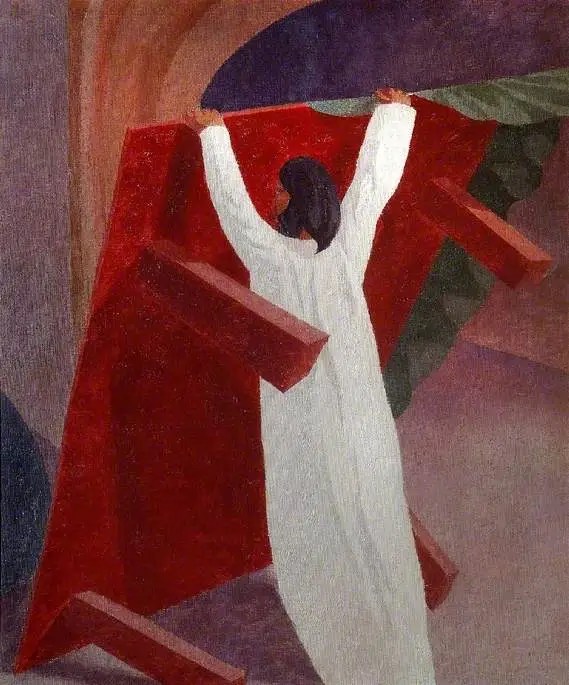
Christ Overturning the Money Changers’ Table, 1921. Stanley Spencer (British, 1891-1959)
Scripture Passage: John 2: 13-19 (20-22)
13The Passover of the Jews was near, and Jesus went up to Jerusalem. 14In the temple he found people selling cattle, sheep, and doves, and the money changers seated at their tables. 15Making a whip of cords, he drove all of them out of the temple, both the sheep and the cattle. He also poured out the coins of the money changers and overturned their tables. 16He told those who were selling the doves, “Take these things out of here! Stop making my Father’s house a marketplace!” 17His disciples remembered that it was written, “Zeal for your house will consume me.” 18The Jews then said to him, “What sign can you show us for doing this?” 19Jesus answered them, “Destroy this temple, and in three days I will raise it up.”
This passage is well-known to us probably not only for its significance but because of its absurdity (at least as we look at it in light of our society). After all, this is the usually-calm, always-loving, infinitely compassionate Jesus just making an absolute spectacle of himself. Now, to put it in context, it wasn’t like this flurry of activity was going on INSIDE the nave of the temple itself. The temple consisted of the very inner part, the holiest of holies, that, for the first-century Jewish tradition, would have been what held the dwelling of God. Then there was an outer part, the “worship space” if you will for those that were cleansed for worship. And then there was this outer, sort of “town square” full of activity and merchants. There was nothing WRONG with it. It wasn’t like they were selling doves on top of the altar or Starbucks from the Communion rail. And the “money-changers” were there purely for convenience, offering a service of exchanging the “uncleansed” coins for the acceptable ones. Again, nothing wrong or out of the ordinary was going on here. This was the way the society ran. This was the norm.
So, Jesus enters. I think that (literally) this was, as we understand it, Jesus’ way of cleansing the temple. Perhaps that outer part that was “acceptable” to culture had become a little too important. Perhaps, rather than merely a pass-through to get to what was important, it had become the central point itself. Rather than a way to prepare for worship, perhaps it had become a way of merchandising God. Or maybe this was Jesus’ way of waking us all up, reminding us that we have set our tables up in the wrong place. Maybe it was Jesus’ way of saying that we had it wrong, that God did not merely exist within the walls of the holiest of places but also beyond.
When this Gospel version by the writer that we know as John was written, it was at least late in the first century and possibly, it was early in the second century. Paul had written his letters and was long gone. The writers of the synoptic Gospels were gone (although, remember, even they weren’t written as it was happening. I can tell you that the writers were NOT following Jesus around like a gaggle of press writers.) And, more importantly, this temple would have been destroyed decades earlier in 70 C.E. during the Siege of Jerusalem. (The Temple has never been rebuilt. After the Muslim conquest of Jerusalem in the 7th century, the Dome of the Rock, or al-Aqsa Mosque, was built on the temple mount. That’s the gold dome that you see in all the pictures of the old city of Jerusalem. And even though Jews are now allowed to pray at the Temple Mount—actually the Western Wall, or Wailing Wall—the mount itself is under the administrative control of the Muslim Waqf.)
But for those of us in the Christian tradition, we claim to espouse that God is everywhere, that God does not just exist in the sanctuary or the church but rather is in our midst–everywhere. (Remember that little song you learned with the words “We are the church” …” the church is a people”?) We believe that the temple, itself, is not the place of God but that God dwells with us, indeed, IN us. Our lives are that metaphorical temple. Really? That would mean that our lives are not such that we are called to separate ourselves from the world. The culture going on around is not bad. The way our society runs is not evil. In fact, our culture and our society is overflowing with God. There is no longer a division between things “of this world” and “of God”. So, for those who believe, everything is full of God. So how do we look upon this place that is full of God? What reverence do we attach to our lives, our bodies, our home, our city, our nation, and our world? No longer can they just be a “pass through” to get to what we think is God. God is here, here in our midst.
Boy, that Jesus WAS a troublemaker! After all, we had everything neatly compartmentalized. We knew good and evil; we knew what was “of God” and “of this world”; we had the “secular” and the “sacred”, our “church lives” and our “work lives” all neatly separated. Really? Is that the way it is? Jesus never said that the world was bad. In fact, God so loved the world… (we are told). But Jesus turned the tables on us, reminding us that this way that we have separated things, this way that we have assigned value and worth of one over the other, is not the way we are called to be. Essentially, I think Jesus knew that from time to time, we would take our eyes off the ball, so to speak, and put the emphasis where it did not belong. That’s what this season of Lent does–it refocuses us on what’s important. Jesus knew that the love of things, the love of power, the love of control, and the acceptance of a system or a religion that values one person over another, and the attempt to keep things like they are would crucify us. But even that, God would oveturn. THAT is how much God loves the world.
So, whew…we’ve been doing a lot of breathing out. And here? Breathe out the ways of the world the way that you know them. In other words, breathe out the norms, breathe out the delineations, breathe out the way that some are in and some are out. And then breathe in the ways of the world. (What? That makes no sense.) God so loved the world…God loved the world so much, wanted the world to grow and change so much, wanted the world to be what it should be so much that God sent a part of God to help us figure that out. Breathe THAT in. See, Jesus didn’t turn the tables in the temple because he was angry. He didn’t turn them because the merchants were evil. Jesus turned the tables because the underside is just as important as the top. Jesus turned the tables because there was more to see. Jesus turned the tables because God doesn’t limit the world to what we know and doesn’t limit the Holy of Holies to what we do not. They intermingle. That’s the message. It’s messy and wonderful. Breathe out the world and breathe it back in. But look at it differently. See, God turns ALL the tables…over and over again. We are not called to compartmentalize or divide; we are called to see it all. Just keep going.
The day of my spiritual awakening was the day I saw—and knew I saw—all things in God and God in all things. (Mechtild of Magdeburg)
From the wilderness of Sin the whole congregation of the Israelites journeyed by stages, as the Lord commanded. They camped at Rephidim, but there was no water for the people to drink. 2The people quarreled with Moses, and said, “Give us water to drink.” Moses said to them, “Why do you quarrel with me? Why do you test the Lord?” 3But the people thirsted there for water; and the people complained against Moses and said, “Why did you bring us out of Egypt, to kill us and our children and livestock with thirst?” 4So Moses cried out to the Lord, “What shall I do with this people? They are almost ready to stone me.” 5The Lord said to Moses, “Go on ahead of the people, and take some of the elders of Israel with you; take in your hand the staff with which you struck the Nile, and go. 6I will be standing there in front of you on the rock at Horeb. Strike the rock, and water will come out of it, so that the people may drink.” Moses did so, in the sight of the elders of Israel. 7He called the place Massah and Meribah, because the Israelites quarreled and tested the Lord, saying, “Is the Lord among us or not?”
Life in the wilderness is, obviously, precarious. They have put their trust in God and in Moses and here they are in the middle of the desert, the hot sun beating down upon them. The parched surroundings reflect their parched bodies and their lagging souls. There is no water anywhere. It seems to many that God has all but deserted them. They had done exactly what they were told and now they thought they would surely die in the desert. And poor Moses. All he can do is listen to the complaining that is directed right at him. But what could he do? He can’t make water. He can’t command the skies to rain. He probably wishes that he could just run away. After all, whose idea was it to make him the leader anyway? He is surely questioning how he got into this mess.
This is not some sort of metaphorical thirst. They were thirsty–really, really, parched and dry thirsty; there was no water. Thirst is perhaps the deepest of human physical needs. What does it mean to thirst for the things you need the most? It’s hard for us in the Western part of the globe to even imagine. (As I write this, I actually got thirsty and went and filled a glass with filtered spring water from Kroger.) And yet, 780 million people lack access to clean and healthy water. That’s about 1 in 9 people in the world or about 2 1/2 times the population of the United States. Lack of access to clean water and sanitation kills children at a rate equivalent to a jumbo jet crashing every four hours. And, amazingly, an American taking a five-minute shower uses more water than the average person in a developing country slum uses for an entire day. Thirst is real.
But as we fill our recycle bins with plastic water bottles, what does this mean for us? For what do we thirst? Again, don’t think of it as metaphorical. It is real. Maybe it’s not physical, but it’s real. For what do you thirst? For security? For a life of ease and plenty? For things to just make a little more sense? Do you thirst for life as you’ve planned it? Do you thirst for righteousness? For justice? For peace? For meaning? How many of us simply thirst to be alive, truly alive, in the deepest depth of our being? Being alive is thirsting for God, thirsting for the one who can walk us through grief and shadows and even death and give us life. It means that we thirst for the one who thirsts for us. Thirsting is the thing that makes us real.
Dag Hammarskjold wrote in his journal the words, “I am the vessel, the draught is God’s. And God is the thirsty one.” God is thirsty. God’s love for each of us is so deep, so intense, so desiring our response that it can only be characterized as a thirst. God, parched and dry, thirsts for our thirst. So, is the Lord among us or not? God knows everything about you. The very hairs of your head are numbered. Nothing in your life is unimportant to God. God has always been with you, always loved you, and always yearned for you to come into the awareness of God’s Presence in your life for which we strive, that sense of needing something more in the deepest part of you, so much that it leaves you parched without it. And, ironically, it means letting go of the need to quench your thirst. Because it is thirst for God that this journey is about. Ironically, we are not questing to quench it but to live it, to open ourselves to the waters that hold God’s creative Spirit. To thirst is to be. To thirst is to know in the deepest part of our being that we need God. To thirst is to be alive.
I thirst for you. Yes, that is the only way to even begin to describe my love for you: I thirst for you. I thirst to love and be loved by you—that is how precious you are to me. I thirst for you. Come to me, and fill your heart and heal your wounds…Open to me, come to me, thirst for me, give me your life—and I will prove to you how important you are to my heart. Do you find this hard to believe? Then look at the cross, look at my heart that was pierced for you…Then listen again to the words I spoke there—for they tell you clearly why I endured all this for you: I thirst. Come to me with your misery and your sins, with your trouble and needs, and with all your longing to be loved. I stand at the door of your heart and knock. Open to me, for I thirst for you. (Mother Teresa of Calcutta)
So, what do we breathe out? Thirst? Need? Desire? No, breathe out the need to quench your thirst with those things that will never quench your thirst. And breathe in thirst. (Yes, this time, I really do mean it spiritually. Don’t quit drinking water. In fact, you probably need more than you’re drinking.) But let yourself thirst. Let yourself feel that thirst for faith, that thirst for God, that thirst for being in your deepest self. Do not be tempted to fill that thirst with easy answers or comfortable commentary. Do not let your thirst be assuaged with things that do not offer you growth and newness, with things that do not bring you closer to God. Let yourself get shaken up. Breathe in that thirst for the life God calls you too. It’s not easy; it’s uncomfortable; and sometimes you will feel that you don’t have everything you need. You don’t. That’s why you’re on this journey. It is a journey of unquenched thirst. Keep walking. Keep growing toward. Keep thirsting for God. That thirst is your faith. That thirst is your life.
After this, when Jesus knew that all was now finished, he said, “I am thirsty.”…Then he bowed his head and gave up his spirit. (John 19:28, 30b)
One needs to keep on thirsting because life grows and enlarges. It has no end; it goes on and on; it becomes more beautiful…[One] cannot be satisfied until [one] ever thirsts for God. (Alexander Baillie)






 Dancing to God