LENT 5B: This Talk of Death

Lectionary Passage:  John 12: 20-33:
Now among those who went up to worship at the festival were some Greeks. They came to Philip, who was from Bethsaida in Galilee, and said to him, “Sir, we wish to see Jesus.” Philip went and told Andrew; then Andrew and Philip went and told Jesus. Jesus answered them, “The hour has come for the Son of Man to be glorified. Very truly, I tell you, unless a grain of wheat falls into the earth and dies, it remains just a single grain; but if it dies, it bears much fruit. Those who love their life lose it, and those who hate their life in this world will keep it for eternal life. Whoever serves me must follow me, and where I am, there will my servant be also. Whoever serves me, the Father will honor.   “Now my soul is troubled. And what should I say—‘Father, save me from this hour’? No, it is for this reason that I have come to this hour. Father, glorify your name.” Then a voice came from heaven, “I have glorified it, and I will glorify it again.” The crowd standing there heard it and said that it was thunder. Others said, “An angel has spoken to him.”30Jesus answered, “This voice has come for your sake, not for mine. Now is the judgment of this world; now the ruler of this world will be driven out. And I, when I am lifted up from the earth, will draw all people to myself.” He said this to indicate the kind of death he was to die.

You can tell it’s getting closer.  As we move through these last weeks of Lent, the time seems to increase to warp speed.  It is almost more than we can take.  I mean, wasn’t it just a few months ago that we were talking about stars and the birth of a child?  Wasn’t it just a few weeks ago that we were following Jesus around Galilee as he built his ministry, as he spread the first real notion of hope that we had ever seen?  And now the talk turns to touble and death.  What are we to do with that?  And what is this thing about wheat again?

First, the wheat must die so that it can grow and bear more fruit.  This is sort of confusing if you do not know what wheat is.  Wheat is what is called a caryopsis, meaning that the outer seed and the inner fruit are connected.  The seed essentially has to die so that the fruit can emerge.  If you were to dig around and uproot a stalk of wheat , there is no seed.  It is dead and gone.  The grain must, in essence, allow itself to be changed.  What this tells us in that in order for something new to happen, in order for a “new” or “renewed” creation to come about, we must allow ourselves to be changed.

So what Jesus is trying to tell us here is that if we do everything in our power to protect our lives the way they are—if we successfully thwart change, avoid conflict, prevent pain—then at the end we will find that we have no life at all.  So why, then, is death so hard for us to talk about, so hard for us to deal with in our life?  In fact, we do everything that we can to postpone it or avoid it altogether.  So maybe that’s why the cross bothers us so much if we really think about it.  Oh, we Christians can focus on the Resurrection and just let the cross somehow disappear into the background, covered in Easter lilies.  But then we have forgotten part of the story.  We have forgotten that God does not leave us to our own devices, does not leave us until we have “figured it out”, does not wait in the wings until we have covered it all up with Easter lilies.  God is there, in the suffering, in the heartache and despair.  And God in Christ, there on the cross, bloodied and writhing in pain, is there not in our place but for us and with us.

Whether you believe that God sent Jesus to die, or that human fear and preoccupation with the self put Jesus to death, or whether you think the whole thing was some sort of colossal misunderstanding…the point of the cross is that God took the most horrific, the most violent, the worst that the world and humanity could offer and recreated it into life.  And through it, everything—even sin, evil, and suffering is redefined in the image of God.  By absorbing himself into the worst of the world and refusing to back away from it, Jesus made sure that it was all put to death with him.  By dying unto himself, he created life that will never be defeated.  And in the same way, we, too, are baptized into Jesus’ death and then rise to new life. 

Yes, in these weeks we turn to death.  It is the way that we turn to life.  And life is the whole reason we started talking about stars and the birth of a baby anyway, right?  After all, without the cross, I think the manger is just a feed trough. All of life makes sense in light of the end.  Brazilian Catholic Archbishop Dom Helder Camera once said “why fear the dark?  How can we help but love it when it is the darkness that brings the stars to us?  What’s more:  who does not know that it is on the darkest nights that the stars acquire their greatest splendor?”  


So, on this twenty-seventh day of Lenten observance, think about what the cross means to you.  What does the cross call you to do?  Who does the cross call you to be?

Grace and Peace,

Shelli  

Drought

It may seem a little strange to talk about drought after all the torrential rains we’ve had this week, but the effects of last summer’s drought are just now starting to come to be.  Estimates are now at $7.6 billion in losses to forestry and livestock.  So, needless to say, last year’s drought is deep and everlasting.

I have to confess that I thought of the notion of “drought” because last night, I could not for the life of me, decide what to write about for today.  I felt like I was in a “drought”.  So, why not go with it?  Lent is often characterized with drought.  We practice giving up and letting go.  Our worship is more reserved, void of celebratory “Alleluia’s” (although if we were REAL Lenten practicioners, we would live in drought during the week and then Sundays would still be celebratory!).  To a certain degree, we who have much have to force ourselves into a 40-day season of drought.  Why?  Because it makes us realize who we are and what we need.  It makes us vulnerable, open, receptive.  It gets us out of ourselves.  (It gets us away from what we WANT to do, what we think we SHOULD do, and listen…)  It shows us what we need.  Besides, maybe a little drought now and then does us good.  After all we are drowning–drowning in work, drowning in our home lives, drowning in our relationships.  We are drowning with too much to do and too much to pay.  We are drowning in an image of someone whom we are not.  And so, God gave us thirst; God gave us drought.  Because when we thirst, we will look for what quenches our thirst.  When our need is the highest, we will reach for something else.

I just had my crepe myrtles in the backyard trimmed.  And once everything was cleared away, I realized that they had done what so many trees had done around us last summer.  Thirsting and unable to quench their need in the deepest part of their being, they took their roots, their very foundation, and began to reach up and out, spreading themselves along the flowerbed.  (And interestingly enough, even joining themselves with other trees, as if they are holding hands through the turmoil.)  Even trees realize when they cannot fend for themselves.  It’s a shame we have such difficulty doing the same.

So, on this twenty-sixth day of Lenten observance, think about what makes you feel like you’re drowning.  And then think about what it is for which you thirst.  And then thirst…

Grace and Peace,

Shelli

LENT 5B: Re-Ordering

Lectionary Passage:  Hebrews 5: 5-10
So also Christ did not glorify himself in becoming a high priest, but was appointed by the one who said to him, “You are my Son, today I have begotten you”; as he says also in another place, “You are a priest forever, according to the order of Melchizedek.” In the days of his flesh, Jesus offered up prayers and supplications, with loud cries and tears, to the one who was able to save him from death, and he was heard because of his reverent submission. Although he was a Son, he learned obedience through what he suffered; and having been made perfect, he became the source of eternal salvation for all who obey him, having been designated by God a high priest according to the order of Melchizedek.

The order of who?  Melchizedek is mentionted twice in the Old Testament Scriptures–once in Genesis and then again in Psalm 110.  He was a priest of the Most High in the time of Abraham.  The name means “righteous king” or “King of Righteousness.”  Some have claimed that these passages refer to a literal human; others claim that it is a priestly order superior to even the Levitical priests.  But it’s not an apostolic designation that is handed down through the church.  It is an eternal one.

Essentially, here, it probably refers not to a “priestly” order of the world but rather an ongoing continuation of God’s relationship in humanity.  In Genesis, Melchizedek came to the side of Abraham when Abraham needed help the most.  And Abraham is blessed and offered bread and wine.  This is God’s plan.  God desires to be in relationship with humanity. And as part of that relationship, we, too, are brought into this ongoing priesthood.  We, too, are blessed and offered bread and wine.  And as priests of this highest order, we serve each other.  We enter relationship with humanity just as God has entered humanity in the form of Christ.  This is the order into which we are born, into which God brings us to be.  And this is the order that we fully enter, relinquish our perceived self, and emerge new and recreated.  This is the highest order of the priesthood.  And this is the one to which we are all invited.

Iraneus (2nd century bishop in Gaul) is supposed to have claimed that “the glory of God is humanity fully alive.”  What does that mean?  What does that mean to be “fully alive”?  I think it means that we embrace everything that God has given us to make our lives be what they are called to be.  That means that we all have gifts, that God calls us all, that we all have a part in building and being the Kingdom of God.  Our only hope of becoming “fully alive” is a humanity, a whole humanity, “fully alive.”

But this is dreadfully hard for us.  Face it–we are a hierarchical people.  We want whatever is due us.  We operate based on tenure rather than gifts, youth rather than wisdom, and power rather than calling.  But, despite what we try to project onto the Creative force that is God, God is not hierarchical.  There are not levels of God’s love or classes in God’s Kingdom.  And, Dante notwithstanding, I don’t even think that there’s an “either / or”.   (What if we someday find that Judas and Brutus are right there with the rest of us?)

The thing is, this “order of Melchizedek” is not hierarchical.  It is an order of those who are called.  It is an order of all of us.  We are all moving to perfection in Christ.  And perhaps the goal is not to reach the height of it all, but to reach the point at which we are fully alive, the point at which we realize that we are part of a whole and the whole is the Kingdom of God.  It is a new order, something we’ve never seen before.  So open your minds and open your hearts and quit trying to get ahead!

So on this twenty-fifth day of Lenten observance, think about what it means to be “fully alive”.  What is is that “gives you life”?  And what is it that gives your neighbor life?  Do something to bring life!

Grace and Peace on this Lenten Journey,

Shelli

Impersonalization of Faith

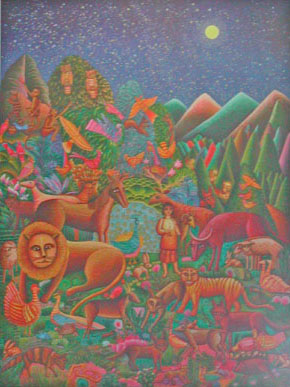
“The Peaceable Kingdom”
John Swanson, 1994

This journey of faith is a personal one, right?  Isn’t that what we’re told?  We’re suppose to find some way to connect to God, some way to find our own path to God, some way to express our own faith.  We are told that we’re supposed to have a personal faith in Jesus Christ.  And so we spend our time to trying to find our way, trying to find that one thing or that one way that makes us feel the most connected to God, makes us feel like we’re finally once and for all getting this faith thing figured out.

But ARE we called to a personal faith?  ARE we called to “find our own way?  I thought we were called to make disciples, to love one another, and to put down our lives.  Those don’t really sound all that individual and personal, when you really think about it.  They sound like community.  They sound like connection.  They sound like Communion.  We are called to be the Body of Christ.  It’s hard to do that by yourself.  I really do think that God envisioned us together.  Perhaps God even envisioned this bantering and this arguing and even this war of words and wits that so many of our religious denominations (including my own United Methodist one) are experiencing.  Maybe it’s part of what we’re meant to do.  It’s painful; it’s hurtful; it sometimes pulls us apart. 

We all have our own vision of what God’s Kingdom looks like.  I know I do.  I envision a world where all of us are welcomed, all of us are fed, and all of us are valued for the gifts that God has placed in each of us.  But do I?  Do I welcome those with whom I disagree?  Do I feed those with whom I am uncomfortable?  And do I truly value those gifts that God has placed in those persons that have a vision that is different from mine?  I don’t think that unity is about sameness.  I’ve come to think that it’s not even about agreement.  Unity has more to do with recognizing that the Kingdom of God, the Body of Christ is bigger than any one group, or one view, or one way of experiencing God.  It has to do with leaving the door open, with sensing that there’s something more, something beyond what we think and what we believe.  And together in faith, we will have to discern when we are called to be patient and when we are called to be persistent, when we are called to be open to moving and when we are called to stand firm, and, finally, when we are called to go into the wilderness, into the unknown and face our demons and prepare ourself for what is to come, and when we are called to go as a people to Jerusalem.  Perhaps this Lenten journey is a call not to strengthen our faith but to impersonalize it and realize that we are called, together, to be the Body of Christ.

So on this twenty-fourth day of Lenten observance, get out of yourself.  Impersonalize your faith a bit and open yourself to someone else on this journey.

Grace and Peace on this Lenten Journey,

Shelli

Mapquest

Houston Map, c. 1890

I’ve always had some level of fascination with maps.  What an amazing thing to think that beginning as early as 1,000 years before the birth of Christ, cartographers would lay down on stone or paper or, today, even computer images a depiction of the world that they saw.  In truth, part of my fascination comes from sheer unadulterated dependence on maps to get to places where I’ve never been before.  For you see, I have very little sense of natural direction.  Once I turn a couple of corners, I really can’t tell you in what direction I’m heading.  It just doesn’t happen.  Hence, my fascination with the fact that not only can someone find their way somewhere but can then depict it in a way that can lead even me to the same place.

It is amazing to me that we can look at a map and see things pretty much the way they are—interstates, state roads, farm-to-market roads, railroad tracks, rivers, bayous, even county lines and airports.  So we can follow this detailed map that someone has drawn and get to that place that we need to be.  A map will give you a view of the world that will enable you to go places that you’ve never been.  So you follow the map, knowing that you’re nearing your destination.  The interstate that you’re on is pretty true to scale.  The exit onto the smaller farm-to-market road is exactly where the map says.  But then you start to see things that aren’t on the map—schools, stores, county seat buildings, town squares, houses, dirt roads, smaller creeks.  (My Mom and I often take a trip to Fredericksburg and on the way we cross over Woman-Hollerin Creek—not on the map—but something that has become a humorous and important landmark for us to find our way.)  And all along the road are these smaller bodies of water over which someone has at some point built a bridge—unimportant, even non-existent, according to the map, but without which the journey would stop.  Because, you see, once we get to a place, our view starts to become bigger and more encompassing than what is possible to show on a map.  We begin to sense the familiar, perhaps even creating our own landmarks along the way.  We move from being dependent solely on what someone else has told us to our own view of what surrounds us.

But go a step farther.  We’re only moving through this place.  There are things that even we cannot see.  We do not see the group of smiling, rowdy six-year old girls in the first house past the filling station celebrating a birthday by wearing paper dresses and decorating cupcakes.  We do not see the little boy crying on the porch behind the next house because his intoxicated father hit him and threw him outside for accidentally spilling the whole bottle of bourbon on the living room rug.  And we do not see the elderly woman sitting alone, missing her children and grandchildren and desperately still grieving over the loss of her husband and her sister over the last six months.  The map will not show us that.  Driving through will not show us that.  The only way to see these things is to become part of them, to actually experience them, to stop and share one another’s lives, to realize our shared experiences and our shared history with each other.  That is the only way to broaden our view enough to see the world.

You know, Christianity has given us a wonderful map, a foundation on which our lives can be built, a tradition of belief that has stood the test of time.  But maps and signs are not what grow our faith.  That is not enough.  A map will only get you to the point where you need to start being, to the place where you have to start seeing.  And at that point, we begin to walk the road.  We begin to live our faith through rituals and liturgy, through Scripture and tradition, through prayer and discipline.  We begin to see those things along the road, those things that make up this journey.  And we also begin to see those things that influence us and pull us away from the road on which we need to be.  But even that is not enough.  For even though our eyes have been opened, we are limited by our own view of the way the world is, by our own personal experiences that affect how we look at things.

So it is on this Lenten journey that we hear the call to change our view, to a new way of seeing and a new way of being, to a way of seeing beyond our view, even beyond what we expect to see.  It is a way of seeing the world in an unleavened way.  Marcel Proust says that “the true voyage of discovery does not involve finding new landscapes but in having new eyes.”  Those new eyes can only be attained through our experiences with others, for it is through others’ eyes and our shared experiences that we truly start to see things as they really are.  And seeing our lives through others enables us to see God through our own lives.   We are not called to just follow the map or to walk through life looking only at what appears to be.  Rather, we are called to see as Christ sees.  And the only way to do this is to experience the world through others’ eyes, to open our lives and our hearts to others with a sort of radical, unchecked, even risky hospitality. We cannot just drive by and look at the houses on the road.  It is what is inside that really counts.  We have to be willing to enter the doors of others’ lives and be just as willing to invite them into ours.  We have to open our eyes to the needs and the experiences of others and truly receive each and every one in the name of Christ. It is entering and experiencing the lives of others and inviting them to experience ours.  It is taking the hand of someone else and offering healing in the name of Christ, that they, too, might clearly see.

Lent calls us to see the world for the first time in a new way, not as something that is, but as something that could be.  Lent calls us to see the world with Easter eyes, full of promise and hope and eternal life.  Lent calls us to step back and look at the world the way God envisions it, as brothers and sisters walking together in peace and harmony and love for each other, not ignoring diversity of lifestyles, cultures, races, views, and even faiths, but embracing them as a part of the landscape of this incredible earth that God created.  The map that we’ve been given only gets us to the place.  It is through our experiences with Christ and our experiences with each other, though, that we will see the way to go and that our eyes will be opened so that we might finally see everything clearly.

K…I guess this can count as one of those “extra” posts I promised!…So, as part of this Lenten journey, think about the map you follow.  What is on the map?  What does it not include?  Where does it call you to look with new eyes?
Grace and Peace on this Lenten Journey,

Shelli


LENT 5B: Heart-Wrenching

Lectionary Passage:  Jeremiah 31: 31-34
The days are surely coming, says the Lord, when I will make a new covenant with the house of Israel and the house of Judah. It will not be like the covenant that I made with their ancestors when I took them by the hand to bring them out of the land of Egypt—a covenant that they broke, though I was their husband, says the Lord. But this is the covenant that I will make with the house of Israel after those days, says the Lord: I will put my law within them, and I will write it on their hearts; and I will be their God, and they shall be my people. No longer shall they teach one another, or say to each other, “Know the Lord,” for they shall all know me, from the least of them to the greatest, says the Lord; for I will forgive their iniquity, and remember their sin no more.

The days are surely coming.  Hmmm!  When would that be that the new covenant will come to be?  We Christians like to put on our post-Resurrection lens and read this with the view of Jesus, the Cross, and the empty tomb in our mind.  Ah…we think, Jesus, Jesus is the new covenant.  Jesus is the covenant that is written on our hearts.  Jesus is the one. Is he?  Are the days surely here?

OK, be honest, have you looked around?  Have you listened to the news today?  (Actually I haven’t had time today, but I can guess!)  BUT, “the days are surely coming!”  Now don’t get me wrong.  I DO believe that Jesus is an embodiment of the New Covenant, the embodiment of God’s Promise, the embodiment of The Way.  And yet, the idea of this being “written on our hearts”, of this New Covenant becoming not just something to which we aspire, not just something by which we try to abide, but something that is actually part of us just downright eludes us.  This covenant is something that should be part of our body, our soul, our heart, our mind, our very being.  The promise is certain, but it doesn’t end there.

Think about it.  Read the words.  This is not about God just tossing some words out there in the hopes that someone will be curious enough or scared enough or ready enough to pick them up.  God is much more nuanced than that.  Rather, God’s vision is that they are written on our hearts, permanently tattooed, part of our very being.  It is as if God is remaking us from the inside out.  Maybe that’s our whole problem.  Maybe we’re making ourselves backwards.  Maybe we’re trying to do the right things and say the right things and fast and pray and live our lives with the hopes that our hearts will be made right.  And in the meantime, God is inside, with heart-wrenching fervor, remaking us from the inside out and waiting patiently for us to stop and notice.

So on this twenty-third day of Lenten observance, just sit.  Listen to your heart.  What is your heart telling you?  After all, the words are there.  And then go tell someone what your heart is telling you.

Grace and Peace on this Lenten Journey,

Shelli

And in the department of true confessions, sorry about the posts (or non-posts!) for the week-end.  It got away from me, so you’ll get “bonus posts” on today or tomorrow!  Shelli

LENT 4B: The Elephant in the Room (or the Sanctuary!)

Lectionary Passage:  John 3: 14-21
And just as Moses lifted up the serpent in the wilderness, so must the Son of Man be lifted up, that whoever believes in him may have eternal life. “For God so loved the world that he gave his only Son, so that everyone who believes in him may not perish but may have eternal life. “Indeed, God did not send the Son into the world to condemn the world, but in order that the world might be saved through him. Those who believe in him are not condemned; but those who do not believe are condemned already, because they have not believed in the name of the only Son of God. And this is the judgment, that the light has come into the world, and people loved darkness rather than light because their deeds were evil. For all who do evil hate the light and do not come to the light, so that their deeds may not be exposed. But those who do what is true come to the light, so that it may be clearly seen that their deeds have been done in God.”

It’s the “elephant in the room”, so to speak, this third verse of the sixteenth chapter of the Gospel According to the writer we know as John.  It’s on street corners and marquis, T-Shirts, football helmets, and sometimes painted on faces at sporting events.  It is often taken as the quintessential “insider” verse, the badge of honor for the believing Christian.  It is often interpreted as “God came; God came to save me and the rest of you are on your own.”  But keep in mind that this Gospel was written later than the others.  To be a follower of Christ, a person of The Way, was just downright hard.  You were NOT an insider.   You were NOT the Christian majority that we so comfortably enjoy. You were part of a fledgling and sometimes persecuted minority that was just trying to hold it together.  So, these words would have been words of encouragement, words of strength, a way of defining who they were as a Jewish minority.  It was a way of reminding them why they were walking this difficult (and sometimes dangerous) path—because of the great Love of God. 

But in the hands of the 21st century Christian majority in our society, these words sometimes become weapons.  They turn into words of exclusion, designating who is “in” and who is “out”, who is acceptable in “honest society” and who is not.  Well, first of all, nowhere in the Gospel are we the ones called to make that determination.  And secondly, look at the whole context of this Gospel by the writer known as John.  It starts out with Creation.  It talks about this great Love that is God, a love that was there from the very beginning.  And it proclaims that God came into the world to save the world.  So how did we interpret this that God had quit loving some of us, that some part of humanity was more worthy of God’s love than another?

The Truth (that’s with a capital T) reminds us that God offers us Life, that God, in effect, DID come into the world to save us—mostly, I would offer, from ourselves, from our misdirected greed, our disproportionately selfish ambition, and from our basic desires to be something other than the one who God has called us to be.  God desires this for everyone.  God really does want to save the world from the world.  And so the Kingdom of God seems to us to sometimes be inching in far too slowly rather than pervading our world.  I think that the world DOES need to somehow be moved to believe, DOES need to somehow begin to see itself anew.  After all, we need to overcome ourselves, overcome all of those misdirected desires.  But that will never happen if the cross is raised as a weapon.  SURELY, we get that it’s something other than that!  Remember, God redeemed it.  God took something so loathsome, so foreboding, so, for want of a better word, evil and turned it into Life.  God is doing the same for the world.  God loves the world so incredibly much that God would never leave us to our own devices (or even, thankfully, to those of who count ourselves as well-meaning believers!).  Instead, God comes into the world and offers us life; indeed, loves us so much that God offers us recreation, redemption, and renewal.  Don’t you think THAT’S the story?  It’s not about who’s in or who’s out.  It’s about Love.  It’s a promise that there’s always more to the story than what we can see or fathom or paint on a sign.  To say that we believe does not qualify us for membership; it leads us to The Way of Life.

My, my…this sanctuary is going to get crowded if we open the doors to everyone!  How about that? Perhaps it’s time we deal with the elephant taking up all this space so there will be room for all!

Wow!  Do you believe that this Season is half over?  We have spent a lot of time in these twenty days exploring our own spirituality.  What if in the next twenty days, we explore what that spirituality means, what it means to reach out to others, to BE who God calls us to be.  Let us start on this twenty-first day of Lenten observance by thinking about what that means to open our doors to all.  What comforts and expectations would we have to drop from our understandings?

Grace and Peace on this Lenten Journey,

Shelli