Who Do You Say That I Am: Servant

“Christ at Rest”
Hans Holbein the Younger, 1519
Berlin State Museums

Scripture Passage:  Philippians 2: 5-11
Let the same mind be in you that was in Christ Jesus,who, though he was in the form of God, did not regard equality with God as something to be exploited, but emptied himself, taking the form of a slave, being born in human likeness. And being found in human form, he humbled himself and became obedient to the point of death— even death on a cross. Therefore God also highly exalted him and gave him the name that is above every name, so that at the name of Jesus every knee should bend, in heaven and on earth and under the earth, and every tongue should confess that Jesus Christ is Lord, to the glory of God the Father.

We are accustomed to hearing Jesus described as a servant, even a suffering servant.  But, to be honest, we sort of cringe.  We don’t like the words “servant” or “slave”.  They uncomfortably remind us of that horrible centuries-long blotch on our nation’s [not so]-otherwise pristine history.  And the idea of our being asked to follow Jesus down that road is probably even more uncomfortable.  It goes against our nature.  We like to be in control.  In fact, we pride ourselves on being in control of our lives.  And now we are told that taking on the form of a slave is the way that one is exalted.  This just doesn’t make sense.  Surrendering is not the way you win or get ahead, is it?

This passage depicts “being in the form of God” as opposite from “being in the form of a slave”.  Essentially, Jesus emptied himself and became dependent upon God, fully surrendered, a servant of God.  He became fully human by surrendering himself to the Divine.  He surrendered self-advancement and instead became fully human, fully made in God’s image, became what he was called to be by God.  He surrendered himself and descended all the way to Golgotha.  But Jesus was not a victim.  He surrendered himself.  That is the difference between this blotch that we think of when we hear the word slavery and the notion of Jesus (and us) being called to become a servant.  God does not force or coerce us into slavery.  God does not take away our control, take away our choices, take away our ability to walk freely wherever we desire to go.  God doesn’t even, to be honest, tell us how we are supposed to believe or how we are supposed to understand God.  The Divine does not do that.  In fact, true humans do not do that.  That is done by us when we allow ourselves to become and act less than human, inhumane, when we become less than who God calls us to be.

So Jesus, with all knowledge of what it entailed, with every molecule of his being, freely and deliberately chose to surrender, chose to forego those things that trap us humans, that convince us that we’re something different than we are, that, at their worst, compel us to be less than human.  And in choosing to relinquish control to God, Jesus was exalted.  And we are called to do the same.  We are created in the image of God.  But an image is not “like God”.  (We are not now nor will we ever be “godly”.)  An image of a thing is not the thing.  But a good image reminds us of the thing itself.  Jesus as fully human surrendered his life so that others might see God.

So, then, how does that help us?  How can we relinquish control to God and still stand firm in our belief, still be persistent in our faith, still be strong in our passion for peace and justice for all?  Shhhh!  Just let go.  God is calling you to do all those things.  But they’re not about you; they’re about God.  God does not need us to work for God.  God is perfectly capable of it all.  But God’s greatest desire is that we choose to follow, choose to become the people of God, choose to be with God in every step of our journey.  God’s desire is that we freely choose to follow the Way of Christ.  It probably has a lot more to do with attentiveness than anything else.  To whom do you pay attention?

So, on this thirty-third day of Lenten observance, be attentive.   whom do you pay attention?  Who do you follow?  What in your life is more important than being with God?  Then let it go…the time is almost here.

Grace and Peace,

Shelli

Who Do You Say That I Am: Healer

“The Healing of the Paralytic”
The oldest known depiction of Jesus
from the Syrian city of Dura Europos
c. 235

Scripture Passage:  Matthew 12: 22-23
Then they brought to him a demoniac who was blind and mute; and he cured him, so that the one who had been mute could speak and see.  All the crowds were amazed and said, “Can this be the Son of David?”

We know of the plethora of stories that depict Jesus as a healer.  In fact, more healing stories are told about Jesus than any other figure in the Jewish tradition.  We like that image, even if we don’t fully understand it.  Most of us have to admit that we’re a little cynical, if not downright distrusting, of stories of miraculous healings.  There’s got to be an explanation, right?  There’s got to be some way to make this make sense and fit into our understandings of how the world works.

And yet, healing is not “fixing”.  The Scriptures that depict healings don’t really say that things were put back the way they were before or the way society assumes they should be.  I think maybe we just read that into them.  In the passage above, the word “cured” is used.  The Greek from which that was translated is therapeuo (rather than therapeia), which can mean cure, heal, or serve. Well, that’s interesting.  Maybe Jesus didn’t “cure” him at all the way we think of “curing”.  Maybe Jesus “served” him, paid attention to him, engaged him, treated him respectfully for possibly the first time in the person’s life.  And maybe it was that simple act of caring, of treating someone like a person rather than an illness or even as “less” than a person that brought healing and wholeness and let him see and hear for the first time in his life what life really held.

To be honest, I don’t think we overestimate Jesus’ ability to heal; I think we water it down, trying to make it understandable and manageable.  I think we try to limit it to literal “fixing” when it’s something much, much more profound, much, much more needed in our world.  God never promised that the world would be fixed.  Suffering abounds.  But God did promise that we would never be alone as we journeyed through it and that, ultimately, all of Creation would be redeemed, would be made new.  It is the story of our faith.  It’s ultimate depiction, the ultimate “healing” story is the story of The Cross, the story of God taking the most horrific, the most despicable, the most inhumane that humanity offers, and offering instead healing and life, offering not a “cure” to death, but a recreation of it.  Jesus’ death was not “fixed”; it was redeemed, made something different, remade into something new–life.

Back to our little word study, the word therapeuo is found again in The Book of Acts (Acts 17: 24-25) but this time the NRSV translates it as “serve”:  “The God who made the world and everything in it, he who is Lord of heaven and earth, does not live in shrines made by human hands, nor is he served by human hands, as though he needed anything, since he himself gives to all mortals life and breath and all things.”

So, on this thirty-second day of Lenten observance, use your imagination.  Imagine what “healing”, what newness, God in Christ offers you.

Grace and Peace,

Shelli

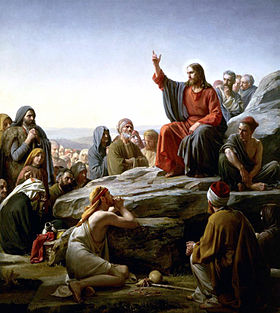
Who Do You Say That I Am: Teacher

“Sermon on the Mount”
Carl Bloch, 19th century

Scripture Passage: Matthew 22: 36-40
“Teacher, which commandment im the law is the greatest?”  He said to him. “‘You shall love the Lord your God with all your heart, and with all your soul, and with all your mind.’  This is the greatest and first commandment.  And a secon is like it: ‘You shall love your neighbor as yourself.’ On these two commandments hang all the law and the prophets.”

I don’t think any of us dispute that Jesus was a teacher.  He was steeped in Scripture and rich with story.  Our canon depicts him as one that people literally followed around to hear and then stayed and hung on every word, sometimes, apparently, even forgetting to bring food to eat!  And yet it wasn’t like Jesus was toting around numerous commentaries or dragging a white board around with him.  I’m pretty sure that Jesus didn’t need my trusty little Sunday-morning tote bag crammed full of everything that I will need for the morning along with numerous books with little sticky notes in them where I’m supposed to read somewhat profound thoughts.  And think about it, did Jesus EVER ask the Disciples to memorize something?  The notion of Jesus as teacher was, it seems to me, more engaged.  I don’t envision Jesus as a lecturer.  I think he probably wanted to hear what people had to say.  In fact, I think Jesus was craving knowledge himself.  Surely he wasn’t plunked down on this earth, Holy Spirit aside, with a full knowledge of everything that was needed to be known.  I mean, really, how boring!  I don’t think God meant for Jesus to walk this earth to spout knowledge at us; I think that Jesus came to show us what it meant to be a disciple, to be a learner, to be a student.

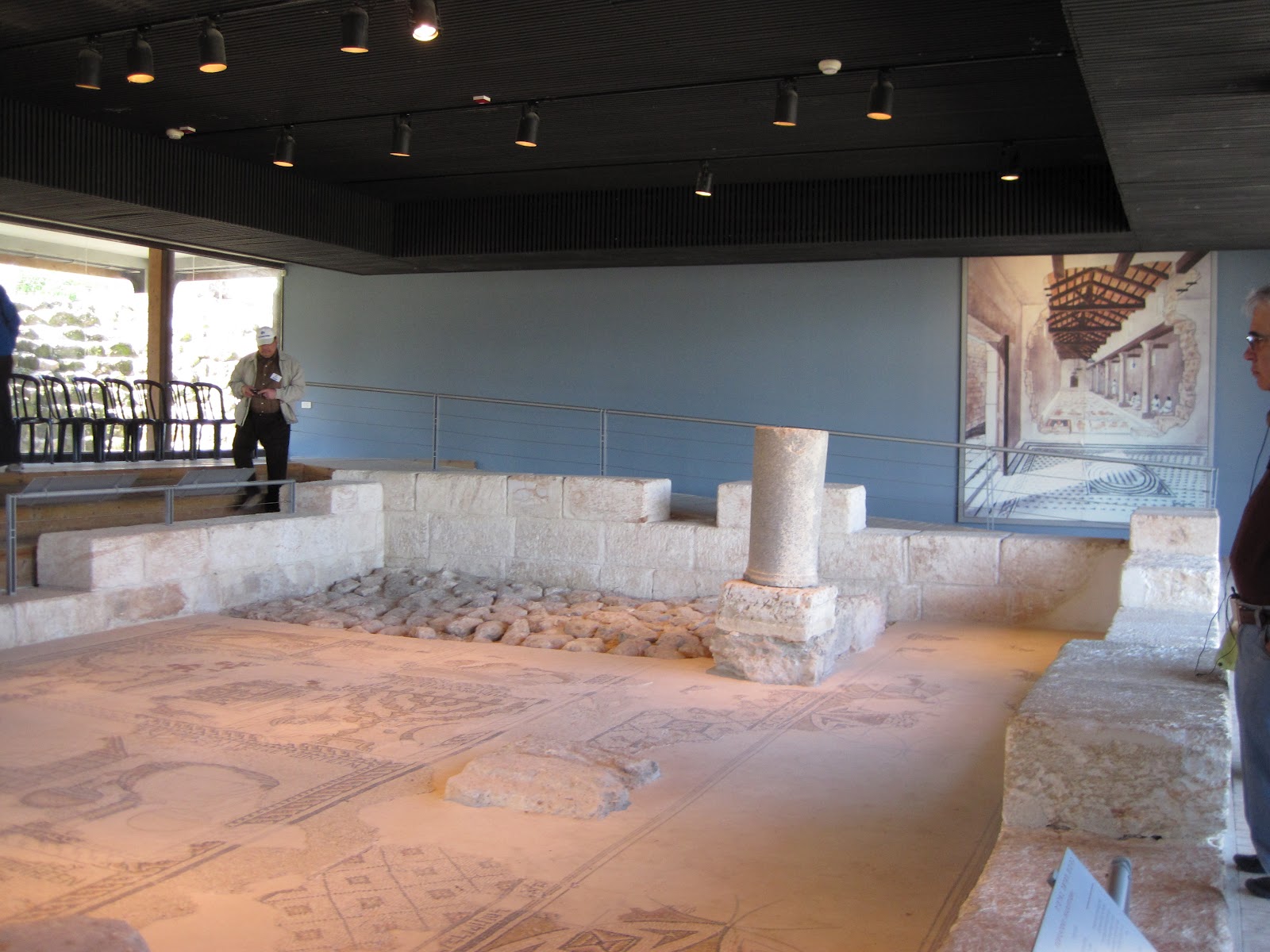
Ruins of Synogogue
Sepphoris (Tzippori) Israel

So, what do you think Jesus was doing with those famous missing years?  What sort of life did he have between the manger and the Jordan, between birth and baptism?  Perhaps he was learning, perhaps even going through the somewhat arduous training to be a rabbi, to be a teacher, to be an authority on the Torah and what it means for one’s life.  Perhaps this training began early, early in his life.  In fact, one of the capital cities of first-century Galilee was Sepphoris, the “jewel” of Galilee.  Nazareth, which didn’t have much at all (remember, nothing good comes from Nazareth) was just three or four miles away.  And in the ruins of that city, guess what’s there?  This thriving Jewish-Roman city was the site of a rabbinical school.  Can’t you just see young Jesus sitting at the feet of the master teachers soaking in everything he could?  (So much, in fact, that the famous visit to Jerusalem as a child seemed only natural for him to stay behind and hang on every word that the rabbis had to offer.)

Jesus did not come to set us straight or to fill us with knowledge.  Jesus came to show us how to be a disciple, to show us how to thirst for knowledge and understanding, to show us how to thirst for God.  I’m pretty sure that Jesus taught sans lesson plans.  Instead, he engaged with those around him that they might know what it means to thirst for the Divine, to want so badly to know God that they would become a disciple, a learner, a student of the Divine.  William Arthur Ward once said that “the mediocre teacher tells; the good teacher explains; the superior teacher demonstrates; and the great teacher inspires.”  So, Jesus, the master teacher inspired us to be disciples.  Go and be filled…

On this thirty-first day of Lenten observance, be inspired by the master teacher.  Become a learner.

Grace and Peace,

Shelli

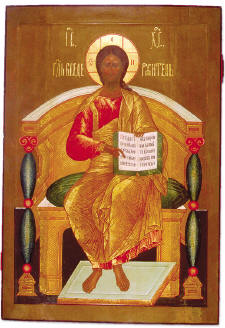
Who Do You Say That I Am: Lord

“The Lord Almighty”
Russian Icon, c. 1900

Scripture Text:  Luke 6:46-49
“Why do you call me ‘Lord, Lord,’ and do not do what I tell you? I will show you what someone is like who comes to me, hears my words, and acts on them. That one is like a man building a house, who dug deeply and laid the foundation on rock; when a flood arose, the river burst against that house but could not shake it, because it had been well built. But the one who hears and does not act is like a man who built a house on the ground without a foundation. When the river burst against it, immediately it fell, and great was the ruin of that house.”

Who do you say that I am?  What does it mean to call Jesus Lord?  The title “Lord” is a funny thing.  We Americans are not really used to it, so, to be honest, we probably don’t even think about what it means.  A “lord” is a designation of a ruling class.  It is used for someone who has power and authority over others.  In a feudal system, the lord was essentially the ruling landowner, one who had control over others simply by the fact that they were probably in some way indebted to the landowner.  The power, the control, was not bestowed by loving subjects but rather was probably coerced through economic subjugation.  The title “lord” was a top-down designation. 

And yet, we freely used the word “Lord” to talk about God, to talk about Jesus.  Titles are funny things.  So are we using the term as a freewheeling synonym for God–God, Lord, YHWH, etc.?  Or are we designating Jesus as “Lord” to make him sound more to us like God (because this whole fully human-fully divine thing is difficult enough for us to grasp)  But, really, who DO we say that Jesus is?  What is the Lordship of Jesus Christ?  After all, if it’s a feudal system that coerces us into its realm, then faith as we understand it doesn’t even exist.  There is not “choice” there.  But it’s also got to be more than a sort of fan club.  (OK…here’s an aside…I just went on Facebook and typed in “Jesus Christ’.  Apparently, Jesus has a Facebook page, several friends, and 4,389,465 “likes”.  Well, there you go…)  But, seriously folks, did you read the Scripture?  We do not enter the Lordship of Jesus Christ by signing up (or “friending”) Jesus. 

The coming of God into our midst in the form of Jesus Christ redefined a lot of things.  The idea of “Lord” and “Lordship was one of them.  I do not think that God desires to coerce us into anything.  God desires us to be in relationship with the Divine, to be a part of this community that, for want of a better word, we have called a lordship.  But just calling Jesus “Lord” is not enough.  Entering this Lordship is about becoming who God calls us to be as children of God.  It is about BEING a follower of Christ, in thought, word, and deed.  And it is about our choosing to do that, choosing to follow Christ, choosing to be Christ, to BE this Lordship in the world.  The Lordship of Jesus Christ is God’s active self in the form a living and new humanity.  We are not members of a fan club (this is not “Team Jesus”!); we are part of a Lordship that reigns over all of Creation.  It is a Lordship that we do not enter but one that we become.  To say that Jesus is Lord means that we affirm that we are no longer who we were before.  We are part of God’s work–part of the doing, part of the welcoming, part of the affirming, part of the loving–in the world.

So, who do you say that I am?  Then, I guess we need to get to work.  And THEN you can post what you did on Facebook if you feel like you need to!

On this thirtieth day of Lenten observance, ask yourself the question, “Who do you say that Jesus is?”, and then ask “And what does being a part of the Lordship of Christ call me to be, call me to do?

Grace and Peace,

Shelli

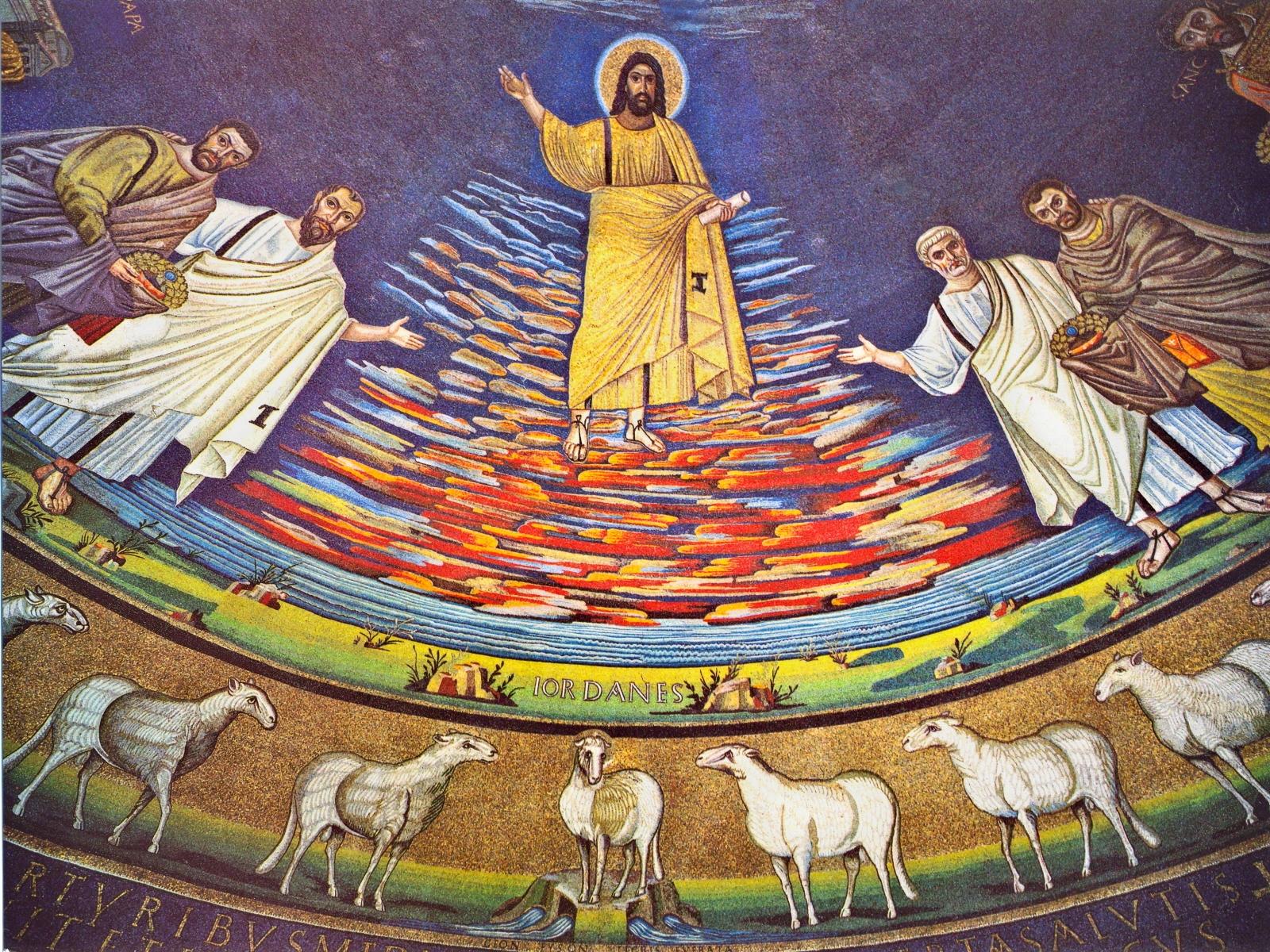
Who Do You Say That I Am: Messiah

7th Century, Unknown artist

Scripture Passage:  Matthew 16: 13-16
Now when Jesus came into the district of Caesarea Philippi, he asked his disciples, “Who do people say that the Son of Man is?” And they said, “Some say John the Baptist, but others Elijah, and still others Jeremiah or one of the prophets.” He said to them, “But who do you say that I am?” Simon Peter answered, “You are the Messiah, the Son of the living God.”

Who do you say that I am?  The question seemed harmless enough.  But how would you answer it?  Who do YOU say that Jesus is?  We are approaching Holy Week.  The tide has already turned toward Jerusalem.  In just six days, Jesus will enter the city of Jerusalem for the last time.  In just six days, the end will begin.  We are all the same.  As we see the end of something approaching, we begin to scramble a bit.  We try our best to glean everything we can, to absorb all of that person, all of their essence, into our lives.  This is no different.  How do we in this short time get to know the person Jesus?  Realizing, of course, that there was an historical figure known as Jesus who was documented and made a part of history, sketchy as it might have been.  But Jesus was something more.  Jesus represented more.  Who do YOU say that Jesus is?

This interaction between Jesus and the disciples is probably the writer’s way of trying to clarify understandings of Jesus and his work and perhaps clear out some of the “misunderstandings”. Keep in mind that in 1st century Judaism, the name “Mashiah” (Messiah) had several different meanings. It essentially means “anointed”, or “one who is anointed” for a specific purpose and vocation. That could mean a prophet, a king, a warrior, or a savior. From that standpoint, the “Messiah” probably meant to each person whatever it was that would fulfill the needs and fears of that person. Also keep in mind that this version of the Gospel was probably written after the destruction of the temple and the devastation of Jerusalem. There were real fears present. There were real questions. OK, then, who IS the Messiah? Who is going to help us now? And what does that mean? Some people saw Messianic qualities in John the Baptist; others in Elijah; others in Jeremiah or others. They saw in those people the answer to their questions, the answers to their own unique array of issues, problems, and fears. But those people were gone. (And, at the point of this writing, so was Jesus!) And yet Jesus, as Messiah, lives as God’s Spirit moves and works through the community of faith building the kingdom of God. The meaning was not one that could be “nailed down”; instead it has to be lived out in one’s life.

This passage also characterizes an understanding of what the church itself is supposed to be. The word “church” is seldom used in the Gospel accounts. In fact Matthew uses it only here and in the 18th chapter of Matthew. The church is not merely an institution. This is not meant to be the beginning the Christian church as we know it. Rather, church here is referring to the foundation that spawns the continuing work of Jesus Christ in the world. It is a foundation that is so strong that nothing else can overcome it—not even death itself. The work of Christ has begun and nothing can stop it. The “key” image in rabbinic thought primarily refers to authority that is given to Peter (and to the church) to BE the church. This really has nothing to do with apostolic succession or “church authority” as we know it today. (That will come MUCH later!) It has nothing to do with building great big congregations; it has to do with being swept into the Kingdom of God and being a part of ushering it into its fullness.

The passage ends with Jesus’ directive to keep what is called the “Messianic Secret”. Why? One would think that he would want it shouted from the rooftops. And yet, the truth is not revealed until well after the Resurrection. It, again, has to be lived into. This writing is pointing to what is to come. As the story continues, Jesus’ earthly life will come to an abrupt and painful end. And, yet, the story continues, bound in heaven and heard on earth. You just have to live into it to get the full meaning and realize that God’s creative power is always and forever loose in the world. There are lots of understandings of God in this world. (Actually, who are we kidding? There are several understandings among those of us who are reading this!) Some understandings resonate with us; some challenge us; some make us uncomfortable; and, frankly, others probably just get in the way. This is not a God to be explained but one to follow. So, then, who do you say Jesus is? Jesus is not a model of the way we should be; rather, Jesus lives through us. So how does that change the answer to the question?

So, what is your understanding of “Messiah”?  What needs do you envision Jesus filling in your life, in the world?  If we say that Jesus is the Messiah, the anointed one, and we say that we are called to follow, then who are we?  Who do you say that you are as a follower of Christ?  What needs do you envision you filling in the world?

On this twenty-ninth day of Lenten observance, ask yourself the question, “Who do you say that Jesus is?”, and then ask “And who does that call me to be as a follower of the Messiah, the anointed One.”?

Grace and Peace,

Shelli

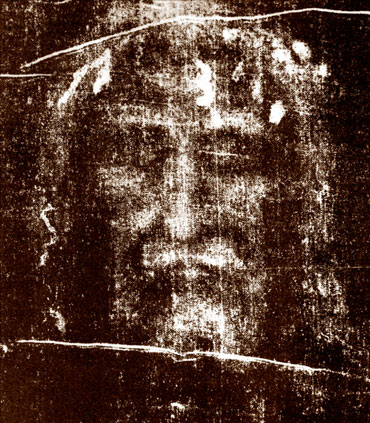
Wishing to See Jesus


The Shroud of Turin

 Lectionary Passage From Today: John 12: 20-21 (22-36)
Now among those who went up to worship at the festival were some Greeks. They came to Philip, who was from Bethsaida in Galilee, and said to him, “Sir, we wish to see Jesus.”

“Sir, we wish to see Jesus.”  Hmm!  I supposed you and everyone else!  We ALL wish to see Jesus.  But somehow that often eludes us.  Oh, we know that Jesus existed.  We have the stories and all.  But what does it mean to see Jesus, REALLY see Jesus?  It’s got to mean seeing more thatn Jesus as a prophet, or a mighty king or a high priest.  It’s got to mean more than standing alongside Jesus the teacher, Jesus the healer, or even Jesus the friend (Although I would be careful with that one–careful that we do not somehow pull the very human Jesus down to our level.  Jesus was FULLY human.  Jesus was what we’re called to be.)  No, seeing Jesus means beoming a part of The Way that is Christ, entering the mystery, the awe, the very essence that is God.  It means being lifted up and gathered in.

So, when these Greeks came asking to see Jesus, what were they seeking?  Do you think they wanted someone to lead them?  Probably not…they had their own leaders.  They had their own teachers.  They had their own friends.  What they desired was what we all desire–for it all to mean something.  They wanted to understand.  They wanted some sort of proof.  They wanted to see Jesus.

There is a story that is told in Feasting on the Word (Year C, Volume 2) of Anthony the Great, the fourth-century leader of Egyptian monasticism:  A Wise older monk and a young novice would journey each year into the desert to seek the wisdom of Anthony.  Upon finding him, the monk would seek instruction on the life of prayer, devotion to Jesus, and his understanding of the Scriptures.  While the monk was asking all the questions the novice would simply stand quietly and take it all in.  The next year the well-worn monk and the young novice again went into the desert to find Anthony and seek his counsel.  Again the monk was full of questions, while the novice simply stood by withouot saying a word.  This pattern was repeated year after year.  Finally, Anthony said to the young novice, “Why do you come here?  You come here year after year, yet you never ask any questions, you never desire my counsel, and you never seek my wisdom.  Why do you come?  Can you not speak?”  The young novice spoke for the first time in the presence of the great saint.  “It is enough just to see you.  It is enough for me just to see you.”

We all wish to see Jesus.  But seeing Jesus is not about seeing with our eyes.  It is not about information-collecting.  It is not about understanding.  It is not about proof.  It is, rather abut Presence.  The vision is that all would see Jesus and finally have their thirst quenched by the Divine.  But you have to realize for what it is you thirst.  We thirst for the Divine; We thirst to see Jesus.  The Cross is the instrument through which we see Jesus.  It is ont the Cross that Jesus becomes transparent, fully revealed.  Seeing Jesus means that we see that vision of the world that God holds for us.  And seeing Jesus also means that we see this world with all of its beauty and all of its horror.  We see the way that God sees.  And we finally see who we are.  And, finally, we are whole.  Seeing Jesus makes us whole and being whole means that we can finally see Jesus and we see everything else that way that it was meant to be.

In The Naked Now:  Learning to See as the Mystics See, Fr. Richard Rohr talks of the experiences of three ment who stoop by the ocean, looking at the same sunset.  As he relays, one man saw the immense physical beauty and enjoyed the event itself.  This man…deals with what he can see, feel, touch, move, and fix.  This was enough reality for him…A second man saw the sunset.  He enjoyed all the beauty that the first man did.  Like all lovers of coherent though, technology, and science, he also enjoyed his power to make sense of the universe and explain what he discovered.  He thought about the cyclical rotations of planets and stars.  Through imagination, intuition, and reason,, he saw…even [more].  The third man saw the sunset, knowing and enjoying all that the first and the second men did.  But in his ability to profess from seeing to explaing to “tasting,” he also remained in awe before an underlying mystery, coherence, and spaciousness that connected him with everything else.  He [saw] the full goal of all seeing and all knowing.  This was the best.  It was seeing with full understanding.

In order to see Jesus, you have to lay yourself aside and breathe in the mystery of it all.  You have to open yourself to being recreated with the eyes of the Divine.

On this fifth Sunday of Lent, close your eyes and breathe in the mystery that surrounds you.  Close your eyes and feel the Presence of Christ that pervades your life.  Close your eyes that you might see.

Grace and Peace,

Shelli

A Return to Silence

Being the church is about being in community, about being together and working together to spread the Gospel for the transformation of all the world.  Most of our church seasons reflect that–Advent draws us together around the manger, Epiphany is our time of manifestation as a people of God, and Pentecost (that l-o-n-g Pentecost season) is the season in which we as a people are called out to BE the church, to BE the Body of Christ in the world.  But so much of this season of Lent is depicted alone, in the wilderness, struggling as we spend 40 days in penitence and renewal as we approach the Cross.  So much of Lent is depicted in solitude and silence, an intentional time with God as we retreat and prepare ourselves for who we are called to be and what we are called to become.

But how can you serve the world in solitude?  How can you help all those that need help when you are alone?  Think about planting things in your garden.  You do not just take them out of the temporary pot and place them on top of the earth and then wait to see what happens.  You have to dig first.  You have to clear away the loose top soil that easily gets strewn about with the winds and the rains and you have to dig deep down into the firm, nutrient-rich undersoil.  It is there that the roots can be nurtured and fed.  It is there that the water can be held long enough to quench thirst.  And it is there that the plant can root itself, becoming strong enough to hold for what is to come.

Lent is like that rich soil underneath.  We have to dig down to find who we really are, to find those gifts and those graces that God has placed deep within us.  We have to dig down that we might tap into that sacred center that exists in each of us.  That cannot be done in a flurry of activity.  It must be done alone, in solitude.  And I think, particularly, in this world in which we live that is often filled with frenzy and busyness, it is important, once in awhile, to give yourself the chance to dig deep, to give yourself some solitude that you might find yourself once again.

But solitude is not solitary confinement.  It must be intentional.  And there, in the midst of the solitude, you will see the community that way it is meant to be known.  Those in monastic orders that feel called to live in solitude and silence are never completely alone.  They see themselves as a part of the community and they see the community the way it is meant to be.  And when they go into their room to pray, they pray for us all.  The community is there with them–in silence.  13th century German mystic, Meister Eckhart said that “nothing is so like God as silence”.  It’s like that rich soil that exists deep underneath what we see.  But we have to dig.

Creation began in silence.  THAT was the beginning.  Before God spoke Creation into being, God was in silence.  Let us return.

So, on this twenty-eighth day of Lenten observance, go into a room and close the door and, if only for awhile, sit in silence.  Do not worry about needing to connect with God or find God.  (Remember God is not lost!)  Just dig…and let God show you what you are meant to find.

Grace and Peace,

Shelli