Keeping Silence

I read the other day that scientists have determined that noise has a definite effect on work efficiency.  Noise quickens the pulse, increases the blood pressure, and upsets the normal rhythms of the heart.  That’s actually pretty scary.  Because every single one of us live and exist in noise.  And if noise affects our work that way, what, exactly, does it do to our spiritual life?  We need silence sometimes.  It is part of the rhythm of life.  Mother Teresa of Calcutta once said that “we need to find God, and [God] cannot be found in noise and restlessness.  God is the friend of silence.  See how nature–trees, flowers, grass–grows in silence; see the stars, the moon, and the sun, how they move in silence…we need silence to be able to touch souls.”

So, why is silence so hard to find?  And why, then, is it so hard to take?  We’re not really programmed that way.  Our world is not programmed that way.  Most of us are used to at the very least a little “background” noise.  In fact, we now employ the use of benign “white noise” to drown out other noise, to bring us closer to silence.   For some of us, that is as close as we get to silence.  What is wrong with us?  Are we so unsure of ourselves and our faith that we cannot just be silent?  Is the honing of our communications skills of higher importance than the contemplation of our faith?

Now, to be honest, I’m not sure that “pure” silence really exists.  There’s always something making noise.  Perhaps “keeping silence” is more about returning to a natural level of noise than it is stopping all noise itself.  In her book, When God is Silent, Barbara Brown Taylor talks about an experience by composer John Cage’s time in an anechoic chamber (a room without echoes).  With his perfect hearing, he picked up two distinct sounds–one high and one low.  When he described them to the engineer in charge, he was told that the high sound was his nervous sytem in operation, and the low one was his blood in circulation.  Noise is part of life.  Keeping silence is not about existing in pure silence; it is about living in pure life, in Creation.  And yet, most of us live most of our lives in noise–artificial noise, the noise of the world, rather than the noise of Creation.

If you go back and read the story of Creation, it began in silence.  I think it probably began in “pure” silence, in a void.  And then God spoke us into being.  In her book, Taylor says, “in his poetic eulogy “The World of Silence”, the French philosopher Max Picard says that silence is the central place of faith, where we give the Word back to the God from whom we first received it.  Surrendering the Word, we surrender the medium of our creation.  We unsay ourselves, voluntarily returning to the source of our being, where we must trust God to say us once again.”

In this Lenten journey, we talk about giving up, we talk about re-aligning our lives with what God envisions for us, and we talk about change.  But maybe the part we’re missing is where we don’t talk.  Shhhhh!  Let God say you into being again.

On this third Sunday of Lenten, just be quiet.  What do you hear?  What does the silence teach you?
Grace and Peace on this Lenten Journey,

Shelli

Light-Yielding

In this Lenten season, we tend to focus on wilderness and darkness.  We are told to look at our selves honestly, compelled to confront our wrongs and name our sins.  The season begins in dust, with the faint sign of the cross made of oil and ash.  And as we sit in the dark, forboding wilderness, wrought with the tempations around us, we strain to see the light that we are promised.  We try hard to see even a small glimmer of the light that our faith tells us is up ahead.  We are told to let go, to relinquish the thinngs that we hold.  But how can we?  This season is too hard, too dangerous, too foreboding.  And so we stay in the darkness for now, content to wallow in our guilt and be comforted by our despair, hiding our shame from the world.  And we go on.  Someday the Light will come.

I don’t think we get it.  Surely this God of light and life does not want us to wallow here.  I mean, anyone that even knows the definition of psychology knows that healing starts with diagnosing our ills, confronting our demons, and naming our sins. In fact, in her book Speaking of Sin, Barbara Brown Taylor contends that sin, that thing that we try to hide away from everyone, is our only hope, because the recognition that something is wrong is the first step toward setting it right again.  She says that “there is no help for those who admit no need of help.  There is no repair for those who insist that nothing is broken, and there is no hope of transformation for a world whose inhabitants accept that it is sadly but irreversibly wrecked.”  But most of us are not comfortable facing ourselves that honestly and so we become content with wallowing in the darkness.  We get stuck in cycles of guilt and self-denial and become well-versed in closing our eyes to our own shortcomings and those of our society.  We somehow convince ourselves and cherish the idea that we live in a classless, equal-opportunity society where everyone has the same chance.  We are taught to save face and tuck our blemishes and sins away so that no one will see.

I don’t think Lent is meant to be a season of wallowing.  No where is it written or implied that this is a season that shows us the way around the cross. (If that was the case, then why didn’t God somehow pluck Jesus off the cross in the nick of time?  But the story wouldn’t be the same.  It would be one of avoiding death, rather than recreating it into life.  It would be a fairy tale, rather than a vision of our eternity.) Rather, Lent is a season of journeying to the cross, of letting go of all those things that impede our vision of the Light, and laying them down and going beyond them as they, too, are recreated into Life.  In that way, it is a season not of wallowing in the darkness but one of yielding to the Light.  The Light is there, waiting.  But we have to yield to it.  We can no longer be content to sit here in the darkness, surrounded by those things we hide, and wait for the light to come.  That’s not the way it works.  We have to let go.  We have to let go of our sins, our despair, and our view that we are not ready yet or not “there” yet, of the notion that we have to somehow prepare ourselves a little bit more.  The Light is not going to magically move in and replace the darkness.  We have to yield to the Light that is already there.  We have to name what impedes our journey and let it go.  And when we let go of the hopelessness that we’ve created, we will finally see the Hope that is already there.  I don’t know about you, but I have some work to do!

On this sixteenth day of Lenten observance, name those sins that you have hidden.  Speak one out loud to someone.  Let it go.  Yield to the Light that is already there.

Grace and Peace on this Lenten Journey,

Shelli

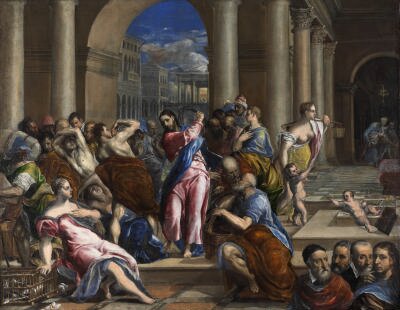
LENT 3B: Turning Tables

Christ Driving the Money-changers
From the Temple
El Greco (Domenikos Theotokopoulos), c. 1570
Minneapolis Institute of Arts

Lectionary Passage:  John 2: 13-22
The Passover of the Jews was near, and Jesus went up to Jerusalem. In the temple he found people selling cattle, sheep, and doves, and the money changers seated at their tables. Making a whip of cords, he drove all of them out of the temple, both the sheep and the cattle. He also poured out the coins of the money changers and overturned their tables. He told those who were selling the doves, “Take these things out of here! Stop making my Father’s house a marketplace!” His disciples remembered that it was written, “Zeal for your house will consume me.” The Jews then said to him, “What sign can you show us for doing this?” Jesus answered them, “Destroy this temple, and in three days I will raise it up.” The Jews then said, “This temple has been under construction for forty-six years, and will you raise it up in three days?” But he was speaking of the temple of his body. After he was raised from the dead, his disciples remembered that he had said this; and they believed the scripture and the word that Jesus had spoken.

This passage is well-known to us probably not for its significance but because of its absurdity.  After all, this is the usually-calm, usually-loving, always-compassionate Jesus just making a spectacle of himself.  Now, to put it in context, it wasn’t like this flurry of activity was going on INSIDE the nave of the temple itself.  The temple consisted of the very inner part, the holiest of holies, that, for this tradition, would have been what held the dwelling of God.  Then there was an outer part, the “worship space” if you will for those that were cleansed and appropriately-ready for worship.  And then there was this outer, sort of “town square” full of activity and merchants.  There was nothing WRONG with it.  It wasn’t like they were selling doves on top of the altar. And the “money-changers” were there purely for convenience, offering a service of exchanging the “uncleansed” coins for the acceptable ones.  Again, nothing wrong or out of the ordinary was going on here.  This was the way the society ran.
Modern model of the 1st Century
Jerusalem Temple
So, Jesus enters.  I think that (literally) this was, as we understand it, Jesus’ way of cleansing the temple.  Perhaps that outer part that was “acceptable” to culture had become a little too important.  Perhaps, rather than merely a pass-through to get to what was important, it had become the central point itself.  Or maybe this was Jesus’ way of waking us all up, reminding us that we have set our tables up in the wrong place.  Maybe it was Jesus’ way of saying that we had it wrong, that God did not merely exist within the walls of the holiest of places but also beyond.

The Dome of the Rock
Jerusalem, Israel

When this Gospel version by the writer that we know as John was written, it was probably already late in the first century.  Paul had written his letters and was gone.  The writers of the synoptic Gospels were gone.  And, more importantly, this temple would have been destroyed ten or twenty years earlier in 70 C.E. during the Siege of Jerusalem. (The Temple has never been rebuilt.  After the Muslim conquest of Jerusalem in the 7th century, the Dome of the Rock, or al-Aqsa Mosque, was built on the temple mount.  And even though Jews are now allowed to pray at the Temple Mount—actually the Western Wall, or Wailing Wall—the mount itself is under the administrative control of the Muslim Waqf.)  

But for those of us in the Christian tradition, we susposedly espouse that God is everywhere, that God does not just exist in the sanctuary or the church but rather is in our midst–everywhere. We believe that the temple, itself, is not the place of God but that God dwells with us.  In essence, God dwells with us and in us.  Our lives are that metaphorical temple. Really?  That would mean that our lives are not such that we are called to separate ourselves from the world.  The culture going on around is not bad.  The way our society runs is not evil.  In fact, our culture and our society is overflowing with God.  There is no longer things “of this world” and “of God”.  For those who believe, everything is full of God.  So how do we look upon this place that is full of God?  What reverence do we attach to our lives, our bodies, our home, our city, our nation, and our world?  No longer can they just be a “pass through” to get to what we think is God.  God is here in our midst.

Boy, that Jesus WAS a troublemaker!  After all, we had everything neatly compartmentalized.  We knew good and evil; we knew what was “of God” and “of this world”; we had the “secular” and the “sacred”, our “church lives” and our “work lives” all neatly separated.  Really?  Is that the way it is? Jesus never said that the world was bad.  In fact, God so loved the world…(we are told).  But Jesus turned the tables on us, reminding us that this way that we have separated things, this way that we have assigned value and worth of one over the other, is not the way we are called to be. Jesus knew that the love of things, the love of power, the love of control, and the acceptance of a system or a religion that values one person over another, and the attempt to keep things like they are would crucify us.  But even that, God would turn upside down.  THAT is how much God loves the world.

On this fifteenth day of Lenten observance, think about where in your life you show reverence to this God in our midst and where you set up tables and forget.  Think of some aspect in your life in which you have never seen God and how it would change if you were to encounter God there.  What is different?  During the rest of Lent, continue to meditate on God in the midst of that place. 

Grace and Peace on this Lenten Journey,

Shelli

Holding Fast

Lent is the season for fasting.  But, to be honest, most of us sort of shrug that off or snicker at the sheer absurdity of it all.  After all, fasting is not in our nature.  It doesn’t fit with our culture or our understanding.  We want to believe in a God of abundance rather than a God that expects us to go without anything.

And yet, fasting is one of the most frequently mentioned ascetic practices in the Bible.  The ancient Hebrews (and those of the Jewish tradition today) observe a special period of fasting as a sign of repentance on the Day of Atonement, or Yom Kippur.  Fasting was a sign of mourning or act of reparation for sins.  It was both a way to express repentance as well as prepare oneself inwardly for receiving the necessary strength and grace to complete a mission of faithful service in God’s name.  This was the reason that Jesus fasted for 40 days in the wilderness–not to prove something but to prepare himself for a life of ministry.  Fasting is neither abstinence from nor avoidance of, but a journey into a place that’s empty enough to fill with what God offers.  Essentially, it is allowing oneself to die to self and rise again in Christ.

So, why is it so hard?  Maybe it is not merely because we have a hard time going without (although I think that is a large part of it.)  Maybe it is because we are expecting it to produce results that it is not meant to produce. Fasting is not meant to be manipulated in that way. It is meant to clear rather than produce.  Think of fasting as response–a response to grief or sin, a response to graciousness or thankfulness, a response to a God who calls us out ourselves.  But perhaps fasting is also about return, a return to our own self before we developed all these needs, before we stored everything away, a return to the self that God created–with proper perspective and an awareness of what basic needs actually are. If you look up the physiology of fasting, you will find that a body can survive for 40 days or more without eating (40 days?  Hmmm! Isn’t THAT interesting?)  In that time, depriving a body of food is not starvation but rather a burning of stored energy.

But I have to say that fasting has never been a huge part of my spiritual discipline.  Being the good Methodist that I am, I have always maintained that I can “add” to my Lenten practice and do the same thing as fasting.  I’m not real sure, though, that that is the case.  Maybe, even metaphorically, I am only storing in excess, building and building for the future, trying to take as much of God’s abundance as I can and stash it away.  Maybe in this 40 days of fasting, we are indeed called to let something go, to return to who we are before we stored it all away–the “leaner”, fuller, more focused self who knew that our basic daily needs would be met and that the abundance of God was really about allowing God to fill our needs and fill our lives and show us the way.  And once our bodies and our minds and our souls (and our houses!) are cleared of all the stored excess, we will be open to what we need–the very breath of God who breathed life into us in the beginning and each and every day–if there’s room.

OK…you saw this one coming:  On this fourteenth day of Lenten observance, give something up that you think you cannot do without–food, sodas, coffee (ohhhh!), shopping, your cell phone, complaining, driving over the speed limit, the need to control, or whatever you come up with.  Give it up this evening and fast until this time tomorrow.  In a small way, you may just come closer to the one that God created before you began to add all those things in!   

Grace and Peace on this Lenten Journey,

Shelli

Lent 3B: Everybody Plays the Fool

Lectionary Text:  1 Corinthians 1: 18-20 (21-24) 25
For the message about the cross is foolishness to those who are perishing, but to us who are being saved it is the power of God. For it is written, “I will destroy the wisdom of the wise, and the discernment of the discerning I will thwart.” Where is the one who is wise? Where is the scribe? Where is the debater of this age? Has not God made foolish the wisdom of the world?..For God’s foolishness is wiser than human wisdom, and God’s weakness is stronger than human strength.

In this Season of Lent, as we come closer and closer to the cross, we get a better and better sense of its meaning.  You know, Paul’s really the only one that really ever dared to speak of the foolishness of the Cross, of the foolishness of God.  And he’s right, because in terms of the world, the Cross is utter foolishness.  The world says “mind your own business”; Jesus says “there is no such thing as your own business”.  The world says “buy low, sell high”; Jesus says “give it all away”.  The world says “take care of your health”; Jesus says “surrender your life to me”.  The world says “Drive carefully—the life you save may be your own”; Jesus says “whoever would save his life will lose it, and whoever loses his life for my sake will find it.”  The world says “get what you are due”; Jesus says, “love your neighbor as yourself”.

In his book, The Faces of Jesus, Frederick Buechner says that “if the world is sane, then Jesus is mad as a hatter and the Last Supper is the Mad Tea Party…In terms of the world’s sanity, Jesus is crazy as a coot, and anybody who thinks he can follow him without being a little crazy too is laboring less under a cross than under delusion.” (Buechner, The Faces of Jesus, p. 61)  Think about it.  It is really pretty ludicrous.  In fact, it’s probably downright absurd.  Here in this season, we are called to enter Christ’s suffering, called to follow Christ to the Cross.  Are we nuts?  That could kill someone!

And yet, there…there up on the altar every single Sunday is that beautiful gleaming cross.  Yeah, we all have them.  We polish them, we wear them, and we hang them on our walls.  (Have you SEEN my cross collection in my office?)  In fact, I think I remember seeing one on top of a cupcake the other day. (You know, I guess you can put anything on top of a cupcake!)  But maybe sometimes we clean it (the cross, not the cupcake) up too much.  Maybe we have forgotten the stench of death emanating from it or the sight of a mangled body hanging from it.  Maybe we have forgotten the foolishness of it all.  Maybe it is just too much for us.  After all, we’re good Methodists, people of the “empty cross”.  But it’s NOT empty; it’s full of life–life born from death, life recreated from despair and hopelessness and the end of all we knew.  But this promise of life did not just pop out of a cupcake.  It did not just appear in the midst of an array of carefully-placed lilies one Easter morning.  God took something so horrific, so dirty, so unacceptable and recreated it into Hope Everlasting.  Daniel Migliore calls it God’s greatest act of Creation yet.  But in terms of what we know, what we expect, even what we deserve, it is an act of utter foolishness.  Who writes this stuff?  In terms of this world, it is fool’s gold; but in terms of God’s Kingdom coming into being, it is the Gold of Fools because it takes us and turns us into the wise.  But perhaps wisdom is not about worshipping a gleaming, pristine cross but rather looking at an instrument of death and seeing the life it holds.  I know…none of it makes sense.  If it all made sense, we wouldn’t need it at all.

And, truth be told, the Scriptures are full of accounts of the wise and powerful ones mocking and getting mocked, never really understanding this lowly carpenter’s son from a no-name town.  But notice that it is the ones who are considered fools–the outsiders, the shunned, the ones who do not measure up to society’s standards–that get it.  So, maybe you have to be a fool. Go ahead.

Everybody plays the fool, sometime,
There’s no exception to the rule, listen baby,
It may be factual, it may be cruel, I ain’t lying,
Everybody plays the fool.
How can you help it, when the music starts to play
And your ability to reason is swept away
Oh, heaven on earth is all you see, you’re out of touch with reality
And now you cry, but when you do, next time around someone cries for you.
Everybody plays the fool, sometimes,
There’s no exception to the rule, listen baby,
It may be factual, it may be cruel, I ain’t lying,
Everybody plays the fool.
(K. Williams, R. Clark, J.R. Bailey, songwriters

http://www.youtube.com/watch?v=8Ni6iB3thsg

So, continuing with our act of giving up so that we can take on, on this thirteenth day of Lenten observance, do something blatantly foolish.  Give up needing to have a life that makes sense.  Feel the freedom of being recreated.   

Grace and Peace on this Lenten Journey,

Shelli

Honing Desire


Pantokrator (Jesus Christ) Icon,
St. Catherine’s Monastery
Mt. Sinai, Egypt

 In this Season of Lent, we hear a lot of talk about journeying and pilgrimage as we come closer to who it is we are called to be, as we come closer to a “oneness” with God.  What exactly does that mean, though…a “oneness” with God?  Now I have to tell you that when I hear someone refer to someone (or, even worse, themselves!) as “godly”, I really just sort of cringe.  Really?  You think you’re like God?  I don’t think so.  We are not called to live a “godly” life.  I hate it when people talk like that.  We are not called to be Divine.  We are called to be Human in the fullest way that there is.  I think that’s what Jesus was trying to show us.  I doubt he would ever depict himself as “perfect”, as unblemished.  He was Human.  That was the whole point.  Jesus came as God Incarnate not to show us how to be Divine but to show us how to be Human. 

But, that said, Jesus was “fully Human”, even as this Christ was “fully Divine”.  The life of Christ was the most human that any could be–SO human, in fact, that it was a life of open and intentional surrender to what is at the very core of each of our beings, to the very image of God, the Imago Dei, the imprint of God that exists in each of us.  And that image, that imprint, is what makes us want to be with God, compels us to follow this Way of Christ.  In the deepest part of each of our beings is the innate desire for relationship with God.  That is what it means to be fully Human.

So perhaps this Season of Lent is one in which we hone our basic desire, the desire that is the core of everything, the core of our being.  Maybe it is that desire that drives us on this journey of faith.  Or maybe, just maybe, the desire for God itself IS the journey.  Maybe a fully-tuned, fully-calibrated desire for God is how we are made perfect in Christ.  I don’t think the point of this journey is to “find God”.  I’m pretty clear that God is not lost, that God knows exactly where God is.  The truth is, I think whether or not I’m aware, God is here, always, just loving me.  God’s desire for relationship with me is so incredibly strong that it begins this journey of faith.  But the journey unfolds as I realize my desire for God.  Being “made perfect” in Christ does not mean becoming without blemish; it means becoming “fully human”; it means desiring the God in which we live and move and have our being.  This faith journey is not about finding a lost God but rather desiring and seeking a lost humanity, an image of God, the very imprint of God in ourselves.

       On this twelfth day of our Lenten observance, give up trying to “find” God or trying to “deserve” God.  Give up desiring to be perfect in this life.  And take on the deepest desire for God that you have ever known.  What does that look like?  At its best, it looks like Jesus.

Grace and Peace,

Shelli

LENT 3B: Tablets From the Sky

“The Ten Commandments” Movie (1956)

Lectionary Passage:  Exodus 20: 1-3 (4-6) 7-8 (9-11) 12-17
Then God spoke all these words: I am the Lord your God, who brought you out of the land of Egypt, out of the house of slavery; you shall have no other gods before me…You shall not make wrongful use of the name of the Lord your God, for the Lord will not acquit anyone who misuses his name. Remember the sabbath day, and keep it holy….Honor your father and your mother, so that your days may be long in the land that the Lord your God is giving you. You shall not murder. You shall not commit adultery. You shall not steal. You shall not bear false witness against your neighbor. You shall not covet your neighbor’s house; you shall not covet your neighbor’s wife, or male or female slave, or ox, or donkey, or anything that belongs to your neighbor.

Things were hard.  Here they were in the middle of the wilderness, hungry, tired, struggling, quarreling, and wondering what in the world they were doing here.  Until now, they had no real identity, no purpose for being here, no point to life.  But this is the point where that all changes.  This is the point at which their lives and their long, horrendous journey become meaningful.  And God gives them a covenant.

Now, contrary to the name of this post, I’m pretty sure that the Ten Commandments did not just drop out of the sky.  It is much more likely that these specific laws were selected from among the gathered moral and social laws of generation upon generation.  In essence, they grew out of a people’s understanding about God and their own relationship with God.  The people are first reminded that God has already saved them before, bringing them out of slavery, bringing them into relationship with God.  But you can’t help noticing that these commandments are formative of who one is before God and how one lives in response to God.  The first four commandments related to one’s relationship with God and the remaining six have to do with the relationship between human beings.  It is really very simple:  You shall love the Lord God with all your heart, and with all your soul, and with all your mind. (with all that you are, with every essence of your being)  And…you shall love your neighbor as yourself.

But in our modern-day society, there are those who have tried to make these words “law” in the judicial sense, simply by displaying them in courthouses or public buildings.  But they are missing the fact that these are not laws to obey but the natural way that we are called to respond to the freedom of God.  In fact, these laws, unlike many others, do not sanction a certain type of government or a specific king.  Rather than dictating what we should do, they depict who we are as a people of God.  They are less about behavior than they are about identity—who God is, who the people are, and who we are as people of God.  It is about how we relate to God, how we relate to each other, and, even, how we provide sustenance and nourishment for our faith journey.  And regardless of whether or not we believe they actually dropped out of the sky, they are like manna in the wilderness, providing sustenance and life.  Think of them as declarations of freedom to become who we are called to be, rather than a set of rules or regulations that force us into becoming what someone else wants us to be.

Now, admittedly, I don’t think they belong on the courthouse lawn or on the walls of a schoolroom.  I think they’re bigger than that and I don’t think they can be contained.  They are, yet again, the very breath and essence of the God who dances with us rather than holds court over us to make sure we follow the rules.  The Decalogue is, once again, God with us.  And this Season of Lent is not about following the rules or being burdened with regulations. It is about experiencing the freedom of this God who dances with us—this one God, who, alone, drives our life with a Spirit of steadfast love and the integrity of respect; this one God who offers us rest and reflection that we might delight in Creation and that we might enjoy the best that it has to offer; this one God who knows that we can only understand the love we are given if we love in return, if we honor the ones from whom we came, if we honor life and love and all of Creation; if we are honest with ourselves and with each other, and if we want the very best for our brothers and sisters.  In this way we will understand this God who offers us life and all that it entails.  Hmmm…that’s fairly far-fetched for us.  Maybe it WAS written on a tablet from the sky.

So, continuing with our act of giving up so that we can take on, on this eleventh day of Lenten observance, let go of needing to have it all defined, of needing to have narrow rules that outline our moral and societal standards, and begin to live your life loving God and loving neighbor in the way that God calls you to live.   
Grace and Peace on this Lenten Journey,

Shelli