Open Season

“…who was conceived of the Holy Spirit, born of the Virgin Mary…”

We say those words every Sunday.  We stand and we look at the cross and we say with all our heart that we believe these words to be true.  Now, the “conceived” part we get–conceived, thought up, breathed into–Jesus was God’s way after eons of breathing Creation into being of finally breathing the very Godself into the world.  The Divine has come to walk with us.  But this Virgin Mary thing?  What is that?  Jesus, born, born as a human, born as a baby.  As unromantic and “un-Nativity-like” as it may be, Jesus was fussy and colicy.  The Son of God, in all likelihood, messed up his first-century diaper.  (I’ve never been accused of being overly-reverent!)  Mary and Joseph were probably sleep-deprived.  And as time went on, Jesus, like all of us, had to learn to walk and talk and be.   He had to grow into who he was. But when’s the last time you held a newborn baby?  When’s the last time you held a baby that was only hours old? It’s just like holding the entire hope of the world in your arms.  There are no preconceptions; there are no agendas; there is no one to impress or keep from disappointing.  There is only a pure and undefiled openness to what comes next, to what God holds.  There is only hope.  You can smell it.  Maybe it’s the smell of birth.  But maybe it’s the smell of the Divine.

So does it really matter?  We get so wrapped up in whether or not Mary’s virginity was literally intact when Jesus was born.  Again, does it really matter?  Does it really matter when you are holding the hope of the world?  Does it really matter when you are holding the world’s salvation in your arms?  Think about it.  Jesus was born, Son of God and Son of Humanity.  Jesus was born to Mary, the mother of the Salvation of the World.  Perhaps the translators of the writing by the writer known as Matthew had it right and Mary was a virgin in every sense of the word–pure, undefiled, and open to receive.  But, more importantly,  Mary was a virgin in the spiritual sense of the word–pure, undefiled, and open to receive what comes next, open to receive whatever God held for her life.  Mary opened her heart and her life that she might birth God into this world.

In this season of Advent, we are called to do the same.  14th century theologian, Meister Eckhart said that “we are all meant to be mothers of God, for God is always needing to be born.”  We are all called to be virgin–pure, undefiled, and open to receive.  We are all called to birth God into this world.  How open are you to what comes next?  How open are you to what God holds for your life?  This is the open season.  This is the season when we shed all the preconceptions of what we think God is.  This is the season when we let go of our need to explain God’s coming into the world and be open to what comes next.  So does it really matter?  You bet it does.  It is the Hope of the World that depends on it.
 
In this season of Advent, give yourself the gift of being open to whatever it is God holds for you and birthing God into your life.  Be virgin.  Be a womb for the hope of the world.

Grace and Peace,

Shelli


ADVENT 3B: They

Lectionary Passage:  Isaiah 61: 1-4, (8-11)
The spirit of the Lord God is upon me, because the Lord has anointed me; he has sent me to bring good news to the oppressed, to bind up the brokenhearted, to proclaim liberty to the captives, and release to the prisoners;to proclaim the year of the Lord’s favor, and the day of vengeance of our God; to comfort all who mourn;to provide for those who mourn in Zion— to give them a garland instead of ashes, the oil of gladness instead of mourning, the mantle of praise instead of a faint spirit. They will be called oaks of righteousness, the planting of the Lord, to display his glory.  They shall build up the ancient ruins, they shall raise up the former devastations.

Something has to change.  We have to try something different.  We cannot live like this anymore.  How many times have you heard that in the last few months?  And how many presidential candidates will rise to grace and fall to failure before we actually even elect the change agent we want for the next four years?  Truthfully, I think I’m getting a case of political whiplash.  And I’m trying hard to keep up.  But it’s a little like trying to read a playbill in a dark theater for a REALLY slow-moving play.  How many scenes were there in this act?  How close are we to intermission?  Look, all we want is for someone to fix things.  Is that so hard?

Really, we’re not that different from these former exiles who were trying desperately to reshape their community.  But it’s gone on awhile.  It’s time for something to happen.  Someone needs to fix things.  So standing in the midst of the ruins of what was once a thriving Jerusalem, the prophetic witness depicts the perfect reign of God, the time when all of Creation will be renewed and fulfilled.  This is the hope for the future.  The prophet here affirms a specific and individual call from God, a call to bring good news, to bind up, to proclaim liberty, to witness, and to comfort.  But then, in verse 3, the pronoun changes.  No longer is the prophet affirming an individual’s call.  The calling is now to the plural “they”.  It’s not just the “me” that is the prophet; it is the “they” that is everyone.  The prophet is not called to “fix” things; the prophet is called to proclaim that all are called to this work.

All of us are part of what the Lord has planted and nourished and grown to bloom.  All of us are “they”.  We are the ones that are called to become the new shoots sprouting to life.  We are the ones that are called to bring good news, to bind up, to proclaim liberty, to bring justice, to witness, and to comfort.  This Scripture may sound vaguely familiar to us for another reason.  In the fourth chapter of the Gospel According to the writer known as Luke, Jesus stands in the synagogue in his home temple in the midst of a world smarting with Roman occupation and cites these same words.  He acknowledges his own calling, he is commissioned to this work.  And he sets forth an agenda using the words of this prophet.  So, here we are reminded once again.  We are reminded what we as the people of Christ are called to do–to bring good news, to bind up, to proclaim liberty, to bring justice, to witness, to comfort, and to build the Kingdom of God.

In this Season of Advent, we look for the coming of God into this world.  We look toward the fullness of God’s Kingdom.  But when we start beginning to look for someone to fix what is wrong in the meantime, we are reminded that we are they.  We are the ones for which we’ve been waiting.  We are the ones that while waiting with hopeful anticipation, we spend our time bringing good news, binding up, proclaiming liberty, bringing justice, witnessing, comforting, and building the Kingdom of God.  So put down the playbill and get busy.


In this season of Advent, give yourself the gift of realizing that you are the one for which you’ve been waiting.

Grace and Peace,

Shelli

BLOG_CMT_createIframe(‘http://www.blogger.com/rpc_relay.html’, ‘16761422496007184414’);

How Can This Be?

We are told over and over in the Scriptures “do not be afraid” or “be not afraid” or “do not fear”.  Well, in my humble experience of the Bible, it strike me that when God or an angel or some other instrument uses these words, one should be extremely concerned!  After all, God is preparing you for something really big.  The world as you know it will start shaking and quaking and the foundation that you’ve so carefully built for yourself will become mere quicksand.  Nothing will ever be the same again.

But of all the “be not afraids” in the Bible, surely the one to a young Galilean girl at the beginning of what we now call the “first century” takes the cake!  “Excuse Me, Mary, I have something for you to do.  I’d like you to give birth to a son even though you haven’t married Joseph yet and even though none of your family or your friends or your community will understand it and even though the world will struggle with this birth so much that it will initially not end well, and, oh yeah, there’s one other small little detail…you will be essentially birthing the salvation of the world!  But, do not be afraid!  So, let me know what you think!”  I think Mary’s initial response (as its translated in our Scriptures) is one of the most profound phrases ever:  “How can this be?” It is the question of faith.  Because, you see, it CAN’T be–not without God and, interestingly enough, not EVEN without Mary.

But in Mary’s defense, she had other preconceptions working against her. (Oh…so we’re not the only ones with that problem!)   There is a folktale that is told in the Book of Tobit (you’ll find it in the Apocrypha) that tells of a jealous angel who would appear on a bride’s wedding night each time she married and killed her bridegroom.  This story, of course, was probably part of the culture in which Mary lived.  So, don’t be afraid?  Good grief…she was terrified!  But she listens to the reassurance that she is given and take it “under advisement”.

And then God waits…(boy, God’s good at waiting–maybe THAT’S part of the lesson!)…God waits patiently for Mary to respond.  The world hangs suspended if only for a time, its very salvation teetering on the brink of its demise.  Oh, sure, if Mary said no, God could have gone to someone else.  God could have found SOMEONE to birth the salvation of the world.  But it wouldn’t have been the same.  After all, the Divine did not just plunk a far-removed piece of the Godself into a womb.  Our understanding is that, yes, the Christ was fully Divine; but Jesus was “born of a woman”, fully human and, as a human, Jesus carried Mary’s unique and specific DNA with him.  Mary was not just a container through which God came into this little world.  Mary’s DNA, Mary’s response, Mary’s “how can this be?”, Mary’s “yes” is all through the salvation of the world.

So, how can this be?  I do believe in the omnipotence of God.  But I also believe that God, in God’s infinite wisdom, chose to give up part of that power.  It’s called free will.  God gave a piece of the Godself to each of us that we might choose to respond in faith.  How can this be?  Certainly not without God and not even without us.  Our faith journey is a partnership with God, a dance between the human and the Divine.  And so God waits…How can this be?…Only if you respond.  Remember, Mary said “yes” and the Divine began to spill in to the womb of the world.  Salvation began. 

In this season of Advent, give yourself the gift of responding to the God that calls you to birth part of the earth’s salvation.  How can this be?  I don’t know…it’s your calling!  What is your response?

Grace and Peace,

Shelli

WALK TO JERUSALEM: Called to this Work

Scripture Text:  John 1: 1-4, 29-42
In the beginning was the Word, and the Word was with God, and the Word was God.  He was in the beginning with God.  All things came into being through him, and without him not one thing came into being. What has come into being in him was life, and the life was the light of all people…The next day he saw Jesus coming toward him and declared, “Here is the Lamb of God who takes away the sin of the world! This is he of whom I said, ‘After me comes a man who ranks ahead of me because he was before me.’ I myself did not know him; but I came baptizing with water for this reason, that he might be revealed to Israel.” And John testified, “I saw the Spirit descending from heaven like a dove, and it remained on him. I myself did not know him, but the one who sent me to baptize with water said to me, ‘He on whom you see the Spirit descend and remain is the one who baptizes with the Holy Spirit.’ And I myself have seen and have testified that this is the Son of God.” The next day John again was standing with two of his disciples, and as he watched Jesus walk by, he exclaimed, “Look, here is the Lamb of God!” The two disciples heard him say this, and they followed Jesus. When Jesus turned and saw them following, he said to them, “What are you looking for?” They said to him, “Rabbi” (which translated means Teacher), “where are you staying?” He said to them, “Come and see.” They came and saw where he was staying, and they remained with him that day. It was about four o”clock in the afternoon. One of the two who heard John speak and followed him was Andrew, Simon Peter’s brother. He first found his brother Simon and said to him, “We have found the Messiah” (which is translated Anointed). He brought Simon to Jesus, who looked at him and said, “You are Simon son of John. You are to be called Cephas” (which is translated Peter).

The writer of John’s version of the Gospel According to Jesus Christ presents this as a sort of “prelude” to Jesus’ ministry.  This passage begins by celebrating Jesus’ origins, tying them back to the very beginning of Creation, tying them back to the Creator of us all.  Then we are given a witness by John the Baptist attesting to who Jesus is, reminding us that this Jesus Christ is the one whose coming was announced by the angel, the one who was born years before in that dark grotto in Bethlehem, the one who he himself had baptized and who God’s Spirit had entered.  This was the Lamb of God who takes away the sin of the world.  Now it was time to begin the work.  This was Jesus’ calling to ministry.  And what did he do first?  He called others, saying, “Come and see…come and see what you haven’t seen before.”
 
Now I know that often when we talk about “calls” from God, many of us squirm in our seats a little. Calls are something that a lot of people limit to clergy. But as early as the Hebrew Scriptures, we read of a qara, which means to call, call out, recite, read, cry out, proclaim, or name. The word was used both as a summons or a general call as well as a specific election, the calling of someone to do a specific task that needed to be done. And, here’s the point—the call is to everyone. It is that voice, sometimes silenced by our busyness and our preconceptions, that is buried deep within our being. It is that voice that calls us to be who God created us to be.  But you will notice that God doesn’t just throw a blanket over humanity to see who will pick it up. And nowhere in the Bible does God really ask and wait for volunteers. The call to each of us is very unique and specific. God calls us to our own part of God’s creation, our own part of the Kingdom of God that is ours to build.  God calls us to walk this road to Jerusalem.

Note here that two disciples follow Jesus as a direct result of John’s witness. John showed them the light. And then two others are called. One is named Andrew we are told, who then gathers his brother Simon Peter. Both become disciples. But the other one that is called is unidentified here. We are not clear who this is. This anonymity is reflective of the writer’s understanding of discipleship as a broader vision. (In essence, the “other disciple” is us!) Discipleship is meant for all of us. Yes, all of us! And when Jesus calls us to follow, the answer is always “come and see”. You have to come and see for yourself. God calls, God names, and God calls each of us by name. Just, come and see!

So how do we respond? What does it mean to respond to our call from God? What does that look like? That calling is to each of us to become the part of God’s Creation that we are called to be. It is at the very center of who we are as followers of Christ. And nowhere in the Scriptures do we read of calls from God like “Hey, if you’re not too busy, on your way home from work, could you feed some homeless people?”  or “Listen, I don’t want you to inconvenience yourself, but when you have time, could you speak out against injustices in this world?” or (my favorite!) “OK, once you’ve “made it”, once you have all of the money that you need to be secure and you are completely adept at what I’m calling you to do, then, very carefully, so as not to make yourself uncomfortable, could you follow me?”  God does not call perfect people.  God calls us. 

The “called” life is one of tensions and convergences and wonderful coincidences that God melds together into a wonderful journey of being.  It seems that God is continually calling us into places and times that we’ve never been, constantly empowering us to push the limits of our “comfort zones”, to embark on a larger and more all-encompassing journey toward a oneness with God.  It seems that God always calls us beyond where we are and beyond where we’ve been, not to the places that are planted and built and paved over with our preconceptions and biases but, rather, to places in the wilds of our lives with some vision of a faint pathway that we must pave and on which we must trudge ahead.  Thomas Merton says that “there is in all visible things…a hidden wholeness.”[i]  It is the image of God in each one of us that must be reclaimed and nurtured so that we might take part in bringing about the fullness of Creation, in bringing the Reign of God into its fullness.  Perhaps, then, the meaning of calling is not one in which we launch out and pursue a new life but is instead one that brings us to the center of our own life, one that brings us home, back to the womb, back to God.  T.S. Eliot says that “the end of all our exploring… will be to arrive where we started…and know the place for the first time.”[ii] 

So, back to the story.  This is the beginning of Jesus’ ministry.  This is the beginning of his own walk and his own work.  We don’t usually think of Jesus being “called”.  We’re more comfortable just imagining him already there, as if he dropped into our lives already formed.  But that’s not the way it works.  God did not just plunk down into our human existence without any connection; rather, God in Jesus inserted the Divine Calling into a long, successive line of called ones–some who were ready and some who were not, some who went willingly to do what they were asked to do, and others who fought the fight of their lives to keep it from happening and lived to tell the tale of encountering God–and it keeps going.  So Jesus had to be called.  It’s what it’s about.  Jesus was formed and then called and then called others who called others who called others…well, you get the drift!  And one way or another, they responded.  Jesus was not the lone ranger.  And those that he called went.  They were nothing special–just ordinary people like you and me.  They were ordinary people asked to take on the work of discipleship and they ended up with a life that they never could have foreseen or imagined.  It is in the ordinariness of our lives that God calls us and asks us to join in the work, to join with Jesus Christ in this work of ministry, to walk with Jesus on this walk to Jerusalem.  Come and see!  It will be magnificent!  And the work has begun…
So, in this Lenten season, listen for where God is calling you and then…come and see!  Because that is the way to Jerusalem…
Grace and Peace,
Shelli 
[i] Wayne Mueller, How Then Shall We Live?  Four Simple Questions that Reveal the Beauty and Meaning of our Lives, (New York, NY:  Bantam Books, 1996), 3
[ii] T.S. Eliot in Pilgrim Souls: An Anthology of Spiritual Autobiographies, ed. by Amy Mandelker and Elizabeth Powers (New York: Simon & Schuster, 1999), 146

Dancing With the Disciples

You know how you do those things that aren’t that terrible but that you would rather most people not know–like (a.) watching soap operas, (b.) eating a whole pint of ice cream, (c.) singing along to The Sound of Music, or (d.) all of the above?  Yes, my answer is, sadly, “(d.)” and that’s probably not all of the stupid things that I do!  So as long as we’re inviting true confessions, I have to admit that I love Dancing With the Stars.  I know it’s stupid.  But I love dancing and, perhaps even more than that, I like watching people that have never danced before, that are scared to death, that are sure that they are the next ones to be voted off by ten or so million of their closest friends, come completely out of themself and have the courage to feel a rhythm that they’ve never felt before.

I pray for all of us that we can do that this Lenten season.  No, not dance with one of the dance pros but, rather, to have the courage to feel a rhythm that we’ve never allowed ourselves to feel before. What would it take to allow ourselves to do that?  What would it take to put aside all of our preconceived ideas, needless inhibitions, and carefully laid plans and just dance?  What would it take for us to finally feel that rhythm of God that runs through us all and truly dance like no one is watching?  You know, I think that one reason my guilty pleasure “Dancing” show is so popular is not that people like to watch others fail (and sometimes even fall!), but that we admire someone who can get out of their element, who can step out of their role that they are “supposed” to live in their life.  Deep down, I am convinced, we all dream of that.  We all know that we’d be better for it.  We all know that there is a dance in our lives that we have yet to dance.  Part of what we’re called to do during this season is do just that–to let go of what we think we should be doing and listen for that rhythm that runs through each of our lives, the rhythm of God calling us to dance whether or not we think we’ve practiced enough.

When Jesus called the disciples, one by one, I’m pretty clear that none of them were practicing dancing in their room when everyone thought they were asleep.  The truth is, they were anything but prepared.  (Hence the continual competition to be the “favorite” and to make sure they understood!)  They had planned something else for their lives–something reasonable, something realistic, something sane.  But then the beat began and they couldn’t help themselves.  They could only dance.  I want to be like that.  I want to dance with the disciples.

I was watching Dancing With the Stars last night.  (Well, gee, I guess there’s no hiding that now so why bother anymore!)  In one of the pre-recorded “practices”, one of the “pros” told one of the “stars” that the reason he couldn’t do the Jive is because he was thinking too much.  She said that he needed to feel it and follow it.  Maybe that’s our problem:  We’re trying to think too much, trying to reason out what God is calling us to do, trying to figure out how to fit it into our carefully-planned life.  The music has already started.  We need to start dancing!

Do you remember the T-Mobile Dance in Liverpool Station, UK about two years ago?  Look at it at: T-Mobile Dance and THEN, go to how it was made: The Making of the T-Mobile Dance.  Enough said…I guess life really is for sharing!  Perhaps we disciples could take some lessons!

“You’ve gotta dance like there’s nobody watching, Love like you’ll never be hurt, Sing like there’s nobody listening, And live like it’s heaven on earth.”  (William W. Purkey)

So, in this Lenten season, dance to the music that’s been there all along and live like it’s heaven on earth.  Who’s stopping you?  What are you hiding?

Grace and Peace,

Shelli

LENT 4A: You’re the One!

Lectionary Text:  1 Samuel 16: 1-13
The Lord said to Samuel, “How long will you grieve over Saul? I have rejected him from being king over Israel. Fill your horn with oil and set out; I will send you to Jesse the Bethlehemite, for I have provided for myself a king among his sons.” Samuel said, “How can I go? If Saul hears of it, he will kill me.” And the Lord said, “Take a heifer with you, and say, ‘I have come to sacrifice to the Lord.’ Invite Jesse to the sacrifice, and I will show you what you shall do; and you shall anoint for me the one whom I name to you.” Samuel did what the Lord commanded, and came to Bethlehem. The elders of the city came to meet him trembling, and said, “Do you come peaceably?” He said, “Peaceably; I have come to sacrifice to the Lord; sanctify yourselves and come with me to the sacrifice.” And he sanctified Jesse and his sons and invited them to the sacrifice. When they came, he looked on Eliab and thought, “Surely the Lord’s anointed is now before the Lord.” But the Lord said to Samuel, “Do not look on his appearance or on the height of his stature, because I have rejected him; for the Lord does not see as mortals see; they look on the outward appearance, but the Lord looks on the heart.” Then Jesse called Abinadab, and made him pass before Samuel. He said, “Neither has the Lord chosen this one.” Then Jesse made Shammah pass by. And he said, “Neither has the Lord chosen this one.” Jesse made seven of his sons pass before Samuel, and Samuel said to Jesse, “The Lord has not chosen any of these.” Samuel said to Jesse, “Are all your sons here?” And he said, “There remains yet the youngest, but he is keeping the sheep.” And Samuel said to Jesse, “Send and bring him; for we will not sit down until he comes here.” He sent and brought him in. Now he was ruddy, and had beautiful eyes, and was handsome. The Lord said, “Rise and anoint him; for this is the one.” Then Samuel took the horn of oil, and anointed him in the presence of his brothers; and the spirit of the Lord came mightily upon David from that day forward. Samuel then set out and went to Ramah.

Once again, God has called the most unlikely, the most unexpected, and the most unprepared candidate to do God’s work.  There seems to be a pattern here.  This time, God’s choice is a young, but apparently good-looking, shepherd, an eighth son, from the village of Bethlehem, and from a family with no real pedigree or appropriate ancestry at all.  And with this person, God lays the road for the hope of the world.  No pressure there!  But the unlikeliness doesn’t stop there.  What about Samuel? God called him to go to Jesse the Bethlehemite and anoint a new king. Well, I’m pretty sure that Saul (i.e, the King!) would not have been impressed with that had he found out. What if Samuel had just said, “You know, God, I would really rather not. That just doesn’t work into my plan.”?

In this Lenten season, what would change about our journey if we knew where we would end up, if we thought that we might end up in a place that we didn’t plan? And what would change about our life if we knew how it was all going to turn out? I mean, think about it…the boy David is out in the field just minding his own business and doing what probably generations of family members before him had done. He sees his brothers go inside one by one, probably wandering what in the world is going on. Finally, he is called in. “You’re the one!” “What do you mean I’m the one?” he probably asked in his teen-age sarcasm. “What in the world are you talking about? Don’t I even get a choice?” “Not so much.” And so David was anointed. “You’re the one!”

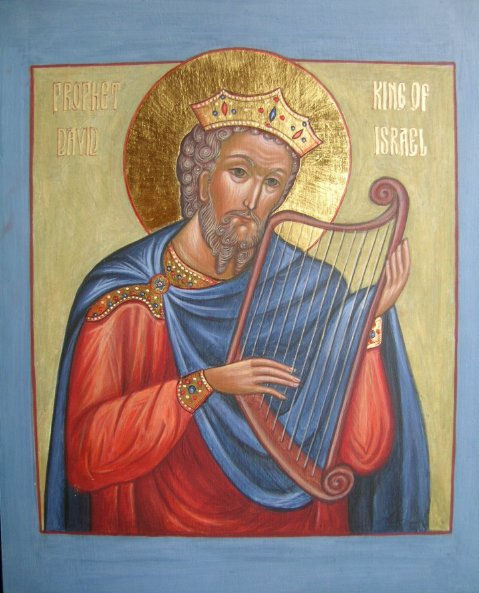
What would have happened if David has just turned and walked away? Well, I’m pretty sure that God would have found someone else, but the road would have turned away from where it was. It would have been a good road, a life-filled road, a road that would have gotten us where we needed to be. But it wouldn’t have been the road that God envisioned it to be.  We know how it all turned out. David started out by playing the supposed evil out of Saul with his lyre. He ultimately became a great king and generations later, a child was brought forth into the world, descended from David. The child grew and became himself anointed—this time not for lyre-playing or earthly kingship but as Messiah, as Savior, as Emmanuel, God-Incarnate. And in turn, God then anoints the ones who are to fall in line and follow him. “You’re the one”.

Do we even get a choice, you ask? Sure, you get a choice. You can close yourself off and try your best to hold on to what is really not yours anyway or you can walk forward into life as the one anointed to build the specific part of God’s Kingdom that is yours. We are all called to different roads in different ways. But the calling is specifically yours. And in the midst of it, there is a choice between death and life. Is there a choice? Not so much! Seeing the way to walk is not necessarily about seeing where the road is going. So just keep walking and enjoy the scenery along the way!

So, on this Lenten journey, look for the unexpected and walk toward it!

Grace and Peace,

Shelli

LENT 2A: Parshas Lech Lecha

LECTIONARY PASSAGE:  Genesis 12: 1-4a
Now the Lord said to Abram, “Go from your country and your kindred and your father’s house to the land that I will show you. I will make of you a great nation, and I will bless you, and make your name great, so that you will be a blessing. I will bless those who bless you, and the one who curses you I will curse; and in you all the families of the earth shall be blessed.” So Abram went, as the Lord had told him; and Lot went with him.

It means “to be a blessing”, parshas lech lecha.  This passage begins what is often called the Patriarchal history of Genesis. All of a sudden the camera zooms into a single family of nomads in a small town in Mesopotamia and, finally, to a single individual.  This is where the history of Israel begins.  The truth is, Abram never saw his future.  And yet his response shaped it.  Abram is chosen to be the one through whom God’s blessing is showered upon the whole world. But in order for this to happen, Abram is told to leave what he knows, to in effect sever ties and go to a new place. (We at this point immediately jump to what that would mean for us–to leave our home, our family, our life.  What, we imagine, a great act of faith!) But remember that Abram’s family was nomadic. They probably didn’t really have a concept of home anyway. And there really wasn’t a family, to speak of—Abram had probably long ago outlived his parents and he had no children. So what was he leaving? Maybe God was calling him away from hopelessness and loneliness and finally showing him purpose, showing him home.

And the Lord promises that Abram will not be alone. And, more than that, God promises blessing. No longer is this just one person or one family; it is the conduit to God showering blessing throughout the world.
Abram is called to be a blessing, the Hebrew Parshas Lech Lecha. It becomes an integral part of the Genesis story and is used eighty-eight times in the book. A blessing is a gift. It involves every sphere of existence. It is more than what we 21st century hearers have allowed it to be. It is not payment for a life well-lived. “Being blessed” is being recreated. (For Abram, this meant moving from a life of nomadic purposelessness to being the “father of a great nation” and, thousands of years later, the patriarch of three world religions.) It takes time. I think to be a blessing means that one enters the story. God calls, God promises, and God walks with us. That is how God is revealed. But the blessing doesn’t come and the blessing doesn’t continue unless one enters the story. God calls, God promises, and God blesses.

Blessing is one of the ways that God makes the presence of God known here and now.  (Joan Chittister)

So, go and be a blessing!
 
Grace and Peace,
 
Shelli