This is the One

David, the Shepherd BoyScripture Passage: 1 Samuel 16: 1-13 (Lent 4A)

The Lord said to Samuel, “How long will you grieve over Saul? I have rejected him from being king over Israel. Fill your horn with oil and set out; I will send you to Jesse the Bethlehemite, for I have provided for myself a king among his sons.” Samuel said, “How can I go? If Saul hears of it, he will kill me.” And the Lord said, “Take a heifer with you, and say, ‘I have come to sacrifice to the Lord.’ Invite Jesse to the sacrifice, and I will show you what you shall do; and you shall anoint for me the one whom I name to you.” Samuel did what the Lord commanded, and came to Bethlehem. The elders of the city came to meet him trembling, and said, “Do you come peaceably?” He said, “Peaceably; I have come to sacrifice to the Lord; sanctify yourselves and come with me to the sacrifice.” And he sanctified Jesse and his sons and invited them to the sacrifice.  When they came, he looked on Eliab and thought, “Surely the Lord’s anointed is now before the Lord.” But the Lord said to Samuel, “Do not look on his appearance or on the height of his stature, because I have rejected him; for the Lord does not see as mortals see; they look on the outward appearance, but the Lord looks on the heart.” Then Jesse called Abinadab, and made him pass before Samuel. He said, “Neither has the Lord chosen this one.” Then Jesse made Shammah pass by. And he said, “Neither has the Lord chosen this one.” Jesse made seven of his sons pass before Samuel, and Samuel said to Jesse, “The Lord has not chosen any of these.” Samuel said to Jesse, “Are all your sons here?” And he said, “There remains yet the youngest, but he is keeping the sheep.” And Samuel said to Jesse, “Send and bring him; for we will not sit down until he comes here.” He sent and brought him in. Now he was ruddy, and had beautiful eyes, and was handsome. The Lord said, “Rise and anoint him; for this is the one.” Then Samuel took the horn of oil, and anointed him in the presence of his brothers; and the spirit of the Lord came mightily upon David from that day forward. Samuel then set out and went to Ramah.

In this Lenten season, what would change about our journey if we knew where we would end up, if we thought that we might end up in a place that we didn’t plan?  And what would change about our life if we knew how it was all going to turn out?  I mean, think about it…the boy David is out in the field just minding his own business and doing what probably generations of family members before him had done.  Perhaps his mind is drifting off in daydreams as he sits there with the sheep.  Perhaps he is thinking about what his life will be, where he plans to go, what he plans to do.  He sees his brothers leave and go inside one by one, probably wandering what in the world is going on.  Finally, he is called in.  “You’re the one!”  “What do you mean I’m the one?” he probably thought.  “What in the world are you talking about?  Don’t I even get a choice?”  “Not so much.”  And so David was anointed.  “You’re the one!”

What would have happened if David has just turned and walked away?  Well, I’m pretty sure that God would have found someone else, but the road would have turned away from where it was.  It would have been a good road, a life-filled road, a road that would have gotten us where we needed to be.  But it wouldn’t have been the road that God envisioned it to be. We know how it all turned out.  David started out by playing the supposed evil out of Saul with his lyre.  He ultimately became a great king (with several bumps–OK, LOTS of bumps–along the way!) and generations later, a child was brought forth into the world, descended from David.  The child grew and became himself anointed—this time not for lyre-playing or kingship but as Messiah, as Savior, as Emmanuel, God-Incarnate.  And in turn, God then anoints the ones who are to fall in line.  “You’re the one”.

Do we even get a choice, you ask?  Sure, you get a choice.  You can close yourself off and try your best to hold on to what is really not yours anyway or you can walk forward into life as the one anointed to build the specific part of God’s Kingdom that is yours.  We are all called to different roads in different ways.  But the calling is specifically yours.  And in the midst of it, there is a choice between death and life.  Is there a choice?  Not so much!  Seeing the way to walk is not necessary about seeing where the road is going but knowing that the road is the Way.  So just keep walking and enjoy the scenery along the way! 

See, we are no different.  We are all chosen, all, on some level, anointed to this holy work.  We can ignore it.  We can cover our ears and cover our eyes and shroud ourselves with excuses and keep walking the way that we would like.  It will get us somewhere, perhaps somewhere that is good and wonderful and makes us feel good.  But what happens when God calls us from the fields and interrupts our daydreams?  What happens when God has something else in store for us?  Each of us given specific and unique gifts.  We are all called.  It’s not a goal to pursue but a calling to hear.  Our lives are the way we live into that call.  This is the one.  We are the ones.  We are the ones for which we’ve been waiting.

You have been telling the people that this is the Eleventh Hour.  Now you must go back and tell the people that this is The Hour.  And there are things to be considered:  Where are you living?  What are you doing?  What are your relationships? Aare you in right relation?  Where is your water? Know your garden. It is time to speak your Truth. Create your community. Be good to each other. And do not look outside yourself for the leader.  This could be a good time! There is a river flowing now very fast. It is so great and swift that there are those who will be afraid. They will try to hold on to the shore. They will feel they are being torn apart, and they will suffer greatly.  Know the river has its destination. The elders say we must let go of the shore, push off into the middle of the river, keep our eyes open, and our heads above the water. See who is in there with you and celebrate.  At this time in history, we are to take nothing personally. Least of all, ourselves. For the moment that we do, our spiritual growth and journey comes to a halt.  The time of the lone wolf is over. Gather yourselves!  Banish the word struggle from your attitude and your vocabulary.  All that we do now must be done in a sacred manner and in celebration. We are the ones we’ve been waiting for. (The Elders Oraibi, Arizona Hopi Nation)

Lent is a time of holy questioning and holy listening.  Where are you living?  What are you doing?  Where is your water?  For what are you being called?  For what are you the one?

Grace and Peace,

Shelli
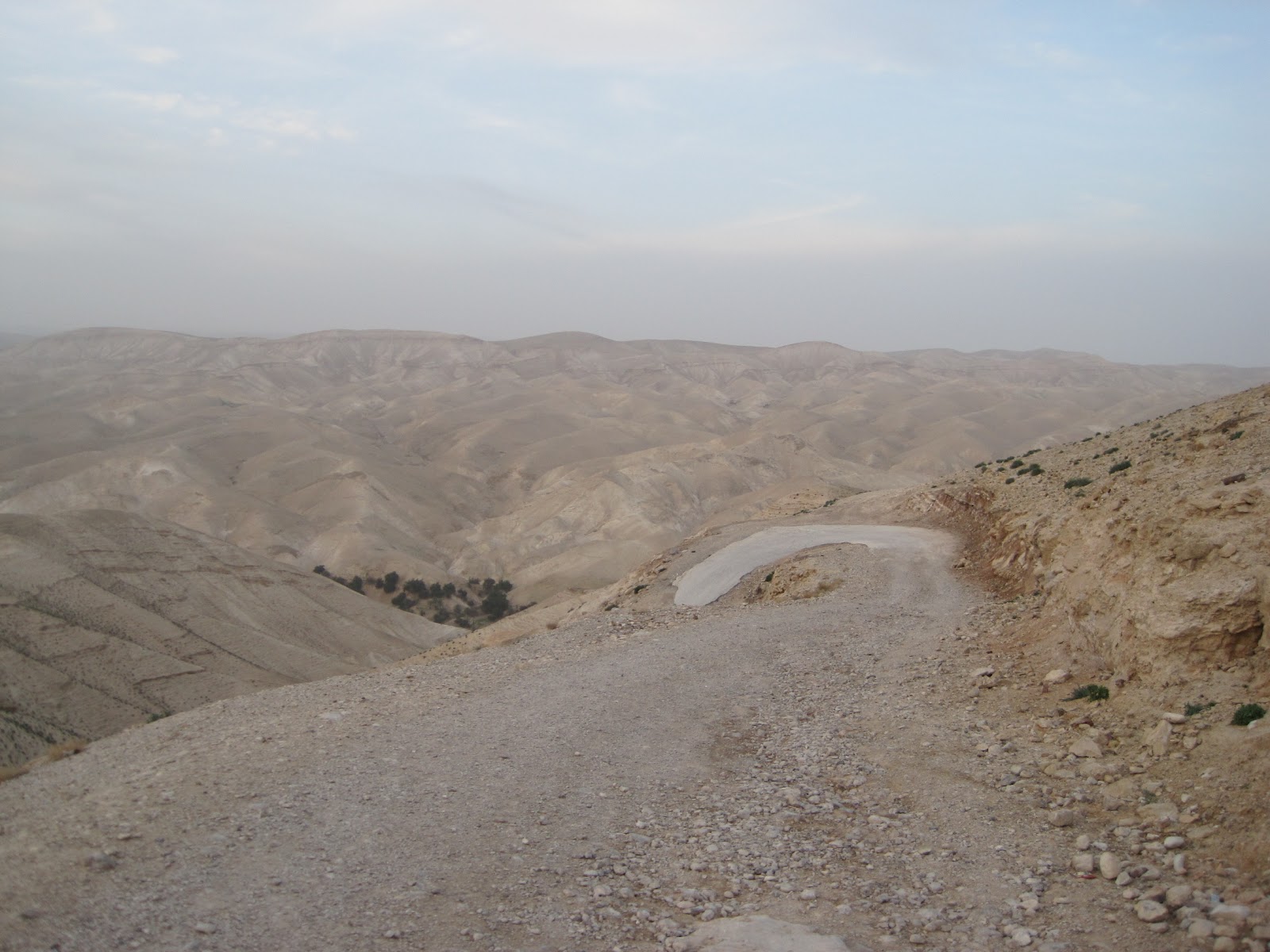
Poustinia


The Judean Wilderness, February, 2010

Scripture Passage:  Matthew 4: 1-11

Then Jesus was led up by the Spirit into the wilderness to be tempted by the devil. He fasted forty days and forty nights, and afterwards he was famished. The tempter came and said to him, “If you are the Son of God, command these stones to become loaves of bread.” But he answered, “It is written, ‘One does not live by bread alone, but by every word that comes from the mouth of God.’” Then the devil took him to the holy city and placed him on the pinnacle of the temple, saying to him, “If you are the Son of God, throw yourself down; for it is written, ‘He will command his angels concerning you,’ and ‘On their hands they will bear you up, so that you will not dash your foot against a stone.’” Jesus said to him, “Again it is written, ‘Do not put the Lord your God to the test.’” Again, the devil took him to a very high mountain and showed him all the kingdoms of the world and their splendor; and he said to him, “All these I will give you, if you will fall down and worship me.” Jesus said to him, “Away with you, Satan! for it is written, ‘Worship the Lord your God, and serve only him.’” Then the devil left him, and suddenly angels came and waited on him.

Well, you know it’s the first Sunday in Lent when you read of the temptation of Christ in the wilderness.  To be honest, most of us are incredibly uncomfortable with this passage.  After all, how can Jesus, Son of God and Son of Man, the gift of the father’s unfailing grace, Emmanuel, God With Us, the Savior of the World be tempted?  How can that even be possible? And why would someone like Jesus even risk it?  What, really, is Jesus doing out in the wilderness all by himself?  What, really, is the purpose at all?  I mean, it almost sounds like this was some sort of proof that Jesus was who he was.  I’ve always been just a bit distrustful of “proof” of the Divine.  So, what is this all about?

In Russian, the word poustinia means “a desert, a lonely and silent place”.  It is a place of solitude.  In the Russian Orthodox tradition, a poustinik was one who was called by God to live alone in the desert with God.  But the notion was not looked upon as a solitary life removed from the rest of the world.  Because it was there that he or she prayed, fasted, and made oneself available to humanity.  Think of the poustinik as humanity’s listener.  The idea was that even though the poustinik lived in solitude, there was always a part of him or her that was open to the world, a door to a life of solitude that invited the world in and sent the person forth.

And yet, this pilgrimage into the wilderness is not really part of the world in which most of us live.  Our culture may be a bit to goal-oriented and scheduled for that.  We tend to respond better to words like “connection”, “community”, and “fellowship”.  (Those are the words on which religious entities build good mission statements, aren’t they?)  Going out into the desert or the wilderness alone to find oneself or center oneself sometimes sounds to us a little selfish, as if the person is not participating with others, not caring for others.  Maybe our problem is that we’ve forgotten the door.  We forgot that there is always a door between solitude with God and the world, between the community of faith and that part of the Godself that each of us hold inside of us.  It is not an either-or.  The poustiniks understood that.  They stepped into the solitude to connect with God while at the same time keeping a foothold on the world, being available in case the world needed them or open to what God needed them to take into the world.  It was a way of listening and a way of active faith. 

Maybe that’s why this passage is so difficult for us.  We forgot that there was always a door.  Jesus was not shutting himself away from the world.  Jesus was called to the world (good grief, he was the Savior of the World, was he not?).  But in the bustling and noisy ways of the world, it is important to find the door, to listen to God, to enter the solitude of our deepest self so that we can finally hear where we are called to go.  There will always be voices pulling us away, pulling us toward things that we think we need, things that we think will help us in life, or things that will give us the power to do what we think we should do.  But deep within us is a holy place of solitude, a place where we can listen to God unencumbered by the voices of the world.   Some of us need to go into the wilderness to hear it; others need to only listen where we are.  Jesus trek into the wilderness was not because he needed to get away from the world but rather so that he could hear the world’s needs and God’s calling to fill them with grace.

The poustinia is within, and one is forever immersed in the silence of God. foreverlistening to the word of God, forever repeating it to others in word and deed.  (Catherine Doherty)

On this Lenten journey as we traverse through the wilderness, think of those place of solitude in your life.  Where are those place where you are at your best at listening to the needs of the world, at listening to what God is calling you to do?

Grace and Peace,

Shelli

After the Garden


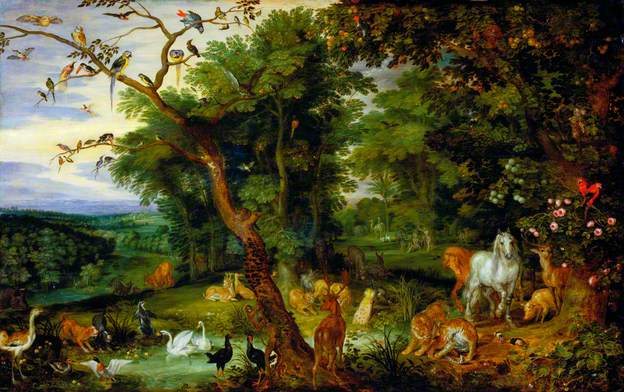
"The Garden of Eden with the Temptation in the Background", by Jan Brueghel the elder, c. 1600, (Victoria and Albert Museum, London)
“The Garden of Eden with the Temptation in the Background”, by Jan Brueghel the elder, c. 1600, (Victoria and Albert Museum, London)

Scripture Passage:  Genesis 2: 15-17, 3: 1-7 (Lent 1A)

The Lord God took the man and put him in the garden of Eden to till it and keep it.  And the Lord God commanded the man, “You may freely eat of every tree of the garden;  but of the tree of the knowledge of good and evil you shall not eat, for in the day that you eat of it you shall die.”…Now the serpent was more crafty than any other wild animal that the Lord God had made. He said to the woman, “Did God say, ‘You shall not eat from any tree in the garden’?” The woman said to the serpent, “We may eat of the fruit of the trees in the garden; but God said, ‘You shall not eat of the fruit of the tree that is in the middle of the garden, nor shall you touch it, or you shall die.’“ But the serpent said to the woman, “You will not die; for God knows that when you eat of it your eyes will be opened, and you will be like God, knowing good and evil.”  So when the woman saw that the tree was good for food, and that it was a delight to the eyes, and that the tree was to be desired to make one wise, she took of its fruit and ate; and she also gave some to her husband, who was with her, and he ate. Then the eyes of both were opened, and they knew that they were naked; and they sewed fig leaves together and made loincloths for themselves.

So at the beginning of this year’s Lenten season, the Lectionary propels us back into our somewhat sketchy past.  St. Augustine and myriads of theologians to follow would have called it the “original sin”, as if it is the cause of all other sins that follow.  Now, admittedly, I don’t like to get stuck on that idea of original sin.  I’m pretty sure that if the first humans had not messed up, someone soon after would have.  But this is the story we have.  We have images of humans walking in a beautiful garden hand in hand without a care in the world.  And then we have some sort of talking snake or prehistoric serpent or some other obnoxious creature that pulls them away from who they are and who they are meant to be.  And they give in.  They give in to the first temptation to be someone they are not.  Then they realize their mistake much too late to change the course of their action.  Well, we know the story.  (Oh, who are we kidding? We’re LIVING the story!)  They are no longer innocent and the beauty of the garden is lost forever.

This has always been an odd story to me.  Now, admittedly, I’m sure it is of no surprise to most of you that I tend to assume that this is fable rather than a literal historical account. But just because it probably isn’t “true” does not mean that it is not full of “Truth”.  In some respects, this is the rawest, most profound, most human Truth that there is.  After all, we all wander down the wrong road every now and again and some of us do it daily without even intending it.  And we all live with consequences of trying to overreach, trying to be someone we’re not, trying to assume things that are not ours to assume.  We all live with consequences of, essentially, overstepping and overreaching and trying to be the god of our own life.  And we all lose that innocence that we once had.

But, really, does God want a bunch of mindless innocents walking around in this world?  If that were the case, then God would never have shared the part of the Godself with us that is known as free will.  You see, God in God’s infinite wisdom gave up omnipotence for relationship.  God doesn’t want a bunch of robotic beings following the Great Divine because they know nothing else.  God created us to desire, to choose, to follow God of our own volition.  Innocence is way overrated.  You see, if God wanted us to stay in some sort of garden, fenced off from the rest of the world, I guess God would have left us there, protected from the world and, mostly, from ourselves.  I really don’t think that this journey we’re on returns us to the Garden, whatever that was.  That was our beginning.  The journey returns us to God, to who God envisions that we can be.  Think of the Garden as our womb, the place that protected and shielded us until we were ready for the journey, until we found that part of ourself that chose to follow, that chose God. 

So what do we do after the garden?  We follow where God leads us; we follow that innate sense that all of us have to return to God and to whom we are called to be.  You see, we have no more excuses.  Read the end of the passage.  Our eyes have been opened.  We know where we fall short; we know that we cannot do this by ourself; we know that God is God and we are not.  And in that is our beginning.  Thanks be to God!

Sin is our only hope, because the recognition that something is wrong is the first step toward setting it right again.  (Barbara Brown Taylor, Speaking of Sin:  The Lost Language of Salvation)

So on this Lenten journey, open your eyes.  Open your eyes and take a good hard look at yourself.  What do you need to choose to leave behind?  Where do you choose to go? What does your beginning, your escape from innocence, look like?

Grace and Peace,

Shelli

After

Wise MenLectionary Scripture Passage for Reflection:  Matthew 2: 1-12

In the time of King Herod, after Jesus was born in Bethlehem of Judea, wise men from the East came to Jerusalem, asking, “Where is the child who has been born king of the Jews? For we observed his star at its rising, and have come to pay him homage.” When King Herod heard this, he was frightened, and all Jerusalem with him; and calling together all the chief priests and scribes of the people, he inquired of them where the Messiah was to be born. They told him, “In Bethlehem of Judea; for so it has been written by the prophet: ‘And you, Bethlehem, in the land of Judah, are by no means least among the rulers of Judah; for from you shall come a ruler who is to shepherd my people Israel.’” Then Herod secretly called for the wise men and learned from them the exact time when the star had appeared. Then he sent them to Bethlehem, saying, “Go and search diligently for the child; and when you have found him, bring me word so that I may also go and pay him homage.”  When they had heard the king, they set out; and there, ahead of them, went the star that they had seen at its rising, until it stopped over the place where the child was. When they saw that the star had stopped, they were overwhelmed with joy. On entering the house, they saw the child with Mary his mother; and they knelt down and paid him homage. Then, opening their treasure chests, they offered him gifts of gold, frankincense, and myrrh. And having been warned in a dream not to return to Herod, they left for their own country by another road.

Happy New Year!  It’s almost over—this season of readying and wrapping, of decking the halls and visiting with friends and family, of over-running and over-eating and over-spending.   If you’re like me, you love all there is about Advent and Christmas but when it’s time for it to be over, you’re ready.  You’re ready to go back to normalcy, back to your usual schedule.  You’re ready to go back to your life.

When I was little, we had a manger scene that sat on the entry table of our home during the Advent and Christmas season.  I think that it was probably my favorite decoration.  Putting it out meant that Christmas was here.  And during the season, my brother and I would continually move it around and change the story a bit.  Sometimes the Mary and Joseph were in the stable and other times they were carefully but precariously placed on the roof.  Sometimes the Shepherds were herding the camel and the Wisemen were traveling with a sheep or an angel.  And sometimes the baby was in the manger and other times the character would show up in various other places throughout the house.  But, always, at the end of the season, it was sad to me to put the manger scene away, to rewrap all the characters in their tissue paper that they wore for most of the year, put away the baby, and close the box.  It was over.  It was time to go back.  Now is the time.  What now?  What do we do after it all ends?  The truth is, “after” is when it begins, “after” is when it becomes real, and “after” is the whole reason we do this at all.

In the Gospel text for this Sunday, we find the last (and maybe the main!) question of Advent.  It comes not at Christmas Eve in the midst of the candlelight and carols but after.  And, believe it or not, it’s not asked by those who had been waiting and hoping for it to happen.  It is asked by some who knew nothing of its happening before.  All they knew was what followed, what came after.  But they believe that the star (or, for some, an unusual conjunction of heavenly bodies that produces an especially bright light) marks the birth of a special child destined to be a king.  They ask, “Where is the child who has been born king of the Jews?

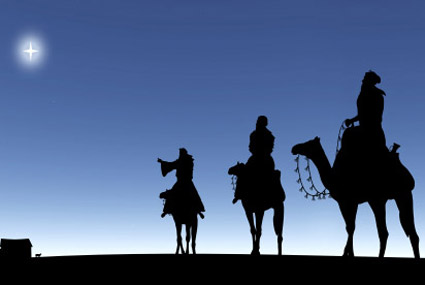
We all know the story of the Wise Ones from the East (Wisemen, or Magi, or Kings, or Zoroastrian followers, or whoever they were numbered in three or however many tradition holds).  They came at the request of King Herod.  They came supposedly to “pay homage”, but we know that that was not the case.  The truth is, Herod had heard that there was a new king in town and for him that was one king too many.  So, “paying homage” was only a precursory mission leading up to the demise of this new competing ruler.  We are told that they brought gifts, gifts fit for a king.  And then the passage tells us that, heeding a warning in a dream, these wise and learned (and probably powerful) members of the court of Herod, left Bethlehem and returned to their own country, a long and difficult journey through the Middle Eastern desert.  Rather than returning to their comfortable lives and their secure and powerful places in the court of Herod, they left and went a different way.  They knew they had to go back to life.  But it didn’t have to be the same.  So they slip away into the night.  Herod is furious.  He has been duped.  So he issues an order that all the children two years old and younger in and around Bethlehem should be killed.  The truth is that Jesus comes into the world as it actually is, not as we wish it to be.  Evil and greed are real and the ways of the world can and do crush life.

This passage moves the story beyond the quiet safety of the manger.  We realize that the manger is actually placed in the midst of real life, with sometimes dark and foreboding forces and those who sometimes get it wrong.   The primary characters are, of course, God and these visitors, these foreign Gentiles who did not even worship in the ways of the Jewish faith.  They were powerful, intelligent, wealthy, and were accustomed to using their intellect and their logic to understand things.  You know, they were a lot like us.  But they found that the presence of the Divine in one’s life is not understood in the way that we understand a math equation.  It is understood by becoming it.

Maybe that’s the point about Christmas that we’ve missed.  Maybe it’s not just about the nativity scene.  Maybe it’s more about what comes after.  We often profess that Jesus came to change the world.  But that really didn’t happen.  Does that mean that this whole Holy Birth was a failure, just some sort of pretty, romantic story in the midst of our sometimes chaotic life?  Maybe Jesus didn’t intend to change the world at all; maybe Jesus, Emmanuel, God with Us, came into this world to change us.  Maybe, then, there IS a new normal.  It has to do with what we do after.  It has to do with how we choose to go back to our lives.  Do we just pick up where we left off?  Or do we, like those wise men choose to go home by another way?   The point of the story is actually what comes after.  And that, my friend, is where you come in.

epiphany-germanySo, the baby cannot just be put away in the manger scene box.  The Incarnation of God happens over and over and over again.  Christmas day happens each and every time that we see God in each other, that we see the sacred in this world, and that we see that we have the Divine all over us.  We cannot go back to life as it was.  It doesn’t exist.  There is indeed a new normal that comes after all of the celebrations and after all of the birthing.  So, in these days after Christmas as you put the decorations away for another year, look around at your new normal.  Look around at what comes after.  What are you called to do?  How have you changed?  What other way will you travel home?

When the star in the sky is gone, When the Kings and Princes are home,

When the shepherds are back with their flocks, The Work of Christmas begins:

            To find the lost, To heal the broken,  To feed the hungry, To release the prisoner,

            To teach the nations, To bring Christ to all, To make music in the heart.

(Howard Thurman, “The Work of Christmas”)

Happy After!

Grace and Peace,

Shelli

Flesh


"The Nativity", Lorenzo Lotto, 1527-1528
“The Nativity”, Lorenzo Lotto, 1527-1528

Scripture Passages for Reflection:

When Joseph awoke from sleep, he did as the angel of the Lord commanded him; he took her as his wife, but had no marital relations with her until she had borne a son; and he named him Jesus. (Matthew 1:24-25)

And she gave birth to her firstborn son and wrapped him in bands of cloth, and laid him in a manger, because there was no place for them in the inn. (Luke 2:7)

And the Word became flesh and lived among us, and we have seen his glory, the glory as of a father’s only son, full of grace and truth. (John 1:14)

The Gospel writers all seemed to struggle a bit to fully convey the wonder, the unfathomable glory, of this night.  In fact, the writer that we know as Mark didn’t even really try.  He or she just jumped right in proclaiming the Good News, seemingly in a tremendous hurry to get the word out.  For the writer of Matthew’s Gospel, he seemed to only be able to state it with some proof of what it was not.  (In other words, this is no ordinary birth.)  And the writer that we call Luke seemed very focused on the physical place of Jesus’ birth and the realization that there really was no room.  But years later, the writer of John’s Gospel, conveyed a notion with which we still struggle:  that God in God’s wisdom after centuries upon centuries of trying to deal with humanity, after years of drawing us toward the Divine, of showing us a vision that God has for each of us, became flesh, one of us.  On this night, God is born human, fully human, into a world that was never really ready, never really prepared (and probably still isn’t).  And, yet, God must have loved the world, even THIS world, more than life itself, to come into it as one of us.  God became human and lived with us.  Incredible thought, isn’t it?

The Incarnation is God’s unveiling, God’s coming out of the darkness and the shadows and the clouds and showing us for the first time what we could not see before. Emmanuel, God With Us, this day walks into our ordinariness.  God has traversed time and space and all things Divine to enter our every day world.  Pierre Teilhard de Chardin said that “by virtue of the creation, and still more of the incarnation, nothing here below is profane for those who know how to see.”  Perhaps God came into this ordinary world to show us the holiness that had been created, the sacredness that in our worldliness, we were somehow missing. God steps into our lives to show us the depths to which we have not allowed ourselves to dig.   No longer can flesh and humanity be deemed “bad”; God came as flesh, came as human, came as one of us.  It would be easy to dismiss the whole thing as something that “seemed” like one of us because, after all, this is God.  And what would God be doing fooling around with the squalor and feebleness of this world?  You see, it is not that God lowered the Godself to our standard but that God’s coming raised us toward the Divine.  And notice in the Christmas stories how they emphasize the lowliness of the surroundings and the danger to the child as much as the miraculous glory of the event.  By entering human existence, even God faces down the power of evil, sin, and death.  In love, God elects to be no more immune than we are from the dangers to love and life.

Thomas Merton once said that “the Advent mystery is the beginning of the end in all of us that is not yet Christ.”  It is all this waiting, all this preparing that we have done that has put us in this place.  It is the place that humbles and amazes at once.  Who would have ever thought?  Who would have ever written the story such that a baby’s birth on a cold desert night in the midst of social turmoil would be the in-breaking of the Godself into our world, Emmanuel, God With Us.  After all this time, all this waiting for God, this hoping against hope that God would show up and pull us out of the mire of humanity, God comes full on into it, not pretending to be like us but becoming one of us.  God came to show us how to be who we are, who we are called to be, and to show us that, once again, it is very, very good.  So, on this night of nights, as the Light begins to dawn and we realize that God has come bursting into our lives and into our world, let us open our eyes and rub the sleep out of them and finally see this thing that has happened.
Reflection:  On this night of nights, what does God in our midst mean for you?  How can this year be different?
Merry Christmas!
Shelli

Advent 4A: The Other Side of the Manger


"Joseph With Infant Christ", Bartoleme' Estaban Murillo, 1665-1666, Museum of Fine Arts, Sevilla, Spain
“Joseph With Infant Christ”, Bartoleme’ Estaban Murillo, 1665-1666, Museum of Fine Arts, Sevilla, Spain

Lectionary Gospel Passage for Reflection:  Matthew 1: 18-25

Now the birth of Jesus the Messiah* took place in this way. When his mother Mary had been engaged to Joseph, but before they lived together, she was found to be with child from the Holy Spirit. Her husband Joseph, being a righteous man and unwilling to expose her to public disgrace, planned to dismiss her quietly. But just when he had resolved to do this, an angel of the Lord appeared to him in a dream and said, ‘Joseph, son of David, do not be afraid to take Mary as your wife, for the child conceived in her is from the Holy Spirit. She will bear a son, and you are to name him Jesus, for he will save his people from their sins.’ All this took place to fulfill what had been spoken by the Lord through the prophet:   ‘Look, the virgin shall conceive and bear a son, and they shall name him Emmanuel’, which means, ‘God is with us.’ When Joseph awoke from sleep, he did as the angel of the Lord commanded him; he took her as his wife, but had no marital relations with her until she had borne a son; and he named him Jesus.

Poor Joseph!  This is the only time that he really gets a starring role in the story and he doesn’t even really have a speaking part. We are all guilty of sort of skipping over Joseph, sort of putting him back in the stable, so to speak.  After all, he’s sort of just an extra character to complete the happy little family, right?  But can you imagine what he must have been going through?  This was not just affecting Mary’s life. It was affecting his life too.  The proper (and probably the easiest) thing would be to quietly divorce her and go on with his life.  To be honest, you have to admire him for just wanting to quietly dismiss the whole problem.  After all, he couldn’t marry her at this point.  The text says that he was a “righteous” man.  This meant that he was faithful to the Scriptures, to the laws of the Torah.  He didn’t have a choice.  He HAD to divorce Mary.  But he would do it quietly.  It seems that he really did feel compassion for her.  But he also had to be a little hurt, probably a little angry.  We can only imagine.

But in the night in a wild fit of sleep came the dream.  Ah, the dream!  “Listen to her, Joseph, she is telling the truth.  And she needs you.  This child will need you.  He will need a father in his life to show him how to grow up, to show him how to become a man.  He will need someone to hold him when he is afraid and scold him when he gets off course as all children do.  He really just needs someone to love him into being.  And Mary?  She is scared.  She needs you.  You can do this together.”  Joseph, God is calling you too.  Mary cannot go through this alone.  And, so Joseph awakened, took Mary in his arms, and entered the sacred story that had been handed to him from generations before him.  And their lives changed forever.

This is his announcement, the Annunciation to Joseph.  The name “Joseph” means “God will add” or “God will increase”.  God called Mary as the God-bearer; but God called Joseph to also respond, to add to the meaning of the story.  After all, it is the Joseph side of the story that once again upsets the social and religious expectation apple cart, so to speak.  It is Joseph that must break the ranks of righteousness and instead become human.  This beautiful nativity story is both wondrous and scandalous at the same time.  And so, somehow Joseph had to trust this strange news that he, too, was being drawn into the story.  Somehow Joseph had to get on board with God turning his whole life upside down.

And then God waits patiently for Joseph to respond. The world hangs suspended if only for a time, its very salvation teetering on the brink of its demise. After all, Mary’s already on board.  But she needs help.  She needs you.  God needs you.  So, how can this be? I do believe in the omnipotence of God. But I also believe that God, in God’s infinite wisdom, chose to give up part of that power. It’s called free will. God gave a piece of the Godself to each of us that we might choose to respond in faith. How can this be? Certainly not without God and not even without us. Our faith journey is a partnership with God, a dance between the human and the Divine. And so God waits…How can this be?…Only if you respond. So, both Mary and Joseph said “yes” and the Divine began to spill into the womb of the world. Salvation has begun.  The world is with child.

Maybe we continually put Joseph on the other side of the manger because it’s more comfortable for us.  After all, this beautiful story that we love so much is not just about God and Mary and a baby.  It is God coming into the world, it is God coming into our midst, it is God coming to us.  And Joseph is really just a plain old guy.  It’s easier to give a small part in the story rather than realize that God needed him too.  Because of God needed Joseph, then God needs us.  God needs us to wake up to what God is calling us to do.

It’s almost time!  There are bells ringing in the distance and hope and peace and eternity are waiting in the wings.  How can this be?  Because the God of all that is Divine also claims the ordinariness of our lives.  God wants to live with each one of us, as one of us.  And each of us is called to be the God-bearer, to bring the hope and peace and eternity that is waiting into our world.  Each of us is called to add to the numbers of generations before us.  The miracle of Christmas does not stop with the birth of a baby.  It instead happens every day that we say “yes” to eternity, “yes” to God’s Kingdom, and “yes” to bringing the Divine into the world.  It’s almost time!  The world is with child.

Who put Joseph in the back of the stable?  Who dressed him in brown, put a staff in his hand, and told him to stand in the back of the crèche, background for the magnificent light of the Madonna?  God-chosen, this man Joseph was faithful in spite of the gossip in Nazareth, in spite of the danger from Herod.  This man, Joseph, listened to angels and it was he who named the Child Emmanuel.  Is this a man to be stuck for centuries in the back of the stable?

Actually, Joseph probably stood in the doorway guarding the mother and child or greeting shepherds and kings.  When he wasn’t in the doorway, he was probably urging Mary to get some rest, gently covering her with his cloak, assuring her that he would watch the Child.  Actually, he probably picked the Child up in his arms and walked him in the night, patting him lovingly until he closed his eyes.

This Christmas, let us give thanks to God for this man of incredible faith into whose care God place the Christ Child.  As a gesture of gratitude, let’s put Joseph in the front of the stable where he can guard and greet and cast an occasional glance at this Child who brought us life.

Ann Weems, Kneeling in Bethlehem


Reflection:  What is your part in the Nativity story?  To what is God calling you to awaken?

Grace and Peace,

Shelli

Resume’

Resume'This Week’s Lectionary Text: Philippians 3: 4b-14

4even though I, too, have reason for confidence in the flesh. If anyone else has reason to be confident in the flesh, I have more: 5circumcised on the eighth day, a member of the people of Israel, of the tribe of Benjamin, a Hebrew born of Hebrews; as to the law, a Pharisee; 6as to zeal, a persecutor of the church; as to righteousness under the law, blameless. 7Yet whatever gains I had, these I have come to regard as loss because of Christ. 8More than that, I regard everything as loss because of the surpassing value of knowing Christ Jesus my Lord. For his sake I have suffered the loss of all things, and I regard them as rubbish, in order that I may gain Christ  9and be found in him, not having a righteousness of my own that comes from the law, but one that comes through faith in Christ, the righteousness from God based on faith. 10I want to know Christ and the power of his resurrection and the sharing of his sufferings by becoming like him in his death, 11if somehow I may attain the resurrection from the dead. 12Not that I have already obtained this or have already reached the goal; but I press on to make it my own, because Christ Jesus has made me his own. 13Beloved, I do not consider that I have made it my own; but this one thing I do: forgetting what lies behind and straining forward to what lies ahead, 14I press on toward the goal for the prize of the heavenly call of God in Christ Jesus.

This passage begins with Paul almost sounding a little arrogant, as if he is presenting his resume’ for being a church leader and quashing anyone else that might think themself better for the job than he.  But then his tone changes quickly.  It’s as if the resume’ is just not enough.  The resume’ is not going to get someone to the point in this faith journey where they need to be.  So Paul’s words become a treatise on faith itself, rather than on Paul.  In fact, Paul is almost disputing that claim that being better-versed or better-practiced in the faith brings one closer to God.  I think he might even say quite the opposite.  Paul would discount any blind following of the rules and order of religion and opt instead for a bare openness to what the faith journey itself holds.  In fact, my guess is that Paul would claim that any reliance on our resume’ will get us nowhere.

I saw a feature on one of the news shows this week that talked about the “new” look of resumes.  With the changing economy coupled with the changing needs of the job market, the traditional one or two page, neatly blocked listing of one’s accomplishments just doesn’t cut it anymore.  Oh, it’s not bad, per se, but it will probably not get one farther than the myriads of other one or two page, neatly blocked presentations that get tossed into the same pile.  It just doesn’t work anymore.  Instead, prospective employers want to get a sense of who the person is.  People are now posting on Facebook and tweeting their presentations.  They are providing PowerPoint and You Tube media releases that either augment or replace their resume’s.  One guy called the company that he was hoping would hire him and asked for his resume’ to be pulled because he had another offer.  They called and talked him into interviewing and then hired him.  The point is, a resume’ is now more than a list of accomplishments; it depicts who the person is.  (Gee, I thought I was being stupendously cutting edge by printing mine out on cream or ecru colored paper!)

But, face it, we are a list-driven people.  We want to neatly and systematically check off what headway we’ve made and our faith journey is no different.  It’s really sort of a “catch-22” when you think about it.  Our religion and our belief system provide the necessary grounding that we need for our journey.  They point us in the right direction.  They start us on our journey and they keep us with at least some modicum of framework of what that journey entails.  And yet, if we rely on them, if we turn them into some sort of spiritual resume’, we are lost.  In fact, they just downright get in the way.   Religion does not provide the answers; it provides the questions.  The “prize”, if you will, is not the attainment of the goal.  It is not being “in”; it is not finally and forever getting the position that we so desperately want.  The prize is the journey, the opening of our lives so that God can weave through and truly become for us the One in which we live and move and have our being.  And in order to do that, as Paul says, we have to leave ourselves (and our resume’s) behind and journey into who we are rather than what we’ve done.

So, on this Lenten journey, forget who you are and journey toward who you are called to be. (And don’t worry about your resume’…we’re all behind the times anyway!)

Grace and Peace,

Shelli