Station III: Vulnerable

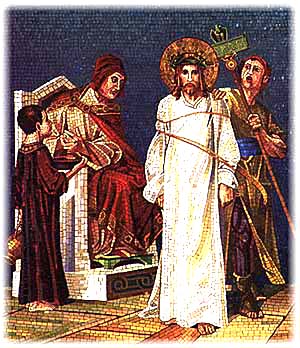
“Station III”, painting by Chris Gollon
Commissioned in 2000 by
St. John on Bethnal Green, London

Scripture Passage:  Matthew 7:25
The rain fell, the floods came, and the winds blew and beat on that house, but it did not fall, because it had been founded on rock.

The third station of this Way of the Cross is the image of Jesus falling under the weight of the cross.  It is one of the non-Canonical stations and yet we know that the sheer exhaustion alone would be enough to make this a reality for any human.  That’s right.  Lest we forget, Jesus was human.  God did not come to earth to live as a figure resembling one of our super heroes, above the fray, untouchable, undaunted by the difficulties of human life.  No, God came as one of us, struggling and vulnerable.  And as Jesus falls, we feel that vulnerability.  It is uncomfortable for us.  After all, if this one on whom we rely, in whom we place all of our hopes and our dreams, is vulnerable, what does that say about out own lives?

Maybe the crux of this Walk is that we ARE supposed to be vulnerable.  Living a life of faith does not place some sort of impermeable bubble around us.  Regardless of what many will tell you, walking this walk does not guarantee that you will be healthy, wealthy, and wise.  If anything, it points to our vulnerability in the most profound way.  As humans, we will at times experience sadness, despair, and the deepest grief imagineable.  We experience those not because we are weak but because we are real.  And Jesus experienced the same thing because he, too, was real.  And, when you think about it, what kind of God is it who will plunge the Divine Self into the deepest of despair and the vulnerability?  It is the kind of God that does more than pull us out of it but rather lays at the bottom of it all and cradles us until it subsides.  But we will only experience that when we allow ourselves to be vulnerable, when we allow ourselves to be real, when we finally allow ourselves to need others, to let them in to our darkness.

This depiction of Jesus falling under the weight of the Cross affirms that vulnerability is part of us.  It also compels us toward the vulnerable, the hurting, the outcast, for it is there that we will find in ourselves empathy and compassion, and, finally, a Love greater than we thought we could have.  If we allow ourselves to be vulnerable, we will be able to see the same in others.  We are not called to become a Super Hero; we are called to cross boundaries and be Christ for others when they need it the most and, perhaps with even greater faith than that, we are called to let others into our grief and pain.  We are the ones who both lift the fallen and allow ourselves to be lifted.  Sometimes we will fall.  Sometimes life will hurt.  But we are never there alone.  But it takes great faith to know that.

Jesus will fall two more times on this Walk.  Life goes on.

Grace and Peace,

Shelli  

Come to the Waters

This Week’s Lectionary Passage:  Isaiah 55: 1-9
Ho, everyone who thirsts, come to the waters; and you that have no money, come, buy and eat! Come, buy wine and milk without money and without price.2Why do you spend your money for that which is not bread, and your labor for that which does not satisfy? Listen carefully to me, and eat what is good, and delight yourselves in rich food.3Incline your ear, and come to me; listen, so that you may live. I will make with you an everlasting covenant, my steadfast, sure love for David.4See, I made him a witness to the peoples, a leader and commander for the peoples.5See, you shall call nations that you do not know, and nations that do not know you shall run to you, because of the Lord your God, the Holy One of Israel, for he has glorified you.  6Seek the Lord while he may be found, call upon him while he is near;7let the wicked forsake their way, and the unrighteous their thoughts; let them return to the Lord, that he may have mercy on them, and to our God, for he will abundantly pardon.8For my thoughts are not your thoughts, nor are your ways my ways, says the Lord.9For as the heavens are higher than the earth, so are my ways higher than your ways and my thoughts than your thoughts.

Most of us do not really know what it means to thirst.  I mean, really, really thirst.  After all, the shortage of clean water in many parts of the world is lost on us.  We just go to the faucet (or the automatic water spout in our refrigerator door or the waiting bottle of water in the bottom fridge door).  Thirst, real thirst, eludes us.  But Timothy Shapiro claims that “hope is preceded by longing”.  You see, God is not requiring us to be right or moral or steadfast.  I don’t think that God is even requiring us to lay prostrate at the feet of God in good, old-fashioned repentance.  God’s only requirement is that we thirst for God, that we desire to be with God so much that we can do nothing else but change our course and follow God.  It is our thirst that draws us closer to God and closer to each other.  We just have to desire something different enough to be part of making it happen.

So, what happens with those of us for whom thirst can be so easily quenched?  How do we learn to hope at the deepest part of our being if we never truly long for anything?  How do we discover what true need is when we often live our lives over-filled and over-served? How do we hunger for something better in a life where we are so satisfied?  Perhaps that is why people like us need this season of Lent, plunging us into the depths of human need and profound grief.  Maybe the point of it all is to teach us how to thirst and, therefore, to show us that for which we long.

God’s abundance, God’s quenching of thirst, God’s feeding of hunger is greater than anything that we can offer ourselves.  But those of us whose lives are already filled to the brim, already stuffed beyond what we need and beyond what we can really manage, often convince ourselves that we need nothing more.  There is nothing more that we can cram into our time or our budget or our houses or our bellies or our lives.  And, yet, we are never satisfied.  Maybe what we’re missing is not something else to fill us; maybe what we’re missing is the longing for something that we cannot quite grasp.  But that longing, that deep, deep, profound longing will only come when we realize that we cannot fill it.  In other words, we do not need something more; we need to learn to thirst, to long. 

So, in this Lenten season, let us clear away the things with which we have filled ourselves and learn to thirst–really thirst.  And there we will find our true hope.

Grace and Peace,

Shelli 

Blivet

Scripture Passage:  Acts 17: 22-25
22Then Paul stood in front of the Areopagus and said, “Athenians, I see how extremely religious you are in every way.23For as I went through the city and looked carefully at the objects of your worship, I found among them an altar with the inscription, ‘To an unknown god.’ What therefore you worship as unknown, this I proclaim to you.24The God who made the world and everything in it, he who is Lord of heaven and earth, does not live in shrines made by human hands,25nor is he served by human hands, as though he needed anything, since he himself gives to all mortals life and breath and all things.

Do you know what a blivet is?  No, I didn’t either.  It is an undecipherable figure, an optical illusion, an impossible object.  It is a figure whose ending and beginning seem to blend together and are yet impossible to reconcile, impossible to separate.  The U.S. Army uses the same word to refer to “an unmanageable situation”.   A blivet cannot be explained, cannot be imagined, and cannot be figured out.  It is totally anathema to our world, where everything has to be explained, planned, and carried out.

Perhaps Lent is our blivet season.  It throws us off a bit.  After all, it counters everything we know. It’s a lot like God.  We want to know God; we strive to know God.  And, yet, God remains elusive to us, sort of a “blivet”, if you will.  Now don’t get me wrong–I don’t think that God is playing some colossal game of hide-and-seek.  God is not TRYING to remain unknown. God is not unknown; we just don’t know how to know God.   In fact, don’t you think God desires to be made known, desires for us to get so close to the Godself that we know God?

We like to think of God as omniscient, omnipresent, omnipotent, and unchangeable (sorry, couldn’t come up with an “omni” for that)  And yet, maybe those depictions short-change us and, in turn, short-change God.  God does not want,- I think, to be “omni” anything.  God instead calls us to be knowing, to be present, and, if the truth be known, God gave up that omnipotent thing to free will.   God is powerful, yes.   But God gave up a part of the Godself for us and a part of the all-powerful Godself to us, to our free will, to our humanity.

I know…this doesn’t really make sense.  Maybe we have a blivet God, who gives the illusion of being omnipotent and omnipresent and omni-everything but instead created the very likeness of the Godself (yes, that would be us!) to be that way, the essence of who God is throughout the earth.

So, in this Lenten season, let us walk this way and be the image of this omni-everything God.

Grace and Peace,

Shelli
 

Station II: Take Up Your Cross

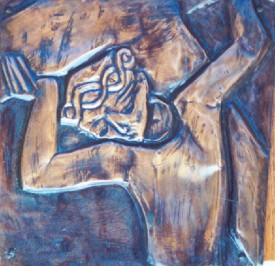
Copper Plate Depicting Station II
Samarpan Spiritual Leadership Center
Poway, CA

Scripture Passage:  Luke 9: 18-24
18Once when Jesus was praying alone, with only the disciples near him, he asked them, “Who do the crowds say that I am?”19They answered, “John the Baptist; but others, Elijah; and still others, that one of the ancient prophets has arisen.”20He said to them, “But who do you say that I am?” Peter answered, “The Messiah of God.”21He sternly ordered and commanded them not to tell anyone,22saying, “The Son of Man must undergo great suffering, and be rejected by the elders, chief priests, and scribes, and be killed, and on the third day be raised.”23Then he said to them all, “If any want to become my followers, let them deny themselves and take up their cross daily and follow me.24For those who want to save their life will lose it, and those who lose their life for my sake will save it.

The second station of the Via Dolorosa depicts Jesus taking up his cross.  Tried in a sham trial and condemned to death, Jesus is handed the heavy blocks of wood that have been hastily bound together.  What began as God’s creation pushed through from the soil has been taken and turned into an instrument of death.  So, Jesus takes up his cross.  The gates of the fortress open and Jesus is pulled to his feet and handed the heavy wood.  He begins to walk what would become known as the Way of the Cross, the Way of Sorrows, the Via Dolorosa.  He passes through the gate.  There is no turning back.

We are told to take up our cross and follow.  Surely that doesn’t mean this!  Surely the Gospel writers meant it metaphorically, meant that we shoul learn to be like Jesus, to follow his example.  It can’t mean this.  Surely we’re not supposed to take this literally!  So, what does that mean to take up our cross then?  If Jesus was nothing more than an example of how we’re supposed to live, we could have just as easily followed Mother Teresa or someone else that did a really good job of being a human.  And when you think about it, Jesus kept getting himself into trouble.  He continuously broke the rules and there are indications in the Gospel accounts that he may possibly have dealt with some anger management issues.  So, how do we follow THAT?  We deny ourselves, take up our cross, and follow.  Now?  Now, when things are not going well?  NOW we’re supposed to follow?

Jesus was not just an example of how to live; Jesus was the very embodiment of the Way to God.  And this Way of the Cross, this way of sorrows, this Via Dolorosa is part of that.  It is not rational to us; it doesn’t make sense.  But Jesus didn’t come to make sense; Jesus came to show us the Way to Life.  Being a disciple, a follower of Christ has little to do with behaving (Thanks be to God!).  Being a disciple means that we take all of this life that we hold dear, all of this life with which we’ve surrounded ourselves, all of these rules and all of these “right” way of doing things and lay them aside.  And we begin walking–through the gate, into the mystery of something that we don’t understand.  In essence, we walk into the unknown carrying nothing but our faith.   We deny ourselves and open our eyes to what God has placed before it.  That is our Way; that is our Cross.  And we walk this Way of the Cross.  It means more than following; it means becoming the very Way itself.  It means yielding ourself to the mystery that is beyond what we know and becoming who we were always meant to be.  It will take us through every aspect of life–through darkness and light, through suffering and joy, through doubt and faith.

It is not an easy way.  The cross is heavy.  The rough-hewn wood is splintering into my skin. Those along the pathway that are yelling and jeering make it even more painful.  This was not what I had planned.  I never thought that it would turn out like this.  I mean, I had so much more to do.  But I will go because I know that I do not walk this way alone.  Life as we know it is not all bathed in light.  Perhaps the darkness ensues at times to show us that God is there, even there, in the darkness, walking with us.  And I also know that somewhere down this road, there is more Light and more Love and more Life than anything that I could have conjured up.  And somewhere it will all make sense.  But, for now, I will take up my cross and walk this Way.

http://www.youtube.com/watch?v=IUFJJ-5K_LY&feature=player_detailpage

Grace and Peace,

Shelli

Jerusalem, Jerusalem…

This Week’s Lectionary Passage:  Luke 13: 31-35
31At that very hour some Pharisees came and said to him, “Get away from here, for Herod wants to kill you.”32He said to them, “Go and tell that fox for me, ‘Listen, I am casting out demons and performing cures today and tomorrow, and on the third day I finish my work.33Yet today, tomorrow, and the next day I must be on my way, because it is impossible for a prophet to be killed outside of Jerusalem.’34Jerusalem, Jerusalem, the city that kills the prophets and stones those who are sent to it! How often have I desired to gather your children together as a hen gathers her brood under her wings, and you were not willing!35See, your house is left to you. And I tell you, you will not see me until the time comes when you say, ‘Blessed is the one who comes in the name of the Lord.’”

Jesus is in Jerusalem.  It is the holy city, the city of dreams of what God holds for all of the earth, the city of holiness and Presence, the City of God.  This city is supposed to be, for all practical purposes, Ground Zero for the coming of the Kingdom of God into this world.  But Jesus stands and looks out over the crying stones and the suffocating walls.  The life that could have been is being snuffed out as we speak and replaced with the fear of something different, the fear that they might lose what they have gathered and attained, the fear of not being in control.  And so the stones cry out and Jesus laments.  “Jerusalem, Jerusalem, for you knew the plan that I had for you…”  And the clouds gather and the city darkens just a bit.  No one really notices it at that point.  No one sees what is coming.  Jesus laments alone–on his knees, before the city that he loves, lamenting for what could have been, what should have been, what will never be again.

We all know how it ended.  This was only the beginning.  The storm clouds would continue to gather until they hovered over the death of the world and then in that fateful moment, they clashed and broke apart, shaking the earth with rage and despair and plunging it into darkness.  Jerusalem, Jerusalem.  What happened?  Just a short time ago, we had such vision, such hope.  We dared to dream dreams.  There was a star that hovered above us lighting our way.  But now…what happened?

And so we sit here 2,000 years later–21 centuries of dreaming dreams and hoping hopes and imagining that we could make the world different.  Oh, it’s not that bad.  Some things have changed.  Little by little we dare to let go just a bit and give God room to spin the world into something that we can’t even imagine.  Did you see that Mississippi ratified the 13th amendment?  I think things are looking up.  Supposedly inspired by the movie “Lincoln”, Mississippi finally filed the final ratification of the 13th amendment banning slavery that was originally approved 148 years ago.  OK, so it takes time…Jerusalem, Jerusalem….Jesus looks out over the Kidron Valley toward Jerusalem and at the same time looks out over the oceans of the world at our cities, looks out at a world that drags its feet to welcome the stranger and washes its hands of justice and mercy…Jerusalem, Jerusalem…

But Jesus’ lament is not a regret.  It is a challenge.  This lament is a reminder to get our house in order.  That’s all Jesus really wanted.  I don’t think he was under any sort of misconception that this was going to happen overnight or even in a little over 30 years.  The truth is, God calls us and when we do not respond, God does not reject us; instead, God surely laments.  And even through the Sacred Eyes now blurred by Divine Tears, God, with open arms, once again invites us home.  Lent calls us to remember that, to remember that even when we make other plans, even when we lose our focus, and even when we completely reject what God is doing, God is always there, always calling us to return.  But until we realize that, we’ll never find our way. 

Grace and Peace,

Shelli
 

Station I: Condemned

Scripture Passage: Luke 23: 20-25
20Pilate, wanting to release Jesus, addressed them again; 21but they kept shouting, “Crucify, crucify him!” 22A third time he said to them, “Why, what evil has he done? I have found in him no ground for the sentence of death; I will therefore have him flogged and then release him.” 23But they kept urgently demanding with loud shouts that he should be crucified; and their voices prevailed. 24So Pilate gave his verdict that their demand should be granted. 25He released the man they asked for, the one who had been put in prison for insurrection and murder, and he handed Jesus over as they wished.

It has begun.  Our recognition of Christ’s Passion is not just relegated to those few heartwrenching hours on Good Friday or even to the few fast-moving days leading up to it.  Christ’s Passion actually began years ago in a small grotto or stable in Bethlehem.  Now do not think that I am one of those that thinks that God sent Christ to our little earth for the sole purpose of dying.  I just can’t see a God who is that cold and calculating.  Christ was not sent here to die but to live and to, at the same time, show us how to do the same. That was the point. 

And yet, even as early as the moment when Herod heard of the possibility of Jesus’ existence and ordered him (and all of the other male children of that age) killed, Jesus was condemned.  Actually, I think you can go back farther than that.  I mean, really, think about it–born in a barn or something to parents that really sort of appear to be illegal immigrants in sort of a no-name town just outside of the hustle and bustle of the holy city.  Jesus came into this world alien, poor, and condemned.  So this condemnation of Pilate’s, sparked on by those in majority rule, those who were trying desperately to maintain life as they knew it, is yet another step in this walk of a sadly condemned Christ.

This first Station of the Cross begins at the Praetorium, the court of law, located in the Fortress of Antonia, north of the Temple Mount.  Pilate is depicted as the accuser and, yet, if it had really been left up to him, Jesus would have been flogged and sent home.  But Pilate was swept into a whirlwind of political and personal agendas.  Jesus was essentially a victim of the conflicts of a society in chaos as its members postured to place themselves higher and stay ahead of the game.  After all, this man was expecting us to change!  So as the crowd became louder and louder as they tried to get the last word, Pilate had no choice but to hand down the sentence that would change the world.

We stand in awe of Jesus.  We are amazed at one who can hold so true to their convictions.  And we blame Pilate and the crowd and the disciples.  (I mean, really, where ARE they???)  And yet, where would we be?  Where would you be?  Would you have put your financial security, your reputation, perhaps even your life on the line to stand up for the condemnation of the innocent, to speak out in the way God calls you to speak?  DO you ever do that?  I have to confess that I fall embarrassingly short of that calling.  Jesus has been condemned to death and we stand not really knowing what to do next.  And so we sit quietly in the warmth of our comfortable lives while the world goes on.

On this Lenten journey, let us truly walk this Way of the Cross by speaking out for the condemned, by standing up for what is right, by being Christ in the world.  Let us finally kneel at the manger and worship Emmanuel, God With Us.  Let us find room this time.

Grace and Peace,

Shelli

How To Be a Good Citizen

This Week’s Lectionary Passage: Philippians 3:17-4:1
17Brothers and sisters, join in imitating me, and observe those who live according to the example you have in us.18For many live as enemies of the cross of Christ; I have often told you of them, and now I tell you even with tears.19Their end is destruction; their god is the belly; and their glory is in their shame; their minds are set on earthly things.20But our citizenship is in heaven, and it is from there that we are expecting a Savior, the Lord Jesus Christ.21He will transform the body of our humiliation that it may be conformed to the body of his glory, by the power that also enables him to make all things subject to himself.  4Therefore, my brothers and sisters, whom I love and long for, my joy and crown, stand firm in the Lord in this way, my beloved.

So what does it mean to be a good citizen?  I mean, we’re taught that beginning when we’re young, right?  Well, according to Paul, it all depends on where one’s citizenship lies.  Essentially, he is laying out two realities–one that surrounds his hearers on this earth and the other, the other is the way to live authentically, the way to live as God calls us to live.  It is a depiction of a life of holiness. 

Now we need to understand here that the people of Philippi were Roman citizens who took this very seriously. Philippi was a Roman, rather than a Greek, colony.  But not everyone was a citizen.  “Citizenship” was not a right.  It was not earned or claimed.  It was something that came with birthright only.  So, their power came through their rights as natural and inherited citizens.  But Paul is claiming to them that they have a much more significant citizenship waiting for them.  It is essentially a redefinition of their very identity.  And this citizenship did not carry a distinction of either class or birthright.  It was open to all.  This was indeed a new citizenship and one founded on the cross.  It is a relationship based on others (as opposed to the self-centered “god in one’s belly” type of life).  It is a citizenship that is not inherited but is rather lived.  It is based on humility and self-sacrifice, just as Jesus Christ lived.  It is a holy and sacred citizenship.

The problem is that you can’t really do both.  We’re not talking about some sort of dual citizenship here.  Paul is claiming that one is either a citizen of this world or a citizen of that vision of what the world could be that God holds. But I don’t think that it’s a clear “either-or” choice either.  (Don’t you hate that?  Isn’t that just the way this walk of faith keeps working?) After all, part of being a “citizen” in this way of Christ is to live in THIS world.  So, basically, we are not choosing to reject the world but rather to live as resident aliens in it, to live as citizens of a world yet to come in a world that is yet to change. (Hmmm!  That just sort of makes your head spin, doesn’t it?)  Yes, we are called to live in a world that expects us to adopt its customs and speak its official language, to worship and vote in the way that the majority expects, and to live quietly and good and productive citizens.  And yet, our calling as followers of Christ has nothing to do with any of that.  It is about living a life that welcomes the diversity that is humanity, that speaks out for the least and the last and against the injustices that this world holds, and living not as merely productive beings but as those who are alive.  And the rights of this citizenship?  That’s easy–it’s the right to live, to be, to love, to become.  It’s the right to come alive and it belongs to us all. 

So, what is the pathway to that citizenship?  It is this…this Way that we’re on, this Way that makes us come alive. So in this Season of Lent, come alive!  What does it mean to live in this world as a citizen of a world to come?

Grace and Peace,

Shelli