Advent 4A: A Little Bit of Water and a Ritz Cracker

Ritz CrackersLectionary Epistle for Reflection:  Romans 1: 1-7

Paul, a servant of Jesus Christ, called to be an apostle, set apart for the gospel of God, which he promised beforehand through his prophets in the holy scriptures, the gospel concerning his Son, who was descended from David according to the flesh and was declared to be Son of God with power according to the spirit of holiness by resurrection from the dead, Jesus Christ our Lord, through whom we have received grace and apostleship to bring about the obedience of faith among all the Gentiles for the sake of his name, including yourselves who are called to belong to Jesus Christ, To all God’s beloved in Rome, who are called to be saints: Grace to you and peace from God our Father and the Lord Jesus Christ.

First of all, this has to be the king of run-on sentences.  Perhaps Paul was not one for taking lots of breaths.  Or was he almost in a panic-state trying to get the words out?  It was as if his audience was somehow drifting away, heading down a road that he did not think was good, leaving Paul behind in a sense.  So, Paul, with more words than a sentence could hold, went chasing after them.  Whatever it is, Paul is reminding his hearers to whom they belong.  Maybe it was his way of trying to call them away from the lure of the world, from what Paul saw as an almost competing society, a competing way of living and being.  See, these people probably had no problem seeing themselves as belonging to Christ, as part of Christ’s kingdom.  I mean, they were new believers.  They were excited.  They were still pumped up from that first evangelical moment that they had experienced.  And yet, there was the Roman Empire looming large around them.  It was hard to refuse.  Who are we kidding?  It was dangerous to refuse.  One could quickly lose everything.

Now I don’t think Paul really wanted them to leave it all behind.  After all, his own identity as a Jew in the Roman Empire was important to him.  He just wanted them to see something different.  He wanted them to see something bigger.  He wanted them to realize that it was not that the Roman Empire was where they belonged now and the Kingdom of God was where they were going; rather, the two existed together.  He wanted people to understand that the Kingdom of God was not the “other way”, not the veritable opposite of the way they were living but rather the “Thing” that encompassed the “thing”.  And maybe they belonged to both things.  (I mean, in our own context, patriotism is not anti-God; it just has the possibility of developing into sort of a misplaced devotion that competes with our spiritual selves.)  All that we are and all that we have and all to which we belong belongs to God.  It is the way God lays claim on us, bursting into our lives as we know them, pouring the very Godself into each and every crevice of our lives until all (yes, ALL) is recreated in the Name of Christ.  We are called not to choose between Christ and the world but to bring Christ to the world.

The other day I baptized a young child that was eating a Ritz cracker through the whole thing. Now, we don’t usually pass out hor’dourves with the Sacraments, but, really, did that change God’s Presence in that moment?  For that matter, who’s to say that it didn’t make that Presence more real?  (OK, so maybe I’m not as much of a sacramental purist as you thought!)  God’s presence and God’s promise comes wherever one is.  Our calling is to respond to that presence in the midst of the lives we lead.  But that entails learning to see and listen in a way that many of us do not.  We need to appreciate how God calls others into being so that we might be able to better discern our own unique way that God is entering our lives.  And the Ritz?  Well, who hasn’t eaten a Ritz? (And, for me, a little peanut butter)  It is not part of the “other” way of living.  All that we have and all that we are belongs to God.  And, you know, that little bit of water that I sprinkled onto that child’s head does not exist in a vacuum.  The choice is not to choose the water or the Ritz.  The choice is not to choose God or empire.  The choice is to follow God through all that is and all that we encounter, to open oneself to becoming new not instead of the old but as even it is made new.

In this Advent season, we have walked in the wilderness.  We have encountered darkness.  We have waited and waited for God to make the Godself known to us.  Maybe that for which we’ve waited was here all along–in the wilderness, in the darkness, in the Empire.  Maybe God’s Presence is found in all of it when we learn to see, when we learn to open ourselves to possibilities.  Maybe God’s Presence is not some big, flashy extravaganza like we’ve been expecting.  Maybe it’s been there all along, sort of like a little bit of water and a Ritz cracker, or maybe more like a baby born into a world that was not ready, that was never ready, a world that couldn’t move over and make room.  Advent is not about welcoming a King; Advent is about making room for a God who comes into our ordinary lives as an ordinary person into an ordinary place and makes it all extraordinary.  Advent is a lot like eating a Ritz cracker through a Holy Sacrament.

Reflection:  What are you expecting God’s Presence to be?  What is the most ordinary thing that you see right now?  Where might God’s Presence in it?

Grace and Peace,

Shelli

Traveling Mercies

Mary and Joseph Journeying to BethlehemScripture Passage for Reflection:  Luke 2: 1-5

In those days a decree went out from Emperor Augustus that all the world should be registered. This was the first registration and was taken while Quirinius was governor of Syria. All went to their own towns to be registered. Joseph also went from the town of Nazareth in Galilee to Judea, to the city of David called Bethlehem, because he was descended from the house and family of David. He went to be registered with Mary, to whom he was engaged and who was expecting a child.

The journey has begun.  We know the drill.  We’ve seen the pictures of the very-pregnant Mary on the donkey with a worn-out Joseph leading the way on the road to Bethlehem.  We know the story.  They were going to Bethlehem, to the city of Joseph’s ancestors.  Now there are reputable scholars that claim that more than likely the writers of Luke and Matthew’s Gospels were mistaken.  There was not,after all, a requirement to return for this registration and so, perhaps, Jesus was actually born in Nazareth (as in the “Jesus of Nazareth”) or EVEN in a small town outside of Nazareth called Bethlehem of Galilee, a Roman-Byzantine town in the northern part of the Jezreel valley.  (Again, does it matter?)  But to make this story work with all the Christmas carols and the myriads of Nativity scenes, they need to go to Bethlehem of Judea.  And so it becomes our journey.

Jezreel ValleyThe 80-100 mile journey probably would have taken about 8 days if Mary was truly bouncing along on some sort of equine creature. So in the second day of their journey, they would have entered the Jezreel valley south of Nazareth and journeyed along the hills of Samaria.  It’s really a foreign concept to us, this traveling of about 10 miles a day or so through weather and wild animals and the certain threat of bandits and thieves as they neared what was essentially foreign territory for them.  But I’ve always had this sense that they did not travel alone but rather were accompanied by other family members, townspeople, or others that would have joined them along the way.  Sadly, I guess I envision traffic!  I mean, after all, this thing didn’t happen in a vaccuum.  Life was going on even in that moment. And life includes traffic!

That’s the way journeys are.  We seldom travel alone.  Together, we begin to let go of what we know, leave behind our securities and all things familiar.  We try to come prepared, packing as many provisions as this poor donkey can hold. And then we try our best to make our way through the sometimes-rough terrain.  So, why do we go through this?  Well, have you ever noticed that the entire Bible is full of people on the move, migrating from one country to another, from one way of being to another?  I mean, it started with that garden story when, essentially, Adam and Eve were moved on for whatever reason.  And Abraham, well he was like the journeying king, dragging his family across miles and miles of land in search of a promise.  In fact, that was the whole deal.  You know, “if you’ll leave your country and journey to a place that you’ve never seen and that you don’t know, this is all going to turn out.” (or something like that).  And then Moses, ah…Moses…dragging hoards of people through wilderness wanderings for 40 or so years.  Are you sensing a pattern here?  Maybe it’s not about where we are headed but the journey itself.  After all, we know this whole Bethlehem tale.  We know that they’ll get there and there won’t be a place.  There’s never a place.  None of these people built a mansion and settled in the gated communities of their lives.  They kept going, sometimes making it and sometimes never seeing the place to which they were journeying.

Our journey is no different.  There’s never a place.  You see, God does not call us down roads that are paved with our plans and our preconceptions.  God calls us instead to travel through the wilds of our lives, to journey with our eyes open that we might see this new thing that God is doing.  T.S. Eliot once said that “the end of all our exploring…will be to arrive where we started…and know the place for the first time.”  There’s never a place.  We never really “arrive”.  The journey does not end. It’s always new, re-created.  That’s the point.   After all, even Mary and Joseph turned and made their way home.  But they were never the same again.  And the baby that is coming?  Well, he was never meant to settle down and stay put.  And there was never really room for him at all.  God didn’t intend to show us how to build a house; God revealed the journey home and threw in traveling mercies on the way. So, let us go and see this thing that the Lord has made known to us!

God travels wonderful paths with human beings; God does not arrange matters to suit our opinions and views, does not follow the path that humans would like to prescribe for God.  God’s path is free and original beyond all our ability to understand or to prove.  (Dietrich Bonhoeffer, in Christmas With Dietrich Bonhoeffer, Manfred Weber, ed.)

Reflection:  What will you take on your journey?  What should you leave behind?  How do you envision your journey today?

Grace and Peace,

Shelli

Advent 4A: All of the Above

Winding PathLectionary Old Testament Passage for Reflection:  Isaiah 7: 10-16

Again the Lord spoke to Ahaz, saying, Ask a sign of the Lord your God; let it be deep as Sheol or high as heaven. But Ahaz said, I will not ask, and I will not put the Lord to the test. Then Isaiah said: “Hear then, O house of David! Is it too little for you to weary mortals, that you weary my God also? Therefore the Lord himself will give you a sign. Look, the young woman is with child and shall bear a son, and shall name him Immanuel. He shall eat curds and honey by the time he knows how to refuse the evil and choose the good. For before the child knows how to refuse the evil and choose the good, the land before whose two kings you are in dread will be deserted.

During this season of Advent this year, we have read texts that get louder and louder with prophetic messages of what is to come.  This is the thing of which Christmas’s are made.  And now we read of the signs and wonders that were shown to the House of David.  “Here, listen people, there is a young woman with child.  She shall bear a son and the world will change.”  That’s essentially what it says.  But wait a minute!  We always read this as a prophetic sign of what will come, a prophet’s vision of the coming of Christ, Immanuel.  But, read it again.  This is in the present tense.  The young woman IS with child.  (as in already)  So, which is it?  Is it a child born immediately after this writing or are we talking about the birth of Jesus?  After all, the writer known as Matthew depicted it differently.  Is it then or is it later?  Yes.  All of the above.

The sign is a child.  The child’s name, Immanuel (or “God with us”) reinforces the divine promise to deliver the people from sure demise.  The child is born of a young woman, the Hebrew “almah”, which means a young woman of marriageable age.  Many scholars think that the young woman may have been Ahaz’s wife and her son the future king Hezekiah.If the author had wanted to depict the woman as a virgin, the word “betulah” would have been used.  But in the Greek translation of the Old Testament, the word was translated as “parthenos” or “virgin”.  So the writer of The Gospel According to Matthew understood the verse as a prediction of the birth of Jesus.  And then all those translators that came after that capitalized on that notion, perhaps in an effort to explain the unexplainable, to rid the text of the ambiguities that were probably meant to be there in the first place.

So, which is it?  Is it a virgin or a young woman?  Is it talking about Hezekiah or Jesus?  Is it what the writer known as Isaiah probably wrote or what the writer known as Matthew assumed or what the later redactors translated?  Yes.  All of the above.  The text and, indeed, the whole Bible is ambiguous at best.  Who are we kidding?  Faith is ambiguous.  It encompasses surety and doubt, light and darkness, life and death.  I don’t really get wrapped up in what “really” happened.  It doesn’t bother me if this is actually talking about Hezekiah.  But it was part of the Matthean writer’s tradition.  It meant something to him.  Somewhere in the words, in the text of his faith, he saw God.  He felt God.  To him, it mean Immanuel.  And so what better way to depict the first century nativity story that we love?  The coming of God WAS foretold–over and over and over again–through sacred stories told and shared by a waiting people.  It continues to be told, the story of God who breathed Creation into being, who entered the very Creation that held the God-breath, and who comes into each of our lives toward the glorious fulfillment of all that was meant to be.

I don’t think that God ever intended to lay it all out for us like some sort of lesson for us to memorize.  God doesn’t call us to have it all figured out but rather to live it, to open our eyes to all the sign and wonders of the world, to all the ways that God walks with us, to all the ways that God calls us to follow, to become.  All of the above, the obvious and the ambiguous, are part of the Truth that God reveals (whether or not our human minds can fathom it as “true”).  We are about to begin our journey to Bethlehem.  It is a road that is filled with ambiguities–loss and finding, sorrow and joy, fear and assurance, doubts and fears, a manger and a cross.  But along the way are signs of the God who is always with us, Immanuel, who carries us from moment to moment and from eon to eon with the promise of new life.  Let us go and see this thing that the Lord has made known–you know, all of the above.  It is this for which we were made.

If God’s incomprehensibility does not grip us in a word, if it does not draw us into [God’s] superluminous darkness, if it does not call us out of the little house of our homely close-hugged truths…we have misunderstood the words of Christianity. (Karl Rahner)

On prisoners of darkness the sun begins to rise, the dawning of forgiveness upon the sinner’s eyes, to guide the feet of pilgrims along the paths of peace, O bless our God and Savior with songs that never cease. (Michael Perry)

Reflection:  What are the things that are ambiguous for you in the story?  How do they really change the story for you?

Grace and Peace,

Shelli

A Pondering Faith


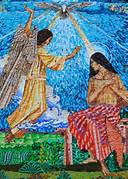
Church of the Annunciation, Nazareth, Israel

Scripture Passage for Reflection:  Luke 1: 26-35

In the sixth month the angel Gabriel was sent by God to a town in Galilee called Nazareth, to a virgin engaged to a man whose name was Joseph, of the house of David. The virgin’s name was Mary. And he came to her and said, ‘Greetings, favoured one! The Lord is with you.’* But she was much perplexed by his words and pondered what sort of greeting this might be. The angel said to her, ‘Do not be afraid, Mary, for you have found favour with God. And now, you will conceive in your womb and bear a son, and you will name him Jesus. He will be great, and will be called the Son of the Most High, and the Lord God will give to him the throne of his ancestor David. He will reign over the house of Jacob for ever, and of his kingdom there will be no end.’ Mary said to the angel, ‘How can this be, since I am a virgin?’* The angel said to her, ‘The Holy Spirit will come upon you, and the power of the Most High will overshadow you; therefore the child to be born* will be holy; he will be called Son of God.

So, what does it mean to ponder?  If you read this Scripture, it does not mean thinking something through until you understand it or until you “get it”.   Nowhere does it say that Mary was ever completely sure about what was going to happen.  Nowhere does it say that she ever stopped asking questions, that she ever stopped pondering what this would mean for her life.  Nowhere does it say that she expected this turn of events.  When you think about it, Mary was probably just like the rest of us.  She probably pretty well had her life figured out.  She was just trying to live it.  And then this angel shows up.  “Excuse me Mary, I know that this might be a little out of the box for you but I need you to stop everything that you’re doing and listen.  God has something special just for you.  See, if it’s not too much trouble, we’d like you to birth the Savior, the Son of God and the Son of Humanity, Emmanual, the Messiah, the very Godself into being.  And, we’d really like to get this show on the road now.”

What if Mary had said no?  What if her fear or her plans had gotten the best of her?  What if she was just too busy planning for whatever was going to happen next in her life?  What if she really didn’t have time to do any pondering today? Now, as much as we’d like to think that we have the whole story of God neatly constructed between the covers of our Bible or on that nifty little Bible app that you have on your iPhone, you and I both know that there is lots of God’s work that is missing.  We really just sort of get the highlights.  Who knows?  Maybe Mary wasn’t the  first that God asked to do this.  Maybe she was the second, or the tenth, or the 386th.  After all, this is a pretty big deal.  I mean, this pretty much shoots that long-term life plan out of the water.  But, you see, this story is not about Mary; it’s about God.  And through her willingness to ponder, her willingness to let go of the life that she had planned, her willingness to open herself to God’s entrance into her life and, indeed, into her womb, this young, dark-haired, dark-skinned girl from the wrong side of the tracks in a sleepy little suburb of Jerusalem called Bethlehem, was suddenly thrust into God’s redemption of the world.  It is in this moment that all those years of envisioning what would be, all those visions that we’ve talked about, it is here, in this moment, that they begin to be.

Annunciation literally means “the announcement”.  The word by itself probably holds no real mystery.  But it is the beginning of the central tenet of our entire Christian faith—The Annunciation, Incarnation, Transfiguration, Resurrection.  For us, it begins the mystery of Christ Jesus.  For us, the fog lifts and there before us is the bridge between the human and the Divine.  Now we Protestants really don’t tend to give it much credence.  We sort of speed through this passage we read as some sort of precursor to “In those days a decree went out from Emperor Augustus…” so we can light our Christmas candle.  This, for us, is the typical beginning of the birth story. But think back.  Something happened nine months before.  This human Jesus, like all of us, had to be grown and nurtured in the womb before the miracles and the ministry started.  The Feast of the Annunciation is the turning point of human history.  It is in this moment, this very moment, that God steps through the fog into humanity and, just like every human that came before, must wait to be fully birthed into this world.

What about us?  When do you let yourself ponder?  When do you expect to encounter the unexpected?  What is your answer when the angel or some other God-sent character comes bursting into your life:  “Excuse me [You], I know that this might be a little out of the box for you but I need you to stop everything that you’re doing and listen.  God has something special just for you.  See, if it’s not too much trouble, we’d like you to birth the Savior, the Son of God and the Son of Humanity, Emmanual, the Messiah, the very Godself into being.  And, we’d really like to get this show on the road now.”  Again, what if Mary had said no?  So, why are we so different from that scared little girl.  So, maybe it’s time for us to get busy pondering!

Annunciation 2Mary pondered these things in her heart, and countless generations have pondered them with her.  Mary’s head is bowed, and she looks up at the angel through her lashes.  There is possibly the faintest trace of a frown on her brow.  “How shall this be, seeing that I know not a man?” she asks, and the angel, the whole of Creation, even God himself, all hold their  breath as they wait for what she will say next.

“Be it unto me according to thy word,” she says, and jewels blossom like morning glories on the arch above them.  Everything has turned to gold.  A golden angel.  A golden girl.  They are caught up together in a stately golden dance.  Their faces are grave.  From a golden cloud between them and above, the Leader of the dance looks on.

The announcement has been made and heard.  The world is with child.

Frederick Buechner, The Faces of Jesus:   A Life Story, p. 8-9

Reflection:  What is God asking you to do with your life?  What part of the story is yours to play, or yours to write, or yours to live?  When have you taken time to ponder?

Grace and Peace,

Shelli


Advent 3A: We the People

Upside Down WorldLectionary Passage for Reflection:  Luke 1:47-55
“My soul magnifies the Lord, 47and my spirit rejoices in God my Savior, for he has looked with favor on the lowliness of his servant. Surely, from now on all generations will call me blessed; for the Mighty One has done great things for me, and holy is his name. His mercy is for those who fear him from generation to generation. He has shown strength with his arm; he has scattered the proud in the thoughts of their hearts. He has brought down the powerful from their thrones, and lifted up the lowly; he has filled the hungry with good things, and sent the rich away empty. He has helped his servant Israel, in remembrance of his mercy, according to the promise he made to our ancestors, to Abraham and to his descendants forever.”

We love this passage.  It is Mary’s Song, the poetic rendering of her realization that she has truly been blessed, that she has been called to do what no one else has done, what no one else will do.  She has been called to give birth to God in this world, to deliver the promise that her people have always known.  But, lest we overly-domesticate the young girl that we know as Mary, these words attributed to her are downright radical.  This is a strong and faithful young woman who is responding to her call not just to birth a baby into the world, but to also open the doors to the eternal as it comes flooding in.  She is the forerunner, the one who opens the door that so many have tried desperately to nail shut then and even now.  She has brought God’s Presence into something that we can see, that we can fathom.  But it comes with a price.  No longer can we continue to live our lives as we have.

E. Stanley Jones called The Magnificat “the most revolutionary document in the world”.  It is said that The Magnificat terrified the Russian Czars so much that they tried to dispel its reading.  It is an out and out call to revolution.  Less subversive language has started wars.  Edward F. Marquart depicts it as God’s “magna carta”.  It is the beginning of a new society, the preamble to a Constitution that most of us are not ready to embrace.  We’d rather chalk it up to the poetry of an innocent young woman.  But this…

God will scatter the proud, those who think they have it figured out, those who are so sure of their rightness and their righteousness.  In other words, those of us who think that we have it all nailed down will be shaken to our core.  The powerful–those with money, those with status, those with some false sense of who they are above others–will be brought down from their high places.  The poor and the disenfranchised, those who we think are not good enough or righteous enough, will be raised up. They will become the leaders, the powerful, the ones that we follow.  The hungry will feel pangs no more and those who have everything–the hoarders, the affluent, those are the ones whose coffers will be emptied to feed and house the world.  God is about to turn the world upside-down.  Look around you.  This is not it; this is not what God had in mind.  And God started it all not by choosing a religious leader or a political dynamo or even a charismatic young preacher but a girl, a poor underage girl from a third-world country with dark skin and dark eyes whose family was apparently so questionable that they are not mentioned and whose marital status seemed to teeter on the edge of acceptable society.  God picked the lowliest of the lowly to turn the world upside down.

We try so hard to do things right, to do what we can to fill the needs of the world.  But the Magnificat does not call us to fix things.  It does not call us to share what think we can with the less fortunate.  It calls us to change, to turn our lives upside down.  So, who is supposed to make this happen?  We are.  You know…”We the People”.  What does this mean?  Well, you know that vision that we keep talking about?  This is it.  This is the beginning.  This is the cracking open of the locked door so it can flood into our lives and into our being.  And if we just listen, just let it be, think what it would like:

There will be no more days like today when we remember the first anniversary of the worst mass school killing in our history.   Never again will we remember 20 children and 6 adults who did not have to die before their lives were filled.  The woman who came through my neighborhood Wednesday night looking through the trash cans for food will have more than the meager pasta and sauce and peanut butter and apples and bananas and crackers that I hastily threw in a bag for her.  No more soldiers and no more children that were just in the wrong place at the wrong time will die in needless violence as we fight for control of this world or attempt to insure that weapons of mass destruction will not be used against us.  There will be no more illness or death because someone could not afford medical care or because they live in a place that does not provide it.  There will be no young people who cannot get a good and solid education with the best resources and technical support that our world and our brains now offer.  Our earth will no longer cry in pain as we consume resources beyond what we need and throw the rest away.  And each of God’s creatures–human and others–will have what they need and the relationships that they need to become what God calls them to be.  In other words, everyone will know, finally, that they have a home.

Aren’t we supposed to be looking toward Christmas?  Isn’t this supposed to be a joyous time?  Why in the world, you ask, am I depressing everyone?  Because, you see, God did not wait to come into the world until everything was right.  God chose instead to come and show us how to be who we were created to be.  And that, that is pure joy beyond anything that we can imagine.  That is our blessing.  Now it’s our turn…“We had the option to do nothing, or to do something.  And then when you think of it like that, we didn’t have any options.” (Mark Barden, whose 7-year old son, Daniel, was killed at Sandy Hook Elementary one year ago today.)

We the People…in Order to form a more perfect Union, establish Justice, insure domestic Tranquility, provide for the common defence, promote the general Welfare, and secure the Blessings of Liberty to ourselves and our Posterity, do ordain and establish this Constitution…

Blessed be the God of Israel, who comes to set us free;
he visits and redeems us, he grants us liberty.
The prophets spoke of mercy, of freedom and release;
God shall fulfill his promise and bring his people peace.

(Michael A. Parry)

Reflection:  What part of God’s vision are you called to bring?  What in your life do you need to turn upside down?  In other words, what do you plan to do with this life you’ve been given?

Grace and Peace,

Shelli

Advent 3A: Not Quite What We Were Expecting

995-103100Lectionary Gospel Passage for Reflection:  Matthew 11: 2-11

When John heard in prison what the Messiah was doing, he sent word by his disciples and said to him, “Are you the one who is to come, or are we to wait for another?” Jesus answered them, “Go and tell John what you hear and see: the blind receive their sight, the lame walk, the lepers are cleansed, the deaf hear, the dead are raised, and the poor have good news brought to them. And blessed is anyone who takes no offense at me.”  As they went away, Jesus began to speak to the crowds about John: “What did you go out into the wilderness to look at? A reed shaken by the wind? What then did you go out to see? Someone dressed in soft robes? Look, those who wear soft robes are in royal palaces. What then did you go out to see? A prophet? Yes, I tell you, and more than a prophet. This is the one about whom it is written, ‘See, I am sending my messenger ahead of you, who will prepare your way before you.’ Truly I tell you, among those born of women no one has arisen greater than John the Baptist; yet the least in the kingdom of heaven is greater than he.

We usually think that we have it all figured out.  We walk through our lives with grand plans and grand illusions of what the world should look like and what we should look like to the world.  John was no different.  He loved Jesus, loved the things that Jesus represented–freedom, peace, righteousness.  And so he had set to work telling everyone how he saw it.  But then all of a sudden, he realized that Jesus was doing things differently. Essentially, what Jesus was doing was not in the mold of what John had envisioned.  John was going around preaching repentance in the face of what was surely the Kingdom of God coming soon.  And here was Jesus healing and freeing and raising the dead.  John probably didn’t see it as wrong—just sort of a waste of time.  After all, in his view, there were people that needed redeeming, and redeemed NOW!  We need to get busy. “Jesus, really, this was not quite what we were expecting!”  So, he asks Jesus, “OK, are you the one who is to come, or are we to wait for another?”  (As if to imply that we may need to wait for someone that will get this show on the road and make everyone get on board the way we think it should be.)

Well, the truth as we know it is that Jesus WAS Emmanuel, Jesus WAS God Incarnate, Jesus WAS the Savior for which the world had waited for so long.  The problem was that the world (and even John) could not see Jesus standing right in front of them because they were too busy looking for what they had expected.  They had expected a mighty warrior.  (Well, where was he?)  They had expected a king to whom everyone would box.  (Well, that wasn’t happening!)  They had expected someone who would clean things up and make life easier.  (And you want me to do WHAT?  Hob-knob with the unacceptables and give up my place to those who haven’t worked for it and share my fortune with the less fortunate and essentially begin to go back down the ladder of progress to find what I’ve been missing?)  Truth be told, the world was expecting a warrior politician and got a baby.  Surely, THIS can’t be right!  I mean, really, how can we put our trust and our faith in one who is essentially one of us?  So, should we wait for another?

A few years ago, the Today Show had a feature story about some young Panda bears who had been brought up in captivity.  But the plan was to eventually return them to their natural habitat.  So, in order to prepare them for what was to come, their caretakers thought that it would be better if they had no human contact.  So to care for them, the people dressed up like panda bears.  In order to show them how to live the way they were supposed to live, they became them.  Well, isn’t THAT interesting!  I think that’s been done before!  In its simplest form, the Incarnation is God’s mingling of God with humanity.  It is God becoming human, dressing up like a human, and giving humanity a part of the Divine.  It is the mystery of life that always was coming into all life yet to be.  God became human and lived here.  God became us that we might see what it means to change the world.   God became like us to show us what it meant for us to be like God in the world.  The miracle of the birth of the Christ child is that God now comes through us.

Jesus really didn’t “fit in”.  Jesus was not anything that any of us were expecting.  That’s the whole point.  Perhaps Jesus calls us to be what the world does not expect.  God did not come into this world to calm and affirm how well we were conducting things.  God came to show us a different way of living, a different way of being.  God came as one of us, Emmanuel, God With Us, to show us how to be one of us, to show us how to be human, fully human.  Who would have ever come up with that?  That was NOT what we were expecting.  Because you see, the miracle of God is here, dwelling in our midst, dwelling in us.  This is the mystery of the redemption of the world.

This text speaks of the birth of a child, not the revolutionary deed of a strong man, or the breath-taking discovery of a sage, or the pious deed of a saint.  It truly boggles the mind:  The birth of a child is to bring about the great transformation of all things, is to bring salvation and redemption to all of humanity.  As if to shame the most powerful human efforts and achievements, a child is placed in the center of world history.  A child born of humans, a son given by God.  This is the mystery of the redemption of the world; all that is past and all that is to come.  All who at the manger finally lay down all power and honor, all prestige, all vanity, all arrogance and self-will; all who take their place among the lowly and let God alone be high; all who see the glory of God in the lowliness of the child in the manger:  these are the ones who will truly celebrate Christmas. (From Christmas With Dietrich Bonhoeffer, ed. By Manfred Weber)

Reflection:  So, what were you expecting?  Where is God in your midst today?  What is God calling to be?

Grace and Peace,

Shelli

What God is About to Do

HorizonPassage for Reflection:  Isaiah 65: 17-18

For I am about to create new heavens and a new earth; the former things shall not be remembered or come to mind. But be glad and rejoice forever in what I am creating; for I am about to create Jerusalem as a joy, and its people as a delight.

I know…more visioning.  I guess that’s where I am this year.  I’m sorry if you were tuning in hoping to feel good about where you are!  No really, I don’t think God is disappointed in us; God just wants the best for us.  Isn’t that just like God?  There is nothing wrong with where we are.  I love this earth.  I love this country.  I love this state and the fact that I’m generations into it.  I love this city.  I love St. Paul’s.  I love my house.  I love my life.  But in case you think I am nothing more than an annoying cheerleader, I also count on the fact that there is always something more, something just over the horizon.  I think that Advent does a good job of reminding us of that horizon, reminding us that what we have and what we hold is really not “it”.  No, regardless of where we think we’ve been headed, we have not “arrived”.

This passage for today is not some unrealistic pipe dream.  It is not something that slashes our view of the life that we’ve created.  It just shows us something more.  It is real.  It is what God is about to do–maybe not tomorrow, maybe not next week, maybe not even in the next ten centuries.  But we are people of faith.  We are people of what God, always, is about to do.  The question is do we live our lives holding on to what we have or do we live our lives looking for what God is about to do.

There is a Native American tale of a chief who had three sons.  He knew that he was nearing the end of his life and had not yet decided which of his sons would succeed him as chief.  So, he gathered them together and pointed to a mountain in the distance.  “I want you to journey to that mountain, climb to its summit, and bring back the thing you think will be most helpful in leading our people”.  After several days, the first son returned with a load of flint stones, used to make arrow tips and spear points.  He told his father, “Our people will never live in fear of their enemies.  I know where there is a mountain of flint.”  The second son climbed to the top of the mountain, and found forests rich with wood for making fires.  When he returned, he said to his father, “Our people will never be cold in winter.  I know where wood can be found in abundance to keep them warm and to cook their food.  The third son returned late and empty-handed.  He told his father, “When I got to the summit, I found nothing worth bringing back.  I searched and searched, but the top of the mountain was barren rock and useless.  Then I looked out towards the horizon, far into the distance.  I was astonished to see new land filled with forests and meadows, mountains and valleys, fish and animals—a land of great beauty and perfect peace.  I brought nothing back, for the land was still far off and I didn’t have time to travel there.  But I would love to go there someday; I delayed coming back because I found it very difficult to return after seeing the beauty of that land.”  The old chief’s eyes blazed.  He grasped his third son in his arms, proclaiming that he would succeed him as the new chief.  He thought to himself, “The other sons brought back worthy things, necessary things.  But my third son has a vision.  He has seen a better land, the promised land, and he burns with the desire to go there.”

As I said, this is not something that God is dangling out there like some sort of teaser knowing that we will never reach it.  God really means for us to glimpse what God is about to do, to move toward it, to love and desire it so much that we can do nothing else but go toward it.  I do not know what my future holds.  None of us do.  But I know that just over the horizon is something so incredible that I burn with desire to go there.  It is the place that God means for me to go.

Today is the twelfth day of Advent.  (Wait, wasn’t that supposed to be the twelfth day of Christmas?)  We are halfway through this waiting, halfway through this season that calls us to put a hold on our plans, to look to the horizon, to strain and squint for a glimpse, just a glimpse of what will be.  Today is the twelfth day of the twelfth month.  The symbolic meaning of twelve is completeness, whole.  That’s right.  The vision has not come to fruition, but that doesn’t mean that it is not complete.  It is there, just as it should be, just over the horizon.  And now…now we will start living into what we see.  Because, you see, it is about what God is about to do…

Reflection:  What does that place just over the horizon look like to you?  What would you give up to take the time to go toward it?  What do you see that God is about to do?

Grace and Peace,

Shelli