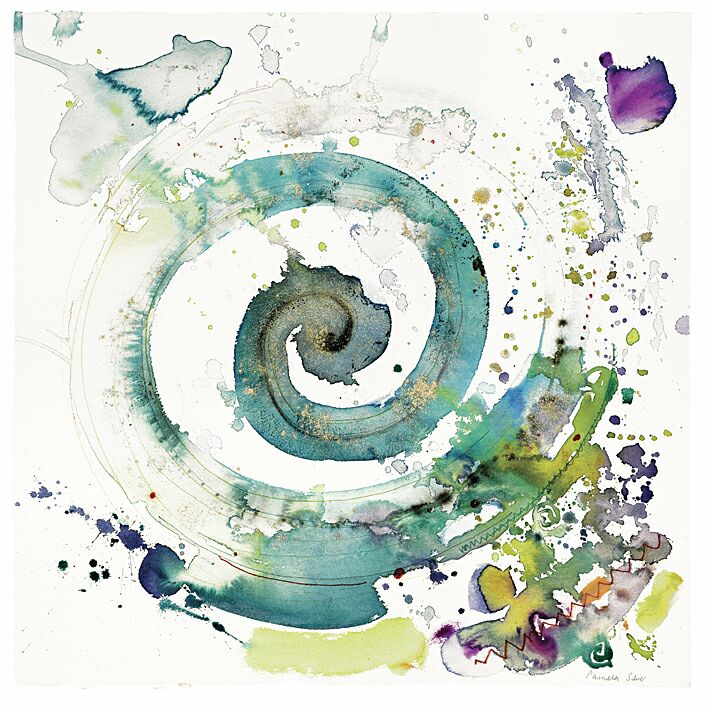
Widening Circles

"Circles in the Sand", by Pamela Silver, 2002

Scripture Passage:  John 4: 5-26 (Lent 3A)

So he came to a Samaritan city called Sychar, near the plot of ground that Jacob had given to his son Joseph.Jacob’s well was there, and Jesus, tired out by his journey, was sitting by the well. It was about noon.A Samaritan woman came to draw water, and Jesus said to her, “Give me a drink.”(His disciples had gone to the city to buy food.) The Samaritan woman said to him, “How is it that you, a Jew, ask a drink of me, a woman of Samaria?” (Jews do not share things in common with Samaritans.)Jesus answered her, “If you knew the gift of God, and who it is that is saying to you, ‘Give me a drink,’ you would have asked him, and he would have given you living water.” The woman said to him, “Sir, you have no bucket, and the well is deep. Where do you get that living water? Are you greater than our ancestor Jacob, who gave us the well, and with his sons and his flocks drank from it?” Jesus said to her, “Everyone who drinks of this water will be thirsty again, but those who drink of the water that I will give them will never be thirsty. The water that I will give will become in them a spring of water gushing up to eternal life.” The woman said to him, “Sir, give me this water, so that I may never be thirsty or have to keep coming here to draw water.” Jesus said to her, “Go, call your husband, and come back.” The woman answered him, “I have no husband.” Jesus said to her, “You are right in saying, ‘I have no husband’; for you have had five husbands, and the one you have now is not your husband. What you have said is true!” The woman said to him, “Sir, I see that you are a prophet. Our ancestors worshiped on this mountain, but you say that the place where people must worship is in Jerusalem.” Jesus said to her, “Woman, believe me, the hour is coming when you will worship the Father neither on this mountain nor in Jerusalem. You worship what you do not know; we worship what we know, for salvation is from the Jews. But the hour is coming, and is now here, when the true worshipers will worship the Father in spirit and truth, for the Father seeks such as these to worship him. God is spirit, and those who worship him must worship in spirit and truth.” The woman said to him, “I know that Messiah is coming” (who is called Christ). “When he comes, he will proclaim all things to us.” Jesus said to her, “I am he, the one who is speaking to you.”

In this season of Lent, we have already read several stories of journeying and movement from one place to another.  We have read of people that have all been called to something new.  Several years ago, I had the opportunity to lead a discussion with the a UMW group on “Immigration and the Bible”.  It’s based on a book with that same name by Joan Maruskin that was published to be a 2013 UMW study (that’s United Methodist Women for you non-Methodists!).  Now, that “immigration” word is, for us, probably nothing less than a lightning bold word.  It is so politically charged nowadays that most of us shy away from it.  But the truth is, it is what the Bible is about.  The Bible is about movement.  It begins with God’s Spirit moving across the face of the earth and ends with a depiction of a city, a New Jerusalem, moving from heaven to earth.  And in between, we read stories of people continuing to be uprooted.  They move from one place to another seeking safety and sanctuary and we are continually given reminders of how we are called to welcome the stranger into our midst.  The Bible is a story of movement and a story of welcome.  And along the way, the call is not to build and prosper but to encounter each other and enter each other’s lives.

But each of us in this world works hard to preserve our perceived image of what that world should be—a world where our political views, our boundaries we have drawn, our wealth and possessions we hold, our standard of living and our understanding of who God is remain intact.  The problem is that our need to preserve ourselves usually gets in the way of our ability to connect with others, our ability to encounter the rest of God’s children.  Because if each of us is waiting for the other to respond in love first, then love will never be the response and the walls of hatred become stronger and more difficult to tear down.

Take the relationship between the Samaritans and the Jews.  Both believed in God.  Both had a monotheistic understanding of the one true God, the YHWH of their shared tradition of belief.  But where the temple of YHWH for the Jews existed on Mount Zion in Jerusalem, the Samaritans instead believed the Scriptures supported the worshipping of God on Mount Gerizim near the ancient city of Shechem.  And with that, a new line of religious understanding was formed.  The Samaritans believed that their line of priests was the legitimate one, rather than the line in Jerusalem and they accepted only the Law of Moses, The Torah, as divinely inspired, without recognizing the writings of the prophets or the books of wisdom.  These differences between the two peoples probably began as early as one thousand years before the birth of Christ and what started as a simple religious division, a different understanding of how God relates to us and we relate to God, eventually grew into a cultural and political conflict that would not go away.  The tension escalated and the hatred for the other was handed down for centuries from parent to child over and over again.

So here is this woman depicted as a stranger, an outcast, a Samaritan.  And here is Jesus breaking all of the boundaries of traditional and accepted Judaism.  First, he, unescorted, speaks to a woman.  In the Talmud, the rabbis warned that conversing with women would ultimately lead to unchastity.  In fact, Jose ben Johanan, of Jerusalem, who lived around 160 B.C., wrote, “He that talks much with womankind brings evil upon himself and neglects the study of the Law and at the last will inherit Gehenna (or the destination of the wicked). ”  (Wow! That sounds pretty serious!) Secondly, Jesus speaks to a woman of questionable repute.  Now, in all probability, this woman was probably just a victim of some form of Levirite marriage gone bad, where she had been handed in marriage from relative to relative as her husbands died, leaving her penniless and out of options.  And, finally, Jesus speaks to the so-called “enemy”.  The truth is, there is nothing about this woman that is wrong or sinful or anything else that we try to tack on her reputation.  The woman was just different.  Her life had been difficult.  She lived in darkness and had no way out of it.  And the most astonishing thing is that this seemingly low-class Samaritan woman who is not even given a name in our Scriptures becomes the witness to the Gospel of Jesus Christ.  Because, you’ll notice, Jesus did not just ask her for a drink.  He engaged her in conversation about spiritual matters.  Once again, the Gospel is found not in Jerusalem and not on Mt. Gerizim and not even in whatever faith community you call “yours”, but in our shared existence as part of this “new humanity”.  The Gospel is found in our encounter with each other.  Here, too, Jesus enters a new phase of his ministry.  Up until this point, Jesus’ encounters have been pretty ethno-centric.  But, here, the Gospel begins to spread to other ethnicities and other peoples.  It begins to include an encounter with the world.

For most of us, our problem is that we are always waiting for someone else to make the first move toward acceptance and reconciliation.  But Jesus did not wait.  Jesus stepped into encounter.  That is what we are called to do.  We are called to go forward on an unpaved road to meet the other. We are called to somehow reach through our prejudice and even our fears and take each other’s hand.  We are called to cross boundaries, rather than constructing them.  We are called to reach through our differences and find our common, shared humanity, all children of God, all made in the image of God.  That is the way that peace is found—one hand at a time.  And that is the way that we encounter Jesus Christ.

Putting this study of “Immigration and the Bible” together, I began to see a new pattern emerge in the Scriptures—well, new for me as I read the Scriptures through a different lens.  The Biblical story is a story of God calling us to go forth and our drawing borders, walling ourselves off, protecting who we are and what we have.  God calls us to go and we draw borders.  God calls us to go and we construct gates.  God calls us to go and we build walls.  But we are called to encounter the stranger.  It is more than being welcoming.  It is more than letting them into our carefully-constructed lives.  It means entering their life and completely opening ours to them.  It means that they become us and we become them.  It means that we encounter each other.

We are in the middle of this season of Lent.  It IS the season of wandering, the season of the wilderness journey.  We always begin Lent with Jesus going into the wilderness, leaving what he knows, leaving the comforts of home.  And I think that part of the reason for that, is that we are called to be wanderers, aliens, and sojourners.  We do not stand in one place waiting for others to come to us.  The Christian journey is always moving us toward something, so we go the way that God calls us to go and along the way, we gather the children of God.  We encounter each other. As Jesus once said, “Go to the street corners and invite to the banquet anyone you find.”  In other words, go and encounter each other because that is how you encounter Christ.

I live my life in ever-widening circles that reach out across the world.  I may not complete this last one but I give myself it it. I circle around God, around the primordial tower.  I’ve been circling for thousands of years and I still don’t know:  am I a falcon, a storm, or a great song? (Rainer Maria Rilke)

We are almost one-third of the way through our Lenten journey.  At this point, where are you circles drawn?  Which ones need to be widened?

Grace and Peace,

Shelli

The Downside of Having Skin


Scripture Passage:  Romans 5: 1-11 (Lent 3A)

Therefore, since we are justified by faith, we have peace with God through our Lord JesusSuffering and Tears Christ, through whom we have obtained access to this grace in which we stand; and we boast in our hope of sharing the glory of God. And not only that, but we also boast in our sufferings, knowing that suffering produces endurance, and endurance produces character, and character produces hope, and hope does not disappoint us, because God’s love has been poured into our hearts through the Holy Spirit that has been given to us.  For while we were still weak, at the right
time Christ died for the ungodly. Indeed, rarely will anyone die for a righteous person—though perhaps for a good person someone might actually dare to die. But God proves his love for us in that while we still were sinners Christ died for us. Much more surely then, now that we have been justified by his blood, will we be saved through him from the wrath of God. For if while we were enemies, we were reconciled to God through the death of his Son, much more surely, having been reconciled, will we be saved by his life. But more than that, we even boast in God through our Lord Jesus Christ, through whom we have now received reconciliation.

This is one of the hardest Scriptures for us (or at least the part of “us” that is “me”).  What do you mean suffering results in hope?  That can’t be right.  I mean, suffering=bad, hope=good.  Everyone knows that.  Isn’t that how it works?  But suffering is a part of life.  It doesn’t mean that you did something wrong.  It certainly doesn’t mean that God is sitting off somewhere doling out suffering like it’s some sort of giant card game.  And, please, DO NOT tell me that God would never give me more than I can handle. (aaaggghhh!)  What are we all supposed to get some sort of ration of suffering?  No, that’s not the way it happens at all.  Suffering just happens.  It happens because it is part of life.  We do not live as mechanical robots.  Suffering is part of the richness and profundity of life.  Maybe it’s the downside of having skin, of being created, of being real.  We all have needs.  Sometimes life is just too much.  (And sometimes it’s not enough.)  But will all suffer.  And where is God?  There…there in the midst of the suffering.  Suffering reveals the heart of God.

Almost twenty years ago, I had the opportunity to visit Auschwitz, Poland.  I expected to be appalled; I expected to be moved; I expected to be saddened at what I would fine.  I did not expect to become so personally or spiritually involved.  As you walk through the concentration camp, you encounter those things that belonged to the prisoners and victims that were unearthed when the camp was captured–suitcases, eye glasses, books, clothes, artifical limbs, and shoes–lots and lots and lots and lots of shoes–mountains of humanity, all piled up in randomness and namelessness and despair.  This is the epitome of suffering.  This is humanity at its worst.  This is humanity making unthinkable decisions about one another based on the need to be in control, based on the need to be proven right or worthy or acceptable at the expense of others’ lives, based on the assumption that one human is better or more deserving than another.  It is something that in this divisive and vitriolic climate, we need to think about, to perhaps revisit what happened in what seems another world but is in THIS century of humanity.

And yet, God CHOSE to be human.  God CHOSE to put on skin, temporarily separating the Godself from the Holy Ground that is always a part of us, and enter our vulnerability.  God willingly CHOSE to become vulnerable and subject to humanity at its worst.  God CHOSE the downside of having skin.  Now maybe God was having an off day when that divine decision was made, but I think it was because beneath us all is Holy Ground.  God came to this earth and put on skin and walked this earth that we might learn to let go, take off our shoes, and feel the Holy Ground beneath our feet.  God CHOSE to be human not so we would learn to be Divine (after all, that is God’s department) but so that we would learn what it means to take off our shoes and feel the earth, feel the sand, feel the rock, feel the Divine Creation that is always with us and know that part of being human is knowing the Divine.  Part of being human is being able to feel the earth move precariously beneath your feet, to be vulnerable, to be tangible, to be real, to take on flesh, to put on skin, to be incarnate.  Part of being human is making God come alive.

Suffering exists.  It always exists.  Right now, there are people living in fear in Syria with no place to go.   There are young persons in North Korea that have seen what freedom can be and are craving it.  (Look at Flash Drives for Freedom.  What a cool thing!) There are people in Africa who do not know from where their next meal come.  Maybe we could stand a little reframing from Paul too.  For us, suffering is a failure; within the vision of God, suffering holds hope for newness.  Because in the midst of suffering, just like in the midst of everything else, we find God.  God walks with us through it, loving us and holding us, perhaps even revealing a way out of it, if we would only listen, and gives us a glimpse of what is to come.  The suffering of the world reveals the heart of God, reveals the holiness that is, if we will only look.  It doesn’t explain it; it doesn’t make it easier; it just reminds us that it is not the final chapter.  Maybe it’s the downside of having skin, which means that you are human, a child of God, made in the image of God, with so much more ahead.

In this season of Lent, we once again walk toward the Cross, with the drums of discord, still this moment far in the distance, growing louder with each step.  This season lasts for forty days.  But those forty days do not include the Sundays of Lent.  Known as “little Easters”, they are opportunities to glimpse and celebrate the Resurrection even in the midst of darkness.  They are reminders that even in this season of Christ’s Passion and Death, their is always a light on the horizon.  Resurrection always comes.  But it’s not a fix; it’s not a reward for the most powerful; it’s what happens when God’s love is poured into our hearts.

Look back from where we have come.  The path was at times an open road of joy.  At others a steep and bitter track of stones and pain.  How could we know the joy without the suffering?  And how could we endure the suffering but that we are warmed and carried on the breast of God? (Archbishop Desmond Tutu)

On this Lenten journey, do not avoid the hard times, but live them, embrace them, make them yours.  And find in them hope for the journey.

Grace and Peace,

Shelli

Deep Waters

Diving into watersScripture Passage:  Ephesians 3: 18-19

I pray that you may have the power to comprehend, with all the saints, what is the breadth and length and height and depth, and to know the love of Christ that surpasses knowledge, so that you may be filled with all the fullness of God.

What does it mean to “go deep”?  (No, I’m not talking about a football pass.)  Depth is a hard thing for many of us to master.  Depth takes time.  Depth takes patience.  Depth is allowing oneself to essentially go beyond where one is comfortable standing.  So many in our culture tend to be content to sort of skirt along the shallow surface, always in a hurry, always trying to move forward, never standing long enough to be able to sink into the depths that call us forth.  Standing in shallow waters feels safe, controlled.  But going deeper gives one insights into newness.  It is a return to the place from which we came.

Think about the earth.  Its surface is beautiful, more beautiful than any of us can even articulate.  But beneath that beauty is oh, so much more.  Just dig into the earth a bit.  That hard sun-bleached dirt on top gives way to that first level of top soil.  It is darker, more full of nutrients.  But dig a little deeper.  Dig into the rich dark earth that rests below that, capable of holding what is good longer, capable of holding water long past any drought.  It’s the reason that deep watering systems are so optimal.  The slow watering drives the water down deep into that rich soil underneath that is capable of holding the water.  And the slow watering encourages the roots of the plants to go deeper, to rich down beyond themselves, beyond what they were initially capable of doing, to be watered continuously by the deep, dark earth.  But there is more beneath that.  Beneath all that dirt are layers upon layers from which we have learned to extract nutrients and fossil fuels that give us energy and much, much more than what we could ever obtain from the surface that we see.

Our life is no different.  What we see is beautiful but it’s just the surface.  We need to go deeper, to delve into the rich, dark earth that brings us life.  I have to admit that our religious traditions often do not encourage us to do that.  We seem to be more worried that the church service might run a little long.  So there seems to be some level of contentment at just skirting along the surface of the meaning of faith.  Maybe it’s because it’s easier.  Maybe it’s because it’s safer. Maybe it’s because deep down (pun intended), we’re all a little afraid of the unknown or the questionable or the difficulties that deep discussion brings about.  Maybe we’re afraid we’ll be left with more questions than answers.  (ACTUALLY, I can tell you that will probably be the case.)  And I don’t really think that we should shy away from going deeper for fear that those new to the tradition will not “understand”.  I think we all want to be challenged.  We want to learn.  We want to traverse the never-ending nuances that make up our faith, the pathways that lead us to God.  But it takes time.  It is not a really good sermon or an overnight retreat project or a short-term study series or even 36 weeks of Disciple I.  It is rather a lifetime of swimming downward into the deep waters of one’s soul.  There is no bottom but rather an infinite depth that we are called to traverse, growing as we go.

The Lenten season is by its very nature one of descent.  It is one of going deep, journeying deep within oneself to a place that is often successfully hidden from view.  It is the way of transformation, a search beyond what we know.  When I was little, I think I had this image of God high above me, looking down.  I assumed that I was supposed to rise above where I was.  I have now realized that I must go deep.  God has in all of us a deep well of living water.  We are called not to just perch on its edge and look down into it, but to plunge deep, immersing ourselves in the questions of faith.  Our finite minds cannot truly wrap themselves around the unfathomable depths of God’s love.  So we have to live it, breathe it, become it.

Every question in life is an invitation to live with a touch more depth, a breath more meaning. (Joan Chittister)

On this Lenten journey, think of those places where you are just skirting the surface of life.  Do not hold back.  Go deep, dive into the deep waters of God. 

Grace and Peace,

Shelli

To Thirst

ThirstyScripture Passage:  Exodus 17: 1-7 (Lent 3A)

From the wilderness of Sin the whole congregation of the Israelites journeyed by stages, as the Lord commanded. They camped at Rephidim, but there was no water for the people to drink. The people quarreled with Moses, and said, “Give us water to drink.” Moses said to them, “Why do you quarrel with me? Why do you test the Lord?” But the people thirsted there for water; and the people complained against Moses and said, “Why did you bring us out of Egypt, to kill us and our children and livestock with thirst?” So Moses cried out to the Lord, “What shall I do with this people? They are almost ready to stone me.” The Lord said to Moses, “Go on ahead of the people, and take some of the elders of Israel with you; take in your hand the staff with which you struck the Nile, and go. I will be standing there in front of you on the rock at Horeb. Strike the rock, and water will come out of it, so that the people may drink.” Moses did so, in the sight of the elders of Israel. He called the place Massah and Meribah, because the Israelites quarreled and tested the Lord, saying, “Is the Lord among us or not?”

Life in the wilderness is, obviously, precarious.  They have put their trust in God and in Moses and here they are in the middle of the desert, the hot sun beating down upon them.  There is no water anywhere.  It seems to many that God has all but deserted them.  They had done exactly what they were told and now they thought they would surely die in the desert.  And poor Moses.  All he can do is listen to the complaining that is directed right at him.  But what could he do?  He can’t make water.  He can’t command the skies to rain.  He probably wishes that he could just run away.  After all, whose idea was it to make him the leader anyway?  He is surely questioning how he got into this mess.

This is not some sort of metaphorical thirst.  They were thirsty–really, really, parched and dry thirsty; there was no water.  Thirst is perhaps the deepest of human physical needs.  What does it mean to thirst for the things you need the most?  It’s hard for us in the Western part of the globe to even imagine.  (As I write this, I actually got thirsty and went and filled a glass with filtered spring water from Kroger.)  And yet, 780 million people lack access to clean and healthy water.  That’s about 1 in 9 people in the world or about 2 1/2 times the population of the United States.  Lack of access to clean water and sanitation kills children at a rate equivalent to a jumbo jet crashing every four hours.  And, amazingly, an American taking a five-minute shower uses more water than the average person in a developing country slum uses for an entire day.  Thirst is real.

So did you know that in 2016, the sale of bottled water actually surpassed the sale of other soft drinks.  Well, aren’t we enlightened?  But as we fill our recycle bins with plastic water bottles, what does this mean for us?  For what do we thirst?  Again, don’t think of it as metaphorical.  It is real.  Maybe it’s not physical, but it’s real. For what do you thirst?  For security?  For a life of ease and plenty?  For things to just make a little more sense?  Do you thirst for life as you’ve planned it?  Do you thirst for righteousness?  For justice? For peace?  For meaning?  How many of us simply thirst to be alive, truly alive, in the deepest depth of our being?  Being alive is thirsting for God, thirsting for the one who can walk us through grief and shadows and even death and give us life.  It means that we thirst for the one who thirsts for us.  Thirsting is the thing that makes us real.

Dag Hammarskjold wrote in his journal the words, “I am the vessel, the draught is God’s.  And God is the thirsty one.”  God is thirsty.  God’s love for each of us is so deep, so intense, so desiring our response that it can only be characterized as a thirst. God, parched and dry, thirsts for our thirst.  So, is the Lord among us or not?  God knows everything about you.  The very hairs of your head are numbered.  Nothing in your life is unimportant to God.  God has always been with you, always loved you, and always yearned for you to come into the awareness of God’s Presence in your life for which we strive, that sense of needing something more in the deepest part of you, so much that it leaves you parched without it.  And, ironically, it means letting go of the need to quench your thirst.  Because it is thirst for God that this journey is about.  Ironically, we are not questing to quench it but to live it, to open ourselves to the waters that hold God’s creative Spirit.  To thirst is to be.  To thirst is to know in the deepest part of our being that we need God.  To thirst is to be alive.

I thirst for you.  Yes, that is the only way to even begin to describe my love for you:  I thirst for you.  I thirst to love and be loved by you—that is how precious you are to me.  I thirst for you.  Come to me, and fill your heart and heal your wounds…Open to me, come to me, thirst for me, give me your life—and I will prove to you how important you are to my heart.  Do you find this hard to believe?  Then look at the cross, look at my heart that was pierced for you…Then listen again to the words I spoke there—for they tell you clearly why I endured all this for you:  I thirst.  Come to me with your misery and your sins, with your trouble and needs, and with all your longing to be loved.  I stand at the door of your heart and knock.  Open to me, for I thirst for you. (Mother Teresa of Calcutta)

Then he bowed his head and gave up his spirit.  I thirst.

On this Lenten journey, I pray that you thirst.  I pray that you experience the deepest and most profound human need that you’ve ever experienced.  I pray that you will know what it means to thirst for God.  Because that is where you will most fully encounter God.  But while we fill our recycling bins with plastic water bottles and quench our thirst with filtered waters from refrigerator doors, I implore you to be a part of projects to bring clean and sustainable water to areas of the world that do not have what we have, to those that truly experience physical thirst.  There are many.  If you feel so inclined, I would encourage you to visit the website for the United Methodist Committee on Relief (Advance # 3020811 is raising funds for the construction of wells to improve drinking water and build toilets in Liberia, Africa.)  Think about it, what if you donated one dime for every glass of water you drank?  Do what you can where you can. 

To donate, click here (and for United Methodists, make sure and enter your church so the church can get credit for the donation.)


Grace and Peace,

Shelli


Unsaid

The Sound of SilenceScripture Passage: Psalm 62: 1a

For God alone my soul waits in silence.

We are not generally a silent people.  Even in the quietness of our homes, there is noise–lots and lots and lots of noise.  (Because a few minutes ago, Maynard the Black Lab was noisily demanding something–still not sure what!) Silence seems to elude us.  On some level, it takes a lot of time and that is a hard thing to come by. And, to be honest, in my world, I’m not even sure it exists.  There is always something making noise.  So how does my soul wait in silence?  How does my soul find that rhythm that it so desperately needs, the natural rhythm of noise and silence.  Maybe we could employ some of that white noise that is supposed to drown out other noises.  Would that work?  But isn’t that just more noise–a special noise designed to drown out other noise?  We work hard at honing our communication skills.  And yet, communication is not just about talking; it’s about that rhythm of expression and listening, of noise and silence.  We need silence sometimes.  It is part of the rhythm of life.  Mother Teresa of Calcutta once said that “we need to find God, and [God] cannot be found in noise and restlessness.  God is the friend of silence.  See how nature–trees, flowers, grass–grows in silence; see the stars, the moon, and the sun, how they move in silence…we need silence to be able to touch souls.”

So, why is silence so hard to find?  Are we unsure of ourselves, a little reticent about what we might hear, perhaps a little fearful of what we might be asked to do? So, we try to fill the emptiness with noise.  Now, to be honest, I’m not sure that “pure” silence really exists.  There’s always something making noise.  Perhaps “keeping silence” is more about returning to a natural level of noise than it is stopping all noise itself.  In her book, When God is Silent, Barbara Brown Taylor talks about an experience by composer John Cage’s time in an anechoic chamber (a room without echoes).  With his perfect hearing, he picked up two distinct sounds–one high and one low.  When he described them to the engineer in charge, he was told that the high sound was his nervous sytem in operation, and the low one was his blood in circulation.  Noise is part of life.  Keeping silence is not about existing in pure silence; it is about living in pure life, in Creation.  And yet, most of us live most of our lives in noise–artificial noise, the noise of the world, rather than the noise of Creation.

If you go back and read the story of Creation, it began in silence.  I think it probably began in “pure” silence, in a void (implying that perhaps “pure” silence is not meant to exist at all).  And then God spoke us (along with everything else) into being.  In her book, Taylor says, “in his poetic eulogy “The World of Silence”, the French philosopher Max Picard says that silence is the central place of faith, where we give the Word back to the God from whom we first received it.  Surrendering the Word, we surrender the medium of our creation.  We unsay ourselves, voluntarily returning to the source of our being, where we must trust God to say us once again.”

In this Lenten journey, we talk about journeying, about surrendering. We talk about re-aligning our lives with what God envisions for us, and we talk about change.  But maybe the part we’re missing is where we don’t talk–I mean, INTENTIONALLY, enter into silence.  Shhhhh!  Let God say you into being again. (And now I’m going to quit talking!)

There is nothing so much like God in all the universe as silence. (Meister Eckhart)

At this point in your Lenten journey, just be silent.  Just listen.  Just wait to be unsaid.

Grace and Peace,

Shelli

The Path of the Wind

WindScripture Passage: John 3: 1-17 (Lent 2A)

Now there was a Pharisee named Nicodemus, a leader of the Jews. He came to Jesus by night and said to him, “Rabbi, we know that you are a teacher who has come from God; for no one can do these signs that you do apart from the presence of God.” Jesus answered him, “Very truly, I tell you, no one can see the kingdom of God without being born from above.” Nicodemus said to him, “How can anyone be born after having grown old? Can one enter a second time into the mother’s womb and be born?” Jesus answered, “Very truly, I tell you, no one can enter the kingdom of God without being born of water and Spirit. What is born of the flesh is flesh, and what is born of the Spirit is spirit. Do not be astonished that I said to you, ‘You must be born from above.’ The wind blows where it chooses, and you hear the sound of it, but you do not know where it comes from or where it goes. So it is with everyone who is born of the Spirit.” Nicodemus said to him, “How can these things be?” Jesus answered him, “Are you a teacher of Israel, and yet you do not understand these things? “Very truly, I tell you, we speak of what we know and testify to what we have seen; yet you do not receive our testimony. If I have told you about earthly things and you do not believe, how can you believe if I tell you about heavenly things? No one has ascended into heaven except the one who descended from heaven, the Son of Man. And just as Moses lifted up the serpent in the wilderness, so must the Son of Man be lifted up, that whoever believes in him may have eternal life. “For God so loved the world that he gave his only Son, so that everyone who believes in him may not perish but may have eternal life. “Indeed, God did not send the Son into the world to condemn the world, but in order that the world might be saved through him.

This is a hard one.  More of us are probably a lot more like Nicodemus than we care to admit.  I don’t think that there’s any question that he was smart, well-learned even.  He was a rabbi, a teacher of all things Scriptural and all things of faith.  He knew what questions to ask and we should give him the benefit of the doubt that he was continuing to probe and explore.  Perhaps he wasn’t as sure anymore of his own certainty when it came to his beliefs.  But he wasn’t ready to admit it even to himself.  He wasn’t really ready to go there yet.  So he goes to Jesus in the dark of night, cloaked in mystery and secrets.  And Jesus begins to explain in the way that Jesus always does–not literally, not factually, but open-ended, inviting one not to believe what he is saying but to enter who he was.

You know, when you have a seminary degree, people often assume that you somehow spent several years of your life studying so that you will have all the answers.  Well, sadly, that would not be the case.  You see, not so sadly, seminary does not teach you the answers; it teaches you how to ask the questions.  That’s what sort of makes up faith, don’t you think–questions that leave us desiring more, questions that will not allow us to rest on the laurels of who we have figured out God is, what we have figured out God meant (Really?)  and what we have figured out God wants us to do.  Faith is what reminds us that there is always something more, always something up ahead, always a faint road that God calls us to walk not so that we will know the answers but so that we will become The Way to God.

And, interestingly enough, this calling often comes when we are at our most vulnerable, cloaked in the dark of night, so to speak.  The anonymous 14th century mystic described it as “the cloud of unknowing”, proposing that the only way to know God is to let go of what we know, to risk surrendering ego and mind and what we have “figured out”, and enter the cloud of the unknown, where we would truly know God.  (The 4th century bishop Gregory of Nyssa contended that as we journeyed deeper into faith, we entered darker and darker places and in the darkness we could finally see what needed to be seen.) That’s where Nicodemus was–still struggling, still wandering somewhat aimlessly in the darkness, still asking “how can this be?”, but beginning to know. (Not “understand”, mind you, just know.)

Jesus tells the questing rabbi that he must be born from above (or “again”, or “anew”–the Greek anothen remains ambiguous at best.)  But whatever it is, you have to let the wind blow where it chooses and just be in it.  When I read that, I thought of “riding out” Hurricane Ike in my pier and beam bungalow a couple of years ago with my mom (who didn’t want me to do that by myself) and my rather confused Black Lab.  What we realized was that, as opposed to a house with a slab that remains staid and unyielding. my house is built so that the hurricane-force winds swirls around it and UNDER it.  It just moves with the wind.  It doesn’t have to bend or push.  There were no straining or creeking walls.  It just moves.  It gives itself to the wind. (Conversely, the tornado that grazed the slab house in which I now live convinced me in that moment that the roof was going to definitely come off!  Thankfully, that did not happen–it just creaked horribly for several minutes over me and yet another confused Black Lab!)

In this Season of Lent, the winds of change are swirling all about.  We hear the sounds but we do not know its path.  We, too, must give ourselves to the wind, must enter the darkness, the cloud of unknowing, and walk, trusting that we will find ourselves in the place where we belong.  We are not always called to understand, but only to know.

Where does the wind come from, Nicodemus?  Rabbi, I do not know.  Nor can you tell where it will go. 

Put yourself into the path of the wind, Nicodemus.  You will be borne along by something greater than yourself.  You are proud of your position, content in your security, but you will perish in such stagnant air. 

Put yourself into the path of the wind, Nicodemus.  Bring leaves will dance before you.  You will find yourself in places you never dreamed of going; you will be forced into situation you have dreaded and find them like a coming home. 

You will have power you never had before, Nicodemus.  You will be a new man. 

Put yourself into the path of the wind.

      (Myra Scovel, “The Wind of the Spirit”, 1970, in Hearing God’s Call, by Ben Campbell Johnson)

In this Season of Changing Winds, what things that you have “figured out” do you need to release?  What will it take for you to let go of needing to understand?  What will it mean for you to know?

Grace and Peace,

Shelli

The Pilgrim’s Way

the_journeyScripture Passage:  Genesis 12: 1

Now the Lord said to Abram, “Go from your country and your kindred and your father’s house to the land that I will show you.

Have you ever noticed that no one spends much time standing still in the Bible?  The story begins with God breathing life into Creation and, in essence, making us a home, a place.  But it doesn’t take but a few chapters before we are on the move–aliens, immigrants, sojourners.  It’s pretty clear that God calls us to be pilgrims on this Way, traveling light and gathering all of Creation together as we move. And along the way, we hear lots of words like “sent forth” and “go” and “follow”.  We are called to be a people on the move (at least figuratively and probably even a little literally), essentially migrating from one place to the next, from one way of being to another.  And most of the time, those that came before us moved freely through their journey without a map, without real plans or even real provisions.  Most of the time they were just journeying to a place they did not know but that they knew that God would show them.

So what has happened to us?  How did we become so planted? How did our lives become so safe?  It was never that way in the beginning.  The journey of faith was a wildly unpredictable one into places unknown. The journey of faith called its travelers to be pilgrims in the wilderness, sojourners through foreign lands.  Oh, we like to think of ourselves as journeyers, particularly we Methodists who readily espouse Wesley’s notion of faith as movement, as, to coin his words, “going on to perfection”.  (Gee, there’s that “go” thing again!)  And yet, we will do everything possible to avoid getting driven to the wilderness or left without everything that we need (or at least the latest technological gadget).  We tend to separate ourselves from discomfort or inconvenience or chaos.  We stick to our plans.  But wildness and chaos often creates a certain energy.  It wakes us up; it makes us pay attention.  This week on the Today Show, Al Roker is doing some sort of “Tech Out” series, meaning not that he techs out but that he TAKES tech out.  He’s going analog and old school and EVEN vinyl.  (Remember those words?  They existed before we became so technologically advanced.  On Monday, he looked at vinyl (yes, vinyl) records.  The interesting thing is that a company that was about to go belly up a few years ago is searching for old LP printing machines because the sale of albums has surpassed the sale of streaming music this year.  Who would’ve thought THAT?  (I mean, because we’re so advanced and all.)

Maybe on some level we really DO crave wilderness.  Maybe that’s why Lent begins in the wilderness.  Have you ever noticed that when you travel you see a lot more than when you’re just driving to and from work?  Is it because there’s more to see?  Or is it that when one is unfamiliar territory, one is more aware of the surroundings, more open to seeing things as they are?  Seeing oneself as a pilgrim, a wanderer, is the same thing.  It keeps our eyes open and our minds alert.  We notice God’s Presence; we notice God’s People; we do not see ourselves as “owners” or even squatters.  We see ourselves as part of Creation.  We begin to see that we are called not to arrive but to journey.  Our faith IS the journey.  So Lent begins in the wilderness and asks us to travel deep within ourselves, beyond our preconceptions, beyond our assumptions, beyond our plans.  We go, open to what God has to show us along the way. (So, maybe it would help if we put down our smart phones just for a little while so that we could see the world!)

It may be that when we no longer know what to do, we have come to our real work. And when we no longer know which way to go, we have begun our real journey. (Wendell Berry)

So as we make this Lenten journey, what do you see?  What are you missing?  Where are you being called to go? (And does that have to involve your cell phone?)

Grace and Peace,

Shelli