17So if anyone is in Christ, there is a new creation: everything old has passed away; see, everything has become new! 18All this is from God, who reconciled us to himself through Christ, and has given us the ministry of reconciliation; 19that is, in Christ God was reconciling the world to himself, not counting their trespasses against them, and entrusting the message of reconciliation to us. 20So we are ambassadors for Christ, since God is making his appeal through us; we entreat you on behalf of Christ, be reconciled to God. 21For our sake he made him to be sin who knew no sin, so that in him we might become the righteousness of God.
We’ve read this before, this “new creation” stuff. We’ve read that God has reconciled us to the Godself through Jesus Christ. OK, now that we’ve gone over our main theology…The truth is, what does that mean? After all, we’re only humans. Right? We’re sinful and messed up and many of us have no idea what this actually means. I mean, what does it mean to be human? We read the Creation stories. God created us. Why? Was it to become something different? Was it to become better? Or are we doomed?
I think many of us tend toward Gnosticism. We imagine the notion of a good God, a God who created us as humans, as sinful, as not “of God”. We have the notion of a divine spark that might pull us out of our plight of humanity, our sinful state. But, remember, God created us. God created us as human. Do you really think God would create us as bad and then expect us to claw our way out of our created demise? That’s bizarre.
So, along came Jesus. So many of us relegate him to a super hero of sorts, a “super human” that is somehow above all this that we have to endure. Really? See, we are told that Jesus was born of a human, born as a human. Otherwise, Jesus never would have been able to reconcile us to God. Jesus came as one of us, as Emmanuel, the one among us, the one who was one of us, the one who showed us the way to be not just “merely human” but “fully human”.
Jesus was fully human and fully divine. Call it the sacred “And”, the very reconciliation of God to the Creation that God so dearly loves. THAT is our understanding of the Cross. The Cross was not a way “out”. It certainly wasn’t a punishment for being human. I don’t even think it necessarily “wipes” our sins out (oh dear, I’m going there!). For me, the Cross is the ultimate reconciliation, the new Creation. It is the place where God recreates humanity, recreates the world, finally gives us a notion as to what it means to be “fully human”. “Fully human” is not “just human” or “merely human”. “Fully human” is the way that Jesus lived, the Way that Jesus walked. “Fully human” is what we’re called to become—not “godly”, certainly not Divine”—just what we were created to be all along.
So, the breathing…Breathe out the notion that you are “merely human” or “only human”. Oh, my goodness, God created you for so much more. And breathe in the message of the Cross, that we are reconciled and made new, that God invites us and walks with us to what God intends for us to be.
Jesus didn’t come to make us Christian; Jesus came to make us fully human. (Hans RMadeleine L’Engle)
6To set the mind on the flesh is death, but to set the mind on the Spirit is life and peace. 7For this reason the mind that is set on the flesh is hostile to God; it does not submit to God’s law—indeed it cannot, 8and those who are in the flesh cannot please God. 9But you are not in the flesh; you are in the Spirit, since the Spirit of God dwells in you. Anyone who does not have the Spirit of Christ does not belong to him.
10But if Christ is in you, though the body is dead because of sin, the Spirit is life because of righteousness. 11If the Spirit of him who raised Jesus from the dead dwells in you, he who raised Christ from the dead will give life to your mortal bodies also through his Spirit that dwells in you.
So many times, this Scripture is one of those that is read as if being “human”, being “flesh” is bad, as if somehow body and spirit are not compatible existing together in Creation. That’s not the way it was intended. After all, didn’t God create us as “flesh”? For Paul, of the “flesh” is not “human”, per se, but rather a perversion of who we should be as humans. But it is the “way of the Spirit” that brings life. Without the Spirit, the essence of Life breathed into the body ultimately dies. The two belong together. God’s Spirit brings breath and life. Paul’s words are not mean to be dualistic, separating two unlike things, but, rather, transformational, depicting the salvific act of transforming sides of a whole that need each other.
We tend to get wrapped up in those things of the “flesh”—our needs, our desires, our fears. Paul is not saying that we dispense with them as bad. They are ours. Paul is making the claim that the Spirit can breathe new life into them. There is no sense in fighting to sustain our identity apart and away from God. It will ultimately die. Paul has more of a “big picture” understanding than we usually let him have. He’s saying that the flesh in and of itself is not bad but the Spirit brings it to life. I don’t think he is drawing a dividing line between darkness and light, between mind and Spirit, between death and life; rather, he is claiming that God’s Spirit has the capability of crossing that line, of bringing the two together, infused by the breath of God. It is a spirituality that we need, one that embraces all of life. It is one that embraces the Spirit of Life that is incarnate in this world, even this world. I mean, really, what good would the notion of a disembodied Spirit really do us? Isn’t the whole point that life is breathed into the ordinary, even the mundane, so that it becomes holy and sacred, so that it becomes life?
And here’s the important part. Verse 1 of this chapter from Romans says that there is “no condemnation”. In other words, through Jesus Christ, we are more than flesh. We are more than those things that we think “make us”. We are more than the identity that the world inflicts upon us. Through Christ, we are “flesh embodied”. Our flesh and our spirit, our body and our soul, our humanness and that piece of the Godself that was so lovingly and graciously supplanted in us is one, undivided. It is that total self that God loves–not just the Spirit, not just the things that are not of this “flesh”, but everything. We are a package deal. Don’t you love package deals?
In his book, Everything Belongs, Richard Rohr says that “in mature religion, the secular becomes the sacred. There are no longer two worlds. We no longer have to leave the secular world to find sacred space because they’ve come together.” In essence, our body and our spirit are one. That is what Paul was saying. Life in the Spirit is an embrace of our whole being. There are no parts that are elevated above the others. It is a new way of learning to see. It is a new way of learning to be. Everything becomes one in God. There are no good parts and bad parts. Everything is waiting to be transformed in the Spirit.
Here’s another way to illustrate it. How many of you like to eat raw eggs? How about a nice tasty tablespoon of flour? Or, perhaps you would rather have a wholesome cup of sickeningly sweet Karo syrup? Well, obviously, none of those things sound that appetizing. In fact, for most of us, they all sound downright disgusting. (I say “most” because I do know of someone (of blessed memory) that used to drink syrup when he thought no one was looking. I so miss that!) But if you take those things and combine them, along with some other ingredients, you get my Grandmother’s pecan pie. Alone, they are worthless. But as a whole, they are wonderful.
We cannot pick and choose what parts of our lives we want to be with God. All of the mail is opened and read. For if one is to live a true life of holiness, there is nothing left out or hidden from sight. There is no secular. It is all sacred. There is no thought in our mind that is not part of the spirit. And there is not one of us that is of lesser importance than another in a true community of faith. Every part of us, no matter what it looks like, no matter what is tastes like, is necessary to make the recipe wonderful. Life in the spirit means that everything belongs in a perfectly balanced recipe for life that perfectly reflects and perfectly reveals all that there is and all that there is meant to be. That’s us–we’re a package deal. Everything belongs! Thanks be to God!
So, for today, breathe out—breathe out that assumption that one’s humanity is bad, that those things “of the flesh” are things from which we are trying to run. And, then, breathe in—all of it. Breathe in everything in your life and be open to God’s way of breathing Spirit into it all.
Perhaps if we are brave enough to accept our monsters, to love them, to kiss them, we will find that we are touching not the terrible dragon that we feared, but the loving Lord of all Creation. And when we meet our Creator, we will be judged for all our turnings away, all our inhumanity to each other, but it will be the judgment of inexorable love, and in the end we will know the mercy of God which is beyond all comprehension. (Madeleine L’Engle)
15The Lord God took the man and put him in the garden of Eden to till it and keep it. 16And the Lord God commanded the man, “You may freely eat of every tree of the garden; 17but of the tree of the knowledge of good and evil you shall not eat, for in the day that you eat of it you shall die.”
3Now the serpent was more crafty than any other wild animal that the Lord God had made. He said to the woman, “Did God say, ‘You shall not eat from any tree in the garden’?” 2The woman said to the serpent, “We may eat of the fruit of the trees in the garden; 3but God said, ‘You shall not eat of the fruit of the tree that is in the middle of the garden, nor shall you touch it, or you shall die.’” 4But the serpent said to the woman, “You will not die; 5for God knows that when you eat of it your eyes will be opened, and you will be like God, knowing good and evil.”
6So when the woman saw that the tree was good for food, and that it was a delight to the eyes, and that the tree was to be desired to make one wise, she took of its fruit and ate; and she also gave some to her husband, who was with her, and he ate. 7Then the eyes of both were opened, and they knew that they were naked; and they sewed fig leaves together and made loincloths for themselves.
This is always such an odd little story. What do we do with it? Yes, it’s known as the “Second Creation Account”. It’s actually probably the first one. This one is out of the Yahwist tradition and the “first one” (the one organized into “days”) is probably more from the Priestly tradition, which would have come a little later. I guess the canon-compilers were going for drama. I don’t know. So, what do we do with it? Well, it’s obvious no one has ever known what to do with it because over the centuries, the tradition slowly morphed into “Eve-blaming”. Oh, yes, let’s blame the girl! Because the guy had nothing to do with it. Are you kidding me? Personally, I think the most obvious lesson is don’t listen to talking snakes. I mean, that seems pretty straightforward, right?
So, first of all, let’s all admit that it’s a story (a good one with lots of special effects but a story nevertheless). I don’t think there was an Adam and Eve. I don’t think there was some sort of secret utopian garden to which we’re trying to return. And, for me, the jury is still out on the talking snake. But the lessons? The lessons are real. The Truth is real. Adam (Adamah) means “man” or “human” (or man of the earth). So, this a wonderful parable or fable not about the birth of one man but rather an attempt to explain how we humans came to be. Adamah is formed from dust (resembling that dust that was smeared on your forehead yesterday). And Eve? The name Eve (Chavah) means “living one” or “source of life”, perhaps even “breath of life”. OK, that’s beginning to make sense. Those are things we’ve seen before.
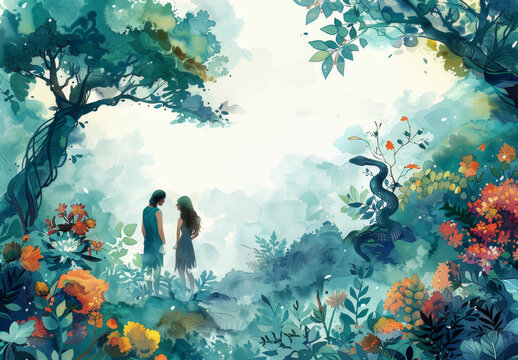
And then there’s this garden. There they were in the garden, innocent, yes, but also unknowing, unthinking, not quite yet human. See, it was the beginning. It was not the place where we were meant to be. God created us to go beyond where we are, to go beyond that “safe” place, rather than to live in some sort of controlled environment where nothing can touch us. But the mistake that these “first humans” made was assuming there was a different way to do that. According to the story, they jumped the gun a bit. We all do it. We think we know best. We think we can figure it out on our own. We think the rules are not for us because, obviously, we know better. (Or maybe we’ve mistakenly listened to a talking snake!)
We are not called to be innocent. That’s just dumb. We’re human. We’re complicated. God made us that way, filled with dust and new life, darkness and light, regret and grace. Again, we’re not called to be innocent. We’re called to be redeemed, renewed, and recreated. That story of that garden was only the beginning. Several modern theologians and writings have referred to it as the “kindergarden of eden”. It was how we began to understand ourselves. And I think the point of it was not the creation of the human creature, the innocent and obedient one, but rather the realization by that creature that he or she was indeed human, that we are both flawed and glorious, that we are made of dust and the very breath of God. The key is that we have to let go, breathe out, if you will, of the need to be in control, the need to go our own way. Because, life is full of talking snakes.
I claim credit for nothing. Everything is determined, the beginning as well as the end, by forces over which we have no control…We all dance to a mysterious tune, intoned in the distance by an invisible piper. (Albert Einstein)
Therefore, just as sin came into the world through one man, and death came through sin, and so death spread to all because all have sinned— sin was indeed in the world before the law, but sin is not reckoned when there is no law. Yet death exercised dominion from Adam to Moses, even over those whose sins were not like the transgression of Adam, who is a type of the one who was to come. But the free gift is not like the trespass. For if the many died through the one man’s trespass, much more surely have the grace of God and the free gift in the grace of the one man, Jesus Christ, abounded for the many. And the free gift is not like the effect of the one man’s sin. For the judgment following one trespass brought condemnation, but the free gift following many trespasses brings justification. If, because of the one man’s trespass, death exercised dominion through that one, much more surely will those who receive the abundance of grace and the free gift of righteousness exercise dominion in life through the one man, Jesus Christ. Therefore just as one man’s trespass led to condemnation for all, so one man’s act of righteousness leads to justification and life for all. For just as by the one man’s disobedience the many were made sinners, so by the one man’s obedience the many will be made righteous.
God is God and we are not. We cannot do this by ourselves. We cannot save ourselves. Do you have it? Is it clear? (Or perhaps our brother Paul should have written yet another run-on sentence!) And yet, we humans, we “adams”, by our very nature bear at least some of God’s characteristics, some of God’s image. So we can’t be all bad, right? Essentially, there is no such thing as being “only human”. After all Christ was human, “fully human” if I’m remembering correctly. So humanity is not bad. I don’t think our humanness makes us bad, despite what others have maintained. After all, God created us human.
So, perhaps the problem is not that we’re “human” but that we are not yet completely “fully human”. You see, we keep lapsing into doing things or allowing things that are less than human or, for want of a better word, inhumane–injustice, poverty, homelessness, prejudice, greed, inequality, divisions, disunity, ____ism, _____ism, _____ism….need I go on? We lapse into who we are not and who we are not meant to be. The notion of “adam” that we glean from the Scriptures is, basically, a human creature, created by God, loved by God, but a creature that is destined for more. Think of it like some sort of mock up or prototype of what humanity is, a beautiful, naked, picturesque creature surrounded by a beautiful garden. And, yet, on some level, this creature is not yet real. It has to become, become real. It has to become. It has to allow God to recreate it into a human.
Christ, God With Us, is, as we know “fully human” and “fully divine”. Christ was the epitome of real, the perfect image of what humanity is–fully human. Christ did not walk this earth to show us how to become divine. (I don’t think that’s our mission! The job of Savior of the World has already been filled. We need not apply or aspire to have that job.) Christ came to show us how to be fully human, truly human, real. That is who we are called to be. We are human, beautifully, wonderfully-made. But God’s vision of us is so much more. The journey is for us to traverse from Adam to Christ, from the human creature to fully human, to that very image of the Godself that we were created to be.
Do you remember the Margery Williams tale of “The Velveteen Rabbit”? “Real…doesn’t happen all at once…You become. It takes a long time. That’s why it doesn’t often happen to people who break easily, or have sharp edges, or who have to be carefully kept. Generally, by the time you are Real, most of your hair has been loved off, and your eyes drop out and you get loose in the joints and very shabby. But these things don’t matter at all, because once you are Real you can’t be ugly, except to people who don’t understand.” You see, as we journey closer to being Real, closer to being fully human, more and more of “us” falls away and is filled by that very image of Christ. We become fully human. We become who God intended us to be.
We are not human being having a spiritual experience. We are spiritual beings having a human experience. (Pierre Teilhard de Chardin)
On this Lenten journey, think what it means to be fully human, what it means to be the very image of Christ in the world.
The Lord God took the man and put him in the garden of Eden to till it and keep it. And the Lord God commanded the man, “You may freely eat of every tree of the garden; but of the tree of the knowledge of good and evil you shall not eat, for in the day that you eat of it you shall die.”…Now the serpent was more crafty than any other wild animal that the Lord God had made. He said to the woman, “Did God say, ‘You shall not eat from any tree in the garden’?” The woman said to the serpent, “We may eat of the fruit of the trees in the garden; but God said, ‘You shall not eat of the fruit of the tree that is in the middle of the garden, nor shall you touch it, or you shall die.’“ But the serpent said to the woman, “You will not die; for God knows that when you eat of it your eyes will be opened, and you will be like God, knowing good and evil.” So when the woman saw that the tree was good for food, and that it was a delight to the eyes, and that the tree was to be desired to make one wise, she took of its fruit and ate; and she also gave some to her husband, who was with her, and he ate. Then the eyes of both were opened, and they knew that they were naked; and they sewed fig leaves together and made loincloths for themselves.
So at the beginning of this year’s Lenten season, the Lectionary propels us back into our somewhat sketchy past. St. Augustine and myriads of theologians to follow would have called it the “original sin”, as if it is the cause of all other sins that follow. Now, admittedly, I don’t like to get stuck on that idea of original sin. In fact, I think the notion compels us to sin again by refusing to admit that we just messed up! And I’m pretty sure that if the first humans had not messed up, someone soon after would have. But this is the story we have.
So we have images of humans walking in a beautiful garden hand in hand without a care in the world. We can imagine babbling brooks and peacocks and calla lilies and llamas (I’ve just always liked llamas.) And then we have some sort of talking (and at that point walking snake) that pulls them away from who they are and who they are meant to be. You can hear it…”oh, come on, it’s not going to hurt you. There is no way that you’ll die. In fact, your life will be better. Your life will be grand. Your life will be perfect if you just do this one thing. God won’t mind. God really didn’t mean what God said.” (And for only $19.99, you can have TWO pieces of fruit if you do it RIGHT NOW! It sort of does sound like an infomercial when you think about it!)
And they give in. They give in to the first temptation to be someone they are not. Or perhaps they are just trying to pad themselves a bit against fears and insecurities to come. Then they realize their mistake much too late to change the course of their action. They are left hurt, vulnerable, and alone. Well, we know the story. (Oh, who are we kidding? We’re LIVING the story!) They are no longer innocent and the beauty of the garden is lost forever.
This has always been an odd story to me. Now, admittedly, I’m sure it is of no surprise to most of you that I tend to assume that this is fable rather than a literal historical account. But just because it probably isn’t “true” does not mean that it is not full of “Truth”. In some respects, this is the rawest, most profound, most human Truth that there is. After all, we all wander down the wrong road every now and again and some of us do it daily without even intending it. And we all live with consequences of trying to overreach, trying to be someone we’re not, trying to assume things that are not ours to assume. We all live with consequences of, essentially, overstepping and overreaching and trying to be the god of our own life. And we all lose that innocence that we once had.
But, really, does God want a bunch of mindless innocents walking around in this world? If that were the case, then God would never have shared the part of the Godself with us that is known as free will. You see, God in God’s infinite wisdom gave up omnipotence for relationship. God doesn’t want a bunch of robotic beings (innocent and well-behaved though they may be) following the Great Divine because they know nothing else. (I mean, that would get downright annoying!) God created us to desire, to choose, to follow God of our own volition. Innocence is way overrated. You see, if God wanted us to stay in some sort of garden, fenced off from the rest of the world, I guess God would have left us there, protected from the world and, mostly, from ourselves. I really don’t think that this journey we’re on returns us to the Garden, whatever that was. That was our beginning. The journey returns us to God, to who God envisions that we can be. Think of the Garden as our womb, the place that protected and shielded us until we were ready for the journey, until we found that part of ourselves that chose to follow, that chose God.
So what do we do after the garden? We follow where God leads us; we follow that innate sense that all of us have to return to God and to whom we are called to be. You see, we have no more excuses. Read the end of the passage. Our eyes have been opened. We know where we fall short; we know that we cannot do this by ourselves; we know that God is God and we are not. And in that is our beginning. Thanks be to God!
Sin is our only hope, because the recognition that something is wrong is the first step toward setting it right again. (Barbara Brown Taylor, Speaking of Sin: The Lost Language of Salvation)
So on this Lenten journey, open your eyes. Open your eyes and take a good hard look at yourself. What do you need to choose to leave behind? Where do you choose to go? What does your beginning, your escape from innocence, look like?
Now before the festival of the Passover, Jesus knew that his hour had come to depart from this world and go to the Father. Having loved his own who were in the world, he loved them to the end. 2The devil had already put it into the heart of Judas son of Simon Iscariot to betray him. And during supper 3Jesus, knowing that the Father had given all things into his hands, and that he had come from God and was going to God, 4got up from the table, took off his outer robe, and tied a towel around himself. 5Then he poured water into a basin and began to wash the disciples’ feet and to wipe them with the towel that was tied around him. 6He came to Simon Peter, who said to him, “Lord, are you going to wash my feet?” 7Jesus answered, “You do not know now what I am doing, but later you will understand.” 8Peter said to him, “You will never wash my feet.” Jesus answered, “Unless I wash you, you have no share with me.” 9Simon Peter said to him, “Lord, not my feet only but also my hands and my head!” 10Jesus said to him, “One who has bathed does not need to wash, except for the feet, but is entirely clean. And you are clean, though not all of you.” 11For he knew who was to betray him; for this reason he said, “Not all of you are clean.” 12After he had washed their feet, had put on his robe, and had returned to the table, he said to them, “Do you know what I have done to you? 13You call me Teacher and Lord—and you are right, for that is what I am. 14So if I, your Lord and Teacher, have washed your feet, you also ought to wash one another’s feet. 15For I have set you an example, that you also should do as I have done to you. 16Very truly, I tell you, servants are not greater than their master, nor are messengers greater than the one who sent them. 17If you know these things, you are blessed if you do them…
31…“Now the Son of Man has been glorified, and God has been glorified in him. 32If God has been glorified in him, God will also glorify him in himself and will glorify him at once. 33Little children, I am with you only a little longer. You will look for me; and as I said to the Jews so now I say to you, ‘Where I am going, you cannot come.’ 34I give you a new commandment, that you love one another. Just as I have loved you, you also should love one another. 35By this everyone will know that you are my disciples, if you have love for one another.”
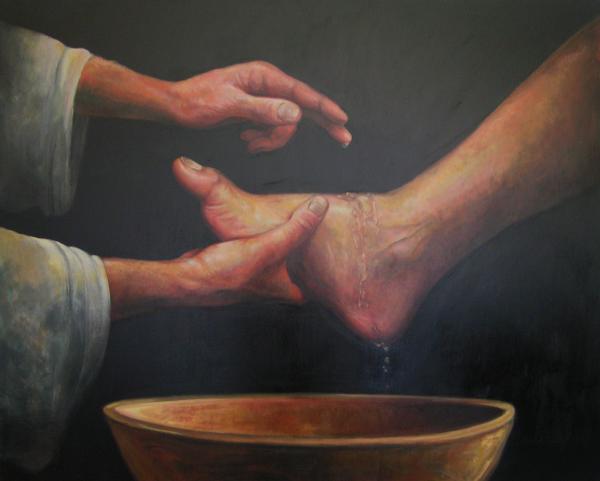
Tonight is the night. Tonight is the night when death begins to cross the threshold into life, when Jesus begins to slip away from the disciples and from his life here on earth and surrenders to what will be, surrenders to where this journey will take him. But before all that, before the history of the world changes, before the Divine comes once again flooding into the earth, before Jesus takes that last walk to the Cross, he gets up and ties a towel around him, kneels, and washes the disciples’ feet. Think about what an intimate act that is in the middle of this Passover crowd.
The first time I participated in a foot washing, I have to admit I was a little reticent at first. Wouldn’t this be uncomfortable? After all, washing feet is very intimate. Yep! That would be the point! I remember washing one woman’s feet. Her name was Caroline. When I picked up her feet, feet that had had a hard life early on in her native Nigeria, feet that had seen wars and conflicts, feet that had known deep grief in the death of her husband when she was a young woman and deep joy at the lives of her four sons who she had raised alone, I felt life. It was palpable, almost scary, as if it shot through me. There, holding in my hand, was not a foot, but life, God-given life, rich life. I was holding her humanity—and mine. And then Caroline started praying aloud in her native language. It was incredible. It was transcendent. I understood what it all meant. I understood why Jesus knelt and washed the disciples’ feet. Washing feet calls one to serve; having one’s feet washed calls one to be vulnerable, to let go, to surrender. Foot-washing is life. It is a way of entering each other, of knowing each other, of sharing each other. If you know these things you are blessed if you do them.
When Jesus was finished, he got up, removed the towel, and looked at the disciples. He had tears in his eyes. He knew this would be the last time that he would share in this way with them. This would, after all, be the last night that Jesus could share humanity with them. He knew that and now they did too. Sharing humanity…such a rich, profound, joyous, sometimes painful experience. Jesus showed us what being fully human looks like—not “only” human, but “fully” human, the way God created us to be. Being fully human means compassion; it means service; it means vulnerability; it means connection; it means love; it means life. It would be impossible to maintain the barriers we build between us if we were fully human.
Oh, don’t get me wrong, I don’t think being fully human means that we sit around with permanent smiles on our faces and sing “Kum-ba-yah” nonstop. (Nothing against that song.) Being human means that you feel—feel joy, sorrow, hurt, anger, etc. So being fully human means that you feel them fully, right? You feel them and then you take your shoes off and wash each other’s feet so that they can feel them too. Wow! Let’s have Congress wash each other’s feet. Not only would that stay a few news cycles, it might even get them to talk or even listen. Let’s have all of the leaders from every country meet for a day of old-fashioned footwashing. I wonder what the world would look like if we shared our humanity.
So on this night of nights, when death looms up ahead, and friends are sharing their lasts, remember what Jesus taught us—how to be human, fully human, how to be real, how to be who God envisioned we would be. Remember that Jesus taught us how to feel, how to live, how to love. If you know these things you are blessed if you do them. And after all these things, Jesus turned and looked to God knowing that the end was here. The soldiers came and took him down the path. He turned and looked back at them—those he had called, those he had led, those he loved. He loved them all, even the one who had just kissed his life away. They would be fine. They were not alone. They had each other. They were on their way to being free, to being fully human. “Take this cup from me. I have done what I came to do. Now I look to you.”
We are not human beings having a spiritual experience. We are spiritual beings having a human experience. (Pierre Teilhard de Chardin)
FOR TODAY: First, take your shoes off. And be fully human.
When his mother Mary had been engaged to Joseph, but before they lived together, she was found to be with child from the Holy Spirit. Her husband Joseph, being a righteous man and unwilling to expose her to public disgrace, planned to dismiss her quietly. But just when he had resolved to do this, an angel of the Lord appeared to him in a dream and said, “Joseph, son of David, do not be afraid to take Mary as your wife, for the child conceived is from the Holy Spirit. She will bear a son, and you are to name him Jesus, for he will save his people from their sins.”
Can you imagine Joseph’s surprise? Good grief, what was God doing while I was busy making plans for God to come? For generations, my people have been looking for a Savior, planning for that moment, when the King would enter triumphantly. What were we expecting? Well, of course, we were expecting someone obvious, someone who would make himself known in the world, someone who is a little bit better than you or I. We were expecting power and might and grandiose presentation. But instead God walked into our very human existence. God traversed time and space and the perceived separation between the sacred and the ordinary and entered our everyday world. On some level, that bothers many of us. After all, we are trying to do BETTER than this; we are aspiring to be more than human. What in the world is God doing messing around in the muck of this world?
Pierre Teilhard de Chardin said that “by virtue of the creation and, still more, of the Incarnation, nothing here below is profane for those who know how to see.” So, perhaps God came into this very ordinary world to show us the holiness that has been created, the sacredness that in our worldliness, we were somehow missing. Perhaps God steps into our lives to show us the depth that we haven’t dared to dig into our lives. Perhaps God came and walked with us not to show us how to be but to show us how to see. But when it’s all said and done, this practice we have of “looking for God” has been proven bizarre. After all, it was never God that was lost! We were never separated from the sacred; we just missed seeing it because it wasn’t what we were expecting. So, again, what were we expecting? Maybe the the whole lesson is that God will come when and where and in the way that God will come. But if there’s a “pattern” to be figured out about this God who cannot be figured out, it’s that God comes into the unexpected, into the unplanned, and into the unprepared places in our lives and lays down in a feed trough and patiently waits for the world to wake up and notice.
While we were busy looking up, with grand plans for “our Savior”, the God who was on “our side”, God slipped in to the bowels of the world and promised redemption for not just those who were busily looking for God, but the whole world. The whole world? The WHOLE world, all of Creation, all of existence. Maybe the reason that God started where God started was that the rest of us were looking beyond where we should be looking, busily looking for someone to complete what we had started, to validate that what we were doing was right, to raise us up beyond the muck of the world. But God, even at this moment, descends into places we would rather shake away. While we were busy looking up, searching for the star in the sky, God descended into humanity.
Maybe we were trying to be something we were not. Maybe we were overreaching a bit. But God, God comes into our world not to validate us, not to complete us, but to re-create us. God is good at starting us over, making us new, giving us eyes to see what we have been missing all along. This human God, this God who laid down in a feed trough, this God who loves everyone humbles us at best. Who are we that we have such lofty expectations as to think that we are beyond loving someone like us? Who are we that we missed the holiness in front of us, the sacredness within us, the piece of the Divine that walks beside us even when we don’t notice? Who are we that we thought ourselves capable of “finding God” without first looking for the God who is always with us, Emmanuel? Who are we that we thought God would come in the way we expected rather than the way that we needed for Life? Who are we that we missed our Life? Who are we that we missed our God? Maybe we should lower our expectations to a feed trough on the outskirts of power and strength and achievement. Because there, not only will we find God, but the “we” that we were all along.
In this final week of Advent (WHAT?!? THERE’S ONLY A WEEK?) , we are all busy preparing for the day of God’s coming. But whether or not we get it done, whether or not the house is clean or the goodies are baked or the presents are wrapped, God will come and the world will never be the same. Expectation is about moving into what will be rather than preparing for what we expect.
What wondrous Love is this, O my soul, O my soul, what wondrous love is this, O my soul! What wondrous Love is this that caused the Lord of life to lay aside his crown for my soul, for my soul, to lay aside his crown for my soul. (USA Folk Hymn)
FOR TODAY: Lower your expectations. Look at your life. Look at your self. See the God who walks with you in the holiness of days.






 Dancing to God