Why Exactly Are We Reading This?

“Herod’s Birthday Feast”, Edward Armitage, 1868

Why are we reading this and what, pray tell, does this have to do with us?  No, I didn’t choose to write on this passage.  It’s actually the chosen Gospel passage for this week based on the Revised Common Lectionary.  And, when you say you’re going to write on the lectionary, this is what you get.  So why is this Gospel passage part of our Scriptures at all?  It’s often recognized as one of those so-called “texts of terror” and seems to be tastelessly and somewhat haphazardly nestled among tales of Jesus’ healing and teaching and miracle-making.  And then this passage appears which isn’t even really focusing on Jesus at all.  That is the reason that I love the Lectionary.  It invites us to broaden our scope of what life holds and our view of where God is and how God moves in and through our lives.  No longer can we pick and choose that to which we will listen or plan the way in which God speaks in our lives.  No longer are we limited to our thirteen favorite passages.  Instead, we must open ourselves to God’s Holy Presence in every aspect of life, including those things that we’d rather just ignore.

We usually know John the Baptist as our “Advent guy”.  He was the one that leaped in the womb when Mary, pregnant with Jesus, entered the house.  He would grow up to be this wild wilderness-sort of man who wore animal skins and ate locusts and honey and preached a seemingly hell-fire and brimstone version of repentance to all he saw.  He was the forerunner, the one who would point to the Light that was to come.  And, if you remember, he was the one that baptized Jesus.  And after the baptism, we are told that John was arrested.  And today’s passage begins to come to be.

It’s an odd story, almost fable-like.  Herod Antipas has had John arrested because John had denounced Herod for putting aside his legitimate wife and marrying the wife of his brother. (Whoever told us that soap operas were a modern invention?)  And yet, on some level, Herod found John sort of fascinating, maybe even respected what he had to say and yearned to hear more, although he definitely thought it was disturbing and confusing and there was no way he could admit this fascination to anyone.  But he certainly did not wish him dead.  But this was not the case with Herod’s wife. So, in order to accommodate his wife’s wrath, he has John arrested.

And then Herod throws himself a birthday party, a big to-do with lots of good food, good wine, and dancing.  And the entertainment for the evening was provided by the young, beautiful, dancing daughter of either Herod’s new (and John had contended illegitimate) wife or of Herod himself (the passage is a little confusing on that fact).  Some people think that this was Salome’, who is depicted as one of the “bad girls” of the Bible. (Don’t know one way or the other!)  Well Herod was so pleased with her performance that he promises her anything.  The world was hers.  She could have anything that she wanted.

So, the young girl runs to her mother just outside the room.  Here was Herodias’ chance.  Her nemesis John would meet his demise and she would be rid of him forever.  And the young girl returns to the party and makes the fateful request for John the Baptist’s head on a platter.  Herod must have nearly choked.  This was not what he wanted!  His vengeful wife and this spoiled child had crossed the line.  He knows that no matter who John is, he does not deserve death.  But, as the governor, he was in what he construed as a tenuous position at best.  After all, he had made a promise and had voiced it aloud in front of numerous witnesses.  If he didn’t follow through with it, no one would trust him again.  So, to save face and to secure the balance of power, he complied.  After all, he was governor.  Some things have to be done for the good of society and for the preservation of the way things are.  And, let’s be honest, there is not one of us here who doesn’t want to be liked by others.  Herod was no different.

But this is not just an historical account about Herod.  I really do think that somewhere in this passage, we are meant to find and look at ourselves and our own lives.  Because we, too, make our own concessions—not to the point, obviously, of ordering someone’s death but in our own way we also bow to convenience and convention.  On some level we all live our lives wanting to be victorious and successful, wanting people to like us, and, like Herod, we sometimes miss the opportunity to do the right thing.  We close our ears and our minds and we look away, hoping the whole messy thing will just go away (or at least we won’t have to read about it!).  And we miss the opportunity to stand up and be who God is calling us to be.

Maybe that is the reason that this horrible story is here in the first place; otherwise, we’d all be tempted to start thinking that this Christian walk involves following some sort of miracle working-healing-rock star-Superman character.  Well, sign us all up for that!  But it’s not about that.  Jesus kept telling everyone not to say anything about all those miracles because following Christ does not mean going where the miracles are; it means becoming Christ-like.  It means becoming holy.  It means, finally, becoming human—fully human as Christ showed us how to be.

This story is one that is not about Jesus; it is rather about one of his followers, one who never wavered in his powerful witness.  This, like so many of the Scriptures, is a story of contrasts.  I think maybe the Gospel is a story of contrasts.  Think about it.  It’s always presented this way:  You can follow the crowd, be accepted, be what the world expects you to be.  You can follow the norms that society has laid down for us.  Or you can follow Jesus.  You can back away into the crowd and say that something should be done or ask why no one is doing anything.  Or you can follow Jesus.  You can BE the change.   We’re not called to admire Jesus; we’re called to become like Jesus.  And sometimes that means that we stand up.  Sometimes that means that we speak out. Sometimes that means we don’t follow the jerks down a terrible storyline.

Years ago I had the opportunity to visit Auschwitz.  I was struck by the obvious, of course. But what surprised me was what was around it.  It is located on a former military base in southern Poland near Krakow.  It’s out in the country away from the town with a railroad track running straight through it.  But around it are farmhouses—century-old farmhouses.  In other words, they were there in 1942.  And I wondered why they didn’t say anything.  There were cattle cars coming and going and the smell of burning flesh at times.  And I realized that as German as I am, those could be my relatives.  Why didn’t they say anything? Would I have said anything?  I fear that answer.

See, holiness is sort of a complex thing.  We crave it, we pursue it, and we try our best to attain it.  But most of us have to be honest with ourselves.  We want it at our beckoning and on our terms.  We don’t want to stir things up or get involved in places that are uncomfortable, that might reflect badly upon us.  We are a lot more like Herod than any of us care to admit.  We opt for convenience and convention and complacency and in a way spend our lives fearing the mystery of holiness, fearing what entering holiness and the unknown would mean for our lives.  Because, I will tell you, holiness will mess up your life more than you can possibly imagine.

You know, I once heard someone refer to the Christian life as linear—as a sequence of steps as we move from creation, through growth and the pursuit of Christian perfection so that we might finally reach that place where we are one with God.  I don’t think that’s right.  I don’t think of Christian perfection, or heaven, or whatever you imagine it to be as something to which we somehow graduate.  It’s actually here and now.  If we just open our eyes, we will see glimpses of the sacred and the holy everywhere.  We will be aware that God is calling us to do something different–now.  And I think God knows that there is a time when things that are wrong come to light.  There is a time when we really are called to look at our own lives and sort of re-evaluate. When we finally stop doing what we think we should be doing or maintaining the life we’ve worked so hard to build or trying to please those who we think we should be pleasing and listen for that which God is calling us to be we will become aware of that holiness of which we are already a part.

There is no doubt that this is still a bizarre thing to include in our Lectionary or even in our Scriptures.  But maybe it’s a call to us to redefine what we think our lives are.  Maybe it’s a way of realizing that becoming holiness does not mean our comfortable business as usual.  Retired United Methodist Bishop William Willimon says that “It’s a fearful thing to commend our spirits to God because well, who knows what God will do with our lives?”  That is the crux—submitting one’s life to God means that one gives up control, gives up the “plan” that one has laid out for his or her life.  Submitting one’s life to God means that one’s life as he or she knows it ends.  And that is indeed a scary thing. 

A familiar poem by Robert Frost includes the line, “Two roads diverged in a wood, and I, I took the one less traveled by, and that has made all the difference.”  That is it.  That is discipleship.  It is not straight; it’s not linear; it is not easy; it is not predictable.  Sometimes it’s messy.  Sometimes you will lose standing or power or that comfortable existence that you’ve so hard to maintain.  Sometimes you will find yourself waiting for someone else to do something, to do the right thing.  What if that’s supposed to be you?  Sometimes you have to stand and do the right thing. 

How would history have changed if Herod had done the right thing, if he had ignored his need for power or recognition and instead had done what he knew was right?  We’ll never know.  What would have happened if some of those farmhouses had had the courage to speak out?  We’ll never know.  But we can do the right thing now.  We can stand and speak for justice and equality and mercy.  We can be the change that the world needs.  That’s what discipleship is.  It’s showing the world what it means to be courageous, to be the one, to be fully human.

Grace and Peace,

Shelli

Lent 1A: So What’s This Deal With the Garden?

garden-of-edenScripture Passage:  Genesis 2: 15-17, 3: 1-7 (Lent 1A)

The Lord God took the man and put him in the garden of Eden to till it and keep it.  And the Lord God commanded the man, “You may freely eat of every tree of the garden;  but of the tree of the knowledge of good and evil you shall not eat, for in the day that you eat of it you shall die.”…Now the serpent was more crafty than any other wild animal that the Lord God had made. He said to the woman, “Did God say, ‘You shall not eat from any tree in the garden’?” The woman said to the serpent, “We may eat of the fruit of the trees in the garden; but God said, ‘You shall not eat of the fruit of the tree that is in the middle of the garden, nor shall you touch it, or you shall die.’“ But the serpent said to the woman, “You will not die; for God knows that when you eat of it your eyes will be opened, and you will be like God, knowing good and evil.”  So when the woman saw that the tree was good for food, and that it was a delight to the eyes, and that the tree was to be desired to make one wise, she took of its fruit and ate; and she also gave some to her husband, who was with her, and he ate. Then the eyes of both were opened, and they knew that they were naked; and they sewed fig leaves together and made loincloths for themselves.

So at the beginning of this year’s Lenten season, the Lectionary propels us back into our somewhat sketchy past.  St. Augustine and myriads of theologians to follow would have called it the “original sin”, as if it is the cause of all other sins that follow.  Now, admittedly, I don’t like to get stuck on that idea of original sin.  In fact, I think the notion compels us to sin again by refusing to admit that we just messed up!  And I’m pretty sure that if the first humans had not messed up, someone soon after would have.  But this is the story we have.

So we have images of humans walking in a beautiful garden hand in hand without a care in the world.  We can imagine babbling brooks and peacocks and calla lilies and llamas (I’ve just always liked llamas.) And then we have some sort of talking (and at that point walking snake) that pulls them away from who they are and who they are meant to be.  You can hear it…”oh, come on, it’s not going to hurt you.  There is no way that you’ll die.  In fact, your life will be better.  Your life will be grand.  Your life will be perfect if you just do this one thing.  God won’t mind.  God really didn’t mean what God said.” (And for only $19.99, you can have TWO pieces of fruit if you do it RIGHT NOW!  It sort of does sound like an infomercial when you think about it!)

And they give in.  They give in to the first temptation to be someone they are not.  Or perhaps they are just trying to pad themselves a bit against fears and insecurities to come. Then they realize their mistake much too late to change the course of their action.  They are left hurt, vulnerable, and alone.  Well, we know the story.  (Oh, who are we kidding? We’re LIVING the story!)  They are no longer innocent and the beauty of the garden is lost forever.

This has always been an odd story to me.  Now, admittedly, I’m sure it is of no surprise to most of you that I tend to assume that this is fable rather than a literal historical account. But just because it probably isn’t “true” does not mean that it is not full of “Truth”.  In some respects, this is the rawest, most profound, most human Truth that there is.  After all, we all wander down the wrong road every now and again and some of us do it daily without even intending it.  And we all live with consequences of trying to overreach, trying to be someone we’re not, trying to assume things that are not ours to assume.  We all live with consequences of, essentially, overstepping and overreaching and trying to be the god of our own life.  And we all lose that innocence that we once had.

But, really, does God want a bunch of mindless innocents walking around in this world?  If that were the case, then God would never have shared the part of the Godself with us that is known as free will.  You see, God in God’s infinite wisdom gave up omnipotence for relationship.  God doesn’t want a bunch of robotic beings (innocent and well-behaved though they may be) following the Great Divine because they know nothing else. (I mean, that would get downright annoying!)  God created us to desire, to choose, to follow God of our own volition.  Innocence is way overrated.  You see, if God wanted us to stay in some sort of garden, fenced off from the rest of the world, I guess God would have left us there, protected from the world and, mostly, from ourselves.  I really don’t think that this journey we’re on returns us to the Garden, whatever that was.  That was our beginning.  The journey returns us to God, to who God envisions that we can be.  Think of the Garden as our womb, the place that protected and shielded us until we were ready for the journey, until we found that part of ourselves that chose to follow, that chose God.

So what do we do after the garden?  We follow where God leads us; we follow that innate sense that all of us have to return to God and to whom we are called to be.  You see, we have no more excuses.  Read the end of the passage.  Our eyes have been opened.  We know where we fall short; we know that we cannot do this by ourselves; we know that God is God and we are not.  And in that is our beginning.  Thanks be to God!

Sin is our only hope, because the recognition that something is wrong is the first step toward setting it right again.  (Barbara Brown Taylor, Speaking of Sin:  The Lost Language of Salvation)

So on this Lenten journey, open your eyes.  Open your eyes and take a good hard look at yourself.  What do you need to choose to leave behind?  Where do you choose to go? What does your beginning, your escape from innocence, look like?

Grace and Peace,

Shelli


Blessed

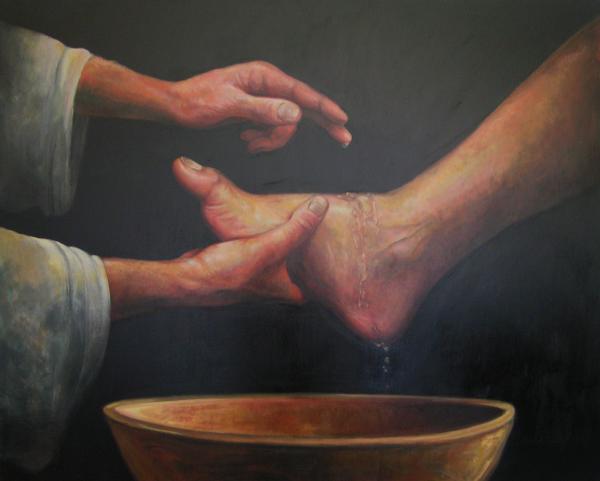
jesus-washing-the-feet-calvin-carterScripture Text:  John 13: 1-17, 31b-35

Now before the festival of the Passover, Jesus knew that his hour had come to depart from this world and go to the Father. Having loved his own who were in the world, he loved them to the end. 2The devil had already put it into the heart of Judas son of Simon Iscariot to betray him. And during supper 3Jesus, knowing that the Father had given all things into his hands, and that he had come from God and was going to God, 4got up from the table, took off his outer robe, and tied a towel around himself. 5Then he poured water into a basin and began to wash the disciples’ feet and to wipe them with the towel that was tied around him. 6He came to Simon Peter, who said to him, “Lord, are you going to wash my feet?” 7Jesus answered, “You do not know now what I am doing, but later you will understand.” 8Peter said to him, “You will never wash my feet.” Jesus answered, “Unless I wash you, you have no share with me.” 9Simon Peter said to him, “Lord, not my feet only but also my hands and my head!” 10Jesus said to him, “One who has bathed does not need to wash, except for the feet, but is entirely clean. And you are clean, though not all of you.” 11For he knew who was to betray him; for this reason he said, “Not all of you are clean.” 12After he had washed their feet, had put on his robe, and had returned to the table, he said to them, “Do you know what I have done to you? 13You call me Teacher and Lord—and you are right, for that is what I am. 14So if I, your Lord and Teacher, have washed your feet, you also ought to wash one another’s feet. 15For I have set you an example, that you also should do as I have done to you. 16Very truly, I tell you, servants are not greater than their master, nor are messengers greater than the one who sent them. 17If you know these things, you are blessed if you do them…


31…“Now the Son of Man has been glorified, and God has been glorified in him. 32If God has been glorified in him, God will also glorify him in himself and will glorify him at once. 33Little children, I am with you only a little longer. You will look for me; and as I said to the Jews so now I say to you, ‘Where I am going, you cannot come.’ 34I give you a new commandment, that you love one another. Just as I have loved you, you also should love one another. 35By this everyone will know that you are my disciples, if you have love for one another.”


Tonight is the night.  Tonight is the night when death begins to cross the threshold into life, when Jesus begins to slip away from the disciples and from his life here on earth and surrenders to what will be, surrenders to where this journey will take him.  But before all that, before the history of the world changes, before the Divine comes once again flooding into the earth, before Jesus takes that last walk to the Cross, he gets up and ties a towel around him, kneels, and washes the disciples’ feet.  Think about what an intimate act that is in the middle of this Passover crowd.

The first time I participated in a foot washing, I have to admit I was a little reticent at first.  Wouldn’t this be uncomfortable?  After all, washing feet is very intimate.  Yep!  That would be the point!  I remember washing one woman’s feet.  Her name was Caroline.  When I picked up her feet, feet that had had a hard life early on in her native Nigeria, feet that had seen wars and conflicts, feet that had known deep grief in the death of her husband when she was a young woman and deep joy at the lives of her four sons who she had raised alone, I felt life.  It was palpable, almost scary, as if it shot through me.  There, holding in my hand, was not a foot, but life, God-given life, rich life.  I was holding her humanity—and mine.  And then Caroline started praying aloud in her native language.  It was incredible.  It was transcendent.  I understood what it all meant.  I understood why Jesus knelt and washed the disciples’ feet.  Washing feet calls one to serve; having one’s feet washed calls one to be vulnerable, to let go, to surrender.  Foot-washing is life.  It is a way of entering each other, of knowing each other, of sharing each other. If you know these things you are blessed if you do them.

When Jesus was finished, he got up, removed the towel, and looked at the disciples.  He had tears in his eyes.  He knew this would be the last time that he would share in this way with them.  This would, after all, be the last night that Jesus could share humanity with them.  He knew that and now they did too.  Sharing humanity…such a rich, profound, joyous, sometimes painful experience.  Jesus showed us what being fully human looks like—not “only” human, but “fully” human, the way God created us to be.  Being fully human means compassion; it means service; it means vulnerability; it means connection; it means love; it means life.  It would be impossible to maintain the barriers we build between us if we were fully human.

Oh, don’t get me wrong, I don’t think being fully human means that we sit around with permanent smiles on our faces and sing “Kum-ba-yah” nonstop.  (Nothing against that song.)  Being human means that you feel—feel joy, sorrow, hurt, anger, etc.  So being fully human means that you feel them fully, right?  You feel them and then you take your shoes off and wash each other’s feet so that they can feel them too.  Wow!  Let’s have Congress wash each other’s feet.  Not only would that stay a few news cycles, it might even get them to talk or even listen.  Let’s have all of the leaders from every country meet for a day of old-fashioned footwashing.  I wonder what the world would look like if we shared our humanity.

Jesus praying in the gardenSo on this night of nights, when death looms up ahead, and friends are sharing their lasts, remember what Jesus taught us—how to be human, fully human, how to be real, how to be who God envisioned we would be.  Remember that Jesus taught us how to feel, how to live, how to love. If you know these things you are blessed if you do them. And after all these things, Jesus turned and looked to God knowing that the end was here.  The soldiers came and took him down the path.  He turned and looked back at them—those he had called, those he had led, those he loved.  He loved them all, even the one who had just kissed his life away.  They would be fine.  They were not alone.  They had each other.  They were on their way to being free, to being fully human.  “Take this cup from me.  I have done what I came to do.  Now I look to you.”

We are not human beings having a spiritual experience.  We are spiritual beings having a human experience. (Pierre Teilhard de Chardin)

FOR TODAY: First, take your shoes off. And be fully human.

Grace and Peace,

Shelli

Lowering Our Expectations

Shoes of PovertyScripture Text:  Matthew 1:18b-21

When his mother Mary had been engaged to Joseph, but before they lived together, she was found to be with child from the Holy Spirit.  Her husband Joseph, being a righteous man and unwilling to expose her to public disgrace, planned to dismiss her quietly.  But just when he had resolved to do this, an angel of the Lord appeared to him in a dream and said, “Joseph, son of David, do not be afraid to take Mary as your wife, for the child conceived is from the Holy Spirit.  She will bear a son, and you are to name him Jesus, for he will save his people from their sins.”


Can you imagine Joseph’s surprise?  Good grief, what was God doing while I was busy making plans for God to come?  For generations, my people have been looking for a Savior, planning for that moment, when the King would enter triumphantly.  What were we expecting?  Well, of course, we were expecting someone obvious, someone  who would make himself known in the world, someone who is a little bit better than you or I.  We were expecting power and might and grandiose presentation.  But instead God walked into our very human existence.  God traversed time and space and the perceived separation between the sacred and the ordinary and entered our everyday world.  On some level, that bothers many of us.  After all, we are trying to do BETTER than this; we are aspiring to be more than human.  What in the world is God doing messing around in the muck of this world?


Pierre Teilhard de Chardin said that “by virtue of the creation and, still more, of the Incarnation, nothing here below is profane for those who know how to see.”  So, perhaps God came into this very ordinary world to show us the holiness that has been created, the sacredness that in our worldliness, we were somehow missing.  Perhaps God steps into our lives to show us the depth that we haven’t dared to dig into our lives.  Perhaps God came and walked with us not to show us how to be but to show us how to see.  But when it’s all said and done, this practice we have of “looking for God” has been proven bizarre.  After all, it was never God that was lost!  We were never separated from the sacred; we just missed seeing it because it wasn’t what we were expecting.  So, again, what were we expecting?  Maybe the the whole lesson is that God will come when and where and in the way that God will come.  But if there’s a “pattern” to be figured out about this God who cannot be figured out, it’s that God comes into the unexpected, into the unplanned, and into the unprepared places in our lives and lays down in a feed trough and patiently waits for the world to wake up and notice.


While we were busy looking up, with grand plans for “our Savior”, the God who was on “our side”, God slipped in to the bowels of the world and promised redemption for not just those who were busily looking for God, but the whole world.  The whole world?  The WHOLE world, all of Creation, all of existence.  Maybe the reason that God started where God started was that the rest of us were looking beyond where we should be looking, busily looking for someone to complete what we had started, to validate that what we were doing was right, to raise us up beyond the muck of the world.  But God, even at this moment, descends into places we would rather shake away.  While we were busy looking up, searching for the star in the sky, God descended into humanity.


Maybe we were trying to be something we were not.  Maybe we were overreaching a bit.  But God, God comes into our world not to validate us, not to complete us, but to re-create us.  God is good at starting us over, making us new, giving us eyes to see what we have been missing all along.  This human God, this God who laid down in a feed trough, this God who loves everyone humbles us at best.  Who are we that we have such lofty expectations as to think that we are beyond loving someone like us?  Who are we that we missed the holiness in front of us, the sacredness within us, the piece of the Divine that walks beside us even when we don’t notice?  Who are we that we thought ourselves capable of “finding God” without first looking for the God who is always with us, Emmanuel?  Who are we that we thought God would come in the way we expected rather than the way that we needed for Life?  Who are we that we missed our Life?  Who are we that we missed our God?  Maybe we should lower our expectations to a feed trough on the outskirts of power and strength and achievement.  Because there, not only will we find God, but the “we” that we were all along.


In this final week of Advent (WHAT?!?  THERE’S ONLY A WEEK?) , we are all busy preparing for the day of God’s coming.  But whether or not we get it done, whether or not the house is clean or the goodies are baked or the presents are wrapped, God will come and the world will never be the same.  Expectation is about moving into what will be rather than preparing for what we expect.


What wondrous Love is this, O my soul, O my soul, what wondrous love is this, O my soul!  What wondrous Love is this that caused the Lord of life to lay aside his crown for my soul, for my soul, to lay aside his crown for my soul. (USA Folk Hymn)


FOR TODAY:  Lower your expectations.  Look at your life.  Look at your self.  See the God who walks with you in the holiness of days.


Grace and Peace,


Shelli