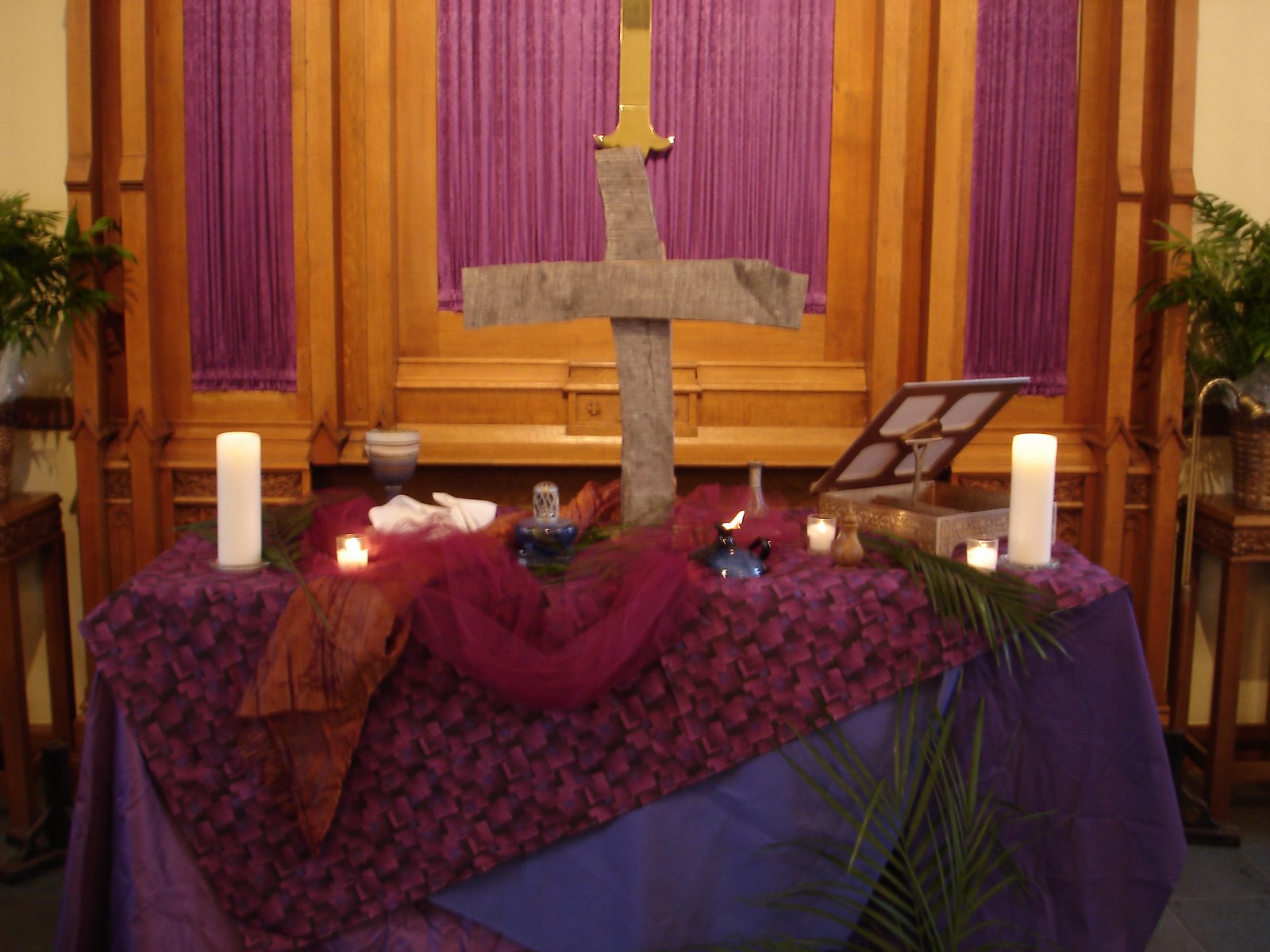
Oil and Water


Scripture Reading: John 12: 1-11
Six days before the Passover Jesus came to Bethany, the home of Lazarus, whom he had raised from the dead. There they gave a dinner for him. Martha served, and Lazarus was one of those at the table with him. Mary took a pound of costly perfume made of pure nard, anointed Jesus’ feet, and wiped them with her hair. The house was filled with the fragrance of the perfume. But Judas Iscariot, one of his disciples (the one who was about to betray him), said, ‘Why was this perfume not sold for three hundred denarii* and the money given to the poor?’ (He said this not because he cared about the poor, but because he was a thief; he kept the common purse and used to steal what was put into it.) Jesus said, ‘Leave her alone. She bought it so that she might keep it for the day of my burial. You always have the poor with you, but you do not always have me.’ When the great crowd of the Jews learned that he was there, they came not only because of Jesus but also to see Lazarus, whom he had raised from the dead. So the chief priests planned to put Lazarus to death as well, since it was on account of him that many of the Jews were deserting and were believing in Jesus.

Holy Week has begun. We have walked this road to the cross throughout this Lenten season and now it is upon us. Most of us don’t really know what it is that we’re supposed to do with this week. We have gone through this season hearing its call to repentance, to emptying, to looking at things differently. But, still, the ending is beginning to loom bigger than we imagined it would be. What is it, exactly, that we’re supposed to do this week?

Henri Nouwen tells us that “passion is a kind of waiting—waiting for what other people are going to do.”[i] He claims that all of Jesus’ life leading up to this week—all of the teaching, all of the healing, all of the miracle-making, the welcoming of sinners, the turning of tables in front of the saints, every action that was part of who Jesus was ends in this week of passion. And the reason is that, as Nouwen says, “All action ends in passion because the response to our action is out of our hands. That is the mystery of work, the mystery of love, the mystery of friendship, the mystery of community…And that is the mystery of Jesus’ love. God reveals [Godself] in Jesus as the one who waits for our response.”[ii] This is the week when Jesus stops doing and waits to be handed over. This is the week when Jesus waits on others.

We are not used to a Christ who does nothing. We are, rather, more comfortable when Jesus is showing us how to do what we’re supposed to do as followers. We are not accustomed to such a passive Christ. I looked up the word “passive” in an etymological dictionary. The root is the Latin passiuus. And then, surprisingly enough, it says “See Passion.” The etymological root of passion, the term that we use to describe Jesus’ suffering journey to the cross, is the Latin passionem, or suffering. And it says “See Passive.” The two words are related. The “Passion”, this time of suffering and being “handed over”, is a movement from planned and intentional action to no longer being in control. All of Jesus’ actions are accomplished. It is finished. It is a time of waiting—waiting for others’ response.

In our lectionary Gospel reading for this Holy Monday, we find this passive Jesus. He visits the home of friends, the home of those whom he had served, those for whom he had done things. And, it says, they give a dinner for him. Jesus is the guest of honor. After all the doing, after all the action, after all the stuff, he now spends time with friends. And they serve him. And then the passage tells us that Mary takes a pound of costly perfumed nard, breaks the seal, and lavishly pours it onto Jesus’ feet. Then as the oil runs down his feet and begins to drip to the floor, she wipes his feet with her hair. The whole house is filled with this overwhelming fragrance.

Well, the disciples just couldn’t leave it alone. What in the world was she doing? Here is this man who has worked for years to bring peace and justice to the world, to heal others, to end poverty and oppression and you waste this oil by pouring it out on him! That oil could have been sold. Things could have been done with that money! We could have done great ministry with what you just poured on his feet! But you have wasted it! You have squandered it!
Then Jesus responds. “Leave her alone,” he says. You see, she gets it. She understands. I do not have long to be with you. She knows where I am going. And she responds. This woman loves Jesus. In fact, she loves Jesus so much that she defies the expected and instead pours out the abundance of her life and anoints Jesus for his burial. This is not the time to talk about budgets or the ways things are normally done. This is the time of Jesus’ waiting and her response. As she anointed Jesus, Mary entered Jesus’ Passion and understood what it meant to have a personal relationship with Christ.

There are those in our society that would describe that breakthrough as being “born again”. But that phrase, commonplace and probably overused and misused as it is today, was not even around over a hundred years ago. Instead, the words that were used to describe this coming into who Jesus is was to say that one was “seized by the power of a great affection.” Isn’t that an incredible phrase—to be “seized by the power of a great affection”? You see, we 21st century folks usually think we have it all figured out. We know what we’re called to do to make disciples of Jesus Christ. We live our lives as best we can within the framework of what God wants us to do. And we do what we can for others by reaching out in the name of Christ. All of that is wonderful. But are we truly “seized by the power of a great affection”? Why do you think Jesus did everything that he did while he was on this earth? Was it just to show us what it is we’re supposed to do? No, Jesus was more than merely an exemplary human being put here for us to emulate. Jesus came to reveal God’s love, to show us how much God loves each of us and how much God desires us, to make known once and for all the affection that God has for all of God’s Creation and for us as children of God. Jesus was God made known, Emmanuel.

There is a story from the Sufi mystical tradition of a disciple that comes to an elder for direction.

“Where shall I find God?” the disciple asked the elder. “God is with you,” the Holy One replied. “But if that is true,” the disciple asked, “why can I not see this Presence?” “Because you are like the fish who, when in the ocean, never notices the water.” It is not that God is not with us; it is that we are unaware of that incredible Presence.[iii]

When we finally stop doing what we think we should be doing and listen for that which God is calling us to be we will become aware of that extraordinary Presence that is God. And in that becoming, we enter the Christ-life.

In our faith understanding, the Sacrament of Baptism is the beginning of our life as a Christian, a new life in Christ, the beginning of a journey toward oneness with God, toward the life of Christ. The waters of Baptism remind us of God’s ever-Presence in our lives, of God’s claim on us, and of the great love that God has for us that was revealed in Christ. It is sacramental because it is God’s love made visible for us. Through this sacrament, we enter this journey with God.
In much the same way, Mary poured the oil upon Jesus. The act was sacramental. Mary understood that love. She entered that love. Indeed, she was “seized by the power of a great affection”. And in pouring the oil, she entered Jesus’ Passion. She became part of Jesus’ journey to the cross.

In Baptism, God uses water to make God’s love visible to us. And as Mary poured the oil on Christ, she made her love visible to God. And, do you remember your basic chemistry lesson? If you pour oil into the water, the oil is raised to the top. Oil and water…God uses both to make this incredible love visible to us. And immersed in that love, we will find ourselves “seized by the power of a great affection.”

This is the week when we come to the end of all our doing. This is the week when we walk with Christ through betrayal and suffering and last suppers and final endings. This is the week when we finally realize that we can do nothing else. And on that final day, as the passive Christ is handed over, there is nothing more for him to do other than wait for our response. Who will follow me? Who will come to me with all your misery and your sins, with all your trouble and your needs, and with all your longings to be loved. Who will follow me? Who will hand over their lives just as I have done that you too might be raised to new life? Because it is then that the oil will be poured out for you in much the same way as you are immersed in the waters of your Baptism.

This week is not an easy one to walk. Sometimes we are still not sure what it is that we’re supposed to do. But this week is not about us; it is not about what we do or how we do it; this week is the week that we are called to be “seized by the power of a great affection”, to become one with Christ, to enter Christ’s suffering and passion and waiting, to make our very lives a sacramental journey. And as we come closer and closer to what seems to be a final ending, we will finally be aware that we are never really alone. God calls us. God is waiting for our response.

In the Name of the One who journeys with us to the Cross!

Grace and Peace,

Shelli

[i] Henri J.M. Nouwen, “From Action to Passion”, in Bread and Wine: Readings for Lent and Easter (Maryknoll, NY: Orbis Books f/ Plough Publishing, 2003), 179-185.
[ii] Ibid.
[iii] Joan Chittister, There Is a Season (Maryknoll, NY: Orbis Books, 1995), 14.

From Palms to Silence


Scripture Reading: Mark 11: 1-11
When they were approaching Jerusalem, at Bethphage and Bethany, near the Mount of Olives, he sent two of his disciples and said to them, ‘Go into the village ahead of you, and immediately as you enter it, you will find tied there a colt that has never been ridden; untie it and bring it. If anyone says to you, “Why are you doing this?” just say this, “The Lord needs it and will send it back here immediately.” ’ They went away and found a colt tied near a door, outside in the street. As they were untying it, some of the bystanders said to them, ‘What are you doing, untying the colt?’ They told them what Jesus had said; and they allowed them to take it. Then they brought the colt to Jesus and threw their cloaks on it; and he sat on it. Many people spread their cloaks on the road, and others spread leafy branches that they had cut in the fields. Then those who went ahead and those who followed were shouting,‘Hosanna! Blessed is the one who comes in the name of the Lord! Blessed is the coming kingdom of our ancestor David! Hosanna in the highest heaven!’ Then he entered Jerusalem and went into the temple; and when he had looked around at everything, as it was already late, he went out to Bethany with the twelve.

Today is Palm Sunday. It was glorious this morning! The day was beautiful. While it was a little dark at the early service, by the time 11:00 rolled around, it was sunny with a little breeze. (Not like last year, when the gale-force winds wrapped a Lenten banner around me just as I was rounding the corner into the church! I’m sure I provided quite a show for the passersby on Main Street.) The crowds poured into the sanctuary, palms waving, while the brass ensemble played. We like parades. We like celebrations. Just for a moment, we are at the height of Jesus’ life–his triumphal entry into Jerusalem. Just for a moment, we feel like victory is about to be declared, that our player has won the game, that our beliefs have been proven right. We wave the palm branches and sing the triumphant hymns. And then….silence.

Just as quickly we move from the Palm Processional to the Passion. Just as quickly we move from triumphalism to surrender. We read through the account of Jesus’ Passion, suffering, and death. The palm branches now litter the sanctuary floor. We step on them to stand and sing “O Love Divine, What Hast Thou Done.” And reality sets in as the sheer purple fabric is draped over the cross.

I have not usually liked the idea of the whole Palm/Passion Sunday thing. It has always felt like we were trying to cram a whole week of despair and suffering into a few minutes and get it over with–sort of like swallowing bad-tasting medicine quickly before it causes any real damage to our palate. But I am struck with the rawness of juxtaposing the whole triumphalism thing with the images of hopelessness and despair. Perhaps it makes us wake up and take notice. Perhaps it makes us finally realize the ludicrousness of the way we sometimes lives our lives, of the way we sometimes think about things, in the face of what God is calling us to be, in the face of where God is calling us to follow.

And so we enter this week by moving quickly from triumphalism to silence, from celebrating to listening, from action to waiting, and from feeling justified because we believe the way we believe to the Passion of Christ crucified.

Our hosannas sung, our palms waved, let us go with passion into this week.
It is a time to curse fig trees that do not yield fruit,
It is a time to cleanse our temples of any blasphemy.
It is a time to greet Jesus as the Lord’s Anointed One,
to lavishly break our alabaster and pour perfume out for him

without counting the cost.
It is a time for preparation…

(From “Holy Week”, Kneeling in Jerusalem, by Ann Weems, p. 67.)
So go forth on your journey to the cross and prepare for your Christ!

Grace and Peace,

Shelli

The Days are Surely Coming

“The days are surely coming…No longer shall they teach one another , or say to each other, ‘Know the Lord,’ for they shall all know me, from the least of them to the greatest, says the Lord; for I will forgive their iniquity, and remember their sin no more.” (Jeremiah 31: 27..34)

The Old Testament scripture from today’s Lectionary’s text paints a vision for which we all look. It is the vision of that time when the covenant “written on the people’s hearts” will finally be fulfilled. As Christians, it is hard for us to not read this Scripture through our own lens. But remember the setting in which this was probably written: It is the time following the exile. The cities have been breached; the temple has been totally destroyed; there is nothing left of the lives that were before. The people who first heard this had become subjects of the Persian king and life as they knew it has been ripped away at its very foundations. But through the prophet Jeremiah, God unveils a vision of reconstruction and renewal. But this time, things will be different…

This time things will be different…How many times have you heard that in your own life? THIS time I won’t eat so much; THIS time I won’t get so upset; THIS time I won’t let myself get into this mess; THIS time I’ll do it right. This time things will be different…But THIS time God is not giving us a set of rules. God is not telling us what to do or when to do it. God instead promises a renewed covenant, a transformation from what was to what will be. And this time things WILL be different…

By writing it in our hearts, God has written Godself into us, renewing that image of the Godself buried deep within our beings. God is making who God is part of our very essence. It is permanent. God has written the capacity for immense love and unending faithfulness into us. And someday…someday…we’ll realize what that means. And this time things WILL be different…

We have spent the last few weeks wandering in our own wildernesses. And today, the road changes. The wilderness seems to be not so evident, as if a sort of organized earthly sprawl is creeping into it. There are more houses than we remember seeing before, more signs of people going about their lives, better pavement on the roads. We must be nearing the city. Jerusalem is just over the horizon. We are not yet there, but we sense that change is in the air. There is a sort of excitement. People are beginning to gather. And somewhere over the hill, there’s a faint cadence of drums and some sort of hammering in the distance. It is hard to understand what it all means. But we, with the Godself written into our being and the promise of a new life deep within our hearts, will walk on…toward Jerusalem. And God walks with us…

So go forth toward the city. There is no way around!

Grace and Peace,

Shelli

Wilderness Wanderings

This week’s lectionary Gospel passage is the Markan account of Jesus’ Baptism, followed by his 40-day time in the wilderness as he prepared for his ministry. Now for most of us, conjuring up images of a wilderness takes some thought as we sit in the midst of skyscrapers, paved roads, and fenced lawns. So we try to imagine thick, wooded landscapes with hanging vines obstructing our way and our view. But, think about it, the wilderness that Jesus knew was probably desert–unobstructed, yes, but with nothing to mark your way, nothing to “hang on to” when you felt like you were getting lost. And what about the pathway? Rather than being merely difficult to tread, it was changing all the time, as the winds and sands continually blew over it, marring its very existence. And then…the temptations…so much more evident in the wilderness–the temptation to take control, the temptation to take the easy way out, the temptation to turn back. So, why in the world would Jesus spend time in this seemingly God-forsaken wilderness?

Jesus, rather than depriving himself, was emptying himself. Without paved pathways and landscapes marking our way, we are vulnerable. And it is when we are the most vulnerable that we realize that we need God. When the temptations are staring us in the face, we need God more than ever. And that is also when we realize that the wilderness is far from being God-forsaken. God is always there but, finally, the fact that we are empty makes us acutely aware of God’s Presence in a way that we’ve never known. In fact, the wilderness is God-bearing and by emptying ourselves, by entering the wilderness, we finally make room to become God-bearing too.

Several years ago, I had the opportunity to visit Hampton Court, near London, which probably has some of the most beautiful gardens in the world. As we walked through the gardens, we were struck by row upon row of colorful blooms—a horticulturist’s dream. There were roses and camellias and daffodils of all sizes and colors and just the fact that they were all so perfect was utterly amazing. The beauty of Creation was at its most picturesque. As we walked through the gardens, there was one area that looked extremely odd among the perfectly manicured plats. It looked forgotten and overgrown, full of weeds and not a flower in sight. It reminded me of those “open for adoption” litter signs where you know that the next mile or so will be littered with trash as a symptom of the “forgotten child”. I thought it was very odd in this plethora of perfection to see something so forgotten, so fallow, and so hopeless. There was even a chain across the entrance barring any more investigation. Someone, I thought, ought to take control here and do something! But as I was about to leave, I noticed a sign. According to the sign, in order for these gardens to bloom throughout the season with continual colors, there is a system of “rolling fallow”—a crop rotation of sorts. This wilderness-looking area was just that—a fallow, resting wilderness—an intentional wilderness in order that it might be nurtured and fed. It was not dead—it was allowing God to work on it.

Maybe that’s what we’re called to do in this season of Lent–to create an intentional wilderness, a place stripped of those things on which we rely, a place where we become the most vulnerable, a place where we have no control, a place where we can meet God, a place where, finally, we can become a God-bearer. Maybe Lent is the time when we finally let go and allow God to work on us that we might burst forth on Easter morning in radiant bloom.

So go forth this season into the wilderness that you might finally be prepared to know God!

Grace and Peace,

Shelli

Transfigured

Today is Transfiguration Sunday, the Sunday when we read of Elijah being taken up to heaven in a whirlwind and the Gospel passage that depicts the Transfiguration of Jesus on the mountain top. Both of these sometimes seem to be sort of fantastical, hard-to-believe images. I mean, after all, the whirlwind, the chariot, bright lights, descending clouds, and, of course, Old Testament heroes and prophets reappearing. But, you know, anything can happen on that mountain. After all, it is on the mountain that we can see beyond ourselves; it is on the mountain that everything is illumined in all directions; and it is on the mountain that God appears to us.
We don’t really know if there was a real “mountain” or not. (In all truth, the literal topography just doesn’t seem to work!) For me, a metaphorical one works just as nicely. It is that place where God appears to me. Some people claim to have had one stand-out, quintessential experience that turned their whole life toward God. For me, I have had a series of mountain-top and near-mountain-top experiences throughout my life. None stand out as “the one”, but each one in its own way has redirected me toward God, toward the cross, and has indeed changed my life.
I think that is the reason that we read of this Transfiguration right before Lent. It is our redirecting, our refocusing, if you will, from our ordinary everyday lives toward the Lenten journey–the journey to the cross. In many ways, the Transfiguration is the climax of the human experience of Jesus–the mountain-top experience. And then Jesus tells the disciples to keep what happened to themselves, if only for now. And then the lights dim. There are no chariots, Moses and Elijah are gone, and, if only for awhile, God seems to be silent. And it is in that silence that Jesus walks down the mountain toward Jerusalem. And he asks us to follow. And we can–because now we see the way to go. Because we have truly been changed!
So go forth from the mountain and begin your journey to the cross!
Grace and Peace,
Shelli

Waiting to Be-Come

Most of us are so busy trying to become something that we often forget to be. God calls us to be–to be open, to be compassionate, to be ready, to be salt, to be light, to be for one another what Christ is for us. And while we are growing into our being, we are called to wait. When we are ready, when we are receptive, God will come and we will then become. So, once again, waiting is not passive. Waiting is not just sitting around until the world changes. Waiting is our time of being–just being with God. It is God’s coming into our lives that sparks our becoming.

So wait this season with purpose and intentional being. Be open to being and you will be open to God’s coming. And when God comes into our being, we become what we are fully meant to be. So, be salt; be light; be who God calls you to be. And wait. O Come, O Come, Emmanuel, Come that I may be-come.

So go forth and be!

Grace and Peace,

Shelli

Journeying through Waiting

Perhaps the reason that we experience such difficulty with this act of waiting is that we have mistaken its meaning. For many of us, waiting means stopping, standing still, even retreating from the “goings on” of life. It often is misconstrued as doing nothing. But while our waiting often looks like that on the outside, I am realizing that active waiting is a journey in and of itself.

Think about this…things that involve transformation–growth, healing, acceptance, even, as we wait in this season of Advent, birth–also involve waiting. It does not mean that nothing is happening; it just means that we are not fully in control of where we are going and how it will all end up. The journey through waiting, then, is definitely ours to walk. The point is that, finally, someone else is leading the way. We just have to open ourselves to the possibility that we might end up in a different place altogether. We just have to open ourselves to the very real possibility that God will come in a way that we have neither planned or expected and do things that we can’t even fathom.

Every valley shall be lifted up, and every mountain and hill be made low; the uneven ground shall become level, and the rough places a plain. Then the glory of the Lord shall be revealed, and all people shall see it together, for the mouth of the Lord has spoken. (Isaiah 40: 4-5, NRSV)

So, go forth and wait!

Grace and Peace,

Shelli