ADVENT 4B: The House of God

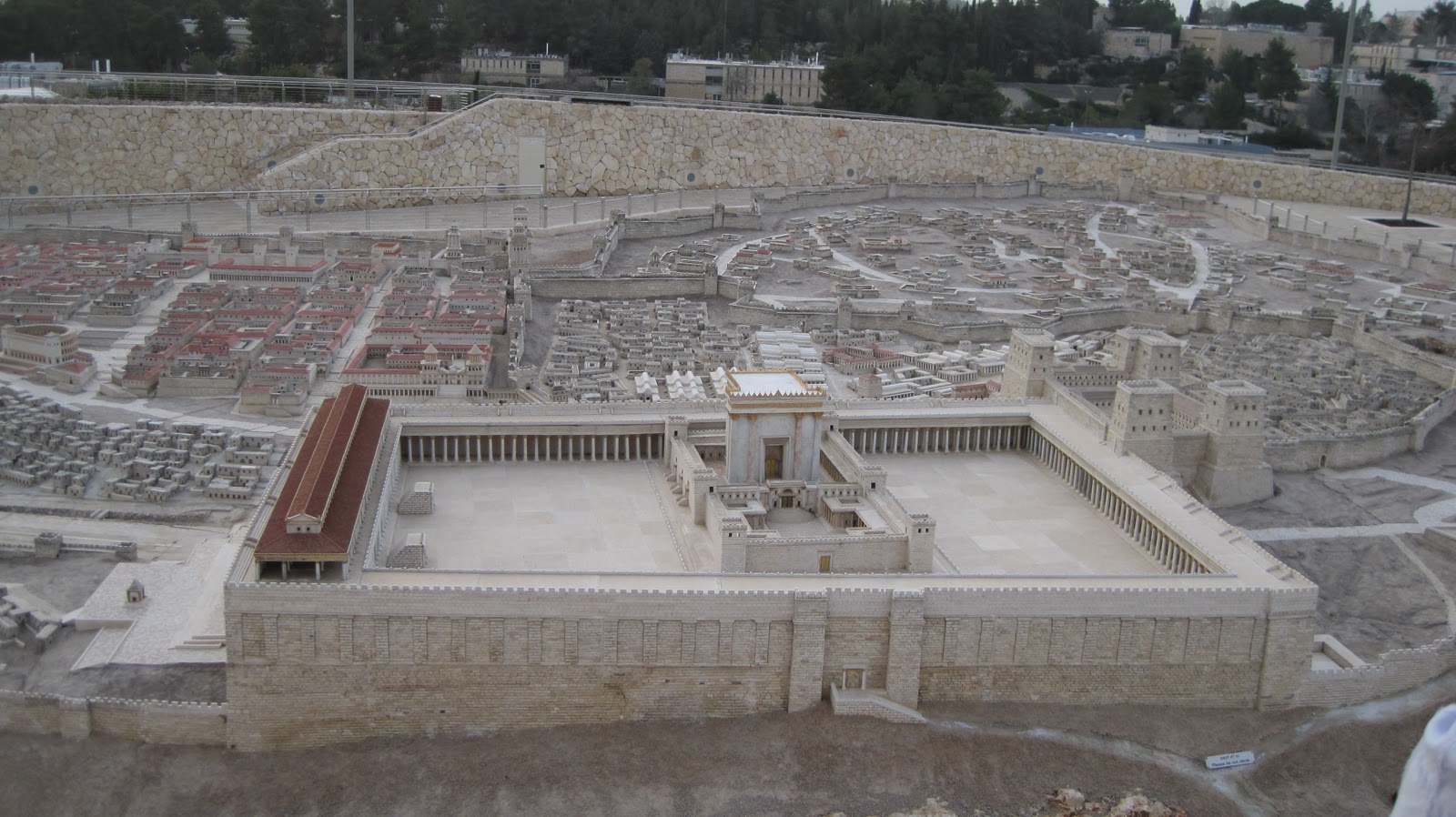
Model of the Temple
Museum in Jerusalem, Israel

Lectionary Text:  2 Samuel 7: (1-5a), 5b-7, (8-9) 10-11, (16)
Go and tell my servant David: Thus says the Lord: Are you the one to build me a house to live in? I have not lived in a house since the day I brought up the people of Israel from Egypt to this day, but I have been moving about in a tent and a tabernacle. Wherever I have moved about among all the people of Israel, did I ever speak a word with any of the tribal leaders of Israel, whom I commanded to shepherd my people Israel, saying, “Why have you not built me a house of cedar?”…And I will appoint a place for my people Israel and will plant them, so that they may live in their own place, and be disturbed no more; and evedildoers shall afflict them no more, as formerly, from the time that I appointed judges over my people Israel; and I will give you rest from all your enemies. Moreover the Lord declares to you that the Lord will make you a house.

This text wraps up the promise that God made to Abram in Genesis 12.  The people have a land that they can claim as their own and they can live in peace.  And David’s reign as king has been pretty much legitimized. Things seem to be going well.  And so David envisions now a more permanent structure to house the ark of the Lord.  In other words, David now desires to build a temple in Jerusalem.

But that night the Lord intervenes by way of Nathan with a promise not necessarily of a permanent “house” but, rather a permanent dynasty, an everlasting house of the line of David.  David has risen from shepherd boy to king and has apparently felt God’s presence through it all.  He now sits in his comfortable palace and compares his “house” to the tent that “houses God” in his mind.  So he decides that God needs a grand house too.  God, through the prophet Nathan responds by asking, in a sense, “Hey! Did you hear me complaining about living in a tent? No, I prefer being mobile, flexible, responsive, free to move about, not fixed in one place.” God then turns the tables on David and says, “You think you’re going to build me a house? No, no, no, no. I’M going to build YOU a house. A house that will last much longer and be much greater than anything you could build yourself with wood and stone. A house that will shelter the hopes and dreams of your people long after ‘you lie down with your ancestors.'” God promises to establish David and his line “forever,” and this is a “no matter what” promise, even if the descendants of David sin, even if “evildoers” threaten.  
The truth is, we all desire permanence; we want something on which we can stand, that we can touch, that we can “sink our teeth into”, so to speak.  We want to know the plan so that we can plan around it.  Well, if this was going to make it easier to understand God, go ahead.  The truth is, this is a wandering God of wandering people.  This is not a God who desires or can be shut up in a temple or a church or a closed mind.  This is not a God who desires to be “figured out.”  This God is palatial; this God is unlimited; this God will show up in places that we did not build.  (and sometimes in places that we really wouldn’t go!)  This God does not live in a house; this God dwells with us—wherever we are.  This God comes as a traveler, a journeyer, a moveable feast.  And this God shows up where we least expect God to be—in a god-forsaken place on the outskirts of acceptable society to a couple of people that had other plans for their lives.  This God will be where God will be.  And it IS a permanent home.

In this Advent season, we know that God comes.  That is what we celebrate; that is what we remember; that is what we expect.  After all, this God we worship is the one that is with us, Emmanuel.  But have we planned too much?  Have we somehow convinced ourselves that God can be directed or choreographed or planned into being?  Have we forgotten what it means to simply build a house in which God can live?  Are you the one to build me a house to live in?  Go ahead, build it.  It will be magnificent!

In this season of Advent, give yourself the gift of building a house of God.  There is no blueprint; there are no plans.  It has no walls, no ceiling, no floor.  It is open to the God who comes.  And know that God will come.

Grace and Peace,

Shelli
      

The Story of God

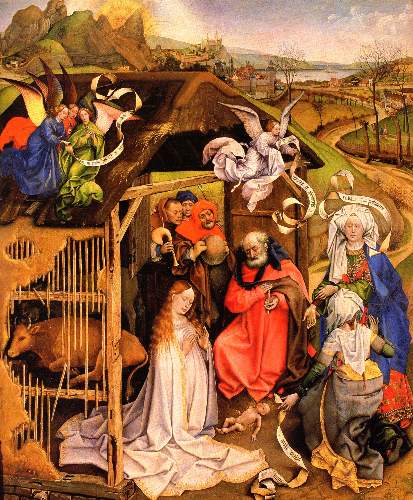
“Birth of Christ”, Robert Campin
ca. 1425-30

There is not one of us that does not love The Christmas Story.  It’s got it all–heartache, darkness, intrigue, danger, animals, innocence, an oppressive government, and a baby to boot.  It’s got all those things that make great tales.  No wonder it’s a bestseller!  No wonder there are so many songs written about it (that we at this moment cannot WAIT to sing!)  But for all the romantic notions of a baby born into a cold desert night in a small town on the other side of the world to poor, struggling parents, this story is not about a birth.  It’s not a story about Jesus.  This is the Story of God.

It began long before this.  It began in the beginning.  It began when God breathed a part of the Godself into being and created this little world.  And as the story unfolded, as God’s Creation grew into being, God remained with them, a mysterious, often unknown Presence, that yearned to be in relationship with what God had breathed into being.  And once in a while, God’s children would stop what they were doing long enough to know and acknowledge the incarnations of God.  Once in awhile, they would encounter a burning bush or a parting sea or an unfathomable cloud on the top of a mountain.  Once in awhile they would stop, take off their shoes, and feel the holiness beneath their feet.  But more often than not, they struggled in darkness, they struggled in war, they struggled in oppression and injustice because they didn’t see the Light that was with them.  God called them and God sent them and some were prophets and some were wise and some were yearning themselves to be with God.  Some wrote hymns and poetry telling of their yearning and others just bowed and hoped that God would notice.

This wasn’t enough.  It wasn’t enough for the people and it wasn’t enough for God.  God yearned to be with what God had created.  God desperately wanted humanity to be what they were made to be, to come home to the Divine.  And so God came once again, God Incarnate, into this little world.  But this time, God came as what God had created.  And so God was born into a cold, dark night.  But the earth was almost too full.  There was little room for God.  But, on that night, in a dark grotto on the outskirts of holiness, God was born.  The Divine somehow made room in a quiet, little corner of the world.  God came to show Creation what had been there all along.  And, yet, there was Newness; there was Light; there was finally Meaning; there was God Made Known.

The Incarnation (the “big I” one!) is God’s unveiling.  It is God coming out of the darkness and out of the shadows and showing us what we could not see before.  God became one of us to show us how to be like God in the world.  So, in this season, we again hear the story.  We hear the story of God.  But unless we realize that it is our story, it still won’t be enough.  God came as God Incarnate into this little world to tell the story that goes back to the beginning.  In the beginning was the Word, and the Word was with God, and the Word was God.  He was in the beginning with God.  All things came into being through him, and without him not one thing came into being.  What has come into being in him was life, and the life was the light of all people.  The light shines in the darkness, and the darkness did not overcome it.  (John 1: 1-5)  And the story continues… 

In this season of Advent, give yourself the gift of being a part of the story, of being Light, of being Life, of being who you were created to be in the beginning.  Give yourself the gift of making room for God.

Grace and Peace,

Shelli
    

THIRD SUNDAY IN ADVENT: Letting Go of Darkness

St. Paul’s United Methodist Church
Houston, TX
December 11, 2011

On this third Sunday in the Advent season, we continue to talk about light, about the Light of God as it comes into the world.  We talk about a light that illumines, a light that shows the way.  We talk about light-bending and light-bearing.  And we are reminded that this is the Light that pushes away the darkness.  And, yet, we still live in darkness.  We still live with injustice.  We still live with fear.  And we still live in a world that yearns for God and searches for Life.

So what is the problem?  If God created Light and then came into this world as Light Incarnate, the living Light, then why is there still so much darkness?  Perhaps it is we that are holding too tightly to the darkness.  Perhaps it is we who just don’t want to let go of that to which we are accustomed, of that which makes us comfortable.  Perhaps it is we who rather than adjusting our eyes to the Light, instead choose to shield our eyes and close our hearts until the Light is easier to handle.  Perhaps it is we that cannot let go of the darkness, of injustices that we allow to exist, of exclusions that we do not protest and hungers that we do not feed, and of those places where education, or medical resources, or the very basics of sustenance and life are not supplied because it is just too difficult.  And, so, there is still darkness.  Oh, we know that it’s there.  But what can we do? 

Don’t you think that if it were completely up to God, the Light would already be encompassing our world and the Kingdom of God would already be living into its fullest being?  I mean, really, what purpose does it serve God to hold back on us?  Why WOULDN’T God want Creation to be what it was created to be?  Why WOULDN’T God desire a world of justice and righteousness and sustenance for all.  Why WOULDN’T God want a world that offers life to all of God’s children?  If God is truly omnipotent, if God is all-powerful, why is our world the way it is?  It is because this omnipotent God chose long ago to give up a piece of the Godself.  It’s called free will.  God gave the greatest gift to humanity imagineable–a piece of the Divine, the ability to make a choice to let go of darkness and be the Light.  And then God came, Emmanuel, God-With-Us, to show us how to be that Light, to show us what it means to be a child of that Light.  God has never intended to remove us from the darkness of our lives but rather to show us how to transform it into Light, how to transform it into Life.  God is not holding back on us; God is waiting for us to let go of the darkness; God is waiting for us to be light.

Light looked down and beheld Darkness.
‘Thither will I go’, said Light.
Peace looked down and beheld War.
‘Thither will I go’, said Peace.
Love looked down and beheld Hatred.
‘Thither will I go’, said Love.
So came Light and shone.
So came Peace and gave rest.
So came Love and brought Life.
(“And the Word Was Made Flesh”, by Laurence Housman)
This morning we lit our third candle.  The Light has almost encircled the wreath.  It gives us the image of the Light encircling the world.  And when it is complete, when darkness is transformed, then the Light of Christ will be born to all.  We are the light-bearers.  We are the ones called to be children of the Light, bringing the Light to all.  So, let go of the darkness that it might be transformed into Life.  Be Light. Be Peace. Be Love.  Be the Image of God.

In this season of Advent, give yourself the gift of letting go of darkness; give yourself the gift of becoming the light that you were called to be, the light that points to the Light of God and brings life to a hurting world.

Grace and Peace,

Shelli


ADVENT 3B: Bending Light

Lectionary Text:  John 1: 6-8, (19-28)
There was a man sent from God, whose name was John. He came as a witness to testify to the light, so that all might believe through him. He himself was not the light, but he came to testify to the light.

Once again, we encounter John, who we now call John the Baptist.  But he’s really John the Witness.  Here, we are told that John is but a witness to something bigger.  He is there to point to the light of Christ that is coming.  But what makes John’s message uncomfortable is that he is always pointing to that which the light illumines.  For the writer of the Gospel According to John, the Logos was the true light bursting forth into humanity.  Rather than an angel announcing the birth of a baby, the writer is using John as a witness to point to that light as well as the purpose of that light.  We love the image of light but sometimes we are uncomfortable with full illumination.  I mean, here’s John, running around like a wild man in the wilderness preaching repentance, calling for us to change, and just being really loud.  Our reaction in this season is to respond with:  “John…shhhh!  You’ll wake the baby.”

After all, this is the Season when we celebrate the birth of Christ.  This is the Season when we want to give gifts to each other and spend time with our families enjoying a veritable plethora of high-sugar baked goods.  This is the Season when we want to decorate our houses with festive reminders of the joyous season and get dressed up and go to parties to celebrate the same.  This is the Season when we want everything to be joyous and beautiful and perfect.  But this John character just gets in the way, doesn’t he?  Doesn’t this come later in the Scriptures?  Doesn’t this come at the beginning of Jesus’ ministry?  Why do we have to think about this now in the middle of the birth stories?

The reason that we read about John is because it’s not about John.  He knew that.  Scary as he sometimes is, you can’t help but admire him.  He did not stand on convention and he really didn’t care at all what people thought.  He had one purpose.  He was to point to the Light.  In fact, when you think about it, he seemed to TRY to deflect attention away from himself.  Maybe that’s the point.  He was not the Light; he was the deflector.  It was his purpose to turn the attention aside and recast it toward the One who WAS the Light.  God created the Light for us so that we can see the Way, so that we can feel God’s Presence in our lives.  God created the Light that it might shine into our lives.  But God also created us in the image of the Godself that we might be able to also shine the Light away from ourselves, to deflect the Light back to God.  If we do nothing but bask in this incredible Light, we are surrounded in shadows.  But if we become a deflector of that Light, then the Light illumines even the darkness.

In this Advent season, we, too, are called to be witnesses of the Light.  It is not about us.  We, too, are called to turn God’s Light back toward God.  We are called to be Light-benders.  And you know what?  The baby’s already awake.  We just need to turn the Light toward the Christ that we might realize that.

In this season of Advent, give yourself the gift of turning the Light away from yourself that you might finally see the Glory of God.

Grace and Peace,

Shelli

(And if you’re interested in the full notes from the week’s lectionary passages, check out http://journeytopenuel.blogspot.com/ )

On the Other Side of the Manger

This past Wednesday night, I had the opportunity to lead an Advent discussion with members of St. Paul’s Hispanic Congregation.  No, my Spanish has not had a sudden improvement.  We slowly went through the discussion and the questions and answers by translating back and forth between English and Spanish.  (Boy, I need to brush up on my Spanish!  The closest I could get is that I would sort of understand the “gist” of the question before Nataly or Mireya translated it for me!)  But I must admit that I also had to brush up on the subject matter.  I must have drawn the short straw or something because my subject matter was Joseph of Bethlehem, husband of Mary, earthly father-figure (for want of a better word) for Jesus.  Joseph?  What is there to say about Joseph?  I mean, Mary has a big moment with the top angel Gabriel, followed by the entire world that waits for her answer.  She even has a song!  And she remains a top character in the plot all the way to the bitter end.  But Joseph?  I think if I were Joseph, I would attempt to renegotiate my contract or something.  I mean, he doesn’t even have a speaking role!  He has no voice!  So, really, what is there to say about Joseph?

We don’t really know that much about him.  His family was probably of Bethlehem, even though he perhaps lived in Nazareth.  One might surmise that he was there for work and, yet, Nazareth wasn’t exactly a thriving metropolis with numerous opportunities for a struggling carpenter.  (That probably meant that Joseph was a builder, the Greek techton, perhaps a stonemason.  After all, how much wood is there really in Israel?)  His and Mary’s was probably an arranged marriage.  Some think that he might have been older.  OK, there’s no real support for that, but whatever…But we know that he was righteous, probably a faithful “rule follower” of the Jewish law.  And he had plans.  He and Mary would marry and have children of their own.  He would have a son.  He would have the privilege of naming him.  But that was not to happen.  Instead, the lovely Mary goes and gets herself knocked up.  Think of what Joseph felt–betrayal, embarrassment, hurt, regret, confusion.  This was not the plan.

And then the dream.  Oh, that’s dangerous.  Biblical dreams never seem to help one’s plan.  Seldom does an instrument of God show up in one’s dream to tell us how great we’re directing our lives!  So, whether Joseph dreamed of an angel, or God, or his own conviction, he realized that in spite of all the rules that had been broken, in spite of the way that life had literally spit on his plan, he loved Mary.  He realized that he was called to be a part of this.  He realized that regardless of what the world told him to do–divorce her silently or accuse her publicly–he could not.  And so, there’s Joseph on the other side of the manger.  The picture is in every Nativity image we have–the Blessed Mary, the mother of Christ looking adoringly at the infant in the manger.  And standing across from her in silent commitment is Joseph of Bethlehem.

This silent figure does not, I think, get his due.  After all, his entire life changed as much as Mary’s.  His plans had to be shelved.  His rules were broken.  He was called to offer love and support and to raise this child, this child that, regardless of whether or not Joseph had a hand in the conception, would never really be his own.  The other side of the manger has no voice.  Instead, he was called to a silent commitment.  He was called to hold the child’s hand, lead him from the manger, and then let him go.  And then Joseph drops out of sight.  He was there twelve years later at the temple when Jesus left his parents but chances are that Joseph was used to Jesus going down roads without him by that time.

Not all of us are meant to be the stars of the play. Some of us have no speaking roles.  In fact, some of us never even make it to the stage. But the story is never complete without each and every one of us.  And those that stand with no voice in silent commitment and humble devotion are the hardest workers of all.  The years of Jesus’ life that were spent with Joseph are not documented in known Scripture.  They are not a part of our canon.  But Jesus had to have someone that took him by the hand and led him to the beginning.  The Gospel story did not just shoot out of thin air–someone was silently leading the way.  Someone early on had to make the conscious decision to silence the world and listen to God.  Someone had to stand on the other side of the manger.

I wish that the other night my Spanish had been not quite as rusty.  We were able to tell the story.  We were able to talk about what Joseph felt.  We were able to place the story in the proper context.  But there was an almost overwhelming silence.  When you’re standing on the other side of the manger, it is only God that you hear.  When there’s nothing to say, when you have no voice,  God still calls you to something bigger than you can possibly imagine.

In this season of Advent, give yourself the gift of silence that you might hear the song of God.

Grace and Peace,

Shelli


ADVENT 3B: Hallowed Be

Lectionary Passage:  1 Thessalonians 5: 16-19 (20-24)
Rejoice always, pray without ceasing, give thanks in all circumstances; for this is the will of God in Christ Jesus for you. Do not quench the Spirit.

How do you pray without ceasing?  I mean, OK, now, let’s pray.  We pray and we pray.  Things are going OK.  We’re praying along.  Wait, who’s phone is that?  Hold on, it’s mine.  Stop praying.  Answer the phone.  OK, now, I need to pick up the house a bit.  And I need to write the blog for tomorrow.  And tomorrow is trash day.  And Maynard needs his dinner. And, to be honest, I think I do too.  Pray without ceasing?  Really?  How do you fit that in?  And, sadly, the Spirit is quenched.

Paul was not laying down a rule for prayer.  Paul never envisioned us living body-bent and knee-bowed 24/7.  After all, there is WAY too much work to do.  We’ve got some Kingdom-building to accomplish, don’t we?  No, Paul was not calling us to a life spent in prayer; He was calling us to a prayerful life, a life that is sacred, hallowed, a life lived in the unquenchable Spirit of God.  It’s not about logging prayer hours.  Rather, it’s about perspective, about seeing everything that is your life as hallowed and holy, as of God, as prayer.  Olga Savin says that “[the Scriptures] tell us that ceaseless prayer in pursuit of God and communion with [God] is not simply life’s meaning or goal, the one thing worth living for, but it is life itself.”  And a life lived the way it is called to be lived is the very will of God.  It is prayer.

And so, pray without ceasing.  When you answer the phone, cherish the family member or the friend or the co-worker who has called you.  In fact, give thanks for the person on the other end who inadvertantly dialed the wrong number.  After all, they, too, are your brother or sister.  God has called us to love one another.  And as you clean and straighten, look around you.  Your dwelling is more than shelter.  It is an expression of you.  Give thanks for the you that God has made.  And then do what God has called you to do.  Use your talents.  Give thanks for them.  They were given to you by God to use in the building of God’s Kingdom.  And that big black lab that wants his dinner?  Personally, I thank God everyday for bringing us together.  How did I find a companion like this on the internet?  He needed me; I needed him.  Isn’t that why Creation exists?  Then sit back and taste dinner.  Taste that which has been lovingly grown by the Divine.  And give thanks.  Every household task, everything thing you do, do as a prayer.  And all of those never-ending interruptions?  Think of them as holy.  (After all, think about it–when did God show up as planned?)  Make everything you do an offering to the Divine.  Let everything you have and everything you are be a preparation for God’s coming.  Embrace it.  Rejoice in it.  Give thanks.

In this season of waiting for the coming of God, pray without ceasing.  In other words, live your life to the fullest and the best.  Offer it to God.  And rejoice in what you have–companionship, beauty, work, love.  G.K. Chesterton exhorted us to “let your religion be less of a theory and more of a love affair.” I love that.  You know, God is coming. It will happen. But don’t forget that God is here. Rejoice! And live your life waiting and rejoicing, rejoicing and waiting.  And, most of all, love.  That is how you pray without ceasing.
 
In this season of Advent, give yourself the gift of seeing your life as prayer, of living in a love affair with God.

Grace and Peace,

Shelli

Open Season

“…who was conceived of the Holy Spirit, born of the Virgin Mary…”

We say those words every Sunday.  We stand and we look at the cross and we say with all our heart that we believe these words to be true.  Now, the “conceived” part we get–conceived, thought up, breathed into–Jesus was God’s way after eons of breathing Creation into being of finally breathing the very Godself into the world.  The Divine has come to walk with us.  But this Virgin Mary thing?  What is that?  Jesus, born, born as a human, born as a baby.  As unromantic and “un-Nativity-like” as it may be, Jesus was fussy and colicy.  The Son of God, in all likelihood, messed up his first-century diaper.  (I’ve never been accused of being overly-reverent!)  Mary and Joseph were probably sleep-deprived.  And as time went on, Jesus, like all of us, had to learn to walk and talk and be.   He had to grow into who he was. But when’s the last time you held a newborn baby?  When’s the last time you held a baby that was only hours old? It’s just like holding the entire hope of the world in your arms.  There are no preconceptions; there are no agendas; there is no one to impress or keep from disappointing.  There is only a pure and undefiled openness to what comes next, to what God holds.  There is only hope.  You can smell it.  Maybe it’s the smell of birth.  But maybe it’s the smell of the Divine.

So does it really matter?  We get so wrapped up in whether or not Mary’s virginity was literally intact when Jesus was born.  Again, does it really matter?  Does it really matter when you are holding the hope of the world?  Does it really matter when you are holding the world’s salvation in your arms?  Think about it.  Jesus was born, Son of God and Son of Humanity.  Jesus was born to Mary, the mother of the Salvation of the World.  Perhaps the translators of the writing by the writer known as Matthew had it right and Mary was a virgin in every sense of the word–pure, undefiled, and open to receive.  But, more importantly,  Mary was a virgin in the spiritual sense of the word–pure, undefiled, and open to receive what comes next, open to receive whatever God held for her life.  Mary opened her heart and her life that she might birth God into this world.

In this season of Advent, we are called to do the same.  14th century theologian, Meister Eckhart said that “we are all meant to be mothers of God, for God is always needing to be born.”  We are all called to be virgin–pure, undefiled, and open to receive.  We are all called to birth God into this world.  How open are you to what comes next?  How open are you to what God holds for your life?  This is the open season.  This is the season when we shed all the preconceptions of what we think God is.  This is the season when we let go of our need to explain God’s coming into the world and be open to what comes next.  So does it really matter?  You bet it does.  It is the Hope of the World that depends on it.
 
In this season of Advent, give yourself the gift of being open to whatever it is God holds for you and birthing God into your life.  Be virgin.  Be a womb for the hope of the world.

Grace and Peace,

Shelli