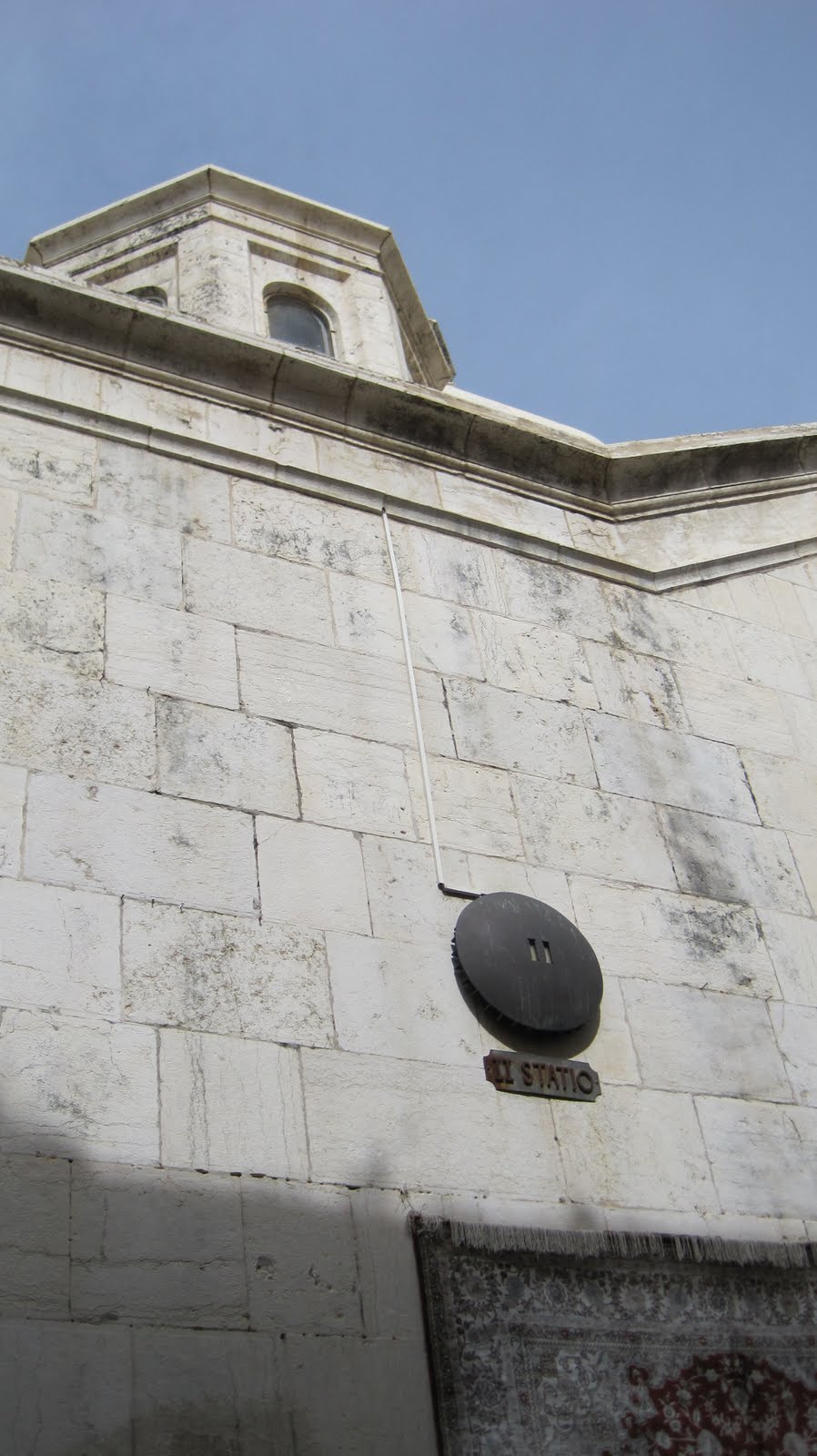
STATION III: Jesus Falls the First Time

Before the station, pray: We adore you, O Christ, and we bless you, because by your holy cross, you have redeemed the world.

Read Matthew 27: 27-31
Then the soldiers of the governor took Jesus into the governor’s headquarters, and they gathered the whole cohort around him. They stripped him and put a scarlet robe on him, and after twisting some thorns into a crown, they put it on his head. They put a reed in his right hand and knelt before him and mocked him, saying, “Hail, King of the Jews!” They spat on him, and took the reed and struck him on the head. After mocking him, they stripped him of the robe and put his own clothes on him. Then they led him away to crucify him.

Jesus was exhausted and trembling under the weight of the cross-beam. He could not take it any longer and fell to the ground, face down in the dust and dirt of the well-traveled path. Someone jerked him up from his moment’s rest and prodded him on. And the world stands and watches, seemingly unmoved by the visceral treatment of one who was once so renowned. “Hail, King of the Jews”, now fallen, now face down in the dust and dirt of the well-traveled path.

Where are we? Do we lay there in the pathway of forgotten footprints? Do we stand by the sidelines too afraid to move? We must get up and get going. It is time to follow. Father, forgive.

Jesus, may your courage be my stamina for getting up again and again, realizing that only the weak fall once. In the name of the One who raises me up on eagle’s wings. Amen.

STATION II: Jesus Takes Up His Cross

Before the station, pray: I adore you, O Christ, and I bless you, because by your holy cross, you have redeemed the world.

Read John 19: 16-17
Then he handed him over to them to be crucified. So they took Jesus; and carrying the cross by himself, he went out to what is called The Place of the Skull, which in Hebrew is called Golgotha.

And Jesus, carrying his own cross, starts his “Way of the Cross”. Weak and alone, but with great dignity, Jesus emerges from the fortress. And yet…there was so much that he still had to accomplish. It was almost too great to bear.

This wooden cross was a tree—a tree that God created, that God nurtured, that God showered with the joy of life—a tree that would become the instrument of Christ’s death. We are asked, then, to bear the cross, to bear the instrument of death. We are asked to bear life.

Sadhu Sundar Singh says that “if we do not bear the cross of the Master, we will have to bear the cross of the world, with all of its earthly goods.” Which cross is yours to bear? Father, forgive.

Jesus, may your willingness to carry your cross be my strength in losing my life that I may find it. In the name of the One who bears all things. Amen.

STATION I: Jesus is Condemned to Death

Before the station, pray: I adore you, O Christ, and I bless you, because by your holy cross, you have redeemed the world.

Read Luke 23: 1-24
Pilate then called together the chief priests, the leaders, and the people, and he said to them, “You brought me this man as one who was perverting the people; and here I have examined him in your presence and have not found this man guilty of any of your charges against him.”…”Crucify, crucify him!”…So Pilate gave his verdict that their demand should be granted.

Jesus is the victim of the consummate power struggle, conflicting purposes that are exacerbated by the personalities and fears of those involved. The person whose life is at stake seems to be ignored. And justice fails. The truth is, Jesus stands for all those things that are different from what we know. Jesus says those things that the world does not want to hear. He speaks against the status quo. He speaks for those rejected and cast aside by acceptable society. Jesus creates chaos in the midst of our orderly lives. He must be silenced.

Oh, we stand in awe of these convictions. We are amazed that someone has the courage to look into the face of death and, without fear, say nothing. And yet many of us are silenced by our fears and our anxieties and our attempts to maintain our carefully preserved lives.

And now he stands…in silence. “And darkness covered the face of the deep.” (Gen. 1:2a). Father, forgive.

Jesus, true and silent victim, let the power of your life, the beauty of your silence, be my courage. In the name of the One who redeems me. Amen.

The Way of the Cross

In this season of Lent, we are called to deepen our own walk with Christ. This means moving beyond what Christ does for us. This means entering the Way of Christ itself, the Way of the Cross. It means experiencing on the deepest Christ’s dying, so that we can experience on the deepest level, Christ’s rising. It means moving from being an observer to being a participant with Christ.

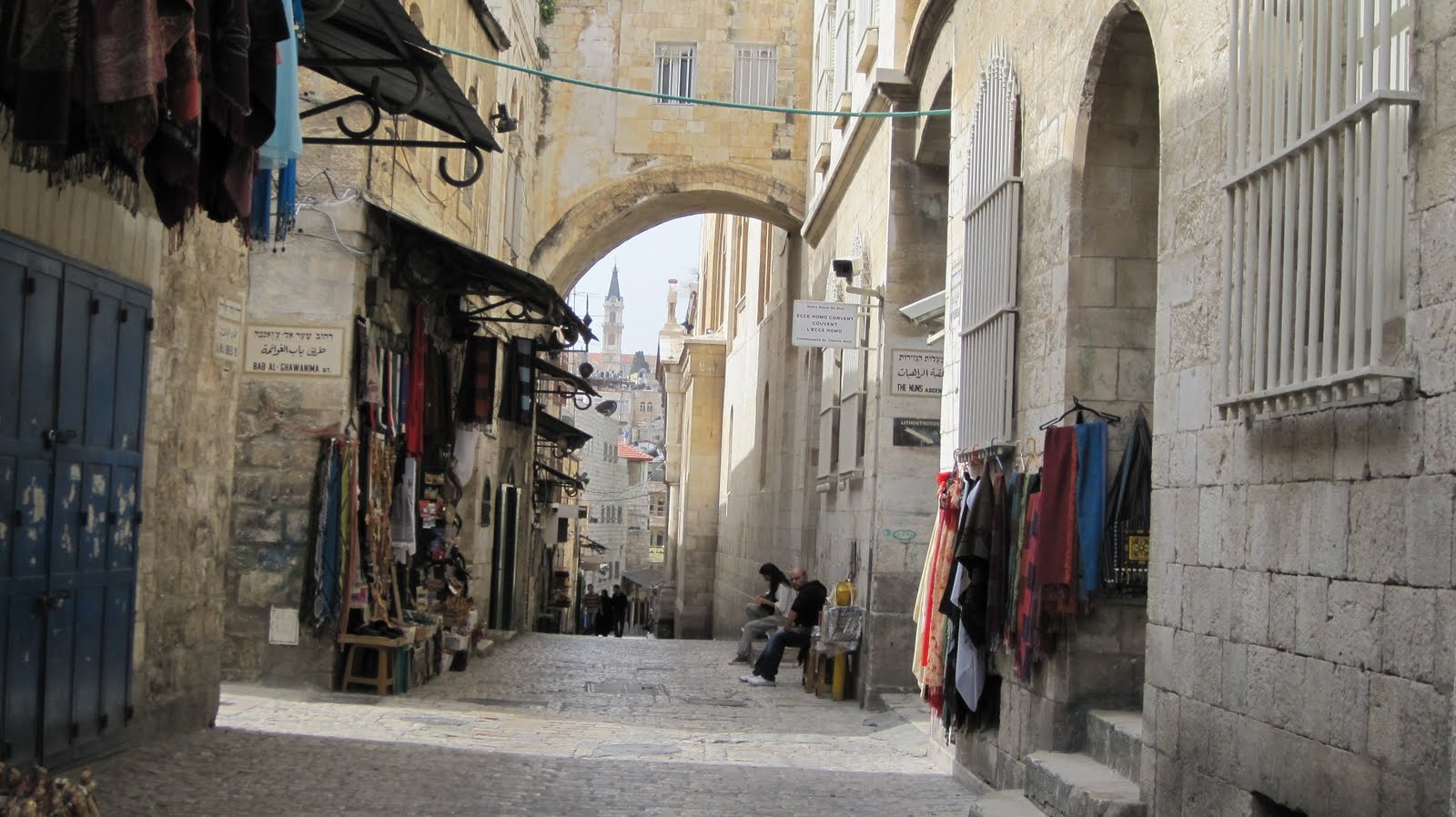
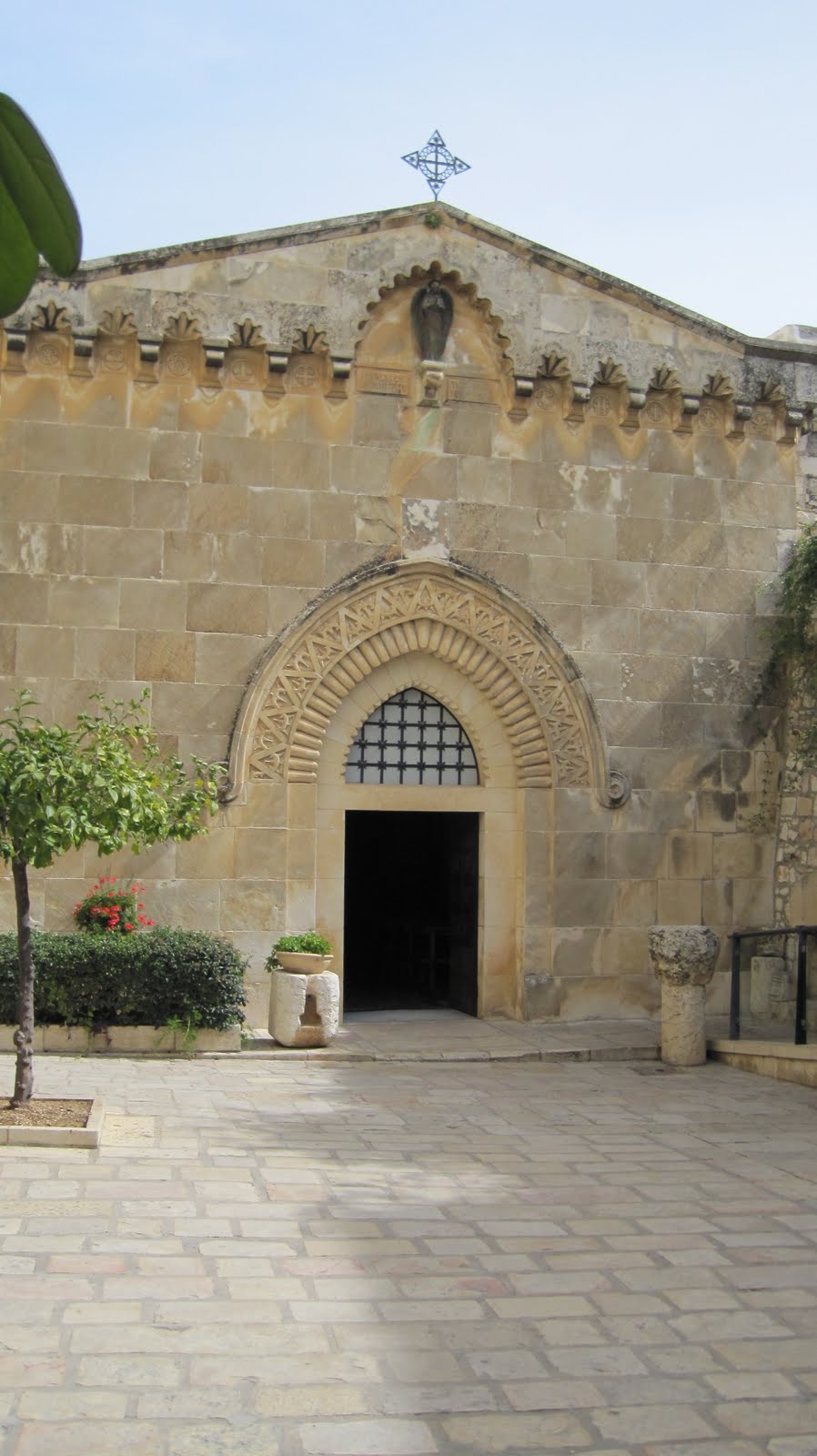
The Stations of the Cross generally refers to a devotion that originated in the 4th century when pilgrims flocked to the Holy Land from all parts of the world to visit the land of Jesus. When they got there, the most popular place visited was the Church of the Holy Sepulchre, which had been built by the Emperor Constantine in 335 A.D. over what was believed to be the tomb of Jesus. Over the years, the route of pilgrim processions—beginning at the ruins of the Fortress Antonia near the Church of the Flagellation (pictured) and ending at the Church of the Holy Sepulchre (the tomb)—was accepted as the way that Jesus had walked to his death. It became known as the “Via Dolorosa”, the “Sorrowful Way”, or “Way of the Cross”.

The Via Dolorosa marks the path Jesus traveled as he carried the cross from the place he was sentenced to the place of his resurrection. Through the years, “stations” developed as early pilgrims honored places where events were likely to have taken place. Many of these stations are only a guess since the Jerusalem of Jesus’ day was almost completely destroyed by the Roman armies in 70 AD. But since the majority of Christians throughout the world could not journey to Jerusalem to walk the Via Dolorosa, the Stations became a spiritual tool that would give them an opportunity for a “mini-pilgrimage”. It became a way for every Christian to enter that Holy Walk, the “Way of the Cross”, the way that takes us through the sorrows and despair of Holy Week that we, too, might emerge victorious in the glory of the Resurrection.

So, walk this way. It may not be easy or pleasant or calming to the soul. But by walking the Way of Sorrows, by entering the walk that Christ walked, one will truly encounter the incredible Feast of Joy. Begin your walk with the prayer below and then, as you walk, stop and gaze upon each station. Say the prayer of contemplation. And look…Think about what it means. Place yourself in its center. And when you are ready, move on…The Path is yours to walk. This is the Way of the Cross.

Lord Jesus Christ, take me along that holy way you once took to your death; Take my mind, my memory, above all my reluctant heart, and let me see what once you did for love of me and all the world.  Amen.  (From Victor Hoagland, C.P., “The Stations of the Cross and Other Devotions to the Passion”, available at http://www.cptryon.org/prayer/xstations/egeria.html, accessed 10 February, 2008.) 

A Journey of Thirsting

Today’s Lectionary Old Testament Text:  Isaiah 55: 1-3, 6

Ho, everyone who thirsts, come to the waters; and you that have no money, come, buy and eat! Come, buy wine and milk without money and without price. Why do you spend your money for that which is not bread, and your labor for that which does not satisfy? Listen carefully to me, and eat what is good, and delight yourselves in rich food. Incline your ear, and come to me; listen, so that you may live. I will make with you an everlasting covenant, my steadfast, sure love for David…Seek the Lord while he may be found, call upon him while he is near…(NRSV)

None of us like to thirst.  In fact, much of our life is about chasing something that will quench our thirsts–our thirst for knowledge, our thirst for acceptance, our thirst for recognition, our thirst for security, our thirst for gratification.  Thirst is an interesting thing.  It is a powerful and undeniable signal to us of what we need, a reminder of those things that sustain us.  And yet, the point seems to be to rid ourselves of it, to live perfectly-quenched lives so to speak.

And yet God is not really calling us to “perfectly-quenched” lives.  God has never said to us, “Get yourselves together, people, so that you can come to me.”; never, “Hurry, people, I don’t have time to wait for you anymore.”  That’s not what it’s about.  That’s not who God is.  Instead, God is inviting everyone who thirsts to come.  Timothy Shapiro claims that “hope is preceded by longing”.  God’s desire is not that we perfect our lives but that we desire so deeply to be with God, long for that relationship as the very source of our being, that we can do nothing other than to come to God.  God is inviting all who thirst to come. It is our thirst that draws us closer to God.  It is that thirsting for God at the very core of who we are that is the journey to God itself. As we long for God, our thirst is quenched by the very thirst for God itself.  

Alexander Stuart Baillie says that this age needs to become more realistic. It needs to listen again to the words of Jesus, who said, ‘I thirst.” He who is the Son of Man, the Son of God, is our example. He is the great pioneer in every realm of life. Surely if he thirsted, how much more do we? Humanity needs to get away from the world of “things as they are” into the world of “things as they ought to be.” This means that men and women must learn to live for others. It is only when we can live a life of self-forgetfulness that we get our truest joy out of life. One needs to keep on thirsting because life grows and enlarges. It has no end; it goes on and on; it becomes more beautiful. When one has done his best there is, he finds, still more to learn and so much more to do. [One] cannot be satisfied until [one]attains unto the stature of Jesus, unto a perfect [human], and ever thirsts for God(Alexander Stuart Baillie, “Thirsting”, in Bread and Wine: Readings for Lent and Easter (Maryknoll, NY: Orbis Books, 2003), 242-243.)

It is only through our thirsting for God that we will find God.  It is only when we thirst that we will truly drink from the cup.

Grace and Peace,

Shelli

Picture:  The Dead Sea, Israel, 2010

Looking Through

We are accustomed to thinking of Lent as a journey–a journey of penitence and perspectives, of crosses and crossings, of giving up and giving over.  But in those times that we dare to stand still, to really think about things, to really contemplate the place to which we’ve walked, what then?  Then Lent is a space through which we look beyond–beyond Lent, beyond the cross, beyond ourselves, beyond to what it is that we will become once this season has ended.

We 21st century journeyers not only want to know where we’re going; we also want to get there–fast!.  We are not really programmed to just stand still and look through something.  We’d rather keep moving, even though some of the steps along this road are painful.  At least when we’re moving, we have some sense of control, some sense that we can change things–if we only keep moving.  But when we stop–when we stand still–it is as if all the control leaves us.  We stand, exposed to the elements, vulnerable to others who are comfortably and successfully moving through life, and suddenly acutely, and often painfully, aware of our own place on the journey.

And yet, part of Lent and part of life is indeed about standing still.  A journey is seldom completed with constant motion.  We are just not made for that. (You can look up that seventh day concept when you have time!) Sometimes we are meant to move; sometimes we are meant to stand still and savor what God has shown us.  Behold!  There is the cross.  There you are.  And if you stand still long enough, you will be able to look through and see where you are headed.  We are not called to walk blindly into the unknown, never looking, never questioning, never contemplating where we are or where we’re going or where we’ve been; we are called to journey toward that which God has illumined in our lives.  So stop–stand still–and look through it all.  Behold!  And then start walking again…

Grace and Peace on the Journey–the walking and the standing,

Shelli

Picture:  Capernaum, Israel (February, 2010)   

Unless You Repent…

This Week’s Lectionary Gospel Passage:  Luke 13: 1-9
At that very time there were some present who told him about the Galileans whose blood Pilate had mingled with their sacrifices. He asked them, “Do you think that because these Galileans suffered in this way they were worse sinners than all other Galileans? No, I tell you; but unless you repent, you will all perish as they did. Or those eighteen who were killed when the tower of Siloam fell on them—do you think that they were worse offenders than all the others living in Jerusalem? No, I tell you; but unless you repent, you will all perish just as they did.” Then he told this parable: “A man had a fig tree planted in his vineyard; and he came looking for fruit on it and found none. So he said to the gardener, ‘See here! For three years I have come looking for fruit on this fig tree, and still I find none. Cut it down! Why should it be wasting the soil?’ He replied, ‘Sir, let it alone for one more year, until I dig around it and put manure on it. If it bears fruit next year, well and good; but if not, you can cut it down.’” (NRSV)

Hmmm!  Maybe we should try the Psalm.  They’re usually a little more friendly, not quite as prickly to the touch, right?  The truth is, we do not like to be threatened and this sounds very threatening.  We’d rather listen to the soothing melodies of assurance and unconditional love and grace.  Repentance is just too stressful, just too harsh and unyielding.  But, unless you repent…
 
I think the problem is that we look at repentance as something negative.  We envision repentance as some sort of self-denial.  We think that we can no longer be who we are but instead we must become some sort of stamped-out “stepford” Christian in order to “measure up” to Jesus Christ.  To quote the old, much-overused, and oft-abused slogan “What Would Jesus Do?” (WWJD), we use Christ as some sort of divine measuring stick of what is good and what is evil, what is right and what is immoral, and, more importantly, what is it that would win us favor and life with God?  So, what would Jesus do?  Well, I’m convinced that he’d throw that rot out with that batch of bad figs!  Because repentance is not negative.  It does not mean losing who you are.  It means discovering the wonder of who you are meant to be.
 
The Greek word that is usually translated as “repentance” is metanoia.    In Classical Greek, it meant to change one’s mind, one’s heart, one’s soul, one’s life.  Penance was not a part of it.  It simply meant to follow a different road.  I think that IS what Jesus would do.  Why is that so difficult for us?  Is the road that we’re on so grand?  For most of us, probably not.  It is just comfortably familiar.  But don’t we deserve more than comfortable?  We are told of a new life, a new creation, an existence of perfect harmony and shalom.  I don’t think that’s necessarily limited to our next life, or heaven, or the other side of the rainbow, or however you envision it.  I think it’s down that road.  But…unless you repent…unless you change course, let go of the life that you’ve created, and listen to the road that beckons before you, you will remain comfortable and secure and right where you are. And then you will die! But, oh, what you will miss!
 
The road ahead looks dark now and even a little bleak.  The skies are blackening and there’s this awful hammering of metal against wood up ahead.  There is shouting and chaos.  It IS tempting to pull the covers over our head and just stay in for the day.  But just beyond that hill, just ahead, through those rocks and trees, there is a tiny flicker of light.  Let us go and see this thing that has happened.  Frederick Buechner says, “To repent is to come to your senses. It is not so much something you do as something that happens. True repentance spends less time looking at the past and saying, “I’m sorry,” than to the future and saying, “Wow!” (Buechner, Wishful Thinking, 79)  But, unless you repent…
 
So, repent and believe the Gospel!
 
Shelli

Picture: Israel (February, 2010)