WALK TO JERUSALEM: Called to this Work

Scripture Text:  John 1: 1-4, 29-42
In the beginning was the Word, and the Word was with God, and the Word was God.  He was in the beginning with God.  All things came into being through him, and without him not one thing came into being. What has come into being in him was life, and the life was the light of all people…The next day he saw Jesus coming toward him and declared, “Here is the Lamb of God who takes away the sin of the world! This is he of whom I said, ‘After me comes a man who ranks ahead of me because he was before me.’ I myself did not know him; but I came baptizing with water for this reason, that he might be revealed to Israel.” And John testified, “I saw the Spirit descending from heaven like a dove, and it remained on him. I myself did not know him, but the one who sent me to baptize with water said to me, ‘He on whom you see the Spirit descend and remain is the one who baptizes with the Holy Spirit.’ And I myself have seen and have testified that this is the Son of God.” The next day John again was standing with two of his disciples, and as he watched Jesus walk by, he exclaimed, “Look, here is the Lamb of God!” The two disciples heard him say this, and they followed Jesus. When Jesus turned and saw them following, he said to them, “What are you looking for?” They said to him, “Rabbi” (which translated means Teacher), “where are you staying?” He said to them, “Come and see.” They came and saw where he was staying, and they remained with him that day. It was about four o”clock in the afternoon. One of the two who heard John speak and followed him was Andrew, Simon Peter’s brother. He first found his brother Simon and said to him, “We have found the Messiah” (which is translated Anointed). He brought Simon to Jesus, who looked at him and said, “You are Simon son of John. You are to be called Cephas” (which is translated Peter).

The writer of John’s version of the Gospel According to Jesus Christ presents this as a sort of “prelude” to Jesus’ ministry.  This passage begins by celebrating Jesus’ origins, tying them back to the very beginning of Creation, tying them back to the Creator of us all.  Then we are given a witness by John the Baptist attesting to who Jesus is, reminding us that this Jesus Christ is the one whose coming was announced by the angel, the one who was born years before in that dark grotto in Bethlehem, the one who he himself had baptized and who God’s Spirit had entered.  This was the Lamb of God who takes away the sin of the world.  Now it was time to begin the work.  This was Jesus’ calling to ministry.  And what did he do first?  He called others, saying, “Come and see…come and see what you haven’t seen before.”
 
Now I know that often when we talk about “calls” from God, many of us squirm in our seats a little. Calls are something that a lot of people limit to clergy. But as early as the Hebrew Scriptures, we read of a qara, which means to call, call out, recite, read, cry out, proclaim, or name. The word was used both as a summons or a general call as well as a specific election, the calling of someone to do a specific task that needed to be done. And, here’s the point—the call is to everyone. It is that voice, sometimes silenced by our busyness and our preconceptions, that is buried deep within our being. It is that voice that calls us to be who God created us to be.  But you will notice that God doesn’t just throw a blanket over humanity to see who will pick it up. And nowhere in the Bible does God really ask and wait for volunteers. The call to each of us is very unique and specific. God calls us to our own part of God’s creation, our own part of the Kingdom of God that is ours to build.  God calls us to walk this road to Jerusalem.

Note here that two disciples follow Jesus as a direct result of John’s witness. John showed them the light. And then two others are called. One is named Andrew we are told, who then gathers his brother Simon Peter. Both become disciples. But the other one that is called is unidentified here. We are not clear who this is. This anonymity is reflective of the writer’s understanding of discipleship as a broader vision. (In essence, the “other disciple” is us!) Discipleship is meant for all of us. Yes, all of us! And when Jesus calls us to follow, the answer is always “come and see”. You have to come and see for yourself. God calls, God names, and God calls each of us by name. Just, come and see!

So how do we respond? What does it mean to respond to our call from God? What does that look like? That calling is to each of us to become the part of God’s Creation that we are called to be. It is at the very center of who we are as followers of Christ. And nowhere in the Scriptures do we read of calls from God like “Hey, if you’re not too busy, on your way home from work, could you feed some homeless people?”  or “Listen, I don’t want you to inconvenience yourself, but when you have time, could you speak out against injustices in this world?” or (my favorite!) “OK, once you’ve “made it”, once you have all of the money that you need to be secure and you are completely adept at what I’m calling you to do, then, very carefully, so as not to make yourself uncomfortable, could you follow me?”  God does not call perfect people.  God calls us. 

The “called” life is one of tensions and convergences and wonderful coincidences that God melds together into a wonderful journey of being.  It seems that God is continually calling us into places and times that we’ve never been, constantly empowering us to push the limits of our “comfort zones”, to embark on a larger and more all-encompassing journey toward a oneness with God.  It seems that God always calls us beyond where we are and beyond where we’ve been, not to the places that are planted and built and paved over with our preconceptions and biases but, rather, to places in the wilds of our lives with some vision of a faint pathway that we must pave and on which we must trudge ahead.  Thomas Merton says that “there is in all visible things…a hidden wholeness.”[i]  It is the image of God in each one of us that must be reclaimed and nurtured so that we might take part in bringing about the fullness of Creation, in bringing the Reign of God into its fullness.  Perhaps, then, the meaning of calling is not one in which we launch out and pursue a new life but is instead one that brings us to the center of our own life, one that brings us home, back to the womb, back to God.  T.S. Eliot says that “the end of all our exploring… will be to arrive where we started…and know the place for the first time.”[ii] 

So, back to the story.  This is the beginning of Jesus’ ministry.  This is the beginning of his own walk and his own work.  We don’t usually think of Jesus being “called”.  We’re more comfortable just imagining him already there, as if he dropped into our lives already formed.  But that’s not the way it works.  God did not just plunk down into our human existence without any connection; rather, God in Jesus inserted the Divine Calling into a long, successive line of called ones–some who were ready and some who were not, some who went willingly to do what they were asked to do, and others who fought the fight of their lives to keep it from happening and lived to tell the tale of encountering God–and it keeps going.  So Jesus had to be called.  It’s what it’s about.  Jesus was formed and then called and then called others who called others who called others…well, you get the drift!  And one way or another, they responded.  Jesus was not the lone ranger.  And those that he called went.  They were nothing special–just ordinary people like you and me.  They were ordinary people asked to take on the work of discipleship and they ended up with a life that they never could have foreseen or imagined.  It is in the ordinariness of our lives that God calls us and asks us to join in the work, to join with Jesus Christ in this work of ministry, to walk with Jesus on this walk to Jerusalem.  Come and see!  It will be magnificent!  And the work has begun…
So, in this Lenten season, listen for where God is calling you and then…come and see!  Because that is the way to Jerusalem…
Grace and Peace,
Shelli 

[i] Wayne Mueller, How Then Shall We Live?  Four Simple Questions that Reveal the Beauty and Meaning of our Lives, (New York, NY:  Bantam Books, 1996), 3
[ii] T.S. Eliot in Pilgrim Souls: An Anthology of Spiritual Autobiographies, ed. by Amy Mandelker and Elizabeth Powers (New York: Simon & Schuster, 1999), 146

WALK TO JERUSALEM: From the Water

The Jordan River,
Yardenit Baptism site, near the Lake of Galilee, Israel
Taken February, 2010

Scripture Text:  Matthew 3: 13-17
Then Jesus came from Galilee to John at the Jordan, to be baptized by him. John would have prevented him, saying, “I need to be baptized by you, and do you come to me?” But Jesus answered him, “Let it be so now; for it is proper for us in this way to fulfill all righteousness.” Then he consented. And when Jesus had been baptized, just as he came up from the water, suddenly the heavens were opened to him and he saw the Spirit of God descending like a dove and alighting on him. And a voice from heaven said, “This is my Son, the Beloved, with whom I am well pleased.”

The reading begins simply: “Then…” It is such a common connector, that we probably sort of gloss over it. But look a little more closely. It wasn’t just the thirty years that Jesus had waited to commit to public ministry. It was the centuries upon centuries and ages upon ages that all of Creation had waited for the dawn to break. In essence, from that very moment when we are told in the first chapter of Genesis that God’s Spirit swept over the face of the waters, Creation has been groaning and straining for this very moment, the very moment when life would emerge from the water.

Thirty years was, in fact, the traditional time that a rabbi waited to be committed to God. In those thirty years, Jesus would have been caring for his mother, and making a living, and preparing himself for ministry. I don’t really think that, contrary to what some may say, Jesus was confused about these roles. He was always serving God. But now…then…the time had come. And as eternity dawns, Jesus is ready to begin. And so he goes to John at the Jordan to be baptized and for a very short amount of time was then actually a disciple, a follower, of John’s.  And, from the water, the work has begun.  From the water, the heavens are opened and the Spirit emerges. And we hear what all the world has always been straining to hear: “This is my Son, the Beloved, with whom I am well pleased.” Even though the writer of the Gospel has presented Jesus as the Son of God in the birth story, it is not until this moment that the title is actually conferred. From the water, comes Jesus Christ as Savior and Redeemer of all of Creation.  From the water, comes a new Spirit. From the water, comes life.

What is it about the water in the River Jordan that so fascinates us? It’s wet and its cold—it’s just like any other water—and yet for more than 2,000 years, we have been captivated by it. When I had the opportunity to go to Israel last February, I, like most Holy Land tourists, could not wait to touch the water in the Jordan River. When that day that had the Jordan River on our itinerary arrived, I was so looking forward to it. This would be the place…this would be the place where I would connect with Jesus Christ.  Well, at the risk of bursting your idyllic Jordan River bubble, I was really disappointed. I imagined a calm and contemplative place on a quiet and peaceful river where I could have a high spiritual moment. Instead, I got Disneyland. The truth is, they have recently moved the place commemorating where Jesus was baptized (yes…I thought that was a little odd too!  The truth is, there are many views of where Jesus’ baptism took place and this one is probably the safest!) and have built a large, modern complex with a huge gift shop where busloads of people buy white robes tastefully monogrammed with the Jordan River Corporation logo so that they can get into the water and be baptized (again and again and again…). But we paid our money and went through the turnstiles and made our way to a place on the river. I hated the noise; I hated the crowds; but the river was beautiful. Somewhere in its depths, there WAS a peace, a calm, a contemplative, spiritual moment of peace. We found a place and had a short service renewing our Baptism. (And in the process had some people get upset with us because we were apparently taking prime real estate and never intending to be “really” baptized. Those [already-baptized] Methodists just always get in the way, don’t they?) And then, one by one, we walked down to the river, placed our hand in the water, and touched our forehead, reminding ourselves that we are Beloved, a son or daughter of God with whom God is well pleased. And in some way from the water, I did have a moment. In the midst of the yelling and the crowds, and the cold, modern structures, I felt the water and I felt Christ.  From the water comes life.

The truth is, there is nothing special about the water in the Jordan. There is nothing special about our own baptismal water.The truth is, when I fill the baptismal font, I usually get the water out of the second floor ladies bathroom.  (At any point in time, Creation lends water both to the Jordan and the sink in the ladies restroom at St. Paul’s!  It’s all the same!)  It’s just ordinary water. But something happens. From the water, comes life. As in the beginning of Creation, God’s Spirit once again sweeps over the waters. And from the water, our life comes. But it is up to us to do something with it. The waters are not made holy because Jesus was baptized in them; they are not made sacred because we clergy stand up there and bless them; the thing that makes them so incredible, so of God, so filled with life, is that from the water emerges the one that we are called to be, the son or daughter of God with whom God is well pleased.

In this Lenten journey, we are once again called to remember our baptism, to remember what gives us life.  Because, you see, that is the way to Jerusalem…

Grace and Peace,

Shelli

WALK TO JERUSALEM: The Birth of God

The Traditional place of Jesus’ birth beneath
The Church of the Nativity, Bethlehem, Israel
Taken February, 2010

Scripture Text:  Luke 2:1-20:
In those days a decree went out from Emperor Augustus that all the world should be registered. This was the first registration and was taken while Quirinius was governor of Syria. All went to their own towns to be registered. Joseph also went from the town of Nazareth in Galilee to Judea, to the city of David called Bethlehem, because he was descended from the house and family of David. He went to be registered with Mary, to whom he was engaged and who was expecting a child. While they were there, the time came for her to deliver her child. And she gave birth to her firstborn son and wrapped him in bands of cloth, and laid him in a manger, because there was no place for them in the inn.  In that region there were shepherds living in the fields, keeping watch over their flock by night. Then an angel of the Lord stood before them, and the glory of the Lord shone around them, and they were terrified. But the angel said to them, “Do not be afraid; for see—I am bringing you good news of great joy for all the people: to you is born this day in the city of David a Savior, who is the Messiah, the Lord. This will be a sign for you: you will find a child wrapped in bands of cloth and lying in a manger.” And suddenly there was with the angel a multitude of the heavenly host, praising God and saying, “Glory to God in the highest heaven, and on earth peace among those whom he favors!” When the angels had left them and gone into heaven, the shepherds said to one another, “Let us go now to Bethlehem and see this thing that has taken place, which the Lord has made known to us.” So they went with haste and found Mary and Joseph, and the child lying in the manger. When they saw this, they made known what had been told them about this child; and all who heard it were amazed at what the shepherds told them. But Mary treasured all these words and pondered them in her heart. The shepherds returned, glorifying and praising God for all they had heard and seen, as it had been told them.

“In those days, a decree went out.”…There it is!  It is probably the best known story of all time and a great story it is–forced occupation, poor couple, long trip, impressive ancestry,  a last-minute birth, animals, humble beginnings, angels, assurance, surprise visitors, well-trained choir, and God.  (You know, in hindsight, if there had been a coach and a glass slipper, this would have been perfect!)  But, seriously, think about it.  This story has gripped the world for twenty centuries.  Jesus of Nazareth was born a human gift to this world, born the way we were all born.  No, the Scripture doesn’t speak of morning sickness and labor pains.  In fact, in our haste to welcome the Christ child into our lives each Christmas Eve, we forget the humanness of the birth.  We forget that he first appeared in the dim lights of that grotto drenched with the waters of Creation, with the smell of God still in his breath.  We forget that Mary was in tears most of the night as she tried to be strong, entering a realm she had never entered, questioning what the angel nine months before had really convinced her to do.  We forget that Jesus was human.

But this night, this silent night, is the night when the Word comes forth, Incarnate.  In its simplest form, the Incarnation is the mingling of God with humanity.  It is God becoming human and, in turn, giving humanity a part of the Divine.  It is the mystery of life that always was coming into all life yet to be.  There is a word that we do not use much. “Liminality”, from the Latin for threshold is used to describe in Old English, “betwixt and between”, a point of being suspended between two realms, two times.  Think of it as an airpline flying over the ocean.  For a few hours, you are suspended between and yet part of two cultures, two worlds.  It is as if you are nowhere and everywhere at the same time.  This is where we are.  Humanity and the Divine are this moment suspended.  Neither has moved forward yet.  Just for a moment, they will dance in this grotto while we look on. 

God has come, sought us out.  Eons of God inviting us and claiming us and drawing us in did not do it.  So God came, came to show us the sacredness that had been created for us, the holy in the ordinary that we kept missing.  God has traversed time and space and the barrier between us and the Divine and as God comes across the line, the line disappears.  God is now with us.  We just have to open our eyes.  And then, the walk begins, a walk that will pass through Galilee and Jerusalem and Golgotha.  And at each point, God asks us to dance again.  And we will never be the same again.  This notion of “Emmanuel”, God With Us, means that all of history has changed.  We have passed through to another time with our feet still firmly planted here.  It has changed us too.  God is not asking us to be Divine.  We are not called to be God.  God is asking us to be who God created us to be and came to walk with us to show us what it meant to be human, to be made, not God, but in the very image of the Divine.

This birth does not just stand alone as an historic high-point in world history.  You cannot look at it by itself.  The Incarnation, Emmanuel, God With Us, is not limited to this silent night.  God comes over and over and over again–in Jesus’ birth, life, ministry, death, and resurrection.  And this night in Bethlehem, this night of humanity, will end only a few miles away.  But it will travel far beyond.  It is part of a something bigger, a cycle of time and space, human and Divine, that has not ended yet and that, as I belief, will continue into eternity until all becomes one with God.  God came that we might have Life!

In this Season of Lent, God comes to show us how to be human, made in the image of the Divine.  What is it that stands in your way, that makes you inhumane?  What stands in the way of walking with God, Emmanuel?  Because, you see, that is the way to Jerusalem…

Grace and Peace,

Shelli

WALK TO JERUSALEM: The Announcement

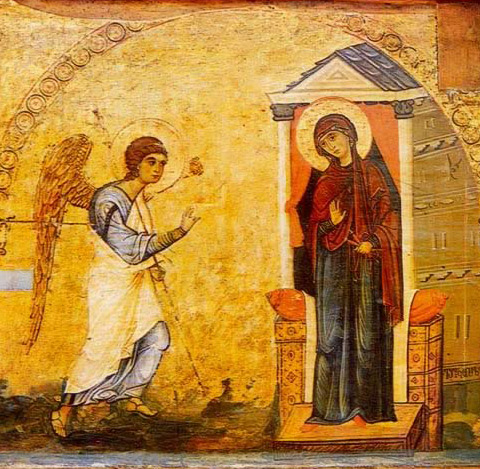
St. Catherine’s Monastery, Egypt, 12 century

Scripture Reading:  Luke 1: 26-38
In the sixth month the angel Gabriel was sent by God to a town in Galilee called Nazareth, to a virgin engaged to a man whose name was Joseph, of the house of David. The virgin’s name was Mary. And he came to her and said, “Greetings, favored one! The Lord is with you.” But she was much perplexed by his words and pondered what sort of greeting this might be. The angel said to her, “Do not be afraid, Mary, for you have found favor with God. And now, you will conceive in your womb and bear a son, and you will name him Jesus. He will be great, and will be called the Son of the Most High, and the Lord God will give to him the throne of his ancestor David. He will reign over the house of Jacob forever, and of his kingdom there will be no end.” Mary said to the angel, “How can this be, since I am a virgin?” The angel said to her, “The Holy Spirit will come upon you, and the power of the Most High will overshadow you; therefore the child to be born will be holy; he will be called Son of God. And now, your relative Elizabeth in her old age has also conceived a son; and this is the sixth month for her who was said to be barren. For nothing will be impossible with God.” Then Mary said, “Here am I, the servant of the Lord; let it be with me according to your word.” Then the angel departed from her.

Most of us good Protestants seldom talk about The Anunciation at all, let alone in the middle of the season of Lent.  The Anunciation literally means “announcement”.  The word itself probably holds no real mystery.  But it is the beginning of the central tenet of our entire Christian faith–Anunciation, Incarnation, Transfiguration, Resurrection, that cycle of holy mystery that with each turn draws us closer and closer to God as God reveals the very Godself more and more to us.  For us, it begins the mystery that is Jesus Christ, the mystery that will take us to Jerusalem.  For us, the fog lifts and there before us is the bridge between the human and the divine. 

In December, we usually speed past this reading, eager as we are to get to “In those days a decree went out from Emperor Augustus…”  We want to get to the beginning of it all.  But think back.  Jesus was human and just like all humans, something happened nine months before.  And whether or not you take the notion of a virgin birth literally, there was something remarkable that happened.  It is in this moment that God steps through the fog into humanity, that the great I AM reveals the Godself to all of Creation, and, just like every one of us must do, waits to be birthed into the world.  It is not just this young girl’s womb that is suddenly filled with child, swelling with expectant life; it is all of Creation that now waits for Light to be born.  The world is with child.

Can you imagine what Mary must have thought?  She was young, she had plans, she had her whole life ahead of her.  “How can this be?” we read.  In today’s vernacular, it would read, “Are you kidding me?”  And so as everything she knew and everything she planned toppled around her, she said “yes” and entered the mystery of God.  Now, I have to admit, I don’t get so wrapped up in needing Mary to be a literal virgin. (In fact, I don’t care enough about it to need to prove it or disprove it, so you can stay anywhere you are on the issue.) After all, would it really change what happened?  Would it really change who God was or what God has done?  Would it really change that this was the moment when the Light of God came into the world, when the Divine suddenly spilled into the womb of the world.  And that the one who held the birthing of God in her hands said yes.  Now, THAT, my friends, I think is important. 
 
Think about it.  What exactly does it mean to be “virgin”?  It means undefiled, pure, ready and open to receive.  Mary, the virgin, was open to receive God unto herself.  The most scandalous part of the whole story has nothing to do with whether or not the birth was “proper” in terms of our world; the scandal is that the great I AM, the holiest of holies, the One whose name could not be said, suddenly enters humanity with all of its violence and corruption and despair and the reordering of our existence begins.  All that we know and all that we plan is beginning to topple around us.  The Anunciation is the anouncement of hope for all of us.
 
If God’s incomprehensibility does not grip us in a word, if it does not draw us into [God’s] superluminous darkness, if it does not call us out of the little house of our homely, close-hugged truths…we have misunderstood the words of Christianity.  (Karl Rahner)
 
So, in this season of Lent, what does it mean for you to be open to receiving Jesus Christ into your life?  Because, you see, that is the way to Jerusalem…
 
Grace and Peace,
 
Shelli

Lenten Discipline: Life

I know that “life” is odd for a Lenten discipline but isn’t that what all of this is about anyway?  Our focus on spiritual disciplines during this season is not merely intended to instill us with a set of rules;  rather, spiritual disciplines provide structure and support for our growing spiritual life.  But, as I said, they are not just rules (and are certainly not just rules to get us through these 40 days leading up to Easter!).  Spiritual disciplines, like Lent, provide the structure through which we can grow, much like those stakes that you are putting on your growing tomato plants or rose bushes.  Hopefully, this Lenten journey is not merely one that gets us on the path on which our spiritual life is meant to be only to be allowed to be forgotten and grown over once the season ends.  The whole idea is to instill a rule for our life, a pathway of sorts that best leads us to oneness with God.

We probably get hung up, though, when we limit our understanding of the “rule for life” to mere rules.  Rules probably get a bad rap in our society, as if someone has laid down some arbitrary boundary to our already-structured life.  Don’t think of it like that, though.  I mean, rules are good when they don’t exist as their own end.  They bring order to chaos.  They bring cycles to confusion.  They bring pathways to wilderness journeys.  (And if a rule doesn’t do something along those lines, then, you’re right, it probably SHOULD be broken!)

Yesterday I was walking my dog.  It was a lovely early evening, with a cool breeze that refreshed without chilling and both of us were enjoying ourselves.  We were walking around our neighborhood enjoying all the new flowers and budding old ones, as if life had somehow just woken up.  Because it was so nice, we took an extra long enjoyable walk.  When we were about 4 1/2 blocks from my house, Maynard had to “do his thing”, if you know what I mean.  We stopped so that he could relieve himself in peace and then (as we always do) we switched places so that his dutiful and well-trained owner could pick it up.  While I was leaning over, I felt something weird on the end of the leash, as if all of a sudden I was holding emptiness.  Now, let me tell you, this is NOT what a dog owner wants to feel when they are 4 1/2 blocks from home!  I glanced over at Maynard just in time to see him do some sort of very intentional acrobatic movement as, with head down, he watched himself take his right leg and pull it through the harness and then underneath it and then repeat it with his left leg.  I don’t know if he had been practicing this and thinking about this for awhile, but all I know is that the harness (with the leash still attached) was laying on the sidewalk with no dog attached to it.  I panicked and reached for him, thinking that he would bolt into some game of canine hide and seek (which he’s done before).  But he just stood there.  It was as if the harness was still attached.  Maybe he just wanted to show me how good he could be by himself.  I don’t know.

Maybe that’s what Lent is supposed to do.  It puts a very gentle harness on us as we go on our walk.  And then, when it is time to break free, when our choice could be to bolt, joining in a sort of human-divine game of hide-n-seek, we stand still on the path, breathing in the breath of God and knowing, intuitively, where to go.  A rule of life just gets us ready for that moment, that point of pure freedom when we intentionally choose God.

Yes, I put the harness back on the dog and we finished our walk.  He didn’t seem to mind being put back in it; in fact, it was obvious he expected it.  I don’t know what he was thinking.  Maybe he just wanted to prove he could get out of it.  Or maybe he just wanted to show me he could do it without it.  I have to admit it, though, I will not give him the chance to try to show me again.  God is much more trusting of us than I am.  That is why God is God and I am not!  But the point is that this journey of faith should not be taken lightly.  It should be done as if our very life depended on it because it is, after all, our life.

So, for this Lenten season, commit yourself to a rule for life  Where do you feel God calling you to stretch and grow?  What kind of balance do you need in your life?  What gives you life?

Grace and Peace,
 
Shelli

Just a word of explanation for the week to come…I struggled with how to proceed this week without “jumping ahead” to the Passion or even to Palm Sunday before I’m really ready to do that.  So, rather than, writing on the Lectionary passages for next Sunday, I’m going to step back a little in this walk.  Tomorrow I will begin with the Anunciation, the announcement of the coming of God into the world and walk from there.  I’ll take a quick walk through the steps of Jesus once again so that I can arrive in Jerusalem as the glorious Palm Sunday processional begins.

And ANOTHER word of explanation…I’ve had some of you who are in the “Google Group” that get emails every day mention that you have had comments but couldn’t comment “back” to me.  That is correct!  But I would LOVE to have your comments.  Click on the “Dancing to God” link at the bottom of the email and that will get you into the blog.  You can make a comment there and all of the blog readers can see it.  I would LOVE for you to do that!  

Disruption

Life is full of disruptions.  I’ve spent the last couple of hours checking on whether or not the United States government is going to shut down tomorrow.  Apparently, in a last minute compromise of sorts, that has been averted–at least for now.  I suppose we’ll play this game again in a week.  Life is full of disruptions.

We are definitely creatures of habit, beings dependent upon the rhythms in our lives–the rhythmic workings of our own physical bodies, the rhythms of day and night, of seasons, of time, and the rhythms that we’ve created in our own lives.  These rhythms are important to us.  They bring us a sense of order.  Life is just easier when it meets our own expectations of what will happen.  But life is full of disruptions.  Perhaps that is one of our lessons for this season of Lent.  In its own way, Lent is about disruptions.  It is about a change in rhythm.  It provides an opportunity to break from the familiar, to release oneself from the staid and sometimes almost robotic way of existing through which we walk without much thought or caring.  Lent invites us to think and care by offering us a sort of holy disruption.  It is a way of changing our rhythm, of relocating our center as we recalibrate our priorities and our lives.  It prepares us to see things differently.  It prepares us for what is to come.

For my Lenten discipline this season, I have been writing on this blog.  It is not always easy.  In fact, sometimes it is downright disruptive (as I’m sure you can tell on those days when I don’t get it in very early!).  And yet, this holy disruption has changed the rhythm in my life.  It has made me think more deeply and more often about things.  It has opened my eyes to ways that I can encounter God that before I would have sped past and completely missed.  It has, indeed, relocated my center.  And as I approach Jerusalem, I am ready for that disruption too.  But the whole point of Lent as a holy disruption implies that it is, or should be, a point of permanent change.  Unlike the bill that is at this moment waiting to pass the House, Lent is not really meant to be a mere stop-gap.  We’re not really supposed to just go back to “life as usual” when the Easter lilies come out.  (Now, you see, that is all the more reason why you shouldn’t give up chocolate for Lent!)  It really is about change and preparing us as we trudge toward the biggest disruption that Creation has ever known.  Because there at the Cross, life as we know it was disrupted by death and then death as we know it was disrupted by Life.  And neither death nor life will ever be the same again.

So, as the drums of Crucifixion begin to get louder,  let your disruption become your Life!

Grace and Peace,

Shelli  

LENT 5A: The New Dead

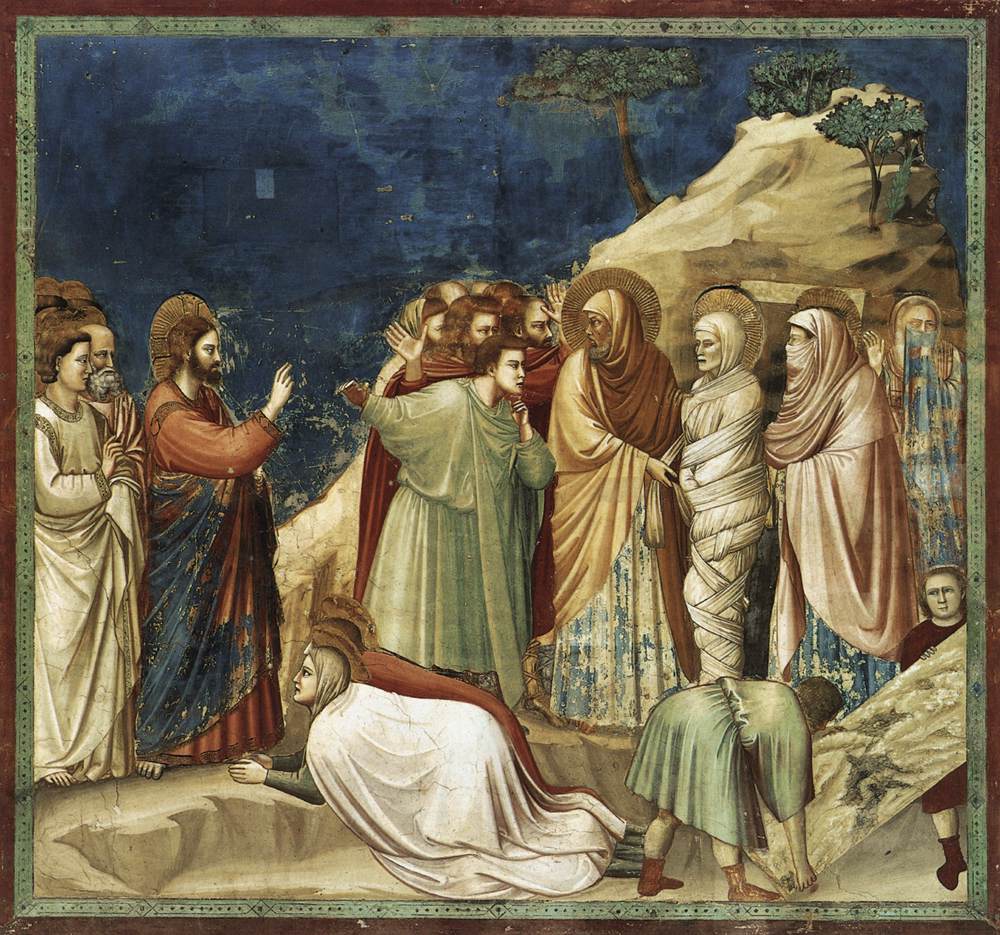
“The Raising of Lazarus”
Fresco by Giotto di Bondone, Italian, 1304-06

Lectionary Text:  John 11: 1-4, 17-26, 41-44
Now a certain man was ill, Lazarus of Bethany, the village of Mary and her sister Martha. Mary was the one who anointed the Lord with perfume and wiped his feet with her hair; her brother Lazarus was ill. 3So the sisters sent a message to Jesus, “Lord, he whom you love is ill.” But when Jesus heard it, he said, “This illness does not lead to death; rather it is for God’s glory, so that the Son of God may be glorified through it.”… When Jesus arrived, he found that Lazarus had already been in the tomb four days. Now Bethany was near Jerusalem, some two miles away, and many of the Jews had come to Martha and Mary to console them about their brother. When Martha heard that Jesus was coming, she went and met him, while Mary stayed at home. Martha said to Jesus, “Lord, if you had been here, my brother would not have died. But even now I know that God will give you whatever you ask of him.” Jesus said to her, “Your brother will rise again.”… Martha said to him, “I know that he will rise again in the resurrection on the last day.” Jesus said to her, “I am the resurrection and the life. Those who believe in me, even though they die, will live, and everyone who lives and believes in me will never die. Do you believe this?”…So they took away the stone. And Jesus looked upward and said, “Father, I thank you for having heard me. I knew that you always hear me, but I have said this for the sake of the crowd standing here, so that they may believe that you sent me.”When he had said this, he cried with a loud voice, “Lazarus, come out!” The dead man came out, his hands and feet bound with strips of cloth, and his face wrapped in a cloth. Jesus said to them, “Unbind him, and let him go.”

So, gray and brown are the new black; forty is the new thirty, fifty is the new forty, and hybrids are the new luxury car.  Things change.  The ways that we live and talk about things change.  There are always new perspectives bursting into our consciousness.  And Lazarus is the “new dead”…Let me explain…have you ever noticed the last part of this story?  “The dead man came out…”.  It is not that “Lazarus came out miraculously alive again”. He did not appear and then go back to work that day.  It says, “the dead man…”.  Lazarus was still dead the way this world thinks of dead.  Jesus did not undo his death.  The point was that Jesus turned it into something new–a new life, a new way of looking at things, a new creation.  “The dead man came out….let him go…”  We can’t even imagine how great it’s going to be. 

Today would have been my grandmother’s 102nd birthday.  She died a year ago in November.  I still miss her.  I can’t even really describe how.  We were more than grandmother and granddaughter.  We were some sort of soul mates.  I still want to call her, to talk to her.  Now don’t get me wrong.  Sometimes she made me so angry, downright infuriated me.  She had that fundamentalist bend that I just didn’t understand.  I suppose I had that progressive bend that she just couldn’t tolerate.  But we were more alike than we were unalike.  We had a kinship beyond our obvious blood connection. I enjoyed doing things for her toward the end.  I remember one time I was helping her go to the bathroom when we were away from her house.  (OK…that may be too graphic!)  But she looked up at me with those deep brown eyes and said, “You know…I used to do this with you.”  “Well then,” I responded, “it’s time I do it for you.”  Things change; people change; life changes.  I still grieve, still want to call her.  I’ve been thinking about her lately, grieving all over again.  I know she’s gone.  And yet, not…

You see, the thing we had in common was our faith.  And that faith, that shared faith, tells me that there is something new.  I don’t think this story of Lazarus was a miracle story, per se.  Jesus did not do some sort of magic trick so that Lazarus could walk out in his burial clothes.  The end of the story (although I’ve never noticed it and never even read any commentary to support this) says that Lazarus was still dead.  Death was not undone.  Lazarus did not get up and go back to his life.  Rather, death was recreated into life.  Recreation is not undoing; recreation is making something new.  There is still grief and wanting for what was, for the familiar, for the usual, for the phone conversations that we crave.  But this is better.  We justF have to live into it.  That’s what faith is about.

This story is also seen as a foreshadowing of Jesus’ own crucifixion and raising.  It’s like he’s saying, “Folks…stay with me here.  There are things that are about to happen that are hard.  In fact, we’re fixing to go through crap.  (Sorry…couldn’t think of a better way to say it!)  Your loss will be unbearable.  And it will not be undone.  I will not pull some magic trick out of a hat at the last minute.  I will not undo my death.  But, as I said…stay with me…look what I’ve done here.  The best is yet to come!  If you stay with me, I can’t even describe the incredible things that will happen.  You just have to experience them for yourself.  Just stay with me. “

Death is not to be undone; rather, it is made new.  It is recreated into life.  It’s the “new dead.”  Isn’t that better?  Do you believe this?

So, in the Lenten season, know that the best is yet to come!

Happy Birthday Grandmother!

Grace and Peace,

Shelli