Mapquest

Houston Map, c. 1890

I’ve always had some level of fascination with maps.  What an amazing thing to think that beginning as early as 1,000 years before the birth of Christ, cartographers would lay down on stone or paper or, today, even computer images a depiction of the world that they saw.  In truth, part of my fascination comes from sheer unadulterated dependence on maps to get to places where I’ve never been before.  For you see, I have very little sense of natural direction.  Once I turn a couple of corners, I really can’t tell you in what direction I’m heading.  It just doesn’t happen.  Hence, my fascination with the fact that not only can someone find their way somewhere but can then depict it in a way that can lead even me to the same place.

It is amazing to me that we can look at a map and see things pretty much the way they are—interstates, state roads, farm-to-market roads, railroad tracks, rivers, bayous, even county lines and airports.  So we can follow this detailed map that someone has drawn and get to that place that we need to be.  A map will give you a view of the world that will enable you to go places that you’ve never been.  So you follow the map, knowing that you’re nearing your destination.  The interstate that you’re on is pretty true to scale.  The exit onto the smaller farm-to-market road is exactly where the map says.  But then you start to see things that aren’t on the map—schools, stores, county seat buildings, town squares, houses, dirt roads, smaller creeks.  (My Mom and I often take a trip to Fredericksburg and on the way we cross over Woman-Hollerin Creek—not on the map—but something that has become a humorous and important landmark for us to find our way.)  And all along the road are these smaller bodies of water over which someone has at some point built a bridge—unimportant, even non-existent, according to the map, but without which the journey would stop.  Because, you see, once we get to a place, our view starts to become bigger and more encompassing than what is possible to show on a map.  We begin to sense the familiar, perhaps even creating our own landmarks along the way.  We move from being dependent solely on what someone else has told us to our own view of what surrounds us.

But go a step farther.  We’re only moving through this place.  There are things that even we cannot see.  We do not see the group of smiling, rowdy six-year old girls in the first house past the filling station celebrating a birthday by wearing paper dresses and decorating cupcakes.  We do not see the little boy crying on the porch behind the next house because his intoxicated father hit him and threw him outside for accidentally spilling the whole bottle of bourbon on the living room rug.  And we do not see the elderly woman sitting alone, missing her children and grandchildren and desperately still grieving over the loss of her husband and her sister over the last six months.  The map will not show us that.  Driving through will not show us that.  The only way to see these things is to become part of them, to actually experience them, to stop and share one another’s lives, to realize our shared experiences and our shared history with each other.  That is the only way to broaden our view enough to see the world.

You know, Christianity has given us a wonderful map, a foundation on which our lives can be built, a tradition of belief that has stood the test of time.  But maps and signs are not what grow our faith.  That is not enough.  A map will only get you to the point where you need to start being, to the place where you have to start seeing.  And at that point, we begin to walk the road.  We begin to live our faith through rituals and liturgy, through Scripture and tradition, through prayer and discipline.  We begin to see those things along the road, those things that make up this journey.  And we also begin to see those things that influence us and pull us away from the road on which we need to be.  But even that is not enough.  For even though our eyes have been opened, we are limited by our own view of the way the world is, by our own personal experiences that affect how we look at things.

So it is on this Lenten journey that we hear the call to change our view, to a new way of seeing and a new way of being, to a way of seeing beyond our view, even beyond what we expect to see.  It is a way of seeing the world in an unleavened way.  Marcel Proust says that “the true voyage of discovery does not involve finding new landscapes but in having new eyes.”  Those new eyes can only be attained through our experiences with others, for it is through others’ eyes and our shared experiences that we truly start to see things as they really are.  And seeing our lives through others enables us to see God through our own lives.   We are not called to just follow the map or to walk through life looking only at what appears to be.  Rather, we are called to see as Christ sees.  And the only way to do this is to experience the world through others’ eyes, to open our lives and our hearts to others with a sort of radical, unchecked, even risky hospitality. We cannot just drive by and look at the houses on the road.  It is what is inside that really counts.  We have to be willing to enter the doors of others’ lives and be just as willing to invite them into ours.  We have to open our eyes to the needs and the experiences of others and truly receive each and every one in the name of Christ. It is entering and experiencing the lives of others and inviting them to experience ours.  It is taking the hand of someone else and offering healing in the name of Christ, that they, too, might clearly see.

Lent calls us to see the world for the first time in a new way, not as something that is, but as something that could be.  Lent calls us to see the world with Easter eyes, full of promise and hope and eternal life.  Lent calls us to step back and look at the world the way God envisions it, as brothers and sisters walking together in peace and harmony and love for each other, not ignoring diversity of lifestyles, cultures, races, views, and even faiths, but embracing them as a part of the landscape of this incredible earth that God created.  The map that we’ve been given only gets us to the place.  It is through our experiences with Christ and our experiences with each other, though, that we will see the way to go and that our eyes will be opened so that we might finally see everything clearly.

K…I guess this can count as one of those “extra” posts I promised!…So, as part of this Lenten journey, think about the map you follow.  What is on the map?  What does it not include?  Where does it call you to look with new eyes?
Grace and Peace on this Lenten Journey,

Shelli



LENT 5B: Heart-Wrenching

Lectionary Passage:  Jeremiah 31: 31-34
The days are surely coming, says the Lord, when I will make a new covenant with the house of Israel and the house of Judah. It will not be like the covenant that I made with their ancestors when I took them by the hand to bring them out of the land of Egypt—a covenant that they broke, though I was their husband, says the Lord. But this is the covenant that I will make with the house of Israel after those days, says the Lord: I will put my law within them, and I will write it on their hearts; and I will be their God, and they shall be my people. No longer shall they teach one another, or say to each other, “Know the Lord,” for they shall all know me, from the least of them to the greatest, says the Lord; for I will forgive their iniquity, and remember their sin no more.

The days are surely coming.  Hmmm!  When would that be that the new covenant will come to be?  We Christians like to put on our post-Resurrection lens and read this with the view of Jesus, the Cross, and the empty tomb in our mind.  Ah…we think, Jesus, Jesus is the new covenant.  Jesus is the covenant that is written on our hearts.  Jesus is the one. Is he?  Are the days surely here?

OK, be honest, have you looked around?  Have you listened to the news today?  (Actually I haven’t had time today, but I can guess!)  BUT, “the days are surely coming!”  Now don’t get me wrong.  I DO believe that Jesus is an embodiment of the New Covenant, the embodiment of God’s Promise, the embodiment of The Way.  And yet, the idea of this being “written on our hearts”, of this New Covenant becoming not just something to which we aspire, not just something by which we try to abide, but something that is actually part of us just downright eludes us.  This covenant is something that should be part of our body, our soul, our heart, our mind, our very being.  The promise is certain, but it doesn’t end there.

Think about it.  Read the words.  This is not about God just tossing some words out there in the hopes that someone will be curious enough or scared enough or ready enough to pick them up.  God is much more nuanced than that.  Rather, God’s vision is that they are written on our hearts, permanently tattooed, part of our very being.  It is as if God is remaking us from the inside out.  Maybe that’s our whole problem.  Maybe we’re making ourselves backwards.  Maybe we’re trying to do the right things and say the right things and fast and pray and live our lives with the hopes that our hearts will be made right.  And in the meantime, God is inside, with heart-wrenching fervor, remaking us from the inside out and waiting patiently for us to stop and notice.

So on this twenty-third day of Lenten observance, just sit.  Listen to your heart.  What is your heart telling you?  After all, the words are there.  And then go tell someone what your heart is telling you.

Grace and Peace on this Lenten Journey,

Shelli

And in the department of true confessions, sorry about the posts (or non-posts!) for the week-end.  It got away from me, so you’ll get “bonus posts” on today or tomorrow!  Shelli

LENT 4B: The Elephant in the Room (or the Sanctuary!)

Lectionary Passage:  John 3: 14-21
And just as Moses lifted up the serpent in the wilderness, so must the Son of Man be lifted up, that whoever believes in him may have eternal life. “For God so loved the world that he gave his only Son, so that everyone who believes in him may not perish but may have eternal life. “Indeed, God did not send the Son into the world to condemn the world, but in order that the world might be saved through him. Those who believe in him are not condemned; but those who do not believe are condemned already, because they have not believed in the name of the only Son of God. And this is the judgment, that the light has come into the world, and people loved darkness rather than light because their deeds were evil. For all who do evil hate the light and do not come to the light, so that their deeds may not be exposed. But those who do what is true come to the light, so that it may be clearly seen that their deeds have been done in God.”

It’s the “elephant in the room”, so to speak, this third verse of the sixteenth chapter of the Gospel According to the writer we know as John.  It’s on street corners and marquis, T-Shirts, football helmets, and sometimes painted on faces at sporting events.  It is often taken as the quintessential “insider” verse, the badge of honor for the believing Christian.  It is often interpreted as “God came; God came to save me and the rest of you are on your own.”  But keep in mind that this Gospel was written later than the others.  To be a follower of Christ, a person of The Way, was just downright hard.  You were NOT an insider.   You were NOT the Christian majority that we so comfortably enjoy. You were part of a fledgling and sometimes persecuted minority that was just trying to hold it together.  So, these words would have been words of encouragement, words of strength, a way of defining who they were as a Jewish minority.  It was a way of reminding them why they were walking this difficult (and sometimes dangerous) path—because of the great Love of God. 

But in the hands of the 21st century Christian majority in our society, these words sometimes become weapons.  They turn into words of exclusion, designating who is “in” and who is “out”, who is acceptable in “honest society” and who is not.  Well, first of all, nowhere in the Gospel are we the ones called to make that determination.  And secondly, look at the whole context of this Gospel by the writer known as John.  It starts out with Creation.  It talks about this great Love that is God, a love that was there from the very beginning.  And it proclaims that God came into the world to save the world.  So how did we interpret this that God had quit loving some of us, that some part of humanity was more worthy of God’s love than another?

The Truth (that’s with a capital T) reminds us that God offers us Life, that God, in effect, DID come into the world to save us—mostly, I would offer, from ourselves, from our misdirected greed, our disproportionately selfish ambition, and from our basic desires to be something other than the one who God has called us to be.  God desires this for everyone.  God really does want to save the world from the world.  And so the Kingdom of God seems to us to sometimes be inching in far too slowly rather than pervading our world.  I think that the world DOES need to somehow be moved to believe, DOES need to somehow begin to see itself anew.  After all, we need to overcome ourselves, overcome all of those misdirected desires.  But that will never happen if the cross is raised as a weapon.  SURELY, we get that it’s something other than that!  Remember, God redeemed it.  God took something so loathsome, so foreboding, so, for want of a better word, evil and turned it into Life.  God is doing the same for the world.  God loves the world so incredibly much that God would never leave us to our own devices (or even, thankfully, to those of who count ourselves as well-meaning believers!).  Instead, God comes into the world and offers us life; indeed, loves us so much that God offers us recreation, redemption, and renewal.  Don’t you think THAT’S the story?  It’s not about who’s in or who’s out.  It’s about Love.  It’s a promise that there’s always more to the story than what we can see or fathom or paint on a sign.  To say that we believe does not qualify us for membership; it leads us to The Way of Life.

My, my…this sanctuary is going to get crowded if we open the doors to everyone!  How about that? Perhaps it’s time we deal with the elephant taking up all this space so there will be room for all!

Wow!  Do you believe that this Season is half over?  We have spent a lot of time in these twenty days exploring our own spirituality.  What if in the next twenty days, we explore what that spirituality means, what it means to reach out to others, to BE who God calls us to be.  Let us start on this twenty-first day of Lenten observance by thinking about what that means to open our doors to all.  What comforts and expectations would we have to drop from our understandings?

Grace and Peace on this Lenten Journey,

Shelli
With the Confidence of the Children of God

Confidence…do we really think of that as relating to our faith?  Or do we assume that it is part of faith itself?  What does it mean to be confident in our faith?  What does it mean to pray or to live “with the confidence of the children of God”?

Confidence in faith is a funny thing.  We are told in this season of Lent that we are to be humble, submissive.  So where does confidence come into the picture?  It has nothing to do with a lack of doubt–doubt is part of faith, or we would not be real. So what is confidence in the faith?  Our United Methodist liturgy includes “with the confidence of the children of God” as an introductory phrase to The Lord’s Prayer before the Eucharist.  What does that mean?  With what confidence do we dare pray the prayer of our Lord?  Is it an assurance that is so profound that we can do nothing else?  What does it mean to have “confidence as the childen of God?”

So, what does it mean to pray, to live, to be “with the confidence of the children of God?”  ARE the children of God confident?  Do the children of God REALLY believe that God has their best interest at heart or do the children of God try desperately to control how Creation treats them?  But confidence has little to do with ability.  Confidence is about assurance, about seeing things in a different way.   Confidence is not surety that something is the way is seems;  rather, it is about trust, trust that God is God.

So, then, let us pray with the confidence of the children of God…Let us pray with the assurance not that everything will turn out alright, but that God is God.


On this twentieth day of Lenten observance, think about what it means to be a confident Christian.  Let us pray with the confidence of the children of God…

Grace and Peace on this Lenten Journey,

Shelli

LENT 4B: But…

Lectionary Passage:  Ephesians 2:1-10
You were dead through the trespasses and sins in which you once lived, following the course of this world, following the ruler of the power of the air, the spirit that is now at work among those who are disobedient. All of us once lived among them in the passions of our flesh, following the desires of flesh and senses, and we were by nature children of wrath, like everyone else. But God, who is rich in mercy, out of the great love with which he loved us even when we were dead through our trespasses, made us alive together with Christ—by grace you have been saved— and raised us up with him and seated us with him in the heavenly places in Christ Jesus, so that in the ages to come he might show the immeasurable riches of his grace in kindness toward us in Christ Jesus. For by grace you have been saved through faith, and this is not your own doing; it is the gift of God— not the result of works, so that no one may boast. For we are what he has made us, created in Christ Jesus for good works, which God prepared beforehand to be our way of life.

There’s actually two parts to this passage.  There’s a “before” and there’s an “after”.  BEFORE you were dead…and AFTER you weren’t.  That’s probably enough.  We can just stop there. 

BUT the writer of this letter (who is more than likely not the Apostle Paul but rather a later follower or disciple of Paul’s) seems to be really focused on continuing this separation between this world and God, between the “sinful” world and God’s promise of grace and life.  Paul had introduced the notion of being justified by grace through faith, the notion that God was a redemptive God, that it was a process by which we traversed the experience of this world and along the way encountered God.  BUT, here, that word “saved” appears, as if it’s past tense, as if it is some badge of honor that we earn and wear as we continue to be forced to live in this sin-filled world in which we live.  Somewhere along the way eschatology became realized, “already”, rather than something to which we look and live into.

Now keep in mind that this letter was probably written in the late first century.  Jesus had come, died on the cross, and the Resurrection on which everything that is “Christian” is based had happened.  And Jesus had promised to return.  That had been imminent for Paul.  BUT that hadn’t happened yet.  The first century Christian followers (it still wasn’t “Christianity”, per se, the way we think of it today) were wondering if perhaps they had misunderstood, perhaps they had gotten the whole thing wrong.  So the emphasis for the writer of Ephesians (as well as others), was a notion of echatology that had already happened, an emphasis on the crowned Jesus sitting at the right hand of God.  And for those of us who are still mired in the throes of worldly evil and worldly despairs, there became a separation, a dualism that was put into place that pretty much exists even today.  So many of us live in this world, burdened by sin, and hope against hope that God will swoop in and save us. 

Really?  Is that it?  What happened to “God did not send the Son into the world to condemn the world, BUT in order that the world might be saved through him.“?  (But…but…but) God’s vision of the Kingdom of God is not to shun the world or even to rid us of all things worldly.  God’s vision of the Kingdom of God is to recreate the world into what it is called to be–BUT the whole world, not the ones who follow the rules or the ones who are “good”, but everyone.  So in this life of faith, we do not magically crossover to being “saved” from being “unsaved” and then sit back and wait for God to pluck us out of our miserable existence.  Rather, we yield to new meanings and new circumstances as God recreates our lives into Life and brings about the fullness of the Kingdom of God throughout this wonderful created world in which we live.

That’s what Lent is about–new meanings and new circumstances.  Maybe it’s about dropping the “but” in life.  God created the life that each of us has.  Why would God call us to leave it behind?  Rather God is recreating it as we speak, bringing it into being, into the image that God envisions for it.  You know, if we look at things with the eyes of a world where God is not, a world that waits for God to return, there is always a “but”;  BUT if we look at all of Creation with the eyes of faith, with the eyes of those who believe in a God who came into our midst to show us how much we are loved, everything has an AND.

On this nineteenth day of Lenten observance, look around you.  Where are you being called to surrender to new meanings in this life that God has created?

Grace and Peace on this Lenten Journey,

Shelli

Protecting Our Identity

Who are you?  No, I mean really.  Who are you?  Most of us live lives that demand that we take on numerous roles.  For me, I am a pastor, a preacher, a friend, a confidante, a counselor, a teacher, a daughter, a sister, a cousin, a homeowner, a sometimes-writer, a reader, a cook, a lover of antiques, a lover of history, and, right now, a human companion and purveyor of food and treats to one dog that I adopted on purpose and another one that twelve days ago accidentally adopted me (does anyone want a really cute dog?).  And those roles are just the tip of the iceberg.  It gives new meaning to “meeting yourself coming and going”.

The articles and advertisements for protecting one’s identity seem endless nowadays.  It’s the new danger in our world, the chance that someone might steal who we are, that we might somehow lose ourselves.  And so we shred and we cut and we lock and we watch.  We do everything to keep who we are intact. And yet, we find ourselves searching for who we are.  Isn’t that interesting?

God created each one of us.  We are unique, full of gifts and graces, most of which we haven’t even tapped into yet.  Each of us is a child of God, with the ability to become fully human and the desire to connect with the Divine.  I think that God actually envisions something for each of us, that God somehow created us with an idea of what the best of each of us is.  But we’re not children of the Stepford clan.  We are not pre-programmed robots that God wound up at the start and then pushed us down the road with enough battery juice to get us to the end of the road.  No, God’s vision of Creation was much more nuanced and much more beautiful than that.  Somewhere along the way, God decided to instill the notion of free will in us, the wherewithal (if, sometimes, not the ability!) to choose–to choose right from wrong, to choose one road or another, to choose to be one role or to be something completely different.  God gave us life and  envisioned what that life could be, envisioned our identity.  But how we get there is completely up to us.

Maybe this life of faith is about protecting our identity, then–from the world, from all those voices that beg for our time or our money or our attention, and, most of all, from ourselves.  Maybe learning to walk this life of faith is about figuring out how to protect our identity, walking that journey of becoming, losing, recapturing, and becoming again that Being that God envisioned us to be from the very beginning. It’s hard.  So, in this Season of Lent, as we strip away all of those encumbrances that pull us away from ourselves, as we try to find the way back to who we are, maybe it’s not just about becoming someone else, but protecting who we are in the first place.  So who are you?  No, I mean, really.  Who are you?
 
On this eighteenth day of Lenten observance, make a list of all your roles in life.  Which ones drain your existence?  Which ones give you life?  It’s a good thing to think about once in awhile.

Grace and Peace on this Lenten Journey,

Shelli  

And I’m serious…anyone want to adopt a dog?

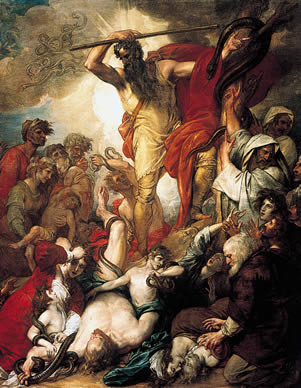
LENT 4B: A Lesson in Snake-Handling

“The Brazen Serpent”
Benjamin West (1738-1820)
BJU Museum & Gallery, Greenville, SC

Lectionary Passage:  Numbers 21: 4-9
From Mount Hor they set out by the way to the Red Sea, to go around the land of Edom; but the people became impatient on the way. The people spoke against God and against Moses, “Why have you brought us up out of Egypt to die in the wilderness? For there is no food and no water, and we detest this miserable food.” Then the Lord sent poisonous serpents among the people, and they bit the people, so that many Israelites died. The people came to Moses and said, “We have sinned by speaking against the Lord and against you; pray to the Lord to take away the serpents from us.” So Moses prayed for the people. And the Lord said to Moses, “Make a poisonous serpent, and set it on a pole; and everyone who is bitten shall look at it and live.” So Moses made a serpent of bronze, and put it upon a pole; and whenever a serpent bit someone, that person would look at the serpent of bronze and live.

OK, this is just odd!  It’s one of those passages that probably wouldn’t have made it into the lectionary except that the Gospel writer that we know as John included it.  (We’ll read that this week too!)  Personally, I think it’s a little over the top–sending poisonous snakes.  I mean, it seems that the people were only asking for a little variety in their menu.  Isn’t this a little out of proportion?  I mean, really:  complaining…bad; poisononous snakes all over the place…REALLY bad.

But from the very beginning of Creation, as one of the Aramaic translations of the Hebrew Bible explains, the snake has slithered on its belly and eaten only dust and yet it has done so without a word of complaint.  So, then, what better character to rule over the people who have murmured over a choice of food?  Essentially, the snake comes to teach humility and patience.  But we as humans cannot resist being more than a little squeamish at the character.  There is something about a snake that demands our full attention.  When someone mentions that a snake is nearby, we don’t ask what lessons can be learned.  Instead, we climb on the furniture or over one another to get out of the way.

Our full attention…to how many things do we give that?  And how many things would we rather climb on the furniture or run to get out of the way rather than dealing with them?  And it is interesting that in order to save the people from the plague of snakes, God gave them a snake.  So, when someone is bitten by a snake, he or she is to look at a snake.  What sense does that make?  Think about it…we are to look at our fear; we are to look at those things that tempt us; we are to look at those things that distract us and pull us away from God.  (Goodness…that sounds a lot like this season of Lent!)  And God, in God’s infinite wisdom puts them on a pole so that we cannot avoid seeing them.

But only in the wisdom of God do we counter something that we fear with that which we fear.  Here, God’s antidote for the snakes is a snake.  Isn’t that sort of paradoxical?   We have to look beyond that with which we are uncomfortable.  We have to look into a sight that brings such fear, such loathing, that it is hard for us to find God’s presence in it.  And, deep within it, is the sight of humility and patience, a creature that, according to Creation mythology, had resigned itself to surrendering to that which ruled its life.  And by looking into one’s fear, by looking into one’s death, one is freed—the ultimate paradox. 

It is notable, too, that nothing is said to imply that God destroys the snakes.  Essentially, God does not destroy the enemy—God recreates it.  Isn’t that an incredible thing?  You see, we need to recognize that the traditional Jewish reading of the “Garden of Eden” story differs from the classical Christian version.  While the snake has often been identified in both faiths as Satan (or satan), the Jewish understanding is not that of something or someone outside of God’s command or a rebel against divine authority.  Rather, it’s sort of a prosecuting attorney, entrusted with testing, entrapping, and testifying against us before the heavenly court.  It’s part of God’s way of maintaining order.  It’s part of God’s way of showing us a mirror to look at ourselves.  So, from that standpoint, these snakes or serpents are not enemies but, rather, part of our ourselves.  (On some level, maybe that’s more uncomfortable even than enemies!)

So, the simple equation is this:  the cure for snakes is a snake…the cure for something is to stare it straight in the face.  Where have we heard that before?  Centuries later, God did it again.  The cure for our death is death—death of those things that stand in the way of our relationship with God, death of those things that make us less than human, death of those things that are not part of who we are as images of God.  And, if you remember, the cure for a life of pain and suffering and temptation is life eternal.  Snakes for snakes; death for death; life for life.

Those whose eyes are fixed on the Son of Man as he is lifted up ultimately see God’s healing of the world.  The Cross is that thing at which we are forced to look, forced to see a part of us that we do not want to see, forced to see the way we murmur and complain about our lives when they’re really not that bad.  In an odd way, the cross is that snake on a pole.  So as hard as it may be, stand still.  It doesn’t make sense in this world.  It’s gruesome and loathsome and filled with danger.  But God, in God’s infinite wisdom, takes it and turns it into life.  We don’t need to become snake-handlers; we just need to be aware of that to which we should be looking.  So, walk now, toward the cross—the instrument of death that gives you life.  

On this seventeenth day of Lenten observance, go commune with a snake…no, just kidding!  Instead, give someone today your full attention.  Do not get pulled away by your cell phone or your watch or your calendar.  
Grace and Peace on this Lenten Journey,

Shelli