Let My People Go (Into the Wilderness)

Open gatesScripture Text:  Exodus 5: 1

 Afterward Moses and Aaron went to Pharaoh and said, “Thus says the Lord, the God of Israel, ‘Let my people go, so that they may celebrate a festival to me in the wilderness.’“

We know the story. The people had been taken away, held in slavery. And now, God is insisting: “Let my people go.” The truth is, it probably wasn’t slavery as we think about it. There were probably not prison bars or shackles or anything of the like. Their slavery may have resembled more of an indentured servant or perhaps an economic enslavement. They could not leave, of course, but not because they were held but because they were bound. It was just as bad and in some cases, it is harder to claim release.


So God screams, “Let my people go.” The truth is, maybe God wasn’t worried about the economic enslavement at all. Because, you see, they had been there awhile, a couple of generations if you’re counting. And as generations go on, we forget, we forget who we are. It would have been so incredibly easy to lapse into the Egyptian society. It wasn’t bad. In fact, it would have been easier to do just that. But it wasn’t who they were. Somehow, I think God’s concern was not that they were economically enslaved but that they had forgotten who they were.  In God’s vision, the wilderness, the place where darkness loomed, was better than the place of safety that enslaved the people.


SO, does this sound familiar?  We are not enslaved.  We are, however, bound.  We are bound by our lifestyle, by what our life expects us to be.  We are bound by the expectations of others.  We are bound by our plans for what our life holds.  We are bound by what we think we are supposed to be in this world.  We, too, have forgotten who we are.  And, just as God did so long ago, the Divine screams into the night, “Let my people go.”  We are not enslaved in the usual sense.  There are no prison bars and no shackles.  But we are enslaved.  This season of Lent is God’s time, God’s time to scream “let my people go,” and be heard.  And even the wilderness is better than what we have.


The wilderness is calling.  The place where we are not bound, where we can finally learn to be free, where  danger meets us and we know that rather turn to the ones who enslave  us, who offer no help in the wilderness, we will finally look to God.  Let us be the ones who finally, once and for all, know that we are offered freedom, freedom, mostly, not from whom holds us, but from the one who we are not.  Let us be the people who, finally, go and be the one that we are meant to be.


I think most of the spiritual life is really a matter of relaxing — letting go, ceasing to cling, ceasing to insist on our own way, ceasing to tense ourselves up for this or against that. (Beatrice Bruteau)


FOR TODAY:  In what ways are you enslaved?  What would it mean to be let go?  God is waiting to do that.


Grace and Peace,


Shelli


With My Mind Stayin’ on Jesus


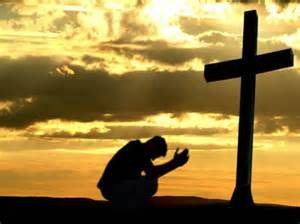
Kneeling at the CrossScripture Text: Mark 8: 31-38

31Then he began to teach them that the Son of Man must undergo great suffering, and be rejected by the elders, the chief priests, and the scribes, and be killed, and after three days rise again. 32He said all this quite openly. And Peter took him aside and began to rebuke him. 33But turning and looking at his disciples, he rebuked Peter and said, “Get behind me, Satan! For you are setting your mind not on divine things but on human things.”  34He called the crowd with his disciples, and said to them, “If any want to become my followers, let them deny themselves and take up their cross and follow me. 35For those who want to save their life will lose it, and those who lose their life for my sake, and for the sake of the gospel, will save it. 36For what will it profit them to gain the whole world and forfeit their life? 37Indeed, what can they give in return for their life? 38Those who are ashamed of me and of my words in this adulterous and sinful generation, of them the Son of Man will also be ashamed when he comes in the glory of his Father with the holy angels.”

So many of us are like Peter. We want to “fix” things, to make sure that everything and everyone is safe and alright. We want things to be OK. We want to get this wilderness place cleaned up and ready for show. But that was never part of the promise. I think Peter actually DID understand that Jesus was the Messiah. He just didn’t fully grasp what that meant. For him, the Messiah was here to fix things, to make it all turn out like it was supposed to turn out. And now Jesus was telling them that the way they had thought it would all turn out was not to be, that instead this Messiah, this one who was supposed to make everything right, was to be rejected and would endure great suffering.  “No, this can’t be!” yelled Peter.  This cannot happen.  We have things to accomplish.  We are not done.  This ministry is important. It cannot go away.  You have to fix this. You have to fix this now! We are not ready to do it alone. We are not ready to be without you. 

Now, contrary to the way our version of the Scriptures interprets it, I don’t think Jesus was accusing Peter of being evil or Satan or anything like that.  More than likely, this was Jesus’ way of reprimanding Peter for getting hung up on the values of this world, getting hung up on our very human desire to save ourselves and the way we envision our lives to be, to fix things.  But what God had in store was something more than playing it safe.  I think that Peter, like us, intellectually knew that.  We know that God is bigger and more incredible than anything that we can imagine.  And yet, that’s hard to take.  We still sort of want God to fix things, to make things comfortable, or at least palatable.  We still sort of want God to lead us to victory, to lead us to being the winning team.  Face it, we sort of still want Super Jesus in the story.  And, of course, Peter loved Jesus.  He didn’t even want to think about the possibility of Jesus, his friend, his mentor, his confidante, suffering, of Jesus dying.

You know, there is a danger in our thinking that God is here to make life easier for us, to keep us safe and warm and free from harm. After all, there’s that whole Cross thing that gets in the way. If we think that God came into this world, Emmanuel, God-with-us to make life better or easier or grander for us, then what do we do with a crucified Savior? What do we do with the cross?  Well, let’s be honest, most of us clean it up, put it in the front of the sanctuary, and, sadly, go on with the security of our lives.  So, what does it mean to “take up your cross and follow”? What does it MEAN to follow God not just to the altar where that gleaming, cleaned-up cross sits, but to follow Christ to the hills of Golgotha, to walk with Jesus all the way to the Cross?  I think it means that sometimes faith is hard; sometimes faith is risky; in fact, sometimes faith is downright dangerous. And, to be honest, faith rarely makes sense in the context of the world in which we live. After all “denying ourselves”, “losing our life to save it”, and “letting go to gain” make absolutely no sense to us. They don’t make sense because we are setting our minds on the human rather than the Divine.

There’s a old Gospel song with these lyrics:  (Hear it at https://www.youtube.com/watch?v=Xit39G0lIk4)

Well, woke up this mo’nin with my mind, stayin’ on Jesus

Woke up this mo’nin with my mind, stayin’ on Jesus

Well, woke up this mo’nin with my mind, stayin’ on Jesus

Halleluh, halleleluh, halleleluh


In all probability, none of us will be physically crucified for our faith.  But it doesn’t mean that we should clean it up and put it out for display either.  Sometimes our journey will take us through waters that are a little too deep and torrential; sometimes we will find ourselves bogged down by mud; and sometimes faith takes us to the edge of a cliff where we are forced to precariously balance ourselves until we find the way down.  The promise was not that it would be safe; the promise was that there was something more than we could ever imagine and that we would never journey through the wilderness alone. The promise was that a Savior would come, not to save us from the world or to save us from evil, but to save us from ourselves.

On this Lenten journey, this journey that takes us through the wilderness all the way to that place beyond the wilderness, to the Cross, we are called to follow Christ. We are called to begin to wake up in the morning with our minds “stayin’ on Jesus”. It will not lead you to safety; it will lead you to Life.

He comes to us as One unknown, without a name, as of old, by the lakeside…He speaks to us the same word:  ‘Follow thou me!” and sets us to the tasks which He has to fulfill for our time…And to those who obey, whether they be wise or simple, [God] will reveal {Godself] in the toils, the conflicts, the sufferings which they shall pass through in this fellowship, and, as an ineffable mystery, they shall learn in their own experience Who [God] is.  (Albert Schweitzer)

FOR TODAY:  Put your plans aside.  Let go of the images of God that you have conjured up.  Let go of the notion of a Savior who will fix things.  Close your eyes.  Then wake up…wake up with minds stayin’ on Jesus…all the way through the wilderness of Golgotha to Life.

Grace and Peace,

Shelli

Beyond the Wilderness


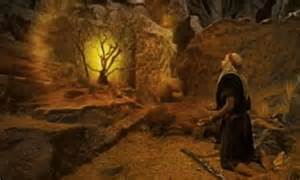
Moses and the Burning BushScripture Text:  Exodus 3: 1-5

 Moses was keeping the flock of his father-in-law Jethro, the priest of Midian; he led his flock beyond the wilderness, and came to Horeb, the mountain of God. 2There the angel of the Lord appeared to him in a flame of fire out of a bush; he looked, and the bush was blazing, yet it was not consumed. 3Then Moses said, “I must turn aside and look at this great sight, and see why the bush is not burned up.” 4When the Lord saw that he had turned aside to see, God called to him out of the bush, “Moses, Moses!” And he said, “Here I am.” 5Then he said, “Come no closer! Remove the sandals from your feet, for the place on which you are standing is holy ground.”

We sometimes miss that nuance when we read this story.  I think I read this for years as if this miraculous burning bush was placed right in Moses’ path, impeding his way, something that he could not possibly miss, perhaps something that he would just trip over if he wasn’t paying attention.  But the passage says that Moses had to “go over” or turn aside to see it, had to actually get off the path that he was on to see this incredible sight.

Here is Moses, who has led his flock to a place “beyond the wilderness”.  I’m not sure what that is.  But it’s apparently a place to which only a journey through the wilderness can take you.  If it’s a literal place, then it’s WAY off any map that we have.  I think it’s more than likely that it’s the place to which you come when you yield to the wilderness, when you let yourself relinquish control and let go of what you are holding so tightly, when, finally, you trust God enough to turn aside to see what God has in store for you.  But, whatever this place is, Moses is leading his flock off the beaten path into a mysterious and unknown place right up to the mountain of God.

And there, off the path, not where he could stumble over it, but where he had to leave his planned pathway to investigate, he sees it—a bush blazing brightly with a fire that did not consume.  This was beyond what was normal.  Well, needless to say, his curiosity was piqued.  He needed to know more, needed to get a closer look.  So he steps toward it.  And then he hears his name.  “Moses, Moses.”  Startled, Moses stammered out a meager response:  “Here I am.”

Now in that moment, I think it’s probable that Moses didn’t even completely understand what was happening.  After all, remember, in early Hebrew thought, if you see God, if you hear God, you die.  And then this great voice tells him to take off his shoes, to take off his shoes because he was standing on holy ground.  Holy ground?  Well, it was ordinary a minute ago!  How did it get to be holy? And then God tells Moses what Moses is called to do.  This shepherd, this ordinary person standing in bare feet on the side of what used to be an ordinary mountain is called to deliver the people of Israel, to lead them to freedom.  This is Moses’ commissioning. And somehow he began to process and understand what was happening.  So, he began to take control of the situation and try his best to get out of what was happening.  After all, Holy Ground is a dangerous place.  For there, you touch the Divine and are changed forever.  There is no going back.

Our Lenten journey is one that will take us beyond the wilderness, to a place where you will see and know things that you’ve never seen and known before, to a place where you will finally turn aside from your plans, from your routine and, there, find yourself standing on Holy Ground.

Holiness comes wrapped in the ordinary. There are burning bushes all around you. Every tree is full of angels. Hidden beauty if waiting in every crumb. Life wants to lead you from crumbs to angels, but this can happen only if you are willing to unwrap the ordinary by staying with it long enough to harvest its treasure. (Macrina Wiederkher, A Tree Full of Angels)

FOR TODAY: Journey to a place beyond the wilderness, beyond the place where you have so far allowed yourself to go. Then turn aside.

Grace and Peace,

Shelli

Reclaimed in the Wildeness

Fork in the desert roadScripture Text:  Genesis 21: 14

14So Abraham rose early in the morning, and took bread and a skin of water, and gave it to Hagar, putting it on her shoulder, along with the child, and sent her away. And she departed, and wandered about in the wilderness of Beer-sheba.

Well our heroes from yesterday are not shining examples of humanity in this story. After God promised Abraham a son with his wife Sarah, they laughed in disbelief. But they waited…and waited…and waited. They got impatient, as we all do at times, and took matters into their own hands. (Don’t we all do that at times?)  So Sarah devised a plan where Abraham would father a child with her slave Hagar. After all, in her mind that would fulfill the promise that Abraham would become the “father of a nation” so maybe this was what God meant all along. But, of course, things did not come out completely rosy. Predictably, Hagar’s pregnancy provoked Sarah’s jealousy and bitterness, and so she drove Hagar into the wilderness. But, true to character, God found her there and welcomed her back, in effect reclaiming her as part of the story. He told her that her child that was to be born would be called Ishmael, which means “God hears”. He said that her descendants would be “too numerous to count”. (This is starting to sound vaguely familiar!)

In the passage for today, it is probably some fifteen years later. It is the occasion of the weaning of Isaac, which probably means that he’s about three years old. Once again, those old wounds and jealousies surface for Sarah and, once again, she drives Hagar, this time with the child Ishmael, into the wilderness. Hagar gives up, toying with just leaving Ishmael to die so the whole sordid thing would end. But then, once again, God hears. And then God makes what is really an extraordinary promise to Hagar that is almost identical to the promise made to Abraham. “I will make him into a great nation…God was with the boy.”

This is a little bit different wilderness story.  Hagar was not “driven” to the wilderness; she didn’t go there for solace or renewal; she wasn’t wandering through it on the way to the Promised Land.  Hagar was sent away, forced into the wilderness mainly by Sarah’s jealousy and resentment and Abraham’s fear and remorse.  And there God again reclaims her, giving her a new story, a new promise of life to come.  The story is a reminder that God is God, once and for all, and that God, with infinite compassion and abounding grace will reclaim us even from ourselves, even from what we humans do to each other.  One by one, in the deepest wilderness of our lives, God reclaims us as children of God.

God’s focus becomes a focus on the future.  Five chapters before this when Hagar had run into the wilderness to avoid Sarah’s wrath, God came.  Sent into the wilderness as forsaken, Hagar encounters God.  In fact, God draws her into conversation.  Hagar becomes the first person in Genesis to encounter an angel of God and the first woman to be given promises (the first woman, ever!).  She becomes the only person in the Old Testament to actually name God.  Hagar, sent into the wilderness so that she would not be part of the story, is reclaimed by God and given a story all her own. In his book, Peculiar Treasures, Frederick Buechner says of this story that it tells “how in the midst of the whole unseemly affair the Lord, half tipsy with compassion, went around making marvelous promises, and loving everybody, and creating great nations, like the last of the big-time spenders handing out hundred dollar bills.”

Both children are recognized as belonging to Abraham but also to a particular future that will be worked out in the future. God announces that it is through Isaac that descendants will be named for Abraham, referring to the covenantal line. But Abraham can be assured that God will care for the future of Ishmael as well, making of him a great nation, making him of the great story that God is continually writing.

In this season of Lent, we do wander in the wilderness.  Some of our wildernesses are self-imposed; some are gifts given from God for renewal and recreation; and some wildernesses are so deep that God must pluck us out of the undergrowth and hold us, setting us upright, so that we begin a new journey.  Lent teaches us that the story is always more than we planned, more than we can see, more than the road that we are on now.  In this wilderness season, the story begins to move beyond ourselves.  We just have to learn to pay attention and allow ourselves to be reclaimed by a story we did not fully know.

Grace fills empty spaces, but it can only enter where there is a void to receive it, and it is grace itself which makes this void. (Simone Weil)

FOR TODAY:  What is your story?  What chapter is God calling you to include?  How is God reclaiming you from the wilderness in which you wander?

Grace and Peace,

Shelli

Lessons From the Desert Fathers


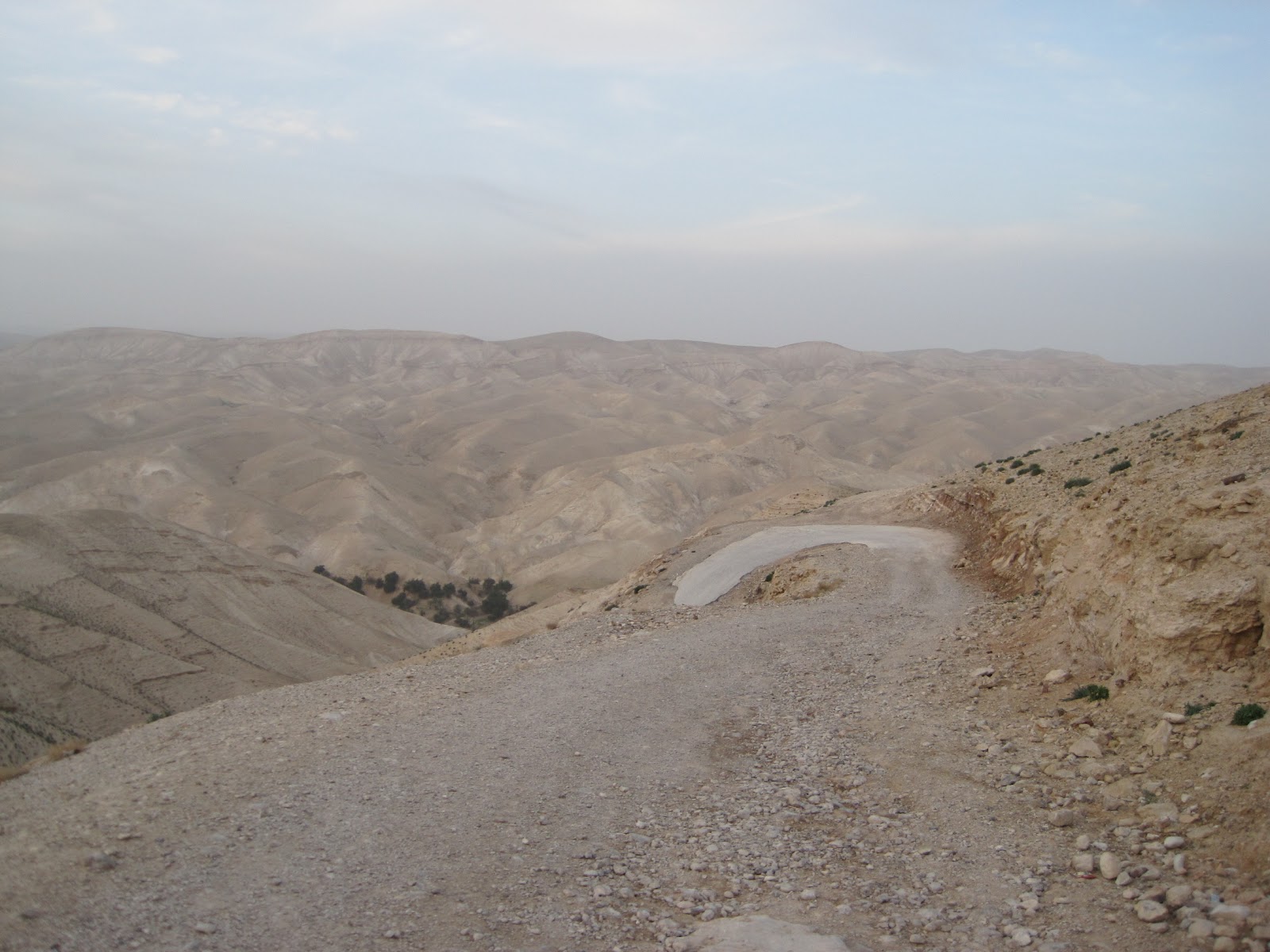
The Judean Wilderness, February, 2010

Scripture Text:  Mark 1: 10-13

10And just as he was coming up out of the water, he saw the heavens torn apart and the Spirit descending like a dove on him. 11And a voice came from heaven, “You are my Son, the Beloved; with you I am well pleased.” 12And the Spirit immediately drove him out into the wilderness. 13He was in the wilderness forty days, tempted by Satan; and he was with the wild beasts; and the angels waited on him.

Jesus was baptized by John and then the version of the Gospel by the writer we know as Mark has immediately being driven into the wilderness.  Still wet with the waters of life, Jesus began his 40-day quest filled with danger, temptation, and probably questions about his own identity and the ministry that would come.  We struggle with this.  We often get hung up on the whole temptation thing, trying to come up with reasons why Jesus, of all people, would have been tempted.  But the writer of this version of the account doesn’t offer more than a mere mention of that.  Instead, we have Jesus being driven out into the wilderness and then the story picks up a few sentences later.  You see, no one followed Jesus out in the desert to get the first hand account.  He was on his own, alone in the wilderness.

We’re not big fans of wildernesses.  In fact, we try to do everything we can to avoid them, or at least find one that has cellular reception and free WIFI available.  And yet, Jesus was driven into the wilderness, as if he had no choice.  Jesus was forced to spend 40 days in what is essentially a wasteland.  The wilderness was waiting for him, offering something that the crowds and the towns and even the synagogue could not.  The wilderness, the place that no one owns, the place that no one has tamed, the place that no one really wants to beat, the place that will never become something that it is not offers just that–itself.  Jesus is not the first to wander in the wilderness and he was not the last.  A few centuries after this, orders of monks in Northern Africa began to make their way into the desert, into the wilderness to experience God’s Presence unhindered by what humans have attempted to create, unhindered by expectations and schedules.  It was the place where they went to renew their prayer life, to begin again.  There were those, like Jesus, that returned to their lives but with new eyes and new hearts.  There were also though that chose to stay , even though they would remain visitors in a place that was not theirs.  In the wilderness, nothing exists but you and God, and, uninterrupted and unhindered, God can create you yet again.

Our wildernesses come in all forms.  Some are self-imposed and others are those to which we are driven at a time that we have no control over where we are going.  The wilderness is hard and dangerous and uncomfortable.  Some are filled with grief and despair.  Others are wrought with a feeling that we will never get out.  Sometimes the wilderness seems unforgiving, as if it’s only focus is to push us into vulnerability, to push us into temptation.  But the lesson that we learn from the wilderness is that, when everything else is gone, when the clouds make us unable to see the way out, when we feel that it will never end, God is there.  And we have become someone new.

Most of us will not drop out of society and make our way to the wilderness.  Even Jesus returned to Galilee, proclaiming the Gospel.  But in this season that remembers Jesus’ time in the wilderness, we can learn what it means to awaken to God’s Presence, to be mindful of this Presence that is always and forever with us, to, day by day, strip those things away that have our attention.  We can learn what it means to enter an intentional wilderness, a place and a time where God is all we have. These forty days are our emptying time—the time when we strip all of our preconceptions away and meet God where God is—right there with us.  We do not walk this road alone.  God is always there.  And when we are tempted to once again take control, God will still be there.  Lent is the time when we allow God to work on us that we might burst forth on Easter morning in radiant bloom.

We need the tonic of wildness, to wade sometimes in marshes where the bittern and the meadow-hen lurk, and hear the booming of the snipe; to smell the whispering sedge where only the wilder and more solitary fowl builds her nest, and the mink crawls with its belly close to the ground.  We can never have enough of nature.  We must be refreshed by the sight of inexhaustible vigor, vast and titanic features, the sea-coast with its wrecks, the wilderness with its living and its decaying trees, the thunder cloud, and the rain which lasts weeks and produces freshets. We need to witness our own limits transgressed, and some life pasturing freely where we never wander. (Henry David Thoreau)

FOR TODAY:  Think of what it would mean to enter an intentional wilderness this Lent, to, day by day strip all those things away that have your attention until all that is left is God, who is recreating you even now.

Grace and Peace,

Shelli


Return to the Waters

man under waterfallScripture Text:  1 Peter 3: 18-22

18For Christ also suffered for sins once for all, the righteous for the unrighteous, in order to bring you to God. He was put to death in the flesh, but made alive in the spirit, 19in which also he went and made a proclamation to the spirits in prison, 20who in former times did not obey, when God waited patiently in the days of Noah, during the building of the ark, in which a few, that is, eight persons, were saved through water.

21And baptism, which this prefigured, now saves you—not as a removal of dirt from the body, but as an appeal to God for a good conscience, through the resurrection of Jesus Christ, 22who has gone into heaven and is at the right hand of God, with angels, authorities, and powers made subject to him.

In this season of returning, here the writer of this general letter known as First Peter dispenses with any talk of being “saved” as it relates to salvation.  Instead, the promise lies in our re-creation, our renewal, our resurrection (the “little r” one), our being made into a new Creation.  It is a reminder that in our baptism, in that moment when the waters covered our body, or covered our head, or when drops of the stuff clinging to another’s hand somehow, some way, landed on our head and brushed our forehead and became the sign of a cross, in THAT moment, we were made new.  It wasn’t just washing away of sin and it certainly wasn’t some sort of something that made us sin no more (although, let me tell you, that would have made this life thing a little easier!)  In that moment as the waters touched us, we were made new, suddenly swept into a new way of being, and our life in Christ began.

Now baptism is not some sort of magic potion that makes everything perfect.  After all, we are not robotic churchy beings.  We are human–messed up, sometimes sinful, sometimes without hope, sometimes without direction, sometimes overwhelmed, but always, always, Beloved children of God.  For those to whom this was written, the words were a reminder that whatever chaos and peril life now holds, it is not permanent, that beyond what we know, beyond what we can imagine, the God of all Creation is working on us even now, creating molecule after molecule, so that when the flood waters of life finally subside, we will remember who and whose we are, a Beloved Child of God with whom God is well pleased.  And no matter what we do, no matter how much we mess up this life that we’ve been given, no matter how much the world’s chaos swirls around us beyond our control, the promise is true.  God is always there beckoning us to return to the waters, to return to where we began and begin again.

This season of Lent is not a season that merely calls us to clean up the mire and muck of our lives.  It is not a season to finally become good and obedient boys and girls.  It is not a season that promises to get your life together (or organize yourself or lose weight or some other thing you think you need to do disguised as a Lenten discipline).  Lent is a season that calls us to return–to who we are called to be, to what gives us life, to God.  It is a season to return to the waters of your baptism, not just for 40 days, but forever.

Do you remember the old version of the Apostles’ Creed, where we proclaim that Jesus descended into hell?  Well, this is the passage from which that notion may have started.  It claims that Jesus proclaimed to those imprisoned spirits; in other words, Jesus entered hell and blew the gates off.  See, you can always begin again.  You can always return to the waters. You just have to be willing to try out some newness.

One cannot step twice in the same river, for fresh waters are forever flowing around us.  (Hereclitus of Ephesus, 535-475 BCE)

FOR TODAY:  Remember your baptism. Now begin again.

Grace and Peace,

Shelli

Return to Grace

Rainbow

Scripture Text:  Genesis 9:12-17

12God said, “This is the sign of the covenant that I make between me and you and every living creature that is with you, for all future generations: 13I have set my bow in the clouds, and it shall be a sign of the covenant between me and the earth. 14When I bring clouds over the earth and the bow is seen in the clouds, 15I will remember my covenant that is between me and you and every living creature of all flesh; and the waters shall never again become a flood to destroy all flesh. 16When the bow is in the clouds, I will see it and remember the everlasting covenant between God and every living creature of all flesh that is on the earth.” 17God said to Noah, “This is the sign of the covenant that I have established between me and all flesh that is on the earth.”

This is actually the tale-end of the story of Noah and the famous ark filled to the brim with the remnants of Creation.  And here…after all this time of pounding rains, all this time cooped up with animals of all kinds, all this time rocking and swaying with the boat…here, God speaks.  The familiar bow of color is set in the clouds as a sign of the promise that God has made.  We usually take it as a sign that God will take care of us, that God will right the wrongs of the world and order them yet again, that God will somehow assuage our pain and grief and put things back the way they were.  Really?  THAT’S not what that says.

Now we can either look at this story as a sort of children’s story, complete with rainbows and pairs of elephants and zebras and orangutans or we can look at this story as one depicting a deity who was so angered by the rebellion of the Creation that God wiped it off the face of the earth. Truthfully, neither one works. Indeed, this is a story about rebellion and human sinfulness. (And to be honest, what story is NOT?) But the whole point is that no matter how far the human creation wandered from the Creator, there was a calling back, a return, an offering of love and forgiveness and a chance to begin again. Now, that’s hard for us to fathom too, possibly because we are not good at offering each other “do-overs”. We are not good at understanding a God who would dispense with all means of justified destruction and just offer Presence and Grace and a future filled with hope. It is hard for us to imagine that no matter what we do, no matter what we screw up or blow up or make up, God is offering a chance to return, a chance to be recreated into something that only God can imagine.

You see, the Celtic tradition would look upon the rainbow not as a promise that God would “fix” the world or “fix” us, but as a threshold, a point between what is and what will be.  So, the promise is not that God will fix everything, but that, always, there is a chance to begin again.  We always and forever, no matter what we’ve done or thought or how many times we’ve flaked out in life, have the chance to return to the beginning. God does not wipe what has happened.  God does not forget what we have done.  Rather God, knowing and remembering full well what the creatures have done in Creation, STILL God offers a threshold through which we can return to Grace–if we will only step through.

The grace of God means something like:  Here is your life.  You might never have been, but you are because the party wouldn’t have been complete without you.  Here is the world.  Beautiful and terrible things will happen.  Don’t be afraid.  I am with you.  Nothing can ever separate us…There’s only one catch.  Like any other gift, the gift of grace can be yours only if you’ll reach out and take it.  Maybe being able to reach out and take it is a gift too.  (Frederick Buechner)

FOR TODAY:  What does it mean to return to grace?  What does it mean not to forget what has happened, not to forget what you have done, but to allow yourself to step through the threshold that God has opened wide, to allow yourself to begin again?

Grace and Peace,

Shelli