The Wilderness is Where We Changed Our Course

Change-DirectionScripture Text:  Matthew 15: 21-28

21Jesus left that place and went away to the district of Tyre and Sidon. 22Just then a Canaanite woman from that region came out and started shouting, “Have mercy on me, Lord, Son of David; my daughter is tormented by a demon.” 23But he did not answer her at all. And his disciples came and urged him, saying, “Send her away, for she keeps shouting after us.” 24He answered, “I was sent only to the lost sheep of the house of Israel.” 25But she came and knelt before him, saying, “Lord, help me.” 26He answered, “It is not fair to take the children’s food and throw it to the dogs.” 27She said, “Yes, Lord, yet even the dogs eat the crumbs that fall from their masters’ table.” 28Then Jesus answered her, “Woman, great is your faith! Let it be done for you as you wish.” And her daughter was healed instantly.


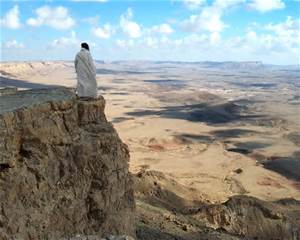
So Jesus travels to a place that is not his, to an unfamiliar place some distance away.  It’s not the wilderness the way we normally define it with deserted pathways and dangerous hideouts and such.  But it IS a wilderness.  When we journey through unknown territory, through places that are not our home, through places that are not ours, places that we have not planned or planted, there is a certain wilderness aspect to them.  In Jesus’ defense, he has to be tired.  He has to be craving some time along to regroup and reflect on his mission (OK, maybe that’s what the introvert in me is projecting!).  But then, all of a sudden, this woman comes up and she’s shouting at him with a foreign accent—not just a loud shout but one that is incessant and wailing and very annoying.  She is begging and begging him to heal her daughter.  But what could Jesus do?  After all, his mission as he understood it was to the Jews and here was this Canaanite Gentile wanting some of his time. Truthfully, this woman had everything working against her—gender, race, religion, class, and nationalism.  In the first century, she was the “outcast of the outcasts”, an outcast even in this wilderness in which Jesus finds himself.

Put yourself in Jesus’ place.  “Perhaps if I ignore her, she will go away.” But, then, the disciples get involved.  “Good grief,” he probably thought, “if they would only be quiet.”  And the woman keeps on—shouting and wailing like some sort of banshee.  What do you do with a pushy Canaanite woman who won’t shut up? “Don’t you understand…I am not here for you…I must first attend to the Jews…the chosen ones…the children of God…the people to which I was promised…it would not be right to abandon their mission for another.”  (I will tell you, the reference to “dogs” is not a nice one.  Without offense to the dog-lovers or dogs among us, in Jewish society, dogs were looked upon as unclean, as scavengers.  To compare someone to a dog was to lower them to the bottom of society.)

But the woman responds, “Yes, Lord, yet even the dogs eat the crumbs that fall from the masters table…Even I, the Gentile, knows that you are Lord.”  All of a sudden Jesus’ tune changes.  This woman has a faith that will not quit.  This woman DOES get it!  The mission is indeed to the Jews. But this woman’s faith has brought her to Jesus as a sign of what is to come. This moment is, in effect, a sort of turning point for Jesus’ whole mission.  In fact, at the risk of overstepping, you could almost say this was a sort of “conversion point” for Jesus.  You also have to consider that this turning point is the reason we’re sitting here.  We are not the “children of Israel” but rather those to whom Jesus’ mission was broadened to include.

I’m actually grateful that the writer that we know as Matthew didn’t try to clean up the story.  This is a powerful statement on Jesus’ humanness, his searching, his exploring, his changing.  In this moment, there, in the wilderness, in the place that was not his, Jesus saw a broader vision of God than even he had had before.

I think that’s why Lent tends to be this sort of wilderness journey.  Traversing through places with which we are unfamiliar, places that perhaps do not feel like home, perhaps will never feel like home, gives us a new perspective.  Maybe we’re not called to make ourselves at home at all.  Maybe we’re rather called to continuously journey through newness, continuously open our minds and our hearts just a little bit more with each turn of the pathway.  I don’t believe that God calls us to stay planted where we are; otherwise, there wouldn’t be so many of these pesky wildernesses in the stories of faith and in our own lives.  You see, the wilderness is where we change our course, where the road turns if only one small degree and unsettled though we are, we turn with it and continue our journey.

But whether small or great, and no matter what the stage or grade of  life, the call brings up the curtain, always, on a miracle of transfiguration-a rite, or moment, of spiritual passage, which, when complete, amounts to a dying and a birth.  The familiar life horizon has been outgrown, the old concepts, ideals, and emotional patterns no longer fit; the time for the passing of a threshold is at hand. (Joseph Campbell)


FOR TODAY:  Look at your lives as if you were visiting.  What is out of place?  What doesn’t fit?  And what is calling you to change your course, to walk in a new way toward a new place?

Grace and Peace,

Shelli

The Wilderness is Where We Found Who We Are

Diving into watersScripture Text:  Mark 1: 4-11

4John the baptizer appeared in the wilderness, proclaiming a baptism of repentance for the forgiveness of sins. 5And people from the whole Judean countryside and all the people of Jerusalem were going out to him, and were baptized by him in the river Jordan, confessing their sins. 6Now John was clothed with camel’s hair, with a leather belt around his waist, and he ate locusts and wild honey. 7He proclaimed, “The one who is more powerful than I is coming after me; I am not worthy to stoop down and untie the thong of  sandals. 8I have baptized you with water; but he will baptize you with the Holy Spirit.”  9In those days Jesus came from Nazareth of Galilee and was baptized by John in the Jordan. 10And just as he was coming up out of the water, he saw the heavens torn apart and the Spirit descending like a dove on him. 11And a voice came from heaven, “You are my Son, the Beloved; with you I am well pleased.”

So Jesus was born in the wilderness.  So Jesus, even as a small child, was whisked off into the wilderness to surely save his life.  And now, Jesus goes into the wilderness and is baptized by John.  You see, Jesus wasn’t baptized at the beautiful marble or wood font that is in the front of your sanctuary.  Jesus wasn’t baptized surrounded by the comforts of air conditioning and pew cushions.  When Jesus knelt, there was no altar cushion beneath his knees.  There was no celebratory lunch after his baptism.  Jesus went into the wilderness and made his way into the cold water of the Jordan, feeling it first with his foot and then slowly, ever so slowly, making his way to the place where John stood.  And as he walked into the water, his clothes and his body were consumed by the waters and the chill overwhelmed him.  And then John, clothed in stinky wet camel’s hair with a sagging leather belt around his waist, gingerly took Jesus and pushed him beneath the swirling waters of the river.  “In the Name of God, I baptize you.”  And as Jesus rose out of the water, gasping for breath, he looked up and the heavens were torn apart, torn apart never to be put back in quite the same way again, never capable of going back to the way they were.  And from this gaping opening in the heavens, the Spirit seemed to descend like a dove.  And they all heard it.  “You are my Son, the Beloved; with you I am well pleased.”

In that moment, there in the wilderness, Jesus found who he was.  There in the wilderness with the wild animals and the blowing sands and the swirling waters of the river Jesus found who he was.  There in the wilderness where life is wild and unpredictable, where the path is not as worn as the one we frequent in the city, where the dwelling place is open to the sky and not walled in, where nothing can be controlled and nothing can be held, Jesus found who he was.  It seems to me that Jesus keeps returning to the wilderness, keeps returning to the place where we don’t expect him to be.  Perhaps our cue is that we are called to do the same.  Perhaps the wilderness is where we find who we are.

You see, in the comforts of our homes, in the security of our lives, in the places where we close our doors and lock them off to the world, we are told what we should be.  We are told that we should pursue success and affirmation, that we should climb the ladder with our accomplishments and our resume’.  We are made to believe that if we mingle with the right people and show up in the right places and post cute little pictures and statements on social media, we will get somewhere.  But in the wilderness, where the pathway is unpredictable and not well-trodden, where we experience some discomfort and disillusionment with who we are, where we experience crises of identity and crises of faith, where we feel like we don’t fit and we don’t belong, where we feel, sometimes, like we can’t even connect with God there, there, we find who we are.  We are pushed down into the waters of unknowing and we emerge with a new perspective.  We are immersed in something that we do not control and cannot stop and find new ways to be.  And the heavens open and the very Spirit of God spills onto us.  And we hear it.  We hear who we are, a daughter or son of God, God’s Beloved, with whom God is well pleased.

Maybe we’re beginning to see a pattern here.  Jesus’ life was not exactly charmed in the worldly sense of the word.  It seems, rather, that the wilderness kept cropping up, somehow pulling him into its grip.  I don’t think it was a test.  I think it was God’s way of pulling us toward freedom, God’s way of releasing us from the expectation of others, from the assumptions that the world hands us of who we are supposed to be, that there is a certain path and a certain way that our life has laid out for us.  Jesus’s life was mostly about walking in the wilderness, walking the way that was not the expected, that was not the norm, walking the way that opened himself to being immersed so that, finally, he could find who he was.

Perhaps that’s the point of our Lenten journey.  It is not just a denying ourselves of something; it is not just doing something different, walking a different walk for a short season.  This Lenten journey forces us into the wilderness, with cold water and murky pathways and hands us a mirror so that we take a good hard look at our lives and finally, finally find who we are:  A daughter or son of God, God’s Beloved, with whom God is well pleased.  And knowing who we are, everything has changed.

It is in the act of offerings our hearts in faith that something in us transforms…proclaiming that we no longer stand on the sidelines but are leaping directly into the center of our lives, our truth, our full potential. (Sharon Salzberg)

FOR TODAY:  Let yourself go into the wilderness.  Immerse yourself.  Find who you are—a daughter or son of God, God’s Beloved, with whom God is well pleased.

Grace and Peace,

Shelli

The Wilderness is Where We Came to Be

nativity-story_282_resizedScripture Text:  Luke 2: 1-7

In those days a decree went out from Emperor Augustus that all the world should be registered. 2This was the first registration and was taken while Quirinius was governor of Syria. 3All went to their own towns to be registered. 4Joseph also went from the town of Nazareth in Galilee to Judea, to the city of David called Bethlehem, because he was descended from the house and family of David. 5He went to be registered with Mary, to whom he was engaged and who was expecting a child. 6While they were there, the time came for her to deliver her child. 7And she gave birth to her firstborn son and wrapped him in bands of cloth, and laid him in a manger, because there was no place for them in the inn.


Oh not this!  How can you call this beautiful story the wilderness?  But the truth is, Jesus was born into a wilderness.  Joseph and Mary had had to travel some distance to get to this place.  And the setting, for all the wonder and awe that it holds for us was not idyllic—forced occupation, taxation without representation, poor couple, long trip under less than favorable circumstances, and, then, no room when they got there.  See, in our haste to welcome the child each year and celebrate once again his arrival into the world, we forget the circumstances into which he came.  We forget that he first appeared in the dim lights of a grotto drenched with the waters of new Creation, with the smell of God still in his breath.  We forget that Mary was probably in tears most of the night as she tried to be strong, entering a realm that she had never entered.  And we forget that Joseph felt oh so very responsible and that the weight of that responsibility, the responsibility for essentially birthing God into this world, was heavy on his shoulders.  We remember Jesus’ birth, the moment when we came to be.  But we forget that the wilderness is where we came to be.

Now this is, of course, not the first time that God has appeared in the wilderness.  Incarnations were happening all along.  God came as winds sweeping across the waters, burning bushes, and thick clouds that shrouded mountains.  God came in dreams and whirlwinds and strange manna appearing in the wilderness.  God always came.  Perhaps we were too busy with our lives to notice.  So, on this particular night in this particular place, God called us into the wilderness of our lives so that we would finally notice.  God seeks us out, showing us the sacredness that had been created for us, the holy that we had missed all along.  On this silent night, in the thick wilderness of night, God comes and dances with humanity, crossing the line between the ordinary and the Divine if only for a while.  God comes to us.

Haven’t you always thought that it would have made more sense for Jesus to born into the establishment, perhaps into at least moderate wealth, in a place where it all would have been noticed?  OK, really?  So what would have happened if Jesus had been born into a single-family McMansion in the suburbs?  See, God always comes into the wilderness.  God chooses to call us into the wild where we will notice that God is there.  God calls us away from what we know, away from those places where we get comfortable and close ourselves off.  God calls us to the place where we are open to newness, open to encounter, open to walking toward rather than closing off.  And on this night, on this beautiful silent night with angels singing and stars shining, the walk to the Cross began.  The wilderness is where we can come to be because it is the place where we know nothing else other than to walk forward.  This season of Lent, this season of walking to the Cross did not just begin this last Ash Wednesday.  It began long ago on that silent night in the wilderness.  It began in the darkness of the wilderness when we came to be.
It gets darker and darker…and then Jesus is born. (Ann Lamott)

FOR TODAY:  Leave the comforts of your life and walk into a wilderness.  What do you see?  Who do you encounter?  Now keep walking.

Grace and Peace,

Shelli

The Wilderness is Where We Began

Creation 1Scripture Text:  Genesis 1: 1-3

In the beginning when God created the heavens and the earth, 2the earth was a formless void and darkness covered the face of the deep, while a wind from God swept over the face of the waters. 3Then God said, “Let there be light”; and there was light.


That’s not the wilderness!  Wilderness has thick, unsculptured trees or endless sand, hard-to-follow paths or paths that keep disappearing.  This isn’t a wilderness. There’s nothing there!  But don’t you think nothingness, a formless void covered in darkness is just about as ultimate a wilderness as you can imagine? And keep in mind that there WASN’T nothingness, per se.  There was a void, a glob (that’s an official very spiritual term!) of disordered chaos.  And God was there, there in the wilderness with the chaos and the glob.  All of Creation began in this wilderness.  God spoke the first creating Word in that wilderness.  God spoke and the formless void began to slowly follow God into being. As the Spirit of God swept over the waters, they moved and parted, letting go of the part of themselves to which they had held so tightly, and they began to change.  And then with another Word, God called Light forth and darkness began to be illuminated.  Creation had begun.  We had begun.  The wilderness is where we began.

We know the rest of the tale.  God continued to create, continued to order the wilderness, to one by one call Creation into being—earth and sky, plants and suns and moons and ordered seasons, swimming creatures, winged creatures, creeping creatures, walking creatures, and, oh yeah, us!  As the last bit of ordering of this incredible called-out Creation, God created Sabbath, the pinnacle, the climax, the glorious coming together into perfect order of all of Creation.  And God delighted in this order and called it good.

The wilderness is where we began.  In our beginnings, in our disordered chaos, God called us forth into being.  God created us not in a haphazard way but in the very image of God.  God called us forth to live into that image, to become the very ones that God envisioned we would be.  We were probably pretty OK in that wilderness void; after all, we knew nothing different.  And then God created us into something new.  And God called it good.  We were God’s delight, God’s beloved.  Oh, sometimes we wander away. Sometimes we mistake really pretty acceptable chaos for God’s ordering.  Sometimes we think we have a better idea of who we could be than this image of God.  And so we need to return to the wilderness, to the place of our creation, to the place where we began, so that God can say us into being once more.

That’s what Lent does for us.  Lent calls us into the wilderness to remind us who and who’s we are, to remind us of that image in which we were made.  Lent calls us into the wilderness so that we can begin again.

Every act of creation is first an act of destruction. (Pablo Picasso)

FOR TODAY:  Look around at this wilderness.  What does it mean to begin again?

Grace and Peace,

Shelli

Becoming Wilderness

"St. John the Baptist", El Greco, c. 1600.
“St. John the Baptist”, El Greco, c. 1600.

Scripture Text:  Matthew 3: 1-5

 In those days John the Baptist appeared in the wilderness of Judea, proclaiming, 2“Repent, for the kingdom of heaven has come near.” 3This is the one of whom the prophet Isaiah spoke when he said, “The voice of one crying out in the wilderness: ‘Prepare the way of the Lord, make his paths straight.’” 4Now John wore clothing of camel’s hair with a leather belt around his waist, and his food was locusts and wild honey. 5Then the people of Jerusalem and all Judea were going out to him, and all the region along the Jordan, 6and they were baptized by him in the river Jordan, confessing their sins.


We never know quite what to do with this strange wilderness man.  You can imagine him covered with dirt and grime after all this time in the wilderness.  His hair is long and unkempt, matted in places and hanging down over one of his eyes.  He is decked out from neck to knee in some sort of strange covering made of camel’s hair that is secured by a roughshod faded leather belt hastily tied around his waist.  And all this time in the wilderness has caused him to lose any hint of a sophisticated palate finely tuned to the gentle blend of herbs and spices and culinary concoctions.  Instead, he is content to eat what he finds—locusts, wild honey, whatever else may cross his path.  Yeah, we never know quite what to do with this strange wilderness man.

John was definitely not a run-of-the-mill preacher.  He had zeal; he had passion; his primary focus was preparing the way of the Lord.   I’m not sure what John saw for those who did not know God.  But he was determined that all who came out to him somehow, some way turned their lives around.  Now this whole idea of “repentance” that John emphasized is not one that we good Methodists often focus on.  It sometimes sounds a little too “hellfire and brimstone” for us. But repentance means turning around, a new mind, a change of direction.  It means throwing off those things that bind us to the life we know for those things that point to a life with God.  It does not mean that God has finally won us over; it means, rather, that our own self, our own story, has finally come to be.  Just being there is not enough; just having Abraham for your ancestor is not enough; just doing the right thing is not enough.  You must change your life.  You must change your path.  You must change how you look at the world.  There are no favorites.  This includes everyone.

So, why did John make his home in the wilderness?  Why didn’t he come to town, plant himself in the middle of the town square, and preach his message there?  Maybe it was not that John himself had such an affinity for the wilderness life.  Maybe it was rather that he saw what we often avoid.  I mean, think about the wilderness—it calls us into things outside our normal routines, outside of the establishments that make up our lives.  The wilderness calls us to learn to see things anew.  Without routines, we have to rely on something that will point us in the right direction; without our comfortable landmarks and our timeworn assumptions, we have to rely on the wilderness and those who we meet on the path showing us the way.

No, we don’t know what to do with him.  We don’t know how to talk to or talk about this wild wilderness man.  After all, John is a threat to proper society and accepted norms.  John IS the wilderness.  Maybe that’s what we need to do—become wilderness.  Now I’m not ready to don camel’s hair and I’m thinking that I might pack some peanut butter and crackers and perhaps a high-protein granola bar to avoid EVER having to eat locusts.  But maybe I do need to become wilderness, to clear the timeworn path through my life, to become open to the wildness of God’s Spirit that blows in and out of places that I never knew, that somehow compels me to travel down roads unknown, sometimes with fear and trepidation, and be willing (no, actually WANT to) turn myself around and see what I have not seen.

OK, John, I guess we get it.  I’m still not keen on the outfit and the meal, but if our Lenten journey has taught us anything, it is to open ourselves to traveling through what we do not know so that it can all be revealed to us.  John saw something that I have been avoiding.  John was not waiting for God’s Kingdom to come to be; he saw it happening.  By becoming wilderness, by stepping out of what he knew, he saw that God was not just coming but was already here.


Not only is another world possible, she is on her way. On a quiet day, I can hear her breathing. (Suzanna Arundhati Roy)


FOR TODAY: Become wilderness. Open your eyes and see God’s Kingdom coming to be. (And, if you need to, pack some peanut butter!)

Grace and Peace,

Shelli

So, Again, Why Are We Here in the Wilderness?

Jesus tempted in the wildernessScripture Text:  Matthew 4: 1-11


Then Jesus was led up by the Spirit into the wilderness to be tempted by the devil. 2He fasted forty days and forty nights, and afterwards he was famished. 3The tempter came and said to him, “If you are the Son of God, command these stones to become loaves of bread.” 4But he answered, “It is written, ‘One does not live by bread alone, but by every word that comes from the mouth of God.’” 5Then the devil took him to the holy city and placed him on the pinnacle of the temple, 6saying to him, “If you are the Son of God, throw yourself down; for it is written, ‘He will command his angels concerning you,’ and ‘On their hands they will bear you up, so that you will not dash your foot against a stone.’” 7Jesus said to him, “Again it is written, ‘Do not put the Lord your God to the test.’” 8Again, the devil took him to a very high mountain and showed him all the kingdoms of the world and their splendor; 9and he said to him, “All these I will give you, if you will fall down and worship me.” 10Jesus said to him, “Away with you, Satan! for it is written, ‘Worship the Lord your God, and serve only him.’” 11Then the devil left him, and suddenly angels came and waited on him.


We’re past the mid-point place in the journey and it’s becoming tiresome. Is it all worth it?  We haven’t really seen any sign of where we’re going and things have gotten so incredibly uncomfortable (and some of it is beginning to get a little personal!).  We’re ready for all of this to be over.  At the beginning of the journey, we heard that Jesus had gone into the wilderness.  We already know that.  But the writer known as Mark didn’t really elaborate on the temptations that Jesus encountered.  This version of the story seems to focus on just that.

First of all, Jesus was fasting.  Now it doesn’t say what kind of fast—there are fastings from all meals except breakfast, there are fastings from everything except water, there are fastings from everything that enters one’s mouth.  There are also other fastings—fastings from certain input into one’s mind, fasting from doing certain things, perhaps fastings from human contact.  Maybe that’s what Jesus was doing.  Because forty days and forty nights by oneself doesn’t provide a lot of company.  He probably was famished.  But whatever Jesus’ fast entailed, it was long and it was hard and he was famished.

So Jesus is tempted when he is the most vulnerable, when all of his guard and his shields were down.  He is tempted to guarantee having what he needs, tempted to impress and be liked, and tempted to be in control.  Henri Nouwen said that the temptations were to be relevant, spectacular, and powerful. Oh, he could have made excuses.  We all do it.  After all, think how much powerful his ministry would have been.  Think what WE could accomplish if we were relevant, spectacular, and powerful.  The truth is, those things are not bad in and of themselves.  Relevance, spectacularness (probably not a word!) and power can do great things when they are harnessed in the right way.  But when they get in the way of who God calls us to be, when they become the reason we are doing things, when they become our primary focus and goal in life, then they have pulled us away from who God calls us to be.

See, Jesus knew those temptations and knew to resist them.  I think the whole reason that Jesus was tempted at all was not to prove that he could resist temptation but rather to put these things in their proper place.  They are not bad; they are just not the main thing, should not be the goal that we are trying to accomplish.  The truth is, this wilderness journey does not beg for us to accomplish; maybe in some way it calls us to famine, to being famished, so that we know exactly what we need.  So, again, why are we here in the wilderness?  We are here to empty our lives of ourselves so that they can be filled with God.  We are here to realize how our souls hunger and thirst for God.  We are here to finally know that nothing fills our emptiness, nothing fills us up, nothing fills our souls but God.  We are here to finally know that longing for God is our main thing because our longing will lead us to what we most need.

One needs to keep on thirsting because life grows and enlarges.  It has no end; it goes on and on; it becomes more beautiful…[One] cannot be satisfied until [one] ever thirsts for God. (Alexander Baillie)

FOR TODAY:  Long for God.  Write down what that means.  What emptiness do you feel?

The Wilderness of Ourselves

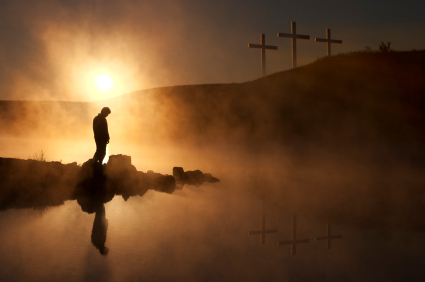
Three Crosses and Silhoutted Person in Prayer at SunriseScripture Text:  John 3: 14-17


14And just as Moses lifted up the serpent in the wilderness, so must the Son of Man be lifted up, 15that whoever believes in him may have eternal life. 16“For God so loved the world that he gave his only Son, so that everyone who believes in him may not perish but may have eternal life. 17“Indeed, God did not send the Son into the world to condemn the world, but in order that the world might be saved through him.

This is it: THE verse.  So what we do with THE verse?  It’s on street corners and billboards and T-Shirts and tattoos and faces and signs at sporting events.  I think it is often read as some sort of great reward for doing the right things.  You know, if you do everything you’re supposed to do, you’ll be rewarded when it’s all said and done.  And if you don’t, well you’re just out of luck.  So, look at me…do what I do, go to church where I go, be what I am, look like I look.  I’m saved; are you?  (I hate that!)

But we’ve read it wrong.  For God so loved the world—not the ones in the right church or the right country or the right side of the line—but the WORLD.  God loved the world, everything about the world, everyone in the world, so much, so very, very, VERY much, that God came and walked among us, sending One who was the Godself in every way, to lead us home, to actually BRING us home, to lead us to God.  Are you saved?  Yes…every day, every hour, over and over and over again.  I’m being saved with every step and move and breath I take.  I think that’s what God does.  God loves us SO much that that is what God does.  God is saving us.

God came into the world to save the world.  So why would we interpret this to mean that God somehow has quite loving some of us or that we have to somehow bargain with God to begin loving us or that “being saved” is a badge of honor?  See, God loves us so much that God is saving us from ourselves.  It’s back to that snake thing.  OK, kids, you think your main problem is snakes?  Alright, here it is, look at it, hanging there on a tree.  Look at it, really, really look at it.  Quash your fear, let your preconceptions go, just do it.  There now, all is well.  No more snakes.

OK, kids, what is the deal this time?  You have let the world order run your life.  You have become someone that you are not.  You have allowed yourself to be driven by fear and preconceptions and greed.  You have opted for security over freedom, held on to what is not yours, and settled for vengeance rather than compassion and love.   I created you for more than this.  I love you too much for this to go on.  Look up.  Look there, hanging on the tree, there on the cross.  Stare at the Cross.  Enter the Cross.  See how much I love you.  In this moment, I take all your sin, all your misgivings, all your inhumanity and let it die with me.  All is well.  All is well with your soul.

In this season of Lent, we inch closer and closer to the cross.  We shy away.  It’s hard to look at.  But perhaps it’s not the gory details, but the realization that we are the culprits.  Lent provides a mirror into which we look and find ourselves standing in the wilderness of ourselves.  But the Cross is our way out (not our way “in” to God, but our way “out” of ourselves).  Because God loves us so much that God cannot fathom leaving us behind.  But the Cross is the place where we finally know that. For God so loved the world that he gave his only Son, so that everyone who believes in him may not perish but may have eternal life. Indeed, God did not send the Son into the world to condemn the world, but in order that the world might be saved through him.


First United Methodist Church, Cleveland, TX

In Christian language, to be truly human is to shape our lives into an offering to God. But we are lost children who have wandered away from home, forgotten what a truly human life might be. When Jesus, our older brother, presented himself in the sanctuary of God, his humanity fully intact, he did not cower as though he were in a place of “blazing fire and darkness and gloom.” Instead he called out, “I’m home, and I have the children with me.” (Thomas Long, from “What God Wants”, 19 March, 2012.)


FOR TODAY:  Bask in God’s love.  Look up.  What do you fear?  What is wrong?  Look at the Cross.  All is well.  All is well with your soul.

Grace and Peace,

Shelli