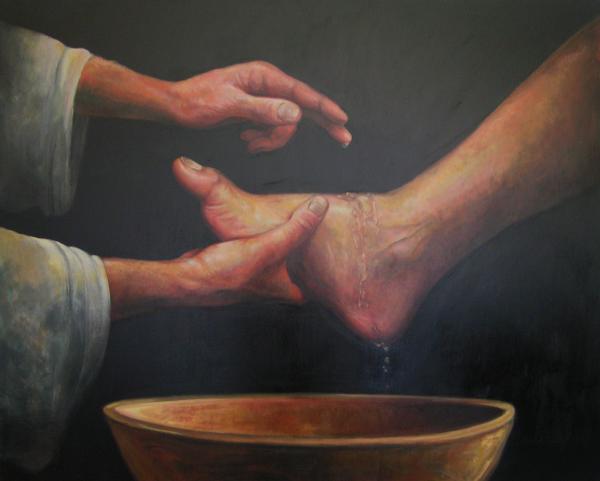
To Hold Dear and Love

14-11-02-#6-Sermon-Thin PlaceScripture Passage (Genesis 15: 1-6)

After these things the word of the Lord came to Abram in a vision, “Do not be afraid, Abram, I am your shield; your reward shall be very great.” 2But Abram said, “O Lord God, what will you give me, for I continue childless, and the heir of my house is Eliezer of Damascus?” 3And Abram said, “You have given me no offspring, and so a slave born in my house is to be my heir.” 4But the word of the Lord came to him, “This man shall not be your heir; no one but your very own issue shall be your heir.” 5He brought him outside and said, “Look toward heaven and count the stars, if you are able to count them.” Then he said to him, “So shall your descendants be.” 6And he believed the Lord; and the Lord reckoned it to him as righteousness.


We are told over and over to not be afraid. But we still want a guarantee. We WANT to believe that God will work it all out; we WANT to believe that God will sustain us; we WANT to believe, but we’d like to know when things will get worked out to at least our satisfaction, if not our comfort and ease. Now this passage is probably better translated as “trust” than “believe”. Is it the same? Well, probably close. But we tend to think of believing in something as knowing that it’s right. That’s not really right, but it’s what most of us have fallen into. In the 16th century, the Saxon meaning depicted it as “to hold dear or love”. That’s different. That’s WAY different. Do you follow because you think it’s right or because you love it and hold it dear? So is belief more about facts or about the meaning it brings to your life?


When we are told not to be afraid, it seems to be more of a call to trust, rather than merely believe. You can believe something, maybe know it’s right in your deepest being, and yet not fully give yourself to it. But Abram was told to trust, to give himself to it. “Come, Abraham. Trust it. Follow it. Give yourself to it. Hold it dear and love it. Become it.” And the covenant, the relationship, came to be.


This journey that we’re on is not, of course, a straight and unhindered pathway. There are hills to climb and valleys to maneuver. There is a wilderness to traverse. There are things that come along and get in our way and change our whole schedule when we least expect it. (I had some of those the last few days, which is why I’m WAY behind on “daily meditations”. So, I owe you four extras somewhere along the way!) But we’re not just called to mindlessly and aimlessly follow what we believe to be true.  We are instead called to trust it in our deepest being, to turn ourselves over to it, if you will. It doesn’t mean that there won’t be “blips” along the way. After all, Abraham (formerly known as Abram) would become the father of three major world religions, but he was perfect. He probably wasn’t even trustworthy. We all know he tried to manipulate the outcome of it all a bit. But this faith journey is not about making us perfect humans; it’s not about our blind acceptance of what we do not understand; it’s about relationship. Faith is about realizing and trusting that we are part of a deep and abiding relationship between God and humanity, actually between God and all of Creation as the holy and the sacred pours into our being bit by bit. No, it makes no sense in terms of this world. That’s what makes it faith. That’s what Lent teaches us. So, do not be afraid. Follow what you love and hold dear and I’ll walk it with you.


Meaning does not come to us in finished form, ready-made; it must be found, created, received, constructed. We grow our way toward it. (Ann Bedford Ulanov)


Thank you for sharing your Lenten journey with me!


Grace and Peace,


Shelli
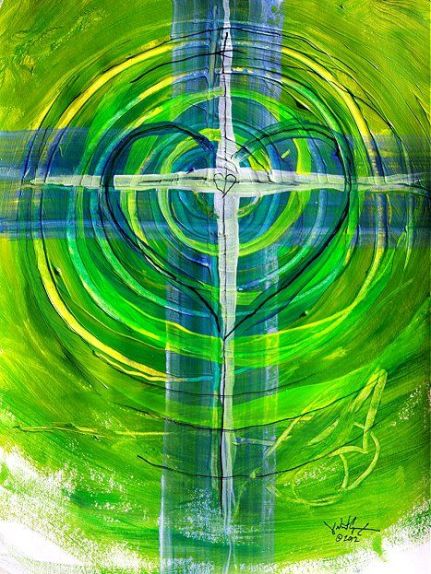
In Our Search for Belief

Cross-Abstract
“Faith, Day and Night”, J. Vincent Scarpace, 2012

Scripture Passage (Romans 10: 8b-13)


“The word is near you, on your lips and in your heart” (that is, the word of faith that we proclaim); 9because if you confess with your lips that Jesus is Lord and believe in your heart that God raised him from the dead, you will be saved. 10For one believes with the heart and so is justified, and one confesses with the mouth and so is saved. 11The scripture says, “No one who believes in him will be put to shame.” 12For there is no distinction between Jew and Greek; the same Lord is Lord of all and is generous to all who call on him. 13For, “Everyone who calls on the name of the Lord shall be saved.”


You know, this whole faith journey thing would be a whole lot easier if the rules were better laid out! So, are you supposed to confess your beliefs first or believe what you’re saying first? (because did you notice they get switched in this passage?) I mean, just make it easy! How DO we get this right? Just tell me what I’m supposed to do and I’ll do it! Just tell me what to say. I’m a pretty fast learner. I could probably remember enough to get through the initial exam anyway.


That’s what most of us want. That’s what those that Paul was first addressing wanted. Good grief, just tell us what we’re supposed to do to get this right! They wanted him to tell them what acts, what righteousness needed to happen so they could check off that they were following the law. We’re no different. We’re used to racking up points or grades or salary levels (or for churches, it would be members or attendees or giving patterns or apportionments—aaaagggghhhh!—there, I’m better!), all so that we can check off that we’ve achieved something. But when you read this, Paul isn’t even laying out what it is we’re supposed to believe. There’s no talk of original sin or not, no mention of which salvation theory Paul thought was the right one, and no list of rules or beliefs to which we needed to adhere to get “in”. Paul’s answer instead was to just believe. Just ask. Just open your mouth and pour out your heart and say it. That’s all. Because, see, it’s there. It’s all right there. Just call on the Lord and start walking.


But there’s another side to this. If we’re not told exactly what it is that we’re supposed to believe, then why would we think that our beliefs are the way everyone should believe? The passage says that “everyone—that means all of us—who calls on the name of the Lord shall be saved.” In other words, desiring God is enough. Desiring God is what leads us toward God. Wanting to pray is praying. Yearning to be with God is being with God. Confessing our belief is believing. It doesn’t mean that we won’t have what seem to be crises of faith. (I have one about every week lately!) It doesn’t mean that we will ever get to the point where we don’t have questions. (If you meet someone that tells you they don’t question God or question what they believe, personally, I’d run! I mean, are you really willing to stake your whole existence on what YOU’VE figured out God is going to do?)


Desiring God, wanting to be with God, wanting to follow is enough. Beginning is enough. I mean, I’ll be honest, if God had some prescribed list of rules and definitive beliefs in mind, why in the world would God have chosen Paul to be the head writer of the greatest treatise on salvation of all time, with his circular thoughts and grammatically incorrect run-on sentences? Maybe God’s whole idea is that we wander and we explore and we question and we journey not until we “get it” but until we realize that the journey IS the way we live with God, that this wilderness in which we find ourselves IS the Way to God and, at the same time, the way to ourselves. That is the reason that in this season, we find ourselves in the wilderness. It is not a punishment. It is a reminder that the God who created us has never left us. It is for us to realize that in the deepest part of our being, we desire to be with God almost as much as God desires to be with us. That is the reason that God came, Emmanuel, God-With-Us, to walk with us, to perhaps wake up our God-given desires to be with God. So, begin. Wanting to be with God IS being with God. And THAT is something in which you can believe.


There is a God-shaped hole in the heart of every [person] which cannot be filled by any created thing, but only by God, the Creator, made known through Jesus Christ. (Blaise Pascal)


Thank you for sharing your Lenten journey with me!


Grace and Peace,


Shelli

The Home We Have Inherited

wandering-arameanScripture Passage (Deuteronomy 26: 1-2, 5, 10-11)
When you have come into the land that the Lord your God is giving you as an inheritance to possess, and you possess it, and settle in it, 2you shall take some of the first of all the fruit of the ground, which you harvest from the land that the Lord your God is giving you, and you shall put it in a basket and go to the place that the Lord your God will choose as a dwelling for his name… 5you shall make this response before the Lord your God: “A wandering Aramean was my ancestor; he went down into Egypt and lived there as an alien, few in number, and there he became a great nation, mighty and populous… 10So now I bring the first of the fruit of the ground that you, O Lord, have given me.” You shall set it down before the Lord your God and bow down before the Lord your God. 11Then you, together with the Levites and the aliens who reside among you, shall celebrate with all the bounty that the Lord your God has given to you and to your house.


See, the problem with this whole Lenten wilderness excursion is that we’re really not ready, right? But have you ever considered that the problem might be that we’re TOO prepared. I mean, maybe we’ve overpacked, dragging what we think is ours, what we think defines us along this dusty road. Maybe we’re so walled off with our own preconceptions of who we are, who God is, what Jesus can do for us, how this whole journey will end up, that we’re not paying attention at all to where we are going or what God is trying to show us along the way.


Look around. We are not the first to travel this way. Oh, don’t get me wrong, it’s not an overly well-worn path, but there is a faint pathway that someone carved out long before we came along. This is not our pathway. This is not our land. This is not OUR country (arguing political pundits aside). This is not OUR church. We inherited what we have. It was handed down to us from those that came before. And it is ours not to possess, not to settle, but to hold, to hold for a season in time. What we have, all that surrounds us was entrusted to us for our care and our use (not for us to USE UP, just for our use.)


This Lenten journey is a reminder of not only where we are headed but also from where we have come. It is a way of our acknowledging that we are not self-made as we would like to think, that all that we are and all that we have is not only from God but IS God’s. But the passage also reminds us that we have time to digest all of that. God doesn’t expect to have all of this figured out or to be fully formed in faith. God is not standing at the doorway to our home like a holy ticket-taker. God is waiting for us to offer the fruits of what God has given us back to God. And then, together, we will celebrate the glorious bounty that belongs to us all. The journey is one that calls us to remember who and whose we are, to remember the place we began, to remember that that walked this path before, and to welcome those that are yet to come. Maybe Lent calls us to let go so that we will realize that what we are holding is not ours to possess.


Complete possession is proved only by giving. All you are unable to give possesses you. (Andre’ Gide)


Thank you for sharing your Lenten journey with me!


Grace and Peace,


Shelli

Oh, All This Talk About Sin!

flower_ashes_by_dennisallendorfScripture Passage (Psalm 51: 1-3, 7-13)

1Have mercy on me, O God, according to your steadfast love; according to your abundant mercy blot out my transgressions. 2Wash me thoroughly from my iniquity, and cleanse me from my sin. 3For I know my transgressions, and my sin is ever before me….Purge me with hyssop, and I shall be clean; wash me, and I shall be whiter than snow. 8Let me hear joy and gladness; let the bones that you have crushed rejoice. 9Hide your face from my sins, and blot out all my iniquities. 10Create in me a clean heart, O God, and put a new and right spirit within me. 11Do not cast me away from your presence, and do not take your holy spirit from me. 12Restore to me the joy of your salvation, and sustain in me a willing spirit. 13Then I will teach transgressors your ways, and sinners will return to you.


I know, we’re not really ready for Lent yet. (I saw a Christmas tree still up less than two weeks ago. That was a whole lot more festive.) This season has come WAY too fast thanks to an apparent impatient spring on the calendar. So, the pancakes were all eaten last night and the masks have been removed and put away. We are ready to begin the journey again. It is a journey of giving up and giving in, of wandering in the wilderness, of stopping or at least slowing down enough to let God’s Spirit begin once again to seep into our being. But first, first, on this day of dust and ashes, we have to talk about sin.


Sin? Who wants to talk about sin? I mean, I’m Methodist. We are “grace” people, after all! We are forgiven people. Isn’t that what we’re told? God’s mercy is infinite. Jesus took care of all that, right? Really? So, you have no part in this? You just want to go on your merry way? The truth is, what relationship with God would we have if we truly thought we were either sinless or our sins were just hosed off of us without us even knowing what had happened? I mean, what in the world is forgiveness if there’s nothing to forgive? But the fact that God loves me not just in spite of me but BECAUSE of me is a much deeper understanding of God. This is a God who is not waiting for me to clean my act up so I can get on the yellow brick road toward a grace-filled life. This is a God who walks with me down this rocky, sometimes steep and treacherous trail through a wilderness I do not understand and showers me with grace even when I am muddied and worn by sin. This is a God who doesn’t just wait for me to return but takes me by the hand and leads me home even when I sin.


There I said it—sin, Sin, SIN! Hmmm! Steeple didn’t fall off, stained glass windows still there, me, still standing. (I just went and looked—yes, the sign out front still says United Methodist!) On this day of dust and ashes, it is our time to acknowledge that yes, we mess up; that yes, we make the wrong choices (I’m hoping God doesn’t yet regret that whole free will decision way back when!); that, yes, we sin. But this day is also the day that we choose—we CHOOSE to follow God on this journey. Now, at the risk of speaking for the Great I AM, I would much rather have a relationship with one who CHOSE to follow rather than one who knew nothing else. Choosing God and being innocent are not the same. This day, we acknowledge that we are both in need of God and that God loves us more than we will ever fathom. Now, you would think those two scenarios would fit together rather well. But somewhere along the way, we have somehow replaced our need for God with our need to be perfect. Albert Outler called it “overreaching”, getting in God’s business. See, God doesn’t need us to be perfect, or sinless, or innocent. God desires us to choose to follow. God desires us to be who God calls us to be.


And so, the pathway looms ahead. It’s not always familiar territory. And, in fact, we usually have to leave part of what we carry and hold so tightly behind. We usually tend to travel too weighted down to notice where we need to go. So, give up what you need to give up or take on what you need to take on. And feel the ashes on your skin to remind you who you are and also whose you are. Let them be a blessing and a beginning. And know that God calls you away from the self that you have imagined. And begin to walk. It is a journey that is hard and difficult and takes you through darkness. But it is a journey that leads to life, that leads to beginning again.


Meanwhile, sin is our only hope, because the recognition that something is wrong is the first step toward setting it right again. (Barbara Brown Taylor, in “Speaking of Sin”)


Thank you for sharing your Lenten journey with me!


Grace and Peace,


Shelli

In the Time Between

StillnessScripture Text:  Luke 23: 48-49

48And when all the crowds who had gathered there for this spectacle saw what had taken place, they returned home, beating their breasts. 49But all his acquaintances, including the women who had followed him from Galilee, stood at a distance, watching these things.


What do we do with this day, this day after, this day before, this time between?  What do we do when our foundations have been shaken to their core and we wander, alone?  What do we do when we stand at a distance and can do nothing to fix it or hurry the healing along?  This IS the deepest part of the wilderness.  We begin to wander again but this time, we are alone.  This time we wander in grief and despair.  The darkness overcomes us.

Have you noticed that all of the Gospels after the frantic accounts of the Crucifixion fall silent on this day?  They all go from some rendition of laying Jesus in the tomb to some version of “after the Sabbath”.  There was, you see, nothing more to say about what had happened and the story had to stop and wait for itself to begin again.  You see, this IS the Sabbath, the time between work and work, the time between conversations, the time between life and life.  This IS the time to be silent, to sit in the deep wilderness and wait, wait again for life to dawn.

The truth is, there IS nothing to do with this day.  See, this day is not ours.  We’re so accustomed to days revolving around our lives that we have forgotten how to wait, how to just be.  Notice that tomorrow morning the Scripture will not give us the account of the Resurrection.  It will instead tell us the story of the revelation of what has happened, the finding of the empty tomb.  We were not there for the Resurrection.  While we were grieving and wondering and trying to find our way in this new wilderness, God was re-creating in the darkness.  God seems to be drawn to the darkness, to the place where the Light most needs to be.

So, in this darkness, in this silence, know that you are not alone.  Know that God is re-creating everything even now.  Know that this is the time to just be still, to just be still and know.

My ego is like a fortress.  I have built its walls stone by stone to hold out the invasion of the love of God.  But I have stayed here long enough.  There is light over the barriers.  O my God…I let go of the past.  I withdraw my grasping hand from the future.  And in the great silence of this moment, I alertly rest my soul. (Howard Thurman)


FOR TODAY:  It is finished.  Just be still.  Just be still and know.

Grace and Peace,

Shelli

Mary’s Song

Lectionary Text: John [18:1-19:15] 16-19 [20-25] 26-30 [31-42]
Then he handed him over to them to be crucified…So they took Jesus; and carrying the cross by himself, he went out to what is called The Place of the Skull, which in Hebrew* is called Golgotha. There they crucified him, and with him two others, one on either side, with Jesus between them. Pilate also had an inscription written and put on the cross. It read, ‘Jesus of Nazareth,* the King of the Jews.’…When Jesus saw his mother and the disciple whom he loved standing beside her, he said to his mother, ‘Woman, here is your son.’ Then he said to the disciple, ‘Here is your mother.’ And from that hour the disciple took her into his own home. After this, when Jesus knew that all was now finished, he said (in order to fulfil the scripture), ‘I am thirsty.’ A jar full of sour wine was standing there. So they put a sponge full of the wine on a branch of hyssop and held it to his mouth. When Jesus had received the wine, he said, ‘It is finished.’ Then he bowed his head and gave up his spirit.

I am standing here but it does not seem real.  I want to hold him, to comfort him, to cradle him in my arms like I did when he was a baby.  But the guards are holding us back.  Oh, please, I don’t think I can stand anymore.  But I must stand.  He has to know that I am here with him.  He has to know how much I love him, how much I hurt for him, how I would trade places with him if I could.

All of the memories are flooding into my head.  I remember that night when the angel came to me.  I did not understand.  I was so afraid.  But I knew I had to say yes.  I had no idea what I was agreeing to do.  And then for nine months I carried the baby in my womb. It was joyous.  In one respect, it was just like any other pregnancy, like the others I had after that.  And yet, it was different.  I always felt like there was someone there with me, guiding me, loving me, helping me through it.  It’s hard to explain.  The birth itself was hard, downright scary in fact.  We traveled to Bethlehem.  It was so far, so painful.  And then when we finally arrived, it was so crowded.  The streets were wild.  I remember that nice man who let us bed down in the room that housed his animals.  I remember the first time I looked into his eyes–those dark, compassionate eyes.  Even as a baby, he had compassionate, loving eyes.  He was special.  I knew that he was special when he came into the world.  I just didn’t know how wonderful he would be.  I remember the day that my cousin’s son baptized him.  He didn’t know I was there.  I hid behind the trees.  After all, he was an adult; he didn’t need his mother always looking on.  And I remember when his ministry started.  He was so brave, so fearless.  It scared me at times.  I thought something like this might happen.  But I am so incredibly proud of him.  I am so proud of what he became, what he made others become that he touched in his life.  He was special.

No, this does not seem real.  Somebody needs to help him.  Please, please, he’s asking for water.  Please, someone give him water.  I’m afraid this is it.  I’m afraid he cannot take it anymore.  I’m afraid he’s going to give up.  Perhaps it would be better.  Perhaps it is better to let go…Oh, how I love him! How I want to go back, to hold him just once more!  It is over.  It is all over.  He is gone.  What was this for?  I don’t understand.  Why the angel?  Why the star?  Why did it all happen if it was going to end this way?  What does God have in mind for him?  He promised me that it would be for good.  He promised me that it would be OK.  I guess I have to believe that, hold on to it, hope.  Someday maybe I’ll see it.

I wanted to stay here until they gave me his body, but I don’t think I can.  There are others here too–Jesus’ friend Mary, who has always been so lovely toward me, and the disciples.  I hope they all realized how much he loved them, how he would do anything for them.  The rain is really coming down now and the skies are angry, angry like me.  The wind is blowing so hard, I can no longer stand against it.  There are rocks and debris sliding down the mountain above us.  It seems that the world is breaking apart.  Will the world ever know what it has lost?  Will the world ever know what it did?  Will God ever forgive this world for killing my son, their son?  Someone just told me that the temple curtain has split in two.  It is as if the holy has spilled into the world.  I can’t explain it.

My son came into this world wrapped in so much hope.  He was supposed to change the world.  He was supposed to open the eyes of the world to what it could be, what it could become.  Is it all for naught?  Or, someday, will we finally understand why he came?  Someday, I know, that God will make it make sense.  But, now, today, I am grieving more than I could know.  But what a gift I’ve had!  What an incredible gift that was taken away all too soon!  I have to leave this place, as hard as it is.  Shabbat is starting in a few minutes.  I must go prepare, light the candles, and usher in the joy of the Sabbath.  I must go rest.  I need it.  I need it to resurrect my hurting soul.  God will be with me.  Let it be.

“My soul magnifies the Lord, and my spirit rejoices in God my Savior, for he has looked with favor on the lowliness of his servant. Surely, from now on all generations will call me blessed; for the Mighty One has done great things for me, and holy is his name. His mercy is for those who fear him from generation to generation. He has shown strength with his arm; he has scattered the proud in the thoughts of their hearts. He has brought down the powerful from their thrones, and lifted up the lowly; he has filled the hungry with good things, and sent the rich away empty. He has helped his servant Israel, in remembrance of his mercy, according to the promise he made to our ancestors, to Abraham and to his descendants forever.”  (Luke 1:46-55)

Shalom, my dear Son!  May God’s Light stay with you!

The point of Holy Week is to empty.  It is the completion of the process of Lent in which we have made room for our death…Resurrection is finding that place that is just for us.  In the beginning of Holy Week, we find ourselves spiritually homeless.  But when we are homeless, we are ready to be sheltered.  The shelter from death, in life, is on its way.  We don’t need to fear the emptiness. (Donna Schaper)


FOR TODAY:  On this day when we remember the Crucifixion, let us grieve for awhile and then keep vigil with the expectant hope of whatever it is God will do next!

Grace and Peace,

Shelli

Blessed

jesus-washing-the-feet-calvin-carterScripture Text:  John 13: 1-17, 31b-35

Now before the festival of the Passover, Jesus knew that his hour had come to depart from this world and go to the Father. Having loved his own who were in the world, he loved them to the end. 2The devil had already put it into the heart of Judas son of Simon Iscariot to betray him. And during supper 3Jesus, knowing that the Father had given all things into his hands, and that he had come from God and was going to God, 4got up from the table, took off his outer robe, and tied a towel around himself. 5Then he poured water into a basin and began to wash the disciples’ feet and to wipe them with the towel that was tied around him. 6He came to Simon Peter, who said to him, “Lord, are you going to wash my feet?” 7Jesus answered, “You do not know now what I am doing, but later you will understand.” 8Peter said to him, “You will never wash my feet.” Jesus answered, “Unless I wash you, you have no share with me.” 9Simon Peter said to him, “Lord, not my feet only but also my hands and my head!” 10Jesus said to him, “One who has bathed does not need to wash, except for the feet, but is entirely clean. And you are clean, though not all of you.” 11For he knew who was to betray him; for this reason he said, “Not all of you are clean.” 12After he had washed their feet, had put on his robe, and had returned to the table, he said to them, “Do you know what I have done to you? 13You call me Teacher and Lord—and you are right, for that is what I am. 14So if I, your Lord and Teacher, have washed your feet, you also ought to wash one another’s feet. 15For I have set you an example, that you also should do as I have done to you. 16Very truly, I tell you, servants are not greater than their master, nor are messengers greater than the one who sent them. 17If you know these things, you are blessed if you do them…


31…“Now the Son of Man has been glorified, and God has been glorified in him. 32If God has been glorified in him, God will also glorify him in himself and will glorify him at once. 33Little children, I am with you only a little longer. You will look for me; and as I said to the Jews so now I say to you, ‘Where I am going, you cannot come.’ 34I give you a new commandment, that you love one another. Just as I have loved you, you also should love one another. 35By this everyone will know that you are my disciples, if you have love for one another.”


Tonight is the night.  Tonight is the night when death begins to cross the threshold into life, when Jesus begins to slip away from the disciples and from his life here on earth and surrenders to what will be, surrenders to where this journey will take him.  But before all that, before the history of the world changes, before the Divine comes once again flooding into the earth, before Jesus takes that last walk to the Cross, he gets up and ties a towel around him, kneels, and washes the disciples’ feet.  Think about what an intimate act that is in the middle of this Passover crowd.

The first time I participated in a foot washing, I have to admit I was a little reticent at first.  Wouldn’t this be uncomfortable?  After all, washing feet is very intimate.  Yep!  That would be the point!  I remember washing one woman’s feet.  Her name was Caroline.  When I picked up her feet, feet that had had a hard life early on in her native Nigeria, feet that had seen wars and conflicts, feet that had known deep grief in the death of her husband when she was a young woman and deep joy at the lives of her four sons who she had raised alone, I felt life.  It was palpable, almost scary, as if it shot through me.  There, holding in my hand, was not a foot, but life, God-given life, rich life.  I was holding her humanity—and mine.  And then Caroline started praying aloud in her native language.  It was incredible.  It was transcendent.  I understood what it all meant.  I understood why Jesus knelt and washed the disciples’ feet.  Washing feet calls one to serve; having one’s feet washed calls one to be vulnerable, to let go, to surrender.  Foot-washing is life.  It is a way of entering each other, of knowing each other, of sharing each other. If you know these things you are blessed if you do them.

When Jesus was finished, he got up, removed the towel, and looked at the disciples.  He had tears in his eyes.  He knew this would be the last time that he would share in this way with them.  This would, after all, be the last night that Jesus could share humanity with them.  He knew that and now they did too.  Sharing humanity…such a rich, profound, joyous, sometimes painful experience.  Jesus showed us what being fully human looks like—not “only” human, but “fully” human, the way God created us to be.  Being fully human means compassion; it means service; it means vulnerability; it means connection; it means love; it means life.  It would be impossible to maintain the barriers we build between us if we were fully human.

Oh, don’t get me wrong, I don’t think being fully human means that we sit around with permanent smiles on our faces and sing “Kum-ba-yah” nonstop.  (Nothing against that song.)  Being human means that you feel—feel joy, sorrow, hurt, anger, etc.  So being fully human means that you feel them fully, right?  You feel them and then you take your shoes off and wash each other’s feet so that they can feel them too.  Wow!  Let’s have Congress wash each other’s feet.  Not only would that stay a few news cycles, it might even get them to talk or even listen.  Let’s have all of the leaders from every country meet for a day of old-fashioned footwashing.  I wonder what the world would look like if we shared our humanity.

Jesus praying in the gardenSo on this night of nights, when death looms up ahead, and friends are sharing their lasts, remember what Jesus taught us—how to be human, fully human, how to be real, how to be who God envisioned we would be.  Remember that Jesus taught us how to feel, how to live, how to love. If you know these things you are blessed if you do them. And after all these things, Jesus turned and looked to God knowing that the end was here.  The soldiers came and took him down the path.  He turned and looked back at them—those he had called, those he had led, those he loved.  He loved them all, even the one who had just kissed his life away.  They would be fine.  They were not alone.  They had each other.  They were on their way to being free, to being fully human.  “Take this cup from me.  I have done what I came to do.  Now I look to you.”

We are not human beings having a spiritual experience.  We are spiritual beings having a human experience. (Pierre Teilhard de Chardin)

FOR TODAY: First, take your shoes off. And be fully human.

Grace and Peace,

Shelli