Intersection

Lectionary Text:  Matthew 21: 1-11
When they had come near Jerusalem and had reached Bethphage, at the Mount of Olives, Jesus sent two disciples, saying to them, “Go into the village ahead of you, and immediately you will find a donkey tied, and a colt with her; untie them and bring them to me. If anyone says anything to you, just say this, ‘The Lord needs them.’ And he will send them immediately.” This took place to fulfill what had been spoken through the prophet, saying, “Tell the daughter of Zion, Look, your king is coming to you, humble, and mounted on a donkey, and on a colt, the foal of a donkey.” The disciples went and did as Jesus had directed them; they brought the donkey and the colt, and put their cloaks on them, and he sat on them. A very large crowd spread their cloaks on the road, and others cut branches from the trees and spread them on the road. The crowds that went ahead of him and that followed were shouting, “Hosanna to the Son of David! Blessed is the one who comes in the name of the Lord! Hosanna in the highest heaven!” When he entered Jerusalem, the whole city was in turmoil, asking, “Who is this?” The crowds were saying, “This is the prophet Jesus from Nazareth in Galilee.”

Last year when I had the opportunity to drive into Jerusalem for the first time, my senses told me that this was no ordinary place.  Most cities have a character, sort of a defining theme.  But this is a city of intersections.  Coming together right here in this small city as cities go (only 49 square miles) is the old city, seemingly untouched by time, and the new sparkling buildings surrounding it.  It is today, as it has always been, a place where the conflicts of both social politics and religious politics come together, not in unity but rather somehow choosing to live side by side with boundaries defined by centuries of distrust for each other and often heightened by physical expressions of that conflict.  And, the most powerful for me, was the intersection of my own life that I live often comfortably removed from this walk of Christ with this entrance into these gates that I had read and heard so much about.  It was almost surreal, as if I was being compelled to live the past and at the same time walk headlong into my future.  Because it is easy to say that one follows Christ.  But where are you when the crowd enters into this city where you don’t feel unsafe but you don’t feel at ease?  Intersections are indeed places of faith, places where God meets you, places where you have to choose to follow or not.

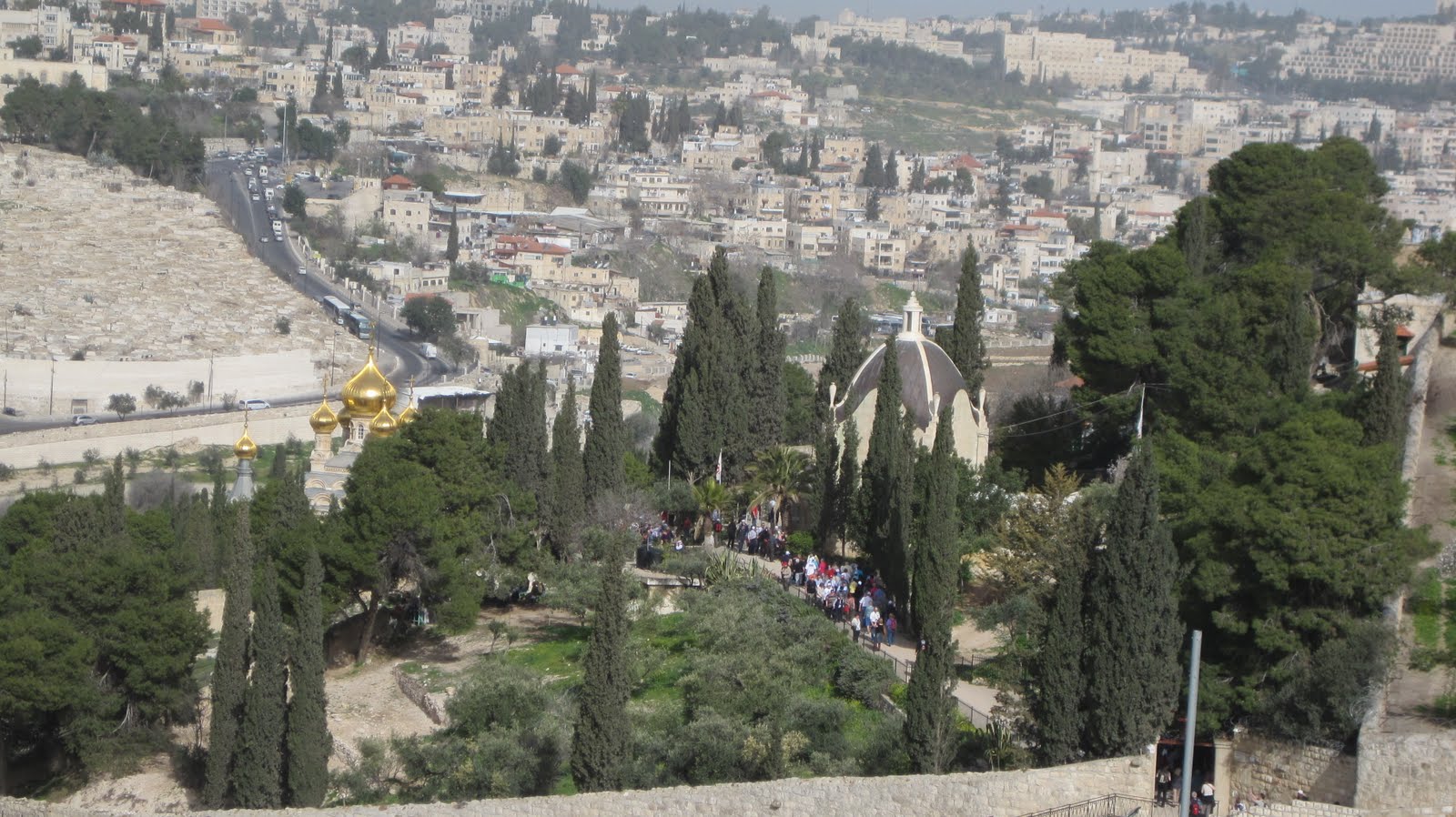
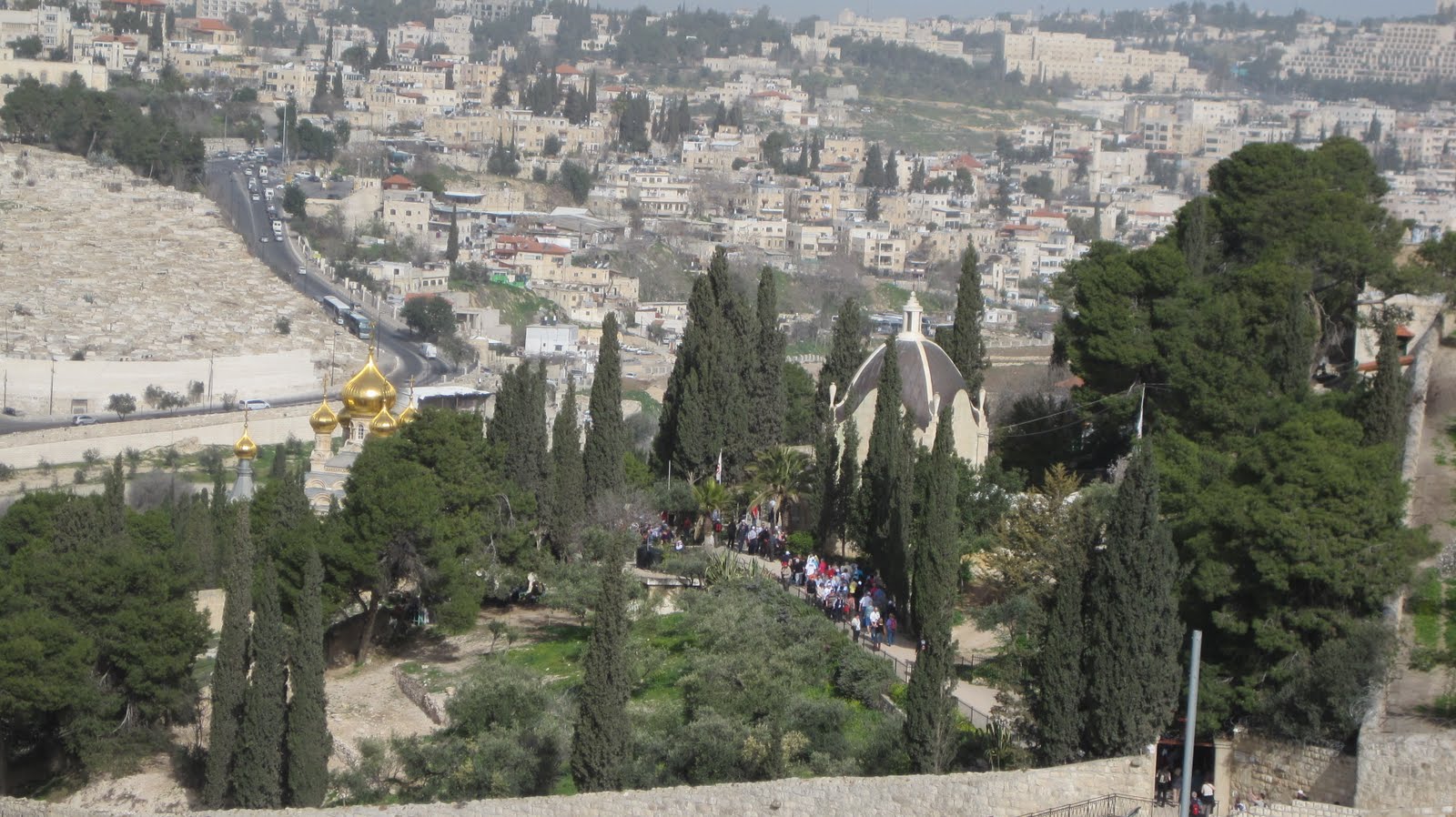
The Palm Sunday Road
Taken February, 2010

Most of us love the Palm Sunday passage.  We like waving our palms and processing into the sanctuary as we did this morning.  We like being a part of this Hosanna crowd.  But this is no ordinary parade.  Winding down the narrow Palm Sunday Road from Mt. Olivet through the Garden of Gethsemane, there is no room for bystanders, no room for those of us that want to just see it and then sneak off through the olive trees.  The road is steep and propels us forward toward the Eastern gate of the city.

In their book “The Last Week”, Marcus Borg and Dominic Crossan, contend that this was one of two parades.  The other was a grand and glorious Roman royal military parade coming into the Western gate.   The juxtaposition of these two processions would have set up quite a contrast.  Once came as an expression of empire and military occupation whose goal was to make sure oppressed people did not find deliverance.  It approached the city using horses, brandishing weapons, proclaiming the power of the empire.  The other procession, using a donkey and laying down cloaks and branches along the road, was coming quietly, profoundly proclaiming the peaceful reign of God.  Their contention is that our whole Palm Sunday “celebration”, as we call it, was a parody of the world as we know it, a satirical reminder that we are different.

Now whether you adhere to the notion of the two parades or not, I think it’s a powerful reminder to us what this processional of palms really meant.  Jesus had already made a name for himself from even as far away as Galilee.  But this was the city, the bustling intersection of Roman occupation and religious doctrine.  And when Jesus entered through the Eastern gate with his funny little entourage brandishing palms, even that was proclaiming blasphemous ideals (because remember that it had been prophesied that the Messiah would enter through the Eastern Gate, also known as the Messiah’s Gate and the Golden Gate).

Then he brought me back to the outer gate of the sanctuary, which faces east; and it was shut. The Lord said to me: This gate shall remain shut; it shall not be opened, and no one shall enter by it; for the Lord, the God of Israel, has entered by it; therefore it shall remain shut. Only the prince, because he is a prince, may sit in it to eat food before the Lord; he shall enter by way of the vestibule of the gate, and shall go out by the same way.  (Ezekiel 44: 1-3)

Street in Jerusalem
Taken February, 2010

So once they had entered this gate, this “parade” that we celebrate would have been on a clear collision course with power and might and the way things were in the world.  Once they had walked into the city, these two worlds, these two ways of being, would have collided.  It is easy for us to stand on the side and wave our palm branches but Palm Sunday thrusts us into something else.  It is an intersection of Galilee and Jerusalem, of Jesus’ ministry and Jesus’ Passion, of establishment and holy rebellion, of the ways of society and the Way of Christ.  This Palm Sunday processional, if we stay with it, thrusts us into Holy Week.  That is the reason that this is known as Palm / Passion Sunday.  You cannot disconnect the two notions.  This Way just keeps moving.  Where are you in the crowd?  The Way of Christ has turned toward the Cross.  Will you follow or go back to what you were doing?

On this day we joyously follow the crowd
Palms in hand and praises fair
Unaware that just inside the city gate
Worlds collide and tempers flare.
And we are faced with the choice
Between silent acquiescence and faith portrayed
For one will pacify the world we know
And one will take us farther along Christ’s Way.


As we enter this holiest of weeks, we must decide whether or not to follow.

Grace and Peace in Holiest of Weeks,

Shelli

Looking for a Miracle

Scripture Passage:  Matthew 12: 38-42
Then some of the scribes and Pharisees said to him, ‘Teacher, we wish to see a sign from you.’ But he answered them, ‘An evil and adulterous generation asks for a sign, but no sign will be given to it except the sign of the prophet Jonah. For just as Jonah was for three days and three nights in the belly of the sea monster, so for three days and three nights the Son of Man will be in the heart of the earth. The people of Nineveh will rise up at the judgement with this generation and condemn it, because they repented at the proclamation of Jonah, and see, something greater than Jonah is here! The queen of the South will rise up at the judgement with this generation and condemn it, because she came from the ends of the earth to listen to the wisdom of Solomon, and see, something greater than Solomon is here!

It is interesting that there are really no “Holy Saturday” Scriptures, per se.  The Lectionary readings jump to the passages that will be used this evening for the Easter Vigil as we hear again the covenants, God’s promises of a world made new.  But what about this morning?  There are no words for the way we feel.  There are no Scriptural or theological platitudes that we can toss around this day to feel better.  There are not even any pictures.  The sun came up just like it normally does and everything looks the same.  Everything, that is, except the empty chair at the table, the missing voice of a teacher, and the closed tomb waiting for the Sabbath to pass so that we can do our work.  The world is still waiting for a sign, waiting for a miracle. But there will be no calming of waves of grief this time; there will be no healing of our pain; and a quick peak shows only tepid water in the jars.  There is no wine this time.  There will be no sign.  The miracle this time is that there will be no miracle.  God, it seems, has finally left us to ourselves.

Perhaps the reason that there was no miracle is that the world itself had changed.  The New Creation had begun.  We were just too wrapped up in our grief and our despair and some of us in our guilt and shame to see what God had begun to do.  The traditional Apostles’ Creed says that Jesus “descended into hell” after the Crucifixion and before the Resurrection.  Most mainline churches (at least of the ones that still choose to even say the universal creeds!) respectfully or regretfully or embarrassingly leave that part out. After all, what does that mean?  Hell is for those who have no hope; hell is the finality of being so bad that you cannot be redeemed, right?  How can Jesus go to hell?  How can the Son of God, the Messiah, wander around and be seen in a neighborhood like that.  It’s just not right. 


Maybe the miracle is that hell and heaven, just as humanity and the Divine, were somehow poured together for all eternity.  Maybe the miracle is that God has now come so close to us that there is no longer a place that we can go without God being there with us, whether or not we can sense that.  Maybe the miracle is that hell, itself, like death, is no more. Maybe the miracle is that we no longer need a miracle.  Because, my friends, we have been promised life.


Jesus laid out what would happen earlier this week.  In the Lectionary Passage from Holy Tuesday (John 12: 20-36), Jesus depicted the events of this week-end as the Christ being “lifted up” and then “gathering all in”.   Now everyone knows that when you begin gathering something, the first sweep starts at the bottom.  You extravagantly dig deep, trying to get everything you can on the first pass.  Maybe on this morning as we grieve and regret and wonder what life will be, God through Christ is digging deep into the bowels of hell and extravagantly gathering them in.  Jesus descended to earth that we might be shown the Way, that we might know what Life means, that we might be redeemed, renewed, and recreated and then be poured over with Light.  Jesus descended to earth that we might be “gathered in”.  Why, then, couldn’t the Lord of Life, descend further, descend beyond where we even thought God could go, and do the same thing?  After all, who are we to say how big or how loving or how extravagantly welcoming God is?


Are you looking for a sign?  There is no need for one.  There is no more need for miracles, no more need for one-time, unique “fixes” to Creation.  It’s ALL being recreated.  Even God can begin again.  But THIS time, God desires not to do it alone.  THAT is the miracle.


In the silence of this day, feel your grief and mark your shame, knowing that the dawn of life is there even for you.  And once the Sabbath passes, we, too, can begin our work.

For thine is the Kingdom, and the Power, and the Glory forever.  Amen.

Grace and Peace on this Holiest of Gathering Days,

Shelli

Friday

Today’s Gospel Passage:  John 19:  16-18, 28-30
Then he handed him over to them to be crucified.  So they took Jesus; and carrying the cross by himself, he went out to what is called The Place of the Skull, which in Hebrew* is called Golgotha. There they crucified him, and with him two others, one on either side, with Jesus between them…After this, when Jesus knew that all was now finished, he said (in order to fulfil the scripture), ‘I am thirsty.’ A jar full of sour wine was standing there. So they put a sponge full of the wine on a branch of hyssop and held it to his mouth. When Jesus had received the wine, he said, ‘It is finished.’ Then he bowed his head and gave up his spirit.

This is the day when Christianity is at its lowest point.  Most of us 21st-century believers like to err on the side of hope, running quickly through these hours, knowing that the Easter dawn is soon appearing.  But I think we do ourselves, not to mention Jesus, a disservice by not looking at this day even without the promise of the Easter feast.

Tradition holds that after the debacle in the garden, Jesus was taken to the House of Caiphas.  It was a fine house right on the edge of the city walls.  There he was thrown into a lower room, a dungeon, if you will, where he spent the night.  This Jesus of Nazareth, the Incarnate Word, who had drawn wise kings and lowly shepherds, who had impressed the high priests of the Temple, who had taught and healed, who had welcomed the outcast and debunked the presumed “in” crowd, who had calmed the storms and raised the dead, who had committed body and blood and had washed the feet of his friends…this was the man who sat alone knowing this night would be his last.

And then in the morning, he was rushed through a facade of a trial and a paltry sentencing, paraded through the streets of the holiest of cities, as he was forced to carry the cross on his back.  But lest we think this was some big deal, life continued to go on.  It was just another Roman execution in a city wrought with polarization and distrust.  The vendors were out that morning selling their wares.  The politicians were out making sure that everyone knew that they had something to do with ridding the community of one who spoke against normalcy and reason, against those who knew best, one who was touted as the Messiah.  And there were others there that felt helpless–a woman who Jesus had healed, the crying women that knew him, his own mother.  No one could do anything.  There was a simple man from Cyrene that carried his cross for a few yards.  After all, it was the least he could do.

And then, we are told, he was lifted up and tacked on to the cross like a haphazardly-strewn note that we tack on to our door.  There was no remorse; there was really no pompous display; there wasn’t really even a show.  Jesus was nailed to the cross as a common and everyday criminal, a bother, really, to sophisticated and proper society.

He breathed his last breath and willingly and intentionally gave up his spirit to the One who created him.  He was gone forever, laid in a Holy Sepulchre, a permanent tomb.  The world would go back to the way it was.  All was quiet.

But then the thunder roared and the clouds covered the light even though it was in the middle of the day.  The earth shook as if Creation’s very core was breaking.  And the temple curtain, the only thing that had for so long separated the holiest of holies from the boundaries of humanity and the earth on which it walked, was torn in two with a violence that no one could imagine, as if in that moment, the Divine had somehow spilled into the earth even as the Son of Man had poured himself into the Divine.

Nothing would ever be the same again.  And when the light finally dawns, we will realize that the earth, that all of humanity, that even God has forever changed.  God took death away and in its place put life and since life can only exist with God, God is here forever.

Easter will dawn, but the light will only serve to illumine what has happened this day, for on this day, Creation has happened again.

Grace and Peace,

Shelli

Gethsemane

Today’s Gospel Passage:  John 13: 1-17, 31b-35
Now before the festival of the Passover, Jesus knew that his hour had come to depart from this world and go to the Father. Having loved his own who were in the world, he loved them to the end. The devil had already put it into the heart of Judas son of Simon Iscariot to betray him. And during supper Jesus, knowing that the Father had given all things into his hands, and that he had come from God and was going to God, got up from the table, took off his outer robe, and tied a towel around himself. Then he poured water into a basin and began to wash the disciples’ feet and to wipe them with the towel that was tied around him. He came to Simon Peter, who said to him, “Lord, are you going to wash my feet?” Jesus answered, “You do not know now what I am doing, but later you will understand.” Peter said to him, “You will never wash my feet.” Jesus answered, “Unless I wash you, you have no share with me.” Simon Peter said to him, “Lord, not my feet only but also my hands and my head!” Jesus said to him, “One who has bathed does not need to wash, except for the feet, but is entirely clean. And you are clean, though not all of you.” For he knew who was to betray him; for this reason he said, “Not all of you are clean.” After he had washed their feet, had put on his robe, and had returned to the table, he said to them, “Do you know what I have done to you? You call me Teacher and Lord—and you are right, for that is what I am. So if I, your Lord and Teacher, have washed your feet, you also ought to wash one another’s feet. For I have set you an example, that you also should do as I have done to you. Very truly, I tell you, servants are not greater than their master, nor are messengers greater than the one who sent them. If you know these things, you are blessed if you do them…“Now the Son of Man has been glorified, and God has been glorified in him. If God has been glorified in him, God will also glorify him in himself and will glorify him at once. Little children, I am with you only a little longer. You will look for me; and as I said to the Jews so now I say to you, ‘Where I am going, you cannot come.’ I give you a new commandment, that you love one another. Just as I have loved you, you also should love one another. By this everyone will know that you are my disciples, if you have love for one another.” 

The meal was one of those moments that we wish we could freeze in time.  Everyone was happy, enjoying each other.  Jesus washed the feet of the disciples, the most intimate of acts.  It proved to be the beautiful epitaph of his servant’s heart, the gift of all gifts on a night that probably only he knew would be his last.  They ate and drank together, honoring the tradition of the Passover, remembering how God had delivered them from bondage, from those things that were not part of them, those things that did not fit with their identity as the people of God.  And at the meal, Jesus broke the bread and gave each one a piece, inviting them to share it with him.  And then he raised the cup…This is my body…This is my blood…Eat…Drink…Do this in remembrance of me.  Do this in remembrance of how God delivers you from bondage to those things that are not part of you.  There were others there…the clattering of dishes…the clanking of cups…the voices raised above the heat of the room.  And yet, somehow they thought it was just them.

And then Jesus gets up to leave and asks them to come.  Let’s take a walk…let’s stroll through the cool night air.  It was one of those moments that we wish we could freeze in time…They walked toward the olive grove…Gethsemane, which means “oil press”, at the foot of the Mt. of Olives.  Jesus went to pray.  Well, we’ll just close our eyes and relax…He will be back in a moment.

I don’t think Jesus took them there because they were ready to hear what would happen.  I don’t think he took them there for support.  I don’t even think he took them there because he thought they would pray with him or something.  I think he took them there so that they would be part of the story, so that these moments that would become part of Jesus would also be part of them.  This was a holy place.  It probably didn’t look like it.  It really was just a bunch of dirt and grass with some olive trees stuck in them.  And it was cold as the damp night air settled in.  But it was here, in a moment frozen in time, that Jesus turned himself over to God.  “Take this cup from me”…not “get me out of this”, but “Take this cup from me”…the cup that he had shared with his friends…the cup that represented his body and his blood and the very essence of his being that he was willing to surrender, to pour out into the world.  “Take this cup from me”…it is time…a moment frozen in time…there is nothing more to do but for Jesus to pour his life into the world, whether or not they are ready, whether or not they even know it.  Father…forgive them…and “take this cup from me now”.

He returned to the sleeping disciples, the bumblers and the doubters, the deniers and the social climbers, the ones who were slow to get it and the one who would betray him.  He loved them all.  And now…they, too, must take the cup.

And in a flash, the frozen moment melts with a kiss of betrayal.  The cup spills into the crowd and Jesus is taken away.  The disciples are stunned.  What now?  What happened?  The world has moved on, but there was that moment…forever frozen in time.

On this holiest of nights, whether you are the sleeper, or the denier, or the betrayer, know that you are also the beloved…a daughter or son of God.  “Take this cup from me now”.

Grace and Peace,

Shelli

Wishing to See Jesus

Today’s Gospel Passage:  John 12: 20-36
Now among those who went up to worship at the festival were some Greeks. They came to Philip, who was from Bethsaida in Galilee, and said to him, “Sir, we wish to see Jesus.” Philip went and told Andrew; then Andrew and Philip went and told Jesus. Jesus answered them, “The hour has come for the Son of Man to be glorified. Very truly, I tell you, unless a grain of wheat falls into the earth and dies, it remains just a single grain; but if it dies, it bears much fruit. Those who love their life lose it, and those who hate their life in this world will keep it for eternal life. Whoever serves me must follow me, and where I am, there will my servant be also. Whoever serves me, the Father will honor. “Now my soul is troubled. And what should I say—‘Father, save me from this hour’? No, it is for this reason that I have come to this hour. Father, glorify your name.” Then a voice came from heaven, “I have glorified it, and I will glorify it again.” The crowd standing there heard it and said that it was thunder. Others said, “An angel has spoken to him.” Jesus answered, “This voice has come for your sake, not for mine. Now is the judgment of this world; now the ruler of this world will be driven out. And I, when I am lifted up from the earth, will draw all people to myself.” He said this to indicate the kind of death he was to die. The crowd answered him, “We have heard from the law that the Messiah remains forever. How can you say that the Son of Man must be lifted up? Who is this Son of Man?” Jesus said to them, “The light is with you for a little longer. Walk while you have the light, so that the darkness may not overtake you. If you walk in the darkness, you do not know where you are going. While you have the light, believe in the light, so that you may become children of light.” After Jesus had said this, he departed and hid from them.

Well, don’t we all…wish to see Jesus, I mean.  What does that mean?  What exactly did those Greeks want?  I’m guessing that they didn’t want a leader.  They had those.  And the Greeks are usually known for being pretty well educated, so I think a claim that they wanted Jesus to teach them something is probably questionable at best.  And I’m sure they had their own friends.  What did they mean?  My guess is that they wanted what all of us want.  They wanted proof.  They wanted it to make sense.  They wanted something more.
 

Nothing has really changed.  That’s what we all want.  We want proof.  We want it to make sense.  We want something more.  We wish to see Jesus.  But we want it on our own terms.  We want proof without doubt; we want sensibility without mystery; and we want something more but only if it doesn’t cost us anything.  So, Jesus, where are you?  Why can’t we see you?
 
This passage is hard.  I preached it yesterday and probably made a B- at best.  You see, the tide has turned.  Jerusalem is there before us.  The problem is that we’re supposed to believe without faltering in the cross. We look at that big gleaming cross in the front of the sanctuary.  We see them on the doors to the church and on the sign outside.  Good grief, we even hang them around our necks. But, contrary to what most of Christianity holds out there as “belief”, I don’t think we were meant to worship the cross.  We were meant to worship God, to hunger and thirst in the deepest parts of our being to encounter God.  Well, we can’t see God.  If we could there’d be no need for faith.  But we can see Jesus, the One who points the Way to God.  But this Jesus is more than a leader.  He is more than a teacher.  Jesus is the One on the Cross.  And at that moment, God does something incredible.  God takes the worst of this world, the worst of humanity, the worst of proof or sensibility, at a cost that no one can fathom…and recreates it.  In that moment on the Cross, God takes the worst of us and the best of God and reconciles them, redeeming us into God, pouring the Divine into humanity for all time.
 
But to see Jesus, we have to be there.  Where were you….?, the song asks.  There…there with Jesus…there with God…all of us together.  But to be there, you have to leave your life that you’ve created behind.  You have to leave your attachments, your wealth, your images of what and who you worship behind.  There is not room for all of that on the Cross.  (After all, God is REALLY big!)  You have to surrender all that you are so that you can become all that you should be.  But you have to do it standing at the Cross.  And there…there He is…there’s Jesus.
 
Go in Peace as you Journey to the Cross,
 
Shelli

The Palm Sunday Road

Today’s Gospel Passage:  Luke 19: 28-40

After he had said this, he went on ahead, going up to Jerusalem…As he rode along, people kept spreading their cloaks on the road. As he was now approaching the path down from the Mount of Olives, the whole multitude of the disciples began to praise God joyfully with a loud voice for all the deeds of power that they had seen, saying, “Blessed is the king who comes in the name of the Lord! Peace in heaven, and glory in the highest heaven!” Some of the Pharisees in the crowd said to him, “Teacher, order your disciples to stop.” He answered, “I tell you, if these were silent, the stones would shout out.”

We like the idea of a parade.  We like being part of a celebration, part of the winning crowd.  This day is glorious.  Jesus winds down the road from the Mount of Olives toward the garden.  Everyone is cheering and shouting.  This is the way it should be.  So we throw our cloaks on the road in front of him.  We want to be part of the crowd.  The cheering is louder and louder.  We are going to take the city by storm.

The problem is that we like the celebration a little too much.  When the crowd begins to quiet and drift away, we follow them.  We were never really part of it at all.  We were really just mere bystanders enjoying the show.  And when the show ends as the road turns toward Jerusalem, we lose interest.  We drift away, now cloaked in silence.

Jesus never meant to be the star of a parade or the honoree at a celebration.  He really could have cared less whether or not we threw our cloaks on the ground in front of him.  I think what he really wanted was for us to finish the journey.  He wanted us to follow.  But instead we drifted away in silence.  And we left it to the stones to shout.  The road that we journey this week is not easy.  It is steep and uneven.  And the shouting stones and clanging iron against wood will be deafening.  But this is the way to peace; this is the way to glory.  Do not leave yet.  Instead, leave your cloak on the road and walk over it yourself.  Follow Jesus.  The road has not ended. 

Into the city I’d follow the children’s band, waving a branch of the palm tree high in my hand; one of his heralds, yes, I would sing loudest hosannas, “Jesus is King!” (From “Tell Me the Stories of Jesus”, William H. Parker)

Grace and Peace,

Shelli

When Nothing Else Makes Sense

A Good Friday Sermon…

Lectionary Text: John 18: 1-19:42

This is the road that we have all walked before. Most of us would rather not. We would rather just close our eyes and wake up when the whole awful thing has ended. We would rather open our eyes and see that everything is alright or, even better, back where it used to be. This is grief. We have all experienced it. We have all felt loss and despair; we have all felt as if the very foundations of our world have been ripped away and left us standing to fend for ourselves. We have all felt at times like the abyss in which we find ourselves is consuming us and that there is no way out. And grief is the one thing that does not get easier each time you do it. Each time cuts a little sharper and a little deeper until nothing of our lives make sense in light of the way it was before. This is the road we walk when nothing else makes sense.

The road we walk today is no different. Oh, perhaps it seems to be, because intellectually we already know the ending to the story. But it is grief nevertheless. We sit here in this darkened sanctuary contemplating what was done on this day. We can hear the sounds of a world going about its business. That’s always a bit odd for me. There’s a part of me that expects the world, if only for a moment, to stop and grieve my grief, to revere what I revere, and to feel this in the same way that I do. But that does not happen. It is mine to feel and mine through which to walk.

If we are feeling this today, can you imagine what the disciples must have been feeling? They were on the ground floor of something wonderful; they were part of changing the world. This radical roving man who they had agreed to follow for life was doing something incredible! What was happening now, though? Was it only five days ago that we came to town? Was it only five days ago that we were at the height of these years—processing into town with all those people cheering us on? Was it just last night that we were eating dinner together? And, now this? What went wrong? Surely this would turn out alright! After all, this man works miracles! But there was to be no miracle this time.

Their grief was insurmountable. And, around them the world was continuing on. We as followers of Jesus ourselves have this sense of this execution being a big deal, as if the whole of Jerusalem and surrounding areas shut down for the day to be a part of it. But the truth was, this happened all the time. This was just one more Roman crucifixion in the life of a city that lived in perilous and often tenuous times on the world stage. And, so the life around them did not stop. And they had to face their grief in the midst of it all.

And at this point, they had to also look at themselves, uncomfortable as that may have been. What part had I played in this whole sequence? What would I do now? And we 21st century disciples also have to ask where we would be in the story. There was Peter, wallowing in guilt for not standing up for his friend, for denying his own belief. He had wanted so badly to be part of Jesus’ “inner circle”. But why couldn’t he come through when it mattered? There were the fishermen James and John. They had willingly followed Jesus, giving up everything they knew. What would they do now? Jesus was their everything. What about Mary Magdalene? Jesus was the first person that had accepted her, that had loved her simply for who she was? And now that was gone. And Judas…Judas carried the heaviest grief of all. He didn’t know whether or not he could live with himself. The very foundations of their world were gone as they watched their whole world nailed to a cross and slip away. None of this made any sense at all.

We Christians have spent centuries trying to make sense of the cross, perhaps even trying to take our own humanity and our own part out of the equation. The truth is that Jesus was put to death because we as humans expected something different. It was humans who took control and did this. But there are more theories of the cross and its atoning power than most of us will ever fathom. It has been described by some as a cosmic battle between good and evil, a battle that God seems to lose at first only to pull it out in the end. Then there is the belief that the cross depicted God’s love in such that we humans might be compelled to follow in faith. And there are those for whom the cross is the satisfaction paid to God for the sins of the world, a substitution of the redeemer for the sinful, implying that God somehow demands a ransom in order to release our redemption and salvation. In all honesty, I struggle with all of these. In fact, none of them by themselves really makes sense to me.

It seems, to me that the cosmic battle takes humanity out of the picture, relegating us to bystanders. If there is no humanity associated with the cross, what, really is the point? And while the notion of God’s love depicted by the cross is of paramount importance to us, if we leave it there, it sort of turns it into an overly sentimental description of the incredible mystery and power of God. Is that all there is? And, probably the most popular understanding in our history, the understanding of the cross as a satisfaction paid to God for our sins does not really make sense for me. Think about it. God created us in the image of Godself. It would not make sense, then, for God to have to be talked into loving us. True redemption is not a required sacrifice, but an act of overwhelming love by God who desires us as much as we need God. It is we humans that try desperately to come up with a reason for the cross, with a reason for Jesus’ death. Perhaps there was no reason. Perhaps God truly took the senseless, the inhumanness of our humanity, and made sense of it.

Truthfully, though, there is no single understanding of the cross that has been accepted by everyone. None of them are mutually exclusive. And none, alone, really make sense of something that is so filled with the pervasive mystery of God. In a way that sometimes makes little sense to us, God turned suffering into joy, betrayal into forgiveness, and death into life. From that standpoint, the cross, for me, could be counted as God’s highest act of Creation in all of time. The cross is God’s overwhelming love made tangible and real and accessible for each of us.

God took something so horrific, so senseless, so utterly inhumane, and so personally painful and recreated it. But when you think about, God had done that before. If you remember, in the beginning, there was nothingness, senselessness and God created all that there is, bringing order to the senselessness. And it was very, very good. And now, at the depth of our grief, in the face of what seems to us senseless, God once again creates life. And once again, all of Creation responds. Other Gospel writers depict the Crucifixion by saying that the whole earth shook, rocks were split, graves opened and the temple curtain that had always separated the sacred from the ordinary was torn in two. As the earth opened up, surely seeming to the world that Creation was undoing itself, the holiest of holies spilled into it. In this moment, when all we see are endings, when grief overwhelms us, when our very lives seem to have been swallowed up, God recreates everything. In this moment, the universe has changed. Death is not just avoided or bypassed but is indeed swallowed up by life. In this moment, death itself is defeated. And God looked at it all. It is finished. And it is very, very good.

There’s still a lot in this world that doesn’t make sense. September 11, 2001 still clangs loudly in our hearts, with its almost jarring effects of despair and hopelessness, suffering and death, and its intrusive way that it has affected our well-tuned and carefully planned lives. Communities were devastated, lives were shattered, and the pall of an incredible hopelessness still to some extent hangs in our hearts over Ground Zero.

Like many other landmarks around it, the Liberty Community Gardens in Battery Park were almost totally destroyed on that day, buried in dust and ashes. What was left was later trampled by the hundreds of workers and then finally destroyed when it was designated as the place where the smashed fire trucks and rescue vehicles would be temporarily discarded.
But more than 2,800 miles away, there were some 75,000 people in the city of Seattle who responded to their own shock and sadness of that day by bringing more than a million flowers to the International Fountain in the Seattle Center. By depositing beauty, it was their way of honoring those who had suffered in the devastation. It was there way of creating something new. But we know that we cannot hold life in our hands. And so as the flowers started to decay, echoing their own tales of death and stench and despair, hundreds of volunteers began the painstaking effort of separating the flowers from the paper, plastic, mementos, and wires that were mixed with them and then chopped and mashed the 80 cubic yards of flowers into mulch for composting.

If you garden at all, you know that compost is a metaphor for renewal, a natural part of life and death, a reminder of new hope gained from loss. It is a reminder of rebirth and recreation. From the sadness of the twin towers, was birthed a source of life.

But the story doesn’t end there. One of the volunteers had an idea. And so, in September of 2002, a year after the desolation of the Battery Park Gardens, thirty-two donated boxes were each filled with forty to fifty pounds of the compost and flown to New York City. And on September 28, 2002, the New York gardens were rededicated—to abundance and beauty, and to a future life recreated from present death. Things will never be back to the way they were before, but God has sown the beginning of something new. But we had to wait to see it in all its fullness.

We had always envisioned a Savior that would make the world around us alright again. Instead God in Christ began recreating the world into that which it is supposed to be. That, of course, is hard to grasp as we stand at the foot of the cross watching our Lord writhe in pain and despair. But Jesus Christ came as fully human, with all of the feelings and emotions that we experience. Christ knew what it was like to be human, knew what it was like to feel pain, and knew what it was like to grieve. It is tempting to ask where God was through all this. God was there. God went to the cross first.

After the Crucifixion, this defeated little band of disciples had no hope. As you can imagine, they had no expectation of anything else to come. Everything in which they believed, in which they had invested their lives, had died on the cross. It seemed to them that the world had been right and they had been wrong. Joan Chittister says that “the road behind us becomes what frees us for the road ahead.” In this moment, God was already freeing them from grief and recreating joy.

And us…there is something in all of us that struggles with the thought of God suffering. We instead imagine a God that stands apart from us, shielded from pain, and prepared to pick up the pieces of our lives when we need it. But God, in God’s infinite wisdom rather recreates our lives from the inside, from the point of our deepest pain and suffering, from the cross, and even we become new Creations whether or not we can see it now. The cross is the rebirth of humanity in all its fullness. In this moment, it is death that dies.

It is hard for us to see right now. It is hard to see clearly through the tears of grief. Christ died on a cross in immense suffering and pain. And those who love him grieve a grief such that they have never known. As we sit here in this dark sanctuary and listen to the bells toll, we will once again feel the finality of it all. But Louis L’Amour once wrote that “there will come a time when you believe everything is finished. That will be the beginning.” And just when nothing else makes sense, it is in that moment that your eternity has begun.

In the Name of Christ Crucified, in the Name of overwhelming Love.

Grace and Peace,

Shelli