ADVENT 4B: ‘Bout Time We Start Dancin’!

Lectionary Text: Romans 16: 25-27
Now to God who is able to strengthen you according to my gospel and the proclamation of Jesus Christ, according to the revelation of the mystery that was kept secret for long ages but is now disclosed, and through the prophetic writings is made known to all the Gentiles, according to the command of the eternal God, to bring about the obedience of faith—to the only wise God, through Jesus Christ, to whom be the glory forever! Amen.

In this Fourth week of Advent, we read this doxology along with the imminence of Jesus’ birth.  Read alongside the story of Mary as God-bearer, we have the sense that the full Gospel is starting to unfold.  This is in no way a “replacement” for the Law of Moses; it is that Law seen to its fulfillment in the new humanity, the new Adam, in Jesus Christ.  Gentiles have been “grafted” into a story that was already taking place, already in full swing.  This is nothing new.  It is, rather, the doxology.  For Paul, HIS gospel was the “unveiling” of something that had been around from the very beginning.

Scholars think that it is quite possible that Paul did not write these verses but that they were attached to the end of the letter perhaps AS a doxology, a statement of praise and proclamation.  But regardless of who wrote it, this is a statement of response.  It is, to use Paul’s words, an “obedience of faith.”  The Incarnation of God in Jesus Christ invokes our response; otherwise it is virtually meaningless.  In Feasting on the Word, Cathy F. Young quotes Helmut Thielicke when he says, “Faith can be described only as a movement of flight, flight away from myself and toward the great possibilities of God.”  The whole gospel in its fullness is about our response.  It is our faith that moves it and opens up the possibilities that God envisioned.

Advent is about letting ourselves envision what God envisions and then moving toward it.  Because into this world that often seems random and meaningless, full of pain and despair; into this society that is often callous and lacking of compassion, directionless and confused; into our lives that many times are wrought with grief and a sense that it is all for naught; into all of it is born a baby that holds the hope of the world for the taking.  We just have to be open and willing to take it.  The great illustrator and writer, Tasha Tudor said, “the gloom of the world is but a shadow.  Behind it, yet within our reach, is joy.  Take joy!”  This is what this doxology says:  All of this that has been laid out for you, all of this that has been created; all of this that has for so long been moving toward your life, take it.  Take joy!  Tomorrow will be your dancing day!

I love Christmas Eve at St. Paul’s.  I actually don’t know how to explain it.  It’s magnificent; it’s magical; it’s mystery.  It’s like nothing you’ve ever experienced before. It moves you into someplace that you have not been before.  It takes you out of yourself and gives you a glimpse, albeit a tiny, tiny glimpse, of what it’s all about, of why we’re here, of that to which we journey.  This will be my eighth year to participate in the processional that winds through the nave, encompassing everyone who is there in music and candlelight and incredible joy.  I say processional because, even though it comes toward the end of the service, it leads us to something more.  It leads us to our response.  It brings me to tears.  (I will say that in these last seven years, I have been brought to tears each year–six because it has moved me beyond myself and the seventh because, I have to tell you, Gail caught Emily’s hair on fire with her candle and had to hastily put it out with her bulletin.  Thankfully, Emily had very little hair product on her hair that night!  We were laughing so hard we couldn’t even see where we were going!  (See, you just don’t know what will happen when you let us loose!)

But the point is that this is our way of taking joy, of connecting to the mystery of the God who came and comes. Often, our choir will sing an Old English carol that I have grown to love (in fact, let it be known, that I want it sung at my funeral!)  because it is a song of joy, a song of deep abiding love.  It is the song that we should all be singing.  It is our invitation to joy.  The song itself is more than a carol.  It has additional verses (although some are extremely anti-semitic).  It tells the story of Jesus’ life, the Gospel, the Good News–the birth, the life, the death, the life.  It is the Song of Joy and our invitation to join in!      

Tomorrow shall be my dancing day; I would my true love did so chance

To see the legend of my play, to call my true love to my dance;

Sing, oh! My love, oh! My love, my love, my love, this have I done for my true love.

Then was I born of a virgin pure, of her I took fleshly substance

Thus was I knit to man’s nature, to call my true love to my dance.

(Refrain)

In a manger laid, and wrapped I was, so very poor, this was my chance
Betwixt and ox and a silly poor ass, to call my true love to my dance.

(Refrain)

Traditional English Carol
OK, the time is not here yet, but don’t you think it’s ’bout time we start dancin’?  Somehow our world has taught us to hold back, to not “count our chickens before they’re hatched”, to be reserved.  But God?  God just wants us to start dancing so that everyone else will join!
 
In this season of Advent, give yourself the gift of taking joy, of realizing what God holds for you, of dancing the dance to which you’ve been invited!  Let tomorrow be your dancing day!

Grace and Peace,

Shelli

Putting On Shoes


God became human.  Well, sure, God can do that if God chooses, but why?  Why would the Divine CHOOSE to become human, CHOOSE to live a life that includes suffering and fear, CHOOSE to live in this imperfect world?  It just doesn’t make a whole lot of sense.  I suppose it’s part of that mystery thing.  And the truth is, we struggle with it.  We try to justify it.  You’ve heard it all before:  “God was the perfect human,” “God was only posing as a human,” or “It was part of God’s plan.”  Really?  God PLANNED to be born into poverty, PLANNED to be born into an oppressive society, PLANNED to struggle, PLANNED to be disliked, and PLANNED to die?  I don’t really know if that was all part of God’s plan or not.  Is it so hard for us to accept that God just CHOSE to be one of us?  After all, part of being human is being subjected to a certain randomness of order, to a life that, as hard as it is for us to imagine, is beyond our control, and to not only the free will of ourself, but also the free will, the choice to do right or do wrong, that others around us have. Being human means that not all of life is a predictable pattern, not all of life is planned.  But, nevertheless, God became human.  After eons and eons of trying to get our attention, God put on shoes and walked with us.

“Incarnate” literally means “taking on flesh.”  It means becoming tangible, real, touchable, accessible.  It means becoming human.  It means putting on shoes. In the book Everything Belongs, Richard Rohr calls it God’s “most dangerous disguise.”  After all, taking on flesh, becoming tangible, becoming real, touchable, accessible also makes one vulnerable and that is incredibly dangerous.  God put on shoes to show us how to be vulnerable, to show us how to give up a piece of ourself and open ourself to the Divine.

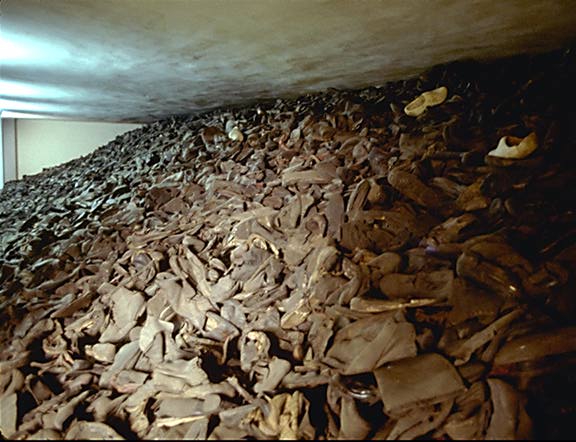
The Shoe Heap, Auschwitz, Poland

More than a decade ago, I had the opportunity to visit Auschwitz, Poland.  I expected to be appalled; I expected to be moved; I expected to be saddened at what I would fine.  I did not expect to become so personally or spiritually involved.  As you walk through the concentration camp, you encounter those things that belonged to the prisoners and victims that were unearthed when the camp was captured–suitcases, eye glasses, books, clothes, artifical limbs, and shoes–lots and lots and lots and lots of shoes–mountains of humanity, all piled up in randomness and namelessness and despair.  This is humanity at its worst.  This is humanity making unthinkable decisions about one another based on the need to be in control, based on the need to be proved right or worthy or acceptable at the expense of others’ lives, based on the assumption that one human is better or more deserving than another.

And yet, God CHOSE to be human.  God CHOSE to put on shoes, temporarily separating the Godself from the Holy Ground that is always a part of us, and entering our vulnerability.  God willingly CHOSE to become vulnerable and subject to humanity at its worst.  But God did this because beneath us all is Holy Ground.  God came to this earth and put on shoes and walked this earth that we might learn to take our shoes off and feel the Holy Ground beneath our feet.  God CHOSE to be human not so we would learn to be Divine (after all, that is God’s department) but so that we would learn what it means to take off our shoes and feel the earth, feel the sand, feel the rock, feel the Divine Creation that is always with us and know that part of being human is knowing the Divine.  Part of being human is being able to feel the earth move under your feet, to be vulnerable, to be tangible, to be real, to take on flesh, to be incarnate.  Part of being human is making God come alive.
  
In this season of Advent, give yourself the gift of being human, being vulnerable, and knowing the God who is Divine. Take off your shoes and feel the earth move under your feet.  God is coming!  The earth is beginning to move!

Grace and Peace,

Shelli


ADVENT 4B: The House of God

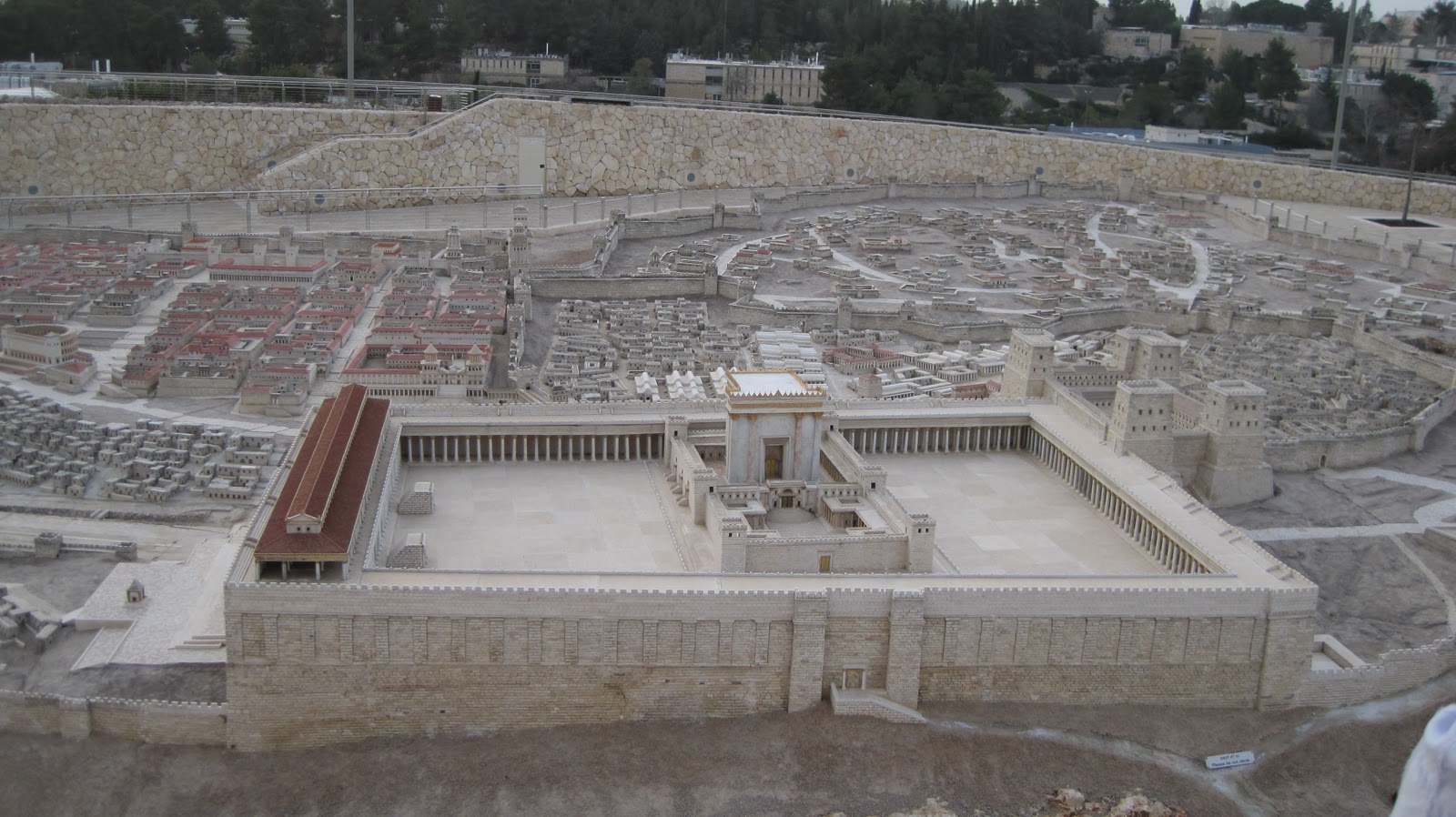
Model of the Temple
Museum in Jerusalem, Israel

Lectionary Text:  2 Samuel 7: (1-5a), 5b-7, (8-9) 10-11, (16)
Go and tell my servant David: Thus says the Lord: Are you the one to build me a house to live in? I have not lived in a house since the day I brought up the people of Israel from Egypt to this day, but I have been moving about in a tent and a tabernacle. Wherever I have moved about among all the people of Israel, did I ever speak a word with any of the tribal leaders of Israel, whom I commanded to shepherd my people Israel, saying, “Why have you not built me a house of cedar?”…And I will appoint a place for my people Israel and will plant them, so that they may live in their own place, and be disturbed no more; and evedildoers shall afflict them no more, as formerly, from the time that I appointed judges over my people Israel; and I will give you rest from all your enemies. Moreover the Lord declares to you that the Lord will make you a house.

This text wraps up the promise that God made to Abram in Genesis 12.  The people have a land that they can claim as their own and they can live in peace.  And David’s reign as king has been pretty much legitimized. Things seem to be going well.  And so David envisions now a more permanent structure to house the ark of the Lord.  In other words, David now desires to build a temple in Jerusalem.

But that night the Lord intervenes by way of Nathan with a promise not necessarily of a permanent “house” but, rather a permanent dynasty, an everlasting house of the line of David.  David has risen from shepherd boy to king and has apparently felt God’s presence through it all.  He now sits in his comfortable palace and compares his “house” to the tent that “houses God” in his mind.  So he decides that God needs a grand house too.  God, through the prophet Nathan responds by asking, in a sense, “Hey! Did you hear me complaining about living in a tent? No, I prefer being mobile, flexible, responsive, free to move about, not fixed in one place.” God then turns the tables on David and says, “You think you’re going to build me a house? No, no, no, no. I’M going to build YOU a house. A house that will last much longer and be much greater than anything you could build yourself with wood and stone. A house that will shelter the hopes and dreams of your people long after ‘you lie down with your ancestors.'” God promises to establish David and his line “forever,” and this is a “no matter what” promise, even if the descendants of David sin, even if “evildoers” threaten.  
The truth is, we all desire permanence; we want something on which we can stand, that we can touch, that we can “sink our teeth into”, so to speak.  We want to know the plan so that we can plan around it.  Well, if this was going to make it easier to understand God, go ahead.  The truth is, this is a wandering God of wandering people.  This is not a God who desires or can be shut up in a temple or a church or a closed mind.  This is not a God who desires to be “figured out.”  This God is palatial; this God is unlimited; this God will show up in places that we did not build.  (and sometimes in places that we really wouldn’t go!)  This God does not live in a house; this God dwells with us—wherever we are.  This God comes as a traveler, a journeyer, a moveable feast.  And this God shows up where we least expect God to be—in a god-forsaken place on the outskirts of acceptable society to a couple of people that had other plans for their lives.  This God will be where God will be.  And it IS a permanent home.

In this Advent season, we know that God comes.  That is what we celebrate; that is what we remember; that is what we expect.  After all, this God we worship is the one that is with us, Emmanuel.  But have we planned too much?  Have we somehow convinced ourselves that God can be directed or choreographed or planned into being?  Have we forgotten what it means to simply build a house in which God can live?  Are you the one to build me a house to live in?  Go ahead, build it.  It will be magnificent!

In this season of Advent, give yourself the gift of building a house of God.  There is no blueprint; there are no plans.  It has no walls, no ceiling, no floor.  It is open to the God who comes.  And know that God will come.

Grace and Peace,

Shelli
      

Open Season

“…who was conceived of the Holy Spirit, born of the Virgin Mary…”

We say those words every Sunday.  We stand and we look at the cross and we say with all our heart that we believe these words to be true.  Now, the “conceived” part we get–conceived, thought up, breathed into–Jesus was God’s way after eons of breathing Creation into being of finally breathing the very Godself into the world.  The Divine has come to walk with us.  But this Virgin Mary thing?  What is that?  Jesus, born, born as a human, born as a baby.  As unromantic and “un-Nativity-like” as it may be, Jesus was fussy and colicy.  The Son of God, in all likelihood, messed up his first-century diaper.  (I’ve never been accused of being overly-reverent!)  Mary and Joseph were probably sleep-deprived.  And as time went on, Jesus, like all of us, had to learn to walk and talk and be.   He had to grow into who he was. But when’s the last time you held a newborn baby?  When’s the last time you held a baby that was only hours old? It’s just like holding the entire hope of the world in your arms.  There are no preconceptions; there are no agendas; there is no one to impress or keep from disappointing.  There is only a pure and undefiled openness to what comes next, to what God holds.  There is only hope.  You can smell it.  Maybe it’s the smell of birth.  But maybe it’s the smell of the Divine.

So does it really matter?  We get so wrapped up in whether or not Mary’s virginity was literally intact when Jesus was born.  Again, does it really matter?  Does it really matter when you are holding the hope of the world?  Does it really matter when you are holding the world’s salvation in your arms?  Think about it.  Jesus was born, Son of God and Son of Humanity.  Jesus was born to Mary, the mother of the Salvation of the World.  Perhaps the translators of the writing by the writer known as Matthew had it right and Mary was a virgin in every sense of the word–pure, undefiled, and open to receive.  But, more importantly,  Mary was a virgin in the spiritual sense of the word–pure, undefiled, and open to receive what comes next, open to receive whatever God held for her life.  Mary opened her heart and her life that she might birth God into this world.

In this season of Advent, we are called to do the same.  14th century theologian, Meister Eckhart said that “we are all meant to be mothers of God, for God is always needing to be born.”  We are all called to be virgin–pure, undefiled, and open to receive.  We are all called to birth God into this world.  How open are you to what comes next?  How open are you to what God holds for your life?  This is the open season.  This is the season when we shed all the preconceptions of what we think God is.  This is the season when we let go of our need to explain God’s coming into the world and be open to what comes next.  So does it really matter?  You bet it does.  It is the Hope of the World that depends on it.
 
In this season of Advent, give yourself the gift of being open to whatever it is God holds for you and birthing God into your life.  Be virgin.  Be a womb for the hope of the world.

Grace and Peace,

Shelli


A Call to Revolution

Scripture Text:  Luke 1:45-55
And blessed is she who believed that there would be a fulfillment of what was spoken to her by the Lord.”And Mary said, “My soul magnifies the Lord,and my spirit rejoices in God my Savior,for he has looked with favor on the lowliness of his servant. Surely, from now on all generations will call me blessed; for the Mighty One has done great things for me, and holy is his name.His mercy is for those who fear him from generation to generation. He has shown strength with his arm; he has scattered the proud in the thoughts of their hearts. He has brought down the powerful from their thrones, and lifted up the lowly; he has filled the hungry with good things, and sent the rich away empty. He has helped his servant Israel, in remembrance of his mercy, according to the promise he made to our ancestors, to Abraham and to his descendants forever.”

It’s called The Magnificat or the Song of Mary.  It is a young girl’s realization that life will never be the same again, her affirmation that God has called her to be a part of something that will turn the world upside down.  Our Christian tradition has probably overly-domesticated the image of Mary a bit, giving her characteristics of one who is young and meek and downtrodden, a scared young girl that became the mother of Christ.  But these words are not meek; in fact, they are downright radical for the first century and for us today.  It is a call to take those who are on top–the rich, the haughty, the successful, the powerful and bring them down.  It is a call to elevate those who are poor, hungry, the very bottom of our society.  Who are we kidding?  In our burgeoning political climate, this is NOT the way to get elected.  This is NOT the way to gain support.  This is anything but politically correct.  In fact, this is a call to revolution.  I’m betting these words will not show up in any of the 584 presidential debates (doesn’t it seem like there are about that many?) between now and next November.

E. Stanley Jones calls The Magnificat, “the most revolutionary document in the world”.  It is said that this document terrorized the Russian Czars.  In fact, for a time during the 1980’s, the government of Guatemala banned its public recitation.  After all, if someone actually paid attention to this stuff, who knows what could happen?  Why, this might be downright dangerous to our acceptable of way life!You know, I think that’s the point.  We are called to DO something. We are called to pay attention. We are called to no longer accept society’s “acceptable” way of life.  The Christian movement did not begin as a comfortable and affirming religious tradition of the majority.  Just like we have domesticated and calmed our image of Mary, we have done the same with our tradition.  You see, Christianity began as a revolution, a revolution against the way the world rewards money and status and power, against the way the world leaves behind those that do not have the resources to care for themselves, and against the way the world sets up standards and rules for the way things should be.  It is a revolution against a world that has lost its sense of grace and compassion and justice.  It is a revolution that followed the Way of Christ.  After all, if someone actually paid attention to this stuff, who knows what could happen?

In this Season of Advent, we are becoming more and more aware of the mystery of God’s Presence and God’s Love that is even now breaking into our way of being.  God With Us, Emmanuel, was not born into our little world to tell us what a stupendous job we are doing!  God came, born as one of us, to show us the Way to something different, to call us into revolution.  Where are you now?  How full do you feel today?  How can you be ready to birth God into your life when you are so full of this world?
 
In this season of Advent, give yourself the gift of answering the call to revolution, of being hungry enough to be filled with God.

Grace and Peace,

Shelli


ADVENT 2B: The Beginning of the Story

ADVENT 2B Lectionary:  Mark 1: 1-8:

The beginning of the good news of Jesus Christ, the Son of God.  As it is written in the prophet Isaiah, “See, I am sending my messenger ahead of you, who will prepare your way; the voice of one crying out in the wilderness:  ‘Prepare the way of the Lord, make his paths straight,’” John the baptizer appeared in the wilderness, proclaiming a baptism of repentance for the forgiveness of sins. And people from the whole Judean countryside and all the people of Jerusalem were going out to him, and were baptized by him in the river Jordan, confessing their sins. Now John was clothed with camel’s hair, with a leather belt around his waist, and he ate locusts and wild honey. He proclaimed, “The one who is more powerful than I is coming after me; I am not worthy to stoop down and untie the thong of his sandals.I have baptized you with water; but he will baptize you with the Holy Spirit.”

Admit it…John the Baptist scares us a little bit–a wilderness man, a wild evangelist, wearing a suit of camel’s hair and making a meal of locusts and honey.  Really?  Why couldn’t the messenger have been someone a little more traditional, someone a little more easier to be around?  But, then again, have you ever known God to stay within the boundaries that we’ve drawn?  Maybe that’s the whole point.  I mean, here is a messenger, paving the path, preparing the way for the coming of the Lord.  No Mary and Joseph, no baby, no stable, no shepherds, no magi, no angels…just…boom…the One is coming that will baptize you with the Spirit of God…the One is coming who will change your life and change your ways and change the world from what we know it to be…the One is coming who will bring us all into the Reign of God.  Hold on…get ready!

The writer of Mark’s Gospel leaves us suspended in time, waiting, rather than living through the whole story together.  Many spiritual writers call that a state of liminality, a point of being betwixt and between, the moment between what is and what will be, a place in which the old world is left behind but we’re not sure what the new one looks like just yet.  It is a point between two times that intersect and become one.  So, are you ready? Well, if you’re not, you need to get that way.  Because in this Gospel, the good news has already begun, whether we’re prepared or not.

Throughout this version of the Gospel, there is a sense of urgency, a sort of abruptness, that somehow compels us to get on board with it, to not tarry with things that do not matter and do not prepare us for the coming. The writer of Mark cuts to the chase:  humanity has waited and prepared itself for this for centuries.  We are reminded of that as the passage pulls in the words of Isaiah, the foretelling of that time when God would come and be among us, when God would come and save us.  Now is the time.  The Christmas celebration for all its splendor and all its beauty and all its twinkling lights is first and foremost the fulfillment of God’s promise of salvation.  This IS the beginning of the good news of Jesus Christ, the Son of God.  This IS the beginning of our story.

But there is another implication here.  In this Advent season, as we wait with expectant hope, we are also reminded that our expectations are limited by our own lives.  God has so much more in store that what we could ever fathom.  Maybe that’s why the writer of Mark quickly takes us to the wilderness and wilds of our lives (and to the bizarre wilderness man!).  You see, God will not be plunked down in the middle of the bustling city of Jerusalem.  God will not come in the way that we plan or imagine how God will come.  Rather, God will emerge in the wilderness of our lives and we will realize that God has been there all along.  We do not have to go to Jerusalem or prepare a grand entry to encounter God.  God comes to us.  We just have to be open to whatever God’s coming is.  And we have to be willing to enter a new beginning.  What we are living is not the prelude; it’s the beginning of the story.

In this season of Advent, give yourself the gift of the wilderness–those wild and untamed places in your lives where you might just experience the coming of God anew.  In other words, all this planning and preparation…forget about it!  Just open yourself to the coming of Christ!

Grace and Peace,

Shelli

Announcing the Beginning

The Anunciation
Icon at St. Catherine’s Monastery

Christmas is coming!  We live this Season of Advent as if its purpose is to point to the beginning (or the “re-beginning”).   We prepare for the coming of God!  But think about it.  Something happened nine months before.  This human Jesus, like all of us, had to be grown and nurtured in the womb before the miracles started.  March 25th—The Feast of the Annunciation—is for some traditions the turning point of human history.  It is in this moment that God steps through the fog into humanity and, just like every human that came before, must wait to be fully birthed into this world.

We Protestants sort of skip over the Anunciation.  And then we start with Christmas and count back nine months.  After all, it’s just a bunch of waiting, right?  OK, that works.  Nine months before Christmas…But March 25th is traditionally regarded as the first day of Creation. (Now, really, I don’t even BEGIN to say that THAT is a real date!  But, it’s as good as any, right?)  So, let’s go with it.  March 25th is the beginning.  The Anunciation…the announcement of the coming of Christ, the coming of God, into our little world…IS the first day of Creation. (You know, “In the beginning was the Word and the Word was…”)  So, begin at the beginning and count forward…to the birth of God into the world. Like Creation, the coming of Christ was the Light pushing the darkness away.

But the world, like any expectant parent, had to wait.  Advent teaches us to wait.  Advent teaches us that birth does not appear in a flash.  Rather, birth, like all things that matter, is a process.  And, it is definitely worth the wait. 

God will come when God will come.  But we don’t want to miss the process of the birth.

In this season of Advent, give yourself the gift of being a part of the process of birthing the world into being.  But part of it means that you have to wait until it’s ready to be.

Grace and Peace,

Shelli