On the Way Down the Mountain

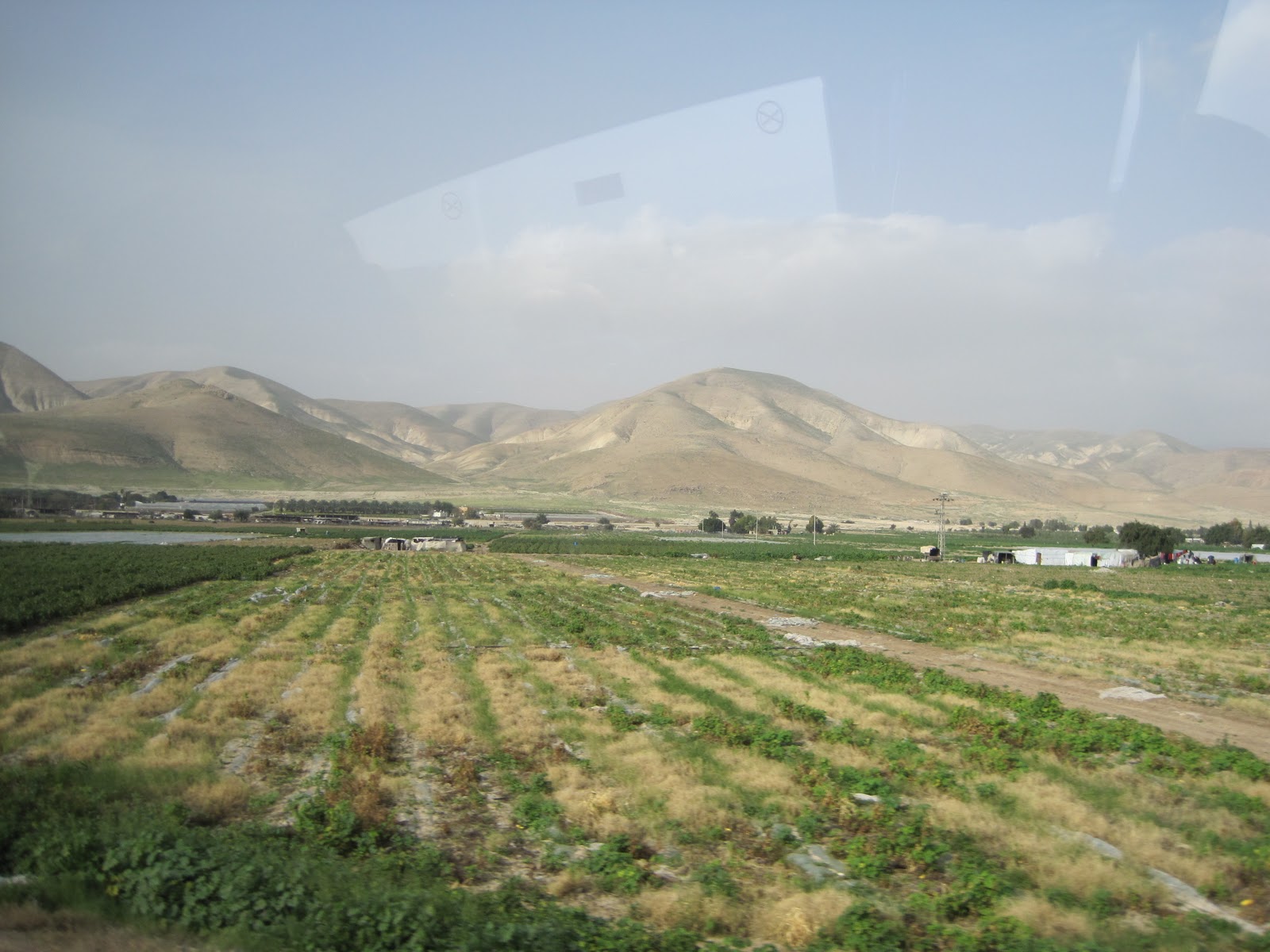
Jezreel ValleyScripture Passage:  Matthew 17: 1-9

Six days later, Jesus took with him Peter and James and his brother John and led them up a high mountain, by themselves. And he was transfigured before them, and his face shone like the sun, and his clothes became dazzling white. Suddenly there appeared to them Moses and Elijah, talking with him. Then Peter said to Jesus, “Lord, it is good for us to be here; if you wish, I will make three dwellings here, one for you, one for Moses, and one for Elijah.” While he was still speaking, suddenly a bright cloud overshadowed them, and from the cloud a voice said, “This is my Son, the Beloved; with him I am well pleased; listen to him!” When the disciples heard this, they fell to the ground and were overcome by fear. But Jesus came and touched them, saying, “Get up and do not be afraid.” And when they looked up, they saw no one except Jesus himself alone. As they were coming down the mountain, Jesus ordered them, “Tell no one about the vision until after the Son of Man has been raised from the dead.”

Boy, that was some trip up that mountain!  Who was ever going to believe this?  But it doesn’t matter because Jesus tells them to be quiet about it, tells them to go back to their lives, go back to their work.  Really?  How in the world can you just go back?  How in the world can you go back to things the way they were after basking in glory?  Well, maybe that’s the point.  Maybe we can’t.

I think that all of us are given glimpses of glory, tastes of the Divine, from time to time, if we only pay attention.  The Celts called them “thin places”, the places where heaven and earth, where the sacred and the ordinary, suddenly, if only for a moment, touch as if they are somehow part of each other, perhaps even dependent on each other.  It is a place of liminality, betwixt and between.  It is a place that belongs not to one or the other but instead is some sort of shared reality as the Sacred and the ordinary spill in to each other.  The people of whose journeys we read in the Torah believed that no one could ever see God without dying.  They talked of God as consuming fire and destructive wind, a rushing force that passes over the earth leaving little in its wake.  That thin place, the place where the earth meets the sky was one of no return.  They assumed that no one would ever come back down the mountain.

Maybe we’ve become a little too accustomed to this God we know.  Maybe our glimpses of glory have become a bit too pre-planned.  Maybe our thin places have gotten a little too thick with earthbound images of who God is in our lives, of how much of God we really want to encounter.  Because, you see, when you truly encounter those glimpses of the Sacred and the Holy, those you truly do not expect, when you let yourself be surprised by a cloud, you cannot help but be changed.  In a way, the early Hebrews were right.  When you encounter God, that you that you’ve made dies a little.  It has to, it has to make room for a God you never knew.

So on our way down the mountain, we realize that we cannot stay.  We cannot stay and bask in glory forever.  We were never called to that, to some sort of pious and righteous existence high above the world.  We were sent, sent down the mountain, back to the world.  But a part of us has died.  And from the ashes, we will rise.  Because, you see, that’s the only way it will happen.  So go, be careful where you walk.  We have to go down the mountain.  We have to go back.  Jerusalem is waiting.  But we are different; we have basked in glory.  For now, we will be quiet about it.  There are others waiting to join us on this journey.  Someday they will all understand.  Someday we will understand.  But in the meantime, we are just called to go.

As you prepare to begin this Lenten journey, where have you encountered those thin places, those moments of almost, just almost, touching the Sacred?
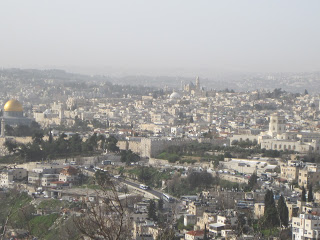
jerusalem04Let us go now to Jerusalem.

Grace and Peace,

Shelli
 

A Pondering Faith


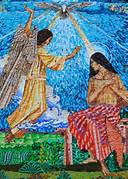
Church of the Annunciation, Nazareth, Israel

Scripture Passage for Reflection:  Luke 1: 26-35

In the sixth month the angel Gabriel was sent by God to a town in Galilee called Nazareth, to a virgin engaged to a man whose name was Joseph, of the house of David. The virgin’s name was Mary. And he came to her and said, ‘Greetings, favoured one! The Lord is with you.’* But she was much perplexed by his words and pondered what sort of greeting this might be. The angel said to her, ‘Do not be afraid, Mary, for you have found favour with God. And now, you will conceive in your womb and bear a son, and you will name him Jesus. He will be great, and will be called the Son of the Most High, and the Lord God will give to him the throne of his ancestor David. He will reign over the house of Jacob for ever, and of his kingdom there will be no end.’ Mary said to the angel, ‘How can this be, since I am a virgin?’* The angel said to her, ‘The Holy Spirit will come upon you, and the power of the Most High will overshadow you; therefore the child to be born* will be holy; he will be called Son of God.

So, what does it mean to ponder?  If you read this Scripture, it does not mean thinking something through until you understand it or until you “get it”.   Nowhere does it say that Mary was ever completely sure about what was going to happen.  Nowhere does it say that she ever stopped asking questions, that she ever stopped pondering what this would mean for her life.  Nowhere does it say that she expected this turn of events.  When you think about it, Mary was probably just like the rest of us.  She probably pretty well had her life figured out.  She was just trying to live it.  And then this angel shows up.  “Excuse me Mary, I know that this might be a little out of the box for you but I need you to stop everything that you’re doing and listen.  God has something special just for you.  See, if it’s not too much trouble, we’d like you to birth the Savior, the Son of God and the Son of Humanity, Emmanual, the Messiah, the very Godself into being.  And, we’d really like to get this show on the road now.”

What if Mary had said no?  What if her fear or her plans had gotten the best of her?  What if she was just too busy planning for whatever was going to happen next in her life?  What if she really didn’t have time to do any pondering today? Now, as much as we’d like to think that we have the whole story of God neatly constructed between the covers of our Bible or on that nifty little Bible app that you have on your iPhone, you and I both know that there is lots of God’s work that is missing.  We really just sort of get the highlights.  Who knows?  Maybe Mary wasn’t the  first that God asked to do this.  Maybe she was the second, or the tenth, or the 386th.  After all, this is a pretty big deal.  I mean, this pretty much shoots that long-term life plan out of the water.  But, you see, this story is not about Mary; it’s about God.  And through her willingness to ponder, her willingness to let go of the life that she had planned, her willingness to open herself to God’s entrance into her life and, indeed, into her womb, this young, dark-haired, dark-skinned girl from the wrong side of the tracks in a sleepy little suburb of Jerusalem called Bethlehem, was suddenly thrust into God’s redemption of the world.  It is in this moment that all those years of envisioning what would be, all those visions that we’ve talked about, it is here, in this moment, that they begin to be.

Annunciation literally means “the announcement”.  The word by itself probably holds no real mystery.  But it is the beginning of the central tenet of our entire Christian faith—The Annunciation, Incarnation, Transfiguration, Resurrection.  For us, it begins the mystery of Christ Jesus.  For us, the fog lifts and there before us is the bridge between the human and the Divine.  Now we Protestants really don’t tend to give it much credence.  We sort of speed through this passage we read as some sort of precursor to “In those days a decree went out from Emperor Augustus…” so we can light our Christmas candle.  This, for us, is the typical beginning of the birth story. But think back.  Something happened nine months before.  This human Jesus, like all of us, had to be grown and nurtured in the womb before the miracles and the ministry started.  The Feast of the Annunciation is the turning point of human history.  It is in this moment, this very moment, that God steps through the fog into humanity and, just like every human that came before, must wait to be fully birthed into this world.

What about us?  When do you let yourself ponder?  When do you expect to encounter the unexpected?  What is your answer when the angel or some other God-sent character comes bursting into your life:  “Excuse me [You], I know that this might be a little out of the box for you but I need you to stop everything that you’re doing and listen.  God has something special just for you.  See, if it’s not too much trouble, we’d like you to birth the Savior, the Son of God and the Son of Humanity, Emmanual, the Messiah, the very Godself into being.  And, we’d really like to get this show on the road now.”  Again, what if Mary had said no?  So, why are we so different from that scared little girl.  So, maybe it’s time for us to get busy pondering!

Annunciation 2Mary pondered these things in her heart, and countless generations have pondered them with her.  Mary’s head is bowed, and she looks up at the angel through her lashes.  There is possibly the faintest trace of a frown on her brow.  “How shall this be, seeing that I know not a man?” she asks, and the angel, the whole of Creation, even God himself, all hold their  breath as they wait for what she will say next.

“Be it unto me according to thy word,” she says, and jewels blossom like morning glories on the arch above them.  Everything has turned to gold.  A golden angel.  A golden girl.  They are caught up together in a stately golden dance.  Their faces are grave.  From a golden cloud between them and above, the Leader of the dance looks on.

The announcement has been made and heard.  The world is with child.

Frederick Buechner, The Faces of Jesus:   A Life Story, p. 8-9

Reflection:  What is God asking you to do with your life?  What part of the story is yours to play, or yours to write, or yours to live?  When have you taken time to ponder?

Grace and Peace,

Shelli


Bending Rules

Bending tree2This Week’s Lectionary Text: Luke 7:36-8:3

I am for the most part a rule-follower (so I’m trying to get back to posting some blogs!).  Part of it is due to what could probably be considered my meticulous, “Type A” personality, but my guess is that most of it is due to my small-town, Protestant upbringing.  Rules are good.  They create boundaries; they can provide protection; they serve as a foundation on which to stand and from which to grow as we are guided by the remnants of the past.  Our society and our lives are built on rules.  So what happens when the rules are not followed?  Does it always result in chaotic anarchy?  Or are there some rules that it’s alright to stretch just a bit? Do you think that there are possibly some rules that need to be bent?

We all know enough about religion to know that it was based on rules from the very beginning.  My own denomination’s generally-accepted beliefs and consensual polity are encapsulated in The Book of Discipline of the United Methodist Church.  This is not a new publication.  It’s been around for about as long as Methodism has been in the United States.  I have a small collection of antique Disciplines and the oldest one that I have is dated 1828.  I also have one that I found in my great-grandfather’s attic.  It’s from 1900.  When you look through it, there are some similarities to our current one.  It has the Articles of Religion and the General Rules.  But it’s also got some rules that we would probably consider just downright odd.  They seemed to be very concerned with how people dressed and intent on insuring that people did not come to church wearing too much jewelry.  There are very few of us that would fit into that mold of what we’re supposed to look like when we come to church.  The point is that sometime rules change.  Sometimes they need to be edited or added to and I think sometimes they need to be thrown out altogether.       

In the Gospel passage that we read, we are given lots of rules.  It starts at the beginning when it tells us that Jesus “took his place at the table.”  He took his place as if there was a designated place where he was supposed to sit.  It was probably, you could surmise, toward the head of the table to the right of the host.  Isn’t that what the rules of etiquette usually tell us?  And then this woman enters—a woman already defined by the community and now by Scripture as a “sinner”.  Somewhere along the way she had apparently broken some rule of conduct and violated what would be considered an acceptable way of living and being. (People have often designated her a prostitute.  Go there if you want, but it never really tells us, so…maybe that’s not a great “rule of thumb”!)  And now she is apparently interrupting what is probably a perfectly-choreographed evening in the home of one of the most respected religious leaders.  She desires to anoint Jesus’ head with oil.  (Boy, I hope she doesn’t get that all over the imported tablecloth!) But standing nearer Jesus’ feet, she is suddenly overcome with emotion and begins to weep.  She begins to wash his feet with her tears, takes down her hair to dry them and then kisses them and pours the anointing oil on them.  What a spectacle that must have been!  And right here in the home of this respected Pharisee!

And so the Pharisee not only pronounces judgment on the woman, but also on Jesus.  After all, they had both broken the rules!  Woman of questionable reputation did not act like this, with weeping and flying hair and all, and if Jesus was really who he claimed to be, he would have known better.  But Jesus’ response is not the apology that the Pharisee and his “respectable” guests probably expected.  Instead Jesus challenges Simon’s pronouncement of both of them by launching into a parable about forgiveness.  And woven through the parable are reminders of what the woman did.  She openly and generously gave of herself, more than anyone else at the table had done.

Jesus is trying to make them realize that there is something more than rules, there is something more than religion, and there is something more than doing the “right thing”.  Ralph Waldo Emerson said that “the faith that stands on authority is not faith”.  I think that is what Jesus is trying to get across.  Faith is not about rules.  The woman’s intense act of love beyond all reasonable expectations and all acceptable actions becomes a means of grace.  It leads us to God.  It shakes us out of our comfort zones of what is normal and expected and even acceptable because, when you think about it, Jesus was very seldom normal and expected and even acceptable.  Instead he showed us how to step out of our boxes and live a life of faith—real faith that is untamed and uncontrolled and virtually undefined, a faith that rips open our carefully-sewn-together lives just enough to let God’s presence spill into them.     

 In a 2006 article in the “National Catholic Reporter”, editor Tom Roberts said that “we live in an age of expanding religion and a diminishing God.”  Those words probably make several of us squirm.  After all, have we become so sure of who we think God is and what we think God wants from us that we are willing to sacrifice the new and expanding ways that God interacts with our lives?  Religion and faith are not the same thing. Religion is about what we believe and why we believe.  It is about tradition, the institution, the system, and, yes, the rules.  When you think about it, our religion has been constructed over centuries.  It has given us creeds and liturgy and definitions of God.  It gathers us and grounds us and reminds us of a world to come.  It gives us commandments and rules that guide the way we live so that we can become what we seek, so that we can journey toward a oneness with God.  It is meant to lead us to God, not pave the way (as in make it easier) or drive us there. 

Somewhere in the midst of those rules we, like Jesus, have to do a little bending.  We have to at some point move beyond and transcend the rules and rituals.  We have to look beyond where we are to that place to which God calls us.  That is where faith comes in.  That is where God, greater than any religion, meets us.

In her book, Called to Question, Joan Chittister says that “in order to find the God of life in all of life, maybe we have to be willing to open ourselves to the part of it that lies outside the circles of our tiny little worlds.”  She goes on to tell a Sufi tale of disciples who, when the death of their master was clearly imminent, became totally bereft.  “If you leave us, Master,” they pleaded, “how will we know what to do?”  And the Master replied, “I am nothing but a finger pointing at the moon.  Perhaps when I am gone you will see the moon.”  The meaning is clear:  It is God that religion must be about, not itself.  When religion [or rules] makes itself God, it ceases to be religion.  But when religion becomes the bridge that leads to God, it stretches us to live to the limits of human possibility.”[i]  Chittister maintains that “religion ends where spirituality begins.”  From that standpoint, these rules, these dogmas, all of these things that make up our religion are not our faith journey, but they lead us through it.  They are, from that standpoint, a means of grace.

And as we change, as our journey changes, as our context changes, perhaps we are sometimes called to the act of bending rules.  It doesn’t mean that we’re dismissing them or ignoring them.  It means that we are allowing the conversation about God to continue.  But more important than that, it means that we are becoming part of the conversation.  We are becoming part of the journey.  And so, perhaps we really are called to a spiritual discipline of bending the rules sometimes.  It is part of the ongoing conversation, the ongoing faith journey of which we are a part.  Sometimes that bending means we just understand it better after we’ve questioned and explored.  Sometimes it means that we need to add something to make it clearer for us and for those who walk this journey with us.  And sometimes it means that we need to get rid of things that no longer augment or serve to depict our understanding of who God is and how God enters and is revealed in our lives.   Hugh E. Brown said that “Christianity is not being destroyed by the confusions and concussions of the time; it is being discovered.”  That is the point.  We don’t discover how God is revealed to us without continuing to think about it, continuing to look and re-address how we have understood God. 

That’s what Jesus was doing that day at the Pharisee’s house.  He wasn’t shunning the rules that had been a part of the faith tradition for as long as anyone could remember.  He was just bending them a bit, making them a bit more pliable, a bit more nimble, a little bit more transcendent, a little bit closer to what God had in mind.  The rules are meant to be foundations on which we can stand and through which God is revealed.  But when they become boundaries that control who is welcome and who is accepted, or who is invited to live out their own calling or who is not, that is not what God is about.  So, Jesus didn’t really follow the rules.  In fact, Jesus often got himself in trouble with those rule-followers.  Jesus just loved God and wanted to reveal that love for us and everyone else.  And here was this woman—a sinful woman, the Scriptures say—shunned by the rule-followers and welcomed by God.  Because you see this woman did what we are called to do—love generously and extravagantly, love the way that God loves.  G.K. Chesterton said that we should “let our religion be less of a theory and more of a love affair.”  There are really very few rules—except to love the way God loves and be open to doing perhaps a little bending.

So, go do a little rule-bending of your own!
 
Grace and Peace,
 
Shelli
 
(To see notes on all of the Lectionary texts for this week, go to http://journeytopenuel.wordpress.com/)


[i] Joan Chittister, Called to Question:  A Spiritual Memoir, (Lanham, MD:  Sheed & Ward, 2004), 19-20.

The Season of Unpreparation

Scripture Passage: Mark 6: 7-12
7He called the twelve and began to send them out two by two, and gave them authority over the unclean spirits.8He ordered them to take nothing for their journey except a staff; no bread, no bag, no money in their belts;9but to wear sandals and not to put on two tunics.10He said to them, “Wherever you enter a house, stay there until you leave the place.11If any place will not welcome you and they refuse to hear you, as you leave, shake off the dust that is on your feet as a testimony against them.”12So they went out and proclaimed that all should repent.

What do you mean we’re not supposed to take anything with us?  This journey is hard.  There might be danger along the way.  We have to be prepared.  Admit it.  That’s what we all think.  After all, this journey to the cross is hard.  We’re not even halfway there–just sixteen days or so–and we’ve already encountered more than we really thought we could handle.  And now we’re told to go out there virtually unprepared for what will come next.

Maybe that’s our problem.  Maybe we mistake this Lenten journey as a time of preparing us for the Cross when, actually, we’re being called to unprepare ourselves, to put it all aside and encounter the raw roughness of the road itself.  This season is not a season of preparation but, rather, a season to shake the dust off, to clear our minds of any baggage that we have brought to this place, and to leave empty-handed, open, ready to receive.

It’s not something that we do well, this letting go, this allowing ourself to appear vulnerable, out of control, and unprepared.  I mean, we know that we have to walk this walk.  We know what’s coming.  We know what we have to go through.  And so we don some sort of cross-cut suit of armor to protect us, to make it just a little bit easier.  But think what Jesus did at the beginning of this journey.  He went into the desert, unprepared, taking nothing.  He did encounter danger–the danger of his own needs, his own desires, his own vision of what his life could hold.  What he encountered was himself.  And then he shook off the dust and left, returning to the road itself.  St. Catherine of Sienna once said that “all the way to God is God.”

This road to the Cross IS the road to which we are called.  It is the Way of God.  The challenge for us in this season is not to prepare ourselves for what is to come, but to clear the way. 

Grace and Peace,

Shelli

The First Day: And Heaven and Nature Sing!

Joy to the World , the Lord is come!
Let earth receive her King;
Let every heart prepare Him room,
And Heaven and nature sing,
And Heaven, and Heaven, and nature sing.

Joy to the World, the Savior reigns!
Let men their songs employ;
While fields and floods, rocks, hills and plains
Repeat the sounding joy,
Repeat, repeat, the sounding joy.

No more let sins and sorrows grow,
Nor thorns infest the ground;
He comes to make His blessings flow
Far as the curse is found,
Far as, far as, the curse is found.


He rules the world with truth and grace,
And makes the nations prove
The glories of His righteousness,
And wonders of His love,
And wonders, wonders, of His love.

(Isaac Watts, 1719)

The day has dawned!  Sometime in the night, God tiptoed into the world and made a home.  And the world will never be the same again.  Most of us barely noticed.  Most of the world wakes this morning and goes on with their lives.  That’s OK.  If God had wanted fanfare, then I supposed God would have come with a bit more flourish and drama.  But instead, God enters as one of us, quietly slipping the Divine into our midst with as little noise as possible.  (Although I suppose it’s hard to enter quietly with a multitude of angels in tow!)

When Isaac Watts first wrote the familiar Christmas carol “Joy to the World”, he didn’t mean for it to be a carol at all.  The words were originally written to celebrate the triumphant second coming of Christ rather than the birth that we celebrate this morning.  I think that’s the reason it works, though.  God’s coming into the world is not merely something that happened more than 2,000 years ago.  Today is not the celebration of the anniversary of Jesus’ birth as if it is some sort of historic relic that we hold; rather, today–THIS day–IS the coming of God into our midst, the realization that even now, Heaven is spilling into our lives, making a home, and Heaven and Nature are singing together.

God comes quietly, tiptoeing into our lives each and every day of our existence.  A new Light has dawned and every day is Christmas!  So when the Holy and Sacred dawn in our life, are we called to join in loud acclaim, or are we called to silently open our our lives and let the Divine spill in?  With all respect to Mr. Watts, I’m not a big watcher of the “Second Coming” of Christ.  I don’t know what that looks like and the Scriptures are not that specific about it.  I think the point of Christmas is that the Lord is come!  God came quietly into our world as the Christ child more than 2,000 years ago.  It was the First Day of the new dawn.  And the Light has been rising each every day since.  And for every heart that quietly opens and makes room for God to tiptoe in and make a home, the Light becomes brighter.  Rather than waiting for God’s coming, let us see that God is here.  Let us see that every day is Christmas.  (And, along the same lines, perhaps every day is the triumphant coming for which we are looking until God’s Kingdom and the recreation of all is complete!)  Joy to the World!  The Lord is come!

The Lord is come!  Let us now go and see this thing that has taken place!


On this First Day of Christmas, open the gift of the Holy and the Sacred, the gift of the Christchild and then open your heart that you might prepare room for God to come each and every day!

Merry Christmas!

Shelli     

So What, Exactly, Were You Expecting?

What were we expecting?  Well, of course, we were expecting someone obvious, someone  who would make himself known in the world, someone who is a little bit better than you or I.  We were expecting power and might and grandiose presentation.  But instead God walked into our very human existence.  God traversed time and space and the perceived separation between the sacred and the ordinary and entered our everyday world.  On some level, that bothers many of us.  After all, we are trying to do BETTER than this; we are aspiring to be more than human.  What in the world is God doing messing around in the muck of this world?

Pierre Teilhard de Chardin said that “by virtue of the creation and, still more, of the Incarnation, nothing here below is profane for those who know how to see.”  So, perhaps God came into this very ordinary world to show us the holiness that has been created, the sacredness that in our worldliness, we were somehow missing.  Perhaps God steps into our lives to show us the depth that we haven’t dared to dig into our lives.  Perhaps God came and walked with us not to show us how to be but to show us how to see.  But when it’s all said and done, this practice we have of “looking for God” has been proven bizarre.  After all, it was never God that was lost!  We were never separated from the sacred; we just missed seeing it because it wasn’t what we were expecting.  So, again, what were we expecting?  Maybe the the whole lesson is that God will come when and where and in the way that God will come.  But if there’s a “pattern” to be figured out about this God who cannot be figured out, it’s that God comes into the unexpected, into the unplanned, and into the unprepared places in our lives and lays down in a feed trough and patiently waits for the world to wake up and notice.

Come, thou long-expected Jesus, born to sety thy people free, from our fears and sins release us, let us find our rest in thee. Israel’s strength and consolation, hope of all the earth thou art, dear desire of every nation, joy of every longing heart.

Born thy people to deliver, born a child and yet a King, born to reign in us forever, now thy gracious kingdom bring.
By thine own eternal spirit rule in all our hearts alone; by thine own sufficient merit, raise us to thy glorious throne.

(Charles Wesley, 1744)

In these final days of Advent,  we are all busy preparing for the day of God’s coming.  But whether or not we get it done, whether or not the house is clean or the goodies are baked or the presents are wrapped, God will come and the world will never be the same.  Expectation is about moving into what will be rather than preparing to bring it into what is.
 
What are you expecting?  That’s probably not it!  Give yourself the gift of being open to the way that God comes without expecting it to happen in a certain way!

Grace and Peace,

Shelli

O Come, O Come, Emmanuel

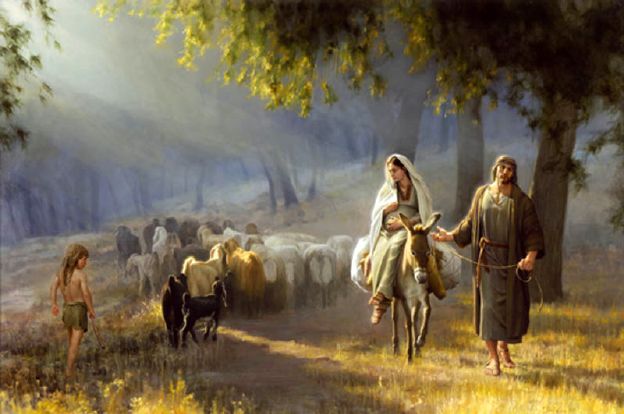
“Journey to Bethlehem”
Joseph Brickey, ca. 1973

So, what does it mean to say “God With us”?  The name, Immanuel, that the child is to be given is a symbolic name, a short Hebrew sentence.  We like the idea of God being here to pull us out of our next quandry in life in which we will find ourselves.  But isn’t it more than that?  God has finally, after an entire history of generations of humanity, sought us out.  In essence, God put aside, if only for a little while, all God-liness, to come and join our little world.  God breaks into humanity not with a triumphant shout but into one of the lowliest, one of the most god-forsaken, one of the most human places of all.  Our image of this patriarchal God sitting on a golden throne somewhere up in the clouds looking down upon this struggling world just doesn’t work anymore.  The God who we could not see, the God who we could not name, the God into whose face we could not look or surely we would die has just become one of us. So what do we do now?

When I was little, I used to lay in bed (when I was supposed to be asleep) and think about the notion of God being “everywhere”.  Well that was something that I just couldn’t get my head around.  I mean, there had to be limits.  There had to be a place where God could not see me.  So I would pull the covers over my head and try to figure out if God could see me there.  We all do that, if only figuratively.  Oh, we SAY that God is with us, we SAY that God walks with us, but then we try to find a temporary hiding place from this God who is “up there” or “out there” or wharever “there” we think God is.  After all, it’s kind of like living with your boss, isn’t it?   I saw a bumper sticker a couple of years ago that read “God is coming.  Look busy!”  Oh, we laugh, because it’s way too close to the way we think!  I mean, we’re all so wrapped up in our lives.  There’s just so little time.  There’s just too much going on!  And the world is changing so rapidly.  It’s not like it used to be.  But we’ll keep working to get to God.  Well, SURPRISE!  God came to us.  Not only that, God came WITH us, entering into the bottom of our house of cards that is our world.  So, it seems now, “getting to God” is really no longer necessary.  Maybe we just have to open our eyes, and hold out our hand, and, oh yeah, it helps if you don’t have the covers pulled over your head!

Modern-Day Israel just outside of the Region of Galilee

Mary and Joseph are journeying toward Bethlehem, silently walking through the dust and sands.  This trip was not convenient but they had no choice.  It normally takes four days or so but it is difficult for Mary to travel.  The world is crazy right now, busy and spinning out of control.  Everything is changing.  There is talk of some unrest and some skirmishes up ahead.  This is not the time to be traveling.  This trip is dangerous.  But they have to keep going.  There’s a baby coming!

O Come, O Come, Emmanuel, and ransom captive Israel,
that mourns in lonely exile here until the Son of God appear.
Rejoice! Rejoice! Emmanuel shall come to thee, O Israel!

O Come, thou Wisdom, from on high, and order all things far and nigh;
to us the path of knowledge show and cause us in her ways to go.
Rejoice! Rejoice! Emmanuel shall come to thee, O Israel!

O come, O come, great Lord of might, who to thy tribes on Sinai’s height
in ancient times once gave the law in cloud and majesty and awe.
Rejoice! Rejoice! Emmanuel shall come to thee, O Israel!

O come, thou Root of Jesse’s tree, an ensign of thy people be; 
before thee rulers silent fall; all people on thy mercy call.
Rejoice! Rejoice! Emmanuel shall come to thee, O Israel!

O come, thou Key of David, come, and open wide our heavenly home.
The captives from their prison free, and conquer death’s deep misery.
Rejoice! Rejoice! Emmanuel shall come to thee, O Israel!

O come, thou Dayspring, come an dcheer our spirity by they justice here;
disperse the gloomy clouds of night, and death’s dark shadows put to flight.
Rejoice! Rejoice! Emmanuel shall come to thee, O Israel!

O come, Desire of nations bind all people in one heart and mind.
From dust thought brought us forth to life; deliver us from earthly strife.
Rejoice! Rejoice! Emmanuel shall come to thee, O Israel!

(9th century Latin, with translations by Laurence Hull Stookey; vs. 2 by Henry Sloane Coffin, 1916)

 
The time is almost here!  In this final week of Advent, give yourself the gift of pulling away everything that clouds your view that you might see the God who Comes.

Grace and Peace,

Shelli