WALK TO JERUSALEM: Orthodoxy

Scripture Text:  Matthew 5: 1-18
When Jesus saw the crowds, he went up the mountain; and after he sat down, his disciples came to him. Then he began to speak, and taught them, saying:  “Blessed are the poor in spirit, for theirs is the kingdom of heaven. “Blessed are those who mourn, for they will be comforted. “Blessed are the meek, for they will inherit the earth. “Blessed are those who hunger and thirst for righteousness, for they will be filled. “Blessed are the merciful, for they will receive mercy. “Blessed are the pure in heart, for they will see God. “Blessed are the peacemakers, for they will be called children of God. “Blessed are those who are persecuted for righteousness’ sake, for theirs is the kingdom of heaven. “Blessed are you when people revile you and persecute you and utter all kinds of evil against you falsely on my account. Rejoice and be glad, for your reward is great in heaven, for in the same way they persecuted the prophets who were before you.  You are the salt of the earth; but if salt has lost its taste, how can its saltiness be restored? It is no longer good for anything, but is thrown out and trampled under foot. “You are the light of the world. A city built on a hill cannot be hid. No one after lighting a lamp puts it under the bushel basket, but on the lampstand, and it gives light to all in the house. In the same way, let your light shine before others, so that they may see your good works and give glory to your Father in heaven. “Do not think that I have come to abolish the law or the prophets; I have come not to abolish but to fulfill. For truly I tell you, until heaven and earth pass away, not one letter, not one stroke of a letter, will pass from the law until all is accomplished.

I’m no real Bible scholar but I think this passage is indeed the pinnacle of Jesus’ ministry.  This is the lynchpin, the place where it all comes together, and, sadly for this world and this culture, the place where Jesus’ message begins to turn away from an affirmation of what we do as “religious folk” to a calling to go forth and do something different.  This passage turns orthodoxy around.  Orthodox…what an interesting and misdefined word.  It has come to define the “accepted” beliefs of the church, the traditional views.  In essence, it has come to mean the opinion of the majority.  But history has shown us that that has often proved to be problematic.

Here’s a date for you:  April 15, 1947…on this day, 64 years ago, Jackie Robinson debuted with the Brooklyn Dodgers and, against all odds, broke baseball’s race barrier and made history.  But, like most history, he had help.  Just before he was signed, the pastor of Plymouth Church of the Pilgrims in Brooklyn had a visitor.  The visitor’s was Branch Rickey, already well-known.  They didn’t have a deep pastoral care talk.  Rickey just paced.  And the minister went about his work.  Then Rickey plopped down in a chair and screamed, “I’ve got it.”  “I’m going to sign Jackie Robinson to the team.”  There were warnings.  A well-known reporter said that there would be riots in the street on this day.  Rickey instead believed that all of heaven would break loose.  (Check out Signing of Jackie Robinson )

The point is that it was time for a change.  It was time for a new way of doing things.  “Orthodoxy” actually means “right belief”.  What  is “right”?  What does that mean?  You see, I think of myself as “orthodox”.  I’m actually extremely traditional, even though I think that word gets a bad rap.  I mean, regardless of all of the church growth movements that profess to have the “ortho-statistics” for churches, I love traditional worship (I mean, REALLY traditional!) worship.  Give me a robe, a processional behind a crucifer, and a couple of Latin chants thrown in for good measure any day against screens and a preacher doing some sort of skit as he blocks my view of the altar.  But, really, that’s not belief.  That’s just where God meets me. The point is, we all think of ourselves as “orthodox”, as right.  But right belief is this…the Beatitudes…the antithesis of this world.  It is a moving forward.  Hmmm!  OK, maybe I AM a “progressive”. 

One thing to note is that the form of these Beatitudes uses two verbs: are and will. Each beatitude begins in the present and moves to future tense. It is the “orthodox” way of thinking.  The move to the future tense indicates that the life of the kingdom must wait for ultimate validation until God finishes the new creation. The Kingdom of God moves forward.  It is so far ahead of where we are, it’s not even fully visible at this point!  In essence, it is the new “right belief”, the new orthodoxy.  It is a way of living based on the sure and firm hope that one walks in the way of God and that righteousness and peace will finally prevail.

Dietrich Bonhoeffer said this: Humanly speaking, we could understand and interpret the Sermon on the Mount in a thousand different ways. Jesus knows only one possibility: simple surrender and obedience, not interpreting it or applying it, but doing and obeying it. That is the only way to hear his word. He does not mean that it is to be discussed as an ideal; he really means us to get on with it.
The Beatitudes lay out a vision of a reversal of the world we know. Jesus calls us to a radical kingdom that is totally different than the world in which we live. And he calls us to “get on with it”.  Now don’t think that Jesus is merely laying out the conditions under which we would be blessed or prosper. It is rather a promise of a radical reversal, an upside-down (or right-side-up) world. It is a promise from a God that wants the best for us, a God that sees that we will indeed be blessed. That is the promise—a blessed relationship with God. So this is a picture of what that Kingdom looks like. It is the way it should be and the way it will be. The Beatitudes are meant to be descriptive rather than instructive.

So, where does that leave us?  We live in a divisive world, a divisive country, and a divisive church.  We all claim to be “orthodox”, “right”.  This is hard.  We walk a fine line between causing more division and proclaiming what we believe to be right.  Now, really, we need to realize that what we believe to be “right” does not make it “right”.  Maybe that’s our whole problem.  I keep hearing of person who profess to be “bridge builders”.  Well, that sounds really politically correct and all.  In fact, it even sounds attractive.  Sure, I’d like to join a bunch of bridge-builders, the peaceful ones, the ones who get along with everyone.  OK…here is the problem.  Where are you headed?  Bridges are not meant for permanent residence.  Are you going forward or backward, left or right, to the future or the past?  You have to CHOOSE!  That is the whole point of this passage that contains what we commonly call “The Beatitudes”.  You see, things are different.  (And if they’re not, this passage professes that they should be!)  What you think is, is not.  And that to which you’ve held so tightly is decaying away as we speak.  Orthodoxy has changed.  In fact, Jesus is the one that changed it!  “Right” belief has changed.  God did not come in Jesus with a message of “Great job, folks,  you have it altogether.  Don’t change a thing!”  No, the message probably reads more like, “You know, I love you more than you could possibly know.  But you are a mess!  Listen…come and see…there’s more to the story than you think you know!”

You know, until 56 years ago, women could not be ordained in the United Methodist Church. (And yet I still get assigned weddings that are upset because I am the wrong gender!)  And, as I said, the race barrier in major league baseball was not broken until 1947.  (But we didn’t have an African-American president until 2008.)  The truth is, things move very slowly.  So much for a reversal of the status quo!  And our churches still continue to exclude those in our midst who do not claim the “orthodox” sexual orientation.  I really don’t understand it.  Surely we know better.  Surely we understand that this depiction of the alternative way of being that Jesus depicted in The Beatitudes is not a pipe dream.  It’s really meant to happen.  It’s the vision of God that God brought into the world in Jesus Christ.  It’s the vision of the world that God holds for us even now.  It’s all the children of God in the whole Kingdom of God.  It’s called Shalom, or the Kingdom of God, or the Reign of God.

But on some level I admire bridge-builders.  They are those that play both crowds–the conservatives and the progressives, the establishment and the rebels, the pharisees and the disciples.  You see, all of us are right about SOMETHING.  But none of us are right about EVERYTHING.  Those bridge-builders can point that out.  The truth is, though, I’m probably too impatient to be one.  I want things to change.  I want the world to look like The Beatitudes.  I want the world to be what God envisions it to be.  But even bridges tend to decay, becoming weather-worn and rotten.  Life moves.  It moves fast.  And if you don’t keep walking, you’re no longer a bridge-builder.  You’re either in danger of falling fast into the underlying currents and being carried away into who knows where or you’re just someone that’s sitting in the way while people are trying to cross.  It’s better to keep moving.  After all, God is way out ahead of us.

OK, one more time…I really am orthodox.  I really do adhere to “right belief”.  I just think it’s a whole lot farther ahead than any of us imagine.  It’s a matter of doing justice, loving kindness, and walking humbly.  Oh wait, someone already said that!  In other words, our faith is measured not in “rightness” but in relationship.  Orthodoxy, “right belief”, is about relationship.  It is about welcoming all of God’s children to the table as the reign of God, the Spirit of the most holy, spills into our midst.  Emmanuel, God With Us.  Isn’t that the crux of the story?

But lynchpins are threatening.  They change the direction.  They change what we think.  They change the world.  They change us and who we appear to be to the rest of the world.  Up until now, everything has pointed to this-the announcement, the birth, the baptism, the calling, this…–as if this was the message, as if this was what the world needed, as if this was the way to the vision that God for us.  Now we wait.  We wait to see how the world responds.  And we turn toward Jerusalem…

So, in this Lenten season,  begin to live a life of reversal, so that as the Divine spilled into earth with the coming of Christ, the earth might become the vision of the Divine in you.         

Grace and Peace,

Shelli

WALK TO JERUSALEM: Called to this Work

Scripture Text:  John 1: 1-4, 29-42
In the beginning was the Word, and the Word was with God, and the Word was God.  He was in the beginning with God.  All things came into being through him, and without him not one thing came into being. What has come into being in him was life, and the life was the light of all people…The next day he saw Jesus coming toward him and declared, “Here is the Lamb of God who takes away the sin of the world! This is he of whom I said, ‘After me comes a man who ranks ahead of me because he was before me.’ I myself did not know him; but I came baptizing with water for this reason, that he might be revealed to Israel.” And John testified, “I saw the Spirit descending from heaven like a dove, and it remained on him. I myself did not know him, but the one who sent me to baptize with water said to me, ‘He on whom you see the Spirit descend and remain is the one who baptizes with the Holy Spirit.’ And I myself have seen and have testified that this is the Son of God.” The next day John again was standing with two of his disciples, and as he watched Jesus walk by, he exclaimed, “Look, here is the Lamb of God!” The two disciples heard him say this, and they followed Jesus. When Jesus turned and saw them following, he said to them, “What are you looking for?” They said to him, “Rabbi” (which translated means Teacher), “where are you staying?” He said to them, “Come and see.” They came and saw where he was staying, and they remained with him that day. It was about four o”clock in the afternoon. One of the two who heard John speak and followed him was Andrew, Simon Peter’s brother. He first found his brother Simon and said to him, “We have found the Messiah” (which is translated Anointed). He brought Simon to Jesus, who looked at him and said, “You are Simon son of John. You are to be called Cephas” (which is translated Peter).

The writer of John’s version of the Gospel According to Jesus Christ presents this as a sort of “prelude” to Jesus’ ministry.  This passage begins by celebrating Jesus’ origins, tying them back to the very beginning of Creation, tying them back to the Creator of us all.  Then we are given a witness by John the Baptist attesting to who Jesus is, reminding us that this Jesus Christ is the one whose coming was announced by the angel, the one who was born years before in that dark grotto in Bethlehem, the one who he himself had baptized and who God’s Spirit had entered.  This was the Lamb of God who takes away the sin of the world.  Now it was time to begin the work.  This was Jesus’ calling to ministry.  And what did he do first?  He called others, saying, “Come and see…come and see what you haven’t seen before.”
 
Now I know that often when we talk about “calls” from God, many of us squirm in our seats a little. Calls are something that a lot of people limit to clergy. But as early as the Hebrew Scriptures, we read of a qara, which means to call, call out, recite, read, cry out, proclaim, or name. The word was used both as a summons or a general call as well as a specific election, the calling of someone to do a specific task that needed to be done. And, here’s the point—the call is to everyone. It is that voice, sometimes silenced by our busyness and our preconceptions, that is buried deep within our being. It is that voice that calls us to be who God created us to be.  But you will notice that God doesn’t just throw a blanket over humanity to see who will pick it up. And nowhere in the Bible does God really ask and wait for volunteers. The call to each of us is very unique and specific. God calls us to our own part of God’s creation, our own part of the Kingdom of God that is ours to build.  God calls us to walk this road to Jerusalem.

Note here that two disciples follow Jesus as a direct result of John’s witness. John showed them the light. And then two others are called. One is named Andrew we are told, who then gathers his brother Simon Peter. Both become disciples. But the other one that is called is unidentified here. We are not clear who this is. This anonymity is reflective of the writer’s understanding of discipleship as a broader vision. (In essence, the “other disciple” is us!) Discipleship is meant for all of us. Yes, all of us! And when Jesus calls us to follow, the answer is always “come and see”. You have to come and see for yourself. God calls, God names, and God calls each of us by name. Just, come and see!

So how do we respond? What does it mean to respond to our call from God? What does that look like? That calling is to each of us to become the part of God’s Creation that we are called to be. It is at the very center of who we are as followers of Christ. And nowhere in the Scriptures do we read of calls from God like “Hey, if you’re not too busy, on your way home from work, could you feed some homeless people?”  or “Listen, I don’t want you to inconvenience yourself, but when you have time, could you speak out against injustices in this world?” or (my favorite!) “OK, once you’ve “made it”, once you have all of the money that you need to be secure and you are completely adept at what I’m calling you to do, then, very carefully, so as not to make yourself uncomfortable, could you follow me?”  God does not call perfect people.  God calls us. 

The “called” life is one of tensions and convergences and wonderful coincidences that God melds together into a wonderful journey of being.  It seems that God is continually calling us into places and times that we’ve never been, constantly empowering us to push the limits of our “comfort zones”, to embark on a larger and more all-encompassing journey toward a oneness with God.  It seems that God always calls us beyond where we are and beyond where we’ve been, not to the places that are planted and built and paved over with our preconceptions and biases but, rather, to places in the wilds of our lives with some vision of a faint pathway that we must pave and on which we must trudge ahead.  Thomas Merton says that “there is in all visible things…a hidden wholeness.”[i]  It is the image of God in each one of us that must be reclaimed and nurtured so that we might take part in bringing about the fullness of Creation, in bringing the Reign of God into its fullness.  Perhaps, then, the meaning of calling is not one in which we launch out and pursue a new life but is instead one that brings us to the center of our own life, one that brings us home, back to the womb, back to God.  T.S. Eliot says that “the end of all our exploring… will be to arrive where we started…and know the place for the first time.”[ii] 

So, back to the story.  This is the beginning of Jesus’ ministry.  This is the beginning of his own walk and his own work.  We don’t usually think of Jesus being “called”.  We’re more comfortable just imagining him already there, as if he dropped into our lives already formed.  But that’s not the way it works.  God did not just plunk down into our human existence without any connection; rather, God in Jesus inserted the Divine Calling into a long, successive line of called ones–some who were ready and some who were not, some who went willingly to do what they were asked to do, and others who fought the fight of their lives to keep it from happening and lived to tell the tale of encountering God–and it keeps going.  So Jesus had to be called.  It’s what it’s about.  Jesus was formed and then called and then called others who called others who called others…well, you get the drift!  And one way or another, they responded.  Jesus was not the lone ranger.  And those that he called went.  They were nothing special–just ordinary people like you and me.  They were ordinary people asked to take on the work of discipleship and they ended up with a life that they never could have foreseen or imagined.  It is in the ordinariness of our lives that God calls us and asks us to join in the work, to join with Jesus Christ in this work of ministry, to walk with Jesus on this walk to Jerusalem.  Come and see!  It will be magnificent!  And the work has begun…
So, in this Lenten season, listen for where God is calling you and then…come and see!  Because that is the way to Jerusalem…
Grace and Peace,
Shelli 

[i] Wayne Mueller, How Then Shall We Live?  Four Simple Questions that Reveal the Beauty and Meaning of our Lives, (New York, NY:  Bantam Books, 1996), 3
[ii] T.S. Eliot in Pilgrim Souls: An Anthology of Spiritual Autobiographies, ed. by Amy Mandelker and Elizabeth Powers (New York: Simon & Schuster, 1999), 146

WALK TO JERUSALEM: The Birth of God

The Traditional place of Jesus’ birth beneath
The Church of the Nativity, Bethlehem, Israel
Taken February, 2010

Scripture Text:  Luke 2:1-20:
In those days a decree went out from Emperor Augustus that all the world should be registered. This was the first registration and was taken while Quirinius was governor of Syria. All went to their own towns to be registered. Joseph also went from the town of Nazareth in Galilee to Judea, to the city of David called Bethlehem, because he was descended from the house and family of David. He went to be registered with Mary, to whom he was engaged and who was expecting a child. While they were there, the time came for her to deliver her child. And she gave birth to her firstborn son and wrapped him in bands of cloth, and laid him in a manger, because there was no place for them in the inn.  In that region there were shepherds living in the fields, keeping watch over their flock by night. Then an angel of the Lord stood before them, and the glory of the Lord shone around them, and they were terrified. But the angel said to them, “Do not be afraid; for see—I am bringing you good news of great joy for all the people: to you is born this day in the city of David a Savior, who is the Messiah, the Lord. This will be a sign for you: you will find a child wrapped in bands of cloth and lying in a manger.” And suddenly there was with the angel a multitude of the heavenly host, praising God and saying, “Glory to God in the highest heaven, and on earth peace among those whom he favors!” When the angels had left them and gone into heaven, the shepherds said to one another, “Let us go now to Bethlehem and see this thing that has taken place, which the Lord has made known to us.” So they went with haste and found Mary and Joseph, and the child lying in the manger. When they saw this, they made known what had been told them about this child; and all who heard it were amazed at what the shepherds told them. But Mary treasured all these words and pondered them in her heart. The shepherds returned, glorifying and praising God for all they had heard and seen, as it had been told them.

“In those days, a decree went out.”…There it is!  It is probably the best known story of all time and a great story it is–forced occupation, poor couple, long trip, impressive ancestry,  a last-minute birth, animals, humble beginnings, angels, assurance, surprise visitors, well-trained choir, and God.  (You know, in hindsight, if there had been a coach and a glass slipper, this would have been perfect!)  But, seriously, think about it.  This story has gripped the world for twenty centuries.  Jesus of Nazareth was born a human gift to this world, born the way we were all born.  No, the Scripture doesn’t speak of morning sickness and labor pains.  In fact, in our haste to welcome the Christ child into our lives each Christmas Eve, we forget the humanness of the birth.  We forget that he first appeared in the dim lights of that grotto drenched with the waters of Creation, with the smell of God still in his breath.  We forget that Mary was in tears most of the night as she tried to be strong, entering a realm she had never entered, questioning what the angel nine months before had really convinced her to do.  We forget that Jesus was human.

But this night, this silent night, is the night when the Word comes forth, Incarnate.  In its simplest form, the Incarnation is the mingling of God with humanity.  It is God becoming human and, in turn, giving humanity a part of the Divine.  It is the mystery of life that always was coming into all life yet to be.  There is a word that we do not use much. “Liminality”, from the Latin for threshold is used to describe in Old English, “betwixt and between”, a point of being suspended between two realms, two times.  Think of it as an airpline flying over the ocean.  For a few hours, you are suspended between and yet part of two cultures, two worlds.  It is as if you are nowhere and everywhere at the same time.  This is where we are.  Humanity and the Divine are this moment suspended.  Neither has moved forward yet.  Just for a moment, they will dance in this grotto while we look on. 

God has come, sought us out.  Eons of God inviting us and claiming us and drawing us in did not do it.  So God came, came to show us the sacredness that had been created for us, the holy in the ordinary that we kept missing.  God has traversed time and space and the barrier between us and the Divine and as God comes across the line, the line disappears.  God is now with us.  We just have to open our eyes.  And then, the walk begins, a walk that will pass through Galilee and Jerusalem and Golgotha.  And at each point, God asks us to dance again.  And we will never be the same again.  This notion of “Emmanuel”, God With Us, means that all of history has changed.  We have passed through to another time with our feet still firmly planted here.  It has changed us too.  God is not asking us to be Divine.  We are not called to be God.  God is asking us to be who God created us to be and came to walk with us to show us what it meant to be human, to be made, not God, but in the very image of the Divine.

This birth does not just stand alone as an historic high-point in world history.  You cannot look at it by itself.  The Incarnation, Emmanuel, God With Us, is not limited to this silent night.  God comes over and over and over again–in Jesus’ birth, life, ministry, death, and resurrection.  And this night in Bethlehem, this night of humanity, will end only a few miles away.  But it will travel far beyond.  It is part of a something bigger, a cycle of time and space, human and Divine, that has not ended yet and that, as I belief, will continue into eternity until all becomes one with God.  God came that we might have Life!

In this Season of Lent, God comes to show us how to be human, made in the image of the Divine.  What is it that stands in your way, that makes you inhumane?  What stands in the way of walking with God, Emmanuel?  Because, you see, that is the way to Jerusalem…

Grace and Peace,

Shelli

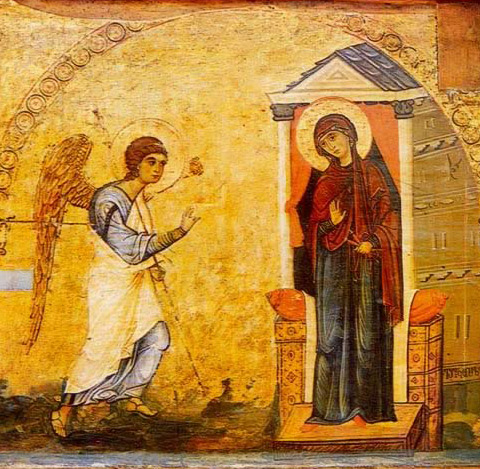
WALK TO JERUSALEM: The Announcement

St. Catherine’s Monastery, Egypt, 12 century

Scripture Reading:  Luke 1: 26-38
In the sixth month the angel Gabriel was sent by God to a town in Galilee called Nazareth, to a virgin engaged to a man whose name was Joseph, of the house of David. The virgin’s name was Mary. And he came to her and said, “Greetings, favored one! The Lord is with you.” But she was much perplexed by his words and pondered what sort of greeting this might be. The angel said to her, “Do not be afraid, Mary, for you have found favor with God. And now, you will conceive in your womb and bear a son, and you will name him Jesus. He will be great, and will be called the Son of the Most High, and the Lord God will give to him the throne of his ancestor David. He will reign over the house of Jacob forever, and of his kingdom there will be no end.” Mary said to the angel, “How can this be, since I am a virgin?” The angel said to her, “The Holy Spirit will come upon you, and the power of the Most High will overshadow you; therefore the child to be born will be holy; he will be called Son of God. And now, your relative Elizabeth in her old age has also conceived a son; and this is the sixth month for her who was said to be barren. For nothing will be impossible with God.” Then Mary said, “Here am I, the servant of the Lord; let it be with me according to your word.” Then the angel departed from her.

Most of us good Protestants seldom talk about The Anunciation at all, let alone in the middle of the season of Lent.  The Anunciation literally means “announcement”.  The word itself probably holds no real mystery.  But it is the beginning of the central tenet of our entire Christian faith–Anunciation, Incarnation, Transfiguration, Resurrection, that cycle of holy mystery that with each turn draws us closer and closer to God as God reveals the very Godself more and more to us.  For us, it begins the mystery that is Jesus Christ, the mystery that will take us to Jerusalem.  For us, the fog lifts and there before us is the bridge between the human and the divine. 

In December, we usually speed past this reading, eager as we are to get to “In those days a decree went out from Emperor Augustus…”  We want to get to the beginning of it all.  But think back.  Jesus was human and just like all humans, something happened nine months before.  And whether or not you take the notion of a virgin birth literally, there was something remarkable that happened.  It is in this moment that God steps through the fog into humanity, that the great I AM reveals the Godself to all of Creation, and, just like every one of us must do, waits to be birthed into the world.  It is not just this young girl’s womb that is suddenly filled with child, swelling with expectant life; it is all of Creation that now waits for Light to be born.  The world is with child.

Can you imagine what Mary must have thought?  She was young, she had plans, she had her whole life ahead of her.  “How can this be?” we read.  In today’s vernacular, it would read, “Are you kidding me?”  And so as everything she knew and everything she planned toppled around her, she said “yes” and entered the mystery of God.  Now, I have to admit, I don’t get so wrapped up in needing Mary to be a literal virgin. (In fact, I don’t care enough about it to need to prove it or disprove it, so you can stay anywhere you are on the issue.) After all, would it really change what happened?  Would it really change who God was or what God has done?  Would it really change that this was the moment when the Light of God came into the world, when the Divine suddenly spilled into the womb of the world.  And that the one who held the birthing of God in her hands said yes.  Now, THAT, my friends, I think is important. 
 
Think about it.  What exactly does it mean to be “virgin”?  It means undefiled, pure, ready and open to receive.  Mary, the virgin, was open to receive God unto herself.  The most scandalous part of the whole story has nothing to do with whether or not the birth was “proper” in terms of our world; the scandal is that the great I AM, the holiest of holies, the One whose name could not be said, suddenly enters humanity with all of its violence and corruption and despair and the reordering of our existence begins.  All that we know and all that we plan is beginning to topple around us.  The Anunciation is the anouncement of hope for all of us.
 
If God’s incomprehensibility does not grip us in a word, if it does not draw us into [God’s] superluminous darkness, if it does not call us out of the little house of our homely, close-hugged truths…we have misunderstood the words of Christianity.  (Karl Rahner)
 
So, in this season of Lent, what does it mean for you to be open to receiving Jesus Christ into your life?  Because, you see, that is the way to Jerusalem…
 
Grace and Peace,
 
Shelli