Amazing, Isn’t it?

This Week’s Lectionary Passage:  Romans 8b-13
“The word is near you, on your lips and in your heart” (that is, the word of faith that we proclaim);9because if you confess with your lips that Jesus is Lord and believe in your heart that God raised him from the dead, you will be saved.10For one believes with the heart and so is justified, and one confesses with the mouth and so is saved.11The scripture says, “No one who believes in him will be put to shame.”  12For there is no distinction between Jew and Greek; the same Lord is Lord of all and is generous to all who call on him.13For, “Everyone who calls on the name of the Lord shall be saved.”

The Word is near you.  It is already there.  You know the answer.  Just listen.  It’s there; hidden deep within your being.  Just believe.  Just confess.  Or is it confess and then believe?  If you notice, the order gets reversed either in the writing or in the translation.  Either way…does it matter?  Do we confess and then believe or do we believe and then confess?  Do we believe what we confess or do we confess what we believe?  Oh, I’m so confused…

I know.  They are just words.  But really, does it matter?  I’m thinking there are a whole lot of rules to this belief thing.  Do we confess?  Do we believe?  Do we confess our beliefs or believe our confessions?  Oh, good grief!  I don’t care.  I’m pretty convinced God doesn’t care.  God just desires that we be with God, that we walk through that threshold where the invitation to “come and see this thing that has happened” is hanging, waiting for each of us.  And the truth is that the invitation is open to all.  As the passsage says, there is no distinction.

So, what came first–the chicken or the egg?  The confession or the belief?  I don’t know.  I don’t think it matters.  God so desires to be with each of us–so much so that God came to this earth as Emmanuel, God With Us.  Call it belief.  God so desires that we realize how much we need God–so much so that God came to show us the way.  Call it confession.  But Paul left it open:  “Everyone who calls on the name of the Lord shall be saved.”  Everyone?  No rules?  No prescribed order of how things happen?  Nope.  Just call.  That’s all it takes.  Call.  That’s all God wants.  And the door will open and you will be welcomed in.  (So what happened to all those rules?)

So as we journey to the Cross, let us stop, step back, let go of the rules and come and see this thing that has happened.  And then, even in the shadows, let us open our eyes and our heart to doing the same thing that God has done.  Invite your neighbor to come and see this thing that has happened.  (Rules?  Nope.  A Profile of who is accepted?  Nope.  An invitation to all?  Yep, that’s the way it works!  Amazing, isn’t it?)

Grace and Peace,

Shelli  

Open Table

Lectionary Passage:  Mark 7: 24-37
To read this passage online, go to http://bible.oremus.org/?ql=213945074.

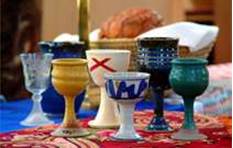
I love being a United Methodist.  I probably take what could be considered an almost unhealthy sense of pride in the fact that we believe in an open table, that we believe that the Feast of Holy Communion, the Eucharist, is not “Methodist” but is instead an open table to which all are welcome.  It sounds good.  It makes us sound like a community in which one would want to be.

But this week’s Gospel reading begins to make us squirm a bit.  After all, we look to Jesus for this model of open invitation, for the depiction of compassion and mercy to which we all aspire.  And then we read this.  I mean, really, is he calling her a “dog”?  Now, with apologies to Maynard, my four-legged roommate, this was NOT a nice thing to say.  And yet, remember, Jesus understood his mission (in fact, EVERYONE understood his mission) as Messiah, the one promised to the chosen people.  Jesus’ mission was to the people of Israel.  There was nothing bad or closed-minded about that; that’s the way it was. So does that mean that this passage depicts a turning point, a veritable transformative moment for even Jesus?  Well, that’s bothersome.  After all, if Jesus needed transformation, where does that leave us?

Well, really, did we think that Jesus was just plunked down on this earth in ready-to-wear form?  After all, remember, he was human, “fully human” we are told.  Transformation is part of our humanity, being transformed is how we become fully human, fully made in the image of God.  It is how we become who we are supposed to be.  Maybe that was the point.  Maybe Jesus was not pushing us at all here, but leading us out of the box that we have built, leading us to who God calls us to be.  Maybe Jesus was showing us that even well-meaning and well-constructed boxes are meant to come crashing down when the time is right.  And the time was right.  This was not a diminishment of Jesus’ power; it was an expansion.  At this moment, the mission began to move and God’s Kingdom began to spread beyond the tight shores of the Galilean Lake and into the Decapolis region.  The Kingdom of God was at hand!

God cannot be contained.  Perhaps this story was Jesus’ realization and affirmation of that very notion.  After all, if Jesus experienced transformation, we are called to do the same.  Once again, Jesus takes a cultural norm (actually several of them!) and turns them on their ear.  It was his awakening to a new reality.  And it was the impetus that pushed the morality police known as his Disciples right out of the box with him.  The walls crash down, the table is set, and all are invited.  Come and feast with your Lord!

But it’s still a hard Scripture.  I mean, really, who did this foreign nameless immigrant think she was?  She was the voice, a voice for all foreign nameless immigrants that dare to claim their crumb at the table, that dare to go where God calls.  You see, the table is really open–not merely to us but by us.  We are the inviters, the ones transformed by relationships with “them”.  What do you bring to the table?  And who do you invite to sit down with you and share the bread and drink the cup?  Who belongs in the Kingdom of God? The Body of Christ given for you. The Blood of Christ poured out for you. And you and you and you and you and you and you and you…..Well, you get the idea.  Did we think this was about us?

Go therefore and make disciples of all nations, baptizing them in the name of the Father and of the Son and of the Holy Spirit, and teaching them to obey everything that I have commanded you.  And remember, I am with you always, to the end of the age. (Matthew 28: 19-20, NRSV)

Grace and Peace,

Shelli

LENT 4B: The Elephant in the Room (or the Sanctuary!)

Lectionary Passage:  John 3: 14-21
And just as Moses lifted up the serpent in the wilderness, so must the Son of Man be lifted up, that whoever believes in him may have eternal life. “For God so loved the world that he gave his only Son, so that everyone who believes in him may not perish but may have eternal life. “Indeed, God did not send the Son into the world to condemn the world, but in order that the world might be saved through him. Those who believe in him are not condemned; but those who do not believe are condemned already, because they have not believed in the name of the only Son of God. And this is the judgment, that the light has come into the world, and people loved darkness rather than light because their deeds were evil. For all who do evil hate the light and do not come to the light, so that their deeds may not be exposed. But those who do what is true come to the light, so that it may be clearly seen that their deeds have been done in God.”

It’s the “elephant in the room”, so to speak, this third verse of the sixteenth chapter of the Gospel According to the writer we know as John.  It’s on street corners and marquis, T-Shirts, football helmets, and sometimes painted on faces at sporting events.  It is often taken as the quintessential “insider” verse, the badge of honor for the believing Christian.  It is often interpreted as “God came; God came to save me and the rest of you are on your own.”  But keep in mind that this Gospel was written later than the others.  To be a follower of Christ, a person of The Way, was just downright hard.  You were NOT an insider.   You were NOT the Christian majority that we so comfortably enjoy. You were part of a fledgling and sometimes persecuted minority that was just trying to hold it together.  So, these words would have been words of encouragement, words of strength, a way of defining who they were as a Jewish minority.  It was a way of reminding them why they were walking this difficult (and sometimes dangerous) path—because of the great Love of God. 

But in the hands of the 21st century Christian majority in our society, these words sometimes become weapons.  They turn into words of exclusion, designating who is “in” and who is “out”, who is acceptable in “honest society” and who is not.  Well, first of all, nowhere in the Gospel are we the ones called to make that determination.  And secondly, look at the whole context of this Gospel by the writer known as John.  It starts out with Creation.  It talks about this great Love that is God, a love that was there from the very beginning.  And it proclaims that God came into the world to save the world.  So how did we interpret this that God had quit loving some of us, that some part of humanity was more worthy of God’s love than another?

The Truth (that’s with a capital T) reminds us that God offers us Life, that God, in effect, DID come into the world to save us—mostly, I would offer, from ourselves, from our misdirected greed, our disproportionately selfish ambition, and from our basic desires to be something other than the one who God has called us to be.  God desires this for everyone.  God really does want to save the world from the world.  And so the Kingdom of God seems to us to sometimes be inching in far too slowly rather than pervading our world.  I think that the world DOES need to somehow be moved to believe, DOES need to somehow begin to see itself anew.  After all, we need to overcome ourselves, overcome all of those misdirected desires.  But that will never happen if the cross is raised as a weapon.  SURELY, we get that it’s something other than that!  Remember, God redeemed it.  God took something so loathsome, so foreboding, so, for want of a better word, evil and turned it into Life.  God is doing the same for the world.  God loves the world so incredibly much that God would never leave us to our own devices (or even, thankfully, to those of who count ourselves as well-meaning believers!).  Instead, God comes into the world and offers us life; indeed, loves us so much that God offers us recreation, redemption, and renewal.  Don’t you think THAT’S the story?  It’s not about who’s in or who’s out.  It’s about Love.  It’s a promise that there’s always more to the story than what we can see or fathom or paint on a sign.  To say that we believe does not qualify us for membership; it leads us to The Way of Life.

My, my…this sanctuary is going to get crowded if we open the doors to everyone!  How about that? Perhaps it’s time we deal with the elephant taking up all this space so there will be room for all!

Wow!  Do you believe that this Season is half over?  We have spent a lot of time in these twenty days exploring our own spirituality.  What if in the next twenty days, we explore what that spirituality means, what it means to reach out to others, to BE who God calls us to be.  Let us start on this twenty-first day of Lenten observance by thinking about what that means to open our doors to all.  What comforts and expectations would we have to drop from our understandings?

Grace and Peace on this Lenten Journey,

Shelli

LENT 3A: On The Outside Looking In

Lectionary Text:  John 4: 5-26 (27-42)
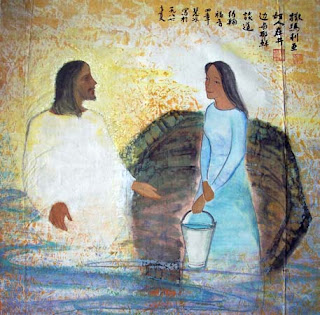
So he came to a Samaritan city called Sychar, near the plot of ground that Jacob had given to his son Joseph. Jacob’s well was there, and Jesus, tired out by his journey, was sitting by the well. It was about noon. A Samaritan woman came to draw water, and Jesus said to her, “Give me a drink.” (His disciples had gone to the city to buy food.) The Samaritan woman said to him, “How is it that you, a Jew, ask a drink of me, a woman of Samaria?” (Jews do not share things in common with Samaritans.) Jesus answered her, “If you knew the gift of God, and who it is that is saying to you, ‘Give me a drink,’ you would have asked him, and he would have given you living water.” The woman said to him, “Sir, you have no bucket, and the well is deep. Where do you get that living water? Are you greater than our ancestor Jacob, who gave us the well, and with his sons and his flocks drank from it?” Jesus said to her, “Everyone who drinks of this water will be thirsty again, but those who drink of the water that I will give them will never be thirsty. The water that I will give will become in them a spring of water gushing up to eternal life.” The woman said to him, “Sir, give me this water, so that I may never be thirsty or have to keep coming here to draw water.” Jesus said to her, “Go, call your husband, and come back.” The woman answered him, “I have no husband.” Jesus said to her, “You are right in saying, ‘I have no husband’; for you have had five husbands, and the one you have now is not your husband. What you have said is true!” The woman said to him, “Sir, I see that you are a prophet. Our ancestors worshiped on this mountain, but you say that the place where people must worship is in Jerusalem.” Jesus said to her, “Woman, believe me, the hour is coming when you will worship the Father neither on this mountain nor in Jerusalem. You worship what you do not know; we worship what we know, for salvation is from the Jews. But the hour is coming, and is now here, when the true worshipers will worship the Father in spirit and truth, for the Father seeks such as these to worship him. God is spirit, and those who worship him must worship in spirit and truth.” The woman said to him, “I know that Messiah is coming” (who is called Christ). “When he comes, he will proclaim all things to us.” Jesus said to her, “I am he, the one who is speaking to you.”

What was she even doing there, this woman of Samaria?  Here she was walking the streets alone, coming to the well in the heat of the day hoping that she wouldn’t run into any of the regulars.  She was tired of being taunted, tired of having to try so hard to ignore the cutting remarks and the cold stares.  And so she comes to draw water hoping against hope that no one would be there, to draw water from this old well steeped in history.  She was surprised when this man appeared.  He was a Jew.  What was he doing here in her city?  She put her head down, hoping that he would just pass by and be on his way.  She didn’t want any trouble.

The less than civil relationship between the Jews and the Samaritans dated back at least 1,000 years before the birth of Christ.  Both believed in God.  Both had a monotheistic understanding of the one true God, the YHWH of their shared tradition of belief.  But where the temple of YHWH for the Jews existed on Mount Zion in Jerusalem, the Samaritans instead worshipped God on Mount Gerizim near the ancient city of Shechem.  And with that, a new line of religious understanding was formed.  The Samaritans believed that their line of priests was the legitimate one, rather than the line in Jerusalem and they accepted only the Law of Moses as divinely inspired, without recognizing the writings of the prophets or the books of wisdom.   What started as a simple religious division, a different understanding of how God relates to us and we relate to God, eventually grew into a cultural and political conflict that would not go away.  The tension escalated and the hatred for the other was handed down for centuries from parent to child over and over again.

But this is not what Jesus saw in the woman.  He asked her for a drink and began a relationship that cut through 1,000 years of prejudice and hatred and outsiders.  Jesus saw her not as a Samaritan and not even as a lowly woman but as a fellow human, a sister, a child of God.  And somewhere in the conversation, the woman saw who Jesus was too.  He was no longer a Jew; she was no longer a Samaritan.  He was no longer the insider looking out; she was no longer the outsider looking in.  They were instead part of a shared humanity with a shared vision of what the world looked like.  The woman’s new life begins when she recognizes Jesus’ identity.

Now I don’t think that Jesus had some grand evangelism plan.  He was not trying to add numbers to his membership.  If you read the whole lectionary passage (I cheated and shortened it a bit!), the woman does not convert to Christianity (which wasn’t really invented yet!).  She doesn’t even convert to Judaism.  She is still a Samaritan.  In fact, it says that she drew other Samaritans into who Jesus was.  The point is that Jesus was not trying to build a flock of followers; he was trying to show people how to see that which illumined the Way to God.  The fact that they saw it was enough.  Perhaps the woman and her friends left after this and went to Mt. Gerizim to pray.  Thanks be to God!  Making disciples of Jesus Christ is not about increasing our church’s membersip.  It is not about forming people to look just like us or expecting them to change so that they can join our partying and praying clan.  Jesus didn’t expect the woman to change.  In fact, he didn’t even expect her to join him.  He just showed her what God’s love poured out into the world really looked like.  And from the outside looking in, she saw him.  And then she went to tell others.  Isn’t that what it’s about?  Maybe our problem is that we’re on the inside looking out.  Jesus is here, come to give each of us life.  Maybe when we’ve finished counting the offering and figuring out how many people were here today, we’ll finally look and see the One who offers us life, the One who brings all of the world into God.

So in this season of wandering and wondering, just learn how to see.

Grace and Peace,

Shelli

Sea Monsters & Flying Things

Genesis 1: 20-23

And God said, “Let the waters bring forth swarms of living creatures, and let birds fly above the earth across the dome of the sky.” So God created the great sea monsters and every living creature that moves, of every kind, with which the waters swarm, and every winged bird of every kind. And God saw that it was good. God blessed them, saying, “Be fruitful and multiply and fill the waters in the seas, and let birds multiply on the earth.” And there was evening and there was morning, the fifth day.

Myth of the Bird Creation is wider and more inclusive than we usually let it be.  If the Resurrection of Jesus is the “new creation”, then where are the sea monsters and the birds?  What happens to them?  The truth is that we probably sort of skip through these verses in the context of the Creation account.  And yet, God thought that those things that were not like us, that did not live the way we live or exist the way we exist were worthy of creating even before us.  What does that say?

I think it reminds us the same thing that Jesus did:  The world was not made in our image.  Creation is not limited to the way we see or the way we think or the way we live.  God is bigger than we can possibly imagine.  God reaches beyond where we go.

The lesson here is simple:  Christ died for you…and him, and her, and the one that you got “pissed off” (sorry, it said it better!) at yesterday, and the one that you don’t understand, and the one that scares you, and the one that doesn’t live the way you do or think the way you do or believe the way you do or sleep with who you think they should or live where you do.  In fact, Christ died for the sea monsters and the flying things, those things that are not us and do not exist where we are.

Remember that on Holy Saturday, tradition tells us that Christ “descended into hell”, sweeping up all those things that are different, all those things that we do not understand, all those things that threaten or defy our being and Christ took them unto himself.  Now if Christ can do that with hell and sea monsters and flying things, why are we so high and mighty about who belongs “in” and who belongs “out”.  After all, that’s not what Jesus did.

Go and welcome them all in!  After all, THAT’S the answer to “What Would Jesus Do”, if you’re keeping track!

Grace and Peace,

Shelli