Imagining Hope in the Wilderness

With all this talk about wildernesses and wanderings, turmoil and temptations, drought and devastation, it is hard to imagine hope.  But the whole point of this journey of faith is not some sort of perverse satisfaction in denying ourselves or in the morbidity of suffering in the wildernesses of our lives.  The point of it all is the promise of life that we have been given and for which we hope.  When we venture into a wilderness, it is not limited to morose sadness and despair.  There is so much more to life than that!  The Scriptures are full of wildernesses.  Some of them are deep and foreboding, some are long and difficult journeys, and some are little more than an unwelcome inconvenience.  But always, always, in Scripture they are a way to somewhere else–parting seas, burning bushes that encounter the holy, or wrestling dreams.  They all lead home.  Beyond the wilderness, on the other side, just over the mountain or just through the trees, is the light, the newly-created dawn.  We just have to imagine it for now.

Maybe that’s what faith is about–imagining the dawn, imagining hope.  After all, if it were clear and always present, we would need no faith.  But even on a clear day, the way is murky and often wrought with danger.  So as we travel, we are called to imagine what is beyond, to imagine what we have yet to see.  It’s the way we find joy in suffering and and hope in despair, not by taking morose satisfaction in our dilemma but in learning to look toward something that we do not see.  There is always something more.  So when you find yourself in a wilderness of pessimism or hopeless, a wilderness in which you just can’t seem to find the way, a wilderness where every turn provides yet another obstacle or yet another challenge or yet another temptation for which you were not prepared, close your eyes and imagine hope.

Think about it.  If you get in your car to drive somewhere don’t you have at least some semblance of where your are going?  Haven’t you sort of imagined what is up ahead?  Why should our faith journey be that much different?  Not that we’re trying to get to a physical destination but rather to a place on the journey where the promise of life is so profoundly evident that we do nothing else but imagine what’s up ahead.  And in our imagination of hope is found life.  Imagining hope brings freedom and joy and strength for the journey.

To be honest, it is this Lenten wilderness that takes us through the desolation of the cross and Golgotha that teaches us hope.  To believe in the cross is to believe that there is something else beyond it.  To live this Way of Christ is to imagine hope.

Hope looks ahead for that which is not yet.  (Henri Nouwen, in Seeds of Hope)

So, continuing with our act of giving up so that we can take on, on this Second Sunday of Lent, let go of somethng about which you are worried, let go of feeling like there’s no way out, let go of feeling like you’ve lost your way, and imagine hope. 

Grace and Peace on this Lenten Journey,

Shelli

LENT 3A: Perfect Peace

LECTIONARY TEXT:  Romans 5: 1-11
Therefore, since we are justified by faith, we have peace with God through our Lord Jesus Christ, through whom we have obtained access to this grace in which we stand; and we boast in our hope of sharing the glory of God. And not only that, but we also boast in our sufferings, knowing that suffering produces endurance, and endurance produces character, and character produces hope, and hope does not disappoint us, because God’s love has been poured into our hearts through the Holy Spirit that has been given to us.  For while we were still weak, at the right time Christ died for the ungodly. Indeed, rarely will anyone die for a righteous person—though perhaps for a good person someone might actually dare to die. But God proves his love for us in that while we still were sinners Christ died for us. Much more surely then, now that we have been justified by his blood, will we be saved through him from the wrath of God. For if while we were enemies, we were reconciled to God through the death of his Son, much more surely, having been reconciled, will we be saved by his life. But more than that, we even boast in God through our Lord Jesus Christ, through whom we have now received reconciliation.

Thomas Merton said that “the Christian must not only accept suffering; the Christian must make it holy.”  That is very strange to us.  What exactly is holy suffering?  Suffering is bad; suffering is unbecoming; suffering is something that we all try to avoid.  So, how then, can we accept this claim that suffering produces hope?  Keep in mind that the early believers to whom Paul wrote were used to a Roman understanding of peace.  Augustus Caesar had established the Pax Romana, which sought to move in on the entire world.  It was an understanding of peace that would come from Roman prosperity and Roman power.  (I suppose they thought that peace would come if everyone else would just shut up and live the way they do!)  So, Paul is taking the “motto of the day” and turning it inside out.  This peace places its hope in glory; it is part of that larger hope of life in Christ.

Today’s news, for me, does not echo chords of peace–a bombing at a Jerusalem bus stop, the military action over Libya, and rumblings of discords from other countries in the area.  And so our discussions about peace become discussions about power.  We seem to be arguing more over who is going to be in charge of the military operations than talking about peace.  Our vision of peace has a lot to do with who’s in charge, with who has the power.  Our idea of power is an end in and of itself, rather than a way to peace.  Maybe we could stand a little reframing from Paul too.  For us, suffering is a failure; within the vision of God, suffering holds hope for newness.  Because in the midst of suffering, just like in the midst of everything else, we find God.  God walks with us through it, loving us and holding us, perhaps even revealing a way out of it, if we would only listen, and gives us a glimpse of what is to come.  The suffering of the world reveals the heart of God, reveals the holiness that is, if we will only look.

Truthfully, I don’t know what perfect peace looks like.  Chances are, I, like all of you, would be limited by a peace that makes my life easier and a lot less scary.  That’s not what it is, comfortable and lovely as that may sound.  Perfect peace is not lack of suffering; it is oneness with God.  And oneness with God enables us to see holiness in everything, to see beauty where there is none, and to see light even in the darkness.  In this season of Lent, we once again walk toward the Cross, with the drums of discord, still this moment far in the distance, growing louder with each step.  This season lasts for forty days.  But those forty days do not include the Sundays of Lent.  Known as “little Easters”, they are opportunities to glimpse and celebrate the Resurrection even in the midst of darkness.  They are reminders that even in this season of Christ’s Passion and Death, their is always a light on the horizon.  Resurrection always comes.  But it’s not a fix; it’s not a reward for the most powerful; it’s what happens when God’s love is poured into our hearts.

So, in this Lenten season, definitely pray for peace but, in the meantime, walk toward hope.

Grace and Peace,

Shelli    

Looking for a Miracle

Scripture Passage:  Matthew 12: 38-42
Then some of the scribes and Pharisees said to him, ‘Teacher, we wish to see a sign from you.’ But he answered them, ‘An evil and adulterous generation asks for a sign, but no sign will be given to it except the sign of the prophet Jonah. For just as Jonah was for three days and three nights in the belly of the sea monster, so for three days and three nights the Son of Man will be in the heart of the earth. The people of Nineveh will rise up at the judgement with this generation and condemn it, because they repented at the proclamation of Jonah, and see, something greater than Jonah is here! The queen of the South will rise up at the judgement with this generation and condemn it, because she came from the ends of the earth to listen to the wisdom of Solomon, and see, something greater than Solomon is here!

It is interesting that there are really no “Holy Saturday” Scriptures, per se.  The Lectionary readings jump to the passages that will be used this evening for the Easter Vigil as we hear again the covenants, God’s promises of a world made new.  But what about this morning?  There are no words for the way we feel.  There are no Scriptural or theological platitudes that we can toss around this day to feel better.  There are not even any pictures.  The sun came up just like it normally does and everything looks the same.  Everything, that is, except the empty chair at the table, the missing voice of a teacher, and the closed tomb waiting for the Sabbath to pass so that we can do our work.  The world is still waiting for a sign, waiting for a miracle. But there will be no calming of waves of grief this time; there will be no healing of our pain; and a quick peak shows only tepid water in the jars.  There is no wine this time.  There will be no sign.  The miracle this time is that there will be no miracle.  God, it seems, has finally left us to ourselves.

Perhaps the reason that there was no miracle is that the world itself had changed.  The New Creation had begun.  We were just too wrapped up in our grief and our despair and some of us in our guilt and shame to see what God had begun to do.  The traditional Apostles’ Creed says that Jesus “descended into hell” after the Crucifixion and before the Resurrection.  Most mainline churches (at least of the ones that still choose to even say the universal creeds!) respectfully or regretfully or embarrassingly leave that part out. After all, what does that mean?  Hell is for those who have no hope; hell is the finality of being so bad that you cannot be redeemed, right?  How can Jesus go to hell?  How can the Son of God, the Messiah, wander around and be seen in a neighborhood like that.  It’s just not right. 


Maybe the miracle is that hell and heaven, just as humanity and the Divine, were somehow poured together for all eternity.  Maybe the miracle is that God has now come so close to us that there is no longer a place that we can go without God being there with us, whether or not we can sense that.  Maybe the miracle is that hell, itself, like death, is no more. Maybe the miracle is that we no longer need a miracle.  Because, my friends, we have been promised life.


Jesus laid out what would happen earlier this week.  In the Lectionary Passage from Holy Tuesday (John 12: 20-36), Jesus depicted the events of this week-end as the Christ being “lifted up” and then “gathering all in”.   Now everyone knows that when you begin gathering something, the first sweep starts at the bottom.  You extravagantly dig deep, trying to get everything you can on the first pass.  Maybe on this morning as we grieve and regret and wonder what life will be, God through Christ is digging deep into the bowels of hell and extravagantly gathering them in.  Jesus descended to earth that we might be shown the Way, that we might know what Life means, that we might be redeemed, renewed, and recreated and then be poured over with Light.  Jesus descended to earth that we might be “gathered in”.  Why, then, couldn’t the Lord of Life, descend further, descend beyond where we even thought God could go, and do the same thing?  After all, who are we to say how big or how loving or how extravagantly welcoming God is?


Are you looking for a sign?  There is no need for one.  There is no more need for miracles, no more need for one-time, unique “fixes” to Creation.  It’s ALL being recreated.  Even God can begin again.  But THIS time, God desires not to do it alone.  THAT is the miracle.


In the silence of this day, feel your grief and mark your shame, knowing that the dawn of life is there even for you.  And once the Sabbath passes, we, too, can begin our work.

For thine is the Kingdom, and the Power, and the Glory forever.  Amen.

Grace and Peace on this Holiest of Gathering Days,

Shelli

The Days are Surely Coming

“The days are surely coming…No longer shall they teach one another , or say to each other, ‘Know the Lord,’ for they shall all know me, from the least of them to the greatest, says the Lord; for I will forgive their iniquity, and remember their sin no more.” (Jeremiah 31: 27..34)

The Old Testament scripture from today’s Lectionary’s text paints a vision for which we all look. It is the vision of that time when the covenant “written on the people’s hearts” will finally be fulfilled. As Christians, it is hard for us to not read this Scripture through our own lens. But remember the setting in which this was probably written: It is the time following the exile. The cities have been breached; the temple has been totally destroyed; there is nothing left of the lives that were before. The people who first heard this had become subjects of the Persian king and life as they knew it has been ripped away at its very foundations. But through the prophet Jeremiah, God unveils a vision of reconstruction and renewal. But this time, things will be different…

This time things will be different…How many times have you heard that in your own life? THIS time I won’t eat so much; THIS time I won’t get so upset; THIS time I won’t let myself get into this mess; THIS time I’ll do it right. This time things will be different…But THIS time God is not giving us a set of rules. God is not telling us what to do or when to do it. God instead promises a renewed covenant, a transformation from what was to what will be. And this time things WILL be different…

By writing it in our hearts, God has written Godself into us, renewing that image of the Godself buried deep within our beings. God is making who God is part of our very essence. It is permanent. God has written the capacity for immense love and unending faithfulness into us. And someday…someday…we’ll realize what that means. And this time things WILL be different…

We have spent the last few weeks wandering in our own wildernesses. And today, the road changes. The wilderness seems to be not so evident, as if a sort of organized earthly sprawl is creeping into it. There are more houses than we remember seeing before, more signs of people going about their lives, better pavement on the roads. We must be nearing the city. Jerusalem is just over the horizon. We are not yet there, but we sense that change is in the air. There is a sort of excitement. People are beginning to gather. And somewhere over the hill, there’s a faint cadence of drums and some sort of hammering in the distance. It is hard to understand what it all means. But we, with the Godself written into our being and the promise of a new life deep within our hearts, will walk on…toward Jerusalem. And God walks with us…

So go forth toward the city. There is no way around!

Grace and Peace,

Shelli

Threshold

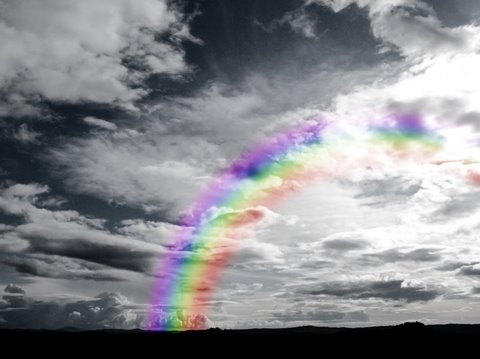
In this Sunday’s Lectionary readings, the passage from the Hebrew Scriptures is the end of the account of Noah and The Great Flood. Noah and his family have listened to God, built the ark, and have now been cooped up for months as the torrential waters pounded against the wood of their somewhat tenuous residence, drowning the very earth and all the foundations that they knew. Noah sends a bird out to “test the waters”. The bird returns. After several attempts, the bird finally does not return. The land is ready; the waters have receded and the earth has reappeared. And there–there in the sky is a splash of color, a bow in the clouds, the sign of God’s promise that Creation will never again be separated from its Creator.

The Celts understood the rainbow as a bridge, a threshold between what is and what will be. It is, in Celtic terms, a “thin place”, as the thin gaseous vapors form a sort of bridge in the clouds between one way of being and the next. This is the bridge to promise and discovery; this is the bridge to life. Hey….maybe there really is a pot of gold at the end!

This is a perfect passage for Lent. We are indeed in a threshold season, a season between one world and the next, between death and eternity, between who we are and what we will be. Lent is not a season where we withdraw, pulling ourselves away from our lives and the world. For some of us, we think we need to do that, giving up things that are part of our lives to remind us of our connection to God. Don’t get me wrong. Lent is a contemplative and retrospective season, a season when we take a good hard look at our lives, at their failings and misgivings, at the ways that we have been complicit in the continued crucifixion of goodness and grace and love. But the retrospection is not to fill us with remorse or regret; it is to propel us forward through the threshold. It is to open to our eyes to the thin places, where the colors come alive and the way is clear.

The rainbow, the promise of hope, is, in physical terms, a reflection. It is a mirror of what surrounds it. And in that mirror, in that threshold, we see ourselves–our life, our death, and, our glorious resurrection. Because, after all, that IS the pot of gold at the end of the rainbow!

So go forth this season and seek the threshold–do not be afraid–it is filled with hope and promise like nothing you’ve ever known!

Grace and Peace,

Shelli