Protecting Our Identity

Who are you?  No, I mean really.  Who are you?  Most of us live lives that demand that we take on numerous roles.  For me, I am a pastor, a preacher, a friend, a confidante, a counselor, a teacher, a daughter, a sister, a cousin, a homeowner, a sometimes-writer, a reader, a cook, a lover of antiques, a lover of history, and, right now, a human companion and purveyor of food and treats to one dog that I adopted on purpose and another one that twelve days ago accidentally adopted me (does anyone want a really cute dog?).  And those roles are just the tip of the iceberg.  It gives new meaning to “meeting yourself coming and going”.

The articles and advertisements for protecting one’s identity seem endless nowadays.  It’s the new danger in our world, the chance that someone might steal who we are, that we might somehow lose ourselves.  And so we shred and we cut and we lock and we watch.  We do everything to keep who we are intact. And yet, we find ourselves searching for who we are.  Isn’t that interesting?

God created each one of us.  We are unique, full of gifts and graces, most of which we haven’t even tapped into yet.  Each of us is a child of God, with the ability to become fully human and the desire to connect with the Divine.  I think that God actually envisions something for each of us, that God somehow created us with an idea of what the best of each of us is.  But we’re not children of the Stepford clan.  We are not pre-programmed robots that God wound up at the start and then pushed us down the road with enough battery juice to get us to the end of the road.  No, God’s vision of Creation was much more nuanced and much more beautiful than that.  Somewhere along the way, God decided to instill the notion of free will in us, the wherewithal (if, sometimes, not the ability!) to choose–to choose right from wrong, to choose one road or another, to choose to be one role or to be something completely different.  God gave us life and  envisioned what that life could be, envisioned our identity.  But how we get there is completely up to us.

Maybe this life of faith is about protecting our identity, then–from the world, from all those voices that beg for our time or our money or our attention, and, most of all, from ourselves.  Maybe learning to walk this life of faith is about figuring out how to protect our identity, walking that journey of becoming, losing, recapturing, and becoming again that Being that God envisioned us to be from the very beginning. It’s hard.  So, in this Season of Lent, as we strip away all of those encumbrances that pull us away from ourselves, as we try to find the way back to who we are, maybe it’s not just about becoming someone else, but protecting who we are in the first place.  So who are you?  No, I mean, really.  Who are you?

 
On this eighteenth day of Lenten observance, make a list of all your roles in life.  Which ones drain your existence?  Which ones give you life?  It’s a good thing to think about once in awhile.

Grace and Peace on this Lenten Journey,

Shelli  

And I’m serious…anyone want to adopt a dog?

LENT 2B: Religiosity on Life Support

Lectionary Text:  Romans 4: 13-17 (18-25):
For the promise that he would inherit the world did not come to Abraham or to his descendants through the law but through the righteousness of faith.If it is the adherents of the law who are to be the heirs, faith is null and the promise is void.For the law brings wrath; but where there is no law, neither is there violation.For this reason it depends on faith, in order that the promise may rest on grace and be guaranteed to all his descendants, not only to the adherents of the law but also to those who share the faith of Abraham (for he is the father of all of us,  as it is written, “I have made you the father of many nations”) —in the presence of the God in whom he believed, who gives life to the dead and calls into existence the things that do not exist.

In our pragmatic 21st century minds, sometimes it is much easier to grasp at the obvious and to make that the basis of our belief.  But, as Paul reminds us, if our whole faith system depends on nothing more than adhering to the set of laws or interpretations that have been laid down by those that came before us, what good is faith?  Remember that faith is about relationship.  The law is not bad.  In fact, it’s usually a necessary construct to help us understand, to help us point to that which we believe.  But it is not the end all.  It is not the God who offers us relationship.

Now, that said, I personally struggle with those who profess to be “spiritual and not religious”.  Really?   For me, it’s a little like traveling without baggage, which can mean that your not weighted down and are essentially free to do what you want, but, chances are, at some point you’re going to find yourself virtually unprepared for what you encounter.  To put it another way, how many of you really want to go to dinner with someone who always leaves their wallet at home?  They may be fun to talk to and all, but is that really the way we live?

There is a story told among Zen Buddhists about a nun who one day approached a great patriarch to ask if he had any insight into the Nirvana sutra she had been reading. “I am illiterate,” the man replied, “but perhaps if you could read the words to me I could understand the truth that lies behind them.” Incredulous, the nun responded, “If you do not know even the characters as they are written in the text, then how can you expect to know the truth to which they point?”  Patiently the patriarch offered his answer, which has become a spiritual maxim for the ages: “Truth has nothing to do with words. Truth can be likened to the bright moon in the sky. Words, in this case, can be likened to a finger. The finger can point to the moon’s location. However, the finger is not the moon. To look at the moon, it is necessary to gaze beyond the finger, right?” (from a commentary by Daniel G. Deffenbaugh, available at http://www.workingpreacher.org/preaching.aspx?lect_date=3/4/2012&tab=3, accessed 27 February, 2012.)

Now I don’t think Paul would in any way dismiss religion or even the rules.  He’s just reminding us that they have their limitations.  They are not God.  In fact, it is easy for them to become idols of worship in and of themselves (and last I read that was frowned upon!).  But they have their place.  They provide a systematic way of at least attempting to understand something that, in all honesty, really makes no sense to us.  (And, to turn it around, professing to be “spiritual and not religious” actually has a good chance of becoming a religion in and of itself.)  An authentic faith, it seems, is one that weaves what doesn’t make sense into understanding, laughter into prayer, and a grace-filled encounter of the Divine into our everyday life.  It is about both transcendence and meaning and, on a good day, the weaving together of the two into a Holy Encounter with the Divine Presence that it always in our life. 

You cannot practice religion for religion’s sake.  That would certainly be the death of your being.  You need to somehow breathe life into it.  That’s where spirituality comes in.  But spiituality cannot stand alone because it has nothing on which to stand.  Together they are religiosity on life support—a practice of faith, an embrace of the faith community, a recognition of one’s call to help and serve others, all with the Spirit of God, the life of your being, breathed into onself. 

G.K. Chesterton said to “let your religion be less of a theory and more of a love affair”.

On and on…continuing with our act of giving up so that we can take on, on this seventh day of Lent, think about the rules that you follow in your life and in your faith.  Which of them give you life?  Which of you them do not?  Let go of those rules that do not give you life, even if they are the “untouchable” ones!  It’s not about rules; it’s about life! 

Grace and Peace on this Lenten Journey,

Shelli

LENT 1B: The Harrowing of Hell

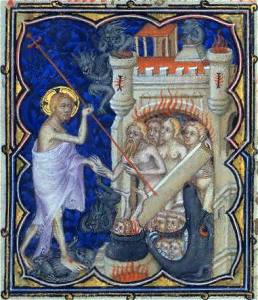
The Harrowing of Hell, depicted in the Petites Heures
de Jean de Berry, 14th c.  illuminated
manuscript commissioned by
John, Duke of Berry.

LECTIONARY PASSAGE:  1 Peter 3: 18-22
For Christ also suffered for sins once for all, the righteous for the unrighteous, in order to bring you to God. He was put to death in the flesh, but made alive in the spirit, in which also he went and made a proclamation to the spirits in prison, who in former times did not obey, when God waited patiently in the days of Noah, during the building of the ark, in which a few, that is, eight persons, were saved through water.  And baptism, which this prefigured, now saves you—not as a removal of dirt from the body, but as an appeal to God for a good conscience, through the resurrection of Jesus Christ, who has gone into heaven and is at the right hand of God, with angels, authorities, and powers made subject to him.

The faith communities to which this was written did not have it easy.  They were the outsiders–shunned, unaccepted, separated from the only society that they knew.  To put it bluntly, they were living in hell.  So this comes as a reminder that what they are experiencing now is not permanent.  It is not the final word.  New life is just over the horizon.  For the writer of this epistle, this is a sure promise, made real through our baptism.  Baptism here is depicted a recreation, as resurrection.  The whole point is that believers do not need to fear the difficulties and sufferings that are present now.  God has indeed promised something new.  In all honesty, I don’t think this writer necessarily saw baptism as merely a cleansing.  Rather, baptism is a claiming.  We are claimed by God.  We are empowered by the Spirit of Christ.  We are made new.  So no matter what hell we might find ourselves in, there is more up ahead.  God has claimed us.  Each of us is a beloved child of God.  Our baptism acknowledges that and, like the waters that flooded the earth, sweeps us into new life.

In fact, even the powers of hell cannot impede the recreation that is happening all around us.  Now our church chooses to recite the more sanitized version of the Apostles’ Creed but there is an older version that dates back to the 5th century that goes like this:  “I believe in God the Father almighty, maker of heaven and earth; and in Jesus Christ, his only Son our Lord, who was conceived by the Holy Ghost, born of the Virgin Mary, suffered under Pontius Pilate, was crucified, dead, and buried. He descended into hell.”  That last sentence is believed to have been loosely taken from this passage.  We read that Jesus proclaimed even to the “spirits in prison”.  In other words, Jesus descended into hell, into the bowels and depths of life.  And, there, he blew the gates open and the eternally forsaken escaped, crossing the threshold to new life.  In the Middles Ages, it was referred to as the “Harrowing of Hell”.  Now, admittedly, there is little basis for this theology but if death hath no sting, why would hell win?  (And to be honest, there’s really little basis for the notion of “hell” as we 21st century folks think of it.  I think Dante did us no favors. ) If God’s promise extends to all of Creation, then perhaps hell really hath no fury.    

Now this is in no way a lessening of the impact or importance of sin.  We all know that.  We sin.  We try not to.  But we sin.  In fact, most of us are pretty good at creating our own hell.  We plunge ourselves into darkness, into separation from God, through fear, or guilt, or shame, and we struggle to claw our way out.  But even the powers of sin are no match for the promise before us.  That is the whole point of our faith.  So, if we believe that, why is it such a stretch to believe that the God of all, the God who loves us, and who has claimed us, could vanquish all the powers that afflict us, that God has vanquished all the powers of hell?

Perhaps this Lenten season of penitence is not so much a call to grovel at the feet of a forgiving God but rather to faithfully follow this God who beckons us home again to begin again.  Maybe it truly is the harrowing of whatever hell we find ourselves in.  But in order to do that, we have to name our sin and release its power.  It’s part of our story.  It’s part of what we must tell.  And with that, the waters subside and the green earth rises again.  Now, I don’t profess to know the whole truth about this hell thing.  It’s not an issue for me.  But I struggle to reconcile the notion of a place called hell with this God who offers eternal mercy and grace and forgiveness, with this God that wants the Creation to return so badly to where they belong, to enter into a relationship with the Godself–so badly, in fact, that this God would come and walk this earth just to show us the way home.  Oh, don’t get me wrong.  Hell definitely exists.  But perhaps it is our creation, rather than God’s.  Perhaps our faith will show us that the gates of hell have already been removed and that all we have to do is walk the way toward life.  Let this Lenten Journey be your Journey toward Life.

So, continuing with our act of giving up so that we can take on, on this third day of Lent, think about those things that create your hell.  Is it fear?  or shame?  or guilt?  Is it the need for everyone to approve of you and like you?  Whatever it is, let it go.  Make room for that which gives you Life.

Grace and Peace on this Lenten Journey,

Shelli

At the center of the Christian faith is the history of Christ’s passion.  At the center of this passion is the experience of God endured by the godforsaken, God-cursed Christ.  Is this the end of all human and religious hope?  Or is it the beginning of the true hope, which has been born again and can no longer be shaken?  For me it is the beginning of true hope, because it is the beginning of a life which has death behind it and for which hell is no longer to be feared…Beneath the cross of Christ hope is born again out of the depths.  (Jurgen Moltmann)

Grace and Peace on Your Lenten Journey,

Shelli    


The Days That Come After

In the beginning when God created the heavens and the earth,the earth was a formless void and darkness covered the face of the deep, while a wind from God swept over the face of the waters.  Then God said, “Let there be light”; and there was light.And God saw that the light was good; and God separated the light from the darkness.God called the light Day, and the darkness he called Night. And there was evening and there was morning, the first day. (Genesis 1: 1-5)

In those days Jesus came from Nazareth of Galilee and was baptized by John in the Jordan.And just as he was coming up out of the water, he saw the heavens torn apart and the Spirit descending like a dove on him.And a voice came from heaven, “You are my Son, the Beloved; with you I am well pleased. (Mark 1: 9-11)

I saw a movie trailer for a new movie called “Extremely Loud and Incredibly Close,” which is apparently a story of a young boy’s life after his father is killed in the 9/11 terrorist attacks.  The trailer ends with these words written on the screen:  “This is not a story about 9/11; it is a story about the days that come after.”  I thought that was a very profound statement.  After all, do we sometimes focus so much on specific times and specific days that we lose what it means to live the rest of them?  In some way, living a life of faith means getting beyond endings.  Maybe it even means getting beyond beginnings.  It means doing something with all of them as part of the totality of life.

Yesterday we remembered the Baptism of Jesus and through that also remembered our own.  And our lectionary readings for the day included the first five verses of Genesis.  We all know that it is the beginning of the story of Creation, the beginning of life, the beginning of our own beginnings.  But, truth be told, it wasn’t the beginning of EVERYTHING.  After all, it says that before it all, the earth did exist.  It’s just that it was a formless, shapeless void.  Perhaps it was a chaotic mass of swirling, meaningless matter.  And then God Said.  Those are the most powerful words imaginable.  With one simple statement, God creates order, shape, life.   As God’s Spirit sweeps over the waters, meaningless matter becomes earth.  It is not perfect; it is not the way it will be; it is the way it should be.  It is good.

But we know it doesn’t stop there.  The days go one and God creates sky, and land, and seas.  Then, rather than directly creating (we sometimes gloss over this), God appoints the earth to start creating, to bring forth vegetation.  God calls Creation to create.  Then God creates suns, and moons, and animals, and us.  And then, as the pinnacle of Creation, God creates Sabbath rest, completion, a taste of eternity.  You see, it doesn’t stop at “in the beginning”. The days that come after are what makes Creation the way it was intended to be.

And in those days that Creation continued,  once again God’s Spirit moved over the waters.  And this time, the heavens were torn apart (not opened, but violently ripped apart in a way that they could never go back together in the same way), and God’s Spirit decended.  And once again, God spoke:  “You are my Son, the Beloved, with whom I am well pleased.”  Once again, God Said. It is good.

The days that come after are the days.  Beginnings and endings are only markers, turning points, crosswalks.  We are told to “remember our baptism and be thankful.”  Truth be told, I don’t remember mine.  I was just a baby.  But remembering is not about the beginning; it is about the days afterward.  So, as people of faith, what will we do with those days afterward?  Faith is not about baptism; it is about the days that come after.

What will you do with your days that come after?

Grace and Peace,

Shelli

P.S.  As a programming note, I’m going to try to post a blog entry twice a week or so during this Season of Epiphany and then return to daily posts during our Lenten journey.  Thanks for staying with me!  Shelli

One Who Is Mighty and Brave

Lectionary Text:  Matthew 14: 22-33
Immediately he made the disciples get into the boat and go on ahead to the other side, while he dismissed the crowds.23And after he had dismissed the crowds, he went up the mountain by himself to pray. When evening came, he was there alone,24but by this time the boat, battered by the waves, was far from the land, for the wind was against them.25And early in the morning he came walking toward them on the sea.26But when the disciples saw him walking on the sea, they were terrified, saying, “It is a ghost!” And they cried out in fear.27But immediately Jesus spoke to them and said, “Take heart, it is I; do not be afraid.”28Peter answered him, “Lord, if it is you, command me to come to you on the water.”29He said, “Come.” So Peter got out of the boat, started walking on the water, and came toward Jesus.30But when he noticed the strong wind, he became frightened, and beginning to sink, he cried out, “Lord, save me!”31Jesus immediately reached out his hand and caught him, saying to him, “You of little faith, why did you doubt?”32When they got into the boat, the wind ceased.33And those in the boat worshiped him, saying, “Truly you are the Son of God.”

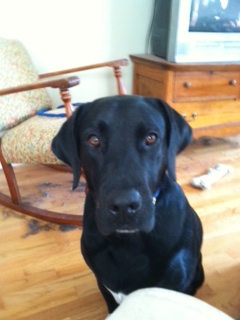
One year ago today, I adopted a rescued Labrador retriever.  He had been picked up in some place downtown where people throw food for homeless dogs.  He landed at B.A.R.C. (For those non-Houstonians, that’s the Bureau of Animal Regulation and Control.  I think they used to call it the “city pound”.) and was there, unbelievably, for three months. On the night before he was to be put down, someone at B.A.R.C. called Scout’s Honor Rescue and told them to come get this “wonderful little black lab” before they put him down.  He was put into foster care and, unbelievably, I found him on the Internet with his own page asking to be adopted.  (Isn’t technology amazing?) Somewhere along the way, someone had named him Vader, which I just thought was odd.  So, I changed his name to Maynard. (Which, admittedly, YOU may think is odd!)  It means “one who is mighty and brave”.  It just seemed to fit for a rescue dog.  He had been hungry and homeless and out in the elements.  He had been caged and deserted and begging.  But when he came home with me, it took a little while.  He was enamored with the dog toys.  He was amazed that there was dinner every night. He thought the yard and the walks were wonderful.  But when I left him, there was a look in his eyes.  I think he always wondered if I was really coming back.  A year later, that look is not there.  He has been swept into my unpredictable life.  He has often been the last one picked up from his weekly daycare outing and a couple of weeks ago, he had to be “emergency boarded” because his owner got tied up at a hospital with a pastoral care visit.  And yet, he knows, beyond a shadow of a doubt, that I will come and take him home.  That is what it means to be one who is mighty and brave—not that fear no longer exists, but that it is no longer the controlling force in one’s life.

Recasting fear is not easy.   Sometimes life is just scary.  Sometimes life changes in an instant.  And sometimes that unknown ending of life as we know it looms larger than we ever thought it would. Yeah, sometimes the winds and the waves pound so loudly that we can’t even hear ourselves think.  Sometimes life is just scary.  God never calls us to leave our fears behind.  They are part of who we are.  But faith empowers us to recast them, to reshape and remold them into something different.  Think about the “recasting” of a thrown pot.  You do not discard the clay; you simply remold it into something that works a little better.

Faith gives us the ability to recast fear into trust.  God created all that is from chaos.  Imagine what God could do with the chaos in our lives today.  God is good at dealing with chaos.  God has done this before.  Our only job is to get out of the boat and trust that, when it’s all said and done, God will take the chaos of our fears and recreate them into trust in what God can do.  “Do not be afraid”, for God has recast your fears into life.  It is knowing beyond a shadow of a doubt that God will always bring you home.

You see, faith is not a shield that we create that protects us from harm.  It is not something that we accomplish or wear like a badge of honor.  I don’t even think it’s something that is measurable.  It’s not something that we check off of our “to do” list.  Rather, faith makes us realize that we’re not in this alone.  Maybe God will pull us out of the storm in the nick of time.  Maybe not.  I think it’s much more profound to believe in a God who will get in the storm with me, who will hold me, allow me to wrestle, allow me to fight against the waves.  I believe in a God who doesn’t demean me or dismiss me for being afraid.  Sure, I’m afraid!  After all, there’s a big wave coming my way right now!  What kind of semi-emotionally-adjusted human WOULDN’T have fears?

You know, Peter had fears.  He admitted he had fears—ghosts, storms, death.  Jesus never said to him that those were unfounded or baseless or stupid.  Jesus just held out his hand and cheered him on.  “Peter, you almost have it, hold on, hold on.”  It is no different for us.  In his 1833 Journals, Ralph Waldo Emerson said that “the wise man in the storm prays to God, not for safety from danger, but for deliverance from fear.” We need to trust our fears.  They are part of our very being.  They are part of the way God made us to be.  But they don’t need to control what we do or who we are.  There is a way to recast those fears into something that is life-giving.

Of what are you afraid?  No, I mean REALLY afraid–that terrifying, nail-biting, knuckle-whitening feeling that washes over you like waves.  Take it.  It is your fear.  It is real.  And then trust, trust that God can create even from this chaos that consumes your life.  I think God has done that before.  In fact, I think God is REALLY good at it, sort of has it down to an art (or at least a promise we can trust.)  And when God asks you to get out of the boat, go ahead.  What’s the worst that can happen?  Maybe you’ll sink to the depths of your soul, but God will sink right along with you.  (Hmmm!  God has done that before too!)  And maybe, just maybe, if only for a moment, you’ll walk on water.  And maybe you won’t.  Does it really matter?  Faith is not about always coming out on top.  I don’t even think it’s about relying on God always pulling us out at the last minute.  Maybe that’s not what’s going to happen!  I think faith has more to do with knowing that God is there on the mountaintop and there in the depths of our existence.  And THAT will make us one who is mighty and brave!

Happy “Adoption” Day Maynard!

Grace and Peace,

Shelli        

EASTER 2A: In the Shadow of a Doubt

Lectionary Text:  John 20: 19-31
When it was evening on that day, the first day of the week, and the doors of the house where the disciples had met were locked for fear of the Jews, Jesus came and stood among them and said, “Peace be with you.” After he said this, he showed them his hands and his side. Then the disciples rejoiced when they saw the Lord. Jesus said to them again, “Peace be with you. As the Father has sent me, so I send you.” When he had said this, he breathed on them and said to them, “Receive the Holy Spirit. If you forgive the sins of any, they are forgiven them; if you retain the sins of any, they are retained.” But Thomas (who was called the Twin), one of the twelve, was not with them when Jesus came. So the other disciples told him, “We have seen the Lord.” But he said to them, “Unless I see the mark of the nails in his hands, and put my finger in the mark of the nails and my hand in his side, I will not believe.” A week later his disciples were again in the house, and Thomas was with them. Although the doors were shut, Jesus came and stood among them and said, “Peace be with you.” Then he said to Thomas, “Put your finger here and see my hands. Reach out your hand and put it in my side. Do not doubt but believe.” Thomas answered him, “My Lord and my God!” Jesus said to him, “Have you believed because you have seen me? Blessed are those who have not seen and yet have come to believe.” Now Jesus did many other signs in the presence of his disciples, which are not written in this book. But these are written so that you may come to believe that Jesus is the Messiah, the Son of God, and that through believing you may have life in his name.

This Scripture probably scares all of us a bit.  Are we just supposed to believe unconditionally, take on a sort of blind faith without questioning, without trying to figure it all out?  I don’t really believe that (but maybe I have my doubts!).  No, really, the Scriptues tell us to believe but nowhere does it say that we’re not supposed to explore that belief.  The truth is, we fault Thomas here and, yet, the others HAD seen.  Of course they believed.  Thomas, though, alone, had the courage and, I would say, the faith, to question it all.  And Jesus gave him the gift of himself, the gift not of answers but of illumination.  Thomas probably still couldn’t explain to you how or why or even if it happened.  He just believed that it did.

Swiss-born theologian and writer Hans Kung said that “doubt is the shadow cast by faith. One does not always notice it, but it is always there, though concealed. At any moment it may come into action. There is no mystery of the faith which is immune to doubt.”  Isn’t that a wonderful thought? Doubt is the shadow cast by faith. Faith in the resurrection does not exclude doubt, but takes doubt into itself. Faith is a matter of worshipping and doubting, doubting and worshipping. It is a matter of being part of this wonderful community of disciples not because God told us to but because our doubts bring us together. Examining our faith involves doubts, it requires us to learn the questions to ask. And it is in the face of doubt that our faith is born. God does not call us to a blind, unexamined faith, accepting all that we see and all that we hear as unquestionable truth; God instead calls us to an illumined doubt, through which we search and journey toward a greater understanding of God.

At the risk of disappointing some of you, going to seminary did not give me all the answers to the faith.  It taught me how to ask the questions.  I think that’s what faith is about–not having the right answers all the time but having the courage and indeed the desire to continue asking those questions that lead us to a more illumined faith.  Who is God?  What is God to you?  Who is Christ?  What does it mean to be Christ in this world?  What does it truly mean to show your brothers and sisters in this world what the Risen Christ means to you?  The list is endless, far into the shadows up ahead.  Faith is not about memorizing doctrines or dismissing questions in light of what some choose to call “orthodox” belief.  And I don’t think we’re called to have the answers but rather to live a faith that becomes alive and illumined by our questions and our exploration and our continued search for what it all means in our life.  That is the way we connect with God.  That is the way we journey toward God.  That is the way to living a life of faith that is propelled by our doubts rather than pulled down by them.  Maybe our doubts are not supposed to live in the shadows of our lives but way out in front, pulling us into a greater understanding of this God that we so desire. Maybe a life of faith IS lived in the shadow of a doubt.  Hey, remember what creates shadows?  Light…  Isn’t that illuminating?

So in this season in which you see the Risen Christ, go ahead and doubt and then let it lead to faith, to the belief that it is so.

Grace and Peace,

Shelli

EASTER 2A: Epilogue

Lectionary Text: 1 Peter 1: 3-9
Blessed be the God and Father of our Lord Jesus Christ! By his great mercy he has given us a new birth into a living hope through the resurrection of Jesus Christ from the dead, and into an inheritance that is imperishable, undefiled, and unfading, kept in heaven for you, who are being protected by the power of God through faith for a salvation ready to be revealed in the last time.  In this you rejoice, even if now for a little while you have had to suffer various trials, so that the genuineness of your faith—being more precious than gold that, though perishable, is tested by fire—may be found to result in praise and glory and honor when Jesus Christ is revealed. Although you have not seen him, you love him; and even though you do not see him now, you believe in him and rejoice with an indescribable and glorious joy, for you are receiving the outcome of your faith, the salvation of your souls.

There’s lots of “Easter” language in this text–new birth, living hope, resurrection.  It speaks of all those things for which we hope, for which we look.  But, truth be told, none of it can really be proven, now can it?  The writer of this letter obviously has a strong faith, a faith that looks toward what will come, toward what we have been promised.  And yet when you’re hurting in the deepest part of you, what good does that really do?  Perhaps this doesn’t speak well for my level of faith, but it drives me positively crazy when someone responds to grief or deep despair by saying, “just put your trust in God and God will take care of it”, or “God never gives us more than we can handle.”, or (even worse!) “it’s God’s will”.  But you and I both know that most of the time you get up the next morning and it’s just as bad or worse.  And these sorts of comments are not only unhelpful; I think they’re just downright mean and often harmful.  The truth is, it IS my faith that gets me through times like this–not faith that God will fix it or make it go back to the way it was but faith in a God that is there with me every step of the way, faith in a God that will see me through the end and on to the next beginning.

This letter was first written to people who were going through some really tough times, possibly people who were suffering because they WERE who they were.  They are not being promised a quick fix.  In fact, there’s a possibility that this is just not going to get any better at all.  Faith is not believing that God will fix it; faith is believing that there is always something more, something beyond what we know, something beyond even this.

Come to think of it, there are lots of great stories that don’t really end the way that you would have rather seen them end.  I remember reading “Little Women” as a child.  In fact, it may have been the first time that I really dealt with heartache and death.  I liked the first part of the story much better when all four girls were there.  After Beth died, no one and nothing was the same.  I finished it and to this day, I love the story, but I just remember feeling so sad. It’s not the only story like that–“Titanic”, “Anne Frank”, “Gone With the Wind”…the list goes on. The point is that sometimes (I would say possibly most of the time) life just doesn’t go the way that you would have written it given the chance.  Prince Charming almost never shows up with a glass slipper and whisks you away to material riches and a life without care.  Suffering is part of life.  We will all suffer, we will all grieve, we will all have something that doesn’t go as planned.  If we didn’t, we wouldn’t be real, we wouldn’t be human.  (I guess we’d be characters in one of those Harlequin Romances or something!)

Faith is not about the story going well; it’s about knowing that there’s an epilogue–the “word after the word”.  No, epilogues are generally not part of the actual story.  Their purpose is to resolve the plot, bring it together, make it once and for all make sense.  I think that’s what faith is.  It’s not believing that God will fix the story but rather believing that God has already written the epilogue.   In the meantime, go ahead and finish the story.  I think this one’s going to get better in the end!

Grace and Peace,

Shelli