Psalm 95: A Season for Worship

Girl WorshippingPsalter:  Psalm 95 (Lent 3A)

O come, let us sing to the Lord; let us make a joyful noise to the rock of our salvation!  Let us come into his presence with thanksgiving; let us make a joyful noise to him with songs of praise!  For the Lord is a great God, and a great King above all gods.  In his hand are the depths of the earth; the heights of the mountains are his also.  The sea is his, for he made it, and the dry land, which his hands have formed.  O come, let us worship and bow down, let us kneel before the Lord, our Maker!  For he is our God, and we are the people of his pasture, and the sheep of his hand. O that today you would listen to his voice!  Do not harden your hearts, as at Meribah, as on the day at Massah in the wilderness, when your ancestors tested me, and put me to the proof, though they had seen my work.  For forty years I loathed that generation and said, “They are a people whose hearts go astray, and they do not regard my ways.” Therefore in my anger I swore, “They shall not enter my rest.”

Sometimes I think that “worship” in our culture is defined based on how gratifying it is to us, on whether or not it is meaningful to us or leave us feeling “spiritual”.   Our worship is sort of graded based on how good the sermon is, or how wonderful the music is, or how it makes us feel.  I know I fall into that trap.  There are just certain styles of worship and worship music that do not feel “worshipful” to me.  But, really, is that what worship is?  What is the point of worship?  Worshippers in Early Judaism believed that God was actually IN the worship space that they carried with them.  And so they would approach the tabernacle with awe and joy.  They didn’t get wrapped up in worship styles or whether or not they liked the sermon.  Worship was about God, about coming into the very Presence of God with thanksgiving.  Worship was about realizing that there was more than us, that God held all of Creation in the Divine Hands and was worthy of worship.

So, when did we lose that?  When did we lose the notion that worship is not about us.  Soren Kierkegaard, when talking about worship, asked that we think about what it means to us.  Using his depiction of worship as a theater, think about your own notion of worship.  Where is the stage?  (Most would say the chancel or the altar.)  Who are the actors?  (Most would say the clergy, the choir, and perhaps the ushers and acolytes, those that “make it happen”)  Who is the audience?  (Well, of course the congregation.)  But Kierkegaard would say that the stage is the whole sanctuary, perhaps the whole world, all  of those places where worship happens.  And the actors?  Well that would be us–all of us, all of us bowing in worship.  And the audience?  The audience is God.  I love that.  I think it reminds us that we are not the center of worship.  It is not about us.

The Psalm reminds us that God is the God of all, that everything is within God’s realm, resting in God.  So we are called to make a joyful noise.  It doesn’t call for happiness.  Happiness, that self-gratifying feeling, is always a little bit elusive.  But joy–joy resides in the deepest part of our being.  It is that sense of awe and presence when we know that God is there, always there, and can do nothing else but come into God’s Presence, nothing else but worship the God of us all.  God desires our worship, not because God is selfish, not because God wants to be honored, not because we in some way owe God that; God desires our worship because God desires us, wants desperately to be with us, for us to feel and know and live in God’s Presence.  And, there, there in God’s Presence, we worship.  Our whole lives, we worship.  Every moment, every place, every piece of our being, worships. O Come, Let us Sing to the Lord!

To worship is to quicken the conscience by the holiness of God, to feed the mind with the truth of God, to purge the imagination by the beauty of God, to open the heart to the love of God, to devote the will to the purpose of God.  (William Temple)

On this third Sunday of the Lenten Season, think about your own worship.  Who is the audience?  What would it mean for your worship to be solely about God and not about you? 

Grace and Peace,

Shelli

To Thirst

ThirstyScripture Passage:  Exodus 17: 1-7 (Lent 3A)

From the wilderness of Sin the whole congregation of the Israelites journeyed by stages, as the Lord commanded. They camped at Rephidim, but there was no water for the people to drink. The people quarreled with Moses, and said, “Give us water to drink.” Moses said to them, “Why do you quarrel with me? Why do you test the Lord?” But the people thirsted there for water; and the people complained against Moses and said, “Why did you bring us out of Egypt, to kill us and our children and livestock with thirst?” So Moses cried out to the Lord, “What shall I do with this people? They are almost ready to stone me.” The Lord said to Moses, “Go on ahead of the people, and take some of the elders of Israel with you; take in your hand the staff with which you struck the Nile, and go. I will be standing there in front of you on the rock at Horeb. Strike the rock, and water will come out of it, so that the people may drink.” Moses did so, in the sight of the elders of Israel. He called the place Massah and Meribah, because the Israelites quarreled and tested the Lord, saying, “Is the Lord among us or not?”

Life in the wilderness is, obviously, precarious.  They have put their trust in God and in Moses and here they are in the middle of the desert, the hot sun beating down upon them.  There is no water anywhere.  It seems to many that God has all but deserted them.  They had done exactly what they were told and now they thought they would surely die in the desert.  And poor Moses.  All he can do is listen to the complaining that is directed right at him.  But what could he do?  He can’t make water.  He probably wishes that he could just run away.  After all, whose idea was it to make him the leader anyway?

This is not some sort of metaphorical thirst.  They were thirsty; there was no water.  Thirst is perhaps the deepest of human physical needs.  What does it mean to thirst for the things you need the most?  It’s hard for us in the Western part of the globe to even imagine.  (As I write this, I actually got thirsty and went and filled a glass with ice and filtered water out of the refrigerator door.)  And yet, 780 million people lack access to clean and healthy water.  That’s about 1 in 9 people in the world or about 2 1/2 times the population of the United States.  Lack of access to clean water and sanitation kills children at a rate equivalent to a jumbo jet crashing every four hours.  And, amazingly, an American taking a five-minute shower uses more water than the average person in a developing country slum uses for an entire day.  Thirst is real.

But for those of us who are filling up our recycle bins with plastic water bottles, what does this mean for us?  For what do we thirst?  Again, don’t think of it as metaphorical.  It is real.  Maybe it’s not physical, but it’s real. For what do you thirst?  For security?  For a life of ease and plenty?  For things to just make a little more sense?  Do you thirst for life as you’ve planned it?  Do you thirst for righteousness?  For justice? For peace?  For meaning?  How many of us simply thirst to be alive, truly alive, in the deepest depth of our being?  Being alive is thirsting for God, thirsting for the one who can walk us through grief and shadows and even death and give us life.  It means that we thirst for the one who thirsts for us.  Thirsting is the thing that makes us real.

Dag Hammarskjold wrote in his journal the words, “I am the vessel, the draught is God’s.  And God is the thirsty one.”  God is thirsty.  God’s love for each of us is so deep, so intense, so desiring our response that it can only be characterized as a thirst. God, parched and dry, thirsts for our thirst.  So, is the Lord among us or not?  God knows everything about you.  The very hairs of your head are numbered.  Nothing in your life is unimportant to God.  God has always been with you, always loved you, and always yearned for you to come into the awareness of God’s Presence in your life for which we strive, that sense of needing something more in the deepest part of you, so much that it leaves you parched without it.  And, ironically, it means letting go of the need to quench your thirst.  Because it is thirst for God that this journey is about.  Ironically, we are not questing to quench it but to live it, to open ourselves to the waters that hold God’s creative Spirit.  To thirst is to be.  To thirst is to know in the deepest part of our being that we need God.  To thirst is to be alive.

I thirst for you.  Yes, that is the only way to even begin to describe my love for you:  I thirst for you.  I thirst to love and be loved by you—that is how precious you are to me.  I thirst for you.  Come to me, and fill your heart and heal your wounds…Open to me, come to me, thirst for me, give me your life—and I will prove to you how important you are to my heart.  Do you find this hard to believe?  Then look at the cross, look at my heart that was pierced for you…Then listen again to the words I spoke there—for they tell you clearly why I endured all this for you:  I thirst.  Come to me with your misery and your sins, with your trouble and needs, and with all your longing to be loved.  I stand at the door of your heart and knock.  Open to me, for I thirst for you. (Mother Teresa of Calcutta)

Then he bowed his head and gave up his spirit.  I thirst.

On this Lenten journey, I pray that you thirst.  I pray that you experience the deepest and most profound human need that you’ve ever experienced.  I pray that you will know what it means to thirst for God.  Because that is where you will most fully encounter God.  But while we fill our recycling bins with plastic water bottles and quench our thirst with filtered waters from refrigerator doors, I implore you to be a part of projects to bring clean and sustainable water to areas of the world that do not have what we have, to those that truly experience physical thirst.  There are many.  If you feel so inclined, I would encourage you to visit the website for the United Methodist Committee on Relief (Advance # 3021026 is improving accessibility to clean water in Ghana.)  Do what you can where you can. 

To donate through UMCOR for this project, click here (For United Methodists, fill your church in so that they get credit!)

Grace and Peace,

Shelli


The Dwelling Place

Open HouseScripture Passage: Psalm 27:4

One thing have I desired of the Lord, that will I seek after; that I may dwell in the house of the Lord all the days of my life, to behold the beauty of the Lord, and to enquire in his temple. (KJV)

The Psalmist gives us great comfort, this idea of dwelling with God forever.  It is our hope; it is our promise; it is what our faith is all about.  So what does it mean to “dwell”?  One definition is to “stay” or to “reside in permanent residence.”  That is usually the way we think of this notion–to live with God, to stay with God forever.  For us, a “dwelling” is something permanent, a structure that protects us and gives us shelter.  It is the place where we can go when life gets to be too much and when we need rest and sustenance.  It is the place where we can hide ourselves away and heal.  It is the place that feels like home. 

But dwellings also wall us off from the rest of the world, setting up boundaries of what is “mine” and what is “yours”.   They allow us to ignore the needs and the lives of those who are not within our walls.  I live in an older neighborhood in Houston.  Once filled with a few older Victorian homes and lots of small 1920’s bungalows (I have one of those), it is now becoming a victim of the so-called “McMansion” syndrome as bungalow after bungalow is torn down so that a sprawling three-story (or even four-story) Victorian wannabe can take over the entire lot.  So, beyond mere protection and shelter, the dwelling has creeped beyond its own boundaries and taken on an identity all its own.

Is this how we read these words now, as if we have somehow taken up residence with God and God’s sprawling house?  Is that what it means to dwell with God, to stay, to hide, take move into a permanent structure (perhaps with other like-minded children of God)?  But there is another meaning of the word “dwell”.  It is also defined as “to linger over” or “ponder”.  So what, then, would it mean to spend all the days of one’s life pondering God, lingering with God?  I don’t think God calls us to stay with God but rather to be with God.  The walls of dwellings sound to me far too limiting of a limitless God. (Which is the reason that the image of Christ becomes the new Temple, the new Dwelling.)  But this dwelling that we have somehow conjured up in our minds is not where God lives but rather where we want God to be, the place where we envision pulling God into our notion of who God is.  But to be, to be with God, means to go where God is, to open one’s mind and heart and soul to being the very image of God, to being the dwelling of God.

Once again, it requires us to make room, to clear our lives of the “stuff” that we have accumulated and to perhaps open the doors and windows and let the fresh air and light in.  God IS our sustenance, our shelter, even, at times, our protector.  But God does not wall us off from the rest of the world.  We are called to go forth, to be God’s image in the world.  We are called to ponder, to linger over, to become.  Doesn’t that sound a little familiar?  Mary treasured all these words and pondered them in her heart. (Luke 2: 19, NRSV)  And then, if you remember, she became the very dwelling of the Godself, the God-bearer, the one that birthed God into the world.  We are not called to stay with God; we are called to be with God, to be a dwelling place for God with God in God.  We are called to be the God-bearers.  It is home, the place where we can truly rest our souls.

My ego is like a fortress.  I have built its walls stone by stone to hold out the invasion of the love of God.  But I have stayed here long enough.  There is light over the barriers.  O my God…I let go of the past, I withdraw my grasping hand from the future, and in the great silence of this moment, I alertly rest my soul.  (Howard Thurman)

On this Lenten journey, what does it mean for you to dwell in God, to ponder?  What does it mean to become a dwelling place for God?

Grace and Peace,

Shelli

After the Garden


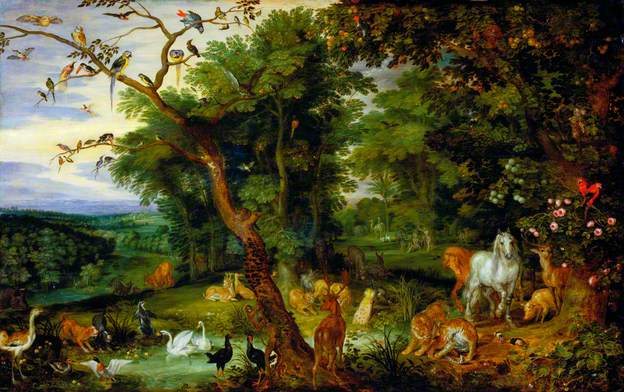
"The Garden of Eden with the Temptation in the Background", by Jan Brueghel the elder, c. 1600, (Victoria and Albert Museum, London)
“The Garden of Eden with the Temptation in the Background”, by Jan Brueghel the elder, c. 1600, (Victoria and Albert Museum, London)

Scripture Passage:  Genesis 2: 15-17, 3: 1-7 (Lent 1A)

The Lord God took the man and put him in the garden of Eden to till it and keep it.  And the Lord God commanded the man, “You may freely eat of every tree of the garden;  but of the tree of the knowledge of good and evil you shall not eat, for in the day that you eat of it you shall die.”…Now the serpent was more crafty than any other wild animal that the Lord God had made. He said to the woman, “Did God say, ‘You shall not eat from any tree in the garden’?” The woman said to the serpent, “We may eat of the fruit of the trees in the garden; but God said, ‘You shall not eat of the fruit of the tree that is in the middle of the garden, nor shall you touch it, or you shall die.’“ But the serpent said to the woman, “You will not die; for God knows that when you eat of it your eyes will be opened, and you will be like God, knowing good and evil.”  So when the woman saw that the tree was good for food, and that it was a delight to the eyes, and that the tree was to be desired to make one wise, she took of its fruit and ate; and she also gave some to her husband, who was with her, and he ate. Then the eyes of both were opened, and they knew that they were naked; and they sewed fig leaves together and made loincloths for themselves.

So at the beginning of this year’s Lenten season, the Lectionary propels us back into our somewhat sketchy past.  St. Augustine and myriads of theologians to follow would have called it the “original sin”, as if it is the cause of all other sins that follow.  Now, admittedly, I don’t like to get stuck on that idea of original sin.  I’m pretty sure that if the first humans had not messed up, someone soon after would have.  But this is the story we have.  We have images of humans walking in a beautiful garden hand in hand without a care in the world.  And then we have some sort of talking snake or prehistoric serpent or some other obnoxious creature that pulls them away from who they are and who they are meant to be.  And they give in.  They give in to the first temptation to be someone they are not.  Then they realize their mistake much too late to change the course of their action.  Well, we know the story.  (Oh, who are we kidding? We’re LIVING the story!)  They are no longer innocent and the beauty of the garden is lost forever.

This has always been an odd story to me.  Now, admittedly, I’m sure it is of no surprise to most of you that I tend to assume that this is fable rather than a literal historical account. But just because it probably isn’t “true” does not mean that it is not full of “Truth”.  In some respects, this is the rawest, most profound, most human Truth that there is.  After all, we all wander down the wrong road every now and again and some of us do it daily without even intending it.  And we all live with consequences of trying to overreach, trying to be someone we’re not, trying to assume things that are not ours to assume.  We all live with consequences of, essentially, overstepping and overreaching and trying to be the god of our own life.  And we all lose that innocence that we once had.

But, really, does God want a bunch of mindless innocents walking around in this world?  If that were the case, then God would never have shared the part of the Godself with us that is known as free will.  You see, God in God’s infinite wisdom gave up omnipotence for relationship.  God doesn’t want a bunch of robotic beings following the Great Divine because they know nothing else.  God created us to desire, to choose, to follow God of our own volition.  Innocence is way overrated.  You see, if God wanted us to stay in some sort of garden, fenced off from the rest of the world, I guess God would have left us there, protected from the world and, mostly, from ourselves.  I really don’t think that this journey we’re on returns us to the Garden, whatever that was.  That was our beginning.  The journey returns us to God, to who God envisions that we can be.  Think of the Garden as our womb, the place that protected and shielded us until we were ready for the journey, until we found that part of ourself that chose to follow, that chose God. 

So what do we do after the garden?  We follow where God leads us; we follow that innate sense that all of us have to return to God and to whom we are called to be.  You see, we have no more excuses.  Read the end of the passage.  Our eyes have been opened.  We know where we fall short; we know that we cannot do this by ourself; we know that God is God and we are not.  And in that is our beginning.  Thanks be to God!

Sin is our only hope, because the recognition that something is wrong is the first step toward setting it right again.  (Barbara Brown Taylor, Speaking of Sin:  The Lost Language of Salvation)

So on this Lenten journey, open your eyes.  Open your eyes and take a good hard look at yourself.  What do you need to choose to leave behind?  Where do you choose to go? What does your beginning, your escape from innocence, look like?

Grace and Peace,

Shelli

What God is About to Do

HorizonPassage for Reflection:  Isaiah 65: 17-18

For I am about to create new heavens and a new earth; the former things shall not be remembered or come to mind. But be glad and rejoice forever in what I am creating; for I am about to create Jerusalem as a joy, and its people as a delight.

I know…more visioning.  I guess that’s where I am this year.  I’m sorry if you were tuning in hoping to feel good about where you are!  No really, I don’t think God is disappointed in us; God just wants the best for us.  Isn’t that just like God?  There is nothing wrong with where we are.  I love this earth.  I love this country.  I love this state and the fact that I’m generations into it.  I love this city.  I love St. Paul’s.  I love my house.  I love my life.  But in case you think I am nothing more than an annoying cheerleader, I also count on the fact that there is always something more, something just over the horizon.  I think that Advent does a good job of reminding us of that horizon, reminding us that what we have and what we hold is really not “it”.  No, regardless of where we think we’ve been headed, we have not “arrived”.

This passage for today is not some unrealistic pipe dream.  It is not something that slashes our view of the life that we’ve created.  It just shows us something more.  It is real.  It is what God is about to do–maybe not tomorrow, maybe not next week, maybe not even in the next ten centuries.  But we are people of faith.  We are people of what God, always, is about to do.  The question is do we live our lives holding on to what we have or do we live our lives looking for what God is about to do.

There is a Native American tale of a chief who had three sons.  He knew that he was nearing the end of his life and had not yet decided which of his sons would succeed him as chief.  So, he gathered them together and pointed to a mountain in the distance.  “I want you to journey to that mountain, climb to its summit, and bring back the thing you think will be most helpful in leading our people”.  After several days, the first son returned with a load of flint stones, used to make arrow tips and spear points.  He told his father, “Our people will never live in fear of their enemies.  I know where there is a mountain of flint.”  The second son climbed to the top of the mountain, and found forests rich with wood for making fires.  When he returned, he said to his father, “Our people will never be cold in winter.  I know where wood can be found in abundance to keep them warm and to cook their food.  The third son returned late and empty-handed.  He told his father, “When I got to the summit, I found nothing worth bringing back.  I searched and searched, but the top of the mountain was barren rock and useless.  Then I looked out towards the horizon, far into the distance.  I was astonished to see new land filled with forests and meadows, mountains and valleys, fish and animals—a land of great beauty and perfect peace.  I brought nothing back, for the land was still far off and I didn’t have time to travel there.  But I would love to go there someday; I delayed coming back because I found it very difficult to return after seeing the beauty of that land.”  The old chief’s eyes blazed.  He grasped his third son in his arms, proclaiming that he would succeed him as the new chief.  He thought to himself, “The other sons brought back worthy things, necessary things.  But my third son has a vision.  He has seen a better land, the promised land, and he burns with the desire to go there.”

As I said, this is not something that God is dangling out there like some sort of teaser knowing that we will never reach it.  God really means for us to glimpse what God is about to do, to move toward it, to love and desire it so much that we can do nothing else but go toward it.  I do not know what my future holds.  None of us do.  But I know that just over the horizon is something so incredible that I burn with desire to go there.  It is the place that God means for me to go.

Today is the twelfth day of Advent.  (Wait, wasn’t that supposed to be the twelfth day of Christmas?)  We are halfway through this waiting, halfway through this season that calls us to put a hold on our plans, to look to the horizon, to strain and squint for a glimpse, just a glimpse of what will be.  Today is the twelfth day of the twelfth month.  The symbolic meaning of twelve is completeness, whole.  That’s right.  The vision has not come to fruition, but that doesn’t mean that it is not complete.  It is there, just as it should be, just over the horizon.  And now…now we will start living into what we see.  Because, you see, it is about what God is about to do…

Reflection:  What does that place just over the horizon look like to you?  What would you give up to take the time to go toward it?  What do you see that God is about to do?

Grace and Peace,

Shelli

Beginning at the End

Closed CurtainAdvent 1A: Matthew 24: 36-44

36“But about that day and hour no one knows, neither the angels of heaven, nor the Son, but only the Father. 37For as the days of Noah were, so will be the coming of the Son of Man. 38For as in those days before the flood they were eating and drinking, marrying and giving in marriage, until the day Noah entered the ark, 39and they knew nothing until the flood came and swept them all away, so too will be the coming of the Son of Man. 40Then two will be in the field; one will be taken and one will be left. 41Two women will be grinding meal together; one will be taken and one will be left. 42Keep awake therefore, for you do not know on what day your Lord is coming. 43But understand this: if the owner of the house had known in what part of the night the thief was coming, he would have stayed awake and would not have let his house be broken into. 44Therefore you also must be ready, for the Son of Man is coming at an unexpected hour.

Oh, this can’t be right.  Our Gospel passage for the first reading in Advent is starting toward the end of the Gospel According to Matthew.  What happened to Mary?  Where are those angels announcing the coming birth?  After all, we need something joyful to think about it as we drag the boxes of Christmas decorations out of storage and begin to prepare for the season that most retailers have already proclaimed on the heels of the Jack-o-Lanterns!  I mean, really, first they tell us that we have to wait to sing Christmas carols and then they give us this perceived warning of a thief coming in the middle of the night.  Why in the world are we beginning at what feels like the end of the story?

There are those in our modern world who will pounce on this Scripture as a warning of what might happen if we do not act right or think right or live right.  There are those who will abuse it by holding over the heads of persons to scare them into religion.  I don’t think that’s what it’s about.  Faith is not about doing the right thing or living the right way or being scared into a place that does not feel welcoming and grace-filled.  Faith is about relationship.  And, as the Scripture says, it is about waking up so that God can gather us in.  God doesn’t want a bunch of zombies that have to be pulled kicking and screaming into faith.  God desires a relationship with those who desire a relationship with God.  And God has faith that in the deepest part of ourselves, there is faith enough for all.

Jesus is not standing at the edge of some far off place waiting for us to step over the line.  Jesus is here, ahead of time itself, calling and gathering and sanctifying each of us as we awake to the morning.  Remember last week’s Scripture that we read for Christ the King? We were again given the image of Jesus hanging on the Cross, minutes away from death.  It was the end.  And there, there beside him was the thief.  “But understand this: if the owner of the house had known in what part of the night the thief was coming, he would have stayed awake and would not have let his house be broken into. 44Therefore you also must be ready, for the Son of Man is coming at an unexpected hour.” The thief was not left behind but instead was gathered into the Reign of God.  Advent is not waiting to see whether or not you make the cut but rather waking up to the glorious Gathering that is happening all around us.

The curtain on the Advent season is about to rise.  Jesus is not waiting in the wings somewhere until the play is done; rather, Jesus is standing on the stage itself, inviting us in.  “Come, wait with me.  You do know when the Glory will come but this waiting is a holy place.  Come, all, wait with me.  Stay awake so that you won’t miss the inbreaking of Glory itself, the dawn of the fullness of the Kingdom of God.”  The reason that we begin at the end is because it is the same as the beginning.  God is the Alpha and the Omega.  Birth and death are all wrapped up together, needing each other to give life.  Awaken now that you do not miss one thing.  Open your eyes.  There is a baby coming!  The extraordinary miracle of what is about to happen is matched only by the moment before it does–this moment, this time.  The world awaits!  Awaken that you do not miss the story!

Awake! awake! and sing the blessed story; Awake! awake! and let your song of praise arise;                                                                       Awake! awake! the earth is full of glory, And light is beaming from the radiant skies;                                                                                  The rocks and rills, the vales and hills resound with gladness, All nature joins to sing the triumph song.

(Refrain)  The Lord Jehovah reigns and sin is backward hurled! Rejoice! rejoice! lift heart and voice, Jehovah reigns! Proclaim His sov’reign pow’r to all the world, And let His glorious banner be unfurled! Jehovah reigns! Rejoice! rejoice! rejoice! Jehovah reigns!

Ring out! ring out! O bells of joy and gladness; Repeat, repeat anew the story o’er again,                                                                             Till all the earth shall lose its weight of sadness, And shout anew the glorious refrain;                                                                                   Ye angels in the heights, sing of the great Redeemer, Who saves us from the pow’r of sin and death.

(Refrain)

“Awakening Chorus”, Charles H. Gabriel, 1905

Reflection:  Advent is our awakening season.  What do you need to do to no longer hit the “snooze button” of your faith?

Grace and Peace,

Shelli

Becoming Prodigal

"The Return of the Prodigal Son", Rembrandt, c.
“The Return of the Prodigal Son”, Rembrandt, c. 1667

This Week’s Lectionary Passage: Luke 15: 1-3, 11b-32

Now all the tax collectors and sinners were coming near to listen to him. 2And the Pharisees and the scribes were grumbling and saying, “This fellow welcomes sinners and eats with them.” 3So he told them this parable:…“There was a man who had two sons. 12The younger of them said to his father, ‘Father, give me the share of the property that will belong to me.’ So he divided his property between them. 13A few days later the younger son gathered all he had and traveled to a distant country, and there he squandered his property in dissolute living. 14When he had spent everything, a severe famine took place throughout that country, and he began to be in need. 15So he went and hired himself out to one of the citizens of that country, who sent him to his fields to feed the pigs. 16He would gladly have filled himself with the pods that the pigs were eating; and no one gave him anything. 17But when he came to himself he said, ‘How many of my father’s hired hands have bread enough and to spare, but here I am dying of hunger! 18I will get up and go to my father, and I will say to him, “Father, I have sinned against heaven and before you; 19I am no longer worthy to be called your son; treat me like one of your hired hands.”’ 20So he set off and went to his father. But while he was still far off, his father saw him and was filled with compassion; he ran and put his arms around him and kissed him. 21Then the son said to him, ‘Father, I have sinned against heaven and before you; I am no longer worthy to be called your son.’ 22But the father said to his slaves, ‘Quickly, bring out a robe—the best one—and put it on him; put a ring on his finger and sandals on his feet. 23And get the fatted calf and kill it, and let us eat and celebrate; 24for this son of mine was dead and is alive again; he was lost and is found!’ And they began to celebrate. 25“Now his elder son was in the field; and when he came and approached the house, he heard music and dancing. 26He called one of the slaves and asked what was going on. 27He replied, ‘Your brother has come, and your father has killed the fatted calf, because he has got him back safe and sound.’ 28Then he became angry and refused to go in. His father came out and began to plead with him. 29But he answered his father, ‘Listen! For all these years I have been working like a slave for you, and I have never disobeyed your command; yet you have never given me even a young goat so that I might celebrate with my friends. 30But when this son of yours came back, who has devoured your property with prostitutes, you killed the fatted calf for him!’ 31Then the father said to him, ‘Son, you are always with me, and all that is mine is yours. 32But we had to celebrate and rejoice, because this brother of yours was dead and has come to life; he was lost and has been found.’”

This is truly one of the world’s best-known and best-loved parables.  In fact, it shows up even in the Mahayana Buddhist tradition as well as others, so I would surmise that everyone has a hard time figuring this out.  The truth is, we humans like the image of one being welcomed home.  And even though those of us who try to do everything right, try to be who we’re supposed to be, are a little bothered by our identification with the older son, we like that image of the safety net that no matter how badly we mess our lives up, we can always begin again.

But when you delve a little deeper, there’s always more to the story.  (Oh, come now, you didn’t think that there would just be one level to a parable told by Jesus, did you?)  So, think about the fact that in this time and in this culture, there were expectations.  Land and resources were viewed as a gift to be handled responsibly.  They were ancestral lands and were meant to stay together, to stay within the family, rather than being split apart and divided.  So, this was a shocking parable, far from anything that its hearers could have imagined.  This father who gave away resources to a younger son that then leaves the family was going against all that the culture prescribed.  And a father that welcomed him back was just being duped.  And then to essentially take him back into the family and heap more abundance upon him was just unthinkable.  Good grief, when will this father ever learn?

We have come to equate the word “prodigal” with one who returns.  But if you look up the word, it means one who is recklessly spendthrift.  It also means yielding abundantly.  So how can those two definitions refer to the same word?  Because the notion of abundance, the notion of offering all that you have and all that you are, the notion of being this prodigal father is deemed irresponsible in our world’s view.  And yet, this image of one who offers all as abundance is the image of God that we get over and over again.  God does not dole out riches or rewards based on who we are and what we do; rather God offers everything, pouring as much of the Godself into our lives as we can possibly hold (and then more that we might spill it out into the world around us).  This is a God of abundance.  We don’t understand it.  We can’t control it.  We can’t even really accept it half the time.  We look for a catch.  After all, the world tells us that we cannot get something for nothing.

But “something for nothing” is exactly what God is offered.  God’s only desire is that we open ourselves to this prodigal abundance that God offers.  You’ve probably often heard a description of this parable ending with something like “head home to the open arms of God, the feast is waiting.”  What if the ending was something more like “just open yourselves to the abundance that is right there.  You don’t have to go anywhere.  You don’t have to do anything.  You just have to desire in the deepest part of your being the incredible blessings and abundance that God is already heaping into your life.”

Here is the God I want to believe in:  a Father who, from the beginning of Creation, has stretched out his arms in merciful blessing, never forcing himself on anyone, but always waiting; never letting his arms drop down in despair, but always hoping that his children will return so that he can speak words of love to them and let his tired arms rest on their shoulders.  His only desire is to bless. (Henri J.M. Nouwen, The Return of the Prodigal Son, 95-96)

So in this Lenten season, open yourself to this Prodigal God, this God of Abundance.  Think what it would mean to become a prodigal, spending lavishly the abundance that God offers and, then, becoming that very abundance yourself.

Grace and Peace,

Shelli