Station V: Anonymous Bystander

Scripture Passage:  Mark 15: 21-24
They compelled a passer-by, who was coming in from the country, to carry his cross; it was Simon of Cyrene, the father of Alexander and Rufus. 22Then they brought Jesus to the place called Golgotha (which means the place of a skull). 23And they offered him wine mixed with myrrh; but he did not take it. 24And they crucified him, and divided his clothes among them, casting lots to decide what each should take.

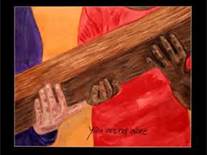
We know the town from where he came–Cyrene, an ancient Greek colony that became a Roman colony near modern-day Shahhat, Libya.  We know that he was a father of two sons.  Beyond that, this man Simon is essentially an anonymous bystander.  We don’t know why he was there at all.  Had he intended to come and bring his sons to this gory event or had they planned to visit Jerusalem, perhaps steep themselves in history and a little shopping, without realizing what this day would bring?  We don’t know what about him prompted the guards to literally pluck him out of the crowd.  All we know is that this man lives in history as the one, the only one, who helped Jesus carry his cross to Golgotha.

The Scriptures do not say that he responded in any way other than to do it.  It is interesting that in all those years upon years of God’s calls being met with “no, not me, please not me” that this anonymous man about whom we know little would be the one to do this.  So God calls a scared, young, no-name peasant girl to bring Jesus into the world and a foreign, probably dark-skinned, anonymous bystander to carry him out.  Isn’t that just like God?  Here, just before the end, God slips one more Divine reversal in.

You know, Simon had to be afraid.  Good grief.  Here he was in the middle of the processional to a crucifixion!  What if they killed him too?  What would happen to his sons?  His family was miles away.  How would they even know what had happened to him?  And, yet, he didn’t seem to question his role.  He put his hand on Jesus’ shoulder as if to say, “I’m here.”  Then he leaned down and picked up the heavy cross, being careful to place his hands rather than running them down the splintering wood.  And then they began to walk–Jesus and this man, this dark-skinned anonymous man who Jesus had never met, this child of God, this new disciple, this one who without hesitation carried the cross of his Savior.  He would go through the gates and up the hill, touching the edge between life and death. 

But, again, I have to ask, where were those disciples?  Where were those who Jesus had called, who Jesus had groomed, who had been part of Jesus’ ministry, who had been Jesus’ friends?  Why was it THIS man and not them?  Why was it Simon that when it was all said and done was the first to take the yoke of Christ unto himself?  After all, it seems, the disciples would have been in the best position.  It would have made a whole lot more sense.  But, then, where would we be?  Where would those of us who Jesus had called, who Jesus had groomed, who are part of Jesus’ ministry?  Why isn’t it us touching the edge between life and death?  Why do we hold back?

28 ‘Come to me, all you that are weary and are carrying heavy burdens, and I will give you rest. 29Take my yoke upon you, and learn from me; for I am gentle and humble in heart, and you will find rest for your souls. 30For my yoke is easy, and my burden is light.’  (Matthew 11: 28-30).  See, we read this with such comfort at what Jesus can do for us.  But what does it mean to “take my yoke”?  For, THAT is the way that our souls will rest.

So, on this Lenten journey, move from being an anonymous bystander to a disciple of Christ.

Grace and Peace,

Shelli



Emergence

Lectionary Passage:  Jeremiah 1: 4-10
4Now the word of the Lord came to me saying,5“Before I formed you in the womb I knew you, and before you were born I consecrated you; I appointed you a prophet to the nations.”6Then I said, “Ah, Lord God! Truly I do not know how to speak, for I am only a boy.”7But the Lord said to me, “Do not say, ‘I am only a boy’; for you shall go to all to whom I send you, and you shall speak whatever I command you,8Do not be afraid of them, for I am with you to deliver you, says the Lord.”9Then the Lord put out his hand and touched my mouth; and the Lord said to me, “Now I have put my words in your mouth.10See, today I appoint you over nations and over kingdoms, to pluck up and to pull down, to destroy and to overthrow, to build and to plant.”

This account of the calling of Jeremiah includes the things that so many call stories do (including, probably, most of ours).  They include a calling from God, a promise that God will help and support and walk with the one that God has seen fit to call.  Then it includes an argument.  “No, no, no, not me.  I have my life all planned out.  This cannot be happening.  In fact, this is really going to mess up my plans.”  But, finally, it includes a response.  In Jeremiah’s case, God puts the words in his mouth, promising him that he would know what to say and when to say it.  And from that time on, Jeremiah is single-minded in what he is called to do.  But the problem is that the words that Jeremiah was called to say were not what people planned on hearing.  In fact, Jeremiah’s message didn’t resonate at all with the society to which he was appointed to serve.  He wasn’t called to tell them how great they were doing; instead, he was called to pluck up, pull down, destroy, and overthrow.  And then, and only then, is he called to build and plant.  What is that about?  This plucking and pulling and destroying and overthrowing doesn’t sound like God’s work.  In fact, it just sounds like out and out chaos.

So did you forget?  Did you forget what God does with chaos?  Read Genesis 1.  God took chaos and created order.  And, as I recall, it turned out pretty well. And yet, we often forget that.  We would much rather God take the plans that we’ve conjured up for our lives and have God just continue them. But sometimes we have to pluck and pull and even destroy and overthrow.  Sometimes, we just need to start again with a new plan.  But change is hard. Change is scary.  Walking that tightrope can tip us into opportunity or crisis at any turn.  So how do we prepare for that?

Maybe we don’t.  Maybe preparation comes not in the form of plans but rather a sort of clearing of our minds and our souls so that God can fill us.  Maybe preparing for change, preparing for what God is going to do in our lives, has to involve plucking and pulling and destroying.  Maybe deep in that chaos is a certain holiness, a newness that has just begun to emerge from its womb.  And God, rather than stamping some sort of holy approval on our comfortable and complacent existence, calls us into a new way of being.  God is always recasting the vision for our lives, always pushing us out of our comfort zones, and always birthing us into newness. 

But God reminded Jeremiah that even in that womb, he was not alone.  God is there in our transformation.  But we can’t stay there.  God has too much in store for us.  So, all through our lifetime, as we emerge from womb to womb, God is birthing us closer and closer to the life that God has created just for us.  Maybe we’re not called so much to plan our lives but rather to emerge.

Grace and Peace,

Shelli 

LENT 2B: Identity

Octavia Spencer accepting the Oscar for Best
Supporting Actress, February 26, 2012.

Lectionary Passage:  Genesis 17: (1-3) 4-7, (15-16):
As for me, this is my covenant with you: You shall be the ancestor of a multitude of nations. No longer shall your name be Abram, but your name shall be Abraham; for I have made you the ancestor of a multitude of nations. I will make you exceedingly fruitful; and I will make nations of you, and kings shall come from you.   I will establish my covenant between me and you, and your offspring after you throughout their generations, for an everlasting covenant, to be God to you and to your offspring after you.

This passage is the story that establishes Abram’s identity.  He would become Abraham, the “father of many people”.  And Sarai, his (sort of) doting and laughing wife, would become Sarah, the “princess of many.”  Abraham and Sarah now have a new identity, an identity that comes from this established relationship with God.  This is what it means to be a covenant people.  In the Jewish tradition, this is the establishment of the identity of a people, the establishment of a covenant people.  God has done a new thing.  Nothing would ever be the same again.

Identity is a funny thing.  With whom do you identify?  With whom do you align yourself?  What are the relationships in your life?  How do you see yourself?  The idea of a covenant connotes an agreement.  But, more than that, it implies a relationship.  This was not some sort of holy “to do” list that was given to Abraham.  God never told him what he had to do to be accepted, to be part of the covenant, to  part of the people, to be “godly” (oh, I hate that word!…”like God”…are any of us really “like God”?)   God never gave him a list of beliefs to which he had to adhere to be part of the covenant community.  (Hmmm!)  Once again, the covenant was not about right living; it was about relationship.  God claimed Abram and Sarai as children of God and their life was never the same.  And then God renames them.  Their names mean something–father and princess.  The new names are symbolic of the new relationship into which they enter.

I looked up the meaning of my name.  “Shelli” (not spelled that way–it is NEVER spelled that way!) is actually a derivative of the Hebrew, Rachel–“ewe, female sheep, little rock, rest, sloped meadow.”  (So, Sarai becomes a princess and I am a sheep that rolls down a small hill and goes to sleep!)  Like I said, identity is a funny thing.  We hold tightly to the way we envision ourselves, to the image that we’ve created.  And then God comes up with the most ludicrous thing, like being the father or the princess of many (or maybe a sheep that follows down a gently sloping meadow! Hmmm!).  It’s just laughable.

We actually didn’t read the part where Abraham laughed.  He laughed because it was far-fetched and downright ludicrous.  But then, when you think about it, most of God’s promises are.  And then when he told Sarai the whole preposterous scenario, she also laughed.  So, do you think it was disbelief or nervousness or something else that brought laughter?  We in our 21st century boxes probably think it a little irreverent. After all, would you dare laugh at God? Well, good grief, don’t you think God is laughing at us sometimes? Perhaps laughter is what brings perspective. It brings humility; it brings a different way of looking at oneself. Laughter is about relationship.  Reinhold Niebuhr wrote, “Humor is the beginning of faith and laughter is the beginning of prayer.”

Abraham laughed. Sarah laughed. And I’m betting God laughed. (You can just imagine the inside joke between the three: “This is going to be good. No one will ever believe this could happen.” You?  Sarai?  LOL!!!–for those who don’t text, it means “laugh out loud”!) Maybe laughter is our grace-filled way of getting out of our self and realizing that, as ludicrous and unbelievable as it may be, God’s promise holds and, more than that, holds something for us–a new identity. Maybe it’s our way of admitting once and for all that we don’t have it all figured out, that, in all honesty, we don’t even have ourselves figured out, that there’s a whole new identity just waiting for us to claim. In this Season of Lent, we are called to get out of our self, to open ourselves to possibilities and ways of being that we cannot even fathom. Go ahead and laugh. It’s probably incredibly ludicrous…and it’s only the beginning.

Now I know that many of you are amazed that I can write this through my sleepy-eyed disposition at 4:00 in the morning.  Well, the truth is, I POST these at 4:00 in the morning while I’m beginning my last hour of shut-eye.  So, as I write this, I’m sort of half-heartedly watching the Academy Awards.  And Octavia Spencer has just won the Oscar for Best Supporting Actress for her portrayal of a maid in the segregated South.  I have to convess that I never got my packed-in life around to see the movie but on a rainy Saturday afternoon, I sat and read the whole book on my Kindle.  It was about identity. It was about the identity that we have and the identity that the world projects upon us. I mean, think about it, how do those who are oppressed, either through out and out slavery or just socially acceptable oppression (even today!) envision themselves.  What is their identity–the one they have or the one that is projected upon them?  They both matter because they both form us.  But the key is that we are called to be transformed by the identity that God has for us.  So whatever identity that you or others project upon yourself, it is the covenant, the identity that calls us and recreates us that matters.

When Octavia Spencer accepted the Oscar tonight, her speech was not eloquent and it was not rehearsed (Thanks be to God!).  If anything, she was so shocked that she was almost laughing!  She voiced the perfunctory thank-you’s and then she closed:  “I share this with everybody.  Thank you world.”

As laughable as it may be, I pray that my identity will be true, worthy of sharing, and will project not a projected image of what I should be, but a “thank you” to the world.  In this Season of Lent, we, as a covenant people, are called to take a good hard look at our identity, at the way our relationship with God is lived out in our lives.  We are called to be real. 

So, continuing with our act of giving up so that we can take on, on this fifth day of Lent, think about your own identity.  What is real?  What is projected?  What part of yourself can you share with everybody?  Let go of those things that only benefit yourself.  And take on those things that say “thank you world!”

Grace and Peace on this Lenten Journey,

Shelli

LENT 1B: The Harrowing of Hell

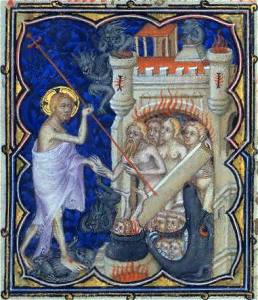
The Harrowing of Hell, depicted in the Petites Heures
de Jean de Berry, 14th c.  illuminated
manuscript commissioned by
John, Duke of Berry.

LECTIONARY PASSAGE:  1 Peter 3: 18-22
For Christ also suffered for sins once for all, the righteous for the unrighteous, in order to bring you to God. He was put to death in the flesh, but made alive in the spirit, in which also he went and made a proclamation to the spirits in prison, who in former times did not obey, when God waited patiently in the days of Noah, during the building of the ark, in which a few, that is, eight persons, were saved through water.  And baptism, which this prefigured, now saves you—not as a removal of dirt from the body, but as an appeal to God for a good conscience, through the resurrection of Jesus Christ, who has gone into heaven and is at the right hand of God, with angels, authorities, and powers made subject to him.

The faith communities to which this was written did not have it easy.  They were the outsiders–shunned, unaccepted, separated from the only society that they knew.  To put it bluntly, they were living in hell.  So this comes as a reminder that what they are experiencing now is not permanent.  It is not the final word.  New life is just over the horizon.  For the writer of this epistle, this is a sure promise, made real through our baptism.  Baptism here is depicted a recreation, as resurrection.  The whole point is that believers do not need to fear the difficulties and sufferings that are present now.  God has indeed promised something new.  In all honesty, I don’t think this writer necessarily saw baptism as merely a cleansing.  Rather, baptism is a claiming.  We are claimed by God.  We are empowered by the Spirit of Christ.  We are made new.  So no matter what hell we might find ourselves in, there is more up ahead.  God has claimed us.  Each of us is a beloved child of God.  Our baptism acknowledges that and, like the waters that flooded the earth, sweeps us into new life.

In fact, even the powers of hell cannot impede the recreation that is happening all around us.  Now our church chooses to recite the more sanitized version of the Apostles’ Creed but there is an older version that dates back to the 5th century that goes like this:  “I believe in God the Father almighty, maker of heaven and earth; and in Jesus Christ, his only Son our Lord, who was conceived by the Holy Ghost, born of the Virgin Mary, suffered under Pontius Pilate, was crucified, dead, and buried. He descended into hell.”  That last sentence is believed to have been loosely taken from this passage.  We read that Jesus proclaimed even to the “spirits in prison”.  In other words, Jesus descended into hell, into the bowels and depths of life.  And, there, he blew the gates open and the eternally forsaken escaped, crossing the threshold to new life.  In the Middles Ages, it was referred to as the “Harrowing of Hell”.  Now, admittedly, there is little basis for this theology but if death hath no sting, why would hell win?  (And to be honest, there’s really little basis for the notion of “hell” as we 21st century folks think of it.  I think Dante did us no favors. ) If God’s promise extends to all of Creation, then perhaps hell really hath no fury.    

Now this is in no way a lessening of the impact or importance of sin.  We all know that.  We sin.  We try not to.  But we sin.  In fact, most of us are pretty good at creating our own hell.  We plunge ourselves into darkness, into separation from God, through fear, or guilt, or shame, and we struggle to claw our way out.  But even the powers of sin are no match for the promise before us.  That is the whole point of our faith.  So, if we believe that, why is it such a stretch to believe that the God of all, the God who loves us, and who has claimed us, could vanquish all the powers that afflict us, that God has vanquished all the powers of hell?

Perhaps this Lenten season of penitence is not so much a call to grovel at the feet of a forgiving God but rather to faithfully follow this God who beckons us home again to begin again.  Maybe it truly is the harrowing of whatever hell we find ourselves in.  But in order to do that, we have to name our sin and release its power.  It’s part of our story.  It’s part of what we must tell.  And with that, the waters subside and the green earth rises again.  Now, I don’t profess to know the whole truth about this hell thing.  It’s not an issue for me.  But I struggle to reconcile the notion of a place called hell with this God who offers eternal mercy and grace and forgiveness, with this God that wants the Creation to return so badly to where they belong, to enter into a relationship with the Godself–so badly, in fact, that this God would come and walk this earth just to show us the way home.  Oh, don’t get me wrong.  Hell definitely exists.  But perhaps it is our creation, rather than God’s.  Perhaps our faith will show us that the gates of hell have already been removed and that all we have to do is walk the way toward life.  Let this Lenten Journey be your Journey toward Life.

So, continuing with our act of giving up so that we can take on, on this third day of Lent, think about those things that create your hell.  Is it fear?  or shame?  or guilt?  Is it the need for everyone to approve of you and like you?  Whatever it is, let it go.  Make room for that which gives you Life.

Grace and Peace on this Lenten Journey,

Shelli

At the center of the Christian faith is the history of Christ’s passion.  At the center of this passion is the experience of God endured by the godforsaken, God-cursed Christ.  Is this the end of all human and religious hope?  Or is it the beginning of the true hope, which has been born again and can no longer be shaken?  For me it is the beginning of true hope, because it is the beginning of a life which has death behind it and for which hell is no longer to be feared…Beneath the cross of Christ hope is born again out of the depths.  (Jurgen Moltmann)

Grace and Peace on Your Lenten Journey,

Shelli    


The Days That Come After

In the beginning when God created the heavens and the earth,the earth was a formless void and darkness covered the face of the deep, while a wind from God swept over the face of the waters.  Then God said, “Let there be light”; and there was light.And God saw that the light was good; and God separated the light from the darkness.God called the light Day, and the darkness he called Night. And there was evening and there was morning, the first day. (Genesis 1: 1-5)

In those days Jesus came from Nazareth of Galilee and was baptized by John in the Jordan.And just as he was coming up out of the water, he saw the heavens torn apart and the Spirit descending like a dove on him.And a voice came from heaven, “You are my Son, the Beloved; with you I am well pleased. (Mark 1: 9-11)

I saw a movie trailer for a new movie called “Extremely Loud and Incredibly Close,” which is apparently a story of a young boy’s life after his father is killed in the 9/11 terrorist attacks.  The trailer ends with these words written on the screen:  “This is not a story about 9/11; it is a story about the days that come after.”  I thought that was a very profound statement.  After all, do we sometimes focus so much on specific times and specific days that we lose what it means to live the rest of them?  In some way, living a life of faith means getting beyond endings.  Maybe it even means getting beyond beginnings.  It means doing something with all of them as part of the totality of life.

Yesterday we remembered the Baptism of Jesus and through that also remembered our own.  And our lectionary readings for the day included the first five verses of Genesis.  We all know that it is the beginning of the story of Creation, the beginning of life, the beginning of our own beginnings.  But, truth be told, it wasn’t the beginning of EVERYTHING.  After all, it says that before it all, the earth did exist.  It’s just that it was a formless, shapeless void.  Perhaps it was a chaotic mass of swirling, meaningless matter.  And then God Said.  Those are the most powerful words imaginable.  With one simple statement, God creates order, shape, life.   As God’s Spirit sweeps over the waters, meaningless matter becomes earth.  It is not perfect; it is not the way it will be; it is the way it should be.  It is good.

But we know it doesn’t stop there.  The days go one and God creates sky, and land, and seas.  Then, rather than directly creating (we sometimes gloss over this), God appoints the earth to start creating, to bring forth vegetation.  God calls Creation to create.  Then God creates suns, and moons, and animals, and us.  And then, as the pinnacle of Creation, God creates Sabbath rest, completion, a taste of eternity.  You see, it doesn’t stop at “in the beginning”. The days that come after are what makes Creation the way it was intended to be.

And in those days that Creation continued,  once again God’s Spirit moved over the waters.  And this time, the heavens were torn apart (not opened, but violently ripped apart in a way that they could never go back together in the same way), and God’s Spirit decended.  And once again, God spoke:  “You are my Son, the Beloved, with whom I am well pleased.”  Once again, God Said. It is good.

The days that come after are the days.  Beginnings and endings are only markers, turning points, crosswalks.  We are told to “remember our baptism and be thankful.”  Truth be told, I don’t remember mine.  I was just a baby.  But remembering is not about the beginning; it is about the days afterward.  So, as people of faith, what will we do with those days afterward?  Faith is not about baptism; it is about the days that come after.

What will you do with your days that come after?

Grace and Peace,

Shelli

P.S.  As a programming note, I’m going to try to post a blog entry twice a week or so during this Season of Epiphany and then return to daily posts during our Lenten journey.  Thanks for staying with me!  Shelli

Beginning the Journey

Whew! It’s over–this season of running and shopping and baking and wrapping and giving and getting and dressing and partying and, oh yeah, worshipping the Christ who has come!  Now we can go back to normal.  Whew!  It’s over!  But what is the deal with all this light around?  Really?  So what was the point?  Truth be told,  as Christmas is the celebration of God’s coming, Epiphany is the manifestation of our going.  Epiphany is the beginning of the journey.  So, in other words, don’t get too comfortable!  There is work to do!

This season of Epiphany probably gets sort of glossed over.  I don’t know, maybe we’re tired.  Maybe we’ve eaten too much or run too much or just too much-ed.  Or maybe we just don’t understand what it’s about.  Epiphany is about making Jesus real, making the Christ child part of your life.  It is about doing beginning to travel down a road that you’ve never traveled before.

We know the story of the Wisemen, those learned ones who came to pay homage to the new king.  I suppose it was just a politically correct fulfillment of accepted etiquette.  There was a new king in town and they would greet him and give him the proper gifts and perhaps he would remember them in the future. (And in the meantime, perhaps the press would treat them kindly in this politically volatile season!) It was, after all, the proper and the smart thing to do. But instead, something happened.  Perhaps it was the star; perhaps it was the king; perhaps it was some sort of divine inspiration.  But, whatever it was, these wandering souls got it.  They saw a pathway that was different than the one that they were on, they saw where God was calling them to go.  And so they went home by another way.

Many of you have heard the Henry Van Dyke story of “The Other Wise Man”.  It is the story of a magi named Artaban, who waited impatiently for the star to shine so that he could travel with the other magi to see the new king. In fact, he had sold all of his possessions and bought three jewels—a sapphire, a ruby, and a pearl—to give to the new baby king.  And, then, he finally saw what he had been waiting for as the dark eastern sky was filled with light.  He hurried to join his friends so that he could meet the king.  But on the way, he came upon the form of a man lying on the side of the road, motionless and dying.  He knew that if he stayed to help the dying stranger, he would miss meeting the Messiah.  So, with a heavy heart, he stayed and cared for the man until his strength returned.  And in return, the man, a Jew, blessed his travel to Bethlehem, where he told him the king had actually been born.  So, left behind by the others, Artaban was forced to sell the sapphire, buy a train of camels, and provisions for the journey. 

But he arrived there three days after the others had departed.  He entered a cottage and found a young mother singing her baby to sleep.  And quietly, the woman told him that the new king and his family had fled secretly in the night.  Suddenly there was a noise outside as Herod’s soldiers came for the child.  Artaban went to the doorway and met the soldiers, telling them that he was alone in the house.  When the soldier did not believe him, he reached in his pocket and pulled out his ruby and gave it to him.  The soldiers went away.  The woman blessed him.

Artaban spent his life searching for the king.  In all this world of anguish, he found many to help, but no one to worship.  He fed the hungry, clothed the naked, healed the sick, and comforted those in despair.  Thirty-three years later, he came for the last time to Jerusalem and was met with a flurry of activity as the city prepared to crucify Jesus of Nazareth.  On hearing this, Artaban knew that this was what he was called to do.  The pearl, the last of his riches, could be offered as ransom for the king’s life.  It was then that a young slave girl was dragged through the streets and threw herself at Artaban’s feet.  Save me, she begged, they are going to kill me.  He sadly took the pearl from his pocket.  It gleamed with radiance as he handed it to the girl so that she could buy her life.  The earth began to shake around him; the sky darkened; and it was then that a heavy tile hit Artaban on the head.  As he lay there, the slave girl bent over him to try to hear what he was saying.  It was then that she heard a faint voice from above—“verily I say unto thee,  Inasmuch as thou hast done it unto one of the least of these my brethren, thou hast done it unto me.”  A calm radiance came over Artaban’s face and he breathed one last breath.  His journey had ended.  His treasures were accepted.  He had met the King many, many times.

Well, obviously, this is fiction.  There’s no basis to it.  It’s not Scriptural.  But the point is that we are the other wisemen.  We are the ones called to the work.  We are the ones that will meet the King.  Maybe we will see it to fruition; more than likely, we will not.  The point is that it’s not about the end-result.  It’s about the journey.  It’s about making the Christ-child real in your lives.  It’s about meeting the King. But more than that, it’s about getting it! It’s about making it real. It’s about letting the Light illumine your life.


God came and the Light shined into our midst.

We are called to follow, to walk in the way illumined by the Light.
Let us follow the Light as it guides us on our journey.
Let us follow the Light as it leads us to Life.
So, in this season of Epiphany, make the newborn Christ real in your life!  There is work to be done!

Grace and Peace,

Shelli     

On the Other Side of the Manger

This past Wednesday night, I had the opportunity to lead an Advent discussion with members of St. Paul’s Hispanic Congregation.  No, my Spanish has not had a sudden improvement.  We slowly went through the discussion and the questions and answers by translating back and forth between English and Spanish.  (Boy, I need to brush up on my Spanish!  The closest I could get is that I would sort of understand the “gist” of the question before Nataly or Mireya translated it for me!)  But I must admit that I also had to brush up on the subject matter.  I must have drawn the short straw or something because my subject matter was Joseph of Bethlehem, husband of Mary, earthly father-figure (for want of a better word) for Jesus.  Joseph?  What is there to say about Joseph?  I mean, Mary has a big moment with the top angel Gabriel, followed by the entire world that waits for her answer.  She even has a song!  And she remains a top character in the plot all the way to the bitter end.  But Joseph?  I think if I were Joseph, I would attempt to renegotiate my contract or something.  I mean, he doesn’t even have a speaking role!  He has no voice!  So, really, what is there to say about Joseph?

We don’t really know that much about him.  His family was probably of Bethlehem, even though he perhaps lived in Nazareth.  One might surmise that he was there for work and, yet, Nazareth wasn’t exactly a thriving metropolis with numerous opportunities for a struggling carpenter.  (That probably meant that Joseph was a builder, the Greek techton, perhaps a stonemason.  After all, how much wood is there really in Israel?)  His and Mary’s was probably an arranged marriage.  Some think that he might have been older.  OK, there’s no real support for that, but whatever…But we know that he was righteous, probably a faithful “rule follower” of the Jewish law.  And he had plans.  He and Mary would marry and have children of their own.  He would have a son.  He would have the privilege of naming him.  But that was not to happen.  Instead, the lovely Mary goes and gets herself knocked up.  Think of what Joseph felt–betrayal, embarrassment, hurt, regret, confusion.  This was not the plan.

And then the dream.  Oh, that’s dangerous.  Biblical dreams never seem to help one’s plan.  Seldom does an instrument of God show up in one’s dream to tell us how great we’re directing our lives!  So, whether Joseph dreamed of an angel, or God, or his own conviction, he realized that in spite of all the rules that had been broken, in spite of the way that life had literally spit on his plan, he loved Mary.  He realized that he was called to be a part of this.  He realized that regardless of what the world told him to do–divorce her silently or accuse her publicly–he could not.  And so, there’s Joseph on the other side of the manger.  The picture is in every Nativity image we have–the Blessed Mary, the mother of Christ looking adoringly at the infant in the manger.  And standing across from her in silent commitment is Joseph of Bethlehem.

This silent figure does not, I think, get his due.  After all, his entire life changed as much as Mary’s.  His plans had to be shelved.  His rules were broken.  He was called to offer love and support and to raise this child, this child that, regardless of whether or not Joseph had a hand in the conception, would never really be his own.  The other side of the manger has no voice.  Instead, he was called to a silent commitment.  He was called to hold the child’s hand, lead him from the manger, and then let him go.  And then Joseph drops out of sight.  He was there twelve years later at the temple when Jesus left his parents but chances are that Joseph was used to Jesus going down roads without him by that time.

Not all of us are meant to be the stars of the play. Some of us have no speaking roles.  In fact, some of us never even make it to the stage. But the story is never complete without each and every one of us.  And those that stand with no voice in silent commitment and humble devotion are the hardest workers of all.  The years of Jesus’ life that were spent with Joseph are not documented in known Scripture.  They are not a part of our canon.  But Jesus had to have someone that took him by the hand and led him to the beginning.  The Gospel story did not just shoot out of thin air–someone was silently leading the way.  Someone early on had to make the conscious decision to silence the world and listen to God.  Someone had to stand on the other side of the manger.

I wish that the other night my Spanish had been not quite as rusty.  We were able to tell the story.  We were able to talk about what Joseph felt.  We were able to place the story in the proper context.  But there was an almost overwhelming silence.  When you’re standing on the other side of the manger, it is only God that you hear.  When there’s nothing to say, when you have no voice,  God still calls you to something bigger than you can possibly imagine.

In this season of Advent, give yourself the gift of silence that you might hear the song of God.

Grace and Peace,

Shelli