Shrive

Then Jesus said, “Father, forgive them; for they do not know what they are doing.” (Luke 23: 34)

Fat Tuesday, Pancake Tuesday, Mardi Gras, Shrove Tuesday–there are a plethora names for this day.  Most of us understand it as an eat-all-you-can, party-till-you-drop day before we enter our Lenten fast.  So, don your Mardi Gras beads and stuff yourself with rich syruppy pancakes and get it all out of your system.  Right?

Well, at the risk of interrupting your partying, I think it’s about something more.  (Don’t you hate that?)  The word “shrove” (as in “Shrove Tuesday”) comes, sadly, not from the word for over-the-top entertaining but from the English verb “shrive”, meaning confess.  (Oh, shoot, you say!)  I know, it’s a hard word for us, particularly when we’re drowning ourselves in pancakes.  But, yes, it is a day of preparation, a day when we leave behind what we know, those things to which we are accustomed, and begin the journey to the Cross.

It is sad that in our world, there are many of us (Christians, that is) that have equated confession with judgment.  And we want to run from it.  After all, sin is somewhat subjective when you think about it.  Try as we might, there are few “black and whites” when it comes to sin and history has shown that when a culture inflicts that notion, oppression of some type usually results.  So confession becomes a somewhat shaky ground on which we tread.

In Barbara Brown Taylor’s book, Speaking of Sin, she says that “sin is our only hope, because the recognition that something is wrong is the first step toward setting it right again.”  That is what this day represents–the invitation to set things right, to confess, to shrive.  It is the day to prepare, to begin that long and arduous turn away from who we have made ourselves to be and toward God and God’s vision for what we could become.  Forgiveness is not the thing that we are trying to attain.  It is the starting point, a gift from God for those who want to begin again.

So, in the midst of your Mardi Gras wildness and your pancake extravaganzas, as you don your masks for one more hidden transgression, remember to stop, to shrive, to begin the turn.  Lent begins tomorrow.

For this season, I will try (yes I will try!) to post at least a short devotional every day on this blog.  Many of you are part of the email group that gets it every time I post.  (For those who have signed up through this blog, you will get it but for some reason known only to Google, you will get it 12-18 hours later.  Go figure!)  So if there are others that would like to be part of the email group that gets it right away, just email me through the St. Paul’s website at stpaulshouston.org.  (Go to “About St. Paul’s”, then “staff”).

Additionally, I am reposting my “Bread and Wine” Lenten blog from several years ago.  It is located at http://breadandwine-lentenstudy.blogspot.com/ or you can let me know if you would like to be added to that email group.

AND another opportunity…I have been posting my Lectionary notes that many of you get emailed each Thursday on http://journeytopenuel.blogspot.com/  It’s a once-a-week post but if you’re interested, take a look.

Thanks for being a part of my Lenten journey!

Grace and Peace,

Shelli

Unveiled

Lectionary Passage:  Luke 9: 28-36 (37-43)
28Now about eight days after these sayings Jesus took with him Peter and John and James, and went up on the mountain to pray.29And while he was praying, the appearance of his face changed, and his clothes became dazzling white.30Suddenly they saw two men, Moses and Elijah, talking to him.31They appeared in glory and were speaking of his departure, which he was about to accomplish at Jerusalem.32Now Peter and his companions were weighed down with sleep; but since they had stayed awake, they saw his glory and the two men who stood with him.33Just as they were leaving him, Peter said to Jesus, “Master, it is good for us to be here; let us make three dwellings, one for you, one for Moses, and one for Elijah” —not knowing what he said.34While he was saying this, a cloud came and overshadowed them; and they were terrified as they entered the cloud.35Then from the cloud came a voice that said, “This is my Son, my Chosen; listen to him!”36When the voice had spoken, Jesus was found alone. And they kept silent and in those days told no one any of the things they had seen.  37On the next day, when they had come down from the mountain, a great crowd met him.38Just then a man from the crowd shouted, “Teacher, I beg you to look at my son; he is my only child.39Suddenly a spirit seizes him, and all at once he shrieks. It convulses him until he foams at the mouth; it mauls him and will scarcely leave him.40I begged your disciples to cast it out, but they could not.”41Jesus answered, “You faithless and perverse generation, how much longer must I be with you and bear with you? Bring your son here.”42While he was coming, the demon dashed him to the ground in convulsions. But Jesus rebuked the unclean spirit, healed the boy, and gave him back to his father.  43And all were astounded at the greatness of God. 

This passage requires that we open our mind and widen our souls; it requires that we strip away the things that we think we have figured out; it asks us to focus our attention on what is to be seen rather than on what we see.  In other words, it ask us to go further, to view our world in the light of God’s Presence—not the way we imagine God to be but the way God invites us to experience the holiness and the sacred that is all around us.  It calls us to see things differently, to remove the veil that we have created in our lives that shield us from things that are uncomfortable or do not make sense.  Seeing things differently is not a new theme for us. 

I mean, think about it.  Here we have the story of a child born into anonymous poverty and raised by no-name peasants.  He grows up, becomes a teacher, probably a rabbi, a healer, and sort of a community organizer.  He asks a handful of people to become his followers, to help him in his mission.  They leave everything they have, give up their possessions and their way of making a living, they sacrifice any shred of life security that they might have had, and begin to follow this  person around, probably often wondering what in the world they were doing. And then one day, Jesus takes them mountain climbing, away from the interruptions of the world, away from what was brewing below.  Don’t you think they were sort of wondering where they were going?

This story is told in all three of the Synoptic Gospels.  The mountain that Jesus and the disciples climb sounds a lot like Mount Sinai that Moses had ascended centuries before.  (The truth is, there is actually no historical mention of what mountain this might have been, or if there was a mountain at all.) Now remember that for this likely Jewish audience, mountains were typically not only a source of grandeur, but also divine revelation.  And also remember again that in their understanding, God was never seen.  God was the great I AM, one whose name could not be said, one whose power could not be beheld.  And so this cloud, a sort of veiled presence of the holiness of God, was something that they would have understood much better than we do. And there on the mountain, they see Jesus change, his clothes taking on a hue of dazzling, blinding white, whiter than anything they had ever seen before.  And on the mountain appear Moses (this time with no veil) and Elijah, standing there with Jesus—the law, the prophets, all of those things that came before, no longer separate, but suddenly swept into everything that Christ is, swept into the whole presence of God right there on that mountain.

So Peter offers to build three dwellings to house them.  I used to think that he had somehow missed the point, that he was in some way trying to manipulate or control or make sense of this wild and uncontrollable mystery that is God.  I probably thought that because that’s what I may tend to do.  But, again, Peter was speaking out of his Jewish understanding.  He was offering lodging—a booth, a tent, a tabernacle—for the holy.  For him, it was a way not of controlling the sacred but rather of honoring the awe and wonder that he sensed. And then the voice…”This is my Son, my Chosen:  listen to him!” OK…what would you have done?  First the mountain, then the cloud, then these spirits from the past, and now this voice…”We are going to die.  We are surely going to die,” they must have thought.  

And then, just as suddenly as they appeared, Moses and Elijah drop out of sight and Jesus was standing there alone, completely unveiled.  In Old Testament Hebrew understanding, the tabernacle was the place where God was.  Here, this changes.  Jesus stays with them and the cloud dissipates.  Jesus IS the tabernacle, the reality of God’s presence in the world.  And all that was and all that is has become part of that, swept into this Holy Presence of God.  And, more importantly, we are invited into it.  No longer are we shielded from God’s Presence.  We become part of it, a mirror for all to experience and encounter the living God. And so the disciples start down the mountain.  Jesus remains with them but they kept silent.  The truth was that Jesus knew that this account would only make sense in light of what was to come.  The disciples would know when to tell the story.  They saw more than Jesus on the mountain.  They also saw who and what he was.  And long after Jesus is gone from this earth, they will continue to tell this strange story of what they saw.  For now, he would just walk with them.  God’s presence remains.

The Hebrews understood that no one could see God and live.  You know, I think they were right.  No one can see God and remain unchanged.  We die to ourselves and emerge in the cloud, unveiled before this God that so desires us to know the sacred and the holy that has always been before us.   The truth is, when we are really honest with ourselves, we probably are a little like the disciples.  We’d rather not really have “all” of God.  We’d rather control the way God enters and affects our lives.  We’d rather be a little more in control of any metamorphosis that happens in our lives.  We’d rather be able to pick and choose the way that our lives change.  We’d rather God’s Presence come blowing in at just the right moment as a cool, gentle, springtime breeze.  In fact, we’re downright uncomfortable with this devouring fire, bright lights, almost tornado-like God that really is God.

This account of the Transfiguration of Jesus seems to us that it should be the climax of the Jesus story—the quintessential mountain-top experience.  After all, how can you top it—Old Testament heroes appearing, God speaking from the cloud, and Jesus all lit up so brightly that it is hard for us to look at him.  But there’s a reason that we read this on the last Sunday before we begin our Lenten journey.  In some ways, it is perhaps the climax of Jesus’ earthly journey.  Jesus tells the disciples to keep what happened to themselves, if only for now.  And then the lights dim.  Moses and Elijah are gone, and, if only for awhile, God stops talking.    

Have you ever been mountain climbing?  The way up is hard.  You have to go slowly, methodically even.  You have to be very careful and very intentional.  You have to be in control.  But coming down is oh, so much harder.  Sometimes you can’t control it; sometimes the road is slick and seems to move faster than your feet.  And sometimes, through no fault or talent of your own, you get to the bottom a little bit sooner than you had planned. Yes, it’s really harder to come down.

Jesus walked with the disciple in the silence.  The air became thicker and heavier as they approached the bottom.  As they descended the mountain, they knew they were walking toward Jerusalem.  The veil that had been there all those centuries upon centuries was beginning to lift.  One week from today, Lent begins.  The Transfiguration is only understood in light of what comes next.  Yes, the way down is a whole lot harder.  We have to go back down, to the real world, to Jerusalem.  (I think that’s why the verses following this account are there.  Life goes on…) We have to walk through what will come. Jesus has started the journey to the cross.  We must do the same.    

Grace and Peace,

Shelli

Emergence

Lectionary Passage:  Jeremiah 1: 4-10
4Now the word of the Lord came to me saying,5“Before I formed you in the womb I knew you, and before you were born I consecrated you; I appointed you a prophet to the nations.”6Then I said, “Ah, Lord God! Truly I do not know how to speak, for I am only a boy.”7But the Lord said to me, “Do not say, ‘I am only a boy’; for you shall go to all to whom I send you, and you shall speak whatever I command you,8Do not be afraid of them, for I am with you to deliver you, says the Lord.”9Then the Lord put out his hand and touched my mouth; and the Lord said to me, “Now I have put my words in your mouth.10See, today I appoint you over nations and over kingdoms, to pluck up and to pull down, to destroy and to overthrow, to build and to plant.”

This account of the calling of Jeremiah includes the things that so many call stories do (including, probably, most of ours).  They include a calling from God, a promise that God will help and support and walk with the one that God has seen fit to call.  Then it includes an argument.  “No, no, no, not me.  I have my life all planned out.  This cannot be happening.  In fact, this is really going to mess up my plans.”  But, finally, it includes a response.  In Jeremiah’s case, God puts the words in his mouth, promising him that he would know what to say and when to say it.  And from that time on, Jeremiah is single-minded in what he is called to do.  But the problem is that the words that Jeremiah was called to say were not what people planned on hearing.  In fact, Jeremiah’s message didn’t resonate at all with the society to which he was appointed to serve.  He wasn’t called to tell them how great they were doing; instead, he was called to pluck up, pull down, destroy, and overthrow.  And then, and only then, is he called to build and plant.  What is that about?  This plucking and pulling and destroying and overthrowing doesn’t sound like God’s work.  In fact, it just sounds like out and out chaos.

So did you forget?  Did you forget what God does with chaos?  Read Genesis 1.  God took chaos and created order.  And, as I recall, it turned out pretty well. And yet, we often forget that.  We would much rather God take the plans that we’ve conjured up for our lives and have God just continue them. But sometimes we have to pluck and pull and even destroy and overthrow.  Sometimes, we just need to start again with a new plan.  But change is hard. Change is scary.  Walking that tightrope can tip us into opportunity or crisis at any turn.  So how do we prepare for that?

Maybe we don’t.  Maybe preparation comes not in the form of plans but rather a sort of clearing of our minds and our souls so that God can fill us.  Maybe preparing for change, preparing for what God is going to do in our lives, has to involve plucking and pulling and destroying.  Maybe deep in that chaos is a certain holiness, a newness that has just begun to emerge from its womb.  And God, rather than stamping some sort of holy approval on our comfortable and complacent existence, calls us into a new way of being.  God is always recasting the vision for our lives, always pushing us out of our comfort zones, and always birthing us into newness. 

But God reminded Jeremiah that even in that womb, he was not alone.  God is there in our transformation.  But we can’t stay there.  God has too much in store for us.  So, all through our lifetime, as we emerge from womb to womb, God is birthing us closer and closer to the life that God has created just for us.  Maybe we’re not called so much to plan our lives but rather to emerge.

Grace and Peace,

Shelli 

Bringing the Words to Life

Lectionary Passage: Luke 4: 14-21
14Then Jesus, filled with the power of the Spirit, returned to Galilee, and a report about him spread through all the surrounding country. 15He began to teach in their synagogues and was praised by everyone. 16When he came to Nazareth, where he had been brought up, he went to the synagogue on the sabbath day, as was his custom. He stood up to read, 17and the scroll of the prophet Isaiah was given to him. He unrolled the scroll and found the place where it was written: 18“The Spirit of the Lord is upon me, because he has anointed me to bring good news to the poor. He has sent me to proclaim release to the captives and recovery of sight to the blind, to let the oppressed go free, 19to proclaim the year of the Lord’s favor.” 20And he rolled up the scroll, gave it back to the attendant, and sat down. The eyes of all in the synagogue were fixed on him. 21Then he began to say to them, “Today this scripture has been fulfilled in your hearing.”

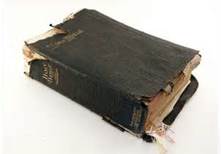
Both this passage and the Old Testament lection for this week (Nehemiah 8: 1-3, 5-6, 8-10) have to do with reading Scripture.  Isn’t that interesting–a Scripture about reading Scripture?  So was it important to include these passages so that we would understand what the Scriptures should mean to us?  After all, we revere the world, processing the Bible in each week, the closest thing that we can get to a tangible representation of “The Word of the Lord.”  And when we reach third grade, we experience one of those all-important church rites when we receive our Bible.  And somewhere along the way, we somehow get the impression that this heavily-bound, often golden-tipped set of pages is itself holy, an instrument of worship, but, more than that, a set of words that can lead us to God.   It is that notion that led me to an almost sick feeling when I have walked into my house three separate times to encounter the chewed and tattered pages of a Bible strewn across the floor.  Yes, Maynard, the over-zealous Black Lab with apparently an unquenchable appetite for the Scriptures, has eaten three Bibles.  I had someone ask me if he had eaten the whole thing.  No, I responded, he’s really just like all of us–picking and choosing what he wants to digest and leaving the rest in disconnected pieces behind.  (Oh, admit it, how many of you have really read the thing cover to cover?)  I mean, I tried a couple of times when I was little (with my third grade Bible) but somewhere around Genesis 10, I’d get discouraged by people I didn’t know and names I couldn’t pronounce and what seemed an overwhelming sense of needless violence.  Hmmm!  I guess the Bible is about us, isn’t it?  

So in this Scripture (the one about reading Scripture), the hometown boy returns and, as was the custome, he stood in the synogogue to read.  Renita Weems contends that this is the way Scripture should be read–in a public gathering, out loud.  The words that Jesus read–“the Spirit of the Lord is upon me…to bring good news…to bind up, to proclaim liberty, to bring release…”–these words were his manifesto.  And in that moment as Jesus read those words that had been read aloud for centuries before by people he didn’t know named names that he couldn’t pronounce, something happened.  The words were brought to life.  Jesus was not reading mere words; rather, the Spirit was pouring into them.  That is what Scripture should do to us.  

This day, we’re in the third of four weeks when our older elementary students participate by reading Scripture in the middle service.  I’ve had the privilege of working with some of those kids during the week before each Sunday to better prepare them.  I love doing that.  There is a freshness, an eagerness, an almost hunger.  They are excited and afraid at the same time.  They sense the gravity of it all, even if they don’t fully understand it.  When did we lose that?  Was it when we finally learned to pronounce the worlds?  Or was it when we became satisfied with what we thought we understood of it?  Or has Scripture become so perfunctory that we have missed what it holds?  You see, the Scriptures contain more than words.  Read between the lines.  There is oh, so much more there.  Don’t focus so much on the words or even what they say.  Let us instead delve into not the words but the Word.  Let us open ourselves to the possibility that it means something more and let God’s Spirit come upon us.  

Scripture has been compared to a lake whose depths have never been fully plumbed.  On the surface it looks like any other lake; that is, we see human words like those in other books.  But when we jump into the lake and begin to swim downward, we may be unable to find the bottom.  It is as if those human words become transparent to some mysterious and infinite depth we can never fully grasp.  Perhaps that is why one writer can say “Sounding in and through the human words of scripture, like the sea within a conch shell, is another reality, vaster than mind or imagination can compass.  God has chosen to be bound to the words of Scripture; in and through them, the Holy One comes near…It is not that the words magically or mechanically contain God’s Presence, but that as we allow the same Spirit through which the scriptures were written to inform our listening, the presence of God in and beyond those words becomes alive for us once more. (Marjorie Thompson, Soul Feast:  The Invitation to the Christian Spiritual Life (Louisville, KY:  Westminster-John Knox Press, 1995), 19-20)  

The Word of the Lord!  

Thanks be to God!  

Grace and Peace,  

Shelli

Water Plus a Miracle

Lectionary Passage:  John 2: 1-11
On the third day there was a wedding in Cana of Galilee, and the mother of Jesus was there.2Jesus and his disciples had also been invited to the wedding.3When the wine gave out, the mother of Jesus said to him, “They have no wine.”4And Jesus said to her, “Woman, what concern is that to you and to me? My hour has not yet come.”5His mother said to the servants, “Do whatever he tells you.”6Now standing there were six stone water jars for the Jewish rites of purification, each holding twenty or thirty gallons.7Jesus said to them, “Fill the jars with water.” And they filled them up to the brim.8He said to them, “Now draw some out, and take it to the chief steward.” So they took it.9When the steward tasted the water that had become wine, and did not know where it came from (though the servants who had drawn the water knew), the steward called the bridegroom10and said to him, “Everyone serves the good wine first, and then the inferior wine after the guests have become drunk. But you have kept the good wine until now.”11Jesus did this, the first of his signs, in Cana of Galilee, and revealed his glory; and his disciples believed in him.

We actually refer to this story that we read from the Gospel According to John as part of our marriage service order, mentioning that in it, “Jesus graced a wedding at Cana of Galilee and gave us the example for the love of one another.”  I’m not really sure why because the truth is this passage is not about marriage; it’s about wine.  So last week we read of Jesus’ baptism and now we read of his first miracle.  He definitely got the show on the road, so to speak.  And yet, the story is a little odd.  We read later of teaching, of healing, of including, even of raising from the dead.  So what’s this thing about wine?  Why was this act important enough to put in the Gospel and, particularly, to place it where it is the first miracle that we find Jesus doing?

Well, according to the Mishnah (which is essentially a redaction of the oral tradition of Judaism and a documentation of the traditional understandings of Scripture), the wedding would take place on a Wednesday if the bride was a virgin and on a Thursday if she was a widow. The bridegroom and his friends made their way in procession to the bride’s house. This was often done at night, when there could be a spectacular torchlight procession. There would be speeches and expressions of goodwill before the bride and groom went in procession to the groom’s house, where the wedding banquet was held. It is probable that there was some sort of religious ceremony, but we have no details. The processions and the feast are the principal items of which we have knowledge. The feast was prolonged, and might last as long as a week (so, OK, that would be quite a lot of wine!).

So Mary, the mother of Jesus, is at the wedding, although her role seems to be more than that of a guest. Perhaps the couple was an extended family member or something.  But she seems to be one of the first to know that the wine is running out. She instructs the servants to do whatever Jesus tells them to do, and they appear willing to take her instructions.  Now you have to understand that this was an embarrassing situation.  The wine has run out, and there appears to be no solution.  Either no more wine is available, or there is no money to buy more wine. The guests seem unaware of what is happening. If something is not done, all will be embarrassed. Some commentators even inform us that litigation was possible in such cases. (Can you imagine being sued for not providing enough food and drink at a marriage ceremony?)  But, regardless, it is clear that Jesus mother expects Jesus to do something out of the ordinary.  She expects him to fix the problem.

In the setting of this story, Jesus has not yet begun to perform all the miracles and the teaching and yet his mother thought he could do this.  It’s unclear whether or not Mary really understood what “hour” to which Jesus was referring or if she really grasped who this man that she had brought into the world was, but, timing aside, Jesus helps out and fills a need.  Maybe it’s a message to us that Jesus didn’t just come for the “big”, splashy things.  Maybe it’s a reminder that God is in even the ordinary, those seemingly small things in life that we think we can handle, that we think don’t really even matter to God.

But this?  I mean, really, wine?  Why didn’t he turn the water into food for the hungry or clothing for the poor?  Why didn’t he end the suffering of one of those wedding guests who were forced to live their lives in pain?  Why didn’t he teach those that were there that God is more impressed by who we are than what we do?  Now THAT would have been a miracle.  But instead Jesus, in his first miraculous act, creates a party, a feast.  Maybe it’s a reminder that we ought to just relax and trust God a little more.  Maybe it’s trying to tell us that God is indeed in every aspect of our life.  And maybe it’s telling us that life is indeed a feast to be celebrated.

And think about the wine itself.  It begins as ordinary grapes.  Well, not really.  If you go even farther back, you start with water.  Everything starts with water.  And then those ordinary grapes with just the right amount of water, the right amount of sunlight, and the right amount of nutrients fed to them from the rich, dark earth begin to seed.  And then we wait, we wait for them to grow and flourish and at just the right time, they are picked and processed and strained of impurities and all of those things that are not necessary.  And then they are bottled and tucked away while again, we wait.  They are placed in just the right temperature, with just the right amount of light, and just the right amount of air quality, and we wait.  We wait and until it becomes…well, a miracle.


And Biblical theologians have over and over pointed to the relationship that this story has with the Eucharist.  Think about it.  We take ordinary bread and ordinary wine (or in our case, ordinary Welch’s Grape Juice), and through what we can only describe as a Holy Mystery, a veritable miracle,  those ordinary things become holy.  They become for us the body and blood of Christ, the very essence of Christ to us, for us, and in us. 
And remember that when the wine ran out, Jesus did not conjure up fresh flagons of wine.  Rather, he took what was there, those ordinary, perhaps even abandoned vessels of ordinary, everyday water and turned it into a holy and sacred gift.  Water and a miracle…

So this story of wine makes a little more sense.  Wine is water—plus a miracle.  But in case it is lost on us, remember that our bodies are roughly two-thirds water.  No wonder the ancient sages always used water as a symbol for matter itself.  Humans, they taught, are a miraculous combination of matter and Spirit—water and a miracle—and thus unique in all of creation.  No wonder that wine is such a powerful, sacramental, and universal symbol of the natural world—illumined and uplifted by the Divine.  Wine is water, plus spirit, a unique nectar of the Divine, a symbol of life.

And we, ordinary water-filled vessels though we are, are no different.  God takes the created matter that is us and breathes Spirit into us, breathes life into us.  We, too, are water plus a miracle.  So as we lift the chalice today, let it be a reminder of Christ’s Spirit infused into us, living in us.  13thcentury German mystic Meister Eckhart said that “every creature is a word of God.”  It’s another way of reminding us that we are water plus a miracle.

So maybe this story of Jesus’ first miracle is not as odd as we thought.  Our lectionary places it immediately following the remembrance of Jesus’ baptism and the remembrance of our own.  It is the point where God’s Spirit, where the holy and sacred itself, was poured into each of us.  So, yes, we are a miracles, created matter, Spirit-breathed.  We are the good wine that God has saved for now.  We are water plus a miracle.

Go be the miracle you were created to be!

Grace and Peace,

Shelli

Happily Ever After…

Lectionary Passage: John 42: 1-6, 10-17
To read this passage online, go to http://bible.oremus.org/?ql=218124859

We come to the end of the Book of Job.  Job has suffered.  He has lost everything.  He has questioned God and expected God to give him reasons for why all these horrible things have happened to him.  But the actions of God are not centered in conventional responses to wickedness and righteousness.  The universe is, instead, filled to the brim with mystery and surprise and wonder.  God’s answer to Job is:  “Think again, Job.  Open your eyes wider to the whole of the cosmos.  Redirect your attentions away from what you have done to what I am doing.”  This is the turning point—Job now has received a new vision of God as YHWH, creator and sustainer as well as struggler with a complex and mysterious order.  It is that new vision of YHWH to which Job responds here.

Job inhabited a closed-minded world of retribution and distributive justice, where people get what they deserve, where there is a just God to see that all get what they earn based on who they are and what they do.  But then Job is invited out to a new world, a world not based upon simple, distributive justice.  And Job sees now that he is not the center of the world—that his relationship with God is found in his interconnectedness to all of the cosmos—that he is but a small, albeit essential, part of the wisdom of God.  In other words, Job has found not an answer but a true relationship with God.  In her book, Sometimes I Hurt:  Reflections on The Book of Job, Mildred Tengbom says it like this: “No one could tell me where my soul might be; I sought for God, but God eluded me.  I sought my brother out and found all three—my soul, my God, and all humanity.”  (Page 200)

So some would like the drama to end here.  After all, hasn’t Job gotten the point?  But if Job has become new, we must see him act out of his newness to discover if that newness is genuine.  We need to see Job back in the world again.

And so the Lord restores Job’s life.  Some of us struggle with this.  It gives it a sense of some sort of fairy tale ending and we all know that that type of ending is seldom, if ever, realistic.  It also gives us the image of that all-too-common presumption that God somehow rewards us, accepts us, or even (as horrifying as this notion is to me!) loves us based on what we do or who we are. But think about it in the context of the larger vision to which Job and we as readers have been invited.  God does not just put Job back together again.  It is better.  If we read it literally, it is better because Job is given more.  But, again, step back and look at the larger picture.  Perhaps it is a metaphor of what is to come.  It says that Job’s days were blessed but it doesn’t say that others were not.  Perhaps it is a vision of what the world can be when we allow ourselves to look at it through the lenses of God.  It is a world of plenty in which all of Creation prospers.  It is a world where we recognize family and our interconnectedness.  It is a world where all receive the inheritance of the world.  It is a world where we all die, old and full of days of a life to come.  “And they all lived happily ever after…”

God has allowed Job to be the hero.  God lets us struggle and win and when we lose our life, God gives it back to us.  The point is that Job actually encountered God and his life changed.  Catherine Marshall once said that Those who have never rebelled against God or at some point in their lives shaken their fists in the face of heaven, have never encountered God at all.” 

God remains Job’s God.  There can no longer be any talk of “reward” here—we have dispensed with that way of thinking.  God has blessed Job because God loves and wants to bless Job.  There is no other reason.  It is not for us to ask why.  Restoration is a feature of life; restoration is what God can do and does.  At the end, I don’t get answers.  I get a deepened relationship with God.  God doesn’t come with easy answers; God comes offering presence.  THAT is the Wisdom of God.

The story of Job is the story of life—our story.  It does not travel in a straight, easy-to-follow line.  It is not level or soft or easy.  It means much, much more than that. If someone tries to present it in some other way, they just don’t get it.  Sometimes life is chaotic; sometimes it’s just hard; and sometimes, through no fault of our own, it’s downright unbearable.  Answers are not what we need. That’s why I like Job.  It DOESN’T give you answers; it teaches you how to journey through life.  So, here is what I get from the story of Job:

  1. Life happens (but we are never alone.)
  2. Some things just don’t make sense.  (Perhaps we are reading them through a clouded lens, or even too MUCH correction—try wearing your contacts AND your glasses)
  3. We need to make sure that our images of God do not stand in the way of God’s presence in our lives or in the lives of those around us.
  4. God desires to be in relationship with us more than God desires for us to figure God out.
  5. Sometimes we need to just shut up and listen.
  6. Sometimes we need to just give up and let it be.
  7. Everything comes from God.  God breathed life and it was so.
  8. The future is an enigma.  Our road is covered in mist.  There will be times when the journey seems perilous and filled with despair.  But when we fling ourselves into what seems an impossible abyss, it is then that we will finally meet God.
  9. God is God.  We are not.
  10. And then we will die, old and full of days, and realize that life has only just begun.

Grace and Peace,

Shelli

Finally God Speaks!

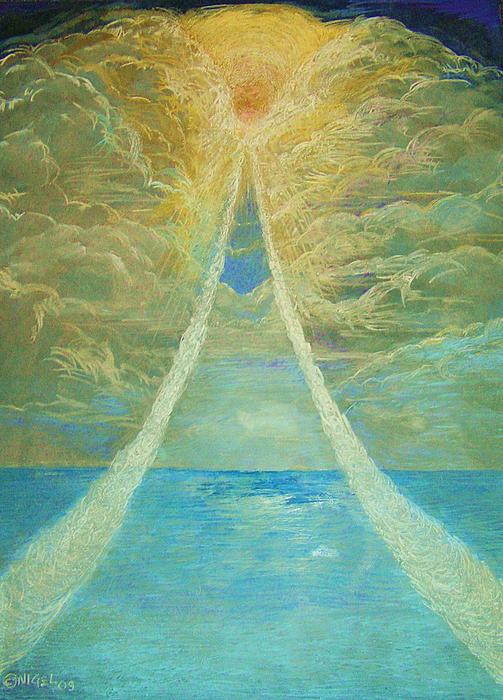
“After the Whirlwind”, by Nigel Wynter

Lectionary Passage:  Job 38:1-7, (34-41)
To read this passage online, go to http://bible.oremus.org/?ql=217564661

Boy, thirty-seven chapters is a long time to wait!  Job has waited, begged, screamed, and threatened to just throw it all in and walk away and finally, in this 38th hour, God speaks.  Now you could read it as if God is some sort of tease dangling hope in front of us until we just can’t take it anymore and then suddenly stepping in as some sort of pumped up superhero.  Or you could read it as if God had some permanent unyielding plan that outlined when it was Job’s turn for God’s time and when it was not.  Or perhaps you could read it that the omnipresent God is not, that God comes when God comes and the rest of the time God eludes us.  I think, though, that the problem rests not with God but with us.  And rather than God teasing us or avoiding us or eluding us or existing as some sort of passive-aggressive super-deity, perhaps we are somehow blinded to that ever-presence of God.

Maybe God had been speaking the whole time.  Maybe in the midst of Job’s pleas and Job’s demands, God really was speaking.  Maybe Job was just so wrapped up in trying to figure out an answer that he missed God’s Presence in his life.  Maybe the only answer for which Job was listening was not the answer at all.  Maybe Job was so sure what the “right” answer was that he wasn’t open to what God was offering in his life.  But when Job reaches the depths of despair, when Job is silenced by everything that has happened, when the noisy friends finally shut up, it is there, there in the silence, that God speaks.  But rather than a booming answering voice demanding apologies or repentance, once again God speaks Job into being.  It is not the voice of the judging God that Job’s friends had claimed would come and set Job straight but is instead the eternal voice of the Creator, once again speaking all that is into being just as God did in the beginning and every moment since.  The whirlwind is not to be confused with a tornado or a hurricane or some other destructive phenomenon.  It is instead the creative, life-changing force that, though undefined and unexplained, is the very voice of God speaking us into being.

And Job is reminded to look around, to look at all of Creation that has been laid down, to breathe in that which Job cannot make and cannot control.  Long ago, the rabbinical teachings noted that of all the animals listed as God’s handiwork–lion, raven, the wild ass, the wild ox, the ostrich, the hawk, the eagle, etc.–none had any real use to humanity.  In other words, the ordering of Creation is not about us; it is about God.  God doesn’t punish Job but rather subtly (well, as subtle as a whirlwind can be, I suppose!) reminds him that God is always present, always speaking Creation into being.  God doesn’t offer answers, as much as we think that would clear everything up.  Rather, God offers Presence and Love.  And that’s probably all God needs to say.

And after the speech, Job is changed.  He doesn’t have any more answers than before.  But what he does have is the realization that in all things, there is a God who is waiting to pick him up or hold him or cradle him in the arms of Love.  The realization came not because Job had faith and not because he believed in some rumor of a God that he learned in Sunday School but because in the depths of his life, he met God and finally the two began to dance.  Perhaps God does not desire our allegiance or our belief or some sort of blindly obedient faith.  Maybe God’s deepest desire is for us to make room in our lives and in our thoughts and in our prayers for God to speak us into being once again.  Shhhh!  God is about to speak…

Grace and Peace,

Shelli