The Season of Unpreparation

Scripture Passage: Mark 6: 7-12
7He called the twelve and began to send them out two by two, and gave them authority over the unclean spirits.8He ordered them to take nothing for their journey except a staff; no bread, no bag, no money in their belts;9but to wear sandals and not to put on two tunics.10He said to them, “Wherever you enter a house, stay there until you leave the place.11If any place will not welcome you and they refuse to hear you, as you leave, shake off the dust that is on your feet as a testimony against them.”12So they went out and proclaimed that all should repent.

What do you mean we’re not supposed to take anything with us?  This journey is hard.  There might be danger along the way.  We have to be prepared.  Admit it.  That’s what we all think.  After all, this journey to the cross is hard.  We’re not even halfway there–just sixteen days or so–and we’ve already encountered more than we really thought we could handle.  And now we’re told to go out there virtually unprepared for what will come next.

Maybe that’s our problem.  Maybe we mistake this Lenten journey as a time of preparing us for the Cross when, actually, we’re being called to unprepare ourselves, to put it all aside and encounter the raw roughness of the road itself.  This season is not a season of preparation but, rather, a season to shake the dust off, to clear our minds of any baggage that we have brought to this place, and to leave empty-handed, open, ready to receive.

It’s not something that we do well, this letting go, this allowing ourself to appear vulnerable, out of control, and unprepared.  I mean, we know that we have to walk this walk.  We know what’s coming.  We know what we have to go through.  And so we don some sort of cross-cut suit of armor to protect us, to make it just a little bit easier.  But think what Jesus did at the beginning of this journey.  He went into the desert, unprepared, taking nothing.  He did encounter danger–the danger of his own needs, his own desires, his own vision of what his life could hold.  What he encountered was himself.  And then he shook off the dust and left, returning to the road itself.  St. Catherine of Sienna once said that “all the way to God is God.”

This road to the Cross IS the road to which we are called.  It is the Way of God.  The challenge for us in this season is not to prepare ourselves for what is to come, but to clear the way. 

Grace and Peace,

Shelli

Station V: Anonymous Bystander

Scripture Passage:  Mark 15: 21-24
They compelled a passer-by, who was coming in from the country, to carry his cross; it was Simon of Cyrene, the father of Alexander and Rufus. 22Then they brought Jesus to the place called Golgotha (which means the place of a skull). 23And they offered him wine mixed with myrrh; but he did not take it. 24And they crucified him, and divided his clothes among them, casting lots to decide what each should take.

We know the town from where he came–Cyrene, an ancient Greek colony that became a Roman colony near modern-day Shahhat, Libya.  We know that he was a father of two sons.  Beyond that, this man Simon is essentially an anonymous bystander.  We don’t know why he was there at all.  Had he intended to come and bring his sons to this gory event or had they planned to visit Jerusalem, perhaps steep themselves in history and a little shopping, without realizing what this day would bring?  We don’t know what about him prompted the guards to literally pluck him out of the crowd.  All we know is that this man lives in history as the one, the only one, who helped Jesus carry his cross to Golgotha.

The Scriptures do not say that he responded in any way other than to do it.  It is interesting that in all those years upon years of God’s calls being met with “no, not me, please not me” that this anonymous man about whom we know little would be the one to do this.  So God calls a scared, young, no-name peasant girl to bring Jesus into the world and a foreign, probably dark-skinned, anonymous bystander to carry him out.  Isn’t that just like God?  Here, just before the end, God slips one more Divine reversal in.

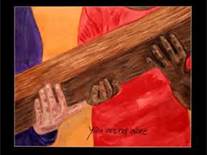
You know, Simon had to be afraid.  Good grief.  Here he was in the middle of the processional to a crucifixion!  What if they killed him too?  What would happen to his sons?  His family was miles away.  How would they even know what had happened to him?  And, yet, he didn’t seem to question his role.  He put his hand on Jesus’ shoulder as if to say, “I’m here.”  Then he leaned down and picked up the heavy cross, being careful to place his hands rather than running them down the splintering wood.  And then they began to walk–Jesus and this man, this dark-skinned anonymous man who Jesus had never met, this child of God, this new disciple, this one who without hesitation carried the cross of his Savior.  He would go through the gates and up the hill, touching the edge between life and death. 

But, again, I have to ask, where were those disciples?  Where were those who Jesus had called, who Jesus had groomed, who had been part of Jesus’ ministry, who had been Jesus’ friends?  Why was it THIS man and not them?  Why was it Simon that when it was all said and done was the first to take the yoke of Christ unto himself?  After all, it seems, the disciples would have been in the best position.  It would have made a whole lot more sense.  But, then, where would we be?  Where would those of us who Jesus had called, who Jesus had groomed, who are part of Jesus’ ministry?  Why isn’t it us touching the edge between life and death?  Why do we hold back?

28 ‘Come to me, all you that are weary and are carrying heavy burdens, and I will give you rest. 29Take my yoke upon you, and learn from me; for I am gentle and humble in heart, and you will find rest for your souls. 30For my yoke is easy, and my burden is light.’  (Matthew 11: 28-30).  See, we read this with such comfort at what Jesus can do for us.  But what does it mean to “take my yoke”?  For, THAT is the way that our souls will rest.

So, on this Lenten journey, move from being an anonymous bystander to a disciple of Christ.

Grace and Peace,

Shelli


Waiting for Figs

figtree1This Week’s Lectionary Passage: Luke 13: 1-9

At that very time there were some present who told him about the Galileans whose blood Pilate had mingled with their sacrifices.2He asked them, “Do you think that because these Galileans suffered in this way they were worse sinners than all other Galileans?3No, I tell you; but unless you repent, you will all perish as they did.4Or those eighteen who were killed when the tower of Siloam fell on them—do you think that they were worse offenders than all the others living in Jerusalem?5No, I tell you; but unless you repent, you will all perish just as they did.”
6Then he told this parable: “A man had a fig tree planted in his vineyard; and he came looking for fruit on it and found none.7So he said to the gardener, ‘See here! For three years I have come looking for fruit on this fig tree, and still I find none. Cut it down! Why should it be wasting the soil?’8He replied, ‘Sir, let it alone for one more year, until I dig around it and put manure on it.9If it bears fruit next year, well and good; but if not, you can cut it down.’”

We spend a lot of time trying to make this faith thing make sense, don’t we?  We try to offer reasons for what happens in our life, the good and the bad.  After all, we surmise, everything has a cause and every cause has an effect.  And so we live under the illusion that somehow we have control over things, that somehow everything in some way has got to make sense.  But truth be known, we really don’t have the answers.  In fact, our lives are really pretty precarious when you think about it and sometimes the answer is just that we have to wait and wonder and be willing to just let God be God.  And repent… 

And then we read this parable of the fruitless fig tree.  The owner waited and waited and no fruit appeared.  So, he got tired of it and told the gardener to cut it down.  After all, nothing was happening.  It was just wasting soil.  But the gardener stopped him, offering to nurture it just a little bit more than it had been, putting fertilizer around it, and waiting just a little bit longer. 

Now, granted, this is not one of our warm and fuzzy passages.  Jesus is not healing or welcoming or feeding a crowd.  In fact, this is downright hard, probably because we find way too much of ourselves in it.  We, too, want so badly to find answers to things that happen in our lives that we often lapse into that same notion of God rewarding and punishing based on what we do that these first century followers did.  After all, what other answer could there be?  And then, the fear factor…if we don’t bear fruit, we get cut down?  If we don’t repent, we’ll die?

Well, do you remember the Book of Job, the quintessential story of all in life that makes no sense at all, that has no answer,  that comes to us from the margins of faith, those places where we’d rather not go?  You remember it…Job, righteous and reverent, loses everything he has.  And most of the book is about his so-called friends and even Job trying to figure out why.  After all, God doesn’t just pull life out from under someone for no reason.  Job must have done something.  He must have not been who he was supposed to be.  The truth is, Job and his friends, like us, I’m afraid, inherited a somewhat myopic world of retribution and distributive justice.  It is hard to imagine a God who loves us just to love us and who, when bad things do happen, when life begins to feel like a whirlwind, appears into the depths of our being to help us stand, to help us walk, and to wait…just a little bit longer.

That’s where that turning, that repentance comes in.  You see, our problem is that we see repentance as a negative thing.  We envision repentance as a change toward being “right” or “moral” or something else that will win us favor with God or rack us up enough points to get us into heaven.  That’s why we sometimes have this Job-like image of God as some controlling entity that pulls some sort of Divine strings based on what we do.  But what kind of God is that?  Repentance is not about losing who you are; it’s not about becoming a puppet of some sort of string-pulling God; it means discovering the wonder of who you are meant to be.

The Greek word that is usually translated as “repentance” is metanoia.  In Classical Greek, it meant to change one’s mind, one’s heart, one’s soul, one’s life.  Penance was not a part of it until later.  We did that to it!  It simply meant to follow a different road.  But, as Jesus said, unless you repent…unless you change course…unless you let go of the life that you’ve created and the image of this string-pulling God that you’ve somehow concocted, and listen to the road that beckons before you, you will remain comfortable and secure and right where you are.  And you will, surrounded by comfort and answers, die!  But, oh, what you will miss!  Frederick Buechner says, “To repent is to come to your senses.  It is not so much something you do as something that happens.  True repentance spends less time looking at the past and saying, ‘I’m sorry,” than to the future and saying, “Wow!” ( Frederick Buechner, Wishful Thinking (San Francisco:  HarperCollins, 1973), 79.) 

So, what does this have to do with waiting on figs?  It sounds a little bit like a threat.  OK, one more chance you lazy fig tree.  Because if you don’t, you will die and that will be it.  You have one more chance to get it right, to repent, to turn, or, that’s it.  Well, you know as well as I that there are well-meaning people in pulpits all over the world saying exactly that.  You have one more shot!  And that it!  Oh, that’s not it at all!  Read it again.  There’s always another chance.  There’s always someone that will come along to nurture and wait patiently for us to turn, for us to change, for us to see what we’re missing.  You see, there ARE consequences for those who do not repent.  But it has nothing to do with punishment.  It has to do with missing who we’re called to be, missing out on the life that is offered us, missing out on being able to see what God is showing us.  And that, my friends, IS a form of dying.

You know, it’s an interesting thing about figs–the common fig bears a first crop, called the breba crop, in the spring on last season’s growth. The second crop is borne in the fall on the new growth and is known as the main crop.  But the fruits cannot happen without the first crop and, likewise, without the last season.  Essentially, the fruit sprouts from a seemingly fruitless crop.  Maybe the gardener saw that.  I think God certainly does.  See God sees things that we miss, things that our eyes, unadjusted as they are to the light, have not seen yet.  God is good at leading us through our darkness and nurturing us over and over again.  The truth is, God is pretty incredible at patiently waiting for figs.

And yet, with all the omnipotence that we imagine God to have, God cannot pull strings.  Because there is one thing that the Almighty cannot do because God in God’s infinite Wisdom placed the power to choose in our hands.  And so God cannot coerce us to love or to serve or to respond.  God cannot force us to see what God is showing us.  And so God waits for figs to bloom and the world to change.  And God holds us and guides us and picks us up off the bottom of our existence time and time again.  There’s always another season.

We read this passage in our Lenten season because it is our season to wake up, to open our eyes, to turn, to love, and to learn that sometimes the world that we see does not make sense.  But it’s not all up to us.  God is waiting patiently for our response.  God knows it’s hard.  After all, it just doesn’t make sense.  We wish it made sense.  G.K. Chesterton said “to let your religion be less of a theory and more of a love affair.”  You see, God just desires that we love.  And for that God waits.  God knows that there’s always a little bit more time to wait for figs. 

So in this Lenten season, turn toward God and wait for figs.

Grace and Peace,

Shelli

Station IV: In the Silence of Grief

Scripture Passage: Luke 2: 7
And she gave birth to her firstborn son and wrapped him in bands of cloth, and laid him in a manger, because there was no place for them in the inn.

The hurt in Mary’s eyes is evident.  This is her son.  This was the child that she carried in the womb, birthed into the world in the rough hues of that cold desert night shielded only by a stable, or a cave, or a grotto, or something of the like.  This was the child that she nurtured and saw grow into a young man.  This was the child that she never understood, the one who seemed to choose his own path, the one who even at a young age always seemed to have some sort of incredible innate wisdom.  This was the child that would rather sit at the feet of the rabbis, would rather soak in all of the eons of lessons, than play like the other children.  This was the young man that had made her so proud, full of compassion and empathy, always thinking of others, always standing up for the poor and the outcast.  This was the young man who had more courage than she had ever seen.  Where did he get that?  She remembers that night long ago in Bethlehem.  They almost didn’t get there in time.  They almost didn’t have a place.  But there he was.  Even the first time that she looked into his eyes, she knew.  This child was different.  Born of her and, yet, not really ever hers.  He always seemed to belong to something bigger.  But she could pretend.  She could think that he was hers.  And she could love him more than life itself.  And now, today, the pain is almost to great to bear.  It looked like this was it.  Was it all for naught?  After all, she herself had given up so much.  What meaning did it have?  Why was it ending so soon?  It couldn’t be time to give him back–not yet.

This station is another one that is considered “non-canonical”.  But we know that Mary was there.  Love would put her there.  Love would make her want to pick him up and hold him, cradle him like she did that cold Bethlehem night.  The station is marked with a relief carved in stone.  The church next to it still has the mosaic floor from an earlier Byzantine church that stood on the premises.  In the floor is an image of a pair of sandals facing north, supposedly marking the place where Mary stood in suffering silence when she saw her son carried on the cross.  

The Mary we know is usually silent.  With the exception of that story of the wedding at Cana when she told Jesus to fix the problem with the wine, she is usually depicted as almost stoic.  I don’t think stoicism has anything to do with it though.  Mary’s grief and pain were real.  When Jesus encountered her this one last time, they both knew it.  And they both felt Mary’s deep, unending, nurturing love.  Perhaps that is what we are to glean from this–that in the midst of one’s grief and pain and unbearable loss is the deepest love imagineable.  We see it in Mary and we know that at this moment, this is what God is feeling too.  After all, both have given themselves for the world and both are shattered  that the world is throwing their love back.  

At this point, nothing need be said.  The love is evident–the love of Mary, the love of God.  It is a love that we must experience–self-giving, suffering, silent–if we are to understand who God is and who God calls us to be.   It is the love that we are called to have for one another, a love that in the deepest of grief pulls us up and pulls us through, a love that would compel us to stand up for another, a love that, finally, creates room, a love that is of God.

So, in this Lenten season, let us, finally, learn to love one another. 

Grace and Peace,

Shelli  

The Road

This Week’s Lectionary Passage:  1 Corinthians 10: 1-13
I do not want you to be unaware, brothers and sisters, that our ancestors were all under the cloud, and all passed through the sea,2and all were baptized into Moses in the cloud and in the sea,3and all ate the same spiritual food,4and all drank the same spiritual drink. For they drank from the spiritual rock that followed them, and the rock was Christ.5Nevertheless, God was not pleased with most of them, and they were struck down in the wilderness.  6Now these things occurred as examples for us, so that we might not desire evil as they did.7Do not become idolaters as some of them did; as it is written, “The people sat down to eat and drink, and they rose up to play.”8We must not indulge in sexual immorality as some of them did, and twenty-three thousand fell in a single day.9We must not put Christ to the test, as some of them did, and were destroyed by serpents.10And do not complain as some of them did, and were destroyed by the destroyer.11These things happened to them to serve as an example, and they were written down to instruct us, on whom the ends of the ages have come.12So if you think you are standing, watch out that you do not fall.13No testing has overtaken you that is not common to everyone. God is faithful, and he will not let you be tested beyond your strength, but with the testing he will also provide the way out so that you may be able to endure it.

Well, it seems as if Paul is trying to shake up his Corinthian hearers a bit.  After all, they were pretty sure of themselves.  They were righteous and God-fearing and their faith was serving them well.  But Paul reminds them that it is not about them.  After all, a life of faith is not a life of checking off the boxes of all things good that one has done and counting one’s accolades; it is, rather, a life of an ongoing relationship with God.  And, as we all know, relationships do not move in a neat escalating line.  They have ups and downs and sometimes feel as if they are going to break completely apart.  Paul (as opposed to others in that day and, sadly, in ours) sees salvation here as a journey, an ongoing relationship, rather than securing a place in heaven or avoiding a place in hell. 

The truth is, relationships are hard.  This faith thing is hard.  It does not guarantee one a life of ease or plenty.  As Paul reminds us, look at the past. Faithful people lived in the shadows and had the waves crash over them.  Things were not easy.  Why would our life be different?  You see, faith is not something that removes us from life, that separates us from the world.  Faith is what calls us to live there, to be who we are called to be in this world, showing the world a different pathway.  Yeah, I know, it’s not easy.  But we have to persevere.

In our time, so much of religion is presented as a cure for all.  Well-meaning seekers are promised that faith, REAL faith, UNENDING faith, UNFALTERING faith, will bring them health and wealth and ease.  OK, excuse me here, but, really…no.  The Scriptures never depicted that.  This faith thing is hard.  Did you forget that it has to do with a cross, an instrument of death?  Did you forget that it acknowledges that pain and suffering is part of life?  Did you forget that we are told to deny ourselves and follow a pathway that we’ve never followed before?  But, more than anything else, did you forget that God has walked ahead?

It may not be easy; it may destroy you; it may even end your life as you know it.  But God has walked this way before.  That’s the difference between shallow, empty pictures of fame and fortune dangled above a well-paved and perfectly landscaped path and following this bumpy, over-grown road with the marks of a cross drug through it and the, albeit faint, footsteps of faithful travelers who have gone before. 

Faith is not about finding the easiest way but following where God has gone before.

Grace and Peace,

Shelli

Station III: Vulnerable

“Station III”, painting by Chris Gollon
Commissioned in 2000 by
St. John on Bethnal Green, London

Scripture Passage:  Matthew 7:25
The rain fell, the floods came, and the winds blew and beat on that house, but it did not fall, because it had been founded on rock.

The third station of this Way of the Cross is the image of Jesus falling under the weight of the cross.  It is one of the non-Canonical stations and yet we know that the sheer exhaustion alone would be enough to make this a reality for any human.  That’s right.  Lest we forget, Jesus was human.  God did not come to earth to live as a figure resembling one of our super heroes, above the fray, untouchable, undaunted by the difficulties of human life.  No, God came as one of us, struggling and vulnerable.  And as Jesus falls, we feel that vulnerability.  It is uncomfortable for us.  After all, if this one on whom we rely, in whom we place all of our hopes and our dreams, is vulnerable, what does that say about out own lives?

Maybe the crux of this Walk is that we ARE supposed to be vulnerable.  Living a life of faith does not place some sort of impermeable bubble around us.  Regardless of what many will tell you, walking this walk does not guarantee that you will be healthy, wealthy, and wise.  If anything, it points to our vulnerability in the most profound way.  As humans, we will at times experience sadness, despair, and the deepest grief imagineable.  We experience those not because we are weak but because we are real.  And Jesus experienced the same thing because he, too, was real.  And, when you think about it, what kind of God is it who will plunge the Divine Self into the deepest of despair and the vulnerability?  It is the kind of God that does more than pull us out of it but rather lays at the bottom of it all and cradles us until it subsides.  But we will only experience that when we allow ourselves to be vulnerable, when we allow ourselves to be real, when we finally allow ourselves to need others, to let them in to our darkness.

This depiction of Jesus falling under the weight of the Cross affirms that vulnerability is part of us.  It also compels us toward the vulnerable, the hurting, the outcast, for it is there that we will find in ourselves empathy and compassion, and, finally, a Love greater than we thought we could have.  If we allow ourselves to be vulnerable, we will be able to see the same in others.  We are not called to become a Super Hero; we are called to cross boundaries and be Christ for others when they need it the most and, perhaps with even greater faith than that, we are called to let others into our grief and pain.  We are the ones who both lift the fallen and allow ourselves to be lifted.  Sometimes we will fall.  Sometimes life will hurt.  But we are never there alone.  But it takes great faith to know that.

Jesus will fall two more times on this Walk.  Life goes on.

Grace and Peace,

Shelli  

Come to the Waters

This Week’s Lectionary Passage:  Isaiah 55: 1-9
Ho, everyone who thirsts, come to the waters; and you that have no money, come, buy and eat! Come, buy wine and milk without money and without price.2Why do you spend your money for that which is not bread, and your labor for that which does not satisfy? Listen carefully to me, and eat what is good, and delight yourselves in rich food.3Incline your ear, and come to me; listen, so that you may live. I will make with you an everlasting covenant, my steadfast, sure love for David.4See, I made him a witness to the peoples, a leader and commander for the peoples.5See, you shall call nations that you do not know, and nations that do not know you shall run to you, because of the Lord your God, the Holy One of Israel, for he has glorified you.  6Seek the Lord while he may be found, call upon him while he is near;7let the wicked forsake their way, and the unrighteous their thoughts; let them return to the Lord, that he may have mercy on them, and to our God, for he will abundantly pardon.8For my thoughts are not your thoughts, nor are your ways my ways, says the Lord.9For as the heavens are higher than the earth, so are my ways higher than your ways and my thoughts than your thoughts.

Most of us do not really know what it means to thirst.  I mean, really, really thirst.  After all, the shortage of clean water in many parts of the world is lost on us.  We just go to the faucet (or the automatic water spout in our refrigerator door or the waiting bottle of water in the bottom fridge door).  Thirst, real thirst, eludes us.  But Timothy Shapiro claims that “hope is preceded by longing”.  You see, God is not requiring us to be right or moral or steadfast.  I don’t think that God is even requiring us to lay prostrate at the feet of God in good, old-fashioned repentance.  God’s only requirement is that we thirst for God, that we desire to be with God so much that we can do nothing else but change our course and follow God.  It is our thirst that draws us closer to God and closer to each other.  We just have to desire something different enough to be part of making it happen.

So, what happens with those of us for whom thirst can be so easily quenched?  How do we learn to hope at the deepest part of our being if we never truly long for anything?  How do we discover what true need is when we often live our lives over-filled and over-served? How do we hunger for something better in a life where we are so satisfied?  Perhaps that is why people like us need this season of Lent, plunging us into the depths of human need and profound grief.  Maybe the point of it all is to teach us how to thirst and, therefore, to show us that for which we long.

God’s abundance, God’s quenching of thirst, God’s feeding of hunger is greater than anything that we can offer ourselves.  But those of us whose lives are already filled to the brim, already stuffed beyond what we need and beyond what we can really manage, often convince ourselves that we need nothing more.  There is nothing more that we can cram into our time or our budget or our houses or our bellies or our lives.  And, yet, we are never satisfied.  Maybe what we’re missing is not something else to fill us; maybe what we’re missing is the longing for something that we cannot quite grasp.  But that longing, that deep, deep, profound longing will only come when we realize that we cannot fill it.  In other words, we do not need something more; we need to learn to thirst, to long. 

So, in this Lenten season, let us clear away the things with which we have filled ourselves and learn to thirst–really thirst.  And there we will find our true hope.

Grace and Peace,

Shelli