Reclaimed in the Wildeness

Fork in the desert roadScripture Text:  Genesis 21: 14

14So Abraham rose early in the morning, and took bread and a skin of water, and gave it to Hagar, putting it on her shoulder, along with the child, and sent her away. And she departed, and wandered about in the wilderness of Beer-sheba.

Well our heroes from yesterday are not shining examples of humanity in this story. After God promised Abraham a son with his wife Sarah, they laughed in disbelief. But they waited…and waited…and waited. They got impatient, as we all do at times, and took matters into their own hands. (Don’t we all do that at times?)  So Sarah devised a plan where Abraham would father a child with her slave Hagar. After all, in her mind that would fulfill the promise that Abraham would become the “father of a nation” so maybe this was what God meant all along. But, of course, things did not come out completely rosy. Predictably, Hagar’s pregnancy provoked Sarah’s jealousy and bitterness, and so she drove Hagar into the wilderness. But, true to character, God found her there and welcomed her back, in effect reclaiming her as part of the story. He told her that her child that was to be born would be called Ishmael, which means “God hears”. He said that her descendants would be “too numerous to count”. (This is starting to sound vaguely familiar!)

In the passage for today, it is probably some fifteen years later. It is the occasion of the weaning of Isaac, which probably means that he’s about three years old. Once again, those old wounds and jealousies surface for Sarah and, once again, she drives Hagar, this time with the child Ishmael, into the wilderness. Hagar gives up, toying with just leaving Ishmael to die so the whole sordid thing would end. But then, once again, God hears. And then God makes what is really an extraordinary promise to Hagar that is almost identical to the promise made to Abraham. “I will make him into a great nation…God was with the boy.”

This is a little bit different wilderness story.  Hagar was not “driven” to the wilderness; she didn’t go there for solace or renewal; she wasn’t wandering through it on the way to the Promised Land.  Hagar was sent away, forced into the wilderness mainly by Sarah’s jealousy and resentment and Abraham’s fear and remorse.  And there God again reclaims her, giving her a new story, a new promise of life to come.  The story is a reminder that God is God, once and for all, and that God, with infinite compassion and abounding grace will reclaim us even from ourselves, even from what we humans do to each other.  One by one, in the deepest wilderness of our lives, God reclaims us as children of God.

God’s focus becomes a focus on the future.  Five chapters before this when Hagar had run into the wilderness to avoid Sarah’s wrath, God came.  Sent into the wilderness as forsaken, Hagar encounters God.  In fact, God draws her into conversation.  Hagar becomes the first person in Genesis to encounter an angel of God and the first woman to be given promises (the first woman, ever!).  She becomes the only person in the Old Testament to actually name God.  Hagar, sent into the wilderness so that she would not be part of the story, is reclaimed by God and given a story all her own. In his book, Peculiar Treasures, Frederick Buechner says of this story that it tells “how in the midst of the whole unseemly affair the Lord, half tipsy with compassion, went around making marvelous promises, and loving everybody, and creating great nations, like the last of the big-time spenders handing out hundred dollar bills.”

Both children are recognized as belonging to Abraham but also to a particular future that will be worked out in the future. God announces that it is through Isaac that descendants will be named for Abraham, referring to the covenantal line. But Abraham can be assured that God will care for the future of Ishmael as well, making of him a great nation, making him of the great story that God is continually writing.

In this season of Lent, we do wander in the wilderness.  Some of our wildernesses are self-imposed; some are gifts given from God for renewal and recreation; and some wildernesses are so deep that God must pluck us out of the undergrowth and hold us, setting us upright, so that we begin a new journey.  Lent teaches us that the story is always more than we planned, more than we can see, more than the road that we are on now.  In this wilderness season, the story begins to move beyond ourselves.  We just have to learn to pay attention and allow ourselves to be reclaimed by a story we did not fully know.

Grace fills empty spaces, but it can only enter where there is a void to receive it, and it is grace itself which makes this void. (Simone Weil)

FOR TODAY:  What is your story?  What chapter is God calling you to include?  How is God reclaiming you from the wilderness in which you wander?

Grace and Peace,

Shelli

Roundabout Way of the Wilderness

Moses in the WildernessScripture Text:  Exodus 13: 17-22

17When Pharaoh let the people go, God did not lead them by way of the land of the Philistines, although that was nearer; for God thought, “If the people face war, they may change their minds and return to Egypt.” 18So God led the people by the roundabout way of the wilderness toward the Red Sea. The Israelites went up out of the land of Egypt prepared for battle. 19And Moses took with him the bones of Joseph who had required a solemn oath of the Israelites, saying, “God will surely take notice of you, and then you must carry my bones with you from here.” 20They set out from Succoth, and camped at Etham, on the edge of the wilderness. 21The Lord went in front of them in a pillar of cloud by day, to lead them along the way, and in a pillar of fire by night, to give them light, so that they might travel by day and by night. 22Neither the pillar of cloud by day nor the pillar of fire by night left its place in front of the people.

The Season of Lent is the wilderness season.  It begins in the wilderness and ends in another wilderness until Easter bursts forth.  And in between those wildernesses are the stories of the way of the wilderness.  Lent is about fasting from what we know and feasting on what we find in our roundabout way through the wilderness.  There are, of course, many mentions of wildernesses in the Scriptures.  The NRSV touts 287 times that the word “wilderness” shows up.  Well, there seems to be a recurring theme here.  Maybe it’s not that wilderness just keeps cropping up in our Scriptures; maybe the Scriptures are rather about the wilderness, or, more specifically, a rhythm of going and return, forsakenness and deliverance, hopelessness and redemption.  The Scriptures begin in the wilderness.  Genesis 1 doesn’t specifically mention the word.  But in its place is a depiction of it as a formless void filled with darkness.  It is where we begin and then God recreates it into order and light.  Pilgrimage, or journeying, is a way of life.  And all of us struggle along the way.  The wilderness is part of our story.  It is part of us.  It is the way we grow in our faith.

When you read the Exodus passage above, we are told that God sort of “redirected” the people through the wilderness to avoid the land of the Philistines.  And there they wandered for forty years, through a wilderness with no real “roadmap”, through shifting sands and places devoid of landmarks.  They journeyed through hopelessness and forsakenness, continually asking questions and doubting that God was there at all.  But they grew.  They grew to know God, grew to know themselves.  What they found in the wilderness was their identity.  The sometimes harsh lessons of the desert transformed the people into God’s people.  Led by a cloud through the desert, the people became people of faith.

We are no different.  This season may sometimes seem to be a roundabout way through the wilderness.  We encounter the dangers of hopelessness and forsakenness; we experience the dangers of questions and doubt; and somewhere in there, if we give ourselves the chance, we are recreated and transformed into newness and life.  During this season, we keep hearing over and over to empty ourselves before God and open ourselves to what God is showing us.  It is our season of unmasking, peeling off all of the layers that do not belong to us, that make us someone who we are not. Leo Tolstoy once said that “there are many reasons for the failure to comprehend Christ’s teaching…but the chief cause which has engendered all these misconceptions is this: that Christ’s teaching is considered to be such that it cannot be accepted, or even not accepted, without changing one’s life.” The wilderness is what changes us, what changes our life.

In the spiritual tradition, wilderness is the place where we leave the world behind and place ourselves at God’s disposal. (Daniel Wolpert)

FOR TODAY:  Embrace your journey through the wilderness.  Make it your story.  This is your beginning.  Place yourself at God’s disposal and change your life.

Grace and Peace,

Shelli

Lessons From the Desert Fathers


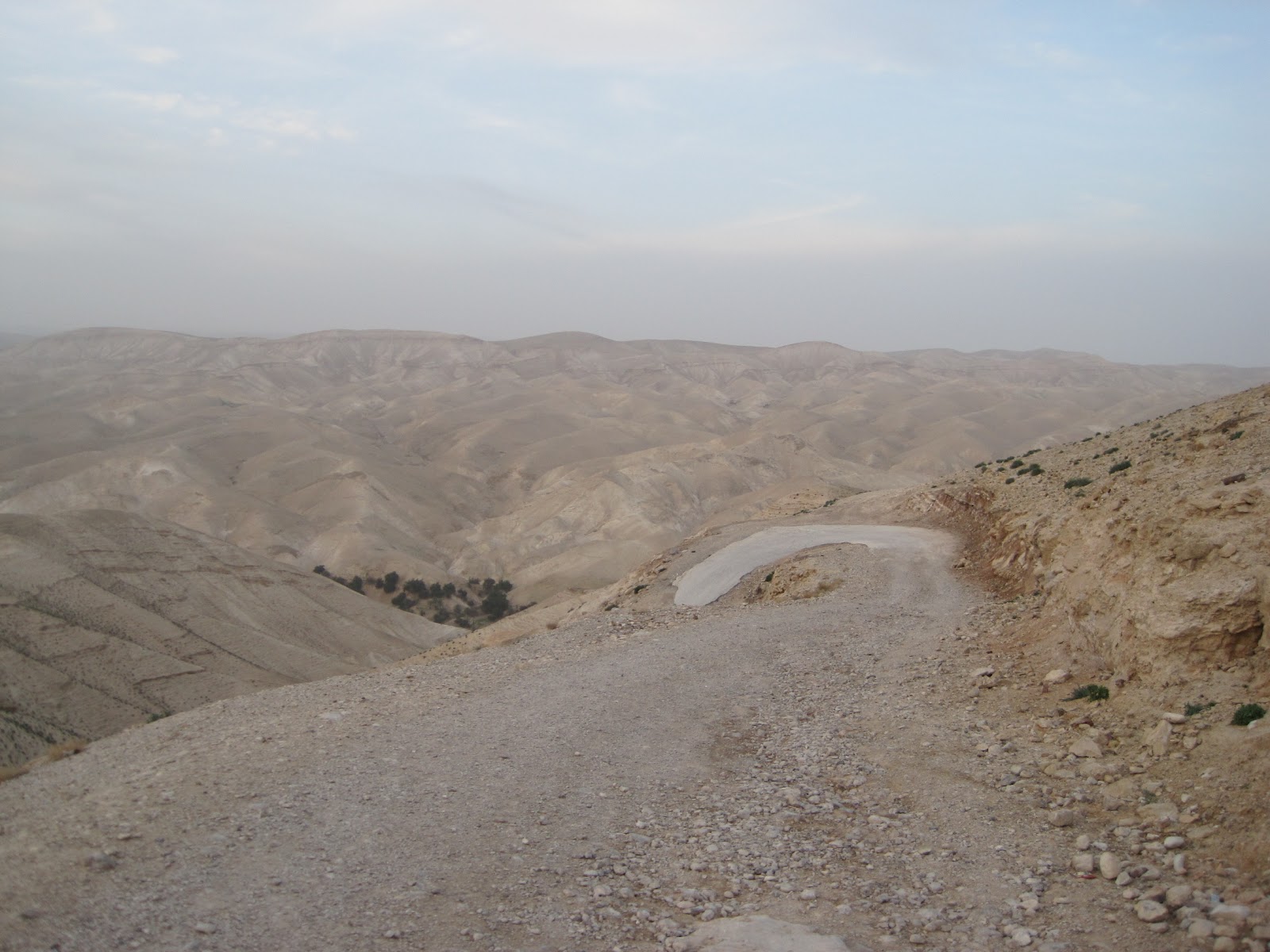
The Judean Wilderness, February, 2010

Scripture Text:  Mark 1: 10-13

10And just as he was coming up out of the water, he saw the heavens torn apart and the Spirit descending like a dove on him. 11And a voice came from heaven, “You are my Son, the Beloved; with you I am well pleased.” 12And the Spirit immediately drove him out into the wilderness. 13He was in the wilderness forty days, tempted by Satan; and he was with the wild beasts; and the angels waited on him.

Jesus was baptized by John and then the version of the Gospel by the writer we know as Mark has immediately being driven into the wilderness.  Still wet with the waters of life, Jesus began his 40-day quest filled with danger, temptation, and probably questions about his own identity and the ministry that would come.  We struggle with this.  We often get hung up on the whole temptation thing, trying to come up with reasons why Jesus, of all people, would have been tempted.  But the writer of this version of the account doesn’t offer more than a mere mention of that.  Instead, we have Jesus being driven out into the wilderness and then the story picks up a few sentences later.  You see, no one followed Jesus out in the desert to get the first hand account.  He was on his own, alone in the wilderness.

We’re not big fans of wildernesses.  In fact, we try to do everything we can to avoid them, or at least find one that has cellular reception and free WIFI available.  And yet, Jesus was driven into the wilderness, as if he had no choice.  Jesus was forced to spend 40 days in what is essentially a wasteland.  The wilderness was waiting for him, offering something that the crowds and the towns and even the synagogue could not.  The wilderness, the place that no one owns, the place that no one has tamed, the place that no one really wants to beat, the place that will never become something that it is not offers just that–itself.  Jesus is not the first to wander in the wilderness and he was not the last.  A few centuries after this, orders of monks in Northern Africa began to make their way into the desert, into the wilderness to experience God’s Presence unhindered by what humans have attempted to create, unhindered by expectations and schedules.  It was the place where they went to renew their prayer life, to begin again.  There were those, like Jesus, that returned to their lives but with new eyes and new hearts.  There were also though that chose to stay , even though they would remain visitors in a place that was not theirs.  In the wilderness, nothing exists but you and God, and, uninterrupted and unhindered, God can create you yet again.

Our wildernesses come in all forms.  Some are self-imposed and others are those to which we are driven at a time that we have no control over where we are going.  The wilderness is hard and dangerous and uncomfortable.  Some are filled with grief and despair.  Others are wrought with a feeling that we will never get out.  Sometimes the wilderness seems unforgiving, as if it’s only focus is to push us into vulnerability, to push us into temptation.  But the lesson that we learn from the wilderness is that, when everything else is gone, when the clouds make us unable to see the way out, when we feel that it will never end, God is there.  And we have become someone new.

Most of us will not drop out of society and make our way to the wilderness.  Even Jesus returned to Galilee, proclaiming the Gospel.  But in this season that remembers Jesus’ time in the wilderness, we can learn what it means to awaken to God’s Presence, to be mindful of this Presence that is always and forever with us, to, day by day, strip those things away that have our attention.  We can learn what it means to enter an intentional wilderness, a place and a time where God is all we have. These forty days are our emptying time—the time when we strip all of our preconceptions away and meet God where God is—right there with us.  We do not walk this road alone.  God is always there.  And when we are tempted to once again take control, God will still be there.  Lent is the time when we allow God to work on us that we might burst forth on Easter morning in radiant bloom.

We need the tonic of wildness, to wade sometimes in marshes where the bittern and the meadow-hen lurk, and hear the booming of the snipe; to smell the whispering sedge where only the wilder and more solitary fowl builds her nest, and the mink crawls with its belly close to the ground.  We can never have enough of nature.  We must be refreshed by the sight of inexhaustible vigor, vast and titanic features, the sea-coast with its wrecks, the wilderness with its living and its decaying trees, the thunder cloud, and the rain which lasts weeks and produces freshets. We need to witness our own limits transgressed, and some life pasturing freely where we never wander. (Henry David Thoreau)

FOR TODAY:  Think of what it would mean to enter an intentional wilderness this Lent, to, day by day strip all those things away that have your attention until all that is left is God, who is recreating you even now.

Grace and Peace,

Shelli


You Start at the Very Beginning…

Dawn in the wildernessScripture Text:  Mark 1: 1-8

The beginning of the good news of Jesus Christ, the Son of God.  As it is written in the prophet Isaiah, “See, I am sending my messenger ahead of you, who will prepare your way;
the voice of one crying out in the wilderness: ‘Prepare the way of the Lord, make his paths straight,’”

John the baptizer appeared in the wilderness, proclaiming a baptism of repentance for the forgiveness of sins. And people from the whole Judean countryside and all the people of Jerusalem were going out to him, and were baptized by him in the river Jordan, confessing their sins. Now John was clothed with camel’s hair, with a leather belt around his waist, and he ate locusts and wild honey. He proclaimed, “The one who is more powerful than I is coming after me; I am not worthy to stoop down and untie the thong of his sandals. I have baptized you with water; but he will baptize you with the Holy Spirit.”

Do you remember the song from “The Sound of Music”?  “You start at the very beginning.  A very good place to start.  When you read, you begin with A-B-C; when you sing you begin with Do-Re-Mi.  The first three notes just happen to be Do-Re-Mi. Do-Re-Mi-Fa-So-La-Ti…..oh let’s see if we can’t make it a little bit easier…”  (Yeah, I’m a Sound of Music dork.)  We’re used to that…starting at the beginning, learning our A-B-C’s before we jump headlong into reading Tolstoy or something.  But, the writer of the Gospel According to Mark seemed to just sort of want to get this show on the road.  We’ve become so accustomed to the beauty and poetry of the nativity that somehow that becomes the season for us.  But here…”The beginning of the good news of Jesus Christ, the Son of God.”  That’s it.  That’s all you get.  No announcement of Jesus’ birth, no birth story, no stable, no inn, no manger, no Mary and Joseph and the babe, no shepherds, no magi.  Just that.  It’s sort of like the Gospel writer is saying “refer to the previous volumes”.  But, of course, most Biblical scholars will tell you that there WERE no previous volumes of the Gospel but that this one was the first.  So, what is that beginning?


Then it goes on:  As it is written….Essentially, the beginning of the good news of Jesus Christ, the Son of God, is everything that came before–all the prophets, all the judges, all the Wisdom, all the kings, Elijah, Moses, Ruth, Jacob, Abraham, Sarai, all the exiles returning home, all the burning bushes and parting waters, all the covenants, all those generations upon generations of people who wandered in the wilderness.  And now…now appearing in the wilderness is this wild, somewhat unkempt, bear of a man who clothes himself in camel’s hair and eats what appears to be whatever crosses his path in the brush.  There were certainly those with “proper” upbringing and “acceptable” expression of their religious beliefs that probably would have been a bit embarrassed by the display.  I mean, maybe it would have gone down easier if it had been someone a tad bit more “traditional”.  (But then, really, was Jesus all that status quo?)  And yet, I’m fascinated with this character of John the Baptist.  He knew who he was.  He knew his place.  He was called to prepare the way.  He was called to BE the voice crying out in the wilderness.  He was called to prepare the way of the Lord.


The beginning of the good news of Jesus Christ, the Son of God.  Here we are, in the wilderness of our lives, wandering a little aimlessly at times, trying our best to connect to God, to feel God’s Presence in our lives.  And yet, we know that God did not plunk down in the middle of the bustling city of Jerusalem.  God did not come in the way that was planned or imagined.  The Son of God emerged into the wilderness that was already there, already so full of God that the very earth shook.  The truth is, God had been there all along.  The good news of Jesus Christ was always beginning.  The same is true for us today.  What we are living is not some sort of prelude of a life to come; it is the very beginning of the story.  Maybe that’s our shortcoming.  Maybe we live lives limited by the chapters surrounding us.  But God…God came and comes over and over and over again, beginning, recreating, starting us over.  Advent is the season of beginnings–the beginning of the church year, the beginning of us, the beginning of what comes next.  Advent is not a preface to the high holy day on which we celebrate the Savior’s birth.  Advent reminds us that we, even now, are the beginning of the good news of Jesus Christ, the Son of God.  “See, I am sending my messenger ahead of you, who will prepare your way; the voice of one crying out in the wilderness: ‘Prepare the way of the Lord, make his paths straight.”  The truth is, the story ALWAYS is at the beginning!


When you come to the end of all the light you know, and it’s time to step into the darkness of the unknown, faith is knowing that one of two things shall happen: Either you will be given something solid to stand on or you will be taught to fly. (Edward Teller)


FOR TODAY:  How are you called to prepare the way for Christ?  How are you called to begin again?


Grace and Peace,

Shelli