Wilderness-found


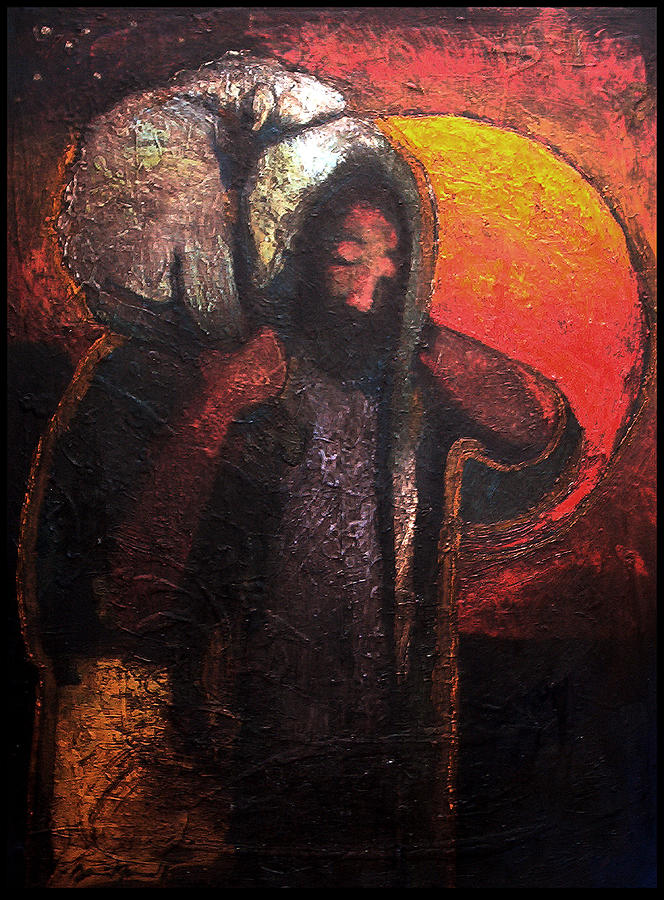
"The Lost Sheep", Daniel Bonnell, USA
“The Lost Sheep”, Daniel Bonnell, USA

Scripture Text:  Luke 15: 4-6

 4“Which one of you, having a hundred sheep and losing one of them, does not leave the ninety-nine in the wilderness and go after the one that is lost until he finds it? 5When he has found it, he lays it on his shoulders and rejoices. 6And when he comes home, he calls together his friends and neighbors, saying to them, ‘Rejoice with me, for I have found my sheep that was lost.’


As we have come to know, the wilderness is treacherous. It is tiresome and mind-draining. It often seems to lengthen time even as one makes his or her way through it. We become impatient. We want it to end. We want to shorten the time that it has its hold on us. We want to take shortcuts to get to the end, so we veer off the path, away from our course, thinking that we have it all figured out. We find ourselves lost.


It is easy in times of wilderness to think that you are alone. It is tempting to assume that you have somehow ended up there of your own doing and that you and you alone are responsible for finding your way out. We’ve all been lost before. We’ve all been in situations where we just can’t seem to find our way back. We’ve all had times whether they be physical, emotional, or even spiritual where we lose our way. We backtrack, trying to find the pathway down which we came so that we can “start again”. But everywhere we look, the choices of where to go all look the same. It becomes overwhelming. We turn and we turn and we panic and we run through this maze of choices over and over again.


When I was young, I was told that if I was lost, I should stay where I was. (Sometimes we’re smarter when we’re children, because we know to listen.) I think intellectually we all know that we should stay on the path and keep walking and yet, as adults, we somehow think we can fix it. We can wander with panic through life with no compass and no real help. We can try this way and that way and backtrack and veer off to nowhere. We can convince ourselves that we need no help, that we can do it. We can be tempted by the shortcuts that are offered along the way. And we stay lost.


Sometimes we are the lost sheep. Sometimes the wilderness seems to consume us. Sometimes the road through it seems to lengthen with each step. But where we did get the notion that solitude meant that we were alone? This wilderness journey is not one that we travel alone. God walks with us, holds us when we need to be held, and when we become the lost sheep, the one who has wandered away, God is there too. God doesn’t “fix” our way through the wilderness or speed up our wilderness time, but we are always wilderness-found.


We just have a couple of more weeks of this Lenten wilderness. We know that it will get harder. We know that, like many wilderness paths, it will seem to lengthen and become more treacherous as we near the end of its hold. But we do not walk it alone. Jesus, walking to the Cross, was never alone. He was in solitude; he was in prayer; he was often deserted by those who traveled with him. But God has walked this way before. God knows the way. So God will always make sure that even though the way is hard, we are always wilderness-found. And God lays us on the Divine shoulders and rejoices.


Look back from where we have come.  The path was at times an open road of joy.  At others a steep and bitter track of stones and pain.  How could we know the joy without the suffering?  And how could we endure the suffering but that we are warmed and carried on the breast of God? (Desmond Tutu)


FOR TODAY:  Let God pick you up.  Let God hold you.  Be aware of God walking with you on this path.

Grace and Peace,

Shelli

Vision Quest

Vision QuestScripture Text:  John 12: 20-33

 20Now among those who went up to worship at the festival were some Greeks. 21They came to Philip, who was from Bethsaida in Galilee, and said to him, “Sir, we wish to see Jesus.” 22Philip went and told Andrew; then Andrew and Philip went and told Jesus. 23Jesus answered them, “The hour has come for the Son of Man to be glorified. 24Very truly, I tell you, unless a grain of wheat falls into the earth and dies, it remains just a single grain; but if it dies, it bears much fruit. 25Those who love their life lose it, and those who hate their life in this world will keep it for eternal life. 26Whoever serves me must follow me, and where I am, there will my servant be also. Whoever serves me, the Father will honor. 27“Now my soul is troubled. And what should I say—‘Father, save me from this hour’? No, it is for this reason that I have come to this hour. 28Father, glorify your name.” Then a voice came from heaven, “I have glorified it, and I will glorify it again.” 29The crowd standing there heard it and said that it was thunder. Others said, “An angel has spoken to him.” 30Jesus answered, “This voice has come for your sake, not for mine. 31Now is the judgment of this world; now the ruler of this world will be driven out. 32And I, when I am lifted up from the earth, will draw all people to myself.” 33He said this to indicate the kind of death he was to die.


In some Native American cultures, a vision quest is a rite of passage, a time of coming of age. In many tribes, a vision quest requires that a person spend at least four to five days secluded in nature, in the wilderness, so to speak. During that time, the person participates in what is characterized as deep spiritual communion. It is a time of transition, perhaps of “finding oneself”. It is a time of finding one’s direction, a turning toward who one is supposed to be.


We know this Scripture passage well. It is the point where Jesus metaphorically, if not literally, turns toward the Cross. It is the point where Jesus begins walking and beckons others to follow, to let go of all to which they are holding and follow. But I think I have often sort of skipped over the first two verses. What an odd interplay. Greeks, outsiders, come to worship at the festival. Now I guess you could assume that they were Jewish if they were coming to worship. But they are still not part of Jesus’ inner circle. And they head right up to Philip. The passage makes it clear that Philip, too, was on some level an “outsider”. He was from Bethsaida, the “house of fishing”, the place on the Galilean Lake where Jesus had probably called him to follow, along with some of the other disciples. And to Philip, the Greek questors make their request: “We wish to see Jesus.”


On the surface, it is a simple enough request. But when you consider that they were Greeks, accustomed to knowledge and learning, probably used to the more pragmatic way of looking at things, the notion of “seeing” Jesus is interesting. And there is no answer given. Jesus goes right into laying out what is about to happen. Maybe the idea is that wishing to see is a way of seeing, that desiring to be close to Jesus brings one closer, that one’s awakening to Jesus’ Passion is what brings one into it.


What if this season of Lent became our vision quest? What if here in the wilderness that leads to the Cross, where our plans go awry and we are at the mercy of circumstances that we cannot seem to control to our liking, we see life, we see Jesus, we see ourselves in a different way? What would it mean here, in a place to which we are unaccustomed, we were to ask to see Jesus—not just assume that Jesus is there, not just walk through Passion and Holy Week the way we always have, but to truly, in the deepest part of our being, desire to see Jesus, to know Jesus (not the Jesus that picks us up, not the Jesus who we like to call our brother or our friend or whatever word implies a close friendship, but the Jesus who has turned and walked away toward the Cross and now beckons us to follow.)? Now is the time. Now is the time for your own vision quest.


Every question in life is an invitation to live with a touch more depth, a breath more meaning. (Joan Chittister)

FOR TODAY:  Go on a vision quest.  Learn to see anew.  Wish, in the deepest part of your being, to see Jesus—not the one that you’ve been so comfortable seeing, but the one who beckons to you to follow.

Grace and Peace,

Shelli

Becoming Wilderness

"St. John the Baptist", El Greco, c. 1600.
“St. John the Baptist”, El Greco, c. 1600.

Scripture Text:  Matthew 3: 1-5

 In those days John the Baptist appeared in the wilderness of Judea, proclaiming, 2“Repent, for the kingdom of heaven has come near.” 3This is the one of whom the prophet Isaiah spoke when he said, “The voice of one crying out in the wilderness: ‘Prepare the way of the Lord, make his paths straight.’” 4Now John wore clothing of camel’s hair with a leather belt around his waist, and his food was locusts and wild honey. 5Then the people of Jerusalem and all Judea were going out to him, and all the region along the Jordan, 6and they were baptized by him in the river Jordan, confessing their sins.


We never know quite what to do with this strange wilderness man.  You can imagine him covered with dirt and grime after all this time in the wilderness.  His hair is long and unkempt, matted in places and hanging down over one of his eyes.  He is decked out from neck to knee in some sort of strange covering made of camel’s hair that is secured by a roughshod faded leather belt hastily tied around his waist.  And all this time in the wilderness has caused him to lose any hint of a sophisticated palate finely tuned to the gentle blend of herbs and spices and culinary concoctions.  Instead, he is content to eat what he finds—locusts, wild honey, whatever else may cross his path.  Yeah, we never know quite what to do with this strange wilderness man.

John was definitely not a run-of-the-mill preacher.  He had zeal; he had passion; his primary focus was preparing the way of the Lord.   I’m not sure what John saw for those who did not know God.  But he was determined that all who came out to him somehow, some way turned their lives around.  Now this whole idea of “repentance” that John emphasized is not one that we good Methodists often focus on.  It sometimes sounds a little too “hellfire and brimstone” for us. But repentance means turning around, a new mind, a change of direction.  It means throwing off those things that bind us to the life we know for those things that point to a life with God.  It does not mean that God has finally won us over; it means, rather, that our own self, our own story, has finally come to be.  Just being there is not enough; just having Abraham for your ancestor is not enough; just doing the right thing is not enough.  You must change your life.  You must change your path.  You must change how you look at the world.  There are no favorites.  This includes everyone.

So, why did John make his home in the wilderness?  Why didn’t he come to town, plant himself in the middle of the town square, and preach his message there?  Maybe it was not that John himself had such an affinity for the wilderness life.  Maybe it was rather that he saw what we often avoid.  I mean, think about the wilderness—it calls us into things outside our normal routines, outside of the establishments that make up our lives.  The wilderness calls us to learn to see things anew.  Without routines, we have to rely on something that will point us in the right direction; without our comfortable landmarks and our timeworn assumptions, we have to rely on the wilderness and those who we meet on the path showing us the way.

No, we don’t know what to do with him.  We don’t know how to talk to or talk about this wild wilderness man.  After all, John is a threat to proper society and accepted norms.  John IS the wilderness.  Maybe that’s what we need to do—become wilderness.  Now I’m not ready to don camel’s hair and I’m thinking that I might pack some peanut butter and crackers and perhaps a high-protein granola bar to avoid EVER having to eat locusts.  But maybe I do need to become wilderness, to clear the timeworn path through my life, to become open to the wildness of God’s Spirit that blows in and out of places that I never knew, that somehow compels me to travel down roads unknown, sometimes with fear and trepidation, and be willing (no, actually WANT to) turn myself around and see what I have not seen.

OK, John, I guess we get it.  I’m still not keen on the outfit and the meal, but if our Lenten journey has taught us anything, it is to open ourselves to traveling through what we do not know so that it can all be revealed to us.  John saw something that I have been avoiding.  John was not waiting for God’s Kingdom to come to be; he saw it happening.  By becoming wilderness, by stepping out of what he knew, he saw that God was not just coming but was already here.


Not only is another world possible, she is on her way. On a quiet day, I can hear her breathing. (Suzanna Arundhati Roy)


FOR TODAY: Become wilderness. Open your eyes and see God’s Kingdom coming to be. (And, if you need to, pack some peanut butter!)

Grace and Peace,

Shelli

Coming Alive in the Wilderness

embrace_lifeScripture Text: Hebrews 5: 5-10


5So also Christ did not glorify himself in becoming a high priest, but was appointed by the one who said to him, “You are my Son, today I have begotten you”; 6as he says also in another place, “You are a priest forever, according to the order of Melchizedek.” 7In the days of his flesh, Jesus offered up prayers and supplications, with loud cries and tears, to the one who was able to save him from death, and he was heard because of his reverent submission. 8Although he was a Son, he learned obedience through what he suffered; 9and having been made perfect, he became the source of eternal salvation for all who obey him, 10having been designated by God a high priest according to the order of Melchizedek.


Second century bishop and saint Iranaeus of Lyons once said that “the glory of God is humanity fully alive.” What does that mean, to be “fully alive”? I don’t think that it means, as we might jump to conclude, reaching some sort of pinnacle of humanity, you know the “be all you can be” phenomenon. It is not in any way hierarchical. It doesn’t mean that one is better or worse or less alive than another. Being fully alive is rather embracing all that we are, all that God envisions us to be. It does not mean being superhuman; it means being fully human; it means being the very image of God such that was perfected in Jesus Christ.


So who is this Melchizedek character? He crops up in the Bible a couple of times at best—in Genesis (Gen. 14:18) as Abraham is called by God and then again in Psalm 110 and then here. His name means “King of Righteousness” or “King of Peace” in some places. Remember that Abraham had been called by God and was promised that he would become the father of many nations. But that hadn’t happened and Abraham was feeling the pressure of it all. So at this lowest, darkest point, in the middle of the wilderness, so to speak, enter Melchizedek, a somewhat shadowy character that drifts in and drifts out, almost not even worth a speaking part in this whole drama of the life. But he offers Abraham blessing, and food, and wine. He just comes. He just shows up. (See, this is all sounding vaguely familiar.)


So enter Jesus Christ, a high priest according the order of Melchizedek. It’s not hierarchical; it’s an ordering of life. And we are baptized into that same order. It is not a designation that comes with power or with tenure or with honor.  We are not “set apart” away from the world or away from life. We are baptized into the order of life, this great continual ordering of God. Our lives will be filled with love. They will also endure suffering. We will walk through feasts and famines. We will traverse mountains of light and dark valleys. And we will journey through the familiarity and comforts of home and places of deep wilderness. Living the depth and breadth of our lives makes us fully alive, makes us real. But, into our high points and our low points, a somewhat shadowy character drifts in and out, offers us blessing, and food, and wine. God just comes. Over and over and over again, God comes. God just shows up. Perhaps being fully alive is knowing that you are loved, not that you have to earn that love or gain that love or do something specific for that love. Love just comes. Being fully alive is knowing in the deepest part of your being how much you are loved, so loved that it literally spills out of your being into the world.


Lent is an invitation to become fully alive, to immerse ourselves into life, to finally allow ourselves to feel pain and emptiness, to feel the Cross, so that we can grasp the untold Joy of Resurrection. Lent is an invitation to become real, to know Love, to know Love in the deepest part of who we are. Maybe Love that is found in the wilderness makes us fully alive. Maybe Love that comes when we need it the most, when our lives are emptied out, when we are surrounded by darkness, when we can do nothing to earn love, is the Love that we finally need to know.


Here is the God I want to believe in: a Father who, from the beginning of Creation, has stretched out his arms in merciful blessing, never forcing himself on anyone, but always waiting; never letting his arms drop down in despair, but always hoping that his children will return so that he can speak words of love to them and let his tired arms rest on their shoulders. His only desire is to bless. (Henri J.M. Nouwen, The Return of the Prodigal Son, 95-96)


FOR TODAY: Be fully alive! Know how much you are loved, loved enough that God is with you always, waiting in Love. Imagine that love spilling into the world.


Grace and Peace,

Shelli

Be Thou My Vision

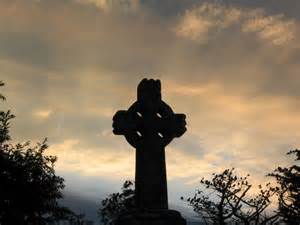
Celtic CrossScripture Text: John 1: 1-5

 In the beginning was the Word, and the Word was with God, and the Word was God. 2He was in the beginning with God. 3All things came into being through him, and without him not one thing came into being. What has come into being 4in him was life, and the life was the light of all people. 5The light shines in the darkness, and the darkness did not overcome it.


Well, just because we’re wandering in the wilderness does not mean that we are not allowed to paint ourselves green and celebrate with good ole’ St. Patrick. Happy St. Patrick’s Day! Because even those of us who are in traditions where we honor few feast days of Saints get in on this one! Now, admittedly, most of us don’t even know much about Patrick or his tradition, save a few legends about snakes and stuff.  Patrick was said to have been born Maewyn Succat (Lat., Magonus Succetus) in Roman Britain in the late 4th century.  When he was sixteen, he was captured by Irish raiders and taken as a slave to Ireland, where he lived for six years before escaping and returning to his family.  He wrote that his faith grew in captivity and he prayed daily.  The story is told that one day Patrick heard a voice saying “your ship is ready” and took it to mean that it was time to return home.  Fleeing his master, he traveled to a port two hundred miles away, found a ship, and sailed home.  He entered the church and later returned to Ireland as a missionary.  By the eighth century, he had become one of the patron saints of Ireland.


Patrick’s life, like his Celtic tradition, is based on pilgrimage.  Life in this tradition is about growing and moving and not “pitching our tent” in one place too long.  It is about connecting to all of Creation, about honoring and revering all as sacred.  It is about treating all of life sacramentally, embracing it as a gift from God and a way to God.  Embracing the Celtic spirit means going on a journey, open to moving from one place to another, one thought to another, one way of seeing to another.  In the midst of this journey, Celtic spirituality recognizes the importance of crossing places, seeing them as thresholds of growth.  These places are truly looked upon as sacred spaces.


I love the Celtic tradition. It has fed me spiritually for some time.  It’s probably a little wilder than that to which most of us are accustomed. Deborah Cronin characterized is as “a bit on the edge”. Rather than shunning the pagan belief that they inherited, they brought Christianity into it, letting the two traditions enter into a holy conversation. In fact, the Celtic Christians, without the limitations imposed by the Roman church, embraced even those considered “heretics” as part of their faith. So their version of the Christian tradition was “broadened” a bit beyond the traditional claims. See, history tells us that the Roman Empire never made it to Ireland, leaving the green isle just beyond the control of both the emperor and the authorities of early Christianity as most of us know it. So Ireland and the other islands that claimed this Celtic strain of belief, birthed a Christian experience somewhat removed both geographically and theologically from mainland Europe. It is Christianity mingled with, but not compromised by, the finest aspects of pagan Celtism, those that found resonance with Christian symbols and understanding. For Celtic Christians the experience of vision is a tangible way of seeing what God has done and then seeing it through God’s creative eyes, followed by seeing the life-giving possibilities God sees. Not overly concerned with ecclesiastical matters, the Celtic Way is instead expressed through the beauty of art and symbols, the richness of prayers and poetry, and an understanding of the sacredness of all of Creation.


What would our faith look like if we understood all Creation as sacred? What would our beliefs be if we allowed them to grow beyond what tradition has handed us? What would our lives look like if saw everything as “of God”, as a way that God is perhaps speaking to us, maybe leading us down a different path? What would our journey be if we became connected to more than what we know, more than what we see? What would it mean to live our lives “a bit on the edge”, in liminality (“betwixt and between”), as the Celts would have called it, on a threshold between what we know and what we don’t, between what we see and what has yet to be revealed to us, between what is true and what is Truth? In this season of Lent, we are called to open our thoughts, open our hearts to the way that God is leading us. We are called not just to see what is obvious but to let God be our Vision, our way of seeing, to enter the Sacred with new eyes and a new heart. Maybe we will find that the way out of this wilderness is not by exiting it but by beginning to see it differently, as a way filled with sacredness and wonder, as a Way of God.  

http://www.bing.com/videos/search?q=celtic+be+thou+my+vision&qpvt=celtic+be+thou+my+vision&FORM=VDRE#view=detail&mid=8DB7AEBD8FDE0203321C8DB7AEBD8FDE0203321C


Human beings may separate things into as many piles as we wish—separating spirit from flesh, sacred from secular, church from world. But we should not be surprised when God does not recognize the distinctions we make between the two. Earth is so thick with divine possibility that it is a wonder we can walk anywhere without cracking our shins on altars. (Barbara Brown Taylor)


FOR TODAY: Close your eyes and imagine God as your Vision. Open your eyes and behold the Sacred in everything…And THEN paint yourself green and do whatever you do to celebrate St. Patty’s Day!


Rath De ‘ort (Gaelic, pronounced Rah Day urt, “The Grace of God on you.”)


Shelli

Turned Inside Out


Inside OutScripture Text: Jeremiah 31: 31-34

 31The days are surely coming, says the Lord, when I will make a new covenant with the house of Israel and the house of Judah. 32It will not be like the covenant that I made with their ancestors when I took them by the hand to bring them out of the land of Egypt—a covenant that they broke, though I was their husband, says the Lord. 33But this is the covenant that I will make with the house of Israel after those days, says the Lord: I will put my law within them, and I will write it on their hearts; and I will be their God, and they shall be my people. 34No longer shall they teach one another, or say to each other, “Know the Lord,” for they shall all know me, from the least of them to the greatest, says the Lord; for I will forgive their iniquity, and remember their sin no more.


Most of us know this passage well. It speaks of a new covenant, one that is written not on tablets or in rainbows but woven into the very being of the people. The context in which this was written is probably following the exile. The cities have been breached, the temple has been totally destroyed, nothing is left of the people’s lives. They have become subjects of the Persian king and have lost everything that they had before. But God through the Prophet Jeremiah gives a vision of reconstruction and renewal. But this time things will be different…


We Christians like to read this with our Easter-colored lenses on. We Christians like to put on our post-Resurrection lens and read this with the view of Jesus, the Cross, and the empty tomb in our mind.  Ah…we think, Jesus, Jesus is the new covenant.  Jesus is the covenant that is written on our hearts.  Jesus is the one. Is he?  I mean, yes, Jesus IS the embodiment of the New Covenant. So we try our best to follow, to do what Jesus would do, to act like Jesus would act. We profess that we believe in Jesus Christ as our Lord and Savior. And then we sort of wait…we wait until Jesus comes or we go or whatever our belief system tells us is going to happen sometime up ahead. But, in the meantime, this covenant sort of eludes us. What happened to it being written on our hearts? What happened to it being part of us?


You know, when you think about it, did Jesus come as Emmanuel, God-With-Us, as one among us who took himself all the way to the Cross out of love for us just so that our belief system would change? Or did Jesus come to show us the Way to God, the way to write the covenant into our very being and become the embodiment of it ourselves? In other words, perhaps this life of faith, this way of being Covenant People, with hearts tattooed and all, is not just a life of profession of belief but one of following and living this Way to God so intently that we become it. Maybe it’s a way of living inside out.


So in this Lenten wilderness, we find our beliefs. They are there, time-tested and comfortable. We can memorize them; we can recite them; we can even talk about them on a good day when we think it’s appropriate and the audience is receptive. But the wilderness shows us that there is more. The wilderness exposes our heart. And there’s that covenant written into it. The wilderness shows us how to turn ourselves inside out and become the Way to God. So, the days are surely coming…maybe when that begins to be is up to us.  Maybe, as we’ve said, we are the ones that we’ve been waiting for.


We live like ill-taught piano students. We are so afraid of the flub that will get us in dutch, we don’t hear the music, we only play the right notes. (Robert Capon)


FOR TODAY: Imagine the covenant written on your heart. Imagine BEING the embodiment of the Way to God. Now dance to the music.


Grace and Peace,

Shelli

So, Again, Why Are We Here in the Wilderness?

Jesus tempted in the wildernessScripture Text:  Matthew 4: 1-11


Then Jesus was led up by the Spirit into the wilderness to be tempted by the devil. 2He fasted forty days and forty nights, and afterwards he was famished. 3The tempter came and said to him, “If you are the Son of God, command these stones to become loaves of bread.” 4But he answered, “It is written, ‘One does not live by bread alone, but by every word that comes from the mouth of God.’” 5Then the devil took him to the holy city and placed him on the pinnacle of the temple, 6saying to him, “If you are the Son of God, throw yourself down; for it is written, ‘He will command his angels concerning you,’ and ‘On their hands they will bear you up, so that you will not dash your foot against a stone.’” 7Jesus said to him, “Again it is written, ‘Do not put the Lord your God to the test.’” 8Again, the devil took him to a very high mountain and showed him all the kingdoms of the world and their splendor; 9and he said to him, “All these I will give you, if you will fall down and worship me.” 10Jesus said to him, “Away with you, Satan! for it is written, ‘Worship the Lord your God, and serve only him.’” 11Then the devil left him, and suddenly angels came and waited on him.


We’re past the mid-point place in the journey and it’s becoming tiresome. Is it all worth it?  We haven’t really seen any sign of where we’re going and things have gotten so incredibly uncomfortable (and some of it is beginning to get a little personal!).  We’re ready for all of this to be over.  At the beginning of the journey, we heard that Jesus had gone into the wilderness.  We already know that.  But the writer known as Mark didn’t really elaborate on the temptations that Jesus encountered.  This version of the story seems to focus on just that.

First of all, Jesus was fasting.  Now it doesn’t say what kind of fast—there are fastings from all meals except breakfast, there are fastings from everything except water, there are fastings from everything that enters one’s mouth.  There are also other fastings—fastings from certain input into one’s mind, fasting from doing certain things, perhaps fastings from human contact.  Maybe that’s what Jesus was doing.  Because forty days and forty nights by oneself doesn’t provide a lot of company.  He probably was famished.  But whatever Jesus’ fast entailed, it was long and it was hard and he was famished.

So Jesus is tempted when he is the most vulnerable, when all of his guard and his shields were down.  He is tempted to guarantee having what he needs, tempted to impress and be liked, and tempted to be in control.  Henri Nouwen said that the temptations were to be relevant, spectacular, and powerful. Oh, he could have made excuses.  We all do it.  After all, think how much powerful his ministry would have been.  Think what WE could accomplish if we were relevant, spectacular, and powerful.  The truth is, those things are not bad in and of themselves.  Relevance, spectacularness (probably not a word!) and power can do great things when they are harnessed in the right way.  But when they get in the way of who God calls us to be, when they become the reason we are doing things, when they become our primary focus and goal in life, then they have pulled us away from who God calls us to be.

See, Jesus knew those temptations and knew to resist them.  I think the whole reason that Jesus was tempted at all was not to prove that he could resist temptation but rather to put these things in their proper place.  They are not bad; they are just not the main thing, should not be the goal that we are trying to accomplish.  The truth is, this wilderness journey does not beg for us to accomplish; maybe in some way it calls us to famine, to being famished, so that we know exactly what we need.  So, again, why are we here in the wilderness?  We are here to empty our lives of ourselves so that they can be filled with God.  We are here to realize how our souls hunger and thirst for God.  We are here to finally know that nothing fills our emptiness, nothing fills us up, nothing fills our souls but God.  We are here to finally know that longing for God is our main thing because our longing will lead us to what we most need.

One needs to keep on thirsting because life grows and enlarges.  It has no end; it goes on and on; it becomes more beautiful…[One] cannot be satisfied until [one] ever thirsts for God. (Alexander Baillie)

FOR TODAY:  Long for God.  Write down what that means.  What emptiness do you feel?