Lost and Found

Scripture Text: Luke 15: 4-6

4“Which one of you, having a hundred sheep and losing one of them, does not leave the ninety-nine in the wilderness and go after the one that is lost until he finds it? 5When he has found it, he lays it on his shoulders and rejoices. 6And when he comes home, he calls together his friends and neighbors, saying to them, ‘Rejoice with me, for I have found my sheep that was lost.’

As we have come to know, the wilderness is treacherous. It is tiresome and mind-draining. It often seems to lengthen time even as one makes his or her way through it. We become impatient. We want it to end. We want to shorten the time that it has its hold on us. We want to take shortcuts to get to the end, so we veer off the path, away from our course, thinking that we have it all figured out. We find ourselves lost.

It is easy in times of wilderness to think that you are alone. It is tempting to assume that you have somehow ended up there of your own doing and that you and you alone are responsible for finding your way out. We’ve all been lost before. We’ve all been in situations where we just can’t seem to find our way back. We’ve all had times whether they be physical, emotional, or even spiritual when we lose our way or we feel ourselves mired in lostness and grief. We backtrack, trying to find the pathway down which we came so that we can “start again”. But everywhere we look, the choices of where to go all look the same. It becomes overwhelming. We turn and we turn and we panic and we run through this maze of choices over and over again.

When I was young, I was told that if I was lost, I should stay where I was. (Sometimes we’re smarter when we’re children, because we know to listen.) I think intellectually we all know that we should stay on the path and keep walking and yet, as adults, we somehow think we can fix it. We can wander with panic through life with no compass and no real help. We can try this way and that way and backtrack and veer off to nowhere. We can convince ourselves that we need no help, that we can do it. We can be tempted by the shortcuts that are offered along the way. And we stay lost.

Sometimes we are the lost sheep. Sometimes the wilderness seems to consume us. Sometimes the road through it seems to lengthen with each step. But where we did get the notion that solitude meant that we were alone? This wilderness journey is not one that we travel alone. God walks with us, holds us when we need to be held, and when we become the lost sheep, the one who has wandered away, God is there too. God doesn’t “fix” our way through the wilderness or speed up our wilderness time, but we are always wilderness-found.

We just have a little bit more time of this Lenten wilderness. We know that it will get harder. We know that, like many wilderness paths, it will seem to lengthen and become more treacherous as we near the end of its hold. But we do not walk it alone. Jesus, walking to the Cross, was never alone. He was in solitude; he was in prayer; he was often deserted by those who traveled with him; he often found himself mired in lostness and grief. But God has walked this way before. God knows the way. So, God will always make sure that even though the way is hard, we are always wilderness-found. And God lays us on the Divine shoulders and rejoices.

Often when the heart is torn with sorrow, spiritually we wander like a traveler lost in a deep wood.  We grow frightened, lose all sense of direction, batter ourselves against trees and rocks in our attempt to find a path.  All the while there is a path–a path of Faith–that leads straight out of the dense tangle of our difficulties into the open road we are seeking. (Helen Keller)

Grace and Peace,

 Shelli

The New Thing

Scripture Text: Isaiah 43: 18-19

18Do not remember the former things, or consider the things of old. 19I am about to do a new thing; now it springs forth, do you not perceive it? I will make a way in the wilderness and rivers in the desert.

I love old things.  They are full of stories and ripe with history. They are real, full of pits and marks from the past. My house is full of antiques (many of which carry generations of family history with them) and, for want of a better word, “repurposed” antique wanna-be’s.  I love history. I love old houses and antique shops and cemeteries. I love connecting with the past and those that came before me. I love old churches and especially those that honor and celebrate their rich histories. See, old things are not the problem; old ideas are not the problem; old notions of who God is and who we are before God are not the problem. The problem comes about when we find ourselves stuck with “the way it has always been”, not wanting to bring the past to life, wake it up, repurpose it so that it has life for us now and beyond. The problem comes when we find ourselves holding on for fear of losing our past or losing our grounding, wandering in the wilderness of former things.

I don’t think God wants us to forget the past. It is part of us. It is coursing through our DNA as we speak, making us who we are. It is what taught us to breathe, taught us to live, taught us to worship, taught us to be. We always carry with us the echoes of what God created before. They are our beginnings. But beginnings are not meant to be held onto. It is to our detriment to pad our lives with the past, to clutch at the beginnings as if they are the end-all, afraid that we might lose them, and to miss the new thing that God is doing, the repurposing of the old into the new.

Tradition is not a bad thing. It is a wonderful thing. It means to come into a conversation that began long before we got here and that will continue long after we are gone. It means realizing that there was something before we got here that is of value. It’s just not finished. We have to enter the conversation, embrace its riches, and then find what Truth is finally ready to be heard and what part of the Truth is ours to finally tell. Edna St. Vincent Millay said that “[Humanity] did not invent God but developed faith to meet a God who is already there.” But the conversation must continue so that we can see the newness that God is doing as Creation is repurposed and Truth becomes fuller.

Lent is known as a season of the wilderness, a season of wandering into the unknown, of being vulnerable, of letting go. Maybe it’s not so much that we are entering wilderness, but that we are exchanging one wilderness for another, leaving the wilderness of former things behind and journeying on through the way that God has made in the wilds of the new and untamed wilderness. But if we do things the “way we’ve always done it”, we will miss the newness springing forth. I can’t help but think about this as we begin to birth our “new normal” as a society.  After this pandemic, there is no way of going “back to normal”.  It doesn’t exist.  The new normal is waiting to be, even if it is shrouded in wilderness right now.  There is no doubt that the wilderness is the place to begin but the beginning cannot be held for more than a moment or it is lost in the past.

It has been the interruptions to my everyday life that have most revealed to me the divine mystery of which I am a part. All of these interruptions presented themselves as opportunities; invited me to look in a new way at my identity before God. Each interruption took something away from me; each interruption offered something new. (Henri J.M. Nouwen)

Grace and Peace,

 Shelli

Betwixt and Between

Scripture Text: John 1: 1-5

In the beginning was the Word, and the Word was with God, and the Word was God. 2He was in the beginning with God. 3All things came into being through him, and without him not one thing came into being. What has come into being 4in him was life, and the life was the light of all people. 5The light shines in the darkness, and the darkness did not overcome it. (John 1: 1-5)

In the 4th century, there was a sixteen year old boy named Maewyn Succat in Roman Britain who was captured by Irish raiders and taken as a slave to Ireland.  He lived there in fear for six years before escaping and returning to his family.  One day, as the story is told, he heard a voice saying “your ship is ready” and fled his master, traveled to a port two hundred miles away, found a ship, and sailed home.  He later returned to Ireland, his place of captivity, the place of his fear, as a missionary.  By the eighth century, he had become one of the patron saints of Ireland.  You probably know him as St. Patrick.

Patrick’s life, like his Celtic tradition, is based on a pilgrimage through the wilderness.  Life in this tradition is about growing and moving and change and not “pitching our tent” in one place too long.  It is about connecting to all of Creation, about honoring and revering all as sacred.  It is about treating all of life sacramentally, embracing it as a gift from God and a way to God.  Embracing the Celtic spirit means going on a journey, open to moving from one place to another, one thought to another, one way of seeing to another.  In the midst of this journey, Celtic spirituality recognizes the importance of crossing places, seeing them as thresholds of growth.  These places are truly looked upon as sacred spaces.

I love the Celtic tradition. It has fed me spiritually for some time.  It’s probably a little wilder than that to which most of us are accustomed. Rather than rejecting the pagan belief that they inherited and being fearful of it, they brought Christianity into it, letting the two traditions enter a holy conversation. So, their version of the Christian tradition was “broadened” a bit beyond the traditional claims. See, history tells us that the Roman Empire never made it to Ireland, leaving the Green Isle just beyond the control of both the emperor and the authorities of early Christianity as most of us know it. So, Ireland and the other islands that claimed this Celtic strain of belief, birthed a Christian experience somewhat removed both geographically and theologically from mainland Europe. It is Christianity mingled with, but not compromised by, the finest aspects of pagan Celtism, those that found resonance with Christian symbols and understanding. For Celtic Christians the experience of vision is a tangible way of seeing what God has done and then seeing it through God’s creative eyes, followed by seeing the life-giving possibilities God sees. The Celtic Way is instead expressed through the beauty of art and symbols, the richness of prayers and poetry, and an understanding of the sacredness of all of Creation.

What would our faith look like if we understood all Creation as sacred? What would our beliefs be if we allowed them to grow beyond what tradition has handed us? What would our lives look like if we saw everything as “of God”, as a way that God is perhaps speaking to us, maybe leading us down a different path rather than fearing it? What would our wilderness journey be if we became connected to more than what we know, more than what we see? What would it mean to live our lives in liminality (“betwixt and between”), as the Celts would have called it, on a threshold between what we know and what we don’t, between what we see and what has yet to be revealed to us, between what is true and what is Truth?

In this season of Lent, we are called to open our thoughts, open our hearts to the way that God is leading us. We are called not just to see what is obvious but to let God be our Vision, our way of seeing, to enter the Sacred with new eyes and a new heart. Maybe we will find that the way out of this wilderness is not by exiting it but by beginning to see it differently, as a way filled with sacredness and wonder, as a Way of God.  Maybe that’s how we’re called to change.  Oh, and Happy St. Patrick’s Day!

I live my life in ever-widening circles that reach out across the world.  I may not complete this last one but I give myself to it.   (Rainer Maria Rilke)

Grace and Peace,

 Shelli

Gather Us In

Scripture Passage:  Psalm 107: 1-3, 17-12 (Lent 4B Psalter)

1O give thanks to the Lord, for he is good; for his steadfast love endures forever. 2Let the redeemed of the Lord say so, those he redeemed from trouble 3and gathered in from the lands, from the east and from the west, from the north and from the south…

17Some were sick through their sinful ways, and because of their iniquities endured affliction;18they loathed any kind of food, and they drew near to the gates of death. 19Then they cried to the Lord in their trouble, and he saved them from their distress;20he sent out his word and healed them, and delivered them from destruction. 21Let them thank the Lord for his steadfast love, for his wonderful works to humankind. 22And let them offer thanksgiving sacrifices, and tell of his deeds with songs of joy.

This psalter is one of thanksgiving, thanking God for the promise of deliverance and for deliverance and redemption itself.  We left out some of the other trouble (in the verses that were skipped) but these words deal with illness and distress.  It also reminds us of the reading about the snakes in Numbers and God’s deliverance and healing.

I love verse 2 and the image of God gathering in the redeemed from all the lands, from east and west and north and south.  It reminds us that though there are many ways that we are separated from God—illness, desperation, our own transgressions—there are even more ways TO God.  And maybe the words of this Psalm are meant to remind us of that.  After all, we are human.  We tend to get mired in where we are.  When things are going well, we forget to reach for God.  And often when the darkness descends upon us, we often deem ourselves “not ready” to do the reaching, as if we need to “clean our lives up a bit” before we let God back into them. 

Whichever applies to us at any given time, we somehow identify with “some who were sick”.  Other translations read “some were fools and took rebellious paths.”  In some ways, that’s even more uncomfortable for us.  After all, we can blame “sickness” on something else.  But when we play the fool, it somehow is laid completely on us.  But, regardless, God redeems.  God ALWAYS redeems.  We don’t have to wait until we’re better, or cleaned up, or “prepared” to let God in.  God is just there, always ready to either deliver, redeem, or just walk us home.

But the Psalm continues.  The Lord sees and knows our pain, our distress.  God delivers us, sometimes picking us up and setting us on our feet headed toward the way that God calls us to go.  And then we give thanks.  We give thanks individually and corporately.  The whole community rejoices with thanksgiving and retells what God has done with great joy.  (That sounds like the Communion liturgy, doesn’t it?)

Worshipping together…that used to be so easy.  You just got up early (and once a year even an hour earlier!!!)  and went to church and planted yourself in a fairly comfortable pew (probably the very same pew each Sunday) and you did your thing.  But the last year that has changed.  We have been forced as a community to revisit what worship is.  I think (and, I have to say, I even hope) that it will change the way we do “church”, the way we look at “church” forever.  For most of my life, church has probably been somewhat inconvenient.  There’s been a wrestling with the surrounding culture for “Sunday” and “church” has had to increasingly share its day with professional sports events and, increasingly, other activities. (Like we forgot that our Jewish brothers and sisters have ALWAYS shared a day!) So, churches have entered the realm of competing for an audience.  (Ugh…THAT’S not good!  That’s getting a little too close to that merchandising God thing again!)

Maybe the pandemic has finally made us realize that we have been asking focusing on the wrong thing.  Corporate worship is not about attendance; it is not about measuring success on how many “butts are in the pews”, so to speak; it is, as the Psalm says, about gathering, gathering in from all directions, gathering in those that are hurting, those that have given up, and those that think they have everything figured out.  And gathering involves opening—opening up the doors, opening up the streaming services, opening through Zoom connections. 

This Lenten season as we wander in the wilderness of not only a journey to the cross, but also a journey through a pandemic, a journey that is sometimes a lonely one, let us focus on gathering.  Let us focus on ways to gather, ways to worship, ways to be together, and then find the myriad of ways that we can tell people what God has done and is doing in our lives.  Maybe if we shift our focus to “keeping Sabbath” rather than “going to church”, we will discover a God who has been there all along—wherever we are present.      

Human beings may separate things into as many piles as we wish—separating spirit from flesh, sacred from secular, church from world.  But we should not be surprised when God does not recognize the distinctions we make between the two.  Earth is so thick with divine possibility that it is a wonder we can walk anywhere without cracking our shins on altars. (Barbara Brown Taylor)

Grace and Peace,

 Shelli

All We Like Sheep

Scripture Passage:  Psalm 78: 52-54

52Then he led out his people like sheep and guided them in the wilderness like a flock. 53He led them in safety, so that they were not afraid; but the sea overwhelmed their enemies. 54And he brought them to his holy hill, to the mountain that his right hand had won.

We tend to think of the wilderness as a place where we are sort of thrown out into virtually alone. We imagine wandering, looking for solace, looking for companionship, looking for someone to help us out of where we are. We search for God as if God is somehow parked at the exit of the wilderness holding a sign with our name on it as we disembark. And yet this psalm reminds us that even in the wilderness we are not alone, that God leads us and guides us through the treacherous terrain. There are times when God, as it says, guides us IN, wandering, living the wilderness. It says that we are led to safety and brought to a place that is holy, that is of God. So, why then, here in the wilderness, do we feel so alone?

We are accustomed to pastoral images in the Bible, beautiful images of the flock being led or shepherds on the hillside. We know what it is supposed to connote. The shepherd guides the sheep to the place where they will be well-fed and cared for, the place where they will grow and flourish into maturity. There is soft, green grass, blue skies, and other sheep in the fold to keep them company as they grow together. But this is not what it looks like right now. Where is the green grass? Where are the blue skies? Where are my trusty companions? And so, searching for our image of where a shepherd is supposed to lead, we leave to look for greener pastures or easier pathways. But the grass isn’t really greener, the skies really aren’t any clearer, and in our confusion, we fall, tumbling down the gulley, bruised and tired.

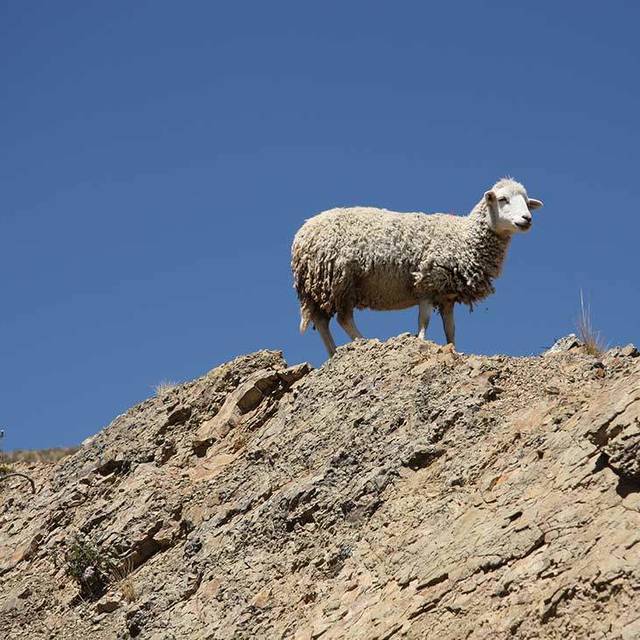
As we have said before, the wilderness is not just something to rush through. God does not always lead us out of the desolation that surrounds us. As the passage says, God leads us through or in the wilderness, helping us navigate the rough paths and the difficult sightlines and, when the time is right, bringing us home. Our problem is that we don’t envision ourselves like sheep because we are trying so hard to be the shepherd of our own lives, to be in control, to be the guide. We are afraid of losing control of our lives. And so, we often wander away and get lost. We may end up in a place that is not ours to be. But think about sheep. Sheep are seldom characterized as one of the smartest beings on the farm and yet, sheep know to whom they belong. Sheep know how to follow. Sheep know how to be part of a flock, holding each other up, helping each other see the shepherd. And when, as happens every now and then, a sheep gets lost, the sheep trusts that the shepherd will come and bring the sheep home.

Lent is a season that teaches us to be more like sheep, to follow God through the wilderness, learning the things that it teaches, accepting the things that it offers, and knowing, that, when it is time, God will guide us out of this lostness, out of despair, out of the loneliness.  You don’t have to fix it; you don’t have to hurry; you don’t have to make it something it is not.  Just follow.  Just live.  But by following God’s lead, we will see beauty we have never seen and companionship we have never known.  That’s what you get when you’re part of a flock. The promise is that, when the time is right, we WILL be led home.

God…leads us step by step, from event to event.  Only afterwards, as we look back over the way we have come and reconsider certain important moments in our lives in the light of all that has followed them, or when we survey the whole progress of our lives, do we experience the feeling of having been led without knowing it, the feeling that God has mysteriously guided us. (Paul Tournier)

Grace and Peace,

 Shelli

Surely the Lord is In This Place

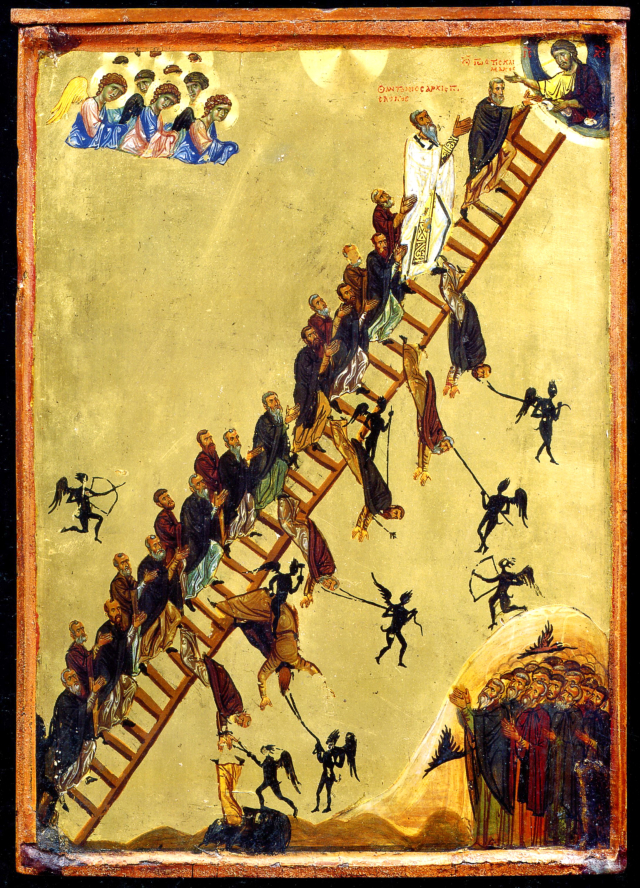
Ladder of Divine Ascent, 12th cen, Monastery of St. Catherine, Sinai

Scripture Passage:  Genesis 28: 10-17

10Jacob left Beer-sheba and went toward Haran. 11He came to a certain place and stayed there for the night, because the sun had set. Taking one of the stones of the place, he put it under his head and lay down in that place. 12And he dreamed that there was a ladder set up on the earth, the top of it reaching to heaven; and the angels of God were ascending and descending on it. 13And the Lord stood beside him and said, “I am the Lord, the God of Abraham your father and the God of Isaac; the land on which you lie I will give to you and to your offspring; 14and your offspring shall be like the dust of the earth, and you shall spread abroad to the west and to the east and to the north and to the south; and all the families of the earth shall be blessed in you and in your offspring. 15Know that I am with you and will keep you wherever you go, and will bring you back to this land; for I will not leave you until I have done what I have promised you.”   16Then Jacob woke from his sleep and said, “Surely the Lord is in this place—and I did not know it!” 17And he was afraid, and said, “How awesome is this place! This is none other than the house of God, and this is the gate of heaven.”

Jacob came to a certain place, a certain place in the wilderness. I don’t think it was a particularly holy place. It was just an ordinary place with an ordinary stone. But then Jacob dreamed. And what a wild dream that was! Now, remember the “back story” of this. Jacob is not just wandering through the wilderness to get a little exercise. He is fleeing from his family and from the hatred of his brother Esau (you know that one that Jacob tricked into giving up his birthright.) Jacob is also fleeing from himself, from his own trickery and his duplicity. Perhaps he has had enough of himself. He is at the lowest point of his life. He is afraid, afraid of what will come next, afraid of Esau, probably a little afraid of God. The wilderness was nothing compared to the fear that Jacob felt.

And then a dream, a remarkable dream, probably the world’s most famous dream, fills his night.  He dreams that a ladder or, more likely, a stairway or a ramp extends from earth to heaven.  (Although, that really messes up that song!)  And on this ladder (or stairway or ramp or ziggurat or whatever it was), there were divine beings traversing up and down.  In this dream, we on earth were not left, as we sometimes think, to our own devices, to wander in the wilderness alone, and the place of the Divine, the Sacred, Heaven, or whatever you want to call this realm, is no longer off-limits to us.  In the wilderness, the two are intertwined, a part of one another.

The point is that, when the dream had ended, God was there.  The Hebrew is a little ambiguous.  It is not clear if God was “before” Jacob or “beside” him.  I think maybe the ambiguity is the point.  No matter where we are, God is there.  And then, Jacob, this one who is always looking out for himself, is given the promise that those before him had been given—land, prosperity, presence, and homecoming.  God promises to bring Jacob home.  Jacob realizes that he has encountered God and he claims God’s promises as part of who God calls him to be.

We are like Jacob.  Sometimes we, too, are wandering in fear—fear of being found out, fear of our past and what we’ve done, fear of the future, fear of the unknown, fear that it will not go as planned.  Perhaps we are afraid of what it means to encounter God, to follow Jesus, to come near to the Cross (not the cleaned-up one…the Golgotha one).  Perhaps we are afraid that our lives will change beyond our control.  We want to encounter God, but we want to do it on our terms. We don’t dare to even imagine that we could possibly do what God is calling us to do. And so, we stay here, afraid of who we are, feet firmly planted in what we know. Maybe “fear not” is calling us to encounter the God who walks with us.  For surely the Lord is in this place and I did not know it!  I was so wrapped up in fear that I did not realize that God was holding it.

To live with the conscious knowledge of the shadow of uncertainty, with the knowledge that disaster or tragedy could strike at any time; to be afraid and to know and acknowledge your fear, and still to live creatively and with unstinting love: that is to live with grace. (Peter Abrahams)

Grace and Peace,

 Shelli

The New Normal

Scripture Passage:  Isaiah 40: 3-5

3A voice cries out: “In the wilderness prepare the way of the Lord, make straight in the desert a highway for our God. 4Every valley shall be lifted up, and every mountain and hill be made low; the uneven ground shall become level, and the rough places a plain. 5Then the glory of the Lord shall be revealed, and all people shall see it together, for the mouth of the Lord has spoken.” 

So, here we wander in the wilderness, hoping against hope that it will all be over soon, that things will finally, once and for all, get back to normal (or at least a more normalized “new normal” that everyone keeps touting). So, what IS normal? Is it places that are not the wilderness? It is times that are not now? Is it ways of being that were before? Here, the exiles, just released from captivity, dripping with newfound freedom, are beginning to return. They are making their way through the wilderness, headed toward “getting back to normal”. But their city and their way of life lies in ruins. They can’t just go back and pick where they left off. They are looking for comfort, for solace, for a promise that God will put things back the way they were before.

But the problem is that’s not the promise that has been made. Rather than repair, God promises re-creation; rather than vindication, God promises redemption; and rather than solace, God promises transformation. God is making something new—lifting valleys, lowering mountains, and, ultimately, when all is said and done, revealing a glory that we’ve never seen before. The truth is, there is no going back. So what is normal? Perhaps “normal” is newness, going forward, becoming re-created. What if THAT was normal?

To be honest, have you ever really witnessed a highway being built? (If you haven’t, you don’t live where I do!) It’s not easy. It takes preparation and time and lots of heavy lifting. You have to recruit people to do it, you have to clear the way, you have to show people how to navigate through it. And once in a while (or every other weekend, as the case may be where we live), they have to close the road so that it can be made new. See, lifting valleys and lowering mountains is not an easy feat. God is not a magician. (Oh, sure, God could raise and flatten with the wave of a hand, I’m sure, but what fun is that?) In fact, I’m thinking the world, all of Creation, is even now groaning and shaking with all the movement that is happening, wanting at its very core to burst forth into being, to ignore God’s prodding to wait and be patient. And, no, it will never be like it was before. There is no going back. There is never any going back. In this life of faith, “normal” is newness, it is going forward through the wilderness toward a new normal.

At the end of the exile, the people realized that their former lives did not exist. And so, in this new normal, they had to rethink and recast their image of God. Rather than relying on what was familiar and comfortable, they had to find God again in the midst of a strange, new world. They had to discover that God was not in the repair business, that God was not there to clean up their mess and fix their woes, that God loves us too much to put things back the way they were before.

We are no different. This wilderness journey that we are on is not a “break” from our lives. Lent is not a season of denying ourselves and giving up sweets and talking about sin and suffering and repentance over and over and then sliding into to Easter morning with a “whew, glad THAT’S over…now we can go back.” If that were the case, there would be no point. If that’s what you think, there is a chocolate bunny that you can have right now! See, the deal is, the wilderness changes you; it changes your life; it changes the world. God is doing something new. There is a new normal. You can never, ever go back. But you CAN go home again. THAT’S what the wilderness teaches you.

Everything that God has created is potentially holy, and our task as humans is to find that holiness in seemingly unholy situations…We must remember that everything in this world has God’s fingerprints on it—that alone makes it special.  Our inability to see beauty doesn’t suggest in the slightest that it is not there.  Rather, it suggests that we are not looking carefully enough or with broad enough perspective to see it.  (Harold Kushner)

Grace and Peace,

 Shelli