The Moment the Whole World Changed

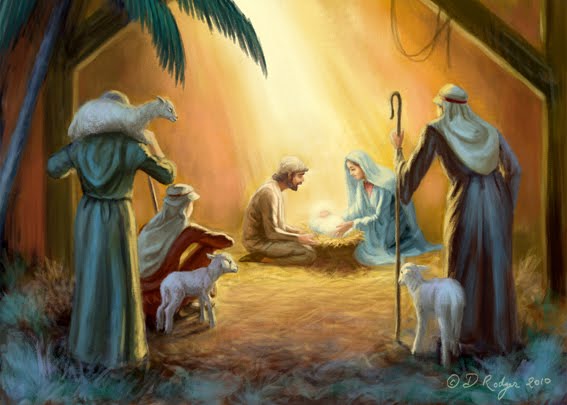
It’s finally here, this night of nights.  The Light for which we’ve waited and journeyed toward peers into the darkness and the world is changed forever.  This is the moment when the world really did change.  We love this story.  Most of us could probably recite it from memory.  But the story may not be EXACTLY the way we think.  It’s not like there was someone with a video camera following them around that night.  Only two of the canonical Gospel writers even tell the story and they tell it very differently.  The non-canonical Gospel According to James tells it in more detail but the birth takes place in some sort of cave.  (But, in all honesty, where did you actually read about a stable?)  The same account also brings in a midwife, which, when you think about it, makes a whole lot of sense.  So, no, I’m not trying to tear down your much-beloved story.  The truth is, it’s not about the story; it’s about the birth.  It’s also about the Light.  It’s about the Light of God coming into the world, however that may have happened.

This is the story of Light.  It’s the Light that has always been there, the light that was created so long ago.  It’s the light that led people home over and over again.  But it was always a light that was hidden in a cloud or shrouded on a mountain or even set in the promise of a bow in the clouds.  In fact, there was belief that if you saw that Light, indeed, if you saw God face-to-face, you would die.  But this night, this story, tells of Light not shining onto the earth but coming into the earth, mingling with us and giving us life.  This is the night that our story becomes the story of Light.

The Bible is not about people trying to get to God or get to the Light; it’s about the story, the story of God.  And this part of it, this chapter that we read and relive tonight, this holy night is not the climax of the story; it is a new chapter, a new beginning.  19th century American author and pastor Henry Van Dyke once asked “And now that this story is told, what does it mean?  How can I tell?  What does life mean?”  And then he answered himself by saying, “If the meaning could be put into a single sentence, there would be no need of telling the story.”

This is the night of the story of God coming out of the darkness and out of the shadows and showing us what we could not see before.  The Light is beginning to dawn.  It’s not a new light.  But this time, the heavens themselves spilled into the earth so that the story would become ours.  This is the story of Light.  It’s also the story of us.  So, what comes next?  Go into the Light…and follow God to write your story.

And change?  HAS the whole world changed?  I mean, we’ve been waiting and hoping and trying to make this happen.  But the truth is, it did.  Think of it as a turn of a corner.  There was nothing wrong with the story before.  It’s how we got here.  It’s part of it.  It was our journey.  And now, we turn.  It changes.  That’s what stories do.  The truth is, the world HAS changed…over and over and over again.  We will change again, not when Jesus returns, but when we realize that we are the ones that are called to change the world.  THAT was God’s vision.  It’s happening, a little at a time, over and over again.  We are called to be the image of Christ, to be the change that the birth of Jesus brought to the world.

The people who walked in darkness have seen a great light; those who lived in a land of deep darkness— on them light has shined. (Isaiah 9:2)

[Verse 1]
Every December, I stop to remember
The humble entrance of our King
An infant so precious
Makes men bow in reverence
I’m still in wonder when I think

[Chorus]
That in one night
The whole world changed
As the heavenly host proclaimed
Glory to God and peace on earth
In a manger our Savior lay
It was the moment the whole world changed

[Verse 2]
Sometimes I imagine
The way that it happenеd
When shepherds knеlt to worship Him
A love that was perfect
And no one deserved it
I’m still moved to tears when I think, oh, woah

[Chorus]
That in one night
The whole world changed
As the heavenly host proclaimed
Glory to God and peace on earth
In a manger our Savior lay
It was the moment the whole world changed

[Interlude]
Oh woah, oh, oh
Oh-oh-oh-oh
Oh-oh-oh-oh
Oh-oh-oh-oh-oh-oh-oh

[Bridge]
Jesus Christ, Emmanuel
Isn’t He so wonderful?
This is our moment to worship
Mighty God and Prince of Peace
Lord of Lords and King of Kings
This is our moment to worship

[Chorus]
Just like that night
The whole world changed
As the heavenly host proclaimed
Glory to God and peace on earth
In a manger our Savior lay
It was the moment the whole world changed

[Outro]
You changed everything, oh
Oh-oh-oh

Merry Christmas!

Shelli

The Beginning of What is Next

So, if you thought I was losing my mind yesterday when I posted the Creation story, now you are completely clear that I have.  Right?  Why this Scripture?  I can pretty much guarantee that no one reading this has ever heard a sermon on this passage.  It’s not anywhere in our lectionary.  (In fact, to pull it off the site from which I usually copy the Scriptures, I had to go to Matthew 1:18 and back up.)  It’s definitely an odd scripture to use on the day before Christmas Eve, the day when we finally emerge from the darkness into the glorious Light.  I mean, we usually skip these verses.  (Admit it, you do!  You don’t read this! I mean, some of the names are barely pronounceable.) It’s full of hard-to-pronounce words that none of us want to have to read aloud and, frankly, they’re kind of boring.  So, why are we reading them?  Because the whole story is buried in the details…

For some years, I’ve been interested in ancestry, in MY ancestry. It’s become quite the project.  I have over 2,000 people noted on Ancestry.com, 2,000 people to whom I am somehow related.  It started as an interest; it’s now part of me.  It’s part of me because I have on some level gotten to know these persons whose DNA pulses through me, whose DNA actually MAKES me.  I’ve learned their stories.  I’ve found out where they were born and where they moved in their lives.  That’s important.  And in the process of doing this, I’ve found people to whom I am related, some of which I already knew!  Even if you don’t know 2,000 people to whom you are somehow related (which means you’re NOT from my hometown!), recognizing that those people (even unknown) are connected to your life will help you know yourself better.  Ralph Waldo Emerson once said that “every [person] is a quotation from his ancestors.”  So, these people in this passage we read (whether or not we can pronounce their names) are part of that very human part of Jesus.  Jesus is a quotation from them.  They are part of this Incarnation we are about to celebrate.  They are part of us.  They are the people that God employed to show us what God-with-us meant.

Oh, I suppose God could come into the world with no help from us, with no help from all those faithful ones who came before us.  But what would it mean?  Why bother?  After all, the name of the Christ child is “God With US”.  Doesn’t that mean something?  God did not just drop the baby out of the sky like some sort of Divine UPS package.  The story is incomplete without those that came before. And it is incomplete without us.  Because without us, without every one of us, without EACH of us, God never would have come at all.  God came as Emmanuel, “God with US”, and calls us into the story.

And what a story it is!  It is a story of those that were called and those that ran away, a story of some who were exiled and some who wrestled, a story of scared and wandering people sent to new places and new lives with new names. The story includes prophets and poets, priests and kings.  It is a story of movement between darkness and light and, always, a hope for a Savior.  This line of David shown by the writer known as Matthew is 42 generations of God’s people, six sets of seven generations that lived and questioned and prayed and worshipped and wondered and sometimes shook their fists at God and then handed it off to the children that followed them.  Now you might remember that the number 7 is one of those numbers that connotes perfection or completeness, the hallowed finishing.  So, six completed ages of the history of God’s people waiting and watching and walking the journey and, yes, waiting on the world to change, brings us to the seventh, the New Creation, the beginning of what is next.

The Incarnation is the mingling of God with humanity.  There’s no way out.  The Divine is even now pouring into our midst and we are changed forever.  But we have to birth the Godchild into our lives.  Knowing that we could never become Divine, the Divine became us.  The world is turned upside down.  And so, God stayed around to show us how to live in this new world.  The writer of Matthew is right.  All this DID take place to fulfill what has been spoken by the Lord through the prophets.  The Light is just beyond our sight, ready to dawn, ready to call us into it that we might continue the story.  We are all walking together.  As Ram Dass said, “we’re all just walking each other home”.

As we come to the end of this path down which we have traveled our Advent journey (because tomorrow morning’s Scripture is a definite change in timbre), I’m not sure how much the world has changed.  I think we’re still waiting.  But think about this.  In the 42 generations up to Jesus and the myriad of generations since then (what is that, like 95 or 100?), the world has changed.  Perhaps one person or one generation has a hard time seeing that change.  But over time, as time unfolds and evolves, the world changes.  And I think, for the most part, in spite of the ebbs and flows in progress that we see now, the world has come just a bit closer to what God intends for it to be.  So, whether we see it or not, we are part of that change.  What we do (or don’t do) contributes to that change.  And, along the way, we change.  And that’s a really, really big part of it.  But we don’t do it alone.  Breathe in the presence of those ancestors that surround you now, those that, like us, struggled to see the fruits of their lives.  Tomorrow the journey will change.  Let us go together and see this thing that has happened. 

Grace and Peace,

Shelli

Back to the Future

We talk a lot about light during the Advent and Christmas seasons, that coming of the Light as it is birthed into the world.  But go back to the beginning.  The Light came to be back then. It was always there, pushing back the darkness and illuminating all of Creation. According to this much-beloved story of Creation, God said the Light into being and there was Light.  This opening part of Genesis is essentially an affirmation of faith in the God who created the world and all that exists.  It doesn’t refer to the beginning, per se, but rather the beginning of the ordering of Creation.  Re-read it.  You will see that “in the beginning” was already there.  The heavens and earth were there as dark, formless voids.  What existed was wild and chaotic and EXACTLY the way God intended it to be—for then.  Think of it as the prelude to our story.  And God began to order Creation and into Creation God breathed Light. In the beginning, God began to re-create Creation—with Light.

The Light was always there, always pushing back the darkness of the world.  But sometimes our eyes are not adjusted to the light and we miss what it is illuminating for us.  We find ourselves in the darkness.  So, Jesus came into the world not just to BE the Light but to show us the Light that was always with us.  Jesus was part of that Light, the revelation of the Light, and came to show us how we, too, can reflect that Light throughout the world.

In this season of Advent, our journey guides us toward the Light.  It is the Light that has always been there.  It is the Light that God created.  It is the Light that Jesus Christ came into the world as God Incarnate, Emmanuel, to reflect, to show us how to be the Light. And yet we often travel in darkness.  The darkness is not bad.  God created the darkness just as God created the light. But the darkness cannot sustain us.  Only the Light, the Light that God created, the Light that God came into the world to reflect can sustain us.

We have focused on our waiting for the world to change, our often desperate and always impatient waiting for our world to become what God envisions.  But that doesn’t mean that the world will be filled with light.  There will still be darkness.  It is what allows us to see the light.  The story—our story—that began with creation continues.  The Light was there, there since God created it.  But Jesus came to show us the Light, to point us toward it.  It IS the story.  And it continues.  And there is darkness in places that we want to see Light.  It is not the way that God envisions it can be; it is the way it is—for now.  And us?  Well, we are not called to merely follow the Light; we are called to carry it into the darkness, to light the dark corners of our world, to light the places that are lit by power and prestige and injustice.  While we’re waiting for the world to change, we are called to practice change, to become light.  That’s what Jesus came to show us how to be. 

LYRICS:

Chorus

And in the night whenever I call
I hear your voice on the wind
speaking my name calling me onward
this life to begin
for these dreams won’t come true
without your love guiding me
I know you’re never far away
I will look to you and journey on

In the mist fog and rain
I am finding my way
through curtains to the light
there is one bidding me to stay
every star in the galaxy
each one there own destiny

– Chorus

Over fresh green pastures and deep valleys
rugged mountains onwards I go
I will not stop to look behind
My future lies in thee unknown, in thee unknown

– Chorus

Grace and Peace,

Shelli

Lamentable

Today is the winter solstice in the northern hemisphere.  It is the moment when the north pole (for the northern hemisphere) is tilted the farthest away on its axis from the sun.  I think it actually occurs at 9:03 a.m. this morning if you want to put it on your calendar.  Today is the day of the year when the light hours are the shortest and the dark hours are the longest.  It’s always been interesting to me that our celebration of Jesus’ birth is placed just after the solstice.  (Because, honestly, we’re not sure when it ACTUALLY happened.  That day was just sort of assigned.)

This passage from Isaiah is the beginning of what most scholars call “Second Isaiah”.  It was probably written toward the end of the Babylonian exile and is directed to those that had been forcibly removed from their home in Jerusalem several years before.  Now, this was not what we typically know of as “slavery”.  Most of the Israelites were allowed to have their own homes and come and go as they please.  They were even allowed to work for a living.  But it was a different culture and a different homeland.  Everything that they had known before was gone.  The society was different.  The culture was different. They weren’t really sure how to maneuver in this new way of living and life around them was surely one of darkness.  It would be easy for them to assume that God had deserted them, that somehow God had left them in a place to which they were unaccustomed and had just left them to fend for themselves.  At the very least, their image of God probably had to be recast.

But around 539 BCE, Cyrus, the ruler of Persia, conquered the Babylonians and so many of those exiled were given the chance to return home.  So, the exiles are filled with a message of trust and confident hope that God will completely end this time of despair and hardship.  Speaking to a city and a way of life that is all but destroyed, the exclamation is made that the exile is indeed about to end.  God is coming to lead the exiles home, bringing redemption and restoration.  In essence, God is coming to show them a new and different way to live, a new and different to look at life even in the midst of darkness.

In this writing, there is no prophet even mentioned.  Instead, here, it is God who is speaking.  It is God who is promising a new start for the city and a people whose lives today lie in ruins.  Out of the void, out of the ruins, it is God’s voice that we hear.  Out of the darkness, a new day is dawning.  “Comfort, O comfort my people…Remember, that every valley shall be lifted up, and every mountain and hill made low, the uneven ground shall become level, and the rough places a plain.  Then my full and final glory will be revealed.”

Now notice here that God does not promise to put things back the way they were before.  God is not limited to simply rebuilding what was taken away.   No, God is recreating, making new, lifting valleys, lowering mountains, and ultimately, when all is said and done, revealing a glory that we’ve never seen before in what is essentially a brand new Creation, a brand new “in the beginning…”.  “See, I am making all things new.” “Comfort” here is not just solace or consolation; it is transformation.  “The light shines in the darkness and the darkness did not overcome it.” 

As I noted yesterday, we live in an “in-between” time.  Old English would refer to it as “betwixt and between”.  It is that time of liminality.  We live in an overlap of time.  The light is shining into the darkness but we are experiencing these long hours of darkness.  I’ve been reading some of the Psalms and Scriptures of lament lately.  It is those writings of grief for the world.  It is those writings of grief for us.  It is those times when we just want to shake our fists and scream at what is going on.  It is those times when we are waiting for the world to change.  We modern-day Christians struggle with that.  Somewhere along the way we were told that we were supposed to be well-behaved around God.  But I think God can take anything we dish out.  And, to be honest, God is not a casual acquaintance.  I would like to think that I am close enough to God to get angry sometimes. 

This passage from Isaiah is an answer to those laments.  It’s not saying that bad things won’t happen; it’s not saying that the world will be perfect.  It’s saying that things are going to get better, that God is recreating us and the world even as we shake our fists and shout into the abyss.  Living as a Christian means that we are constantly pulled and stretched between the poles of longing and lament, of hope and despair, of grief and resurrection.  It is all part of our faith.  We do not live in some naïve state of being with the belief that God will somehow remove us from the reality of the present.  No, we are asked to be here, living in faith.  We are truly people of joy and hope.  That’s why the woes of the world hurt us so badly.  That’s why we grieve.  That’s why we lament, a holy practice of lament.  That’s why sometimes we shake our fists and scream into the lamentable abyss.  And God comes and sits with us, Emmanuel, God-with-us, and offers comfort and renewal, restoration and hope.

Lyrics:

[Verse 1]
I’ve seen more than I, I wanna see
The people I love turnin’ on me
But I know, I know, I know, I know there’s a
A better day comin’
I’ve been dreamin’ that one fine day
All my trouble gonna fade away
And I know, I know, I know, I know there’s a
A better day comin’

[Chorus]
Woah-oh, woah-oh
A better day comin’
Woah-oh, woah-oh
A better day comin’

[Verse 2]
And it’s harder holdin’ on to forgiveness
To lay those ghosts to rest
Oh, but the sun can rise out of the darkest night
No anger, no bitterness
Can fill the hole inside my chest
Too long, too long, too long, too long have I
Have I been runnin’
Ooh, that blue horizon ain’t far away
I hear it callin’ out my name
And I know, I know, I know, I know
There’s a better day comin’
The sun’s gonna rise out of the darkest night
It’s gonna change everything, woah-oh

Grace and Peace,

Shelli

Already and Not Yet

This season of Advent is about learning to hope.  It is about waiting, waiting on the restoration for which we pray and journey and that we believe God has promised us.  So, what does restoration mean to you?  In the days from which this Psalm came, the people had wandered in the wilderness, a wilderness that was not just hard to navigate but was downright inhospitable.  Danger lurked everywhere so the people prayed to God to restore them.  Restoration meant safety.  Restoration meant finally having a home.  They had been delivered but restoration is something more.

Thomas Merton once said that “the Advent mystery is the beginning of the end in all of us that is not yet Christ.” And so, we pray for that to happen.  We pray for God to restore us.  Again, what does that mean?  In our world, “restoration” means to put something back, to return it to its former condition.  Is that what it means?  I mean, why would God do all this and call us into the fray to go back to something that “was”.  One of the Perkins seminary professors once called that the “Kindergarten of Eden”.  Think about it.  We’re not trying to get back to some prehistoric utopian garden.  That notion was talking about the beginning, the time when we humans began.  It was a way of placing us into a history that was and still is and will always be.

But time is not linear.  Advent teaches us that.  We are waiting for the coming of a God who has come, who is here.  We wait for a vision of the world to come to be that is here now.  We just have to see it; we just have to become it.  We just have to let go of our expectations that it will be what we already know.  Richard Rohr says that “people don’t see things as they are; we see things as WE are.”  That’s our problem.  We are hoping for a restoration of what we imagine rather than the final restoration of a vision of God that is beyond anything we can fathom.  The restoration for which we hope and pray is not a return to what was; it is a coming to the vision of what will be.  The restoration for which we pray is not a return; it is a becoming.  It is all things becoming, as Merton said, the Christ.  It is hope and love and mercy and grace finally embracing a world that is wrought with despair and lostness and hopelessness. 

We live in between times.  The coming of God is already and not yet.  The reign of Christ is already and not yet.  We are being restored little by little, as if it is seeping into our bones and marrow even as we feel despair.  Remember, Paul’s description of Creation groaning with labor pains?  (Romans 8:22) Yes, we are waiting on the world to change.  It is a world that is already and not yet.

Lyrics

The answer’s been here all along
We just need to hold each other ’til the hurt is gone
Oh, to belong, still a dream

Look what we’ve imagined with pain
Make believing we aren’t the same
But you and I know the truth
Imagine what we could do
If we imagined with love

Wild where the energy flows
The window’s wide open
All we see is the door that’s closed
Sad how it goes
So it goes, ’til it goes

Look what we’ve imagined with pain
Make believing we aren’t the same
But you and I know the truth
Imagine what we could do
If we imagined with love

Time for all of us to wake up out of this hypnotic state
Instead of dreaming fast asleep, we should be dreaming wide awake

Look what we’ve imagined with pain
Make believing we aren’t the same
But you and I know the truth
Imagine what, we could do, if we choose
Yeah, what do we have to lose
If we imagined with love?

Grace and Peace,

Shelli

The Other Story

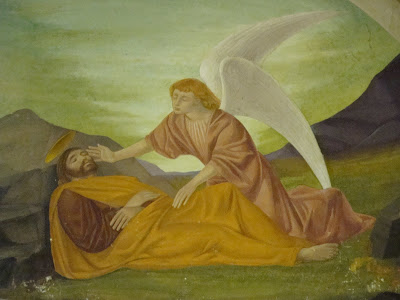
So, here, we get the story of the annunciation.  Wait, didn’t we talk about the annunciation yesterday?  No, this is the OTHER one.  This is the other side of the story.  We’re guilty of skipping over it, this calling of Joseph.  I suppose it’s pretty easy.  After all, he doesn’t even talk.  We really know very little about him. We know he was from Nazareth, a sort of no-name town in Galilee.  We can surmise that he was a carpenter because Jesus is described as the son of a carpenter several times in Scripture.  And we know that he was engaged, or actually betrothed to Mary.  This is not like our engagement.  This was a marital contract.  It just wasn’t consummated.  They were not just dating.  But you know what?  Joseph had plans.  He had some idea laid out of how his life would go.  And, when you think about it, Joseph had to be hurt, probably even angry at Mary.  And then came the dream.  (What is it about Josephs and dreams?)

The writer known as Matthew is the only one that gives Joseph his moment.  But, interestingly enough, he doesn’t even get a chance to ask a question (like, “How can this be?”)  or voice his opinion or perhaps shake his fist in utter disbelief.  I don’t know if it’s the moment or the Scripture, but Joseph is somehow rendered speechless.  He’s not even given a small speaking role.  Instead, Joseph, who had apparently already decided what he was going to do (a plan that it should be noted in the face of the tradition was merciful and compassionate).  He was going to quietly dismiss her.  And, I suppose, Joseph would have faded into the pages of the story with no other mention.  Perhaps Mary could have gotten help from her cousins.  They probably would have put her up.  And Jesus and John would have grown up like brothers.  It could have all worked out, but a better story was waiting.  Because in this moment, Joseph is handed a dream.

It was apparently a wild fit of a dream.  I mean, the Lord came.  That cannot have been a comfortable situation.  And, true to form, God tells him not to be afraid.  “Oh, no,” Joseph thought, “I have read this before.  When the Lord tells you not to be afraid, things tend to happen–things like the floor of your world on which your standing giving way and you falling uncontrollably into something that you never imagined and for which you certainly could never have planned.  Hold on!”  And the Lord hands him a story that doesn’t even make sense.  Joseph is being asked to step back into the story.  And oh, what a story it has become.  Joseph is being asked to raise the child that IS the Messiah.  Joseph is being asked to love him and guide him and discipline him (Good grief, how do you discipline a Messiah?  I mean, does he get like some sort of Divine time out?)  Joseph is even told what to name the child—Emmanuel, “God With Us”.

Well, I’m betting that Joseph’s first thought when he awoke was that he had eaten some bad lamb or something.  He probably laid there for a few minutes processing it all.  I mean, remember, the verses before the ones we read remind us that Joseph was descended from a long line of dreamers.  In fact, old Grandpa Jacob (like 34 “greats” ago) had fought back, wrestling until the break of day!  Remember that?  And then Joseph got up and moved out of the way and followed.  He had plans.  He had a reputation to think of.  He had a face that he had to present to the temple.  He had a life.  But Joseph moved aside and fell speechless.  And then, and then God gave him his voice.

The 20th century theologian Dietrich Bonhoeffer who died for speaking out about the Nazi regime, once said that “We have become so accustomed to the idea of divine love and of God’s coming at Christmas that we no longer feel the shiver of fear that God’s coming should arouse in us.  We are indifferent to the message, taking only the pleasant and agreeable out of it and forgetting the serious aspect, that the God of the world draws near to the people of our little earth and lays claim to us.  The coming of God is truly not only glad tidings, but first of all frightening news for everyone who has a conscience.”[i]

Lays claim to us…This Scripture makes us realize that God’s coming into the world did not just involve God, an angel, and Mary.  Joseph was there too, as were all of those who came before and all of those (including us) who came after.  God’s coming is not just the birth of a baby in a pretty nativity story; God’s coming is the way that God lays claim on us.  God’s coming is the way that God turns all of our lives upside down.  God’s coming is the way that the story changes.

The truth is, there was a story.  And Joseph had written some of his chapters in not realizing that they didn’t lead to the vision that God had in mind.  When I was in seminary, I was privileged to be a part of a small group of students (there were maybe thirty of us) that had a wonderful conversation with John Irving (the author of “A Prayer for Owen Meany”, “The Cider House Rules”, and “The World According to Garp”).  Someone asked what was probably an expected question:  How do you craft your stories?  The answer was probably not as expected.  John Irving said that he always writes the end of the story first and then fleshes out the plot and the characters and the themes to get to that ending.

Don’t you think that’s what God has done?  God has this vision for what the world should be.  And along the way, God calls and comforts and cajoles to coax us toward that ending.  The early chapters are not written.  That’s up to us.  But the ending is the very vision of God.  So, God called Joseph.  Joseph had a story.  He was writing it.  And when he was called, he changed it.  What about us?  We are waiting on the world to change.  What if that vision has already been written?  What if the way we get there, the way the world changes, is us?  What if the change is not the ending but the way the story plays out?  What if our calling is to write a better story?

Grace and Peace,

Shelli


[i] From “The Coming of Jesus in our Midst”, by Dietrich Bonhoeffer, in Watch for the Light:  Readings for Advent and Christmas, December 21

The Turning of the World

We love this passage.  It is Mary’s Song, the Magnificat, the poetic rendering of her realization that she has truly been blessed, that she has been called to do what no one else has done, what no one else will do.  She has been called to give birth to God in this world, to deliver the promise that her people have always known.  But don’t get too lost in the poetry and the familiarity. For one thing, from Mary’s standpoint, this is turning her world upside down.  American Methodist missionary E. Stanley Jones called The Magnificat “the most revolutionary document in the world”.  It is said that The Magnificat terrified the Russian Czars so much that they tried to dispel its reading.  More recently, it was banned in Argentina when the mothers of the disappeared used it to call for non-violent resistance.  In the 1980’s, the government of Guatemala banned its recitation.  It is an out and out call to revolution.  Less subversive language has started wars.  Edward F. Marquart depicts it as God’s “magna carta”.  It is the beginning of a new society, the preamble to a constitution that most of us are not ready to embrace.  We’d rather chalk it up to the poetry of an innocent young woman and keep getting ready for Christmas.  But we can’t do that.  It’s something much, much more.

See, this is God’s vision for the world. It is not a world where the best and the brightest and the richest and the most powerful come out on top. It is not a world that we can control. It is not a world where we can earn what we have and deserve who we are. It is rather a world where God’s presence and God’s blessings are poured onto all. But it comes with a price. Those who have, those who are, those whose lives are filled with plenty are called to change, to open their lives to God and to others. Because God will scatter the proud, those who think they have it figured out, those who are so sure of their rightness and their righteousness.  In other words, those of us who think that we have it all nailed down will be shaken to our core.  The powerful–those with money, those with status, those with some false sense of who they are above others–will be brought down from their high places.  The poor and the disenfranchised, those who we think are not good enough or righteous enough, will be raised up. They will become the leaders, the powerful, the ones that we follow.  The hungry will feel pangs no more and those who have everything–the hoarders, the affluent, those are the ones whose coffers will be emptied to feed and house the world.  God’s vision of the world is not fair in the terms that we are used to considering; it is, rather just, a justice that is nothing like we’ve ever known. 

God is about to turn the world upside-down.  Look around you.  This is not it; this is not what God had in mind.  And God started it all not by choosing a religious leader or a political dynamo or even a charismatic young preacher but a girl–a poor underage girl from a third-world country with dark skin and dark eyes whose family was apparently so questionable that they are not even mentioned and whose marital status seemed to teeter on the edge of acceptable society.  God picked the lowliest of the lowly to turn the world upside down.

But this is not some isolated poem in the middle of Mary’s story.  These words are the Gospel. Let me say that again.  These words ARE the Gospel.  If you were to put the Gospel into its Cliff Notes version, I would think you could take the words of The Magnificat, Matthew 22: 37-39 (love God, love neighbor), and Matthew 28:20b (“I am with you always until the end of the age.”) and have a pretty good idea of what Jesus was trying to say—love God, love each other, know that I am there, and let my vision be your world. 

I know, that doesn’t fit with the direction we’re going now in our society.  In fact, there seem to be factions everywhere that are explicitly fighting AGAINST this turning, dismissing its ideal as some sort of utopian socialist notion.  Is it a misunderstanding of the Gospel?  Is it fear?  Is it something else?  There are those that would indeed call this socialist or communist or some other “ist” that they don’t like.  But the turning of the world, the gentle, but intentional act of taking what is and making it be what should be, is painful.  It’s painful for us all.  It means we have to let go of everything to which we’re holding.  Even in our current discomfort with what is happening, we are way too comfortable.  We have raised Mary to something that is inaccessible, donning her with golden statues and painted masterpieces.  We have forgotten who she was and what she gave up—for us.  And then we allow those with pride and power and wealth to pursue their own interests and then hold on to their place.  We chalk it up to free capitalism and we forget that pride and power and wealth have often been earned on the backs of the hungry, on the backs of those whose lives are hard, on the backs of those that our society often dismisses.  The turning of the world is dangerous business.

Because when you’re turned upside down, things tend to spill. No longer can we hold onto what we know. No longer can we rest on the laurels of our past. If we’re going to be part of God’s vision of the world, we have to give up those things that are not part of it. We have to change, learn to live a new way, look upon the world and others not as competition, not as threats, but as the very vision of God pouring into the world. So, THIS Advent, what are you willing to let go of so that you will have room to offer a place for God? How willing are you to turn your world upside down? How are you being called to give birth to Christ in this world?  Mary did it.  Now it’s our turn.

Grace and Peace,

Shelli