Collateral Damage

This is one of the hardest Scriptures for us (or at least the part of “us” that is “me”).  What do you mean suffering results in hope?  That can’t be right.  I mean, suffering is bad, hope is good.  Everyone knows that.  Isn’t that how it works?  But suffering is a part of life.  It doesn’t mean that you did something wrong.  It certainly doesn’t mean that God is sitting off somewhere doling out suffering like it’s some sort of giant card game.  And, please, DO NOT tell me that God would never give me more than I can handle. (aaaggghhh!)  What, are we all supposed to get some sort of ration of suffering?  No, that’s not the way it happens at all.  Suffering just happens.  It happens because it is part of life.  We do not live as mechanical robots.  Suffering is part of the richness and profundity of life.  Maybe it’s the downside of having skin, of being created, of being real.  We all have needs.  Sometimes life is just too much.  (And sometimes it’s not enough.)  But we will all suffer.  And where is God?  There…there in the midst of the suffering.  Suffering reveals the heart of God.

Nearly thirty years ago, I had the opportunity to visit Auschwitz, Poland.  I expected to be appalled; I expected to be moved; I expected to be saddened at what I would fine.  I did not expect to become so personally or spiritually involved.  I did not expect my empathy to kick in in a way that I felt it so deeply.  As you walk through the concentration camp, you encounter those things that belonged to the prisoners and victims that were unearthed when the camp was captured–suitcases, eye glasses, books, clothes, artificial limbs, and shoes–lots and lots and lots and lots of shoes–mountains of humanity, all piled up in randomness and namelessness and despair.  This is the epitome of suffering.  This is humanity at its worst.  This is humanity making unthinkable decisions about one another based on the need to be in control, based on the need to be proven right or worthy or acceptable at the expense of others’ lives, based on the assumption that one human is better or more deserving than another.  It is something that in this divisive and vitriolic climate, we need to think about, to perhaps revisit what happened in what seems another world but is in THIS century of humanity.

I’ve thought about that trip a lot lately.  There is so much suffering today.  And somehow we make excuses for 72,000 dead in Gaza since October 7, 2023.  We ignore 400,000-500,000 deaths in the Russian incursion into Ukraine.  And now we don’t even talk about more than 1,000 Iranians dead from the attacks that we have inflicted.  You can say there are reasons for all of those wars.  There are.  But it doesn’t alleviate the suffering.

And yet, God CHOSE to be human.  God CHOSE to put on skin, temporarily separating the Godself from the Holy Ground that is always a part of us, and entering our vulnerability.  God willingly CHOSE to become vulnerable and subject to humanity at its worst.  God CHOSE the downside of having skin.  Now maybe God was having an off day when that divine decision was made, but I think it was because beneath us all is Holy Ground.  God came to this earth and put on skin and walked this earth that we might learn to let go, take off our shoes, and feel the Holy Ground beneath our feet.  God CHOSE to be human not so we would learn to be Divine (after all, that is God’s department) but so that we would learn what it means to take off our shoes and feel the earth, feel the sand, feel the rock, feel the Divine Creation that is always with us and know that part of being human is knowing the Divine.  Part of being human is being able to feel the earth move precariously beneath your feet, to be vulnerable, to be tangible, to be real, to take on flesh, to put on skin, to be incarnate.  Part of being human is making God come alive.

Suffering exists.  It always exists.  Maybe we could stand a little reframing from Paul too.  For us, suffering is a failure; within the vision of God, suffering holds hope for newness.  Because in the midst of suffering, just like in the midst of everything else, we find God.  God walks with us through it, loving us and holding us, perhaps even revealing a way out of it, if we would only listen, and gives us a glimpse of what is to come.  The suffering of the world reveals the heart of God, reveals the holiness that is, if we will only look.  It doesn’t explain it; it doesn’t make it easier; it just reminds us that it is not the final chapter.  Maybe it’s the downside of having skin, which means that you are human, a child of God, made in the image of God, with so much more ahead.

The suffering of the world also reveals the heart of us, if we will only listen.  It reveals our connectedness.  It reveals the community that God created just as God created each of us as individuals.  In this season of breathing, we’re not called to breathe out the suffering.  That is part of life.  But I think we need to breathe out the callousness of our reaction to it.  We need to breathe out the excuses and the way we ignore it and the way we attribute it to “collateral damage”.  We need to breathe in the way that God heals and resurrects and the way that we are called to be a part of that in the world.

In this season of Lent, we once again walk toward the Cross, with the drums of discord, still this moment far in the distance, growing louder with each step.  This season lasts for forty days.  But those forty days do not include the Sundays of Lent.  Known as “little Easters”, they are opportunities to glimpse and celebrate the Resurrection even in the midst of darkness.  They are reminders that even in this season of Christ’s Passion and Death, there is always a light on the horizon.  Resurrection always comes.  But it’s not a fix; it’s not a reward for the most powerful; it’s definitely not a dismissal of collateral damage; it’s what happens when God’s love is poured into our hearts.

Grace and Peace,

Shelli

When the Manna Ceases to Be

MannaScripture Passage (Joshua 5: 9-12)

9The Lord said to Joshua, “Today I have rolled away from you the disgrace of Egypt.” And so that place is called Gilgal to this day. 10While the Israelites were camped in Gilgal they kept the passover in the evening on the fourteenth day of the month in the plains of Jericho. 11On the day after the passover, on that very day, they ate the produce of the land, unleavened cakes and parched grain. 12The manna ceased on the day they ate the produce of the land, and the Israelites no longer had manna; they ate the crops of the land of Canaan that year.


It was a glorious morning when the manna first showed up, fields upon fields of what seemed to be never-ending sustenance in the midst of deep hunger and despair. They ate their fill and it went away only to show up yet again the next day. It was what they needed at the time. It was God’s mercy and God’s grace and God’s fill raining down upon them. They had come out of Egypt downtrodden and emotionally beaten. They were not who they had been or who they were supposed to be. They couldn’t provide for themselves and the anger and the frustration and the disgrace became a part of their lives. They seemed to be in some sort of never-ending spiral of despair upon despair. And then, one day, they awoke to manna, gleaming pools of white that beckoned them to eat their fill, to feel better. It was comfort food at is finest.


And then one day, they ate unleavened bread and parched grain. It was food that they had grown and harvested, food that they had been able to produce themselves. It was wonderful, wonderful to eat of the harvest that they had a hand in bringing to be. It felt good to feel like they were getting back on their feet again. And then they realized that the manna has ceased to be. It no longer came unbidden in the morning. It no longer just appeared out of the clouds. It no longer came and what was interesting was that they really hadn’t realized it.


The manna was never meant to be permanent. It was never intended to be the thing that would sustain them forever. You can call it a stop-gap of sorts. But it’s probably better depicted as God’s way of helping us stand. We all have times of despair, times when the manna is the only thing we have to sustain us. But if we spent the rest of our lives just eating manna every morning, what would life really hold? We couldn’t leave the place and travel to new worlds. We have to be there in the morning when the fields burst into white. We couldn’t just relax and maybe even sleep in. After all, the manna was only there for a couple of hours. But, more importantly, we couldn’t grow. We couldn’t become those who God intended us to be—the planters, the harvesters, the helpers, those that hope for something more, that understand that God promises something more. So God gently nudges us away from this sort of dependence. (God did that before when we first began…I mean, does anyone even remember where that little Garden is anymore?) Maybe God’s intention is not that we be dependent upon God but that we choose to depend upon God. Those are different.


So in this Lenten season, we remember the manna. We remember the way that God sustained us, holding us, helping us stand. We remember and then begin to walk. And what we learn is that God is not trying to limit our world or constrict our view. God is there when we need help standing. And then when we begin to walk, when we finally begin to hope, when we begin to become more of who God intends us to be, God walks with us as we plant and harvest and become a part of growing God’s Kingdom. And if we fall again, God will pick us up and show us fields of manna—if only for a time. We can depend on that.


Let yourself get shaken up. What are you willing to give up to ensure your own unfolding, and the unfolding of what is holy in your life? Where you stumble, here is your treasure. (Joseph Campbell)


Thank you for sharing your Lenten journey with me!


Grace and Peace,


Shelli

Wilderness-found


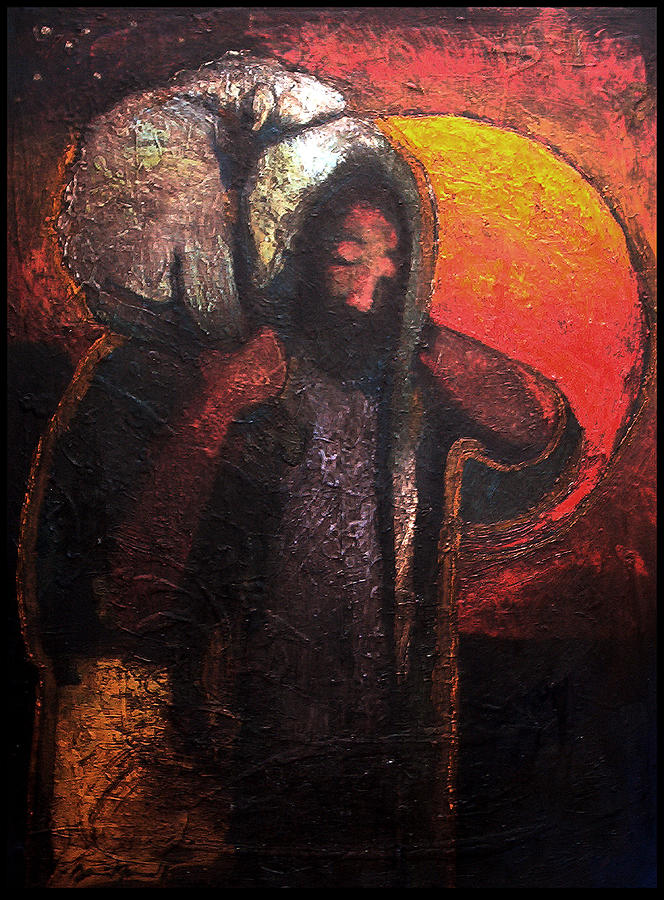
"The Lost Sheep", Daniel Bonnell, USA
“The Lost Sheep”, Daniel Bonnell, USA

Scripture Text:  Luke 15: 4-6

 4“Which one of you, having a hundred sheep and losing one of them, does not leave the ninety-nine in the wilderness and go after the one that is lost until he finds it? 5When he has found it, he lays it on his shoulders and rejoices. 6And when he comes home, he calls together his friends and neighbors, saying to them, ‘Rejoice with me, for I have found my sheep that was lost.’


As we have come to know, the wilderness is treacherous. It is tiresome and mind-draining. It often seems to lengthen time even as one makes his or her way through it. We become impatient. We want it to end. We want to shorten the time that it has its hold on us. We want to take shortcuts to get to the end, so we veer off the path, away from our course, thinking that we have it all figured out. We find ourselves lost.


It is easy in times of wilderness to think that you are alone. It is tempting to assume that you have somehow ended up there of your own doing and that you and you alone are responsible for finding your way out. We’ve all been lost before. We’ve all been in situations where we just can’t seem to find our way back. We’ve all had times whether they be physical, emotional, or even spiritual where we lose our way. We backtrack, trying to find the pathway down which we came so that we can “start again”. But everywhere we look, the choices of where to go all look the same. It becomes overwhelming. We turn and we turn and we panic and we run through this maze of choices over and over again.


When I was young, I was told that if I was lost, I should stay where I was. (Sometimes we’re smarter when we’re children, because we know to listen.) I think intellectually we all know that we should stay on the path and keep walking and yet, as adults, we somehow think we can fix it. We can wander with panic through life with no compass and no real help. We can try this way and that way and backtrack and veer off to nowhere. We can convince ourselves that we need no help, that we can do it. We can be tempted by the shortcuts that are offered along the way. And we stay lost.


Sometimes we are the lost sheep. Sometimes the wilderness seems to consume us. Sometimes the road through it seems to lengthen with each step. But where we did get the notion that solitude meant that we were alone? This wilderness journey is not one that we travel alone. God walks with us, holds us when we need to be held, and when we become the lost sheep, the one who has wandered away, God is there too. God doesn’t “fix” our way through the wilderness or speed up our wilderness time, but we are always wilderness-found.


We just have a couple of more weeks of this Lenten wilderness. We know that it will get harder. We know that, like many wilderness paths, it will seem to lengthen and become more treacherous as we near the end of its hold. But we do not walk it alone. Jesus, walking to the Cross, was never alone. He was in solitude; he was in prayer; he was often deserted by those who traveled with him. But God has walked this way before. God knows the way. So God will always make sure that even though the way is hard, we are always wilderness-found. And God lays us on the Divine shoulders and rejoices.


Look back from where we have come.  The path was at times an open road of joy.  At others a steep and bitter track of stones and pain.  How could we know the joy without the suffering?  And how could we endure the suffering but that we are warmed and carried on the breast of God? (Desmond Tutu)


FOR TODAY:  Let God pick you up.  Let God hold you.  Be aware of God walking with you on this path.

Grace and Peace,

Shelli

With My Mind Stayin’ on Jesus


Kneeling at the CrossScripture Text: Mark 8: 31-38

31Then he began to teach them that the Son of Man must undergo great suffering, and be rejected by the elders, the chief priests, and the scribes, and be killed, and after three days rise again. 32He said all this quite openly. And Peter took him aside and began to rebuke him. 33But turning and looking at his disciples, he rebuked Peter and said, “Get behind me, Satan! For you are setting your mind not on divine things but on human things.”  34He called the crowd with his disciples, and said to them, “If any want to become my followers, let them deny themselves and take up their cross and follow me. 35For those who want to save their life will lose it, and those who lose their life for my sake, and for the sake of the gospel, will save it. 36For what will it profit them to gain the whole world and forfeit their life? 37Indeed, what can they give in return for their life? 38Those who are ashamed of me and of my words in this adulterous and sinful generation, of them the Son of Man will also be ashamed when he comes in the glory of his Father with the holy angels.”

So many of us are like Peter. We want to “fix” things, to make sure that everything and everyone is safe and alright. We want things to be OK. We want to get this wilderness place cleaned up and ready for show. But that was never part of the promise. I think Peter actually DID understand that Jesus was the Messiah. He just didn’t fully grasp what that meant. For him, the Messiah was here to fix things, to make it all turn out like it was supposed to turn out. And now Jesus was telling them that the way they had thought it would all turn out was not to be, that instead this Messiah, this one who was supposed to make everything right, was to be rejected and would endure great suffering.  “No, this can’t be!” yelled Peter.  This cannot happen.  We have things to accomplish.  We are not done.  This ministry is important. It cannot go away.  You have to fix this. You have to fix this now! We are not ready to do it alone. We are not ready to be without you. 

Now, contrary to the way our version of the Scriptures interprets it, I don’t think Jesus was accusing Peter of being evil or Satan or anything like that.  More than likely, this was Jesus’ way of reprimanding Peter for getting hung up on the values of this world, getting hung up on our very human desire to save ourselves and the way we envision our lives to be, to fix things.  But what God had in store was something more than playing it safe.  I think that Peter, like us, intellectually knew that.  We know that God is bigger and more incredible than anything that we can imagine.  And yet, that’s hard to take.  We still sort of want God to fix things, to make things comfortable, or at least palatable.  We still sort of want God to lead us to victory, to lead us to being the winning team.  Face it, we sort of still want Super Jesus in the story.  And, of course, Peter loved Jesus.  He didn’t even want to think about the possibility of Jesus, his friend, his mentor, his confidante, suffering, of Jesus dying.

You know, there is a danger in our thinking that God is here to make life easier for us, to keep us safe and warm and free from harm. After all, there’s that whole Cross thing that gets in the way. If we think that God came into this world, Emmanuel, God-with-us to make life better or easier or grander for us, then what do we do with a crucified Savior? What do we do with the cross?  Well, let’s be honest, most of us clean it up, put it in the front of the sanctuary, and, sadly, go on with the security of our lives.  So, what does it mean to “take up your cross and follow”? What does it MEAN to follow God not just to the altar where that gleaming, cleaned-up cross sits, but to follow Christ to the hills of Golgotha, to walk with Jesus all the way to the Cross?  I think it means that sometimes faith is hard; sometimes faith is risky; in fact, sometimes faith is downright dangerous. And, to be honest, faith rarely makes sense in the context of the world in which we live. After all “denying ourselves”, “losing our life to save it”, and “letting go to gain” make absolutely no sense to us. They don’t make sense because we are setting our minds on the human rather than the Divine.

There’s a old Gospel song with these lyrics:  (Hear it at https://www.youtube.com/watch?v=Xit39G0lIk4)

Well, woke up this mo’nin with my mind, stayin’ on Jesus

Woke up this mo’nin with my mind, stayin’ on Jesus

Well, woke up this mo’nin with my mind, stayin’ on Jesus

Halleluh, halleleluh, halleleluh


In all probability, none of us will be physically crucified for our faith.  But it doesn’t mean that we should clean it up and put it out for display either.  Sometimes our journey will take us through waters that are a little too deep and torrential; sometimes we will find ourselves bogged down by mud; and sometimes faith takes us to the edge of a cliff where we are forced to precariously balance ourselves until we find the way down.  The promise was not that it would be safe; the promise was that there was something more than we could ever imagine and that we would never journey through the wilderness alone. The promise was that a Savior would come, not to save us from the world or to save us from evil, but to save us from ourselves.

On this Lenten journey, this journey that takes us through the wilderness all the way to that place beyond the wilderness, to the Cross, we are called to follow Christ. We are called to begin to wake up in the morning with our minds “stayin’ on Jesus”. It will not lead you to safety; it will lead you to Life.

He comes to us as One unknown, without a name, as of old, by the lakeside…He speaks to us the same word:  ‘Follow thou me!” and sets us to the tasks which He has to fulfill for our time…And to those who obey, whether they be wise or simple, [God] will reveal {Godself] in the toils, the conflicts, the sufferings which they shall pass through in this fellowship, and, as an ineffable mystery, they shall learn in their own experience Who [God] is.  (Albert Schweitzer)

FOR TODAY:  Put your plans aside.  Let go of the images of God that you have conjured up.  Let go of the notion of a Savior who will fix things.  Close your eyes.  Then wake up…wake up with minds stayin’ on Jesus…all the way through the wilderness of Golgotha to Life.

Grace and Peace,

Shelli