When We Realized Who We Were


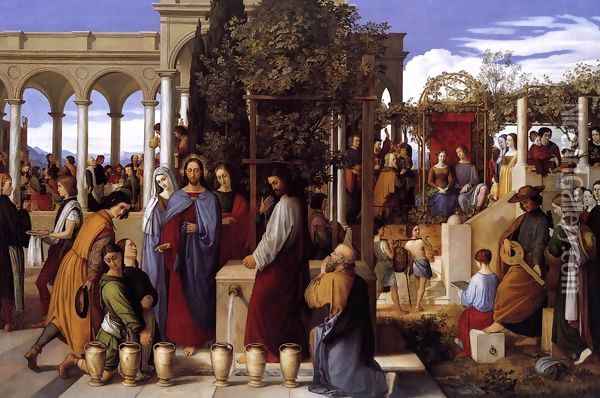
The Wedding Feast at Cana, Julius Schnorr Von Carolsfeld, 1819

Scripture Passage:  John 2: 1-11

On the third day there was a wedding in Cana of Galilee, and the mother of Jesus was there. Jesus and his disciples had also been invited to the wedding. When the wine gave out, the mother of Jesus said to him, “They have no wine.” And Jesus said to her, “Woman, what concern is that to you and to me? My hour has not yet come.” His mother said to the servants, “Do whatever he tells you.” Now standing there were six stone water jars for the Jewish rites of purification, each holding twenty or thirty gallons. Jesus said to them, “Fill the jars with water.” And they filled them up to the brim. He said to them, “Now draw some out, and take it to the chief steward.” So they took it. When the steward tasted the water that had become wine, and did not know where it came from (though the servants who had drawn the water knew), the steward called the bridegroom and said to him, “Everyone serves the good wine first, and then the inferior wine after the guests have become drunk. But you have kept the good wine until now.” Jesus did this, the first of his signs, in Cana of Galilee, and revealed his glory; and his disciples believed in him. 

So do you remember that day at the wedding?  The wedding was grand and glorious.  The bridegroom and his friends made their way in procession to the bride’s house. It was in the dark of night with a spectacular torchlight procession.  Then there were speeches and expressions of goodwill before the couple made their way to the groom’s house for the banquet.  And then the unthinkable happened.  The wine ran out.  Wow, that was actually pretty embarrassing. (And there are commentators that have noted that litigation was even possible in a case like this!  How odd!)  Most of the guests didn’t seem to know what was happening, but Jesus’ mother was in a panic.  And so she looks to her son.  “Jesus, fix this!”  And, miracle of miracles, he did.

This has always been an odd story for me. I mean, really, wine? Why didn’t he turn the water into food for the hungry or clothing for the poor? Why didn’t he end the suffering of one of those wedding guests who were forced to live their lives in pain? Why didn’t he teach those that were there that God is more impressed by who we are than what we do? Now THAT would have been a miracle. But instead Jesus, in his first miraculous act, creates a party, a feast. Maybe it’s a reminder that we ought to just relax and trust God a little more, maybe even enjoy basking in the very Presence of God. Maybe it’s trying to tell us that God is indeed in every aspect of our life. And maybe it’s telling us that life is indeed a feast to be celebrated.

And think about the wine itself. It begins as ordinary grapes. Well, not really. If you go even farther back, you start with water. Are you beginning to see that, really, everything starts with water? And then those ordinary grapes with just the right amount of water, the right amount of sunlight, and the right amount of nutrients fed to them from the rich, dark earth begin to seed. And then we wait, we wait for them to grow and flourish and at just the right time, they are picked and processed and strained of impurities and all of those things that are not necessary. And then they are bottled and tucked away while again, we wait. They are placed in just the right temperature, with just the right amount of light, and just the right amount of air quality, and we wait. We wait and until it becomes…well, a miracle.  And Biblical theologians have over and over pointed to the relationship that this story has with the Eucharist. Think about it. We take ordinary bread and ordinary wine (or in our case, ordinary Welch’s Grape Juice), and through what we can only describe as a Holy Mystery, a veritable miracle, those ordinary things become holy. They become for us the body and blood of Christ, the very essence of Christ to us, for us, and in us.

And remember that when the wine ran out, Jesus did not conjure up fresh flagons of wine. Rather, he took what was there, those ordinary, perhaps even abandoned vessels of ordinary, everyday water and turned it into a holy and sacred gift. Water and a miracle…Wine is water–plus a miracle.  But in case it is lost on us, remember that our bodies are roughly two-thirds water. No wonder the ancient sages always used water as a symbol for matter itself. Humans, they taught, are a miraculous combination of matter and Spirit—water and a miracle—and thus unique in all of creation. No wonder that wine is such a powerful, sacramental, and universal symbol of the natural world—illumined and uplifted by the Divine. Wine is water, plus spirit, a unique nectar of the Divine, a symbol of life.  And we, ordinary water-filled vessels though we are, are no different. God takes the created matter that is us and breathes Spirit into us, breathes life into us. We, too, are water plus a miracle. 13th century German mystic Meister Eckhart said that “every creature is a word of God.” It’s another way of reminding us that we are water plus a miracle, beloved children of God.

Jerusalem is just within our reach.  Our journey holds it in sight.  And so to prepare for what is to come, we remember who we are.  We remember that time that seems like only yesterday and also a lifetime away when Jesus showed us who we were.  And thinking back to this day, thinking back to that first miracle, we realize that it’s not about wine; it’s about us.  This was Jesus’ lesson in who we are.  It’s a reminder that WE are the miracle–created matter, water-born and Spirit-breathed.  We ARE the good wine, saved just for now.  We are water plus a miracle.

There are only two ways to live your life.  One is as though nothing is a miracle.  The other is as though everything is a miracle. (Albert Einstein)

There are only days left in our Lenten journey, days left to gather ourselves for the Cross.  Who are you?  Who were you created to be? What would it mean to live your life as though you were a miracle? 

Grace and Peace,

Shelli


When We Started to Become

WaterScripture Text:  Mark 1: 4-11

John the baptizer appeared in the wilderness, proclaiming a baptism of repentance for the forgiveness of sins. And people from the whole Judean countryside and all the people of Jerusalem were going out to him, and were baptized by him in the river Jordan, confessing their sins. Now John was clothed with camel’s hair, with a leather belt around his waist, and he ate locusts and wild honey. He proclaimed, “The one who is more powerful than I is coming after me; I am not worthy to stoop down and untie the thong of his sandals. I have baptized you with water; but he will baptize you with the Holy Spirit.”  In those days Jesus came from Nazareth of Galilee and was baptized by John in the Jordan. And just as he was coming up out of the water, he saw the heavens torn apart and the Spirit descending like a dove on him. And a voice came from heaven, “You are my Son, the Beloved; with you I am well pleased.”

Looking back from our journey, we remember, we remember the day that we started to become.  At this point, we remember that day in the Jordan, all of Creation dripping from the sacred waters. And, yet, that whole idea of Jesus being baptized is sometimes odd for us.  After all, part of what we associate with baptism is forgiveness.  How can one who is supposed to be sinless be forgiven?  But the fact that Jesus was baptized only suggests that Jesus associated himself with the need to gather God’s people and to prepare for the Lord’s coming with a gesture of repentance, an entrusting of oneself wholly and completely to God. It also reminds us that Baptism is not about us. We cannot baptize ourselves. It is about God’s presence in our life.

I think the Baptism account from the Gospel According to Mark is my favorite.  Only in this version do we hear of the “heavens being torn apart”—not opened for a time as in Matthew and Luke—but torn apart. The Greek word for this means “schism” (which, interestingly enough, is similar to chaos, similar to what God’s Creation ordered.). It’s not the same as the word open. You open a door; you close a door; the door still looks the same. But torn—the ragged edges never go back in quite the same way again. At this point of Jesus’ baptism, God’s Spirit becomes present on earth in a new way. A brand new ordering of Creation has begun. The heavens have torn apart. They cannot go back. Nothing will ever be the same. Everything that we have known, everything that we have thought has been torn apart and that is the place where God comes through. And the heavens can never again close as tightly as before.  This is when we started to become.

This story of Jesus’ Baptism calls us to remember our own. It is more than being showered or sprinkled with remnants of God’s forgiveness.  It is our beginning, our very “becoming”, as the gift of God’s grace washes away those things that impede our relationship with God and gives us new birth, new life. Just as God swept over the waters when Creation came to be, God swept across the waters so that we would become.  And it calls us to do something with our life.  But I actually don’t remember the day of my baptism. It happened when I was a little over seven months old, on Palm Sunday, April 15, 1962. It was at First United Methodist Church, Brookshire, TX and Rev. Bert Condrey was the officiant. I had a special dress and lots of family present. That would be all I really know.  And yet we are reminded to “remember our baptism”. What does that mean for those of us who don’t? I think “remembering” is something bigger than a chronological recount of our own memories. It is bigger than remembering what we wore or where we stood or who the actual person was that touched our head with or even immersed us in water. It means remembering our very identity, our creation, what it is that made us, that collective memory that is part of our tradition, our liturgy, our family.  It means remembering not just how the journey began but that in its very beginning we became part of it.  And now this same journey takes us to the cross.

That is what “remembering” our baptism is. It’s not just remembering the moment that we felt that baptismal stream; it is remembering the story into which we entered. It is at that point that the Christian family became our own as we began to become who God intends us to be. And for each of us, whether or not we noticed it, the heavens tore apart, spilled out, and the Holy Spirit emerged. And we, too, were conferred with a title. “This is my child, my daughter or son, my beloved, with whom I am well pleased.”  You are part of something beyond yourself, beyond what you know, and beyond what you can remember. Rainer Maria Rilke once said that “the future enters into us, in order to transform itself in us, long before it happens.” Your past now reaches far back before you were here and your future is being transformed and redeemed in you even as we speak.

After he was baptized, Jesus stood, dripping wet, to enter his ministry. The heavens tore apart and poured into the earth. All of humanity was there in that moment—those gone, those to come, you, me. So we remember now how we still stand, wet with those same waters, as we, too, are called into ministry in the name of Christ. It is up to us to further the story. This day and every day, remember your baptism, remember that you are a daughter or son of God with whom God is well pleased and be thankful. You are now part of the story, part of this ordering of chaos, part of light emerging from darkness, part of life born from death. You are part of God’s re-creation. And it is very, very good.  This is the journey for which we live; this is the journey for which we were created; this is the journey that gives us Life.  And, in this moment, we remember when we started to Become. 

Your life is shaped by the end you live for.  You are made in the image of what you desire. (Thomas Merton)

On this Lenten journey, we continue to gather our past into our Lives and we remember what made us, remember when we became who we are, when we began this journey.  What does it mean to you to “Remember your Baptism”?

Grace and Peace,

Shelli


When We Came to Be


"Birth of Christ", Robert Campin, c. 1425-1430
“Birth of Christ”, Robert Campin, c. 1425-1430

Scripture Text:  Luke 2: 1-7

In those days a decree went out from Emperor Augustus that all the world should be registered. This was the first registration and was taken while Quirinius was governor of Syria. All went to their own towns to be registered. Joseph also went from the town of Nazareth in Galilee to Judea, to the city of David called Bethlehem, because he was descended from the house and family of David. He went to be registered with Mary, to whom he was engaged and who was expecting a child. While they were there, the time came for her to deliver her child. And she gave birth to her firstborn son and wrapped him in bands of cloth, and laid him in a manger, because there was no place for them in the inn.

“In those days, a decree went out.”…There it is!  It is probably the best known story of all time and a great story it is–forced occupation, poor couple, long trip, impressive ancestry,  a last-minute birth, animals, humble beginnings, angels, assurance, surprise visitors, well-trained angelic choir, and God.  (You know, in hindsight, if there had been a coach and a glass slipper, this would have been perfect!)  But, seriously, think about it.  This story has gripped the world for more than twenty centuries.  Jesus of Nazareth was born a human gift to this world, born the way we were all born.  No, the Scripture doesn’t speak of morning sickness and labor pains.  In fact, in our haste to welcome the Christ child into our lives each Christmas Eve, we forget the humanness of the birth.  We forget that he first appeared in the dim lights of that grotto drenched with the waters of Creation, with the smell of God still in his breath.  We forget that Mary was in tears most of the night as she tried to be strong, entering a realm she had never entered, questioning what the angel nine months before had really convinced her to do.  We often sort of over-romanticize it, forgetting that Jesus was human.

But that night, that silent night, was the night when the Word came forth, Incarnate.  In its simplest form, the Incarnation is the mingling of God with humanity, the mingling of God with us.  It is God becoming human and, in turn, giving humanity a part of the Divine.  It is the mystery of life that always was coming into all life yet to be.  This night, this silent night, was the night that we came to be.  In this moment, Humanity and the Divine are somehow suspended together, neither moving forward, both dancing together in this grotto.  This is the night for which the world had waited.

God has come, sought us out.  Eons of God inviting us and claiming us and drawing us in did not do it.  So God came, came to show us the sacredness that had been created for us, the holy in the ordinary that we kept missing.  God has traversed time and space and the barrier between us and the Divine and as God comes across the line, the line disappears.  God is now with us.  We just have to open our eyes.  And then, the walk began, a walk that is passing through Galilee and, soon, Jerusalem and Golgotha.  And at each point, God asks us to dance again.  And we will never be the same again.  This notion of “Emmanuel”, God With Us, means that all of history has changed.  It means that we have changed.  Lest we over-romanticize that night as one of beauty and candlelight and “Silent Night”, that night was the night we came to be.  We have passed through to another time with our feet still firmly planted here.  God is not asking us to be Divine.  We are not called to be God.  God is asking us to be who God created us to be and came to walk with us to show us what it meant to be human, to be made, not into God, but in the very image of the Divine.

Tradition tells us that the birth happened just a few miles from Jerusalem.  We think of it as another world.  We think of it in the silence without remembering that God came into the midst of a world that is filled with pain and darkness, filled with danger and injustice, filled with the stench of death.  We forget that Jesus was born just a short distance way from a place that is called Golgotha with a waiting cross.  But God still came.  God always comes.  God came to show us Light in the darkness and Life in the midst of death.  God came to show us how to be.  Our journey that we are on now is not separate from that night.  That night was the night it began, the night that God, even in the face of the madness of this world, poured the Sacred and the Divine into our lives.  We were changed forever.  And we can’t separate our past from who we are now.  We can’t help but carry the manger with us on this journey and try our best to make room.  It is part of us.  It is part of when we came to be.  It is what sent us on this journey, the journey that leads us to Jerusalem.

We have become so accustomed to the idea of divine love and of God’s coming at Christmas that we no longer feel the shiver of fear that God’s coming should arouse in us.  We are indifferent to the message, taking only the pleasant and agreeable out of it and forgetting the serious aspect, that the God of the world draws near to the people of our little earth and lays claim to us.  The coming of God is truly not only glad tidings, but first of all frightening news for everyone who has a conscience. (Dietrich Bonhoeffer)

On this day in this Lenten journey, remember when you came to be.  What do you remember about knowing what that means?

Grace and Peace,

Shelli

When Things Began to Change


Church of the Annunciation, Nazareth, Israel

Scripture Text:  Luke 1: 30a-38

“Do not be afraid, Mary, for you have found favor with God. And now, you will conceive in your womb and bear a son, and you will name him Jesus. He will be great, and will be called the Son of the Most High, and the Lord God will give to him the throne of his ancestor David. He will reign over the house of Jacob forever, and of his kingdom there will be no end.” Mary said to the angel, “How can this be, since I am a virgin?” The angel said to her, “The Holy Spirit will come upon you, and the power of the Most High will overshadow you; therefore the child to be born will be holy; he will be called Son of God. And now, your relative Elizabeth in her old age has also conceived a son; and this is the sixth month for her who was said to be barren. For nothing will be impossible with God.” Then Mary said, “Here am I, the servant of the Lord; let it be with me according to your word.” Then the angel departed from her.

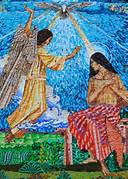
Think back.  Think back to that time when things began to change.  Think back to the announcement.  Think back to the point where our world as we know it was rocked to its foundations as God revealed the very Godself to us, bursting into our world, the world that we thought was the one.  For us, it began the mystery that is Jesus Christ, the mystery that brought us here, the mystery that will take us to Jerusalem.  But in this moment we remember, the fog lifted and there before us was the bridge between the human and the Divine.  This IS the beginning of Jesus Christ.  We often sort of skip over that sometimes, choosing not to get much beyond that night of mangers and stars and visiting field hands.  Think about it.  Jesus was fully human and this human Jesus, like all of us, had to be grown and nurtured in the womb before the miracles started.  March 25th (that would be nine months before Christmas) is celebrated as The Feast of the Annunciation, the veritable turning point of all human history.  It is was in this moment that God stepped through the fog into humanity and, just like every human before and every human since, must wait to be fully birthed into this world.

In the beginning when God created the heavens and the earth, the earth was a formless void and darkness covered the face of the deep, while a wind from God swept over the face of the waters.  Then God said, “Let there be light”; and there was light. (Genesis 1: 1-3)

And in some traditions, March 25th is regarded as the first day of Creation.  (Now, really, I don’t even begin to see THAT as a real date!  But it’s a good thing to remember and that date is as good as any, right?)  So, let’s go with it.  March 25th marks the beginning, when God’s Spirit moved across the face of the waters bringing Light into the Darkness.  So the Annunciation…the announcement of the coming of Christ, the coming of God, into our little world…is that day when once again the darkness begins to fill with Light.  So, begin at the beginning and count forward…to the birth of God into the world. Like Creation, the coming of Christ was the Light pushing the darkness away.  It was when things began to change.  The world was with child.

So on this 29th day of Lent, we realize how close we really are, realize that, once again, things are about to change.  It is scary as the ground beneath us begins to shift and the shadows around us begin to move about.  But think about that moment when things began to change.  Can you imagine what Mary must have thought?  She was young, she had plans, she had her whole life ahead of her.  “How can this be?” we read.  In today’s vernacular, it would read, “Are you kidding me?  I had my whole life planned.  It was safe.  It was known.  It was figured out.”  And, if only for a moment, God and the world waited expectantly in the silence.  And so as everything she knew and everything she planned toppled around her, she said “yes” and entered the mystery of God.  And we, those who would follow, those who come into this sometimes maddening, always-changing world, those who are tempted to play it safe and planned, will also say yes.  And in that moment, once again, God’s Spirit will sweep over the face of the waters and bring Light into the darkness.

Hope holds with it the promise that God always answers our questions by showing up, not necessarily with what we ask for but with remarkable gifts that change our lives and the world.   (Mary Lou Redding)

So as things begin to change, envision Light, envision the Light as it moves into the darkness.  What does it mean to follow?  What does it mean to say “yes” when the world is rocking on its foundations?

Grace and Peace,

Shelli


Psalm 130: A Season of Waiting for Morning

First LightToday’s Psalter:  Psalm 130 (Lent 5A)

Out of the depths I cry to you, O Lord.  Lord, hear my voice! Let your ears be attentive to the voice of my supplications!  If you, O Lord, should mark iniquities, Lord, who could stand?  But there is forgiveness with you, so that you may be revered.  I wait for the Lord, my soul waits, and in his word I hope;  my soul waits for the Lord more than those who watch for the morning, more than those who watch for the morning.  O Israel, hope in the Lord! For with the Lord there is steadfast love, and with him is great power to redeem.  It is he who will redeem Israel from all its iniquities.

The Psalmist writes from the deepest bowels of life.  It is his or her lowest point, feeling so overwhelmed with despair, almost hopeless.  And yet, there, is the sound of the still small voice.  It’s only a whisper but it is there.  The Psalmist strains to hear, laying there in the darkness, unable to sleep, unable to see the light of the morning.  It is a Psalm of faith.  It is the expression of one who though wallowing in the depths of sadness and despair, cannot feel God’s Presence and, yet, knows in the deepest part of his or her being that God is there.  It is the writing of one who knows that there is always morning, if we will only wait.

The words of the Psalm promise us that no matter how dark the night will be, there is always morning.  There is always redemption.  The King James Version depicts it as “plenteous redemption”.  We often hear of redemption as if it is some sort of payment that God required for our sins, as if Jesus’ death was somehow foreordained because we were such sinful creatures that God could take it no more.  But redemption also means restoration, to bring something to a better state.  It is what the Psalmist knows.  God is there, though unseen, restoring, recreating, even in this moment of darkness.  Redemption is not about payment; it is about the promise of morning, the promise of life.  Redemption is not about what Jesus gave us or what Jesus did for us but what God in Christ does even now.  God brings morning.

The Psalm does not give us empty promises that “everything will be alright”.  Rather, it is honest.  Sometimes life hurts.  Sometimes life hurts more than we think we can bear.  Sometimes we have our own dark night of the soul.  But in the darkness, we learn to wait.  We learn to hope.  That is what Lent is–a waiting in the depths.  We are journeying now deeper and deeper into the darkness.  We know that it will be painful, at times even unbearable.  But our faith tells us that God is present whether or not we can feel the presence.  And so we learn to wait.  We wait through pain and betrayal and last nights together.  We wait through darkness and death.  We wait in the stillness and foreboding silence.  We wait because we know that morning always comes.

Bidden or unbidden, God is present.  (Desiderius Erasmus, 1466-1536, Also attributed to Carl Jung, because the quote was posted above his door in his house in Switzerland.)

“Out of the Depths”, John Rutter, “Requiem”

On this 5th Sunday of Lent, claim your own depths.  Imagine what your own recreation looks like.

Grace and Peace,

Shelli

I have posted a reflection on the Stations of the Cross as a “page” on the blog.  If you go to dancingtogod.com and click on it at the top, you can view it.


Returning Home

Returning HomeScripture Text:  Joel 2: 12-13

Yet even now, says the Lord, return to me with all your heart, with fasting, with weeping, and with mourning; rend your hearts and not your clothing. Return to the Lord, your God, for he is gracious and merciful, slow to anger, and abounding in steadfast love, and relents from punishing.

By my count, this is the 28th day of Lent.  We are coming closer.  Our journey’s footprint is beginning to narrow, honing in on our destination.  Things are beginning to change.  You can feel it in the air.  If you listen, really listen, you can hear the voices growing louder.  There’s a part of us that wants to go back, perhaps hide away until it is all over but we know that’s not the way it works.  The journey with all of its twists and turns are part of life.  We speak of going out into the world, of “broadening” our mission, often with a sense of leaving home behind.  But Lent teaches us something different.  Our journey’s map is one of widening circles as we gather the world in and, yet, the point of it, the center, tends to become a little clearer with each step.  We begin to sense the center of all these circles.  We begin to feel at home.

I have several times had the wonderful gift of sharing final journeys.  It is a time of remembering, yes, but it is more.  In the last few years of my grandmother’s life, she seemed to be gathering her memories around her, trying to recap them, trying to capture what was important so that she could leave it behind intact.  Maybe that’s what we should do when things begin to change.  Rather than walking blindly and fearlessly into the unknown as if we have some sort of prideful martyr complex, maybe we are called to gather what we have learned, those whom we have loved, those memories that are part of us, and claim them.  God calls us forward on this journey to leave behind things like material items and things to which we hold to our detriment, things that are not ours to hold.  God calls us forward not to leave our selves behind but to claim the real self that we are.  And those memories, those things we have learned, those we have loved are part of our real self.  They are part of God’s way of returning us to God.

Ann Danielson said that “home is where your story begins“.  I don’t think that’s limited to the place that you were born, the place in which you began.  Home is not meant to be a place.  It is meant to be a way of being.  Maybe that means that each new beginning, each time our story begins, is home.  Our journey is not one of going to a place we do not know but one of returning, returning to who we are called to be, returning to God.  That is what Lent teaches us.  It is a season of reflection and introspection.  It is a season of gathering and pruning, of knowing which things we are called to release and what we are called to hold.  Lent is the season when we reset our journey once again so that it is calibrated with our story, so that the journey is one both of returning home and being home.  It is a journey of returning and re-turning.  Lent is a season when we finally know what it means to be home, to know what claims us, to know what give us life.

Our true home is in the present moment.  The miracle is not to walk on water. The miracle is to walk on the green earth in the present moment. Peace is all around us–in the world and in nature–and within us–in our bodies and our spirits. Once we learn to touch this peace, we will be healed and transformed. (Thich Nhat Hanh)

On this 28th day of Lent, as the pathway begins to turn, remember from where you’ve come.  Gather what is important, what is part of you, those things you need to claim.

Grace and Peace,

Shelli


You, Resurrected


The Raising of Lazarus, Duccio de Buoninsegna, 1308-11

Scripture Text:  John 11: (1-16) 17-44 (45) (Lent 5A)

When Jesus arrived, he found that Lazarus had already been in the tomb four days. Now Bethany was near Jerusalem, some two miles away, and many of the Jews had come to Martha and Mary to console them about their brother. When Martha heard that Jesus was coming, she went and met him, while Mary stayed at home. Martha said to Jesus, “Lord, if you had been here, my brother would not have died. But even now I know that God will give you whatever you ask of him.” Jesus said to her, “Your brother will rise again.” Martha said to him, “I know that he will rise again in the resurrection on the last day.” Jesus said to her, “I am the resurrection and the life. Those who believe in me, even though they die, will live, and everyone who lives and believes in me will never die. Do you believe this?” She said to him, “Yes, Lord, I believe that you are the Messiah, the Son of God, the one coming into the world.” When she had said this, she went back and called her sister Mary, and told her privately, “The Teacher is here and is calling for you.” And when she heard it, she got up quickly and went to him. Now Jesus had not yet come to the village, but was still at the place where Martha had met him. The Jews who were with her in the house, consoling her, saw Mary get up quickly and go out. They followed her because they thought that she was going to the tomb to weep there. When Mary came where Jesus was and saw him, she knelt at his feet and said to him, “Lord, if you had been here, my brother would not have died.”

When Jesus saw her weeping, and the Jews who came with her also weeping, he was greatly disturbed in spirit and deeply moved. He said, “Where have you laid him?” They said to him, “Lord, come and see.” Jesus began to weep. So the Jews said, “See how he loved him!” But some of them said, “Could not he who opened the eyes of the blind man have kept this man from dying?” Then Jesus, again greatly disturbed, came to the tomb. It was a cave, and a stone was lying against it. Jesus said, “Take away the stone.” Martha, the sister of the dead man, said to him, “Lord, already there is a stench because he has been dead four days.” Jesus said to her, “Did I not tell you that if you believed, you would see the glory of God?” So they took away the stone. And Jesus looked upward and said, “Father, I thank you for having heard me. I knew that you always hear me, but I have said this for the sake of the crowd standing here, so that they may believe that you sent me.” When he had said this, he cried with a loud voice, “Lazarus, come out!” The dead man came out, his hands and feet bound with strips of cloth, and his face wrapped in a cloth. Jesus said to them, “Unbind him, and let him go.”

This has always been at the very least a strange story to me.  I think I once had some image of Lazarus walking out of the tomb, with tattered grave clothes dangling and an unbearable stench following him, and then dressing and sitting down for a nice fish dinner with Jesus and his sisters.  But the Scripture is not here to show us magic or to in some way depict a God that with the veritable snap of a finger can just put everything back like it was before. (Well, I don’t know, I supposed God CAN, but why?  That’s not really the way God works.  God has something much better in store.)  This story is taken as a precursor to Jesus’ own Resurrection.  It was Jesus’ way of promising life.  But, ironically, it is also the act that turns the tables toward Jesus’ demise.  Here, standing within two miles or so from Jerusalem, the journey as we know it begins to wind to an end.  Even now, the Sanhedrins are gathering their swords and the night is beginning to fall.

So, why would Jesus do that?  Surely he knew what might happen.  Surely he knew how many red flags his presence near Jerusalem had already raised.  And what about Lazarus?  Who was this mysterious man whose main part in the whole Biblical story is to die and be raised?  Why do this with someone as seemingly insignificant as this?  Maybe its because Lazarus is us–you and me.  Maybe the whole point of the passage is not to point to Jesus’ Resurrection but to our own.  Do you think of yourself as journeying toward resurrection?  Do you believe this?  Sure, we talk about journeying to God, about journeying to the Promised Land, whatever that might be, and about journeying to where God call us.  But do you think of it as resurrection?  Do you think of yourself dying and then raised?  Maybe each of us is Lazarus.  Maybe that’s what Jesus wanted us so badly to believe and live.

We talk a lot of this Lenten journey as our journey to the Cross, our journey with Christ.  So, does it stop there?  I think the story goes on.  Jesus is Resurrected.  Maybe that’s what Jesus was trying to show us–not that we would be somehow plucked from death in the nick of time and not that God really has need of putting our lives back together like some sort of Humpty-Dumpty character, but that we, too, are journeying toward resurrection, toward new life.  Lent is the journey that shows us that.  Lent shows us that the journey is sometimes hard, sometimes painful. Lent shows us not that death will not claim us but that death will not have the final word.  Lent shows us that our faith tells us that there is more.  Lent shows us what it means for Christ to unbind even us–even you and me–and let us go.  Through all of life’s transitions, through all of life’s sad endings, through all of life’s unbearable turns, there is always a beginning.  There is always resurrection–over and over and over again.

There was, indeed, something I had missed about Christianity, and now all of a sudden I could see what it was.  It was the Resurrection!  How could I have been a church historian and a person of prayer who loved God and still not known that the most fundamental Christian reality is not the suffering of the cross but the life it brings?…The foundation of the universe for which God made us, to which God draws us, and in which God keeps us is not death, but joy.  (Roberta Bondi)

As our Lenten Journey begins to turn toward Jerusalem, what does it mean to be a part of it?  And what does it mean to envision you, resurrected?

Grace and Peace,

Shelli