The Wilderness is Where We Came to Be

nativity-story_282_resizedScripture Text:  Luke 2: 1-7

In those days a decree went out from Emperor Augustus that all the world should be registered. 2This was the first registration and was taken while Quirinius was governor of Syria. 3All went to their own towns to be registered. 4Joseph also went from the town of Nazareth in Galilee to Judea, to the city of David called Bethlehem, because he was descended from the house and family of David. 5He went to be registered with Mary, to whom he was engaged and who was expecting a child. 6While they were there, the time came for her to deliver her child. 7And she gave birth to her firstborn son and wrapped him in bands of cloth, and laid him in a manger, because there was no place for them in the inn.


Oh not this!  How can you call this beautiful story the wilderness?  But the truth is, Jesus was born into a wilderness.  Joseph and Mary had had to travel some distance to get to this place.  And the setting, for all the wonder and awe that it holds for us was not idyllic—forced occupation, taxation without representation, poor couple, long trip under less than favorable circumstances, and, then, no room when they got there.  See, in our haste to welcome the child each year and celebrate once again his arrival into the world, we forget the circumstances into which he came.  We forget that he first appeared in the dim lights of a grotto drenched with the waters of new Creation, with the smell of God still in his breath.  We forget that Mary was probably in tears most of the night as she tried to be strong, entering a realm that she had never entered.  And we forget that Joseph felt oh so very responsible and that the weight of that responsibility, the responsibility for essentially birthing God into this world, was heavy on his shoulders.  We remember Jesus’ birth, the moment when we came to be.  But we forget that the wilderness is where we came to be.

Now this is, of course, not the first time that God has appeared in the wilderness.  Incarnations were happening all along.  God came as winds sweeping across the waters, burning bushes, and thick clouds that shrouded mountains.  God came in dreams and whirlwinds and strange manna appearing in the wilderness.  God always came.  Perhaps we were too busy with our lives to notice.  So, on this particular night in this particular place, God called us into the wilderness of our lives so that we would finally notice.  God seeks us out, showing us the sacredness that had been created for us, the holy that we had missed all along.  On this silent night, in the thick wilderness of night, God comes and dances with humanity, crossing the line between the ordinary and the Divine if only for a while.  God comes to us.

Haven’t you always thought that it would have made more sense for Jesus to born into the establishment, perhaps into at least moderate wealth, in a place where it all would have been noticed?  OK, really?  So what would have happened if Jesus had been born into a single-family McMansion in the suburbs?  See, God always comes into the wilderness.  God chooses to call us into the wild where we will notice that God is there.  God calls us away from what we know, away from those places where we get comfortable and close ourselves off.  God calls us to the place where we are open to newness, open to encounter, open to walking toward rather than closing off.  And on this night, on this beautiful silent night with angels singing and stars shining, the walk to the Cross began.  The wilderness is where we can come to be because it is the place where we know nothing else other than to walk forward.  This season of Lent, this season of walking to the Cross did not just begin this last Ash Wednesday.  It began long ago on that silent night in the wilderness.  It began in the darkness of the wilderness when we came to be.
It gets darker and darker…and then Jesus is born. (Ann Lamott)

FOR TODAY:  Leave the comforts of your life and walk into a wilderness.  What do you see?  Who do you encounter?  Now keep walking.

Grace and Peace,

Shelli

The Wilderness is Where We Began

Creation 1Scripture Text:  Genesis 1: 1-3

In the beginning when God created the heavens and the earth, 2the earth was a formless void and darkness covered the face of the deep, while a wind from God swept over the face of the waters. 3Then God said, “Let there be light”; and there was light.


That’s not the wilderness!  Wilderness has thick, unsculptured trees or endless sand, hard-to-follow paths or paths that keep disappearing.  This isn’t a wilderness. There’s nothing there!  But don’t you think nothingness, a formless void covered in darkness is just about as ultimate a wilderness as you can imagine? And keep in mind that there WASN’T nothingness, per se.  There was a void, a glob (that’s an official very spiritual term!) of disordered chaos.  And God was there, there in the wilderness with the chaos and the glob.  All of Creation began in this wilderness.  God spoke the first creating Word in that wilderness.  God spoke and the formless void began to slowly follow God into being. As the Spirit of God swept over the waters, they moved and parted, letting go of the part of themselves to which they had held so tightly, and they began to change.  And then with another Word, God called Light forth and darkness began to be illuminated.  Creation had begun.  We had begun.  The wilderness is where we began.

We know the rest of the tale.  God continued to create, continued to order the wilderness, to one by one call Creation into being—earth and sky, plants and suns and moons and ordered seasons, swimming creatures, winged creatures, creeping creatures, walking creatures, and, oh yeah, us!  As the last bit of ordering of this incredible called-out Creation, God created Sabbath, the pinnacle, the climax, the glorious coming together into perfect order of all of Creation.  And God delighted in this order and called it good.

The wilderness is where we began.  In our beginnings, in our disordered chaos, God called us forth into being.  God created us not in a haphazard way but in the very image of God.  God called us forth to live into that image, to become the very ones that God envisioned we would be.  We were probably pretty OK in that wilderness void; after all, we knew nothing different.  And then God created us into something new.  And God called it good.  We were God’s delight, God’s beloved.  Oh, sometimes we wander away. Sometimes we mistake really pretty acceptable chaos for God’s ordering.  Sometimes we think we have a better idea of who we could be than this image of God.  And so we need to return to the wilderness, to the place of our creation, to the place where we began, so that God can say us into being once more.

That’s what Lent does for us.  Lent calls us into the wilderness to remind us who and who’s we are, to remind us of that image in which we were made.  Lent calls us into the wilderness so that we can begin again.

Every act of creation is first an act of destruction. (Pablo Picasso)

FOR TODAY:  Look around at this wilderness.  What does it mean to begin again?

Grace and Peace,

Shelli

A Much-Needed Wilderness

ivan-nikolaevich-kramskoy-christ-in-the-desert1Scripture Text:  Luke 4: 1-2

 Jesus, full of the Holy Spirit, returned from the Jordan and was led by the Spirit in the wilderness, 2where for forty days he was tempted by the devil. He ate nothing at all during those days, and when they were over, he was famished.


Yes, as a matter of fact, this IS the third time we’ve heard this account as part of our wilderness journey. But we haven’t heard it from the same Gospel-writer.  All three of the synoptic Gospels include the account of Jesus being led into the wilderness following his Baptism. It’s one of the few passages that was not only included by each writer, but actually was included within pretty much the same sequence in the happenings of Jesus’ life. There doesn’t seem to be any need on the part of any of the writers to “rearrange” things to further the focus that the writer was trying to impart. It’s just included. It’s part of the story. Apparently, each Gospel account recognizes this as, for want of a better word, a much-needed wilderness.


So have you ever thought of the wilderness as something that we NEED? We probably spend more time trying our very best to avoid it or, if it can’t be avoided, to at least hurry to the end, trying to cram as much as we can into it, but with the goal to get to the end as soon as possible so that we can go back to normal, go back to our lives. But Jesus was led into the wilderness and stayed for forty days. He had just been baptized. According to the Scriptures, John the Baptist had just pointed to who he was and what his life meant. God had proclaimed him the “Beloved”, and had voiced what pleasure the Divine took in him. He was set to go, set to begin his ministry. Standing there on the banks of the Jordan, he was ready to begin. And he did. He began with what was apparently a much-needed wilderness.


So for forty days, Jesus wandered in the wilderness. Sure, he was tempted to control it, tempted to overpower it, tempted to make it his. He was probably tempted to go home, although none of the Gospel-writers wrote that one down. But he didn’t. He walked the wilderness. He prayed, he looked at himself, he talked to God. My guess is that he probably argued with and questioned God a bit. (Well, maybe that’s what I would have done!) The wilderness was not any easier for Jesus than it is for us. But Jesus knew that he had to embrace the time, that preparing himself for the years to come, for the tiresome tasks of serving others, for the draining tasks of healing and teaching, for the frustrating tasks of calling others who did not always stay on the path, for the disheartening tasks of rejection and difficulty and questions, and, finally, finally, for the implausible task of walking to the Cross, had to be done in this wilderness. This wilderness would give him what he needed and he knew it. It was the place where he had to let go of his own plans and his own preconceptions of what his life would hold. It was the place where he had to take a good hard luck at himself, at the ways that he stood in the way of his own life. It was the place where he would know, finally know, that he WAS God’s Beloved with whom God was well pleased and that God would never forsake him. It was the place that, finally, Jesus knew who he was and what he was called to do.


We need the wilderness experience just as badly. It’s not a place where we prove our love to God or where we show how strong or how spiritual or how faithful we are. It is the place where we finally get out of ourselves, out of our routines, off the path that we have so carefully carved out for our lives, and, finally, without being able to see where we are going, we know that we are on the right path. It is the place where we can come to know who we are and what we are called to do.   Now we are ready to begin. And we return from the wilderness as a different one, as one who knows ourself as God’s Beloved, with whom God is well pleased.  We will return famished and ready to fill ourselves with God.


It may be that when we no longer know what to do, we have come to our real work. And when we no longer know which way to go, we have begun our real journey. (Wendell Berry)


FOR TODAY:  Look around you.  Quit trying to figure a way out.  Just walk through the wilderness and see what God has to show you.

Grace and Peace,

Shelli

Wilderness-found


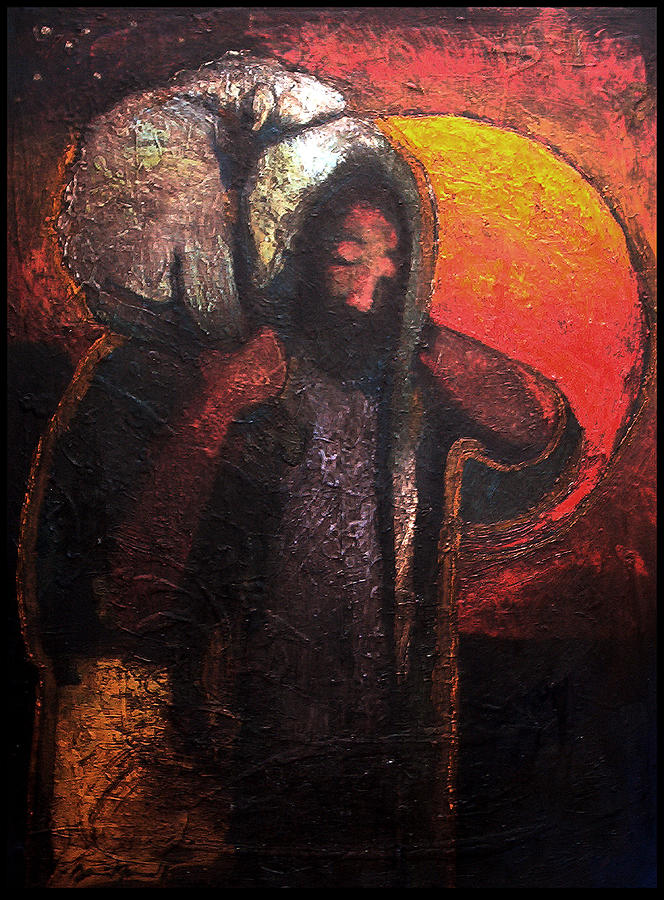
"The Lost Sheep", Daniel Bonnell, USA
“The Lost Sheep”, Daniel Bonnell, USA

Scripture Text:  Luke 15: 4-6

 4“Which one of you, having a hundred sheep and losing one of them, does not leave the ninety-nine in the wilderness and go after the one that is lost until he finds it? 5When he has found it, he lays it on his shoulders and rejoices. 6And when he comes home, he calls together his friends and neighbors, saying to them, ‘Rejoice with me, for I have found my sheep that was lost.’


As we have come to know, the wilderness is treacherous. It is tiresome and mind-draining. It often seems to lengthen time even as one makes his or her way through it. We become impatient. We want it to end. We want to shorten the time that it has its hold on us. We want to take shortcuts to get to the end, so we veer off the path, away from our course, thinking that we have it all figured out. We find ourselves lost.


It is easy in times of wilderness to think that you are alone. It is tempting to assume that you have somehow ended up there of your own doing and that you and you alone are responsible for finding your way out. We’ve all been lost before. We’ve all been in situations where we just can’t seem to find our way back. We’ve all had times whether they be physical, emotional, or even spiritual where we lose our way. We backtrack, trying to find the pathway down which we came so that we can “start again”. But everywhere we look, the choices of where to go all look the same. It becomes overwhelming. We turn and we turn and we panic and we run through this maze of choices over and over again.


When I was young, I was told that if I was lost, I should stay where I was. (Sometimes we’re smarter when we’re children, because we know to listen.) I think intellectually we all know that we should stay on the path and keep walking and yet, as adults, we somehow think we can fix it. We can wander with panic through life with no compass and no real help. We can try this way and that way and backtrack and veer off to nowhere. We can convince ourselves that we need no help, that we can do it. We can be tempted by the shortcuts that are offered along the way. And we stay lost.


Sometimes we are the lost sheep. Sometimes the wilderness seems to consume us. Sometimes the road through it seems to lengthen with each step. But where we did get the notion that solitude meant that we were alone? This wilderness journey is not one that we travel alone. God walks with us, holds us when we need to be held, and when we become the lost sheep, the one who has wandered away, God is there too. God doesn’t “fix” our way through the wilderness or speed up our wilderness time, but we are always wilderness-found.


We just have a couple of more weeks of this Lenten wilderness. We know that it will get harder. We know that, like many wilderness paths, it will seem to lengthen and become more treacherous as we near the end of its hold. But we do not walk it alone. Jesus, walking to the Cross, was never alone. He was in solitude; he was in prayer; he was often deserted by those who traveled with him. But God has walked this way before. God knows the way. So God will always make sure that even though the way is hard, we are always wilderness-found. And God lays us on the Divine shoulders and rejoices.


Look back from where we have come.  The path was at times an open road of joy.  At others a steep and bitter track of stones and pain.  How could we know the joy without the suffering?  And how could we endure the suffering but that we are warmed and carried on the breast of God? (Desmond Tutu)


FOR TODAY:  Let God pick you up.  Let God hold you.  Be aware of God walking with you on this path.

Grace and Peace,

Shelli

Becoming Wilderness

"St. John the Baptist", El Greco, c. 1600.
“St. John the Baptist”, El Greco, c. 1600.

Scripture Text:  Matthew 3: 1-5

 In those days John the Baptist appeared in the wilderness of Judea, proclaiming, 2“Repent, for the kingdom of heaven has come near.” 3This is the one of whom the prophet Isaiah spoke when he said, “The voice of one crying out in the wilderness: ‘Prepare the way of the Lord, make his paths straight.’” 4Now John wore clothing of camel’s hair with a leather belt around his waist, and his food was locusts and wild honey. 5Then the people of Jerusalem and all Judea were going out to him, and all the region along the Jordan, 6and they were baptized by him in the river Jordan, confessing their sins.


We never know quite what to do with this strange wilderness man.  You can imagine him covered with dirt and grime after all this time in the wilderness.  His hair is long and unkempt, matted in places and hanging down over one of his eyes.  He is decked out from neck to knee in some sort of strange covering made of camel’s hair that is secured by a roughshod faded leather belt hastily tied around his waist.  And all this time in the wilderness has caused him to lose any hint of a sophisticated palate finely tuned to the gentle blend of herbs and spices and culinary concoctions.  Instead, he is content to eat what he finds—locusts, wild honey, whatever else may cross his path.  Yeah, we never know quite what to do with this strange wilderness man.

John was definitely not a run-of-the-mill preacher.  He had zeal; he had passion; his primary focus was preparing the way of the Lord.   I’m not sure what John saw for those who did not know God.  But he was determined that all who came out to him somehow, some way turned their lives around.  Now this whole idea of “repentance” that John emphasized is not one that we good Methodists often focus on.  It sometimes sounds a little too “hellfire and brimstone” for us. But repentance means turning around, a new mind, a change of direction.  It means throwing off those things that bind us to the life we know for those things that point to a life with God.  It does not mean that God has finally won us over; it means, rather, that our own self, our own story, has finally come to be.  Just being there is not enough; just having Abraham for your ancestor is not enough; just doing the right thing is not enough.  You must change your life.  You must change your path.  You must change how you look at the world.  There are no favorites.  This includes everyone.

So, why did John make his home in the wilderness?  Why didn’t he come to town, plant himself in the middle of the town square, and preach his message there?  Maybe it was not that John himself had such an affinity for the wilderness life.  Maybe it was rather that he saw what we often avoid.  I mean, think about the wilderness—it calls us into things outside our normal routines, outside of the establishments that make up our lives.  The wilderness calls us to learn to see things anew.  Without routines, we have to rely on something that will point us in the right direction; without our comfortable landmarks and our timeworn assumptions, we have to rely on the wilderness and those who we meet on the path showing us the way.

No, we don’t know what to do with him.  We don’t know how to talk to or talk about this wild wilderness man.  After all, John is a threat to proper society and accepted norms.  John IS the wilderness.  Maybe that’s what we need to do—become wilderness.  Now I’m not ready to don camel’s hair and I’m thinking that I might pack some peanut butter and crackers and perhaps a high-protein granola bar to avoid EVER having to eat locusts.  But maybe I do need to become wilderness, to clear the timeworn path through my life, to become open to the wildness of God’s Spirit that blows in and out of places that I never knew, that somehow compels me to travel down roads unknown, sometimes with fear and trepidation, and be willing (no, actually WANT to) turn myself around and see what I have not seen.

OK, John, I guess we get it.  I’m still not keen on the outfit and the meal, but if our Lenten journey has taught us anything, it is to open ourselves to traveling through what we do not know so that it can all be revealed to us.  John saw something that I have been avoiding.  John was not waiting for God’s Kingdom to come to be; he saw it happening.  By becoming wilderness, by stepping out of what he knew, he saw that God was not just coming but was already here.


Not only is another world possible, she is on her way. On a quiet day, I can hear her breathing. (Suzanna Arundhati Roy)


FOR TODAY: Become wilderness. Open your eyes and see God’s Kingdom coming to be. (And, if you need to, pack some peanut butter!)

Grace and Peace,

Shelli

Coming Alive in the Wilderness

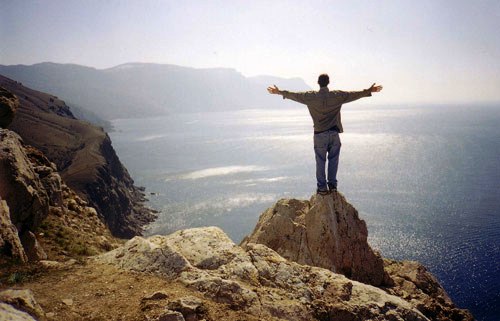
embrace_lifeScripture Text: Hebrews 5: 5-10


5So also Christ did not glorify himself in becoming a high priest, but was appointed by the one who said to him, “You are my Son, today I have begotten you”; 6as he says also in another place, “You are a priest forever, according to the order of Melchizedek.” 7In the days of his flesh, Jesus offered up prayers and supplications, with loud cries and tears, to the one who was able to save him from death, and he was heard because of his reverent submission. 8Although he was a Son, he learned obedience through what he suffered; 9and having been made perfect, he became the source of eternal salvation for all who obey him, 10having been designated by God a high priest according to the order of Melchizedek.


Second century bishop and saint Iranaeus of Lyons once said that “the glory of God is humanity fully alive.” What does that mean, to be “fully alive”? I don’t think that it means, as we might jump to conclude, reaching some sort of pinnacle of humanity, you know the “be all you can be” phenomenon. It is not in any way hierarchical. It doesn’t mean that one is better or worse or less alive than another. Being fully alive is rather embracing all that we are, all that God envisions us to be. It does not mean being superhuman; it means being fully human; it means being the very image of God such that was perfected in Jesus Christ.


So who is this Melchizedek character? He crops up in the Bible a couple of times at best—in Genesis (Gen. 14:18) as Abraham is called by God and then again in Psalm 110 and then here. His name means “King of Righteousness” or “King of Peace” in some places. Remember that Abraham had been called by God and was promised that he would become the father of many nations. But that hadn’t happened and Abraham was feeling the pressure of it all. So at this lowest, darkest point, in the middle of the wilderness, so to speak, enter Melchizedek, a somewhat shadowy character that drifts in and drifts out, almost not even worth a speaking part in this whole drama of the life. But he offers Abraham blessing, and food, and wine. He just comes. He just shows up. (See, this is all sounding vaguely familiar.)


So enter Jesus Christ, a high priest according the order of Melchizedek. It’s not hierarchical; it’s an ordering of life. And we are baptized into that same order. It is not a designation that comes with power or with tenure or with honor.  We are not “set apart” away from the world or away from life. We are baptized into the order of life, this great continual ordering of God. Our lives will be filled with love. They will also endure suffering. We will walk through feasts and famines. We will traverse mountains of light and dark valleys. And we will journey through the familiarity and comforts of home and places of deep wilderness. Living the depth and breadth of our lives makes us fully alive, makes us real. But, into our high points and our low points, a somewhat shadowy character drifts in and out, offers us blessing, and food, and wine. God just comes. Over and over and over again, God comes. God just shows up. Perhaps being fully alive is knowing that you are loved, not that you have to earn that love or gain that love or do something specific for that love. Love just comes. Being fully alive is knowing in the deepest part of your being how much you are loved, so loved that it literally spills out of your being into the world.


Lent is an invitation to become fully alive, to immerse ourselves into life, to finally allow ourselves to feel pain and emptiness, to feel the Cross, so that we can grasp the untold Joy of Resurrection. Lent is an invitation to become real, to know Love, to know Love in the deepest part of who we are. Maybe Love that is found in the wilderness makes us fully alive. Maybe Love that comes when we need it the most, when our lives are emptied out, when we are surrounded by darkness, when we can do nothing to earn love, is the Love that we finally need to know.


Here is the God I want to believe in: a Father who, from the beginning of Creation, has stretched out his arms in merciful blessing, never forcing himself on anyone, but always waiting; never letting his arms drop down in despair, but always hoping that his children will return so that he can speak words of love to them and let his tired arms rest on their shoulders. His only desire is to bless. (Henri J.M. Nouwen, The Return of the Prodigal Son, 95-96)


FOR TODAY: Be fully alive! Know how much you are loved, loved enough that God is with you always, waiting in Love. Imagine that love spilling into the world.


Grace and Peace,

Shelli

Turned Inside Out


Inside OutScripture Text: Jeremiah 31: 31-34

 31The days are surely coming, says the Lord, when I will make a new covenant with the house of Israel and the house of Judah. 32It will not be like the covenant that I made with their ancestors when I took them by the hand to bring them out of the land of Egypt—a covenant that they broke, though I was their husband, says the Lord. 33But this is the covenant that I will make with the house of Israel after those days, says the Lord: I will put my law within them, and I will write it on their hearts; and I will be their God, and they shall be my people. 34No longer shall they teach one another, or say to each other, “Know the Lord,” for they shall all know me, from the least of them to the greatest, says the Lord; for I will forgive their iniquity, and remember their sin no more.


Most of us know this passage well. It speaks of a new covenant, one that is written not on tablets or in rainbows but woven into the very being of the people. The context in which this was written is probably following the exile. The cities have been breached, the temple has been totally destroyed, nothing is left of the people’s lives. They have become subjects of the Persian king and have lost everything that they had before. But God through the Prophet Jeremiah gives a vision of reconstruction and renewal. But this time things will be different…


We Christians like to read this with our Easter-colored lenses on. We Christians like to put on our post-Resurrection lens and read this with the view of Jesus, the Cross, and the empty tomb in our mind.  Ah…we think, Jesus, Jesus is the new covenant.  Jesus is the covenant that is written on our hearts.  Jesus is the one. Is he?  I mean, yes, Jesus IS the embodiment of the New Covenant. So we try our best to follow, to do what Jesus would do, to act like Jesus would act. We profess that we believe in Jesus Christ as our Lord and Savior. And then we sort of wait…we wait until Jesus comes or we go or whatever our belief system tells us is going to happen sometime up ahead. But, in the meantime, this covenant sort of eludes us. What happened to it being written on our hearts? What happened to it being part of us?


You know, when you think about it, did Jesus come as Emmanuel, God-With-Us, as one among us who took himself all the way to the Cross out of love for us just so that our belief system would change? Or did Jesus come to show us the Way to God, the way to write the covenant into our very being and become the embodiment of it ourselves? In other words, perhaps this life of faith, this way of being Covenant People, with hearts tattooed and all, is not just a life of profession of belief but one of following and living this Way to God so intently that we become it. Maybe it’s a way of living inside out.


So in this Lenten wilderness, we find our beliefs. They are there, time-tested and comfortable. We can memorize them; we can recite them; we can even talk about them on a good day when we think it’s appropriate and the audience is receptive. But the wilderness shows us that there is more. The wilderness exposes our heart. And there’s that covenant written into it. The wilderness shows us how to turn ourselves inside out and become the Way to God. So, the days are surely coming…maybe when that begins to be is up to us.  Maybe, as we’ve said, we are the ones that we’ve been waiting for.


We live like ill-taught piano students. We are so afraid of the flub that will get us in dutch, we don’t hear the music, we only play the right notes. (Robert Capon)


FOR TODAY: Imagine the covenant written on your heart. Imagine BEING the embodiment of the Way to God. Now dance to the music.


Grace and Peace,

Shelli