(part of the “Breathing Out” Lenten Series)

Scripture Passage: John 3: 14-17
14And just as Moses lifted up the serpent in the wilderness, so must the Son of Man be lifted up, 15that whoever believes in him may have eternal life. 16“For God so loved the world that he gave his only Son, so that everyone who believes in him may not perish but may have eternal life. 17“Indeed, God did not send the Son into the world to condemn the world, but in order that the world might be saved through him.
This is it: THE verse. So, what we do with THE verse? It’s on street corners and billboards and T-Shirts and tattoos and faces and signs at sporting events. I think it is often read as some sort of great reward for doing the right things, the recognition of a narrow and exclusive pathway. You know, if you do everything you’re supposed to do, you’ll be rewarded when it’s all said and done. And if you don’t, well you’re just out of luck. You messed up. So, look at me…do what I do, go to church where I go, be what I am, look like I look. I’m saved; are you? (Define that! Do we really understand what that means?)
Really? Truthfully, I used to hate this verse. The way it was taught did not make sense to me. I mean, why would the guy that welcomed all those thousands of people on a hillside (or a plain if you’d rather read it in The Gospel According to Luke) suddenly say, “nope…just this group”? Yeah, I think we’ve read it wrong. (Cue the lightning bolt, I guess…) For God so loved the world—not the ones in the right church or the right country or the right side of the line—but the WORLD. God loved the world, everything about the world, everyone in the world, so much, so very, very, VERY much, that God came and walked among us, sending One who was the Godself in every way, to lead us home, to actually BRING us home, to lead us to God. Are you saved? Yes…every day, every hour, over and over and over and over again. I’m being saved with every step and move and breath I take. I think that’s what God does. God loves us SO much that that is what God does. God is saving us. God came into the world to save the world. So why would we interpret this to mean that God somehow has quit loving some of us or that we have to somehow bargain with God to begin loving us or that “being saved” is a badge of honor? See, God loves us so much that God is saving us from ourselves—all of us, as in the WHOLE WORLD.
The reference to the snake refers to Numbers 21:4-9. It is the account of the Lord sending poisonous serpents into the wilderness that can be countered by making a serpent and putting it on a pole so that everyone who looks at it will live even though they were bit by a poisonous snake. (OK….whatever!…I’m not really a snake person.) So, essentially, it’s like this: You think your main problem is snakes? I mean, THAT’S your problem? Alright, here it is. Look at it hanging there on the tree. Quash your fear, let your preconceptions go. There…no more snakes. You don’t have to fear snakes.
So, this time? You have let the world order run your life. You have become someone that you are not. You have allowed yourself to be driven by fear and preconceptions and greed. You have opted for security over freedom, held on to what is not yours, and settled for vengeance rather than compassion and love. You have conjured up wars against each other. I created you for more than this. I love you too much for this to go on. Look up. Look there, hanging on the tree, there on the cross. Stare at the snake. Stare at the Cross. Enter the Cross. See how much I love you. In this moment, I take all your sin, all your misgivings, all your inhumanity and let it die with me. All is well. All is well with your soul. There…no more death. You don’t have to fear death.
Many people read this verse as the depiction of a narrow way, a way that is defined by the Jesus that they imagine. I don’t think that. I read it not as a narrow pathway to God but one that is wide and welcoming, one that is merciful and grace-filled, on that each of us can find a way to walk. That’s Jesus’ message for me: “Come, THIS way…I’ll show you! Because that is how much you are loved.”
There are so many of us that are quick to define who is “in” and who is “out” as far as God is concerned. Really? Are you sure? I mean, isn’t that a little above your holy pay grade, so to speak. For God so loved the world that he gave his only Son, so that everyone who believes in him may not perish but may have eternal life. Indeed, God did not send the Son into the world to condemn the world, but in order that the world might be saved through him. So, come all you that are searching and those that are lost. Come all who struggle with being accepted in the church, all who have been shunned and made to feel that they are less than. Come ALL of God’s children. You are loved. You are so loved that God walked this earth in the form of a human to show us all the way. And, yes, I think that is REALLY, REALLY good news.
So, for today’s breathing exercise…Breathe out what the world tells you about who is “in” and who is “out”. Breathe out the vision of a church and a Kingdom of God that only includes those who believe the “right” way, who walk the prescribed path. Breathe out hatred and exclusion and xenophobia of God’s children, no matter who they are. Then breathe in…breathe in that great, great love of God that Jesus showed us. Breathe in that you are so deeply and incredibly loved that you can’t even fathom its depth.
In Christian language, to be truly human is to shape our lives into an offering to God. But we are lost children who have wandered away from home, forgotten what a truly human life might be. When Jesus, our older brother, presented himself in the sanctuary of God, his humanity fully intact, he did not cower as though he were in a place of “blazing fire and darkness and gloom.” Instead, he called out, “I’m home, and I have the children with me.” (Thomas Long)
Grace and Peace,
Shelli
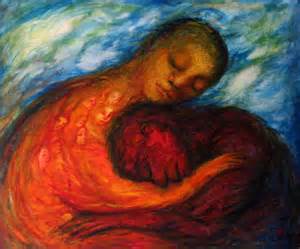





 Dancing to God