A Deserted Place

You know, sometimes discipleship is just downright exhausting.  Oh, who are we kidding?  Sometimes just being a normal person trying to keep your head above water is downright exhausting.  Sometimes it seems too hard or too much or too complicated.  Discipleship (and life, for that matter) is really sort of a balancing act.  It is full of rhythms of converging order and chaos, beginnings and ending, and pulsing light and dark and sometimes we struggle to somehow balance all those aspects of life as we continue our journey forward. 

This passage depicts a time in the life of the disciples not unlike that.  Remember that the verses preceding the ones we read are the account of the death of John the Baptist (Why did we read that again?).  And at this point, we are told that the apostles return from sort of their first tour of service and gather around Jesus, telling him everything that had been happening with their mission.  They are excited.  They have wonderful stories of healings and teachings and people that are really listening to them.  They are becoming witnesses of the Gospel and things are beginning to change!  And yet, they are realizing that this discipleship thing is hard; it’s exhausting; sometimes it’s just frustrating.  And during this time, John the Baptist had been brutally executed.  This is certain to have cast a somber shadow over their elation at the success of their mission.  This had to be scary.  After all, John had been part of Jesus’ work.  John had, essentially, been one of them, doing what they’re doing.  But, as we know, we cannot always control or predict what happens in life. And so, in the midst of their shock and sadness and grief, and probably fear, Jesus tells the apostles (and himself), to “come away and rest”.  He tells them to go to a deserted place, a quiet place.  It was a place of Sabbath.

Now, probably with very little effort, we, too, will identify with this busy life, the throng of demands, the ongoing needs of those around us, and, possibly, even with the dangers that somehow impede our journeys.  We can even identify with those times when, like these disciples, we feel that we can’t even take time to eat, those times when there’s so much going on, when there are so many balls being juggled, that you feel like you can’t even breathe.  You’ll notice here that there were verses that we skipped in this week’s prescribed lectionary passage.  They are the account of the feeding of the five thousand.  Yeah, I’m thinking that wasn’t a time of rest, that was NOT a deserted place.  As much as the disciples wanted to serve, wanted to BE disciples, that was hard.  You can imagine that they wanted so badly to go off and rest, to go off and be by themselves to grieve, to reflect, to be.  So, Jesus tells them to stop, desist, take some time to care for themselves, and not to feel that they have to immediately respond to every cry in the world.  Yeah, Jesus got it!  Jesus knew we were human.

It is a lesson for us all.  It is part of the lesson that Jesus is trying to make the disciples realize.  They are not God; they are not the saviors of the world; they are limited human beings who need to rest.  They are not called to do all the work themselves.  Remember, they are the ones that are called to call others who call others who call others.  We are not in this alone.  This is part of human reality and, more importantly, it is part of that rhythmic dance of creation to which we all belong.  And so, the disciples did what Jesus had said to do and got into a boat and went to a deserted place.

But, as we all know, just because we choose a time to sail away does not mean that the rhythm of life stops.  We are told that there were people on the shore who recognized them and hurried to greet them.  (Don’t you hate that?  Leave me alone!)  But these people needed something—they were hungry for what Jesus offered.  Jesus responded to their needs, teaching and caring for them.  The disciples were there too, perhaps a little miffed that their “deserted place” had now become a somewhat public arena.  In the verses that the lectionary omits, they wanted to send them away.  This was their time; this was when they were supposed to rest.  But Jesus told them, “no, give them something to eat, sustenance for their bodies and food for their souls.”  So, in a way that is so familiar to us, he took the food, and blessed it and gave it to the disciples to serve the people around them.  Rest would come.

In her book, Sabbath Keeping, Donna Schaper says that “Sabbath is a way of living, not a thing to have or a list to complete.  By observing it we become people who both work and rest, and who know why, when, and how we do either.  We also recognize the occasions on which we do both at the same time.  We know how to pray, how to be still, how to do nothing.  Sabbath people know that “our” time is really God’s time, and we are invited to live in it.  We are living our eternity now—this Tuesday and Wednesday, this Saturday and Sunday.”  Isn’t that what we are trying to do—find that rhythm of life to which God invites us, that balancing act, if you will, that is God’s call to us?  This is the way that our time and God’s time converge and become one.  This is the way that our hearts beat the heartbeat of God and our ears hear God’s music.

The Jewish culture in which Jesus and the disciples lived was one that embraced time much more than space.  The understanding was that, contrary to the way we look at time, all hours were not alike.  Each hour was unique and the only one given at that moment.  Each hour held its own identity and its own purpose and within all of those hours, the Sabbath, those times when God calls us to rest and renew and return to our deepest relationship with God, were like great cathedrals, the Holiest of Holies, that sanctified time from which God then sent us into the world.

But we have lost that rhythm of being sent out into the world and renewed within God’s sanctified time, as God’s work prepares us to be sent forth again.  We are so busy doing our own work that we’re not allowing God to do God’s work on us.  It is wrapped in this holy time of rest with God that we get this glimpse of the holy and the sacred that exists for us even now.  It is what gives us the vision to do the work that needs to be done.  It allows us a chance to once again get in touch with God’s purposes for us and for the world.  It is a way of emptying ourselves.  Mother Teresa once proclaimed, “Let us remain as empty as possible so that God can fill us up.”  This is the way that God fills us up.  It is the way of becoming Sabbath, the Holiest of Holies, consecrated for God.  It is part of being a disciple.

This idea of the Sabbath being holy is not new.  In fact, ancient Judaism saw Sabbath rest and eternity as one, of the same essence.  Abraham Heschel relates a legend that claims that “at the time when God was giving the Torah to Israel, [God] said to them:  My children!  If you accept the Torah and observe my commandment, I will give you for all eternity a thing most precious that I have in my possession.  And what, asked Israel, is that precious thing which Thou wilt give us if we obey Thy Torah?  The world to come.  Show us in this world an example of the world to come.  The Sabbath is an example of the world to come…The Sabbath possesses a holiness like that of the world to come.”

I know.  Sabbath is hard.  There is just too much to do.  There are just so many hours in the day.  There are too many people depending on me.  If I don’t do it, it won’t happen.  Are any of these resonating with any of you? John Westerhoff, who is a well-known theologian, calls the phrase “if I don’t do it, it won’t happen” a proclamation of atheism.  Wow!  None of us are in this alone.  If you don’t do it, either someone else will or it just wasn’t meant to happen.  If you believe in the God who is always with you, always holding you, always guiding you; if you believe in the God who created you and loves you so much that this God would give you this gift of Sabbath to make you aware of that, if you believe in the God who calls us into this household of believers where we support each other into becoming the Body of Christ, then why don’t you believe that God will somehow empower you to find a way to get everything done that needs done?  Go back and read the Gospel passage again.  There was work to be done—LOTS of work to be done–and the disciples waited in the boat. “Come away and rest.”

In 1951, Rabbi Abraham Heschel wrote what I think is the quintessential classic entitled The Sabbath.  In it, Heschel says that “unless one learns how to relish the taste of Sabbath while still in this world, unless one is initiated in the appreciation of eternal life, one will be unable to enjoy the taste of eternity in the world to come.  Sad,” he says, “is the lot of the one who arrives inexperienced and when led to heaven has no power to perceive the beauty of the Sabbath…”

The traditional Jewish Sabbath begins at sundown, the Christian Sabbath with morning worship.  In both, Sabbath time begins with the lighting of candles and a stopping—to welcome the Sabbath in.  The Jewish understanding is that the Sabbath is welcomed in like a queen.  It is more than rest; it is promise.  It is a release from whatever enslaves us.  For the early Jews, that was actually embodied slavery; for us, it is choosing to be released from clocks and commitments and phones and schedules and all those burdens that we bear.  Marcia Falk writes that “three generations back my family had only to light a candle and the world parted.  Today, Friday afternoon, I disconnect clocks and phones.  When night fills my house with passages, I begin saving my life.” This is the beginning of sacred time.  This is the beginning of eternity.  This is where we find life.

Sabbath is not rest the way we think.  Sabbath is connection.  Sabbath is responding to God’s invitation to enter the holiest of holies, to leave ourselves behind, if only for a day, and find ourselves. Sabbath is not a nap, not a withdrawal. Sabbath is rest in the God we know, the God who is wanting us to connect, wanting us to find ourselves.

Grace and Peace,

Shelli

The Light of the World

Peter Adams, Cristo-Redentor, Corcovado Mountain, Rio

Scripture Text: John 8:12

12Again Jesus spoke to them, saying, “I am the light of the world. Whoever follows me will never walk in darkness but will have the light of life.” 

Jesus is the light of the world.  We’ve heard that many times.  We like that.  It comforts us, give us hope for this sometimes-messed up world in which we live.  So, we wait.  We wait for the Light to come flooding in, for the darkness to subside, for the world to be what it is and always was meant to be.  And in the meantime, we rely on faith.  We look toward Jesus to lead us home.

Does that sound about right?  But what if it’s different from what we imagine?  What if the waiting is not for the time that the Light will come and fill our world but for the time that we will finally let the Light into where we are standing now?  See, contrary to what we’d like to visualize, I’m beginning to believe that Jesus has no intention of lighting up the world like some sort of massive fluorescent light fixture.  God is not dangling full lighting at us as a reward for our faith or for changing our ways or anything else.

The Light is already here.  Jesus did not say “I am going to be the Light of the world” or “Someday I’ll light up the world”.  Jesus said “I AM the light of the world.  The Light is shining into the world.  Sometimes it is hidden.  Sometimes we hide from it.  Sometimes we shrink away from it.  Sometimes we miss it because we’re looking in another direction.  But the Light is here, shining its way into the world.  The world is made of Light.

This Season of Advent is not preparing us for the Light to come; it is preparing us to learn to see what is already here.  It wakes us up, clears our eyes, and shows us how to focus on the Light that is shining into our lives.  And if we look toward that Light, if we learn to see it even through the shadows, the darkness in which we sometimes reside will not disappear but will become a hollow space prepared for Light.  Jesus said, “I am the light of the world. Whoever follows me will never walk in darkness but will have the light of life.” 

Hope is being able to see that there is light despite all of the darkness. (Desmond Tutu) 

Grace and Peace,

 Shelli

When Everything Changes

Scripture Text: John 13: 1-17, 31b-35

Now before the festival of the Passover, Jesus knew that his hour had come to depart from this world and go to the Father. Having loved his own who were in the world, he loved them to the end.2The devil had already put it into the heart of Judas son of Simon Iscariot to betray him. And during supper3Jesus, knowing that the Father had given all things into his hands, and that he had come from God and was going to God,4got up from the table, took off his outer robe, and tied a towel around himself.5Then he poured water into a basin and began to wash the disciples’ feet and to wipe them with the towel that was tied around him.6He came to Simon Peter, who said to him, “Lord, are you going to wash my feet?”7Jesus answered, “You do not know now what I am doing, but later you will understand.”8Peter said to him, “You will never wash my feet.” Jesus answered, “Unless I wash you, you have no share with me.”9Simon Peter said to him, “Lord, not my feet only but also my hands and my head!”10Jesus said to him, “One who has bathed does not need to wash, except for the feet, but is entirely clean. And you are clean, though not all of you.”11For he knew who was to betray him; for this reason he said, “Not all of you are clean.”12After he had washed their feet, had put on his robe, and had returned to the table, he said to them, “Do you know what I have done to you?13You call me Teacher and Lord—and you are right, for that is what I am.14So if I, your Lord and Teacher, have washed your feet, you also ought to wash one another’s feet.15For I have set you an example, that you also should do as I have done to you.16Very truly, I tell you, servants are not greater than their master, nor are messengers greater than the one who sent them.17If you know these things, you are blessed if you do them.  31When he had gone out, Jesus said, “Now the Son of Man has been glorified, and God has been glorified in him.32If God has been glorified in him, God will also glorify him in himself and will glorify him at once.33Little children, I am with you only a little longer. You will look for me; and as I said to the Jews so now I say to you, ‘Where I am going, you cannot come.’34I give you a new commandment, that you love one another. Just as I have loved you, you also should love one another.35By this everyone will know that you are my disciples, if you have love for one another.”  

This is the night when everything changes.  I always thought that the disciples assumed that they had more time, that somehow Jesus would pull it out in the end.  After all, to them, the mission had just begun.  How could these three years be for naught?  Was I wrong to join it?  Was it a waste of time?  The air hangs heavy with change.  Something is wrong.  The wilderness seems to be overtaking them.

It’s a hard day.  We know what is coming tomorrow.  We have read over and over again—the story of loss and betrayal, of the disciples sleeping, of Jesus’ surrender, of Jesus being dragged off to the house of Caiaphas on this very night.  We have over and over and over experienced regret and bewilderment and grief.  This is the night that everything changes, when the wilderness week seems to fold onto us, almost choking us.    

But can you feel it?  Can you feel the love tonight?  Can you feel something beyond where you were?  Do we ever remember the love of this night?  They came together for a Passover dinner.  I always thought that they were alone, gathered in some sort of stuffy upstairs room, maybe with Leonardo da Vinci standing on the side painting the scene for posterity.  But then I saw, even if it was a “traditional understanding” of the place, the Upper Room in the Old City of Jerusalem.  It was big, bigger than I had ever imagined.  What dawned on me was that this was Passover, the community gathering.  Jesus wasn’t just there crammed into some sort of painting with the disciples; he was there with the whole community, sharing life and community and food.  But at some point, he sat down with his closest friends and it became intimate.  It became a dinner of love on that last night.  They shared food; they shared wine; and Jesus washed their feet.  Jesus showed them what intimacy and love for another human really meant–that one would become vulnerable, would do for another what perhaps was not the most comfortable thing to do, that one would change for another, as hard as that might be.  Love became not a caring or a sharing but an entering, an entering into the life of another.

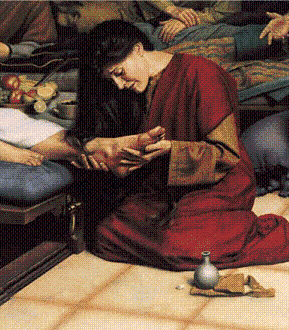
This foot washing thing is hard.  It is way too intimate for most of us westerners.  After all, we are pretty private, seemingly reserved; we honor each other’s imaginary space.  But once a year, the church I once served would have a foot washing at the mid-day Maundy Thursday service.  It wasn’t just a ceremonial thing to show us how it was done.  There wasn’t one clergy washing the feet of some brave designated congregant.  It was the whole service.  Everyone came.  We worshipped in silence for about twenty-five minutes and one by one, people would remove their shoes and place their feet in the water to be washed.  It was completely quiet except for the sloshing of the water in the pail.  Toward the end, the clergy would switch places and someone would wash our feet. 

It was a small service, intimate really.  I remember the first year we did it.  We were reticent, hesitant to trust that people would come through.  So, admittedly, we had a couple of “ringers”.  Well, the ringers came and then the rest did.  One by one, they all came.  I sat there on the floor moved by something that I had never experienced.  I was touching people’s feet.  They had removed their shoes at the pew and had walked barefoot to the seat where we had the plastic tub in which water would be poured over their feet.  It was incredible.

And then Caroline came.  Caroline–in her full Nigerian dress and gele (the elaborate head covering they wear) and her permanent posture of prayer.  She came and she sat and she placed her foot in the water.  I picked up her foot.  Caroline and her family were part of the Nigerian freedom movement.  She had come from the tribes and had wanted more.  She had worked hard, always putting aside her own desires for what she thought was important–others and God.   She had lost her young husband in that movement and had raised her four young sons alone.  I looked at this older woman’s foot in my hands, deep with lines of life and passion, and I had tears in my eyes.  It was a foot that as a young child had run barefoot through African jungles.  It was a foot that had marched for freedom.  It was a foot that had known grief, and pain, and joy.  I was holding life.  I was not holding someone’s foot.  I was holding their life.  I was affirming them, praying for them, washing away for them all the things that got in the way of what they so treasured.  As I was gingerly washing Caroline’s foot, she raised her hands, looked up into the ceiling, and she began to pray.  They were words from one of the tribal communities in Nigeria that I did not understand and composed a prayer that I understood completely.  It was incredible.  It was love at its deepest level–love for Christ, love for humanity, love for each other, love for God and all that we have together. 

Caroline died a few years ago.  We grieved at her funeral.  But we also danced, danced with joy.  (I think we need to start dancing with joy at funerals!) She left the most incredible love.  At her memorial service, I remembered that day when I washed her feet.  I remembered that day that was filled with love, that was filled with the Presence of Christ on that night.  It had changed me.

You see, love is a funny thing.  It is not perfectly complete.  Jesus knew that on that night.  He and the disciples did not sing “Kum-ba-yah” and then leave.  In Jesus’ life, love meant rejection and exile, frustration and misunderstanding, Presence and turning, welcome and redemption.  This very night, Love would be apathy and betrayal, surrender and pardon.  But, in this moment, Love was a bunch of friends who had a dinner together and had their feet washed.  They were feet filled with lines of life and passion.  Jesus washed their feet and held their life.  That’s all love is about.  Love is Life.  Love brings us together in a way that does not subdue us into one but embraces who we are.  Love takes all that we are and creates Love.  Love changes us.  It turns the wilderness into a place of Love.  Nothing else can create itself.  But Love can.  That’s why we love one another.  That’s why Jesus commanded us to love.

On this night, we take all that we are, sinners and saints, kings and vagabonds, the betrayer and the beloved, the anointed and the one who anoints, the nay-sayers and the ones who miss the signs of the sacred, the pharisee and the rule-breaker, the faith-filled and the doubter, Caroline and me and you–we are all here, gathered together, showered in the most incredible love imaginable.  Can you feel the Love tonight?  You feel it because you’ve been changed.  Tomorrow we will kneel at the cross.  But, tonight, in this moment, can you feel the Love? 

If the world is sane, then Jesus is mad as a hatter and the Last Supper is the Mad Tea Party…In terms of the world’s sanity, Jesus is crazy as a coot, and anybody who thinks he can follow him without being a little crazy too is laboring less under a cross than under delusion. (Frederick Buechner)

Grace and Peace,

 Shelli

A Procession Through the Back Door

Scripture Text: Mark 11: 1-11

When they were approaching Jerusalem, at Bethphage and Bethany, near the Mount of Olives, he sent two of his disciples 2and said to them, “Go into the village ahead of you, and immediately as you enter it, you will find tied there a colt that has never been ridden; untie it and bring it. 3If anyone says to you, ‘Why are you doing this?’ just say this, ‘The Lord needs it and will send it back here immediately.’” 4They went away and found a colt tied near a door, outside in the street. As they were untying it, 5some of the bystanders said to them, “What are you doing, untying the colt?” 6They told them what Jesus had said; and they allowed them to take it. 7Then they brought the colt to Jesus and threw their cloaks on it; and he sat on it. 8Many people spread their cloaks on the road, and others spread leafy branches that they had cut in the fields. 9Then those who went ahead and those who followed were shouting, “Hosanna! Blessed is the one who comes in the name of the Lord! 10Blessed is the coming kingdom of our ancestor David! Hosanna in the highest heaven!” 11Then he entered Jerusalem and went into the temple; and when he had looked around at everything, as it was already late, he went out to Bethany with the twelve.

Here we are—bustling city, Passover festival, and a parade!  It seems that we’re not in the wilderness anymore!  Whew!  We made it!!!  As Jesus comes into Jerusalem, there is excitement and joy.  He is here!  And they honor him.  But, to be honest, we probably read a little bit more into this parade than is there.  From the time I was little, I had this sense that Jesus came into the middle of the city, flanked by all of the crowds.  He was “it.”  (But then it didn’t make much sense as to why it went so badly so fast.)  The truth is, Jesus was not “it” in Jerusalem.  Jesus was heading what was then a small fledgling movement on the outskirts of established religion and recognized society. 

He was coming down a narrow road that winds down Mt. Olivet and was then entering through the eastern gate of Jerusalem, the “back door” of the city, for all practical purposes.  The Western gate was the main gate.  It was the one where all the military pomp and circumstance entered, a gate fit for royalty.  Hmmm!  It seems that Jesus makes a habit of coming in the back door—into forgotten grottos and wilderness baptisms and ministries that begin around a lake rather than a bustling Holy City.  So, this seems only fitting.  Maybe that’s the point.  God doesn’t always enter in the way we expect, doesn’t always show up when it fits the best into our schedule or our circumstances.  Instead, God slips in through the back door of our wilderness lives when we sometimes barely notice and makes a home with us.

So, the onlookers stay around for just a little while.  And then the back-door parade fizzles.  As the road goes by the Garden of Gethsemane and down toward Bethany and the outer walls of Jerusalem, many leave and go back to their lives.  Maybe they had something to do; maybe they didn’t want to contend with all the holiday traffic in downtown Jerusalem; or maybe they were afraid of what might happen. So, Jesus enters the gate of the city almost alone, save for a few of the disciples.

Where are we in this moment?  Jerusalem is here.  The wilderness through which we’ve traveled is behind us.  But it has prepared us for a new wilderness of sorts.  As followers, we know that the road is not easy.  It will wind through this week with the shouts of “Crucify him” becoming louder and louder.  We will experience pain and grief and even betrayal.  The road is steep and uneven.  And the shouting stones and clanging iron against wood will be deafening.  But this is the way—the way to peace, the way to knowing God, the way Home.  This is our road; this is our Way; this is the procession to life.  The way to the Cross, through the wilderness of this week is our Way to Life.

The truth is the wilderness through which we’ve wandered these past weeks was not just to get us here; it was to prepare us for the wilderness to come.  And now we have to decide.  Are we the ones running away or are we following Jesus?  The ahead will be hard and painful.  We know that.  But it is the way to life.  The gate is just up ahead. And as followers of Jesus, we, too, are again driven into the wilderness.  But this wilderness is different.  Rather than encompassing a broad sweeping desert, it is contained within these walls; rather than pathways that are difficult to see, we know the road all too well; and rather than a time of solitude, the noises are deafening.  But we can no longer sit on the steps outside the gate.  Jerusalem awaits. And Jesus has begun his walk to the Cross.

Our hosannas sung, our palms waved, let us go with passion into this week.

It is a time to curse fig trees that do not yield fruit; a time to cleanse our temples of any blasphemy.

It is a time to greet Jesus as the Lord’s Anointed One, to lavishly break our alabaster and pour perfume out for him without counting the cost.

It is a time for preparation.

The time to give thanks and break bread is upon us.

The time to give thanks and drink of the cup is almost here.

Eat, drink, remember

As each of us asks ourselves, “Is it I who will betray you?”

And on that darkest of days, each of us must stand beneath the tree and watch the dying if we are to be there when the stone is rolled away.

The only road to Easter morning is through the unrelenting shadows of that Friday,

Only then will the alleluias be sung; Only then will the joyful dancing begin.

“Holy Week”, by Ann Weems. In Kneeling in Jerusalem

The miracle of the Red Sea,” the rabbis taught, “is not the parting of the waters. The miracle of the Red Sea is that with a wall of water on each side, the first Jew walked through.” The implications are clear: God is not in this alone. Yes, God may be all-powerful and eternally unfailing, but that’s not the point. The real key to the coming of the reign of God on earth, the rabbis imply, is not God’s fidelity. The real determinant between what ought to be and what will be in this world is the mettle of our own unflagging faith that the God who leads us to a point of holy wakefulness stays with us through it to the end. The key to what happens on earth does not lie in God’s will. All God can do is part the waters. It lies in the courage we bring to the parting of them. It lies in deciding whether or not we will walk through the parting waters of our own lives today. Just as surely as there was need for courage at the Red Sea, just as surely as there was need for courage on Jesus’ last trip to Jerusalem, there is need for it here and now, as well. (Joan Chittister, in “The Road to Jerusalem is Clear:  Meditations on Lent”, National Catholic Reporter, March 30, 2001)

Grace and Peace,

 Shelli

The Overturning

“Christ driving the money changers away from the temple”, El Greco, c. 1610

Scripture Passage:  John 2: 13-19 (20-22) (Lent 3B)

13The Passover of the Jews was near, and Jesus went up to Jerusalem. 14In the temple he found people selling cattle, sheep, and doves, and the money changers seated at their tables. 15Making a whip of cords, he drove all of them out of the temple, both the sheep and the cattle. He also poured out the coins of the money changers and overturned their tables. 16He told those who were selling the doves, “Take these things out of here! Stop making my Father’s house a marketplace!” 17His disciples remembered that it was written, “Zeal for your house will consume me.” 18The Jews then said to him, “What sign can you show us for doing this?” 19Jesus answered them, “Destroy this temple, and in three days I will raise it up.” 

This passage is well-known to us probably not only for its significance but because of its absurdity.  After all, this is the usually-calm, always-loving, infinitely compassionate Jesus just making an absolute spectacle of himself.  Now, to put it in context, it wasn’t like this flurry of activity was going on INSIDE the nave of the temple itself.  The temple consisted of the very inner part, the holiest of holies, that, for the first-century Jewish tradition, would have been what held the dwelling of God.  Then there was an outer part, the “worship space” if you will for those that were cleansed for worship.  And then there was this outer, sort of “town square” full of activity and merchants.  There was nothing WRONG with it.  It wasn’t like they were selling doves on top of the altar. And the “money-changers” were there purely for convenience, offering a service of exchanging the “uncleansed” coins for the acceptable ones.  Again, nothing wrong or out of the ordinary was going on here.  This was the way the society ran.

So, Jesus enters.  I think that (literally) this was, as we understand it, Jesus’ way of cleansing the temple.  Perhaps that outer part that was “acceptable” to culture had become a little too important.  Perhaps, rather than merely a pass-through to get to what was important, it had become the central point itself.  Rather than a way to prepare for worship, perhaps it had become a way of merchandising God.  Or maybe this was Jesus’ way of waking us all up, reminding us that we have set our tables up in the wrong place.  Maybe it was Jesus’ way of saying that we had it wrong, that God did not merely exist within the walls of the holiest of places but also beyond.

When this Gospel version by the writer that we know as John was written, it was at least late in the first century and more than likely, was in the second century.  Paul had written his letters and was long gone.  The writers of the synoptic Gospels were gone (although, remember, even they weren’t written as it was happening.  I can tell you that the writers were NOT following Jesus around like a gaggle of press writers.)  And, more importantly, this temple would have been destroyed decades earlier in 70 C.E. during the Siege of Jerusalem. (The Temple has never been rebuilt.  After the Muslim conquest of Jerusalem in the 7th century, the Dome of the Rock, or al-Aqsa Mosque, was built on the temple mount.  That’s the gold dome that you see in all the pictures of the old city of Jerusalem. And even though Jews are now allowed to pray at the Temple Mount—actually the Western Wall, or Wailing Wall—the mount itself is under the administrative control of the Muslim Waqf.)  

But for those of us in the Christian tradition, we claim to espouse that God is everywhere, that God does not just exist in the sanctuary or the church but rather is in our midst–everywhere. We believe that the temple, itself, is not the place of God but that God dwells with us, indeed, IN us.  Our lives are that metaphorical temple. Really?  That would mean that our lives are not such that we are called to separate ourselves from the world.  The culture going on around is not bad.  The way our society runs is not evil.  In fact, our culture and our society is overflowing with God.  There is no longer a division between things “of this world” and “of God”.  (Remember that Jacob’s Ladder thing the other day.  The realms are comingled, sort of intersected.  We live in the “both and”) So, for those who believe, everything is full of God.  So how do we look upon this place that is full of God?  What reverence do we attach to our lives, our bodies, our home, our city, our nation, and our world?  No longer can they just be a “pass through” to get to what we think is God.  God is here, here in our midst.

Boy, that Jesus WAS a troublemaker!  After all, we had everything neatly compartmentalized.  We knew good and evil; we knew what was “of God” and “of this world”; we had the “secular” and the “sacred”, our “church lives” and our “work lives” all neatly separated.  Really?  Is that the way it is? Jesus never said that the world was bad.  In fact, God so loved the world…(we are told).  But Jesus turned the tables on us, reminding us that this way that we have separated things, this way that we have assigned value and worth of one over the other, is not the way we are called to be. Essentially, I think Jesus knew that from time to time, we would take our eye off the ball, so to speak, and put the emphasis where it did not belong.  That’s what this season of Lent does–it refocuses us on what’s important. Jesus knew that the love of things, the love of power, the love of control, and the acceptance of a system or a religion that values one person over another, and the attempt to keep things like they are would crucify us.  But even that, God would oveturn.  THAT is how much God loves the world.

 As long as we aim to get something from God on some kind of exchange, we are like the merchants.  If you want to be rid of the commercial spirit, then by all means do all you can in the way of good works, but do so solely for the praise of God. (Meister Eckhart, 13th cen German theologian and mystic)

Grace and Peace,

 Shelli

With God on Our Hands

Lectionary Passage:  Luke 2: 22-35 (36-40)

22When the time came for their purification according to the law of Moses, they brought him up to Jerusalem to present him to the Lord 23(as it is written in the law of the Lord, “Every firstborn male shall be designated as holy to the Lord”), 24and they offered a sacrifice according to what is stated in the law of the Lord, “a pair of turtledoves or two young pigeons.”  25Now there was a man in Jerusalem whose name was Simeon; this man was righteous and devout, looking forward to the consolation of Israel, and the Holy Spirit rested on him. 26It had been revealed to him by the Holy Spirit that he would not see death before he had seen the Lord’s Messiah. 27Guided by the Spirit, Simeon came into the temple; and when the parents brought in the child Jesus, to do for him what was customary under the law, 28Simeon took him in his arms and praised God, saying, 29“Master, now you are dismissing your servant in peace, according to your word; 30for my eyes have seen your salvation, 31which you have prepared in the presence of all peoples, 32a light for revelation to the Gentiles and for glory to your people Israel.” 33And the child’s father and mother were amazed at what was being said about him. 34Then Simeon blessed them and said to his mother Mary, “This child is destined for the falling and the rising of many in Israel, and to be a sign that will be opposed 35so that the inner thoughts of many will be revealed—and a sword will pierce your own soul too.” 

So before you exhale after all your cooking and wrapping and running around frantically to get everything done, I have to tell you that we’re not done.  The truth is, the birthing is never really over.  This is the Season of Christmas (as opposed to the Season of Advent that we just completed).  But we don’t get a whole lot of help from the Scriptures.  We read the story of Jesus’ birth and then Scripture accounts of the days and years that followed are spotty at best.  This passage is one of the few accounts of Jesus’ childhood.  But it is a reminder that Jesus was a Jew, lived among Jews, and, for that matter, was Jewish for his entire life.

So, in this passage that we read, our story has jumped forty days from the birth story that we read just a few days ago.  Eight days after Jesus had been born, he had, in accordance with Jewish law, been circumcised and named.  Now thirty-two days later, they go to the temple.  The trip is serving two purposes.  First of all, Mary must be purified.  According to the twelfth chapter of Leviticus, after a woman gives birth, she is impure for forty days.  At the end of that time, she is to bring an offering to the temple and be purified.  Additionally, Jesus, the firstborn son, is to be consecrated and offered to God. 

So, in this moment, a man named Simeon appears.  It says that he took Jesus in his arms.  Can you imagine Mary and Joseph’s reaction?  After all, this was their newborn, probably the first time that they had ever really had him out in public, and this old man comes out of the shadows and scoops up their child.  But something made them step back.  Was it his words, or his demeanor, or something else?  This frail, older man, held the child with a tenderness that was amazing.  He cradles Jesus in his arms and looks into his eyes.  And he begins to prophesy.

But the words were a bit different than the foretelling over the last months and weeks from angels and shepherds and the like. “Master, now you are dismissing your servant in peace, according to your word; 30for my eyes have seen your salvation, which you have prepared in the presence of all peoples, 32a light for revelation to the Gentiles and for glory to your people Israel.”  Simeon was a righteous and devout man.  His Jewish faith had been important to him his entire life.  And that faith included a promise that God would indeed send a Savior, a Messiah.  And he knew that his life would not end until he had seen the promise fulfilled.  So he looked down into the bright, dark brown eyes of this child and he knew. Simeon had waited his entire life for this child, for this moment.  Now he could die in peace. Don’t take that as a giving up of life.  It was his resolve.  His life, his promise, had been fulfilled.  He was at such peace that he couldn’t even imagine life being any more than it was in this moment.  He had not waited for moments or the four weeks of Advent or even a few months.  He had waited decades, his entire life, for this moment. 

Simeon’s Song, the Nunc Dimittis (Latin for “now send away”), is sometimes sung after Communion and often at the end of a funeral.  It is a plea for peace.  He is not asking for death; he is accepting it and with it, the promise of redemption.  For Simeon, death is no longer a pall that hangs over him; it is part of life.

So as Simeon, with a gleam of life in his eyes, hands the child back to Mary, he adds: This child is destined to cause the falling and rising of many in Israel, and to be a sign that will be spoken against, so that the thoughts of many hearts will be revealed. And a sword will pierce your own soul too.  In other words, once again, things are about to change.  This child is special.  This child provokes a decision that each person must make.  Notice the order.  We talk of the rise and fall of people, the rise and fall of nations, the rise and fall through history of whole societies.  But THIS child, THIS child will cause the falling and rising, THIS child will turn the world upside down and bring life.  In that moment, Mary knew that she would experience grief.   But she also knew that her grief would rise and become life.

So why are we talking about death so soon after the glory of Jesus’ birth?  Shouldn’t we get a little bit of a reprieve before we start walking to the cross?  The reason is that the two cannot be separated.  Simeon knew who Jesus was.  He saw Jesus’ life.  He saw Jesus’ death.  And he saw life again. He saw, even at that early time, the signs of redemption.

So what do we do with this?  You know, we probably should have known.  This thing for which we have hoped, and waited, had to involve us in some way.  God was born unto us.  We, like Simeon, have God on our hands.  What do we do with God now? I don’t know about you but on some level, it’s hard to find the right words.  Maybe all we have left to do is praise and sing and respond.  God has come into this world and is here, here on our hands.   

The truth, of course, is that Jesus’ coming does not end with the calendar or with the festivities or with the final packing-up.  His coming is always a beginning and a sending.  We, too, are now sent away.  We, too, are at peace with letting our old selves die and becoming the ones unto whom Christ was born. The hope that was so prevalent during Advent, the promise for which we waited and prepared, is here, right before us.  God is with us, on our hands. 

Christ has come!  God has been born unto us and we have God all over our hands.  Jesus’ coming begins our going.  We are not sent into the world with all the answers or with an assurance that we really even know what we’re doing.  Our directions, like our Scriptures, are spotty at best.  We are not called to be perfect; we are not called to be brilliant; we are called to be courageously faithful, to go, to go and be Christ in the world.  Christ has come!  And we have begun.

It may be that when we no longer know what to do, we have come to our real work. And when we no longer know which way to go, we have begun our real journey. (Wendell Berry)

Grace and Peace,

Shelli

With the Turn of a Page

book-pages-16-12-22Six days later, Jesus took with him Peter and James and his brother John and led them up a high mountain, by themselves. 2And he was transfigured before them, and his face shone like the sun, and his clothes became dazzling white. 3Suddenly there appeared to them Moses and Elijah, talking with him. 4Then Peter said to Jesus, “Lord, it is good for us to be here; if you wish, I will make three dwellings here, one for you, one for Moses, and one for Elijah.” 5While he was still speaking, suddenly a bright cloud overshadowed them, and from the cloud a voice said, “This is my Son, the Beloved; with him I am well pleased; listen to him!” 6When the disciples heard this, they fell to the ground and were overcome by fear. 7But Jesus came and touched them, saying, “Get up and do not be afraid.” 8And when they looked up, they saw no one except Jesus himself alone. 9As they were coming down the mountain, Jesus ordered them, “Tell no one about the vision until after the Son of Man has been raised from the dead.” (Matthew 17: 1-9)

I am thinking about all of the ministry, all of the good that he did in those short years.  He was so good to those that had believed in him and had followed him through so much. And they were so devoted.  And, slowly, slowly they began to understand what I did—that this man was the very essence of God, that this man was the Word made flesh.  It was hard for me to understand and I had actually had that incredible encounter with the angel.  But for those who followed him, these were men and women of faith, men and women who chose to put themselves aside and do God’s work.  They had not had a dream with an angel or one where God spoke to them.  They had not seen the brilliance of that star that shone over Bethlehem and seemed to point to what had happened.  These were ordinary people who had families and lives but who believed that they were a part of something beyond themselves.

I was not there that day when Jesus led some of them up to that mountain top.  I was not there when he was changed into light right before their eyes.  I was not there when God intervened.  I was not there when all of the Law and all of the Prophets and all of history came spilling into our ordinary lives on that mountain.  But to hear Peter and James and John describe it, it was amazing.  I was not there but it was still my story.  And I realized in that moment that God’s coming did not begin with me.  I realized that I was blessed to be a part of it, an instrument that God called to be a page in a story.  It was a story that had begun to be written long before I was born and one that will continue far beyond me.  But I think that it was there on that mountaintop that it all came together.  And the brilliance of it all was more than any of us could take for very long.  Sometimes we have to look away and begin writing to grasp it at all.

And then Jesus descended the mountain with the faithful at his side and headed into Jerusalem.  I would have liked to stop it there.  I would have liked to find a way to freeze the frame of the story, to close the book and protect the pages that were already there.  But the story had to go on.  I understand that so well now.  And the faithful understand that.  The faith-filled men and women since the beginning have understood that they are not the story but that the story is incomplete without them.  So they find their voice and they find their faith and they walk down the mountain with our Lord.  We all have a page to write.  The story would go on without it, but God would rather have them all.

But whether small or great, and no matter what the stage or grade of  life, the call brings up the curtain, always, on a miracle of transfiguration-a rite, or moment, of spiritual passage, which, when complete, amounts to a dying and a birth.  The familiar life horizon has been outgrown, the old concepts, ideals, and emotional patterns no longer fit; the time for the passing of a threshold is at hand. (Joseph Campbell)

FOR TODAY:  What is on your page?

Peace to you as we come closer to that holiest of nights,

Shelli