Matthew 17:1-9 (Transfiguration A)
Six days later, Jesus took with him Peter and James and his brother John and led them up a high mountain, by themselves. 2And he was transfigured before them, and his face shone like the sun, and his clothes became dazzling white. 3Suddenly there appeared to them Moses and Elijah, talking with him. 4Then Peter said to Jesus, “Lord, it is good for us to be here; if you wish, I will make three dwellings here, one for you, one for Moses, and one for Elijah.” 5While he was still speaking, suddenly a bright cloud overshadowed them, and from the cloud a voice said, “This is my Son, the Beloved; with him I am well pleased; listen to him!” 6When the disciples heard this, they fell to the ground and were overcome by fear. 7But Jesus came and touched them, saying, “Get up and do not be afraid.” 8And when they looked up, they saw no one except Jesus himself alone. 9As they were coming down the mountain, Jesus ordered them, “Tell no one about the vision until after the Son of Man has been raised from the dead.”
Seeing things differently is not a new theme for us. I mean, think about it. Here we have the story of a child born into anonymous poverty and raised by no-name peasants. He grows up, becomes a teacher, probably a rabbi, a healer, and sort of a community organizer. He asks a handful of people to become his followers, to help him in his mission. They leave everything they have, give up their possessions and their way of making a living, they sacrifice any shred of life security that they might have had, and begin to follow this person around, probably often wondering what in the world they were doing. And then one day, Jesus takes them mountain climbing, away from the interruptions of the world, away from what was brewing below. Don’t you think they were sort of wondering where they were going? I mean, MOUNTAIN CLIMBING? Don’t we have more important things to accomplish? Shouldn’t we stay here where the action is?
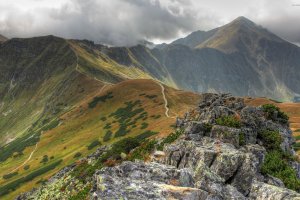
We don’t really know what mountain this was. There is speculation that perhaps it occurred on Mount Tabor or Mount Hermon, both of which are some of the tallest mountains in the Galilean area and both of which are prime spots in the Jezreel valley. The Franciscans built their Church of the Transfiguration on Mt. Tabor, so perhaps you can now use the familiar words that “tradition holds” that that is where the mountain is. But no one really knows. Some even surmise that there IS no geographic location, presenting it as if it just rose up, uninterrupted, from the rough-hewed terrain. Either way, the mountain is part of the topography of God. Even for people, such as myself, who cannot claim a single, stand alone, so-called “mountain-top experience” that brought them to Christ but rather came year by year and grew into the relationship…even for us…this IS the mountain-top experience. And there, on that mountain, veiled in a cloud, everything changes.
Now remember that for this likely Jewish audience, mountains were typically not only a source of grandeur, but also divine revelation. And also remember that in their understanding, God was never seen. I like that—allowing God to be awesome, allowing the mystery of God to always be. God was the great I AM, one whose name could not be said, one whose power could not be beheld. And so, this cloud, a sort of veiled presence of the holiness of God, was something that they would have understood much better than we do. In fact, they would have assumed that if Moses or anyone else actually saw God, they would die.
And there on the mountain, they see Jesus change, his clothes taking on a hue of dazzling, blinding white, whiter than anything they had ever seen before. It wasn’t that light was suddenly shining on him, illuminating him. Jesus WAS the light. And on the mountain appears Moses and Elijah, standing there with Jesus—the law, the prophets, all of those things that came before, no longer separate, but suddenly swept into everything that Christ is, swept into the whole presence of God right there on that mountain.
So, Peter offers to build three dwellings to house them. I used to think that he had somehow missed the point, that he was in some way trying to manipulate or control or make sense of this wild and uncontrollable mystery that is God. I probably thought that because that’s what I may tend to do. But, again, Peter was speaking out of his Jewish understanding. He was offering lodging—a booth, a tent, a tabernacle—for the holy. For him, it was a way not of controlling the sacred but rather of honoring the awe and wonder that he sensed.
And then the voice…”This is my Son, the Beloved; with him I am well pleased; listen to him!” OK…what would you have done? First the mountain, then the cloud, then these spirits from the past, and now this voice…”We are going to die. We are surely going to die,” they must have thought. And then Jesus touches them and in that calm, collected manner, he says, “Get up and do not be afraid.”
And then, just as suddenly as they appeared, Moses and Elijah drop out of sight. In Old Testament Hebrew understanding, the tabernacle was the place where God was. Here, this changes. Jesus stays with them alone. Jesus IS the tabernacle, the Light of the world, the reality of God’s presence with us. And all that was and all that is has become part of that, swept into this Holy Presence of God.
And so the disciples start down the mountain. Jesus remains with them but he tells them not to say anything. The truth was that Jesus knew that this account would only make sense in light of what was to come. The disciples would know when to tell the story. They saw more than Jesus on the mountain. They also saw who and what he was. And long after Jesus is gone from this earth, they will continue to tell this strange story of what they saw. For now, he would just walk with them. God’s presence remains.
Jesus walked down the mountain with the disciples in the silence. The air became thicker and heavier as they approached the bottom. As they descended the mountain, they knew they were walking toward Jerusalem. The veil that had been there all those centuries upon centuries was beginning to lift. The Transfiguration is only understood in light of what comes next. Yes, the way down is a whole lot harder. We have to go back down, to the real world, to Jerusalem. We have to walk through what will come. Jesus has started the journey to the cross. We must do the same. The journey to Jerusalem awaits.
He comes to us as One unknown, without a name, as of old, by the lakeside…He speaks to us the same word: ‘Follow thou me!” and sets us to the tasks which He has to fulfill for our time…And to those who obey, whether they be wise or simple, [God] will reveal {Godself] in the toils, the conflicts, the sufferings which they shall pass through in this fellowship, and, as an ineffable mystery, they shall learn in their own experience Who [God] is. (Albert Schweitzer)
And a little promotion…yes, I’ll be writing daily during Lent (which, yes, begins Wednesday, February 18). Join me for a series entitled “Breathing Out”…SW
Grace and Peace,
Shelli

 Dancing to God