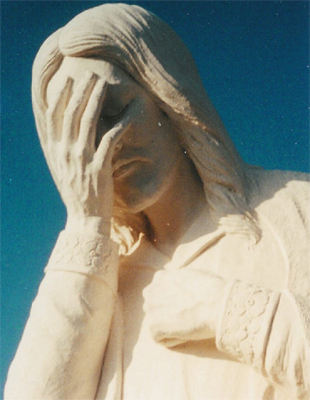
Sanctuary

I’ve come to this moment and this place. I understood what I was called to do.  It was what was needed. Everyone was so locked in, often misinformed, often following a way that was not good for them, a way that was pulling them away from God, away from each other.  Oh, they meant well.  They were trying to follow the laws, trying to believe in the way they had been taught, trying so hard to make the way for themselves. But what they missed was the God who was with them, who had always been with them.  What they missed was the God of Love. I so prayed to show them the God of Love.

I was called to show them a new way, a way that would allow them to see the beauty and the grace and the mercy that God had in store for them, a way that would show how much God loves them, how much God desires for them. There were times when I felt it happening. There were those times when the disciples followed me, timidly leaving their lives behind and hesitantly following in this new way. There was that afternoon on the side of the mountain when the excitement was palpable.  There were so many that day that seemed ready to follow a new path. There were so many that understood. There they were, talking and eating together and being the people of God.

There were times I did not expect that were so wonderful, so life-giving. There was the one that was healed that came back, that understood the mercy and the grace. There was the woman at the well that taught me that my mission was bigger that even I had thought, that God was calling me to the world.  I pray that her voice will always be heard. And there was Lazarus.  My friend, my confidante, the one who always supported me.  When he died, I grieved.  And when he was raised, it was such a celebration.  His resurrection was what I prayed everyone would understand.  Thank you, God, for that gift, for the rising and the life.

I hope I did everything I could. I pray that my time here was what was needed, that somehow the fruitfulness will sprout even after I am gone, that this new Way will be imprinted on your people and in your world. I pray that part of me, part of what I did, part of what I taught, and part of how much I loved them will remain. I pray that this will not all be for naught. I pray that they will continue the pathway I have tried to show them.

But, always, in the shadows, there seemed to be something pulling everyone away, convincing everyone that they had to put themselves first, that they had to fear others, that they had to preserve their way of life, that somehow the earthly kings were above You or that in some perversion of your Word, there was belief that you somehow had sanctioned what is being done in the world, that you had somehow blessed the warring and the madness and the hunger and the exclusion. I weep because they have forgotten who they are.  They have forgotten that they are your children, that they are made in your image, a reflection of your being and your Presence in the world. 

And so, in this moment before I enter the city, I weep.  I weep for you my children.  I weep that I will not have more time, that what I tried to impart to you may not have taken hold.  I weep at the thought that when I am gone, you will simply turn back to your own ways. I weep that God’s love and mercy and grace have eluded you. I weep for you, Jerusalem, that you might have become so inward-looking that you have missed the gracious dance that the Father offers each of you.

Dear Father, I weep these tears this day.  Thank you for the gift of these tears.  Thank you for not taking them away just yet because they are your tears.  This is your lament.  This is your city, your holiest of cities, the place of your presence, that has seemed to push away what you offer, that has seemed to push away your love.

I do not weep for me.  I know that I have done your work.  I know that you have called me to this time—just this time.  I know that there will be other children of yours that will carry your love, that will carry your message to the world.  I pray for their strength and their fortitude.  I pray that they will know how to love you like I do.  I pray that this Way of Christ will be theirs.

Go with me, dear Father.  Carry me into what is to come.  I am ready.  I do this for you.  I do this for your children.  I do this for your kingdom.  I pray for all that is to come.  I pray for the generations of your children that will follow in my name.  I pray that what I tried to do, what I hoped to do, what I prayed that I would do, was done.  Forgive them Lord.  Be with them Lord.  Let them know your love.  Let them be your sanctuary. Let them breathe out the ways of the world and breathe in all that You are.

1Hear my prayer, O Lord; give ear to my supplications in your faithfulness; answer me in your righteousness. 2Do not enter into judgment with your servant, for no one living is righteous before you. 3For the enemy has pursued me, crushing my life to the ground, making me sit in darkness like those long dead. 4Therefore my spirit faints within me; my heart within me is appalled. 5I remember the days of old, I think about all your deeds, I meditate on the works of your hands. 6I stretch out my hands to you; my soul thirsts for you like a parched land. (Psalm 143)

      Grace and Peace,

      Shelli

      Out of the Depths

      The Psalmist writes from the deepest bowels of life.  It is his or her lowest point, feeling so overwhelmed with despair, almost hopeless.  And yet, there, is the sound of the still small voice.  It’s only a whisper but it is there.  The Psalmist strains to hear, laying there in the darkness, unable to sleep, unable to see the light of the morning.  It is a Psalm of faith.  It is the expression of one who though wallowing in the depths of sadness and despair, cannot feel God’s Presence and, yet, knows in the deepest part of his or her being that God is there.  It is the writing of one who knows that there is always morning, if we will only wait.

      The words of the Psalm promise us that no matter how dark the night will be, there is always morning.  There is always redemption.  The King James Version depicts it as “plenteous redemption”.  We often hear of redemption as if it is some sort of payment that God required for our sins, as if Jesus’ death was somehow foreordained because we were such sinful creatures that God could take it no more.  But redemption can also mean restoration, to bring something to a better state.  It is what the Psalmist knows.  God is there, though unseen, restoring, recreating, even in this moment of darkness.  Redemption is not about payment; it is about the promise of morning, the promise of life.  Redemption is not about what Jesus gave us or what Jesus did for us but what God in Christ does even now.  God brings morning.

      The Psalm does not give us empty promises that “everything will be alright”.  Rather, it is honest.  Sometimes life hurts.  Sometimes life hurts more than we think we can bear.  Sometimes we have our own dark night of the soul.  But in the darkness, we learn to wait.  We learn to hope.  That is what Lent is–a waiting in the depths.  We are journeying now deeper and deeper into the darkness.  We know that it will be painful, at times even unbearable.  But our faith tells us that God is present whether or not we can feel the presence.  And so, we learn to wait.  And in the waiting we sense that veil between darkness and light, between death and life.  So, we wait through pain and betrayal and last nights together.  We wait through darkness and death.  We wait in the stillness and foreboding silence.  We wait because we know that morning always comes.

      We modern-day worshippers have, sadly, almost lost the voice of lament.  We praise God in good times and we beg God to change things in times of despair.  We struggle with waiting, with just waiting in the darkness, with knowing that God is there whether or not we feel that Presence.  When we are in the depths, we seldom wait.  We instead do everything we can to raise ourselves out of it.  What we miss is that in the waiting, it is God who will raise us up.  The Hadassah Hospital in Jerusalem has a chapel that is known for its stained glass windows created by Marc Chegal.  They are set within a domed ceiling that directs the worshippers’ gaze heavenward.  But directly below the windows is an odd place where the floor is sunken and in the middle of the depression is a pulpit.  The floor was intentionally made that way with the belief that all prayer should be “out of the depths”.

      How would our prayers sound if they were out of the depths, if they were out of the waiting?  How much more precious would redemption be?  I think that is the reason that we push ourselves into those depths on Good Friday.  We push ourselves to be taunted by death because only from that sunken place can resurrection come to be.  So, in this time as we get closer to that taunt of death, as we come nearer and nearer to the Cross, remember to breathe.  Breathe out the tendency to “fix” it, to clean it up and sanitize the whole idea for human consumption.  And breathe in what you find in the depths—the promise of plenteous redemption.  If we would only wait…

      Lacrimosa (Mozart)

      Lyrics (Latin)

      Lacrimosa dies illa
      Qua resurget ex favilla
      Judicandus homo reus.
      Huic ergo parce, Deus:
      Pie Jesu Domine,
      Dona eis requiem. Amen.

      Lyrics (English)

      Full of tears will be that day 
      When from the ashes shall arise 
      The guilty man to be judged; 
      Therefore spare him, O God, 
      Merciful Lord Jesus, 
      Grant them eternal rest. Amen.

      Grace and Peace,

      Shelli

      Life Breathed Into Flesh

      So many times, this Scripture is one of those that is read as if being “human”, being “flesh” is bad, as if somehow body and spirit are not compatible existing together in Creation.  That’s not the way it was intended.  After all, didn’t God create us as “flesh”?  For Paul, of the “flesh” is not “human”, per se, but rather a perversion of who we should be as humans. But it is the “way of the Spirit” that brings life.  Without the Spirit, the essence of Life breathed into the body ultimately dies.  The two belong together.  God’s Spirit brings breath and life.  Paul’s words are not mean to be dualistic, separating two unlike things, but, rather, transformational, depicting the salvific act of transforming sides of a whole that need each other.

      We tend to get wrapped up in those things of the “flesh”—our needs, our desires, our fears. Paul is not saying that we dispense with them as bad. They are ours.  Paul is making the claim that the Spirit can breathe new life into them. There is no sense in fighting to sustain our identity apart and away from God. It will ultimately die. Paul has more of a “big picture” understanding than we usually let him have. He’s saying that the flesh in and of itself is not bad but the Spirit brings it to life. I don’t think he is drawing a dividing line between darkness and light, between mind and Spirit, between death and life; rather, he is claiming that God’s Spirit has the capability of crossing that line, of bringing the two together, infused by the breath of God. It is a spirituality that we need, one that embraces all of life. It is one that embraces the Spirit of Life that is incarnate in this world, even this world. I mean, really, what good would the notion of a disembodied Spirit really do us? Isn’t the whole point that life is breathed into the ordinary, even the mundane, so that it becomes holy and sacred, so that it becomes life?

      And here’s the important part.  Verse 1 of this chapter from Romans says that there is “no condemnation”.  In other words, through Jesus Christ, we are more than flesh.  We are more than those things that we think “make us”.  We are more than the identity that the world inflicts upon us.  Through Christ, we are “flesh embodied”.  Our flesh and our spirit, our body and our soul, our humanness and that piece of the Godself that was so lovingly and graciously supplanted in us is one, undivided.  It is that total self that God loves–not just the Spirit, not just the things that are not of this “flesh”, but everything.  We are a package deal.  Don’t you love package deals?

      In his book, Everything Belongs, Richard Rohr says that “in mature religion, the secular becomes the sacred. There are no longer two worlds. We no longer have to leave the secular world to find sacred space because they’ve come together.” In essence, our body and our spirit are one. That is what Paul was saying. Life in the Spirit is an embrace of our whole being. There are no parts that are elevated above the others. It is a new way of learning to see. It is a new way of learning to be. Everything becomes one in God. There are no good parts and bad parts. Everything is waiting to be transformed in the Spirit.

      Here’s another way to illustrate it. How many of you like to eat raw eggs? How about a nice tasty tablespoon of flour? Or, perhaps you would rather have a wholesome cup of sickeningly sweet Karo syrup? Well, obviously, none of those things sound that appetizing. In fact, for most of us, they all sound downright disgusting. (I say “most” because I do know of someone (of blessed memory) that used to drink syrup when he thought no one was looking.  I so miss that!) But if you take those things and combine them, along with some other ingredients, you get my Grandmother’s pecan pie. Alone, they are worthless. But as a whole, they are wonderful.

      We cannot pick and choose what parts of our lives we want to be with God. All of the mail is opened and read. For if one is to live a true life of holiness, there is nothing left out or hidden from sight. There is no secular. It is all sacred. There is no thought in our mind that is not part of the spirit. And there is not one of us that is of lesser importance than another in a true community of faith. Every part of us, no matter what it looks like, no matter what is tastes like, is necessary to make the recipe wonderful. Life in the spirit means that everything belongs in a perfectly balanced recipe for life that perfectly reflects and perfectly reveals all that there is and all that there is meant to be. That’s us–we’re a package deal.  Everything belongs! Thanks be to God!

      So, for today, breathe out—breathe out that assumption that one’s humanity is bad, that those things “of the flesh” are things from which we are trying to run.  And, then, breathe in—all of it.  Breathe in everything in your life and be open to God’s way of breathing Spirit into it all.

      Grace and Peace,

      Shelli

      Sing to the Lord

      Sometimes I think that “worship” in our culture is defined based on how gratifying it is to us, on whether or not it is meaningful to us or leave us feeling “spiritual”.   Our worship is sort of graded based on how good the sermon is, or how wonderful the music is, or how it makes us feel. I’m guilty of it.  There are just certain styles of worship and worship music that do not feel “worshipful” to me.  But, really, is that what worship is?  What is the point of worship?  Worshippers in Early Judaism believed that God was actually IN the worship space that they carried with them.  And so, they would approach the tabernacle with awe and joy.  They didn’t get wrapped up in worship styles or whether or not they liked the sermon.  Worship was about God, about coming into the very Presence of God with thanksgiving.  Worship was about realizing that there was more than us, that God held all of Creation in the Divine Hands and was worthy of worship.

      So, when did we lose that?  When did we lose the notion that worship is not about us? Soren Kierkegaard, when talking about worship, asked that we think about what it means to us.  Using his depiction of worship as a theater, think about your own notion of worship.  Where is the stage?  (Most would say the chancel or the altar.  (Newsflash:  It’s really NOT a stage.))  Who are the actors?  (Most would say the clergy, the choir, and perhaps the ushers and acolytes, those that “make it happen”) Who is the audience?  (Well, of course the congregation.)  But Kierkegaard would say that the stage is the whole sanctuary, perhaps the whole world, all of those places where worship happens.  And the actors?  Well, that would be us–all of us, all of us bowing in worship.  And the audience?  The audience is God.  I love that.  I think it reminds us that we are not the center of worship.  It is not about us.

      The Psalm reminds us that God is the God of all, that everything is within God’s realm, resting in God.  So, we are called to make a joyful noise.  It doesn’t call for happiness.  Happiness, that self-gratifying feeling, is always a little bit elusive.  But joy–joy resides in the deepest part of our being.  It is that sense of awe and presence when we know that God is there, always there, and can do nothing else but come into God’s Presence, nothing else but worship the God of us all.  God desires our worship, not because God is selfish, not because God wants to be honored, not because we in some way owe God that; God desires our worship because God desires us, wants desperately to be with us, for us to feel and know and live in God’s Presence.  And, there, there in God’s Presence, we worship.  Our whole lives, we worship.  Every moment, every place, every piece of our being, worships. O Come, Let us Sing to the Lord!

      So, on this day, breathe out… breathe out your opinions of worship.  Breathe out your judgment of how “good” the worship is, what order the bulletin is in, or how long it lasts.  (And, for today, breathe out the fact that you’re tired because the time changed and it starts an hour earlier!)  And as you worship today, breathe in the very presence of God.  Breathe in the God who is always there and who wants desperately to be with you.  Worship is not separate from life.  If you breathe in deeply enough, it will become your life.  Your life will become worship.

      Oh…and make sure you turn you pay attention to what time it is!

      Grace and Peace,

      Shelli

      The Coming of Light

      Scripture Text: John 12: 44-46

      44Then Jesus cried aloud: “Whoever believes in me believes not in me but in him who sent me. 45And whoever sees me sees him who sent me. 46I have come as light into the world, so that everyone who believes in me should not remain in the darkness.

      I think we often have this sense that the Light is the end-all.  After all, it’s the thing to which we’ve journeyed, the thing for which we’ve searched.  But have you ever looked at light?  (I know.  You’re really not supposed to do that.)  But while I was thinking about this post, I looked up at my kitchen light.  It’s one of those flood lights that you can turn and redirect.  I was in my living room and it didn’t have many lights on so, basically, I was in the darkness looking at a light.  And behind the light, surrounding the light, was a circular rainbow.  See, there’s always more in the Light. And it could only be seen in the dark.

      This Scripture comes in the midst of the readings that we use for Holy Week.  Jesus is preparing for the cross.  But part of that preparation was pointing yet again toward God.  Jesus more than once confirmed that he was the “Light to the world” but he never let it stop there.  There is always more to the Light.  Jesus was always quick to remind his followers of that.  He espoused that they were not believing in him as a person, as a man who showed them the Light.  They were rather believing in God.  They were looking toward the Light that Jesus had been sent to show them.

      OK, hang with me here…at the risk of going all 4th century on you, I’m going to go all 4th century on you!  In “The Life of Moses”, St. Gregory of Nyssa (c. 335-c. 395) contends that a person’s encounter with the mystery of God comes in three parts—light, cloud, and darkness.  (I know, that sort of sounds backwards.)  He sees the first stage in our quest to encounter God in light, such as Moses’ vision of God in the burning bush, illuminating the darkness of our sin and ignorance about who God really is.  The second stage is a journey into partial darkness where Moses encounters God as the cloud, an intermingling of darkness and light.  The final stage is entering where God really is (not a place, mind you, but a way of being).  And in that, we come to the realization that God IS Light, that God IS Mystery, that God is utterly incomprehensible.  In this place, Moses declared on Mt. Sinai that he had seen God or, in other words, had seen the eternal mystery that is God and had finally begun to understand his part of that Mystery.

      The crux of this rather long-winded explanation is that the Light to which we journey is not the end; it is the beginning.  The Light is the beginning of our knowing not God in God’s fullness.  We are not meant to know that.  God IS mystery.  But the Light to which we journey is the beginning of us knowing not who God is but who we are meant to be as we encounter our Creator, our Sustainer, our Redeemer, the One in whom we believe. It’s also the beginning of us finally knowing that the darkness is also filled with Light.  As we come into the Light as it dawns on the world, we begin to see beyond—and it is glorious!

      I have come as light into the world, so that everyone who believes in me should not remain in the darkness.

      In every beginning, there is darkness.  The darkness of chaos seems eternal, Yet form emerges: light dawns, and life is born. (Sixth Service of The New Union Prayerbook) 

      Grace and Peace,

       Shelli

      A Light in the Window

      Scripture Text: Psalm 18: 1-3, 28

      1I love you, O Lord, my strength. 2The Lord is my rock, my fortress, and my deliverer, my God, my rock in whom I take refuge, my shield, and the horn of my salvation, my stronghold. 3I call upon the Lord, who is worthy to be praised, so I shall be saved from my enemies…28It is you who light my lamp; the Lord, my God, lights up my darkness.

      Remember once again in the first chapter of Genesis when God created Light?  The Light was created to push back the darkness.  It didn’t “win” over the darkness; darkness was not gone.  This is not a light war.  Even darkness was created by God.  But then came Light, pushing back the darkness, re-creating the darkness into Light.  In essence, Light illumines the darkness.  God lights up the darkness.

      This Psalm can be traced back to the era of the First Temple (Solomon’s Temple) before the Babylonian Exile.  It was considered a Royal Psalm, words echoing the belief that God would save the king, that God was the one behind the king, the God who had always been strong and reliant, the God whose actions were always just and merciful and would continue to be.

      What, then, does it mean for God to light our darkness?  What does it mean for God, strong and reliant, just and merciful, to push back the darkness in our lives and illumine where we stand?  Are we ready for that?  Do we trust in that?  As we’ve mentioned before, sometimes the darkness gets a little too comfortable.  We become accustomed to strategically hiding part of ourselves, which is, of course, easier in the darkness.  And, after all, there’s always still darkness, right?  But if we truly allow ourselves to look toward the Light, the darkness will begin to subside.  We’re not used to the Light.  Our eyes will sting at first until we clear the remnants of darkness from them.  But when we begin to focus, it will all come into view—pushing back the darkness.

      Try it.  All it takes is a candle—one candle in the darkness.  If you light one candle, there is Light. Maybe it’s not everything you want.  Maybe it’s not enough to read or something.  But it’s enough to light your way.  It just takes one candle to begin to push back the darkness.  It just takes something small.  I think that’s how God does it.  I think that’s how God has always done it.  God doesn’t turn on all the lights at once.  Sometimes God slips into the darkness like a baby in a manger. 

      We’ve always been in darkness.  I think that’s so we can see the Light.  God doesn’t supply us with headlights or spotlights or even a strategically-placed flashlight.  You know why?  Because we don’t need light to find Light.  God created darkness for us.  It was the place that we were born before our eyes could adjust to the Light.  It was the place where we grew and learned to see the Light.  But through our lives, God always put a light in the window, just enough Light so that we would know where to go.  God begins to light our darkness, lighting one lamp after another.  Because that’s all it takes to light up our darkness.  Look toward the Light and the darkness will be pushed away.  Look for the Light in the window.

      In faith there is enough light for those who want to believe and enough shadows to blind those who don’t. (Blaise Pascal) 

      Grace and Peace,

       Shelli

      God’s Delight

      Scripture Text: Psalm 119: 9-16 (Lent 5B Alternative Psalter)

      9How can young people keep their way pure? By guarding it according to your word.

      10With my whole heart I seek you; do not let me stray from your commandments.

      11I treasure your word in my heart, so that I may not sin against you.

      12Blessed are you, O Lord; teach me your statutes.

      13With my lips I declare all the ordinances of your mouth.

      14I delight in the way of your decrees as much as in all riches.

      15I will meditate on your precepts, and fix my eyes on your ways.

      16I will delight in your statutes; I will not forget your word.

      Do you delight in God?  It’s a strange word, probably one we don’t use that often.  The dictionary says it means to “please someone greatly”.  I don’t know if that really works here.  I mean, I don’t really think of God as “pleasing me greatly”, as if that’s what God is trying to do—just please me, like it’s all about me. (Because I’m clear that it’s not all about me!)  No, this rather make me think of some of the wisdom passages that speak of daring to have a love for God that is deeper than you even thought possible, a love that comes from the very depths of one’s soul, (read Song of Songs or Song of Solomon when you get a chance!) from the place that you did not think it was even possible to access.  It’s a love that is so deep that you seem to become a part of what you love, a part of the very experience that IS God.  I think THAT’S what delighting in God is.

      See, so many of us think of God as some sort of barely accessible character on the outskirts of our lives, watching over us, maybe even supervising us.  But I don’t get the impression that that’s what God desires.  Why in the world would God have created everything that is and then filled the earth (or, I don’t know, maybe even some other places!) with humans and other creatures just to watch them and make sure they behave.  That sounds very exhausting to me.  No, I think God created us because we are God’s delight.  We are part of what makes God delight, along with all the rest of Creation. 

      So, perhaps delighting in God is coming closer to the delight that God has for us.  And if it is something that God does, then, by my calculation, it is holy.  Perhaps, then, delighting in God is to acknowledge that holiness, to dare to come closer, to actually get out of ourselves, and experience it, to know delight.  In Hebrew thought, to “know” is not just limited to intellectual capacity.  It is not just understanding facts or that something exists.  To know God is not just to know OF God.  To “know” connotes a familiarity, an intimacy.  To know God is to delight in God.

      In this wilderness season, we have encountered the unfamiliar, a strangeness that is not that to which we are accustomed.  And yet, as we travel, we have grown to know it, to know the path itself rather than the destination.  That is delight.  The whole idea of delighting in God just as God delights in us sort of, to me, loosens some of those limits that we have placed upon our relationship with God.  No longer is God that overwhelming deity that supervises me or controls me like a puppet on a string.  No longer is God something for which I’m required to clean up my act or be presentable to encounter.  No longer is God waiting until I have enough faith or enough belief or whatever else before I can approach God.  God does not wait for us to change; God waits for us to delight in God.  God is always there delighting in me, delighting in all of us.  And when we come to understand that, when we come to know God with the intimacy of our Creator, of our very source of being, then we, too, can delight. 

      This season of Lent is one that reveals to us that deep and abiding relationship with God.  It is a relationship where God delights in us and we delight in God.  And rather than following the rules that we’ve laid out or acting “appropriately”, delight can almost be characterized as a type of holy play, a conversation between our soul and its Creator.  To delight in God is to know who God created us to be.  It is a oneness with God (not a BECOMING God—that will never happen.  God is God; we are not.)  Delighting is not being “godly”; delighting is knowing God in the deepest part of your being.  What a delight! 

      With so much in creation, why did You bother to make this blue planet so beautiful?  Why was it worth the effort?  This blue planet is insignificant, seemingly unimportant, yet You have made it painfully beautiful.  Why?  The answer, I think, is that is the way You do everything.  Beauty—mighty and small—delights You.  This tiny planet delights You.   (Andrew Greeley)

      Grace and Peace,

       Shelli