(part of the “Breathing Out” Lenten Series)
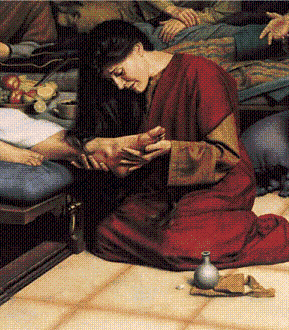
Scripture Text: John 12: 1-11
12Six days before the Passover Jesus came to Bethany, the home of Lazarus, whom he had raised from the dead. 2There they gave a dinner for him. Martha served, and Lazarus was one of those at the table with him. 3Mary took a pound of costly perfume made of pure nard, anointed Jesus’ feet, and wiped them with her hair. The house was filled with the fragrance of the perfume. 4But Judas Iscariot, one of his disciples (the one who was about to betray him), said, 5“Why was this perfume not sold for three hundred denarii and the money given to the poor?” 6(He said this not because he cared about the poor, but because he was a thief; he kept the common purse and used to steal what was put into it.) 7Jesus said, “Leave her alone. She bought it so that she might keep it for the day of my burial. 8You always have the poor with you, but you do not always have me.” 9When the great crowd of the Jews learned that he was there, they came not only because of Jesus but also to see Lazarus, whom he had raised from the dead. 10So the chief priests planned to put Lazarus to death as well, 11since it was on account of him that many of the Jews were deserting and were believing in Jesus.
We are getting closer. Jerusalem is upon us. We have walked this Way of letting go and picking up, of feeling both despair and hope, of lament and joy, of breathing out and breathing in. But, still, the ending is beginning to loom bigger than we imagined it would be. What is it, exactly, that we’re supposed to do with it all? How do we walk with Jesus to the place where he is handed over?
This passage is usually read on Holy Monday. It is part of the walk that we walk during Holy Week that ends with Jesus’ crucifixion. It includes Palm Sunday, the Anointing, the description of the Cross (the wheat passage), the account of Judas, Maundy Thursday, and Good Friday. But this passage is part of the “taking stock” that we are doing this week, the walk with Jesus through his life.
The truth is that we are not used to a Christ who does nothing, who just surrenders. We are, rather, more comfortable when Jesus is showing us how to do what we’re supposed to do as followers. We like a Jesus who is strong and confident leading our team. We are not accustomed to such a passive Christ. I looked up the word “passive” in an etymological dictionary. The root is the Latin passiuus. And then, surprisingly, it says “See Passion.” The etymological root of passion, the term that we use to describe Jesus’ suffering journey to the cross, is the Latin passionem, or suffering. And it says “See Passive.” The two words are related. The “Passion”, this time of suffering and letting go and being “handed over”, is a movement from planned and intentional action to no longer being in control. All of Jesus’ actions are accomplished. It is finished. It is a time of waiting—waiting for others’ response. Jesus has shown us how to let go, how to surrender.
In the passage, we find this passive Jesus. He visits the home of friends, the home of those whom he had served, those for whom he had done things. And, it says, they give a dinner for him. Jesus is the guest of honor. After all the doing, after all the action, after all the stuff, he now spends time with friends. And they serve him. And then the passage tells us that Mary takes a pound of costly perfumed nard, breaks the seal, and lavishly pours it onto Jesus’ feet. Then as the oil runs down his feet and begins to drip onto the floor, she bows and wipes his feet with her hair. The whole house is filled with this overwhelming fragrance, sort of a combination of mint and ginseng, sickeningly sweet.
Well, the disciples just couldn’t leave it alone. What in the world was she doing? Here is this man who has worked for years to bring peace and justice to the world, to heal others, to end poverty and oppression and you waste this oil by pouring it out on him! That oil could have been sold. Things could have been done with that money! We could have done great ministry with what you just poured on his feet! But you have wasted it! You have squandered it!
Jesus responds. “Leave her alone,” he says. You see, she gets it. She understands. I do not have long to be with you. She knows where I am going. And she responds. This woman loves Jesus. In fact, she loves Jesus so much that she defies the expected, shuns her role as the subservient female, and instead pours out the abundance of her life and anoints Jesus for his burial. This is not the time to talk about budgets or the ways things are normally done. This is the time of Jesus’ waiting and her response. As she anointed Jesus, Mary entered Jesus’ Passion and understood what it meant to have a personal relationship with Christ.
There are those in our society that would describe that breakthrough as being “born again”. But that phrase, commonplace and probably overused and misused as it is today, was not even around over a hundred years ago. Instead, the words that were used to describe this coming into who Jesus is was to say that one was “seized by the power of a great affection.” Isn’t that an incredible phrase—to be “seized by the power of a great affection”? You see, we 21st century folks usually think we have it all figured out. We know what we’re called to do to make disciples of Jesus Christ. We live our lives as best we can within the framework of what God wants us to do. And we do what we can for others by reaching out in the name of Christ. All of that is wonderful. But are we truly “seized by the power of a great affection”? Why do you think Jesus did everything that he did while he was on this earth? Was it just to show us what it is we’re supposed to do? No, Jesus was more than merely an exemplary human being put here for us to emulate. Jesus came to reveal God’s love, to show us how much God loves each of us and how much God desires us, to make known once and for all the affection that God has for all of God’s Creation and for us as children of God. Jesus was God made known, Emmanuel.
There is a story from the Sufi mystical tradition of a disciple that comes to an elder for direction. “Where shall I find God?” the disciple asked the elder. “God is with you,” the Holy One replied. “But if that is true,” the disciple asked, “why can I not see this Presence?” “Because you are like the fish who, when in the ocean, never notices the water.” It is not that God is not with us; it is that we are unaware of that incredible Presence. When we finally stop doing what we think we should be doing, let go, and listen for that which God is calling us to be we will become aware of that extraordinary Presence that is God. And in that becoming, we enter the anointed Christ-life.
We are about to enter the week when we come to the end of all our doing. This is the wilderness week when we let go and walk with Christ through the suffering of the Cross. This is the week when we finally realize that we can do nothing else. And on that final day, as the passive Christ is handed over, there is nothing more for him to do other than wait for our response. Who will follow me? Who will come to me with all your misery and your sins, with all your trouble and your needs, and with all your longings to be loved? Who will follow me through the wilderness? Who will hand over their lives just as I have done that you too might be raised to new life? Because it is then that the oil will be poured out for you in much the same way as you are immersed in the waters of your Baptism.
I have read several modern interpretations of the theology about Mary that posits that Mary of Bethany and Mary of Magdala were actually the same person, the sister of Lazarus, whom Jesus had raised. There is also the belief that Martha was possibly a later edition to the narrative. In other words, Lazarus only had one sister in this interpretation. I’ve read some of Professor Elizabeth Schrader-Polczer’s work and Diana Butler Bass also writes about it. Most of the work is based on the earliest existing texts including the Gospel of John (before the Western translators got hold of it) as well as some non-canonical texts (including The Gospel of Mary Magdalene). So, I’m not completely convinced yet but I find it extraordinarily fascinating. Because what it does is place Mary right in the story—the whole story. It shows us that Mary confesses Christ, serves Jesus, anoints him for burial, witnesses his death, and proclaims the first Easter message.
What I find fascinating is that IF this is the case, it means that Mary was doing everything at that dinner. She was serving (as women did and even do) AND she was engaged, sitting at the feet of Jesus and anointing him for burial. Mary got it. Mary understood it enough that she did not allow herself to be strapped by the ways of the world, to be limited by her gender or her role, to be told the “proper” way to do something. She allowed herself to be truly “seized by the power of a great affection”. And, in that moment, Jesus was everything to her. In that moment, she gave herself to him. In that moment, the connection that they shared was the human connection that God calls us all to share—to love each other without distraction. So, breathe out…breathe out all those things that pull you away from paying attention to each other, from engaging. I have a handful of friends (one is a cousin) with whom I have regular or semi-regular lunches. We do not engage with our phones. We do not read anything but the menu. We just spend time together. We talk. We share. We ask advice. We talk about books and theology and family and memories. The point is that we breathe out the world and engage with each other. That’s what Mary did. I envision that if there WAS no Martha, then the dirty dishes were left in the sink for a while (the scandal!). And then we breathe in…we breathe in Jesus. We become seized by the power of a great affection.
Mary breathed out. She breathed out what was expected. She breathed out everything that would be said about her. And then she knelt down and lifted the cup and poured out the oil until nothing was left. It dripped down Jesus and onto the floor and seeped into the floor boards. She tried to wipe it up with her hair. And then she breathed in. She wanted to remember this moment. Days later would be too late. Now was the time to engage. In this moment she knew. And she breathed in the presence of her Lord.
Jesus is Christ because he is truly human…He is the true Human because of his maturity, because of the way he showed us, beyond and inclusive of morality, the way to be a human being. He tells the disciples that they will always have the poor with them—and that today he is here and he wants the friendship, he wants the spice, he wants the life…He is also telling us one thing more—that life is good, that its hidden design is goodness, that we may and should be sure to enjoy life. Dig down. Dig deeper. Get intoxicated. Smell the spices. Jesus did. So may we. Even if we aren’t there yet. (Donna E. Schaper)
Grace and Peace,
Shelli




 Dancing to God