Matthew 2:1-12 (Epiphany A)
In the time of King Herod, after Jesus was born in Bethlehem of Judea, wise men from the East came to Jerusalem, 2asking, “Where is the child who has been born king of the Jews? For we observed his star at its rising, and have come to pay him homage.” 3When King Herod heard this, he was frightened, and all Jerusalem with him; 4and calling together all the chief priests and scribes of the people, he inquired of them where the Messiah was to be born. 5They told him, “In Bethlehem of Judea; for so it has been written by the prophet: 6‘And you, Bethlehem, in the land of Judah, are by no means least among the rulers of Judah; for from you shall come a ruler who is to shepherd my people Israel.’” 7Then Herod secretly called for the wise men and learned from them the exact time when the star had appeared. 8Then he sent them to Bethlehem, saying, “Go and search diligently for the child; and when you have found him, bring me word so that I may also go and pay him homage.”
9When they had heard the king, they set out; and there, ahead of them, went the star that they had seen at its rising, until it stopped over the place where the child was. 10When they saw that the star had stopped, they were overwhelmed with joy. 11On entering the house, they saw the child with Mary his mother; and they knelt down and paid him homage. Then, opening their treasure chests, they offered him gifts of gold, frankincense, and myrrh. 12And having been warned in a dream not to return to Herod, they left for their own country by another road.
Happy Epiphany! All the waiting is over. The twelve days are behind us and we are set, ready to start our journey. Are you packed? I know, I don’t usually get around to posting beyond Advent and Lent, but I’m really, really, really going to try. I’ll try to post once a week in line with the Lectionary passages and we’ll see what happens. And then, for Lent…well, we’ll see what happens!
So, today is Epiphany. Many of you probably read this passage for Epiphany Sunday this past Sunday. But today is the day. So, let’s read it again. Because, now is the time. What now? What do we do after it all ends? The truth is, “after” is when it begins, “after” is when it becomes real, and “after” is the whole reason we do this at all.
The text that we read is the one that our lectionary designates for every Epiphany Sunday, regardless of what Lectionary year it is. It begins by setting us “in the time of King Herod”. And in it, we find that the last question of Advent comes not at Christmas but afterward and is asked not by an individual but by a group. They believe that the star (or, for some, an unusual conjunction of heavenly bodies that produces an especially bright light) marks the birth of a special child destined to be a king. And they ask, “Where is the child who has been born king of the Jews?
And so, Herod hears that a king had been born in Bethlehem. Well, the formula is simple—a king is born, but a king is already here; and in Herod’s mind and the minds of all those who follow him, there is room for only one king. The passage says that King Herod was frightened and all Jerusalem with him. They probably were pretty fearful. After all, there was a distinct possibility that their world was about to change. It seemed that the birth of this humble child might have the ability to shake the very foundations of the earth and announce the fall of the mighty. Things would never be the same again.
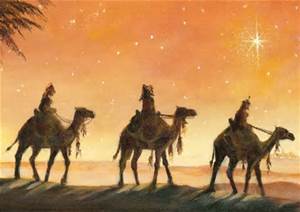
So, Herod relies on these wisest ones in his court. The writer of Matthew’s Gospel says that they’re from the East. Some traditions hold that these wise ones were Magi, a Priestly caste of Persian origin that followed Zoroastrianism and practiced the interpretation of dreams and portents and astrology. Other traditions depict them with different ethnicities as the birth of this Messiah begins to move into the whole world. In fact, it was the early Western church that gave them names that depict this. (No, these names are not in the Bible.) But according to tradition, Melchior was a Persian scholar, Caspar was a learned man from India, and Balthazar, a scholar with a Babylonian name. These three areas represented the known world at that point. The Messiah had come to every nook and cranny of the world.
But, regardless of who they were, somewhere along the way, they had heard of the birth of this king and came to the obvious place where he might be—in the royal household. So, sensing a rival, Herod sends these “wise ones” to find the new king so that he could “pay homage” to him. We of course know that this was deceitful. His intent was not to pay homage at all, but to destroy Jesus and stop what was about to happen to his empire. It was the only way that he could preserve what he had.
According to the passage, the wise men know that Christ was born; they needed God’s guidance, though, to find where Christ was. When they get to the place where the star has stopped, the passage tells us that they were “overwhelmed with joy”. They knelt down and paid the new king homage and offered him gifts fit for a king. Even though later interpreters have often tried to place specific meanings on these gifts of gold, frankincense, and myrrh, it is possible that the writer of the Gospel of Matthew simply thought that these gifts, exotic and expensive as they were, were gifts that would be worthy of a great and mighty king. They were gifts of joy, gifts of gratitude, gifts of celebration.
And then the passage tells us that, heeding a warning in a dream, these wise and learned (and probably powerful and wealthy) members of the court of Herod, left and returned to their own country, a long and difficult journey through the Middle Eastern desert. But rather than returning to their comfortable lives and their secure and powerful places in the court of Herod, they left and went a different way. They knew they had to go back to life. But it didn’t have to be the same.
So they slip away. Herod is furious. He has been duped. So he issues an order that all the children two years old and younger in and around Bethlehem should be killed. The truth is that Jesus comes into the world as it actually is, not as we wish it to be. Evil and greed are real and the ways of the world can and do crush life.
So, think about something. This IS part of the Christmas story. It is the final chapter that sets the stage for who this newborn King in the manger or the feed trough or whatever it was actually is for the world. We know the story. He was born to Mary and Joseph, the descendants of David. He was born into a family that had always expected him, had always hoped for him, had always dreamed that one day, one day, the world would be a better place because he came to be.
But, all too quickly, God moved. God moved beyond this family, beyond these generations. And the angel appeared to those shepherds, the untouchables, the ones with whom no one mingled because, frankly, they smelled bad. They smelled like sheep. I mean, who wants to smell like sheep? (ACTUALLY, Pope Francis once said that a shepherd SHOULD smell like sheep if he or she is really a shepherd.) But who wants to mingle with those in the bottom rung of society, those who everyone needs but who no one wants to be around? But God was there. And they came, these shepherds. They responded to the call to come and see this thing that has happened.
First to the family. Then to the ones in our community, whether or not we choose to accept them or love them. And then God moved again. God came to those Magi, those foreigners, the ones from the East. They were not citizens. They were interlopers. They were visitors, maybe even immigrants, certainly not believers. They were the ones that we typically would fear. But they came. And they changed. They came and the world knew that this newborn King had come.
Almost a century later, the writer of the Gospel According to John would write that “For God so loved the world that he gave his only Son, so that everyone who believes in him may not perish but may have eternal life.” (John 3:16) Oh, you thought that was a new thought. No, that was those shepherds. That was those Magi. That was us. Because we are the world.
So, what do we do with this? We love. We become the world. We cut through all the imperialism happening right now, all the racism happening right now, all the fear-mongering being drummed up right now, and we just love. Because, see, we are not individuals. We are the world. And when we see that, we also see that God comes.
Our God is the One who comes to us in a burning bush, in an angel’s song, in a newborn child. Our God is the One who cannot be found locked in the church, not even in the sanctuary. Our God will be where God will be with no constraints, no predictability. Our God lives where our God lives, and destruction has no power and even death cannot stop the living. Our God will be born where God will be born, but there is no place to look for the One who comes to us. When God is ready God will come even to a godforsaken place like a stable in Bethlehem. Watch…for you know not when God comes. Watch, that you might be found whenever, wherever God comes. (Ann Weems)
(Yes, amazingly, this was MORE THAN 40 YEARS AGO!)
Happy New Year and Blessed Epiphany!
Shelli

 Dancing to God