Out of the Depths

The Psalmist writes from the deepest bowels of life.  It is his or her lowest point, feeling so overwhelmed with despair, almost hopeless.  And yet, there, is the sound of the still small voice.  It’s only a whisper but it is there.  The Psalmist strains to hear, laying there in the darkness, unable to sleep, unable to see the light of the morning.  It is a Psalm of faith.  It is the expression of one who though wallowing in the depths of sadness and despair, cannot feel God’s Presence and, yet, knows in the deepest part of his or her being that God is there.  It is the writing of one who knows that there is always morning, if we will only wait.

The words of the Psalm promise us that no matter how dark the night will be, there is always morning.  There is always redemption.  The King James Version depicts it as “plenteous redemption”.  We often hear of redemption as if it is some sort of payment that God required for our sins, as if Jesus’ death was somehow foreordained because we were such sinful creatures that God could take it no more.  But redemption can also mean restoration, to bring something to a better state.  It is what the Psalmist knows.  God is there, though unseen, restoring, recreating, even in this moment of darkness.  Redemption is not about payment; it is about the promise of morning, the promise of life.  Redemption is not about what Jesus gave us or what Jesus did for us but what God in Christ does even now.  God brings morning.

The Psalm does not give us empty promises that “everything will be alright”.  Rather, it is honest.  Sometimes life hurts.  Sometimes life hurts more than we think we can bear.  Sometimes we have our own dark night of the soul.  But in the darkness, we learn to wait.  We learn to hope.  That is what Lent is–a waiting in the depths.  We are journeying now deeper and deeper into the darkness.  We know that it will be painful, at times even unbearable.  But our faith tells us that God is present whether or not we can feel the presence.  And so, we learn to wait.  And in the waiting we sense that veil between darkness and light, between death and life.  So, we wait through pain and betrayal and last nights together.  We wait through darkness and death.  We wait in the stillness and foreboding silence.  We wait because we know that morning always comes.

We modern-day worshippers have, sadly, almost lost the voice of lament.  We praise God in good times and we beg God to change things in times of despair.  We struggle with waiting, with just waiting in the darkness, with knowing that God is there whether or not we feel that Presence.  When we are in the depths, we seldom wait.  We instead do everything we can to raise ourselves out of it.  What we miss is that in the waiting, it is God who will raise us up.  The Hadassah Hospital in Jerusalem has a chapel that is known for its stained glass windows created by Marc Chegal.  They are set within a domed ceiling that directs the worshippers’ gaze heavenward.  But directly below the windows is an odd place where the floor is sunken and in the middle of the depression is a pulpit.  The floor was intentionally made that way with the belief that all prayer should be “out of the depths”.

How would our prayers sound if they were out of the depths, if they were out of the waiting?  How much more precious would redemption be?  I think that is the reason that we push ourselves into those depths on Good Friday.  We push ourselves to be taunted by death because only from that sunken place can resurrection come to be.  So, in this time as we get closer to that taunt of death, as we come nearer and nearer to the Cross, remember to breathe.  Breathe out the tendency to “fix” it, to clean it up and sanitize the whole idea for human consumption.  And breathe in what you find in the depths—the promise of plenteous redemption.  If we would only wait…

Lacrimosa (Mozart)

Lyrics (Latin)

Lacrimosa dies illa
Qua resurget ex favilla
Judicandus homo reus.
Huic ergo parce, Deus:
Pie Jesu Domine,
Dona eis requiem. Amen.

Lyrics (English)

Full of tears will be that day 
When from the ashes shall arise 
The guilty man to be judged; 
Therefore spare him, O God, 
Merciful Lord Jesus, 
Grant them eternal rest. Amen.

Grace and Peace,

Shelli
The One Who is Raised to Begin Again

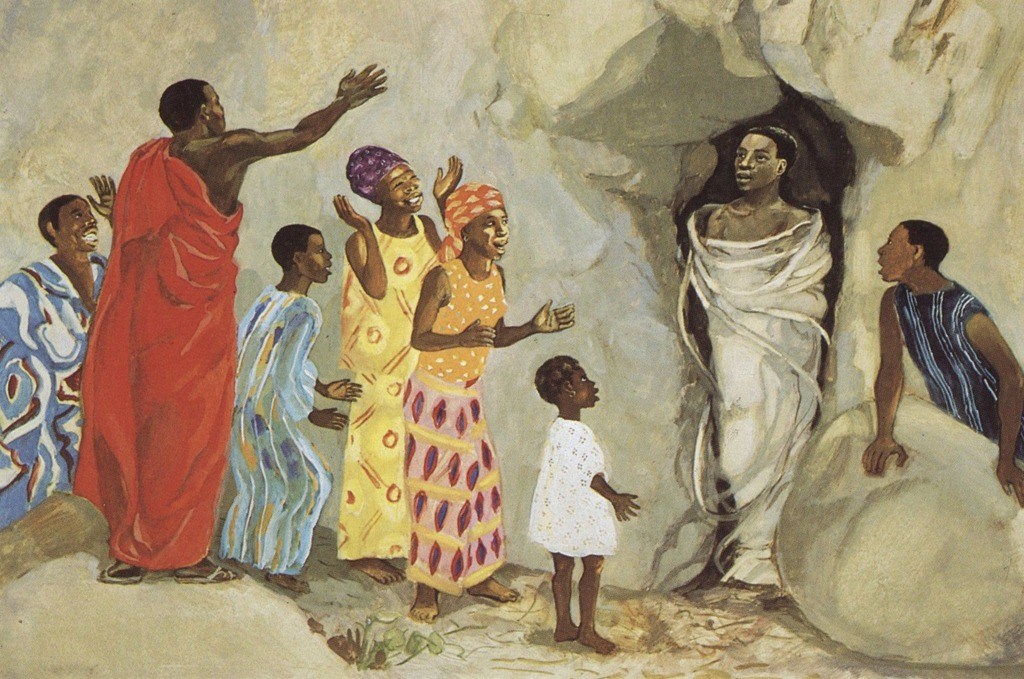
This has always been at the very least a strange story to me.  I think I once had some image of Lazarus walking out of the tomb, with tattered grave clothes dangling and an unbearable stench following him (probably from a 3rd grade Sunday School picture!), and then dressing and sitting down for a nice fish dinner with Jesus and his sisters.  But the Scripture is not here to show us magic or to in some way depict a God that with the veritable snap of a finger can just put everything back like it was before. (Well, I don’t know, I supposed God CAN, but why?  That’s not really the way God works.  God has something much better in store.)  This story is taken as a precursor to Jesus’ own Resurrection.  It was Jesus’ way of promising life.  But ironically, it is also the act that turns the tables toward Jesus’ demise.  Here, standing within two miles or so from Jerusalem, the journey as we know it begins to wind to an end.  Even now, the Sanhedrins are gathering their swords and the night is beginning to fall.

This passage is odd.  Even when you read it all (I “shortened” it but I’m not sure how good a job I did), it’s more about the minutia around Lazarus’ death and rising than about Lazarus himself.  In fact, we really know very little about the character Lazarus except that he was dead and then he wasn’t.  Like us, the characters deal with death by dealing with minutia.  When my dad passed away, I was definitely the queen of the minutia.  One family member removed herself completely.  Another one wept in the front room.  (I remember thinking…I want to do that, to weep, to wail, to scream, but, instead, I’m organizing and directing.)  When my grandmother died, my dad and I sat alone in the hospital room for hours waiting on the funeral home.  We recounted memories, talked about what it meant, and felt that thin veil that gathers when a loved dies, the sense of the presence of those who were loved and who were important there with us.  THAT’s what I wanted.  I wanted to sense that veil.  But instead, I directed and hosted and gathered information—the police, the EMT’s, more police (he died at home), and then the funeral home.  I barely remember it but somehow it happened.  Isn’t that how we often deal with death?  But here…Jesus steps in and raises Lazarus.

So, why would Jesus do that?  Surely he knew what might happen.  Surely he knew how many red flags his presence near Jerusalem had already raised.  And what about Lazarus?  Who was this mysterious man whose main part in the whole Biblical story is to die and be raised?  Why do this with someone as seemingly insignificant as this?  Maybe it’s because Lazarus is us–you and me.  Maybe the whole point of the passage is not to point to Jesus’ Resurrection but to our own.  Do you think of yourself as journeying toward resurrection?  Do you believe this?  Sure, we talk about journeying to God, about journeying to the Promised Land, whatever that might be, and about journeying to where God call us.  But do you think of it as resurrection?  Do you think of yourself dying and then being raised?  Maybe each of us is Lazarus.  Maybe that’s what Jesus wanted us so badly to believe and live.

We don’t talk a lot about our own resurrection.  Perhaps it’s because we think that feat is reserved for Jesus Christ.  Or maybe we don’t want to talk about it because in order to talk about our resurrection, we must also acknowledge our death.  We must acknowledge an ending.  Resurrection, of course, doesn’t happen without death.  But that’s been the promise through the whole story when you think about it.  Think of all the stories of redemption, of re-creation, of resurrection—stories of raising and passing over and wrestling, stories of new life.  That’s the message. 

We talk a lot of this Lenten journey as our journey to the Cross, our journey with Christ.  So, does it stop there?  I think the story goes on.  Jesus is Resurrected.  Maybe that’s what Jesus was trying to show us–not that we would be somehow plucked from death in the nick of time and not that God really has need of putting our lives back together like some sort of Humpty-Dumpty character, but that we, too, are journeying toward resurrection, toward new life.  Lent is the journey that shows us that.  Lent shows us that the journey is sometimes hard, sometimes painful. Lent shows us not that death will not claim us but that death will not have the final word.  Death thins that veil between earth and heaven, between this life and the next.  And resurrection steps in and tears it apart, ripping it at the seams for all to experience.  (Read the Passion story—there’s a curtain that rips) 

Lent shows us that our faith tells us that there is more.  Lent shows us what it means for Christ to unbind even us–even you and me–and let us go.  Through all of life’s transitions, through all of life’s sad endings, through all of life’s unbearable turns, there is always a beginning.  There is always resurrection–over and over and over again. So, breathe…breathe out finality, breathe out hopelessness, breathe out endings.  Our faith tells us that the only endings are those that are transformed to beginnings, to life.  So, breathe in life.  We are all Lazarus, whether or not we know it.  Just start breathing again…

Grace and Peace,

Shelli

Seeing Jesus

And now the conversation begins turns to this talk of death and loss.  We know we’re getting closer, that the tide is beginning to turn.  But we’re not sure.  We’re not sure that our journey really prepared us at all.  But we need to start talking about it.

The reading starts by telling us of the arrival of some Greeks. Now this may seem to us to be sort of periphery to the point of the story but it’s not. For you see, this arrival of the Greeks is something new. It marks the beginning of an entirely new section of the Gospel. These are not merely Greek-speaking Jews, but Gentiles who have made the pilgrimage to Jerusalem for the Passover feast. These are non-Jews, Gentiles from across the sea who wanted to meet the Hebrew holy man. This is the beginning of the world seeing Jesus and knowing who he is.  They approach Philip and request to “see” Jesus, to have a meeting with him. Perhaps they want to know more of who this Jesus is. Perhaps they just want to talk to him. Or perhaps they want to become disciples. But regardless of why they are here, their arrival points to the fulfillment of the church’s future mission—to make disciples of Jesus Christ for the redemption of the world, to see Jesus. This is the decisive dividing line between Jesus coming as a Jewish Messiah and Christ, through his death and resurrection, fulfilling God’s promise for the renewal and redemption of all of Creation. Now is the time for the Son of Man to be glorified.  Jesus did not just come to save you and me.  Remember, Jesus is the Savior of the World, to show God to the world.  Jesus has begun to draw the world into the Cross.

Change is all around us.  No, not all of it is good right now.  Our world seems to be shaking a bit—war, growing economic worries, divisiveness, escalating disregard for the “other”, even a new “acceptable” racism, an “acceptable” xenophobia, an “acceptable” homophobia, an “acceptable” hatred toward those with whom we share this world, and even more war.  It’s scary.  Sure, we could run, go back to our old ways, to the comfort and safety of home.  We could yell and scream and demand that someone put it back the way it was.  The problem is that nothing stays the same.  Even if we could return, it would not feel like home.  For you see, this journey has changed us.  We walk this season of clearing and surrender and then we realize that this season never really ends.  We are different.  We don’t look different but we do see differently.  Jesus has taught us how to see.

But what is this thing with wheat?  (OK, to the end, Jesus seemed to continue speaking in confusing parables!)  Well, wheat is a caryopsis, meaning that the outer “seed” and the inner fruit are connected. The seed essentially has to die so that the fruit can emerge. If you were to dig around in the ground and uproot a stalk of wheat, you would not find the original seed. It is dead and gone. In essence, the grain must allow itself to be changed.  So, what Jesus is trying to tell us here is that if we do everything in our power to protect our lives the way they are—if we successfully thwart change, avoid conflict, prevent pain—then at the end we will find that we have no life at all.  He goes on…” Those who love their life lose it, and those who hate their life in this world will keep it for eternal life. Whoever serves me must follow me, and where I am, there will my servant be also. And whoever does this, God will honor.” This is the only time that the Gospel speaks of God honoring someone. And we begin to see the connection unfolding. Whoever follows Jesus through his death, will become part of his everlasting life.

You see, we can’t go back to what we know because it is no longer ours.  The Light has become part of us.  Jesus wanted us to understand not just that he was leaving soon, not just that his death was imminent, but that this journey to the cross was not just his to make, but ours. This lifting up and this drawing in is all ours.  We ARE the Children of the Light.  Now is the time to walk with Jesus to the cross.  Now is the time to see Jesus.

The season is continuing on.  What we know is coming seems to move toward us faster, overwhelming us.  Now is the time to see Jesus.  So, breathe out—breathe out that tendency to want to go back, to retreat, no matter how hard life is, no matter what the world throws at you.  And breathe in—breathe in allowing yourself to be changed, to grow, to step forward and be the very image of Christ in the world.  Breathe in the presence of Jesus.

Grace and Peace,

Shelli

Finding the Breath That Remains

“Ru’ah.”  As we’ve mentioned before, it is the Hebrew word that is here translated as “breath,” God breathing life.  It is also translated as “wind” or “spirit”.  Actually, we English-speakers don’t really have a translation that will do it justice.  It is not JUST breath; it is the very essence of God giving us life, God’s Spirit, God’s Word breathed into all of Creation, into all that is life.

Ezekiel was both a priest and a prophet in the 6th century BCE, before and during the time of the conquest of Judah and the Babylonian exile.  Ezekiel himself was taken into exile, into a land far away from the land of his birth and of his identity.  The temple was destroyed and the city lay in ruins.  All seemed hopeless and gone.  The bones here, whether taken literally or as metaphor, are dry, lifeless, and broken.  They symbolize all of the hopes and dreams that now lay in despair.  The kingdom of Israel is gone and their lives have gone away with it.  There is nothing left but corpse-like bones.

And then, according to Ezekiel, “the hand of the Lord came upon me.”  In The Message, Eugene Peterson says that “God grabs me”.  Think of that image.  Here was Ezekiel, probably feeling the weight of despair of those around him and virtual helplessness at what he could do as their leader.  But then “God GRABBED him…I have something to show you.”  And there in the middle of death and destruction and despair, God showed him what only God could see.  God showed him that there was something there—there was always something there.  And then God breathes life into the bones and the bones come to life.  It is a story of resurrection.

The idea of God creating and recreating over and over again is not new to us.  But most of us do not this day live in exile.  We are sitting comfortably at home; we are residing in the place where our identity is claimed.  So how can we, then, understand fully this breathing of life into death, this breathing of hope into despair?  The image is a beautiful one and yet we sit here breathing just fine.  We seldom think of these breaths as the very essence of God.  In the hymn, “I’ll Praise My Make While I’ve Breath”, Isaac Watts writes the words, “I’ll praise my God who lends me breath…”  Have you ever thought of the notion of God “lending you breath”?  Think about it.  In the beginning of our being, God lent us breath, ru’ah, the very essence of God.  And when our beings become lifeless and hopeless, that breath is there again.  And then in death, when all that we know has ended, God breathes life into dry, brittle, lifeless bones yet again.  Yes, it is indeed a story of resurrection.

God gave us the ability to breathe and then filled us with the very Breath of God.  We just have to be willing to breathe.  It involves inhaling.  It also involves exhaling.  So, exhale, breathe out all of that stuff that does not give you life, all of that stuff that dashes hopes and makes you brittle, all of that stuff that you hold onto so tightly that you cannot reach for God.  Most of us sort of live our lives underwater, weighed down by an environment in which we do not belong.  We have to have help to breathe, so we add machines and tanks of air.  But they eventually run out and we have to leave where we are and swim to the top.  And there we can inhale the very essence of God, the life to which we belong.  God lends us breath until our lives become one with God and we can breathe forever on our own.

“Lending breath”…it is ours, but only for a moment, only for a breath.  We do not keep it, we do not store it away.  Like manna, we fill our lungs to capacity as only they are designed by God to do and then we exhale.  We let go.  We release that breath of life into Creation to make room to breathe again.  Most of us take it for granted, this rhythmic breathing in and breathing out.  We don’t really think about each of these breaths that have been lent to us, these God-breathed gasps that are ours for only a short time.  Actually, more of life is like that than we like to think.  We like to think that we are in control, that we orchestrate our breathing in and our breathing out.  But, really, the breath is not ours.  It is God-breathed.  It is what give us life, over and over and over again.  In a way, each and every moment, we are resurrected.  We begin again.  But we forget that.  Lent reminds us, reminds us that there is more than what we control, more than what we know.  Lent reminds us that the air we breathe is not our own, that we need to exhale.

We don’t tend to use the word “resurrection” as often on this side of the cross.  We wait until we have walked through the turmoil.  We wait until we have walked through that shadow of death and have been laid aside in a tomb.  I’m wondering if we don’t talk about it because it DOES involve a death, an exhaling of sorts, a letting go of all those things to which we hold that do not bring us life, that are not part of who we are meant to be.  That death, that exhaling, is a way of making room, making room for that God-given breath within us that is trying desperately to bring us life.  Resurrection allows one to breathe.

So, more breathing exercises…Breathe out—breathe out those things that make you dry and brittle, those things that weigh you down, those things that you try desperately to hold because you think you should or because you are fearful what will happen if you don’t.  Breathe out those things that do not bring you life.  And then breathe in…breathe in that breath, like manna from heaven, that brings newness and life.  The breath is there, that “Ru’ah,” that breathe that was breathed into you in the very beginning.  Just breathe… 

Grace and Peace,

Shelli

The Place We Dwell

(Yes, I used KJV because, according to my Grandmother, you cannot read Psalm 23 in any other version…)

Lent is a season of shadows.  During this time we walk through the shadow of the Cross, the shadow of death, and, even, the shadow of our former selves.  Maybe that’s the point of Lent–to wrestle us away from our comfortable, perfectly-manicured lives, from all those things that we plan and perceive, from all those things that we hide and, finally, teach us to traverse the nuances that the journey holds.  And yet, think about it.  What exactly creates shadows?  The answer is light.  Light must be behind the shadowed object.  So, the shadow of the Cross, the shadow of death, even the shadow of our former selves cannot be without the Light.

Faith is, by its very nature, a journey through wilderness, through green pastures and still waters and loss and despair and doubt and not really knowing what comes next. It is a journey through a place where all of a sudden God is not as God should be, not as the God that we have somehow conjured up in our own mind. No longer is God a freshly cleaned-up deity handing out three cotton candy wishes to faithful followers. In the wilderness, we find God in the trenches and in the silence of our lives. Or maybe it is that that is the place that we finally notice God at all. When our lives are emptied out, when our needs and our deepest emotions are exposed, is the time that a lot of us realize that God was there all along. Maybe part of our walk is a way of getting to the depths of ourselves, the place where in our search for God, we find our faith in God, and there in the silence we find our hope.

In her book, When God is Silent, Barbara Brown Taylor tells “a story from the Sufi tradition about a man who cried, “Allah! Allah!” until his lips became sweet with the sound. A skeptic who heard him said, “Well! I have heard you calling out but where is the answer to your prayer? Have you ever gotten a response?” The man had no answer to that. Sadly, he abandoned his prayers and went to sleep. In his dreams, he saw his soul guide, walking toward him through a garden. “Why did you stop praising?” the saint asked him. “Because I never heard anything back,” the man said. “This longing you voice IS the return message,” the guide told him. The grief you cry out from draws you toward union. Your pure sadness that wants help is the secret cup.”

Now, don’t get me wrong. I am not one of those people that think that God sends us suffering or heartache or grief to make us stronger or to test our faith or just to prove something. I don’t think I’d have a lot of respect for a God that has so little compassion for those who love God so much. God is always there, listening and guiding, and wanting us to get a sense of the holy and the sacred to which we’ve been called. But the point is that those times when life is not that great, when we struggle in the very depths of our being, are the times when God reaches through our waiting and our struggles and we can finally hear the silence that is God. We experience the biggest part of God when our need is the greatest.

Now I know that this Psalm brings about different thoughts and memories for each of us—some wonderful, some painful, some bittersweet. It’s probably one of those few passages that you can actually recite all the way through. It goes beyond the words, beyond the rhythm, beyond the hearing. It is truly beloved. It is a glimpse of the holy and the sacred.

My own standout experience with it happened several years ago. I was in seminary with little or no worship experience. I went to the funeral of one of my great aunts. And then, after the perfunctory family lunch (with our rather large family) and the funeral, we began to make our way to the cemetery for the burial. It was just a short drive. As we arrived, one of the ministers came up to me and asked me if I would like to read the Scripture at the graveside. Well, I have to tell you, when you’re in seminary, have little or no worship experience, and must now do this in front of your entire rather large family, many of whom are thinking it’s odd or wrong or at the very least just sort of cute that this woman is going to seminary to become a pastor, it’s a little overwhelming. I opened the funeral handbook (yes, there’s a funeral handbook! Perhaps we’re not as smart as you think!). And there, there it was…this wonderful Psalm. I would read that. But I did not choose it because I had opened to it; I did not choose it because it was familiar to me and I knew that there weren’t any hard words. I chose it because I knew that my grandmother, though nearly deaf, could hear it.  As I began to read, there was a stillness that settled over the crowd. The Spring wind that had been blowing all day stopped and all I heard was the faint sound of some wind chimes near the cemetery entrance. And I heard my voice but it didn’t sound like it was coming from me. As we got into the car to go, my grandmother whispered to me, “I heard you.” Don’t think it was a miracle; she didn’t hear a word I said. But it was part of her.   She had repeated it for 92 or 93 years at that point. She no longer needed to listen to the words. She could hear them anyway.

Several years later, I stood in another cemetery beside my grandmother’s casket, reading these words again.  This time I had graduated from seminary and had a little experience in worship. But don’t get me wrong…there was also my entire rather large family, many of whom are thinking it’s odd or wrong or at the very least just sort of cute that this woman has become a pastor. At the cemetery, I read the Scripture. I chose the same Psalm, not because my grandmother could hear it, but because I could.  (I will say that my grandmother always insisted that this Psalm could ONLY be read in the King James Version, so let that be a lesson too!)

Life is filled with shadows, places that you did not plan to go, places that scare you and challenge you, places that are filled with pain.  But God did not call us to walk through blinding Light.  God called us to learn to see.  Maybe the shadows help us do that.  Maybe the shadows are the reason we see the Light.

The crux is that this Psalm is meaningful to just about all of us.  I think it may be more than just the comfort it supposedly brings.  I think it depicts the place we dwell.  It depicts our life—all of it.  It depicts that incredible life that God created filled with good and bad, sunshine and shadows, celebration and despair.  But what we have to do is breathe out the tendency that we have to discount that, to perhaps only welcome the good while trying to hide or excuse the painful aspects.  Because all of it makes us who we are.  So, breathe in all of it…breathe in the place where you dwell.  Go back and re-read the Psalm.  It is where you are, always are—there with God, the great shepherd of all of us.

Grace and Peace,

Shelli

Shadows

Scripture Text: Psalm 23 (KJV)

23 The Lord is my shepherd; I shall not want. He maketh me to lie down in green pastures: he leadeth me beside the still waters. He restoreth my soul: he leadeth me in the paths of righteousness for his name’s sake. Yea, though I walk through the valley of the shadow of death, I will fear no evil: for thou art with me; thy rod and thy staff they comfort me. Thou preparest a table before me in the presence of mine enemies: thou anointest my head with oil; my cup runneth over. Surely goodness and mercy shall follow me all the days of my life: and I will dwell in the house of the Lord for ever. (Psalm 23, KJV)

Most of us can say this Psalm in our sleep.  We love the pastoral images of the shepherd.  We love the restoring still waters.  We love the table set and prepared for us.  But verse 4…”Yea, though I walk through the valley of the shadow of death…”  Right there in the middle of all this pastoral light is a bit of darkness.  It’s a hard verse.  We know that we will walk through darkness.  We know that we all encounter the shadow of death, the pall that hangs over us when a loved one dies or when one’s death is imminent.  Because the truth is, we were not promised that life would not be hard or hold losses; we were promised that we would not walk it alone and that Light would be on the other side.

This wilderness season of Lent is a season of shadows.  During this time, we walk through the shadow of the Cross, the shadow of death, and, even, the shadow of our former selves.  Maybe that’s the point of Lent–to wrestle us away from our comfortable, perfectly-manicured lives, from all those things that we plan and perceive, from all those things that we hide and, finally, teach us to traverse the nuances that the journey holds.  But think about something.  What exactly creates shadows?  The answer is light.  Light must be behind the shadowed object.  So, the shadow of the Cross, the shadow of death, even the shadow of our former selves cannot be without the Light illuminating it.

This season of Lent is one that by its very nature is a journey through wilderness, through loss and despair and doubt and not really knowing what comes next. It is a journey through a place where all of a sudden God is not as God should be. No longer is God a freshly cleaned-up deity handing out three cotton candy wishes to faithful followers. In the wilderness, we find God in the trenches and in the silence of our lives. Or maybe it is that this is the place that we finally notice God at all. When our lives are emptied out, when our needs and our deepest emotions are exposed, is the time that a lot of us realize that God was there all along. Maybe Lent is way of getting to the depths of ourselves, the place where in our search for God, we find our faith in God, and there in the silence we find our hope and our Light.

In her book, When God is Silent, Barbara Brown Taylor tells “a story from the Sufi tradition about a man who cried, “Allah! Allah!” until his lips became sweet with the sound. A skeptic who heard him said, “Well! I have heard you calling out but where is the answer to your prayer? Have you ever gotten a response?” The man had no answer to that. Sadly, he abandoned his prayers and went to sleep. In his dreams, he saw his soul guide, walking toward him through a garden. “Why did you stop praising?” the saint asked him. “Because I never heard anything back,” the man said. “This longing you voice IS the return message,” the guide told him. The grief you cry out from draws you toward union. Your pure sadness that wants help is the secret cup.”

Life is filled with shadows, places that you did not plan to go, places that scare you and challenge you, places that are filled with pain.  But God did not call us to walk through blinding Light.  God called us to learn to see.  Maybe the shadows help us do that.  Maybe the shadows are the reason we see the Light.  And the Light will show us the way.

To live with the conscious knowledge of the shadow of uncertainty, with the knowledge that disaster or tragedy could strike at any time; to be afraid and to know and acknowledge your fear, and still to live creatively and with unstinting love: that is to live with grace. (Peter Abrahams)

Grace and Peace,

 Shelli