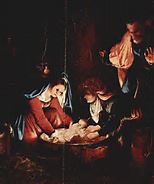
Flesh


"The Nativity", Lorenzo Lotto, 1527-1528
“The Nativity”, Lorenzo Lotto, 1527-1528

Scripture Passages for Reflection:

When Joseph awoke from sleep, he did as the angel of the Lord commanded him; he took her as his wife, but had no marital relations with her until she had borne a son; and he named him Jesus. (Matthew 1:24-25)

And she gave birth to her firstborn son and wrapped him in bands of cloth, and laid him in a manger, because there was no place for them in the inn. (Luke 2:7)

And the Word became flesh and lived among us, and we have seen his glory, the glory as of a father’s only son, full of grace and truth. (John 1:14)

The Gospel writers all seemed to struggle a bit to fully convey the wonder, the unfathomable glory, of this night.  In fact, the writer that we know as Mark didn’t even really try.  He or she just jumped right in proclaiming the Good News, seemingly in a tremendous hurry to get the word out.  For the writer of Matthew’s Gospel, he seemed to only be able to state it with some proof of what it was not.  (In other words, this is no ordinary birth.)  And the writer that we call Luke seemed very focused on the physical place of Jesus’ birth and the realization that there really was no room.  But years later, the writer of John’s Gospel, conveyed a notion with which we still struggle:  that God in God’s wisdom after centuries upon centuries of trying to deal with humanity, after years of drawing us toward the Divine, of showing us a vision that God has for each of us, became flesh, one of us.  On this night, God is born human, fully human, into a world that was never really ready, never really prepared (and probably still isn’t).  And, yet, God must have loved the world, even THIS world, more than life itself, to come into it as one of us.  God became human and lived with us.  Incredible thought, isn’t it?

The Incarnation is God’s unveiling, God’s coming out of the darkness and the shadows and the clouds and showing us for the first time what we could not see before. Emmanuel, God With Us, this day walks into our ordinariness.  God has traversed time and space and all things Divine to enter our every day world.  Pierre Teilhard de Chardin said that “by virtue of the creation, and still more of the incarnation, nothing here below is profane for those who know how to see.”  Perhaps God came into this ordinary world to show us the holiness that had been created, the sacredness that in our worldliness, we were somehow missing. God steps into our lives to show us the depths to which we have not allowed ourselves to dig.   No longer can flesh and humanity be deemed “bad”; God came as flesh, came as human, came as one of us.  It would be easy to dismiss the whole thing as something that “seemed” like one of us because, after all, this is God.  And what would God be doing fooling around with the squalor and feebleness of this world?  You see, it is not that God lowered the Godself to our standard but that God’s coming raised us toward the Divine.  And notice in the Christmas stories how they emphasize the lowliness of the surroundings and the danger to the child as much as the miraculous glory of the event.  By entering human existence, even God faces down the power of evil, sin, and death.  In love, God elects to be no more immune than we are from the dangers to love and life.
Thomas Merton once said that “the Advent mystery is the beginning of the end in all of us that is not yet Christ.”  It is all this waiting, all this preparing that we have done that has put us in this place.  It is the place that humbles and amazes at once.  Who would have ever thought?  Who would have ever written the story such that a baby’s birth on a cold desert night in the midst of social turmoil would be the in-breaking of the Godself into our world, Emmanuel, God With Us.  After all this time, all this waiting for God, this hoping against hope that God would show up and pull us out of the mire of humanity, God comes full on into it, not pretending to be like us but becoming one of us.  God came to show us how to be who we are, who we are called to be, and to show us that, once again, it is very, very good.  So, on this night of nights, as the Light begins to dawn and we realize that God has come bursting into our lives and into our world, let us open our eyes and rub the sleep out of them and finally see this thing that has happened.
Reflection:  On this night of nights, what does God in our midst mean for you?  How can this year be different?
Merry Christmas!
Shelli

Threshold

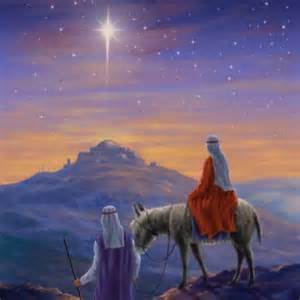
Journey to Bethlehem-colorScripture Passage for Reflection:  Luke 2: 1-5

In those days a decree went out from Emperor Augustus that all the world should be registered. This was the first registration and was taken while Quirinius was governor of Syria. All went to their own towns to be registered. Joseph also went from the town of Nazareth in Galilee to Judea, to the city of David called Bethlehem, because he was descended from the house and family of David. He went to be registered with Mary, to whom he was engaged and who was expecting a child. 

There is a word that we do not use much called “liminality”.  It is from the Latin word for threshold and is used to describe a state of being “betwixt and between”a point of being suspended between what has happened and what will be.  It is likened to being on an airplane flying over the ocean between two continents.  For a few hours, it is as if you are suspended between times, cultures, and nations.  It is as if you are nowhere and everywhere at the same time.  It is a place of enlarged vision, enlarged perspective and no real place to put down roots.  Liminality is a place that our souls crave, a place where our spiritual sense is somehow heightened, a place where se can see both who we are and who we will become.  On this eve of the Great Eve, we find ourselves a little “betwixt and between”.

Think of this day so long ago.  Bethlehem was in reach for this scared young couple who were so unsure of exactly what the world held for them.  They were rounding the final peaks of their journey.  But this day they found themselves no longer a part of their old lives and yet they didn’t really know what tomorrow would hold. But now, now they were traveling through a foreign land.  It was the land of Joseph’s family.  He had been there often as a child.  But the place was different somehow, full of those who followed this emperor, nothing like he really remembered.  The road was packed with travelers returning to the place of their ancestors to make their presence known to the government.  Joseph felt like he should know these people and, yet, they were all strangers to him.  Mary and Joseph did not feel like they were part of this new world and yet their old world did not exist.  There didn’t seem to be any room for them at all.

We are indeed standing on the edge of a brave new world.  Oh sure, we do this once a year whether we’re ready or not. Once a year, the night of nights comes and we sing Silent Night and we light our candle and once again welcome the Christ Child into our lives.  Why is this year any different?  Because, in this moment, standing on this edge between who we are and who we will be has the possibility of changing everything.  This is the moment when we decide whether or not to turn toward Bethlehem or to turn and go back.  Standing in this place of “betwixt and between”, we see both, fully in our view.

We are not that different from that scared young couple.  We find ourselves pulled between the life we’ve so carefully created and the life we’ve been promised.  It is hard to not hold so tightly to those structures that give us power and prestige and security.  And yet, God doesn’t call us to leave our lives behind but to live all that we are and all that we have within that vision that God holds for us.  And it is in this moment, standing here between the two that allows us to see how to do that, that allows us to see our lives the way that God sees them and journey on.  It is in this moment that God gives us new eyes and asks us to follow the star.  And if we do that, this year WILL be different.  We are standing in the threshold between a waiting world and one in which the Divine has already poured into our midst.  We live in the already and the not yet.  But for those who see with new eyes, the road ahead is the only one that makes sense anymore.  Because that is the way to Bethlehem.  Let us go and see this thing that has happened.  There’s a world about to be born.

This text speaks of the birth of a child, not the revolutionary deed of a strong man, or the breath-taking discovery of a sage, or the pious deed of a saint.  It truly boggles the mind:  The birth of a child is to bring about the great transformation of all things, is to bring salvation and redemption to all of humanity.

As if to shame the most powerful human efforts and achievements, a child is placed in the center of world history.  A child born of humans, a son given by God.  This is the mystery of the redemption of the world; all that is past and all that is to come.

All who at the manger finally lay down all power and honor, all prestige, all vanity, all arrogance and self-will; all who take their place among the lowly and let God alone be high; all who see the glory of God in the lowliness of the child in the manger:  these are the ones who will truly celebrate Christmas. (From Christmas With Dietrich Bonhoeffer, ed. By Manfred Weber)

Reflection:  On this eve of Eve’s, name those things that are holding you back from THIS year being different.

Grace and Peace,

Shelli