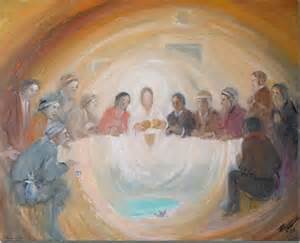
Lectionary Text: John 6: 24-35 (Proper 13B)
24So when the crowd saw that neither Jesus nor his disciples were there, they themselves got into the boats and went to Capernaum looking for Jesus. 25When they found him on the other side of the sea, they said to him, “Rabbi, when did you come here?” 26Jesus answered them, “Very truly, I tell you, you are looking for me, not because you saw signs, but because you ate your fill of the loaves. 27Do not work for the food that perishes, but for the food that endures for eternal life, which the Son of Man will give you. For it is on him that God the Father has set his seal.”
28Then they said to him, “What must we do to perform the works of God?” 29Jesus answered them, “This is the work of God, that you believe in him whom he has sent.” 30So they said to him, “What sign are you going to give us then, so that we may see it and believe you? What work are you performing? 31Our ancestors ate the manna in the wilderness; as it is written, ‘He gave them bread from heaven to eat.’” 32Then Jesus said to them, “Very truly, I tell you, it was not Moses who gave you the bread from heaven, but it is my Father who gives you the true bread from heaven. 33For the bread of God is that which comes down from heaven and gives life to the world.” 34They said to him, “Sir, give us this bread always.” 35Jesus said to them, “I am the bread of life. Whoever comes to me will never be hungry, and whoever believes in me will never be thirsty.
So in August of Year B of the lectionary (as in this year), we talk about a lot of bread. In fact, we end up with four weeks of bread, manna, and Parker House rolls (kidding, not those!). What is that about? Well, bread is sustenance; bread is comfort; bread is an ordinary thing, something that most of us eat every day in some form. Now Jesus says, “I am the bread of life.” Bread is what we need.
“The Body of Christ given for you.” You probably hear it at least once a month, maybe more. What does that mean? What does it mean for the Body of Christ to be given for you? When you go up to the altar rail and you are handed that piece of essentially ordinary bread and you hear those words, what does that mean? Part of it is a reminder of Jesus’ death, the body—the literal body—that was given out of love for us. But if that’s all it was, this meal would only be a symbolic remembrance of that. There’s more. Isn’t that just like Jesus? There’s ALWAYS more. You see, that holy meal is not just so we can remember that Jesus died for us; I think it’s really about remembering that Jesus lived for us. Jesus became us. Jesus walked this earth as one of us. Jesus died as one of us. Jesus, God Incarnate, became one of us and when this very earthly Jesus was gone, we were left with the Spirit of God surrounding and flooding in to every aspect of our lives. We were left with this–the Body of Christ. The Body of Christ given for you. So now what?
The Gospel passage for this week follows up to last week’s passage about the Feeding of the 5,000 (or more…there’s ALWAYS more.) It’s a little funny. It’s like these people are chasing Jesus throughout this lakeside region, almost stalking him. They wanted more. But Jesus was no dummy. He essentially tells them, “Look, you’re not looking for me because you understood what I said and want to give your life to me and follow the Way; you’re looking for me because you want your needs met. You want me to give you more food or more stuff or more guarantees of safety and security or more of what you desire. You don’t really want to change; you just want to be filled up.” Instead, Jesus offers himself. He offers himself as the bread of life. Whoever comes to me will never be hungry, and whoever believes in me will never be thirsty. So, is this about bread, or isn’t it? Is it about literal, material bread that fills our stomachs and provides sustenance for life? Or is it about being filled spiritually, having one’s soul filled with all this is God? Yes…both of those. Jesus is talking about both of those.
Jesus is trying to connect physical hunger and spiritual hunger. The two cannot be separated. It is the Word made flesh and the ordinary made Holy. After all, what good is food that fills our stomachs if we are spiritually hungry? And, yet, what does it say about God’s Presence if one is so hungry that he or she cannot see past that? Mahatma Gandhi once said that “there are people in the world so hungry, that God cannot appear to them except in the form of bread.” It is true. The two cannot be separated. Jesus knew that. So, Jesus offered food for the hungry—in every way. (That’s the reason he just came out of figuring out lunch for more than 5,000 people!) The Body of Christ given for you. But beyond just offering bread, Jesus became bread, became that sustenance that fills our lives in every way. Jesus, God Incarnate, was God, was the life-giving bread that our bodies and our souls so crave. Jesus gave us himself. Jesus gave us the very Body of Christ.
So here we are, the Body of Christ, each of us called to become the very incarnation of God in our midst, each of us called to become bread, living bread that is offered to others, each of us called to become the very real presence of Christ in the world, each of us called to now be the Word made flesh. That’s right, WE are called to be that. We come to the table every month, sometimes more. We come with thanksgiving for what Jesus gave us. We come to remember Jesus’ life, death, and resurrection. But we also come because at that table, in that place, somehow ordinary bread and ordinary wine (or grape juice, in the case of us United Methodists!) becomes something that sustains us forever, something that means we will never hunger or thirst again. And that ordinary table becomes a great banquet to which everyone is invited. And we, ordinary people with ordinary gifts somehow, some way, somehow become the Body of Christ.
I want to ask you…How many of you like flour—just flour, nothing else? How about shortening? Maybe, some raw eggs? OK, how many of you go for your daily treat of baking soda? See, none of those by themselves make a whole lot of sense. But all of them, along with some sugar, some bananas, and some pecans, make my grandmother’s banana bread. You see, you take these ordinary things and put them together and they become incredible. We are no different. Ordinary people, ordinary gifts, and you take them and put them together and somehow, some way, they become the Body of Christ. Woodrow Wilson once said of our country: “America is nothing if it consists merely of each of us; it is something only if it consists of all of us.” It’s the same with the Body of Christ. We are not a group of individuals clustered together into a church; we are the Body of Christ—each of us and all of us, together. Oh, individually, we are important, we are loved. God created us. But together, oh, together, we’re the very Body of Christ. Together, we’re extraordinary!
You know, those people came back, wanting more from Jesus. What they didn’t understand was that there was always more. In the 4th century, St. Augustine said that our souls are restless until they find their rest in God. We will always hunger, we will always thirst, until we figure out that it is this—this table, these people, this banquet, this Body of Christ–that sustains us. The Body of Christ given for you. And then God gives all of us gifts to become bread, to become wine, to become the Body of Christ for the world.
Years ago, I was at a church where I was one of six or so clergy, so we weren’t always in each worship service. One Communion Sunday, I was not in the middle and the last services. I was going to get things done. But I kept getting pulled away, needing to go across the Plaza to the other building. At one point, crossing the Plaza, I glanced out onto the street. It was a little street called Fannin in downtown Houston and there was an older man who was trying very painstakingly to cross four lanes of museum district traffic with a walker and only his daughter supporting him. The traffic was whizzing by and it was not good.
I grabbed the crossing guard that we had and made him stop the traffic and went out and helped him across. It took a really long time and by the time he got across, he was exhausted (and there were four lanes of traffic that were very irritated with me). I asked the guard to go get a chair and we sat him down right there on the curb of Fannin underneath one of the sprawling Oaks with cars speeding by. His daughter didn’t know what to do.
I started talking to him and he told me that he just wanted to come for Communion. He was on his way to be checked into the hospital and he just wanted Communion. He didn’t belong to our church; I had never met him. But he needed more. He said that he didn’t think he had the energy, though, to walk all the way into the sanctuary. I told him that I was one of the pastors. I told him to stay there, sitting on this chair on the curb under the Oak tree with cars whizzing by and I would make this happen.
I ran into the sanctuary just as they were serving Communion. Now, for those of you that are not familiar with St. Paul’s, it is very high church, very proper. Everything is done right. The worship is stupendous. But I leaned over the Communion rail to one of the other pastors. “Terry, I need two to go. I’ll explain later.”
So, with bread and cups, I went outside and served the man and his daughter. They were both crying. They got it. I’m sad to say that that man went into the hospital and passed away a week later. That would be the last time that he took Communion. But on that street corner, under the Oak tree, with cars whizzing by, was the Body of Christ. The ordinary not only becomes holy; the two become unable to be separated. That IS the Body of Christ.
So, when we come to that table, ordinary and gifted as we are, we receive the bread and receive the cup, and our hunger and our thirst will subside, and somehow, some way, the very real presence of Christ will be there, the living bread, the eternal cup. And through the Mystery of God, even we, each of us, will become the Body of Christ. And then we will go into the world and be the Body of Christ for others. (And you just thought it was a bite of bread and grape juice!)
Eat this bread. Drink this cup. Come to me and never be hungry. Trust in me and you will not thirst. The Body of Christ given for you. Amen.
We are not human beings having a spiritual experience. We are spiritual beings having a human experience. (Pierre Teilhard de Chardin)
Grace and Peace,
Shelli
 Dancing to God